

Europe Bentonite Mining Market Size & Forecast:
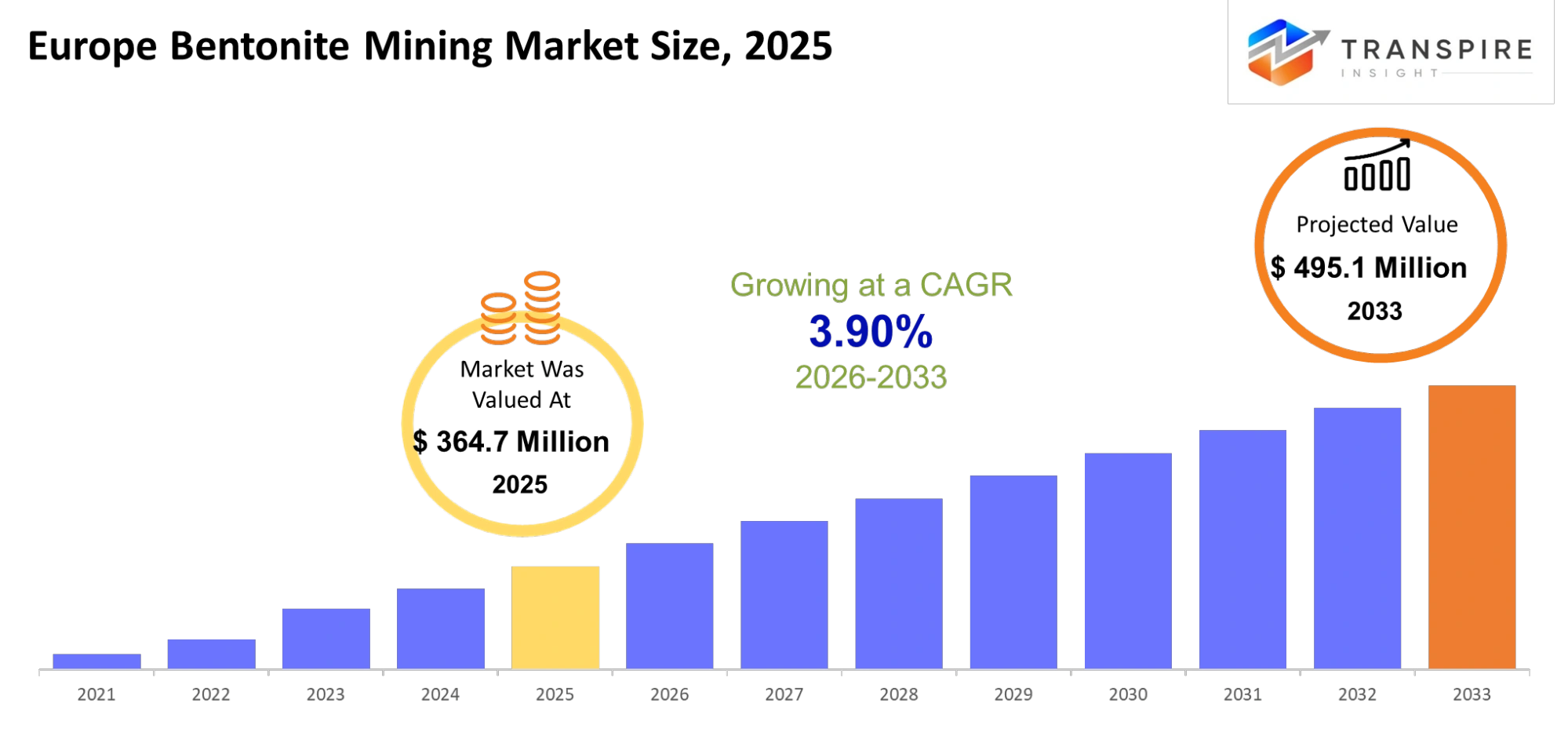
- Europe Bentonite Mining Market Size 2025: USD 364.7 Million
- Europe Bentonite Mining Market Size 2033: USD 495.1 Million
- Europe Bentonite Mining Market CAGR: 3.90%
- Europe Bentonite Mining Market Segments: By Type (Sodium Bentonite, Calcium Bentonite, Activated Bentonite, Others), By Application (Drilling Fluids, Foundry Sands, Cat Litter, Iron Ore Pelletizing, Construction, Others), By End-User (Oil & Gas Industry, Foundries, Construction Firms, Agriculture Sector, Chemical Industry, Others), By Form (Powder, Granules, Slurry, Others).
To learn more about this report,  Download Free Sample Report
Europe Bentonite Mining Market Summary:
The Europe Bentonite Mining Market size is estimated at USD 364.7 Million in 2025 and is anticipated to reach USD 495.1 Million by 2033, growing at a CAGR of 3.90% from 2026 to 2033. The Europe bentonite mining market supports essential industrial activities that depend on material stability and containment solutions. Foundries use the material for binding sand molds while oil and gas operators utilize it for well stabilization and environmental contractors need it to seal landfills and stop groundwater contamination. The solution provides containment and integrity solutions for both heavy industrial operations and infrastructure projects.
The demand for products has changed because companies now require more stringent environmental regulations than they did three to five years ago. The engineered barrier systems developed for waste containment and water protection regulations have become common because they require bentonite to be used. The European Union implemented more stringent landfill and drilling fluid standards which forced companies to upgrade their materials.
The result has been that businesses now acquire products through a stable purchasing process which follows specific requirements instead of their previous pattern of purchasing through periodic intervals. Revenue growth now depends on two factors: regulatory enforcement and infrastructure investment while industrial output remains a secondary factor.
Key Market Insights
- The Bentonite Mining Market in Europe will see Western Europe as its main market area since the region will control about 45% of the market during 2025 with Germany France and the Netherlands serving as its main market drivers.
- The infrastructure development and increased drilling activities in Poland and Romania make Eastern Europe the most rapidly developing area until 2030.
- Sodium bentonite dominates the market with its 60% market share because it offers better swelling capabilities and it is commonly used in drilling fluids and sealing systems.
- Calcium bentonite stands as the second biggest market component because it finds use in both foundry sands and civil engineering applications.
- Activated bentonite will experience rapid growth as its usage increases for high-performance environmental and industrial applications between 2025 and 2030.
- Foundry applications lead the Europe Bentonite Mining Market with nearly 30% share, driven by automotive and heavy machinery manufacturing demand.
- The application of environmental sealing and landfill lining materials has become the most rapidly developing market sector because EU waste management laws require their use.
- The oil and gas sector uses bentonite for drilling fluid stabilization and borehole integrity, which gives it over 35% market share.
- The construction and infrastructure sector grows most rapidly because it needs tunneling and foundation engineering and water containment projects.
What are the Key Drivers, Restraints, and Opportunities in the Europe Bentonite Mining Market?
The European Bentonite Mining Market experiences its main growth driver when European Union environmental regulations and waste disposal regulations become more strict. The new landfill directives together with groundwater protection requirements establish the need for engineered barrier systems which depend on bentonite to create seals. The regulations in force now require organizations to spend money on essential items instead of choosing between optional purchases. The containment infrastructure upgrade process used by municipalities and industrial operators transforms bentonite from a standard material into a specialized product which guarantees controlled costs and predictable revenue streams for vendors. Public infrastructure projects together with environmental cleanup activities create permanent contract work, which leads to increased contract quantities, whereas industrial demand experiences seasonal variations.
The main obstacle in this situation exists because Europe contains its best bentonite deposits only in certain areas. The extraction process together with material processing requires specific clay compositions which do not allow for easy replacement with alternate materials. The supply chain suffers from delays because the markets face both logistics expenses and obstacles to international trade. The process of obtaining environmental clearances together with new resource development requires extended approval procedures which results in slow supply chain development. The process results in restricted production capabilities, which leads to extended project durations and decreased revenue potential during times of maximum infrastructure development.
Eastern Europe offers a large opportunity for developing tunnel systems and underground infrastructure projects. Modern rail systems and metro systems need slurry walls and tunnel boring fluids which require high-performance bentonite materials for their construction. The transportation modernization efforts of Poland and Hungary create an opportunity for suppliers who establish local processing facilities and develop specialized product lines to gain high-value contracts and establish permanent supply partnerships.
What Has the Impact of Artificial Intelligence Been on the Europe Bentonite Mining Market?
European bentonite mining operations are experiencing operational changes because artificial intelligence together with advanced digital technologies, which include AI-based control systems, now handle all aspects of extraction and processing and logistics operations. The operators use AI-based control systems to manage their slurry processing and moisture control and ore grading activities through automated real-time control. The system uses sensor technology to track clay quality which enables automated control changes during milling and activation operations that cut down on material waste while producing consistent results. The mining vehicle emission monitoring system uses GPS and telematics data to track fleet compliance while the system uses these technologies to find optimal haulage routes and track emissions according to EU environmental regulations.
Mining operations increasingly use machine learning models to predict required maintenance work on crushers and dryers and conveyor systems. The systems use vibration pattern analysis and thermal data assessment to predict equipment failures up to three days before they occur which helps decrease unplanned downtime by 20 percent. AI-based optimization systems help transportation fleets achieve better fuel efficiency while processing operations consume less energy which results in lower operational expenses and better compliance with regulations.
The process of adopting new technologies faces obstacles because organizations must spend money on system integration while they deal with multiple incompatible data systems. The presence of outdated systems at many mining locations prevents AI models from achieving their required data quality because these models need continuous high-quality data throughout their operational period.
Key Market Trends
- The system requires using engineered barrier systems which the EU landfill and groundwater directives created since 2021. The system requires organizations to purchase bentonite materials for their operations instead of allowing them to choose between purchasing materials or using them.
- Between 2020 and 2024 buyers shifted from purchasing products through spot market transactions to establishing long-term supply agreements which resulted in reduced price fluctuations and better demand forecasting for major producers.
- Western Europe used to control most of the market until 2022 when Eastern European nations started building rail systems and metro networks and tunneling facilities.
- The usage of sodium bentonite has increased by more than 10% since 2020 because its drilling and environmental containment applications provide better sealing capabilities.
- The demand for foundry operations has remained constant since 2022 because automotive production has decreased while industrial projects now use environmental sealing applications as their primary solution.
- Imerys and Clariant have expanded their funding for activated bentonite processing because they want to develop higher-value environmental and specialized products.
- Production facilities need to be situated near end-use markets because logistics disruptions and energy cost increases which started in 2023 have made it necessary for producers to move their operations.
- The implementation of digital monitoring together with AI process optimization has enabled plants to achieve better operational productivity because some facilities have achieved energy savings of 15% since 2022.
- The environmental permitting process now requires 20 to 30 percent more time than it did in 2021 which has created delays for new mining projects and decreased mining supply during times of maximum infrastructure demand.
Europe Bentonite Mining Market Segmentation
By Type
The market leader sodium bentonite has nearly 60% market share because drilling fluids and environmental sealing needs create strong demand for it. Sodium bentonite serves as the ideal material for regulated containment systems and oilfield operations because it possesses superior swelling ability and sealing effectiveness. Calcium bentonite ranks second because it provides sufficient binding performance at a lower price which makes it suitable for foundry sands and construction.
The market for activated bentonite remains limited but its usage is increasing in advanced applications which include wastewater treatment and specialized industrial operations. Sodium bentonite demand increases because infrastructure and environmental compliance spending establishes new needs while activated grades gain value through processing. The forecast period will see suppliers transition to activation technologies and customized grades which will help them achieve higher profit margins and better market distinction.
By Application
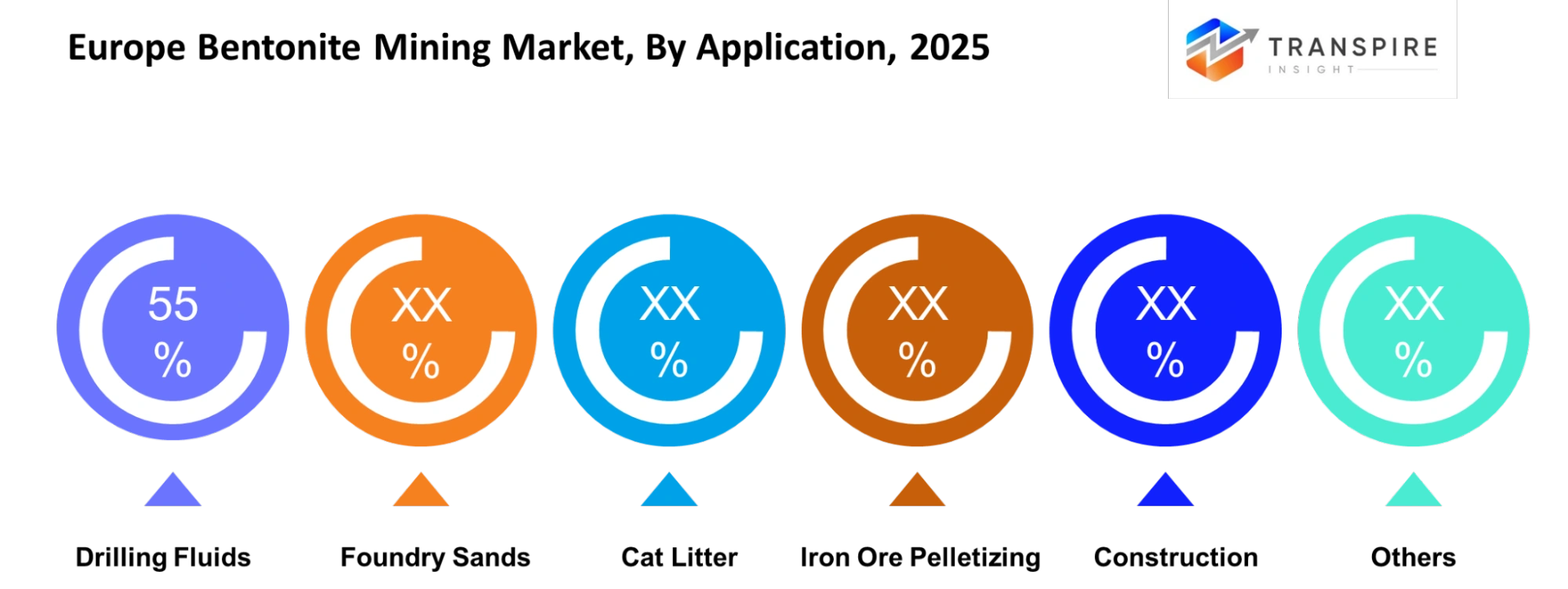
Drilling fluids and foundry sands together account for a significant portion of demand, with drilling fluids leading due to oil and gas exploration and geothermal projects. Foundry sands maintain their stable market position because industrial casting needs for automotive and machinery production processes remain constant.
Eastern European infrastructure development and steel manufacturing expansion are driving growth in construction and iron ore pelletizing industries. Cat litter exhibits steady yet gradual development because its demand depends more on consumer retail needs than industrial market trends. Environmental and construction applications will grow faster than existing market segments which will require suppliers to adjust their production schedules according to regulatory requirements and infrastructure development needs.
To learn more about this report, Download Free Sample Report
By End-User
The oil and gas industry controls more than one-third of total end-user demand because it requires drilling fluids and well stabilization materials. Foundries maintain their status as essential industry segments while their expansion has slowed down because of changing automotive production patterns.
Construction companies have become the fastest-growing sector because urban infrastructure projects need tunneling and foundation engineering and containment work. The agricultural and chemical industries provide minor contributions which primarily support soil conditioning and absorbent product development. The upcoming demand growth will begin to favor construction activities because suppliers will focus on public infrastructure projects through supply contract agreements.
By Form
The market shows powder form as its leading product because it offers easy transport and storage advantages along with multiple application possibilities which include drilling and foundry operations. Granules follow as a preferred format in consumer and agricultural uses where controlled application is required.
Slurry form is gaining traction in construction, and civil engineering especially in diaphragm walls and tunneling operations because its immediate usability delivers efficiency improvements. Each form serves a distinct operational need, which limits substitution across applications. Slurry and customized processed forms will experience growth in their market presence and this development will motivate producers to spend money on establishing local processing facilities together with their on-site mixing systems.
What are the Key Use Cases Driving the Europe Bentonite Mining Market?
The main application of this technology serves oil and gas drilling operations through its use of bentonite which stabilizes boreholes and manages extraction pressure. The application generates its highest demand because operators need performance-critical materials which directly impact well integrity and operational safety to perform their work.
The EU waste regulations require stricter standards which now permit environmental sealing through landfill liners and groundwater protection systems. Construction companies in Eastern Europe utilize bentonite material for their tunneling and foundation operations which include the construction of slurry walls that support urban infrastructure projects.
New wastewater treatment and geothermal drilling renewable energy projects show increasing interest in emerging use cases. The applications remain niche at present but they demonstrate considerable potential because regulatory frameworks are becoming more stringent and industrial and municipal sectors are increasing their investments in alternative energy.
|
Report Metrics |
Details |
|
Market size value in 2025 |
USD 364.7 Million |
|
Market size value in 2026 |
USD 378.9 Million |
|
Revenue forecast in 2033 |
USD 495.1 Million |
|
Growth rate |
CAGR of 3.90% from 2026 to 2033 |
|
Base year |
2025 |
|
Historical data |
2021 - 2024 |
|
Forecast period |
2026 - 2033 |
|
Report coverage |
Revenue forecast, competitive landscape, growth factors, and trends |
|
Regional scope |
Europe (Germany, United Kingdom, France, Italy, Spain and Rest of Europe) |
|
Key company profiled |
Imerys, Ashapura Group, Bentonite Performance Minerals, Clariant, LKAB Minerals, Wyo-Ben, Black Hills Bentonite, Tolsa Group, MidPoint Chemicals, Amcol, Minerals Technologies, Eurobent, CETCO, Laviosa Minerals, Cimbar |
|
Customization scope |
Free report customization (country, regional & segment scope). Avail customized purchase options to meet your exact research needs. |
|
Report Segmentation |
By Type (Sodium Bentonite, Calcium Bentonite, Activated Bentonite, Others), By Application (Drilling Fluids, Foundry Sands, Cat Litter, Iron Ore Pelletizing, Construction, Others), By End-User (Oil & Gas Industry, Foundries, Construction Firms, Agriculture Sector, Chemical Industry, Others), By Form (Powder, Granules, Slurry, Others) |
Which Regions are Driving the Europe Bentonite Mining Market Growth?
The industrial base of Western Europe uses bentonite through its controlled applications which face environmental regulations that are enforced strictly in the region. The countries of Germany and France achieve high compliance with landfill containment rules and groundwater protection regulations which results in continuous demand for materials. The combination of established processing facilities and integrated logistics networks and their location near end-use industries establishes a consistent supply network. The construction and energy sectors obtain materials through established procurement systems which create long-term predictable buying patterns.
Southern Europe holds the second position because construction activities and foundry operations and marine infrastructure projects create continuous demand which exists independently of regulatory requirements. Spain and Italy use their existing resources to maintain constant demand through their infrastructure maintenance programs and port development projects. The construction sector maintains its current level of activity because economic recovery and tourism-related urban upgrades create building projects which increase bentonite needs. This region generates dependable revenue through its industrial output which operates on cyclic patterns instead of using policy-based demand for Western European markets.
The material consumption rate in Eastern Europe grows fastest due to expanding infrastructure projects and energy diversification initiatives. The countries of Poland and Romania have increased their investment in rail corridor development and tunneling and geothermal project implementation since 2022 which has created new demand for these services. The execution speed of projects has improved through EU funding support and regional development policies because these policies establish clear implementation frameworks. The current market conditions enable new participants to create local processing facilities while securing initial supply agreements until 2026 through 2033.
Who are the Key Players in the Europe Bentonite Mining Market and How Do They Compete?
The Europe Bentonite Mining Market maintains its current level of competition through the presence of both local mining companies and international mineral processing companies who compete based on their operational costs and product quality and their ability to meet specific usage requirements. Existing companies maintain their market position through long-term supply agreements and their ability to access mineral reserves, while new companies concentrate on specialized processing methods and their capacity to deliver products within restricted areas. The main competitive factor now consists of product consistency and activation technology plus the ability to meet environmental requirements which have become more stringent than before. Buyers now prioritize suppliers who can meet certified performance standards for containment and drilling applications, which raises entry barriers.
Imerys establishes its unique market position through its specialized processing methods and extensive Western European business operations, which provide high-purity bentonite and activated bentonite for use in environmental sealing systems. Clariant develops its business through its specialty grades and personalized product offerings, which use its chemical treatment expertise to create solutions for industrial and environmental markets. Both companies expand their operations through technology advancements and their partnerships with waste management and infrastructure companies.
LKAB Minerals uses its complete control over operations and its access to Nordic mineral reserves to provide dependable supply services, which construction and energy customers need for their projects. The Ashapura Group operates its business through cost-saving measures and export capabilities, which enable it to serve customers who prioritize low prices while expanding its distribution network in Eastern European markets. The marketing strategies of the two companies provide a clear distinction between their premium technology-based market approach and their low-cost production-based market strategies.
Company List
- Imerys
- Ashapura Group
- Bentonite Performance Minerals
- Clariant
- LKAB Minerals
- Wyo-Ben
- Black Hills Bentonite
- Tolsa Group
- MidPoint Chemicals
- Amcol
- Minerals Technologies
- Eurobent
- CETCO
- Laviosa Minerals
- Cimbar
Recent Development News
In March 2026, Imerys Implements Pricing Adjustment Mechanism: Imerys, a key global industrial minerals supplier including bentonite, announced pricing adjustments due to geopolitical and logistics volatility affecting supply chains. The move reflects cost pressure in raw material flows used in drilling and industrial bentonite applications serving U.S. and European customers.
Source: https://www.imerys.com
In March 2026, Wyo-Ben Celebrates 75 Years & Industrial Expansion: Wyo-Ben, a major U.S. bentonite producer, marked its 75th anniversary while highlighting continued expansion in sodium bentonite production used for drilling fluids and industrial sealing applications. The company emphasized increased supply reliability for North American and export markets, including Europe-linked oil & gas demand.
Source: https://www.wyoben.com
What Strategic Insights Define the Future of the Europe Bentonite Mining Market?
The Bentonite Mining Market in Europe is developing into a structure that requires compliance with specifications which now determine demand through infrastructure resilience and environmental protection standards. The period between 2023 and 2030 will see growth patterns that depend on public funding for containment systems and tunneling operations and energy transition initiatives while water protection and waste management regulations receive stronger enforcement. Suppliers who provide dependable certified results will receive advantages over competitors who offer inexpensive bulk products.
The risk of material substitution in engineered barriers presents a hidden danger because polymer-based liners and synthetic sealants continue to achieve better durability and installation performance. If cost-performance thresholds shift, certain applications could gradually reduce reliance on bentonite. Central and Eastern Europe currently presents a new opportunity for geothermal energy expansion because drilling activities are increasing and high-performance sealing materials have become essential.
Market participants should invest in activation technologies and application-specific formulations while building partnerships with infrastructure developers to secure early-stage project integration.
Europe Bentonite Mining Market Report Segmentation
By Type
- Sodium Bentonite
- Calcium Bentonite
- Activated Bentonite
- Others
By Application
- Drilling Fluids
- Foundry Sands
- Cat Litter
- Iron Ore Pelletizing
- Construction
- Others
By End-User
- Oil & Gas Industry
- Foundries
- Construction Firms
- Agriculture Sector
- Chemical Industry
- Others
By Form
- Powder
- Granules
- Slurry
- Others
Frequently Asked Questions
Find quick answers to common questions.
The approximate Europe Bentonite Mining Market size for the market will be USD 495.1 Million in 2033.
The key segments of the Europe Bentonite Mining Market are By Type (Sodium Bentonite, Calcium Bentonite, Activated Bentonite, Others), By Application (Drilling Fluids, Foundry Sands, Cat Litter, Iron Ore Pelletizing, Construction, Others), By End-User (Oil & Gas Industry, Foundries, Construction Firms, Agriculture Sector, Chemical Industry, Others), By Form (Powder, Granules, Slurry, Others).
Major players in the Europe Bentonite Mining Market are Imerys, Ashapura Group, Bentonite Performance Minerals, Clariant, LKAB Minerals, Wyo-Ben, Black Hills Bentonite, Tolsa Group, MidPoint Chemicals, Amcol, Minerals Technologies, Eurobent, CETCO, Laviosa Minerals, Cimbar.
The current market size of the Europe Bentonite Mining Market is USD 364.7 Million in 2025.
The Europe Bentonite Mining Market CAGR is 3.90%.
- Imerys
- Ashapura Group
- Bentonite Performance Minerals
- Clariant
- LKAB Minerals
- Wyo-Ben
- Black Hills Bentonite
- Tolsa Group
- MidPoint Chemicals
- Amcol
- Minerals Technologies
- Eurobent
- CETCO
- Laviosa Minerals
- Cimbar
Recently Published Reports
-
Apr 2026
Active Power Filter Market
Active Power Filter Market Size, Share & Analysis Report By Type (Shunt Active Power Filters, Series Active Power Filter, Hybrid Active Power Filter), By Application (Harmonics Mitigation, Reactive Power Compensation, Voltage Regulation, Power Factor Correction), By Phase (Single Phase, Three Phase), By End-User Industry (Manufacturing, Healthcare, Commercial, Automotive, Oil and Gas, Others), and Geography (North America, Europe, Asia-Pacific, Middle East and Africa, South and Central America), 2021 - 2031
-
Apr 2026
Electrical Transformer Market
Electrical Transformer Market Size, Share & Analysis Report By Core (Closed, Shell, and Berry), By Insulation (Gas, Oil, Solid, Air, and Other), By Phase (Single, and Three), By Rating (100 MVA to 500 MVA, 501 MVA to 800 MVA, and 801 MVA to 1200 MVA), and Geography (North America, Europe, Asia-Pacific, Middle East and Africa, South and Central America), 2021 – 2031
-
Apr 2026
Hydraulic Piston Pumps Market
Hydraulic Piston Pumps Market Size, Share & Analysis Report By Type (Axial Piston Pumps, Radial Piston Pumps), By Operating Pressure (Low Pressure, Medium Pressure, High Pressure), By Application (Construction, Mining, Agriculture, Automotive, Oil & Gas, Industrial Machinery, Others), By End-User (OEMs, Aftermarket), and Geography (North America, Europe, Asia-Pacific, Middle East and Africa, South and Central America), 2021 – 2031
-
Apr 2026
Laboratory Gas Generators Market
Laboratory Gas Generators Market Size, Share & Analysis Report By Product (Nitrogen Gas Generator, Hydrogen Gas Generator, Zero Air Gas Generator, Purge Gas Generator, TOC Gas Generators, Others), By Application (Gas Chromatography, Liquid Chromatography-mass Spectrometry (LC-MS), Gas Analyzers, Others), By End-user (Life Science, Chemical & Petrochemical, Food & Beverage, Others), and Geography (North America, Europe, Asia-Pacific, Middle East and Africa, South and Central America), 2021 – 2031