
Middle East and Africa Marine Engines Market Summary
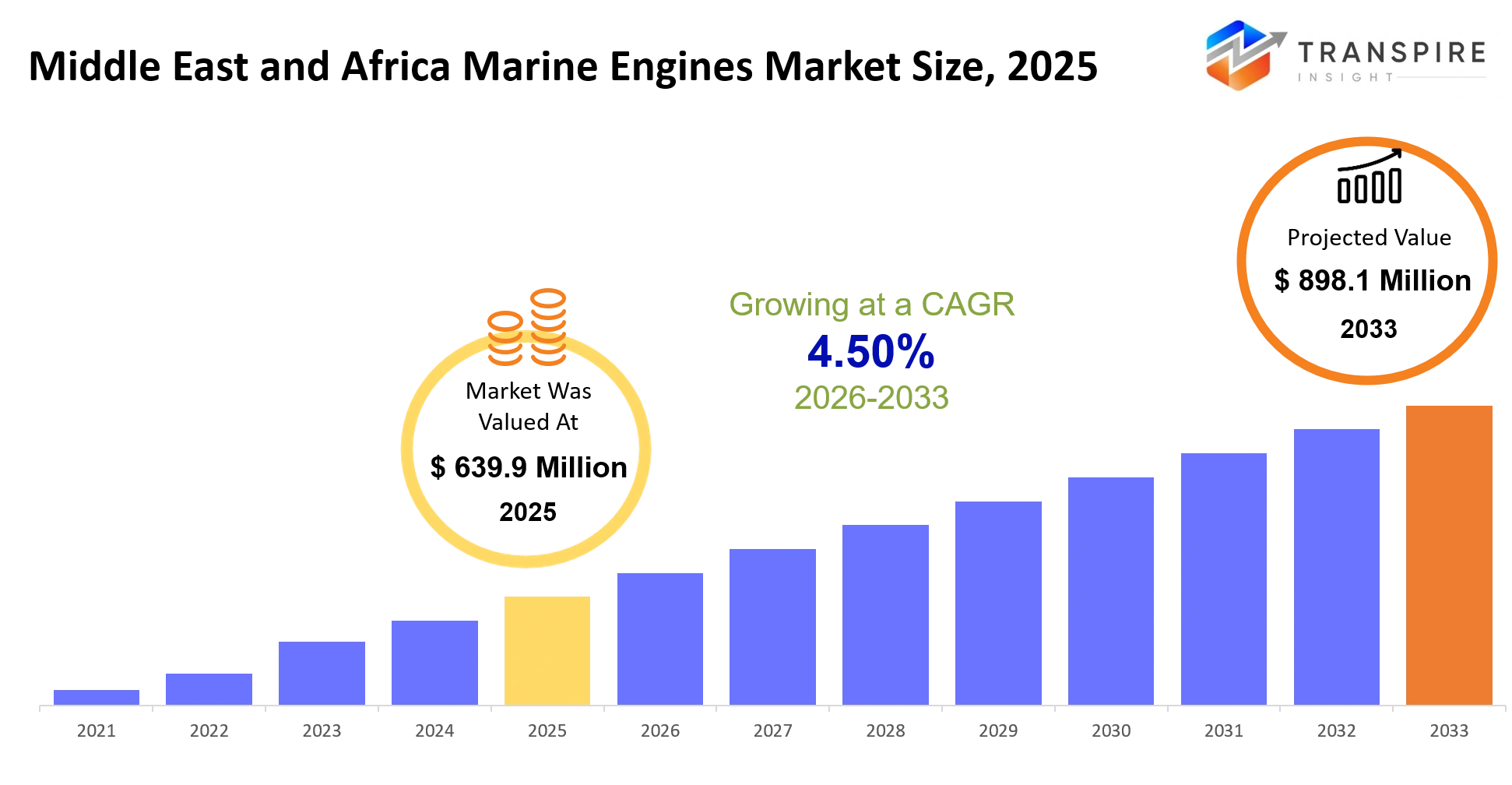
As per Transpire Insight Analysis, the Middle East and Africa Marine Engines Market size is estimated at USD 639.9 Million in 2025 and is anticipated to reach USD 898.1 Million by 2033, growing at a CAGR of 4.50% from 2026 to 2033.
In the Middle East and Africa, the marine engines market underpins commercial shipping, offshore energy activities, fishing fleets, naval ships, and passenger transport, as propulsion systems keep regional sea lanes and coastal businesses running smoothly. Engine producers are trying to tweak and upgrade fuel efficiency, uptime, and compliance, especially as emission requirements get tighter and stricter, while also making sure vessels can work across a range of marine conditions. Over the last five years, the whole market seems to be drifting away from standard diesel propulsion toward dual-fuel setups, hybrid propulsion, and engines with digital monitoring, and shipowners are doing this because they see more environmental constraints coming. The International Maritime Organisation emission rules , plus the wider disruptions in global shipping after the COVID-19 pandemic, sped up modernisation cycles and engine replacement plans. Meanwhile, ports are expanding , offshore energy spending is slowly coming back, and regional governments are reinforcing maritime infrastructure, so vessel operators are investing more in efficient propulsion methods that cut day to day operating costs, stretch the engine’s useful life, and boost fleet output, which in turn gives steady revenue chances for engine manufacturers, and also for maintenance service providers.
Middle East and Africa Marine Engines Market Size & Forecast:
- Middle East and Africa Marine Engines Market Size 2025: USD 639.9 Million
- Expected Market Value 2033: USD 898.1 Million
- Forecast CAGR: 4.50%
- Leading country in 2025:Saudi Arabia
- Fastest-growing country:Nigeria
- Key Profile: Wärtsilä, MAN Energy Solutions, Rolls-Royce Solutions, Caterpillar, Cummins, Yanmar, Volvo Penta, Mitsubishi Heavy Industries, Hyundai Heavy Industries, Scania, Deutz, Doosan Enerbility, Kawasaki Heavy Industries, Anglo Belgian Corporation, Baudouin.
Key Market Insights
- The Middle East and Africa Marine Engines Market is projected to land around USD 898.1 million by 2033, kind of showing that investments in commercial shipping and offshore fleets are still ongoing, even if the pace moves around.
- In 2025 , the Middle East dominated the market, with about 58% share, backed by big commercial ports, ongoing offshore oil work, and fleet expansion plans that keep getting renewed.
- Africa is likely to become the fastest-growing regional market through 2033, since governments keep expanding port infrastructure across the African Continental Free Trade Area, which is sort of a constant push in logistics.
- By product type , four-stroke marine engines held the biggest slice at nearly 42% in 2025, mainly because they offer fuel efficiency and operational flexibility in a very practical way.
- Dual-fuel marine engines are seen as the fastest-growing propulsion segment, as LNG usage increases and future alternative fuels start reshaping how vessels get bought and retrofitted, pretty directly.
- When it comes to vessel applications , cargo ships stayed in front with roughly 48% market share, supported by expanding regional container routes plus bulk trade flows.
- Offshore support vessels showed the quickest adoption of advanced engine monitoring systems as offshore energy investment activity rebounded after 2022 , and operators looked more closely at reliability.
- On the end-user side, commercial shipping companies remain the largest group, while naval modernization programs across Gulf countries create a customer segment that’s growing pretty fast.
- Key players , like Wärtsilä, MAN Energy Solutions, Caterpillar, Cummins, Hyundai Heavy Industries, and Rolls-Royce Solutions, keep putting money into digital engine management, hybrid propulsion, and service coverage expansion in the region.
- Manufacturers are increasingly trying to stand apart via predictive maintenance software, lifecycle service agreements, fuel optimization technologies, and low-emission propulsion platforms, essentially trying to get ahead before regulation and demand tighten up.
What are the Key Drivers, Restraints, and Opportunities in the Middle East and Africa Marine Engines Market?
The strongest growth driver seems to be the modernization of commercial fleets, to meet international emission rules, but also to lower fuel usage. The International Maritime Organization’s emission regulations have basically prodded shipping companies into swapping older propulsion set ups with electronically controlled dual-fuel, plus more fuel efficient engines. Meanwhile Governments across the Gulf keep investing in ports, logistics routes, and offshore energy work, which is creating a kind of steady demand for both new commercial vessels and retrofit programs. And that demand then bumps up engine sales, aftermarket work, and long term maintenance agreements, so manufacturers can stretch recurring revenue along with the usual original equipment deliveries, kind of at the same time.
The biggest structural constraint is still the very high capital cost tied to advanced marine propulsion systems, and also the fairly narrow availability of supporting fuel infrastructure for alternative fuels. Dual-fuel engines, hybrid propulsion arrangements, and digital monitoring platforms often mean big vessel changes, specialized maintenance know how, and trained personnel. A lot of operators across developing African markets keep extending the life of conventional diesel fleets, mainly because financing is limited , so replacement cycles slow down. That in turn delays adoption of next generation propulsion technologies, which then trims the potential revenue not just for OEMs, but for aftermarket segments too.
The strongest future opportunity feels like it’s in marrying alternative fuels with intelligent engine management systems. LNG-ready, methanol-ready, and ammonia-capable engines, when paired with AI based performance optimization, give shipowners more day to day operational flexibility. At the same time, they can prepare fleets for upcoming environmental regulations, without as much scramble later.
What Has the Impact of Artificial Intelligence Been on the Middle East and Africa Marine Engines Market?
Artificial intelligence plus advanced digital technologies are kinda reshaping how marine engines get run, mainly by boosting vessel efficiency, making regulatory compliance easier, and better maintenance planning too. In many places, modern propulsion setups are starting to mix onboard sensors with AI driven analytics so the engine control can be automated a bit, fuel injection can be optimized, emissions can be monitored, and international environmental rules can actually be met without all the usual manual checking. At the same time, fleet operators lean on intelligent monitoring platforms, they continuously check things like engine temperature , vibration, lubrication condition, and exhaust traits. Then the control systems respond on the fly, tuning performance to match whatever operating conditions show up.
Then there’s the machine learning part, it sifting through historical operating data to forecast component failures before they spiral into breakdowns. This kind of predictive maintenance cuts down on surprise downtime , and it also tends to stretch the engine life cycle. Digital twins together with cloud based fleet management platforms also help with voyage planning, they can dial in lower fuel use, and even estimate emissions behavior across different operational profiles. Overall, these systems can help shipping companies reduce maintenance spending, improve fleet availability, and reach real fuel savings, while still supporting compliance reporting.
Even so, adoption is still held back, mostly due to high integration costs. Also satellite connectivity can be inconsistent once you are offshore, and there s limited access to high quality operational datasets, especially for aging vessel fleets. Because of that, many regional operators are still stuck with legacy propulsion systems, which means they don’t have the sensor infrastructure needed for advanced analytics. That slows down the wider spread of intelligent marine engine management solutions , in a way that’s kind of frustrating but also understandable.
Key Market Trends
- IMO emission regulations, introduced after 2020 kind of pushed the whole market toward swapping out conventional diesel engines faster, toward electronically controlled dual fuel propulsion systems , yeah.
- After 2021, engine manufacturers started moving away from just selling equipment, and more into long term lifecycle maintenance plus digital service agreements, which sounds obvious now but was a shift.
- From 2022 up through 2025, LNG-capable propulsion systems got wider adoption as operators made plans for upcoming emission requirements, kind of like pre budgeting for compliance.
- Remote engine diagnostics really expanded too, mainly because satellite connectivity improved across commercial shipping fleets in the Middle East, so it was easier to watch everything in almost real time.
- Then AI based predictive maintenance platforms helped lower unexpected engine failures , by flagging performance quirks before a mechanical breakdown happens, sometimes literally at the anomaly stage.
- Gulf countries also accelerated money into smart ports and logistics corridors, and that helped encourage buyers to procure more modern propulsion technology for commercial vessels.
- Meanwhile, engine manufacturers increasingly built methanol-ready propulsion platforms, and also ammonia-ready ones, to keep customers ready for the next marine fuel transitions, rather than forcing a last minute change.
- Strategic partnerships between engine makers and shipbuilders strengthened regional service networks after 2023, and the aftermarket support capabilities got noticeably better in those places.
- Commercial shipping companies too started choosing engines with real time emissions monitoring, so compliance reporting feels less annoying, and operations could be optimized with fewer surprises.
- Top names like Wärtsilä, MAN Energy Solutions, Caterpillar, Cummins, and Rolls-Royce Solutions expanded their digital engine management portfolios, to sharpen competitive differentiation, and honestly to stay ahead of the curve.
Middle East and Africa Marine Engines Market Segmentation
By Engine Type
Two stroke engines can keep running nonstop in big commercial transport because the high torque, and the fuel efficiency… both fit those long-distance itineraries pretty well. Four-stroke engines, meanwhile work a lot for medium commercial operations, offshore work, and passenger transport, since the overall steadier behavior and maintenance routines tend to be less of a headache. Gas turbine engines are still a thing for specialized defense uses and other high performance situations where you really need quick throttle response, rapid acceleration, that kind of demand. Hybrid marine engines and electric marine engines are also set to grow further, since operators keep shifting toward lower emission propulsion and they’re steadily improving how efficiently the whole setup runs over time.
Dual fuel engines are drawing investment because the ability to switch between conventional fuel and cleaner alternatives gives more flexibility, and that helps with meeting environmental regulations. Diesel engines still hold a large portion of the market mainly because the infrastructure is already there, reliability has been proven over and over, and fuel is widely available across regional ports. Other engine varieties handle special operational scenarios, where a standard propulsion arrangement may not deliver the exact performance that’s needed. Product diversification lets manufacturers cover both regular day to day operations, and newer low emission projects at the same time.
By Vessel Type
Cargo ships show up as the largest vessel category, mostly because regional trade, container transportation, and bulk commodity movement all lean on dependable propulsion systems, pretty much year round. Tankers lean hard on high-capacity engines for moving crude oil, refined products, and liquefied fuels across international shipping routes, without much tolerance for downtime. Passenger ships need efficient propulsion too, so they can stick to dependable schedules while also keeping operational safety in place and passenger comfort supported. Naval vessels, meanwhile depend on advanced engine technology that brings durability, speed, and mission readiness when conditions get rough and the operating tempo stays demanding.
Fishing vessels use reliable engines that keep working efficiently through long hours and in changing sea conditions. Offshore support vessels help oil and gas activities with sturdy propulsion for supply runs, maintenance work, and emergency response services. Yachts and leisure boats are adopting compact yet efficient engine setups, this helps lower operating costs while also improving onboard performance. Then there are other vessel categories that open extra options, for specialized commercial and industrial marine operations in a more custom way.
By Power Output
Engines below 1,000 HP mostly end up on smaller commercial setups, fishing runs, and recreational use, where keeping things compact , and the day-to-day operating efficiency stays a big deal. For engines that land between 1,000 and 5,000 HP , those typically cover medium cargo hauling, passenger transport work, and offshore support boats, you know, the kind of operation that needs steadier throughput. When the power is in the 5,000 to 10,000 HP band, it’s generally about bigger commercial fleets, because they want stronger propulsion capability , and they can’t always “make do” with less. Anything above 10,000 HP still matters a lot for high-capacity cargo transport, tankers, and naval uses, where scale is basically unavoidable.
Medium speed engines tend to strike a sensible compromise , fuel economy plus dependable behavior across a range of commercial tasks. High speed engines are for situations that need fast response, sharper handling, and shorter routes, almost like the schedule matters more than anything else. Then there are the other power categories , they basically cover specialized needs where a normal rating might not deliver the right performance. Having a broad set of power options lets manufacturers cover different vessel sizes, and fit those operating demands across local regional markets.
By Application
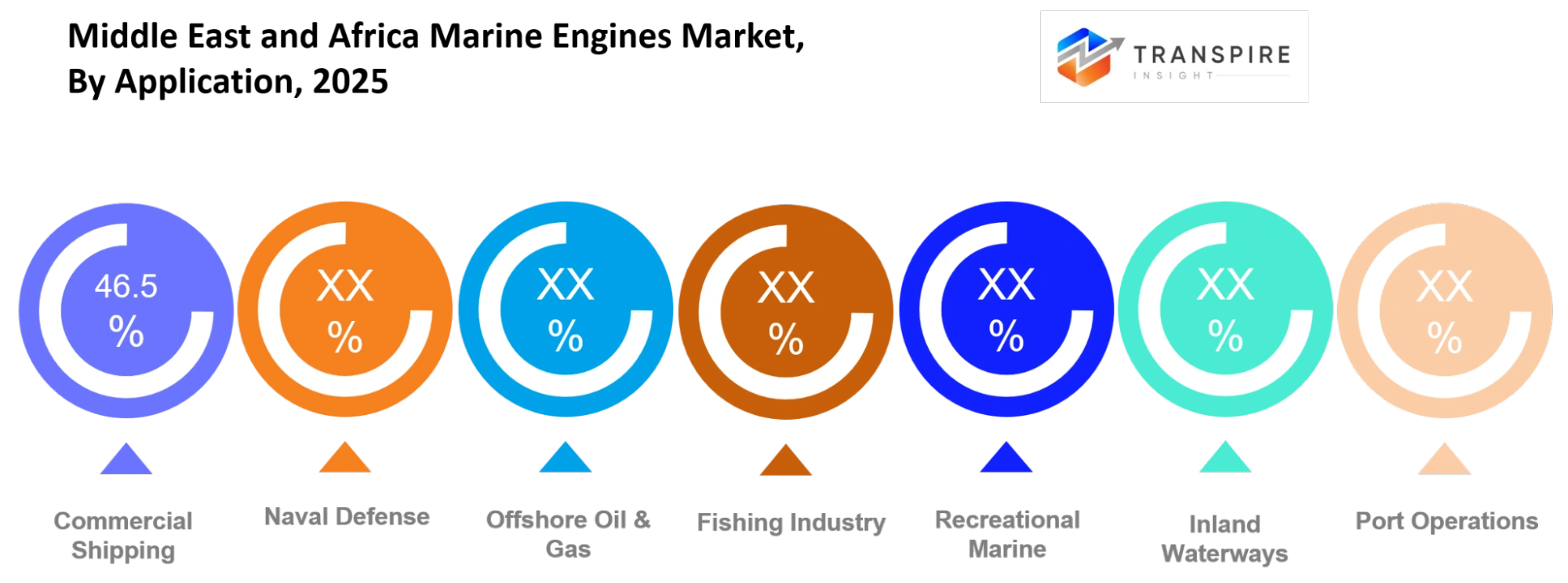
Commercial shipping still looks like the biggest use, mostly because cargo has to keep moving without interruption , so dependable propulsion matters a lot, it also helps operating efficiency and it trims fuel use. Naval defense keeps pushing for ongoing procurement of advanced engines, the kind that can keep working when conditions get rough and operational demands stack up. In the offshore oil and gas space, supply vessels plus maintenance work, and even exploration backing, all lean on propulsion systems that are built to last and stay steady. Meanwhile the fishing industry relies on durable engines to keep productivity on track for long stretches, day after day during extended operating periods.
Recreational marine activity keeps growing too, with tourism spending and marina development popping up across multiple coastal economies. Inland waterways bring a quieter but consistent set of opportunities, since regional transport networks support both passenger and commercial movement. Port operations also need efficient engines, especially for tugboats, pilot vessels, and harbor support equipment. Other uses add extra demand as well, through specialized industrial marine tasks and government marine missions, it’s not just one lane , there are several.
By End User
Shipbuilders count for a big portion of this market, because when new vessels get built, it pretty much drags along demand for advanced propulsion systems in both commercial, and industrial arenas. At the same time, naval forces keep putting money into dependable engine technologies, which in turn boosts operational ability, supports fleet modernization, and even helps with long term maintenance efficiency. Shipping companies tend to pick efficient propulsion systems, mainly to cut fuel costs , while also staying aligned with regulatory compliance. Offshore operators are looking for dependable engines that can keep working, without interruption, even in harsh offshore conditions.
Fishing companies go for sturdier propulsion options because they help reduce downtime and increase day to day productivity during the seasonal rush. Government agencies also buy marine engines for patrol, rescue, transportation, and infrastructure support services. Then marine service providers create aftermarket prospects through maintenance, repair, upgrades, and replacement work. Beyond that, other end users add extra pull via specialized marine applications spread across different regional industries, and it all stacks up.
What are the Key Use Cases Driving the Middle East and Africa Marine Engines Market?
Commercial shipping is basically the main thing here , because moving cargo really hinges on dependable propulsion systems , especially when trade needs to keep going without stops between regions and across borders . Big cargo ships then naturally lean toward efficient engines , not only to cut running expenses , but also to make fuel use more effective, and to keep timetables steady along the big shipping routes.
Then there’s offshore oil and gas, plus naval defense , both of which keep pushing more engine adoption , though for slightly different reasons . Offshore support vessels, for instance , still need dependable propulsion for bringing supplies and handling maintenance tasks out at sea . At the same time , naval fleets are investing in more advanced engine technologies , aiming to boost operational readiness, and also support stronger long-term fleet performance.
After that , some newer chances are showing up in hybrid propulsion for coastal transport , and electric propulsion for port work and short-haul marine services . On top of that, smart engine management systems, especially with predictive maintenance features, will help raise efficiency , reduce maintenance costs , and make it easier to stay aligned with future environmental expectations , even as the rules keep tightening.
|
Report Metrics |
Details |
|
Market size value in 2025 |
USD 639.9 Million |
|
Market size value in 2026 |
USD 659.8 Million |
|
Revenue forecast in 2033 |
USD 898.1 Million |
|
Growth rate |
CAGR of 4.50% from 2026 to 2033 |
|
Base year |
2025 |
|
Historical data |
2021 - 2024 |
|
Forecast period |
2026 - 2033 |
|
Report coverage |
Revenue forecast, competitive landscape, growth factors, and trends |
|
Regional scope |
Middle East and Africa (Saudi Arabia, United Arab Emirates, South Africa, Rest of Middle East and Africa) |
|
Key company profiled |
Wärtsilä, MAN Energy Solutions, Rolls-Royce Solutions, Caterpillar, Cummins, Yanmar, Volvo Penta, Mitsubishi Heavy Industries, Hyundai Heavy Industries, Scania, Deutz, Doosan Enerbility, Kawasaki Heavy Industries, Anglo Belgian Corporation, Baudouin. |
|
Customization scope |
Free report customization (country, regional & segment scope). Avail customized purchase options to meet your exact research needs. |
|
Report Segmentation |
By Engine Type (Two-Stroke Engines, Four-Stroke Engines, Gas Turbine Engines, Hybrid Marine Engines, Electric Marine Engines, Dual-Fuel Engines, Diesel Engines, Others); By Vessel Type (Cargo Ships, Tankers, Passenger Ships, Naval Vessels, Fishing Vessels, Offshore Support Vessels, Yachts & Leisure Boats, Others); By Power Output (Below 1,000 HP, 1,000–5,000 HP, 5,000–10,000 HP, Above 10,000 HP, Medium-Speed Engines, High-Speed Engines, Others); By Application (Commercial Shipping, Naval Defense, Offshore Oil & Gas, Fishing Industry, Recreational Marine, Inland Waterways, Port Operations, Others); By End User (Shipbuilders, Naval Forces, Shipping Companies, Offshore Operators, Fishing Companies, Government Agencies, Marine Service Providers, Others). |
Which Regions are Driving the Middle East and Africa Marine Engines Market Growth?
The Middle East sort of holds the biggest share of the regional market, mainly because key shipping corridors, world class ports, and solid government investment keep backing up day to day commercial maritime business. Countries like the United Arab Emirates and Saudi Arabia still keep modern logistics infrastructure in place, they also have active offshore energy industries and big commercial vessel fleets that are basically asking for advanced propulsion systems. When regulations got aligned with International Maritime Organization emission rules, it pushed fleet modernization along, and more operators started adopting fuel efficient engines. On top of that there is a mature mix of ship repair facilities, marine engineering companies, fuel suppliers, and aftermarket service providers , and together they keep supporting long term market leadership.
South Africa shows up as the second largest regional contributor but the story is a bit different. It seems to lean more on steady maritime trade and well established port operations rather than offshore energy expansion. Strategic ports that handle cargo moving between Asia, Europe, and Africa help keep engine maintenance demand on track, along with retrofits and replacement programs. Shipowners are continuing to put money into efficient propulsion technologies to boost operational reliability , and also to lower lifecycle costs. With steady infrastructure spending and dependable commercial shipping activity, South Africa stays a resilient contributor to regional industry revenue.
Meanwhile, the rest of Africa , driven by places like Egypt, Kenya, Nigeria, and Morocco, is expected to post the fastest growth through the forecast period. Lately there have been investments around port modernization, coastal shipping infrastructure, and regional trade initiatives, and these have sped up orders for new commercial vessels as well as the marine equipment that goes with them.
Who are the Key Players in the Middle East and Africa Marine Engines Market, and How Do They Compete?
Competition is still moderately consolidated, mainly because the big global engine makerf have these strong engineering skills, wide service coverage , and longer term ties with both shipbuilders plus the people running commercial fleets. In practice, technology improvement, lifecycle service deals, fuel flexibility , and the regional aftermarket help have become the key things that really steer the purchasing decision. The established players keep pushing to hold and grow share, using advanced propulsion systems and also expanding digital monitoring tools, which then help with day to day performance and also lower maintenance costs.
Wärtsilä kinda stands out with an integrated propulsion mix, hybrid solutions , and digital lifecycle services aimed at tuning fuel use and lowering emissions impact. MAN Energy Solutions leans heavily on large two-stroke and dual-fuel engines for shipping, and it keeps investing in alternative fuel know-how, which supports competitiveness in decarbonization projects. Caterpillar instead leans on dependable medium-speed engines, backed by a large dealer and maintenance ecosystem, so aftermarket response stays fast across commercial and industrial marine use.
Cummins highlights compact, fuel stingy engine platforms for commercial and government marine work, and it’s also building out digital diagnostics plus engine control technologies. Rolls-Royce Solutions builds high-performance propulsion for naval and other specialized marine needs, where operational trustworthiness and advanced engineering, really matter.
Company List
- Wärtsilä
- MAN Energy Solutions
- Rolls-Royce Solutions
- Caterpillar
- Cummins
- Yanmar
- Volvo Penta
- Mitsubishi Heavy Industries
- Hyundai Heavy Industries
- Scania
- Deutz
- Doosan Enerbility
- Kawasaki Heavy Industries
- Anglo Belgian Corporation
- Baudouin
Recent Development News
In April 2026, Wärtsilä launched an integrated propulsion solution for Meriaura's next-generation short-sea cargo vessel. The future-ready propulsion package combines fuel-flexible engines and emission control technologies, supporting lower greenhouse gas emissions and improved operational efficiency.
Source: https://www.wartsila.com
In April 2025, MAN Energy Solutions secured a propulsion package contract from Hindustan Shipyard Limited for five Indian Navy Fleet Support Ships. The agreement includes MAN 32/44CR marine engines, gearboxes, shaft generators, and controllable pitch propellers, strengthening the company's naval propulsion portfolio.
Source: https://www.man-es.com
What Strategic Insights Define the Future of theMiddle East and Africa Marine Engines Market?
The market seems to be moving, kind of , toward integrated propulsion platforms that try to bundle fuel flexibility, digital monitoring, and emissions optimization… not just chase engine power the way it used to be. This shift is mostly pushed by tougher environmental rules, higher operating costs, and then a steady wave of investment into newer commercial fleets across the Middle East and a few chosen African economies. There is one more subtle risk though: the alternative fuel infrastructure isn’t developing evenly, so it could slow down the big, wide adoption of dual-fuel arrangements, like engines that are methanol-ready or ammonia-ready, even if the technology is advancing pretty fast.
At the same time, there’s also a real opportunity that’s starting to show up. It’s the growing expansion of intelligent engine management systems for medium-sized commercial fleets, especially those that operate from ports in Africa that are being modernised. Manufacturers and investors should beef up regional service networks and, on the propulsion side, design solutions that can work with multiple future fuels. That way, customers can upgrade their fleets over time without being locked into just one fuel pathway or having to bet everything right now.
Middle East and Africa Marine Engines Market Report Segmentation
By Engine Type
- Two-Stroke Engines
- Four-Stroke Engines
- Gas Turbine Engines
- Hybrid Marine Engines
- Electric Marine Engines
- Dual-Fuel Engines
- Diesel Engines
- Others
By Vessel Type
- Cargo Ships
- Tankers
- Passenger Ships
- Naval Vessels
- Fishing Vessels
- Offshore Support Vessels
- Yachts & Leisure Boats
- Others
By Power Output
- Below 1,000 HP
- 1,000–5,000 HP
- 5,000–10,000 HP
- Above 10,000 HP
- Medium-Speed Engines
- High-Speed Engines
- Others
By Application
- Commercial Shipping
- Naval Defense
- Offshore Oil & Gas
- Fishing Industry
- Recreational Marine
- Inland Waterways
- Port Operations
- Others
By End User
- Shipbuilders
- Naval Forces
- Shipping Companies
- Offshore Operators
- Fishing Companies
- Government Agencies
- Marine Service Providers
- Others
Frequently Asked Questions
Find quick answers to common questions.
The expected Middle East and Africa Marine Engines Market size will be USD 898.1 Million in 2033.
Key segments for theMiddle East and Africa Marine Engines Market are By Engine Type (Two-Stroke Engines, Four-Stroke Engines, Gas Turbine Engines, Hybrid Marine Engines, Electric Marine Engines, Dual-Fuel Engines, Diesel Engines, Others); By Vessel Type (Cargo Ships, Tankers, Passenger Ships, Naval Vessels, Fishing Vessels, Offshore Support Vessels, Yachts & Leisure Boats, Others); By Power Output (Below 1,000 HP, 1,000–5,000 HP, 5,000–10,000 HP, Above 10,000 HP, Medium-Speed Engines, High-Speed Engines, Others); By Application (Commercial Shipping, Naval Defense, Offshore Oil & Gas, Fishing Industry, Recreational Marine, Inland Waterways, Port Operations, Others); By End User (Shipbuilders, Naval Forces, Shipping Companies, Offshore Operators, Fishing Companies, Government Agencies, Marine Service Providers, Others).
Major Middle East and Africa Marine Engines Market players are Wärtsilä, MAN Energy Solutions, Rolls-Royce Solutions, Caterpillar, Cummins, Yanmar, Volvo Penta, Mitsubishi Heavy Industries, Hyundai Heavy Industries, Scania, Deutz, Doosan Enerbility, Kawasaki Heavy Industries, Anglo Belgian Corporation, Baudouin.
The Middle East and Africa Marine Engines Market size is USD 639.9 Million in 2025.
The Middle East and Africa Marine Engines Market CAGR is 4.50% from 2026 to 2033.
- Wärtsilä
- MAN Energy Solutions
- Rolls-Royce Solutions
- Caterpillar
- Cummins
- Yanmar
- Volvo Penta
- Mitsubishi Heavy Industries
- Hyundai Heavy Industries
- Scania
- Deutz
- Doosan Enerbility
- Kawasaki Heavy Industries
- Anglo Belgian Corporation
- Baudouin
About the Authors

Avinash Kumar
I’m Avinash Kumar, a Senior Research Analyst at Transpire Insight, with expertise in the Electronics and Semiconductor and Energy & Power industry. My work focuses on analyzing emerging technologies, market trends, industry developments, and innovation across these sectors. I specialize in transforming complex technical and market insights into clear, research-backed content that helps professionals, businesses, and decision-makers stay informed. Through continuous industry research and data-driven analysis, I strive to deliver accurate, reliable, and practical perspectives on the latest advancements shaping the semiconductor and energy landscape.

Chakradhar Khansole
Chakradhar serves as the Research Director at Transpire Insight, bringing over 8 years of experience in technology, innovation, and strategic market intelligence. He specializes in transforming complex market data into actionable business insights that enable organizations to make informed, growth-oriented decisions. Recognized for his strategic vision and analytical expertise, Chakradhar leads high-impact research initiatives, delivering comprehensive market assessments, competitive intelligence, and forward-looking industry analysis.
Recently Published Reports
-
Apr 2026
Active Power Filter Market
Active Power Filter Market Size, Share & Analysis Report By Type (Shunt Active Power Filters, Series Active Power Filter, Hybrid Active Power Filter), By Application (Harmonics Mitigation, Reactive Power Compensation, Voltage Regulation, Power Factor Correction), By Phase (Single Phase, Three Phase), By End-User Industry (Manufacturing, Healthcare, Commercial, Automotive, Oil and Gas, Others), and Geography (North America, Europe, Asia-Pacific, Middle East and Africa, South and Central America), 2021 - 2031
-
Apr 2026
Electrical Transformer Market
Electrical Transformer Market Size, Share & Analysis Report By Core (Closed, Shell, and Berry), By Insulation (Gas, Oil, Solid, Air, and Other), By Phase (Single, and Three), By Rating (100 MVA to 500 MVA, 501 MVA to 800 MVA, and 801 MVA to 1200 MVA), and Geography (North America, Europe, Asia-Pacific, Middle East and Africa, South and Central America), 2021 – 2031
-
Apr 2026
Hydraulic Piston Pumps Market
Hydraulic Piston Pumps Market Size, Share & Analysis Report By Type (Axial Piston Pumps, Radial Piston Pumps), By Operating Pressure (Low Pressure, Medium Pressure, High Pressure), By Application (Construction, Mining, Agriculture, Automotive, Oil & Gas, Industrial Machinery, Others), By End-User (OEMs, Aftermarket), and Geography (North America, Europe, Asia-Pacific, Middle East and Africa, South and Central America), 2021 – 2031
-
Apr 2026
Laboratory Gas Generators Market
Laboratory Gas Generators Market Size, Share & Analysis Report By Product (Nitrogen Gas Generator, Hydrogen Gas Generator, Zero Air Gas Generator, Purge Gas Generator, TOC Gas Generators, Others), By Application (Gas Chromatography, Liquid Chromatography-mass Spectrometry (LC-MS), Gas Analyzers, Others), By End-user (Life Science, Chemical & Petrochemical, Food & Beverage, Others), and Geography (North America, Europe, Asia-Pacific, Middle East and Africa, South and Central America), 2021 – 2031