

Middle East and Africa Managed DNS Services Market Size & Forecast:
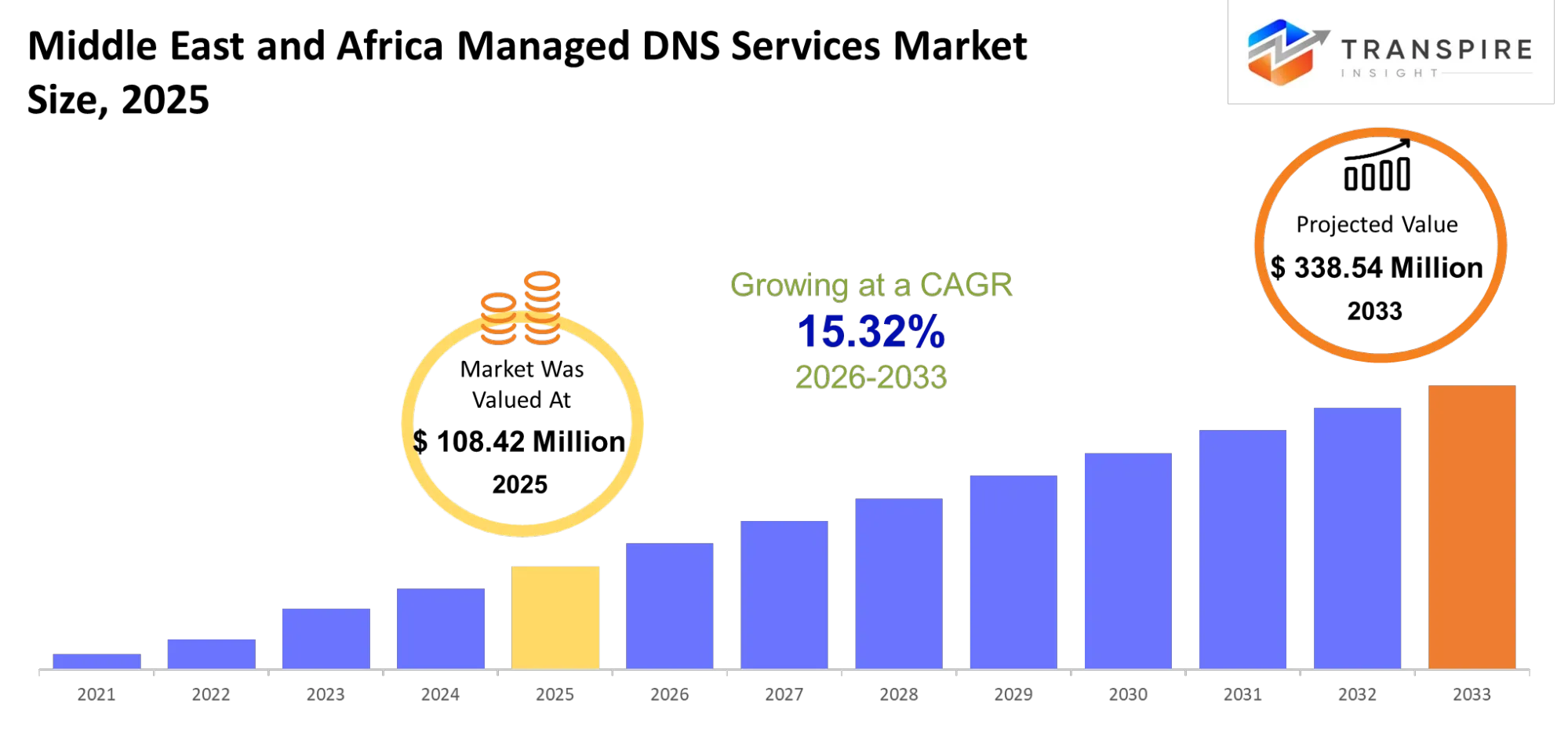
- Middle East and Africa Managed DNS Services Market Size 2025: USD 108.42 Million
- Middle East and Africa Managed DNS Services Market Size 2033: USD 338.54 Million
- Middle East and Africa Managed DNS Services Market CAGR: 15.32%
- Middle East and Africa Managed DNS Services Market Segments: By Type (Primary DNS, Secondary DNS, Anycast DNS, GeoDNS, Traffic Management DNS, Others); By Application (Website Management, Cloud Services, Security Management, Traffic Routing, Load Balancing, Content Delivery, Others); By End-User (Enterprises, SMEs, IT Companies, Telecom Operators, Government, BFSI, Others); By Deployment (Cloud-based, On-premise, Hybrid, Others)
To learn more about this report,  Download Free Sample Report
Middle East and Africa Managed DNS Services Market Summary
The Middle East and Africa Managed DNS Services Market was valued at USD 108.42 Million in 2025. It is forecast to reach USD 338.54 Million by 2033. That is a CAGR of 15.32% over the period.
The managed DNS service market in the Middle East and Africa serves as a digital foundation which enables continuous secure website access through three different systems. The services enable organizations to maintain operational flow by preventing service interruptions while they safeguard their online systems from cyber threats which particularly target banking and telecom and energy and public service sectors that require constant digital access.
Over the last three to five years, the market has shifted from basic domain resolution management toward cloud-native, security-integrated DNS platforms that combine performance optimization with threat detection. The Gulf region and parts of Africa experienced a digital transformation acceleration because governments implemented data localization initiatives. The rise in regional cyber incidents which included distributed denial-of-service attacks on financial institutions and public infrastructure systems forced organizations to update their outdated DNS systems. Enterprises that implement hybrid cloud systems and digital services for customers find that their managed DNS usage generates both stable revenue from services and extended contracts with service providers.
Key Market Insights
- The Gulf Cooperation Council controls most of the Managed DNS Services Market in the Middle East and Africa because of their cloud infrastructure investments.
- The national digital transformation programs of Saudi Arabia together with its hyperscale data center projects create the highest demand in the region.
- Sub-Saharan Africa will become the fastest expanding regional market until 2030 because of enterprise digital transformation and telecom network updates.
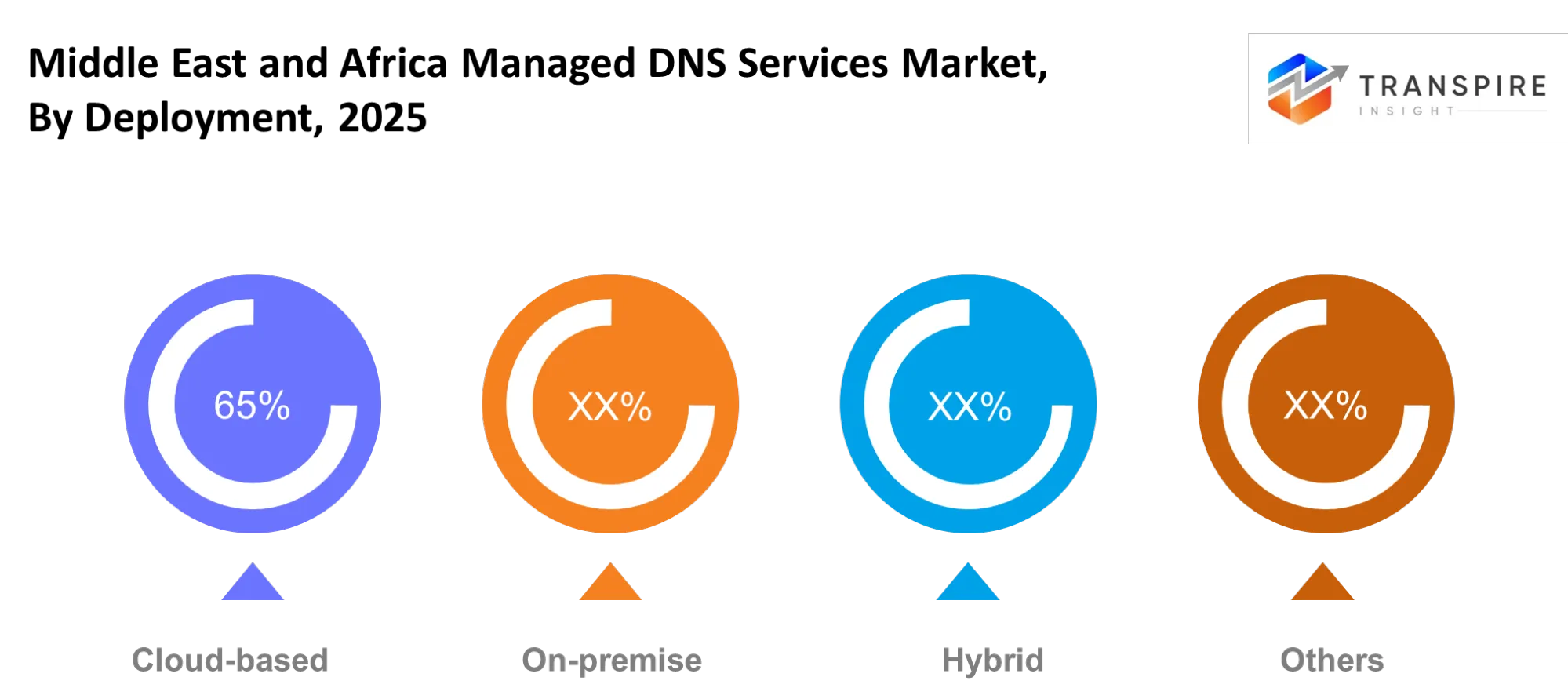
- The market for cloud-managed DNS services will exceed 54% of industry size in 2025 because companies are moving to multi-cloud systems.
- The second-largest service segment consists of DDoS-protected authoritative DNS solutions which have grown because cyberattacks have become more common.
- The period will experience its most rapid growth through AI-enabled DNS traffic analytics which will grow because of its ability to integrate live threat intelligence technology.
- The banking and financial services sector leads application demand because it will generate about 29% of Middle East and Africa Managed DNS Services Market revenue during 2025.
- The market share of large enterprises reaches approximately 63% because their businesses require specialized network systems and continuous operational availability.
- The adoption of managed services by SMEs will increase until 2030 because subscription-based DNS models make it easier for them to operate their services.
- Public sector organizations represent a rapidly growing end-user category across regional cybersecurity modernization programs.
What are the Key Drivers, Restraints, and Opportunities in the Middle East and Africa Managed DNS Services Market?
The Middle East and Africa Managed DNS Services Market experiences its strongest growth because Gulf countries and major African business centers implement their national digital transformation programs. Over the last five years, enterprises have completed network infrastructure upgrades because governments established cloud migration mandates and data localization rules and cybersecurity compliance regulations. Organizations now adopt managed DNS services because they need third-party providers to deliver uptime protection and fast data transmission and security defense solutions. The subscription-based revenue model for managed DNS services grows stronger as banking and telecom and public-sector organizations expand their digital operations.
The primary structural challenge exists because digital infrastructure development varies greatly between different regions of Africa and specific markets in the Middle East. Many enterprises still operate legacy on-premise systems with limited interoperability with cloud-native DNS architectures. The process of upgrading these environments requires organizations to invest large amounts of money and employ technical specialists who will execute network-wide updates. The organization faces two main problems that stem from its current infrastructure situation and its existing employee skill deficits. The organization experiences two negative effects because it takes longer to complete projects and it loses potential income from enterprise customers who would have switched to their services.
The deployment of edge computing technology presents the most obvious opportunity for upcoming business development in markets. The development of edge-managed DNS platforms in Saudi Arabia and the UAE and South Africa results from investments in regional hyperscale data centers. Enterprises that need faster application performance should choose providers who combine AI-powered traffic optimization with local DNS resolution capabilities.
What Has the Impact of Artificial Intelligence Been on the Middle East and Africa Managed DNS Services Market?
Artificial intelligence transforms regional DNS operations through automated systems that manage traffic routing and detect anomalies and handle incident response across enterprise networks. The control systems which use AI technology continuously monitor DNS query patterns to search for harmful traffic patterns which they use to automatically redirect requests and initiate protection measures before service interruptions become critical. Major managed service providers now use machine learning models to monitor millions of DNS transactions in real time which helps them decrease manual work while they respond faster to distributed denial-of-service attacks.
Predictive analytics now provides operational performance enhancements through its implementation. Machine learning models forecast traffic surges and detect abnormal latency behavior while they predict infrastructure bottlenecks before these issues disrupt application availability. This system enables providers to implement dynamic network resource allocation and maintain optimal server load distribution. The banking and telecom industries achieve better DNS uptime performance through these capabilities which enable service availability to exceed 99.99% while incident resolution times decrease and operational expenses get minimized.
The main limitation remains integration complexity. Many enterprises across emerging regional markets still operate fragmented legacy network environments that generate inconsistent telemetry data. The system needs operational limits which restrict model accuracy and raise implementation costs while they lead to slower adoption.
Key Market Trends
- GCC enterprises made the transition to cloud-managed systems for their DNS services between 2021 and 2025 which resulted in better resilience and decreased chances of system failures.
- The banking systems in the Middle East experienced an increase in DDoS attacks after 2022 which led to greater adoption of automated DNS security and mitigation services provided by Cloudflare and Akamai.
- African telecom operators established hybrid cloud DNS systems after 2023 to enhance mobile data handling and optimize performance for applications that need low latency.
- Between 2023 and 2026 enterprises started using AI-based DNS traffic analytics which helped them identify network irregularities more quickly while decreasing their network downtime.
- Public sector organizations in Saudi Arabia acquired managed DNS services through their cloud migration projects which followed Vision 2030 digital transformation programs.
- The period from 2022 to 2025 saw Oracle and AWS develop additional regional DNS edge nodes in the UAE and Bahrain to enhance latency performance for enterprise SaaS applications.
- Since 2021 Gulf countries implemented data localization laws which compelled enterprises to adopt regionally managed DNS systems instead of using global DNS defaults.
- South African financial institutions implemented managed DNS redundancy solutions after 2022 to enhance their system availability while satisfying new cybersecurity requirements.
Middle East and Africa Managed DNS Services Market Segmentation
By Type :
The primary DNS system enables initial domain name resolution which provides basic access to websites. The secondary DNS system operates as a backup solution which allows services to continue running during system failures. Anycast DNS technology enhances performance by connecting users to their nearest available servers. GeoDNS uses user location data to determine how to route their internet traffic. Traffic Management DNS helps maintain network balance while controlling incoming network traffic.
The secondary systems create two benefits which help maintain system reliability during outages while decreasing the chances of service interruptions. Users experience better performance through Anycast and GeoDNS which reduce their waiting times while delivering more accurate network path information. The traffic management functions enable websites and applications to maintain consistent performance during periods of heavy traffic which helps users from different regions access content without interruptions.
By Application :
Domain name system services enable website management to control domain access and maintain consistent website performance. The users depend on DNS services to establish seamless links between themselves and cloud services. Network security management employs DNS filtering together with protection methods that defend against dangerous websites. Traffic routing establishes optimized user pathways to access content.
The system uses load balancing to distribute incoming requests across different servers which helps prevent any single server from becoming overloaded. Content delivery systems create faster internet connections which decrease waiting times for users. The digital operations of these applications maintain a steady state which leads to improved system availability that allows businesses to deliver online services without interruption across different geographical locations and network environments.
By End-User :
Organizations use managed DNS solutions to operate their digital systems across multiple locations worldwide. Small and medium-sized enterprises use DNS services to establish an online presence while maintaining their website operation at a reasonable cost. IT companies implement DNS solutions to manage their network systems and provide their operational services. Telecom operators use DNS systems to manage their network data flow.
Government agencies employ DNS technology to deliver public services in a secure manner. The banking, financial services, and insurance (BFSI) industry implements DNS solutions to conduct secure financial transactions while safeguarding customer information. Educational institutions and service organizations represent additional user groups who depend on digital systems to maintain stable and secure internet access during their daily work and communication activities.
By Deployment :
The cloud-based system enables organizations to manage their DNS operations remotely while expanding their business requirements through cloud-based infrastructure. Organizations that require control over their internal networks can utilize on-premise systems to manage their DNS networks. The hybrid system enables organizations to achieve operational efficiency by selecting their preferred management system to implement business activities.
The utilization of cloud-based systems enables organizations to scale their operations while experiencing decreased maintenance requirements. Organizations can maintain better control over their confidential information through the use of on-premise systems. Hybrid systems enable organizations to maintain both security measures and operational flexibility through their capability to move between internal systems and cloud systems according to their business operations.
To learn more about this report, Download Free Sample Report
What are the Key Use Cases Driving the Middle East and Africa Managed DNS Services Market?
The primary function of Managed DNS Services in the Middle East and Africa market provides secure domain resolution which operates continuously for banking financial services and telecom systems because any service interruption will prevent transactions and block customer access and break digital payment systems that support the growing number of online payment channels.
Telecom operators use mobile data routing for optimization while government platforms protect citizen services through their cloud migration initiatives which advance between the UAE and Saudi Arabia and South Africa's enterprise digital infrastructure modernization efforts that need low-latency application delivery and compliance with regulatory standards.
The forecast period will show how AI-powered DNS threat intelligence and edge computing systems for Internet of Things environments will create use cases that enable organizations to control their network traffic while securing their digital systems.
|
Report Metrics |
Details |
|
Market size value in 2025 |
USD 108.42 Million |
|
Market size value in 2026 |
USD 124.79 Million |
|
Revenue forecast in 2033 |
USD 338.54 Million |
|
Growth rate |
CAGR of 15.32% from 2026 to 2033 |
|
Base year |
2025 |
|
Historical data |
2021 - 2024 |
|
Forecast period |
2026 - 2033 |
|
Report coverage |
Revenue forecast, competitive landscape, growth factors, and trends |
|
Regional scope |
Middle East and Africa (Saudi Arabia, United Arab Emirates, South Africa, Rest of Middle East and Africa) |
|
Key company profiled |
Akamai, Cloudflare, AWS, Google, IBM, Oracle, Microsoft, Neustar, Dyn, NS1, Verisign, Cisco, Huawei, Tencent, Alibaba |
|
Customization scope |
Free report customization (country, regional & segment scope). Avail customized purchase options to meet your exact research needs. |
|
Report Segmentation |
By Type (Primary DNS, Secondary DNS, Anycast DNS, GeoDNS, Traffic Management DNS, Others); By Application (Website Management, Cloud Services, Security Management, Traffic Routing, Load Balancing, Content Delivery, Others); By End-User (Enterprises, SMEs, IT Companies, Telecom Operators, Government, BFSI, Others); By Deployment (Cloud-based, On-premise, Hybrid, Others) |
Which Regions are Driving the Middle East and Africa Managed DNS Services Market Growth?
The Gulf Cooperation Council currently leads the Middle East region which dominates the Middle East and Africa Managed DNS Services Market because of its digital sovereignty policies and extensive sovereign cloud initiatives. The governments of UAE and Saudi Arabia have implemented a requirement that all public sector entities and essential infrastructure facilities must utilize cloud services as their primary solution. Enterprises have been motivated to transfer their DNS operations to managed services which include security features and traffic management systems. The region maintains its leadership position through its extensive collection of hyperscale data centers and regional internet exchange points and global companies such as AWS and Oracle.
The South African market operates as a stability-based market because its demand depends on established financial services and dependable telecom services and the POPIA data protection laws which create structured regulatory frameworks. The GCC experiences policy-driven growth while this region expands through steady business IT expenditure and the extended modernization process of its banking and insurance systems. Organizations that require managed DNS services depend mainly on their need for system reliability and secure transaction handling capabilities because they do not have immediate requirements for digital change initiatives. The service providers in this region develop a reliable income stream which maintains steady performance throughout their operational period.
The fastest-growing area in the world today exists outside South Africa throughout Sub-Saharan Africa because people in these regions use mobile internet and fintech companies expand their operations in Nigeria and Kenya. The recent installation of undersea cables and the establishment of cloud regions have created better connectivity while decreasing latency problems. The new system enables businesses to move from their old systems to cloud-based DNS solutions at a faster rate than they predicted. The region offers substantial growth opportunities until 2033 because it contains two main sectors that drive growth through telecommunications and digital payment systems.
Who are the Key Players in the Middle East and Africa Managed DNS Services Market and How Do They Compete?
The Middle East and Africa Managed DNS Services Market shows a moderately consolidated structure at the top, where global cloud and security providers dominate while smaller regional telecom operators gradually lose share. The primary factors driving competition in the market include DNS security depth, edge network performance, compliance readiness, and automation capacity which compete against each other without involving price as a determining factor. The enterprises today select providers who help decrease latency, prevent DDoS attacks, and provide smooth operation between hybrid cloud systems that run on distributed resources.
Cloudflare operates its business through an edge-first system which unites DNS resolution with its capacity to address threats in real time and the company has expanded its geographical presence through new edge installations and business partnerships throughout the UAE and Saudi Arabia. Akamai Technologies develops its DNS services by prioritizing security and uses its established connections in media and telecom routing to increase its market presence across African business networks. Amazon Web Services uses Route 53 DNS services as part of its comprehensive cloud platform while its infrastructure growth in Bahrain and the UAE enables it to serve large businesses that need integrated cloud and DNS solutions.
Oracle Cloud Infrastructure provides businesses with its enterprise-grade DNS service, which offers government and regulated Gulf industries. IBM security consultants work with financial institutions to create DNS management systems which handle their hybrid cloud environments. Google Cloud uses its worldwide backbone network to decrease DNS latency while building fintech partnerships in the region through its advanced peering infrastructure.
Company List
- Akamai
- Cloudflare
- AWS
- IBM
- Oracle
- Microsoft
- Neustar
- Dyn
- NS1
- Verisign
- Cisco
- Huawei
- Tencent
- Alibaba
Recent Development News
In February 2026, NTT DATA announced the acquisition of Zero&One. The deal strengthens NTT DATA’s cloud and managed services portfolio across the Middle East and Africa, enhancing its ability to deliver integrated cloud and DNS-adjacent infrastructure services, including cloud migration and application modernization for regional enterprises.
Source https://www.nttdata.com/
In November 2025, DNSFilter entered into a strategic partnership with Midis Group. The collaboration expanded protective DNS and cloud-based security services across the Middle East, enabling enterprises in the region to adopt AI-driven DNS threat detection and content filtering through Midis Group’s distribution network.Source https://www.dnsfilter.com/
What Strategic Insights Define the Future of the Middle East and Africa Managed DNS Services Market?
The Middle East and Africa Managed DNS Services Market is evolving toward security-focused DNS systems which will work with complete cloud and edge computing environments. The adoption of new technologies will be determined by national cloud requirements and the growth of digital services which need fast response times in banking and telecom and public infrastructure over the next five to seven years. The industry is changing from independent DNS management systems to complete network protection solutions which use artificial intelligence to enhance system efficiency while maintaining security requirements.
The danger of provider concentration which sees a few major global hyperscale companies controlling essential DNS resolution services exists as a hidden threat which undermines the apparent industry growth. Enterprises face operational disruption when their dependencies on systems increase because any changes to pricing models or service policies or geopolitical conditions will disrupt their operations. The potential for African markets to establish different compliance standards creates a major obstacle to cross-border service delivery which will become more challenging to achieve as connectivity improves.
The development of edge-native DNS services which will serve new hyperscale data center facilities in Saudi Arabia and UAE and East Africa brings strong business potential. The deployments will support ultra-low latency enterprise applications which will be used in fintech and digital government systems. Market participants should establish local edge alliances and develop AI-based traffic intelligence systems to capture early market share in upcoming distributed DNS systems.
Middle East and Africa Managed DNS Services Market Report Segmentation
By Type
- Primary DNS
- Secondary DNS
- Anycast DNS
- GeoDNS
- Traffic Management DNS
By Application
- Website Management
- Cloud Services
- Security Management
- Traffic Routing
- Load Balancing
- Content Delivery
By End-User
- Enterprises
- SMEs
- IT Companies
- Telecom Operators
- Government
- BFSI
By Deployment
- Cloud-based
- On-premise
- Hybrid
Frequently Asked Questions
Find quick answers to common questions.
The Middle East and Africa Managed DNS Services Market size is USD 338.54 Million in 2033.
Key segments for the Middle East and Africa Managed DNS Services Market are By Type (Primary DNS, Secondary DNS, Anycast DNS, GeoDNS, Traffic Management DNS, Others); By Application (Website Management, Cloud Services, Security Management, Traffic Routing, Load Balancing, Content Delivery, Others); By End-User (Enterprises, SMEs, IT Companies, Telecom Operators, Government, BFSI, Others); By Deployment (Cloud-based, On-premise, Hybrid, Others).
Major Middle East and Africa Managed DNS Services Market players are Akamai, Cloudflare, AWS, Google, IBM, Oracle, Microsoft, Neustar, Dyn, NS1, Verisign, Cisco, Huawei, Tencent, Alibaba.
The Middle East and Africa Managed DNS Services Market size is USD 108.42 Million in 2025.
The Middle East and Africa Managed DNS Services Market CAGR is 15.32% from 2026 to 2033.
- Akamai
- Cloudflare
- AWS
- IBM
- Oracle
- Microsoft
- Neustar
- Dyn
- NS1
- Verisign
- Cisco
- Huawei
- Tencent
- Alibaba
Recently Published Reports
-
Apr 2026
3D Optical Profiler Market
3D Optical Profiler Market Size, Share & Analysis Report By Type (Desktop 3D Optical Profiler, and Portable 3D Optical Profiler), By Technology (Confocal Technology, and White Light Interference), By End-Use Industry (Manufacturing, Research Institutions, Automotive, Aerospace and Defense, Medical Devices, and Other), and Geography (North America, Europe, Asia-Pacific, Middle East and Africa, South and Central America), 2021 - 2031
-
Apr 2026
Depth Sensor Market
Depth Sensor Market Size, Share & Analysis Report By Type (Infrared Depth Sensors, Time-of-Flight (ToF) Sensors, Stereo Vision Sensors, Structured Light Sensors, Ultrasonic Depth Sensors), By Application (Automotive, Robotics, Gaming, Consumer Electronics, Industrial Automation, Healthcare, Security & Surveillance, Others), By End Users (Automotive Manufacturers, Consumer Electronics Companies, Healthcare Providers, Industrial Companies, Security Agencies, Gaming Companies, Robotics Companies, Others), and Geography (North America, Europe, Asia-Pacific, Middle East and Africa, South and Central America), 2021 – 2031
-
Apr 2026
Digital Manufacturing Market
Digital Manufacturing Market Size, Share & Analysis Report By Component (Hardware, Software, and Services), By Technology (Robotics, 3D Printing, Internet of Things (IoT), and Others), By Application (Automotive and Transportation, Aerospace and Defense, Consumer Electronics, Industrial Machinery, and Others), By Process Type (Computer-Based Designing, Computer-Based Simulation, Computer 3D Visualization, Analytics, and Others), and Geography (North America, Europe, Asia-Pacific, Middle East and Africa, South and Central America), 2021 – 2031
-
Apr 2026
Digital Visa Services Market
Digital Visa Services Market Size, Share & Analysis Report By Type (Individual Travelers, Group Travelers), By Application (Tourism, Business Travel, Others), and Geography (North America, Europe, Asia-Pacific, Middle East and Africa, South and Central America), 2021 – 2031