
Middle East and Africa Lightning Surge Protector Market Size & Forecast:
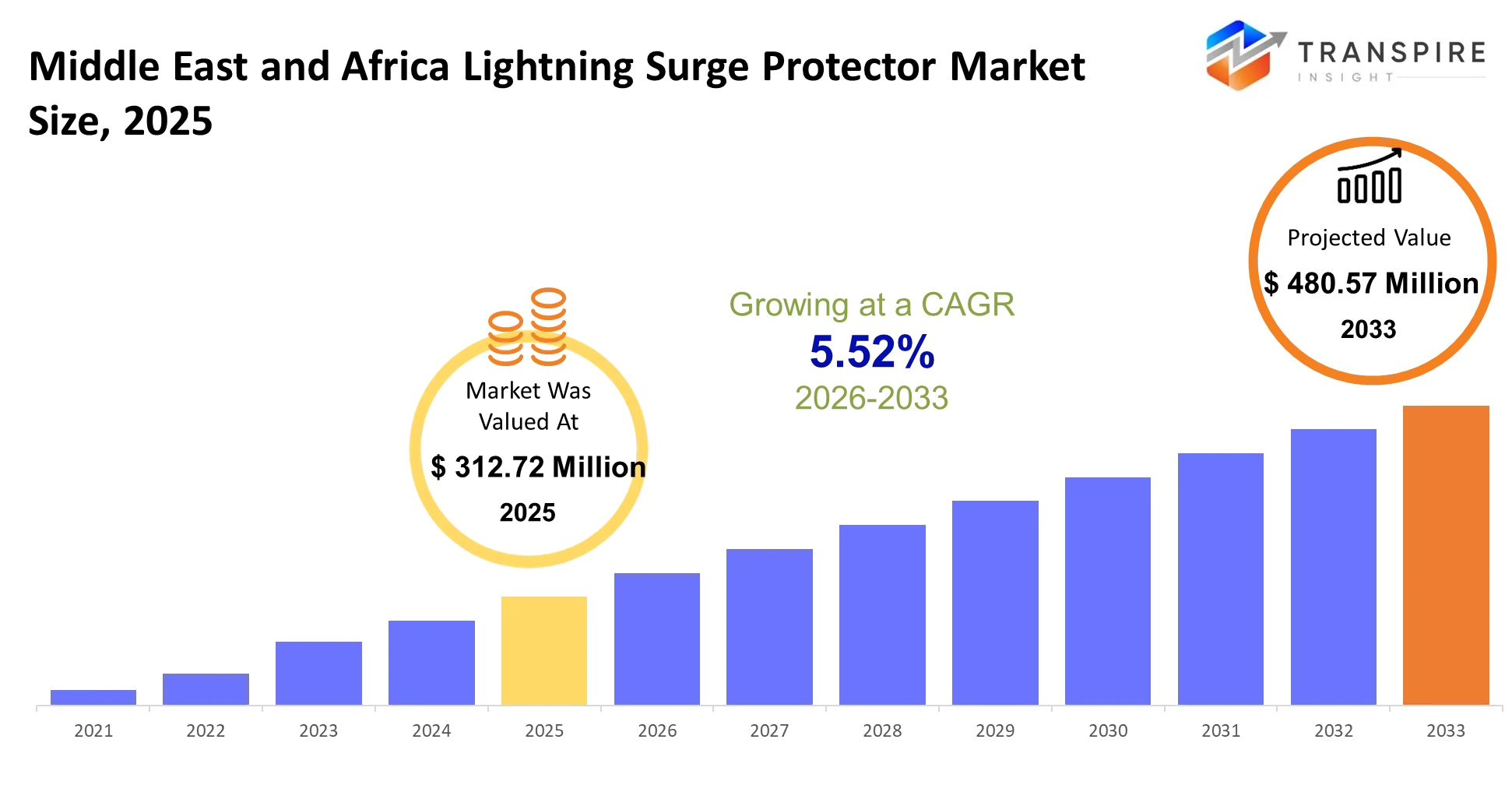
- Middle East and Africa Lightning Surge Protector Market Size 2025: USD 312.72 Million
- Middle East and Africa Lightning Surge Protector Market Size 2033: USD 480.57 Million
- Middle East and Africa Lightning Surge Protector Market CAGR: 5.52%
- Middle East and Africa Lightning Surge Protector Market Segments: By Type (Type 1, Type 2, Type 3, Combined Devices, Hybrid Protectors, Others); By Application (Residential, Commercial, Industrial, Telecom, Power Utilities, Renewable Energy, Others); By End-User (Households, Enterprises, Industrial Firms, Utilities, Telecom Operators, Construction Firms, Others); By Voltage (Low Voltage, Medium Voltage, High Voltage, Others)
To learn more about this report,  Download Free Sample Report
Middle East and Africa Lightning Surge Protector Market Summary
The Middle East and Africa Lightning Surge Protector Market was valued at USD 312.72 Million in 2025. It is forecast to reach USD 480.57 Million by 2033. That is a CAGR of 5.52% over the period.
The essential function of lightning surge protectors is to safeguard electrical systems against voltage surges which originate from lightning strikes and grid instability and switching operations that have the potential to damage transformers and control systems and telecom towers and industrial automation equipment. The Middle East and Africa region has established these systems as standard equipment which utility companies and oil and gas facilities and transport networks and data centers and renewable energy installations use to protect their operations from power interruptions which would result in expensive downtime.
The market has experienced a shift during the past three to five years which moved away from conventional passive protection systems and introduced smart surge protection devices that feature remote monitoring and predictive diagnostics functions. The implementation of this change has gained momentum through the execution of extensive grid modernization initiatives together with the development of digital infrastructure systems. The renewable energy sector experienced rapid growth together with the establishment of distributed power systems which emerged as a primary driver for this transformation after regional energy diversification initiatives completed their objectives. The implementation of more advanced electrical networks by operators results in increased vulnerability to transient overvoltage events. The market is experiencing stronger acceptance of advanced surge protection solutions which leads to organizations choosing higher-value systems while they establish ongoing service contracts throughout the area.
Key Market Insights
- Gulf Cooperation Council countries dominate, holding nearly 42% market share in 2025, supported by infrastructure upgrades and large-scale smart grid investments.
- South Africa remains the second-largest contributor, driven by utility network reinforcement and industrial power reliability initiatives.
- North Africa is the fastest-growing regional cluster, forecast to expand through 2026-2031 due to renewable energy integration projects.
- Type 1 surge protectors lead with approximately 38% market share in 2025, favored for external lightning strike defense.
- Type 2 surge protection devices hold the second-largest share due to widespread commercial building retrofits.
- The Middle East and Africa Lightning Surge Protector Market sees its primary demand source from power transmission and distribution, which constitutes approximately 36% of total market demand.
- The renewable energy sector experiences its highest growth rate through 2031 because solar and wind capacity installations drive expansion of renewable energy projects.
- Data centers require advanced surge protection solutions to meet their growing operational needs.
- Utility companies control approximately 40% of the market because they update substations and enhance network protection systems.
- Oil and gas companies maintain their strategic buying activities for equipment needed in high-hazard work environments.
What are the Key Drivers, Restraints, and Opportunities in the Middle East and Africa Lightning Surge Protector Market?
The rapid modernization of regional power infrastructure systems serves as the main driving force which accelerates the Middle East and Africa Lightning Surge Protector Market. The electrical networks of Saudi Arabia, the UAE, and South Africa have become more complicated because these countries implemented extensive grid expansion projects together with renewable energy integration requirements. The national energy diversification strategies of the country initiated a transformation which established solar parks and smart substations and digital transmission systems as essential components of its energy framework. The expansion of interconnected assets by utilities creates a higher risk of transient voltage events, which establishes surge protection as an essential requirement for procurement processes. The equipment sales increase together with the service contracts, which creates additional revenue sources for the market.
The most significant structural barrier is the uneven quality of electrical infrastructure across several African economies. The current markets operate with infrastructure that depends on outdated grid systems which produce unstable voltage outputs and enforce electrical safety regulations at insufficient levels. The process of transmission and distribution system upgrades requires public funds and regulatory agreements together with long-term financing which makes this issue a long-term problem. The current situation leads to delayed surge protection system installations, especially in secondary industrial areas, which creates obstacles for market growth and replacement demand.
A major growth opportunity lies in hyperscale data center expansion across the Gulf region. Saudi Arabia and the UAE attract major digital infrastructure investments because their data facilities need advanced power protection systems. The market for advanced smart surge protectors with predictive monitoring capabilities will experience significant growth in this new high-value segment.
What Has the Impact of Artificial Intelligence Been on the Middle East and Africa Lightning Surge Protector Market?
Artificial intelligence together with advanced digital technologies transforms surge protection systems throughout the Middle East and Africa by providing enhanced monitoring capabilities and automatic fault detection and better protection of their operational assets. Surge protection systems now use AI-powered monitoring systems which enable utilities and industrial operators to automatically detect voltage changes while recording system faults and monitoring protection status in real time. The system monitors network status since it detects transient overvoltage conditions which trigger automatic warnings to control rooms before any equipment damage happens.
Machine learning models now enable better predictive maintenance operations. The models use historical surge event data together with load patterns and weather conditions and asset performance data to detect protection device degradation before actual system failures occur. The predictive function enables operators to determine optimal replacement schedules which helps them decrease unexpected service interruptions. Digital surge monitoring systems have resulted in data centers and power substations achieving both better uptime results and higher maintenance efficiency while decreasing expenses related to manual inspections.
Renewable energy installations provide clear operational advantages because smart analytics enhance system dependability and aid in meeting grid stability regulatory requirements. The primary drawback of AI-based surge protection systems which work with traditional electrical systems remains their expensive integration requirements. The majority of regional facilities still require digital infrastructure which enables them to execute real-time analytics while operational data remains scattered and makes it difficult to build accurate models which delays their expansion into developing regions.
Key Market Trends
- The Gulf utilities have allocated about 30 percent of their new procurement budgets since 2022 to digitally monitored surge protection systems which replace traditional standalone surge protection devices.
- Industrial buyers accelerated their programs to retrofit facilities after South Africa experienced major grid instability events which caused manufacturing plants to suffer voltage-related production interruptions during 2023.
- The regional distribution partnerships of Schneider Electric and ABB expanded between 2023 and 2025 which enabled them to decrease the delivery times that had previously delayed infrastructure project execution.
- After solar park expansion renewable energy developers started to specify hybrid surge protection systems which protect inverter systems from increased transient voltage stress. Saudi Arabian and UAE regulators have increased substation protection requirements since 2021 which forces EPC contractors to implement more advanced protection systems.
- Data center operators changed their purchasing habits by selecting remote diagnostic capabilities as their main requirement while hyperscale projects adopted monitored protection modules as their standard practice after 2024.
- The pandemic caused disruptions which made manufacturers in the UAE decrease their dependence on imported parts while they established localized assembly operations throughout their industrial zones.
- Telecom tower operators increasingly adopted modular replacement designs which achieved a 20 percent reduction in field maintenance downtime compared to traditional fixed unit systems.
- The competitive behavior of Eaton Siemens and Phoenix Contact changed after they dedicated more resources to developing predictive maintenance software than to creating new hardware products.
Middle East and Africa Lightning Surge Protector Market Segmentation
By Type :
The Middle East and Africa lightning surge protector market separates its product offerings according to different protection standards which electrical systems employ. Type 1 devices serve as entrance points for direct lightning strikes, while Type 2 devices operate to control remaining surge electricity. Type 3 protectors ensure equipment protection at locations which require heightened safety measures.
The market shows increasing interest in combined devices and hybrid protectors because these products deliver multiple protection capabilities through a single device. Hybrid protectors enable organizations to build systems which need both their existing infrastructure and new developments. The category contains specialized equipment which functions exclusively with specific electrical systems. The growing number of infrastructure projects together with the expanding power grid systems create continuous demand throughout all product categories.
By Application :
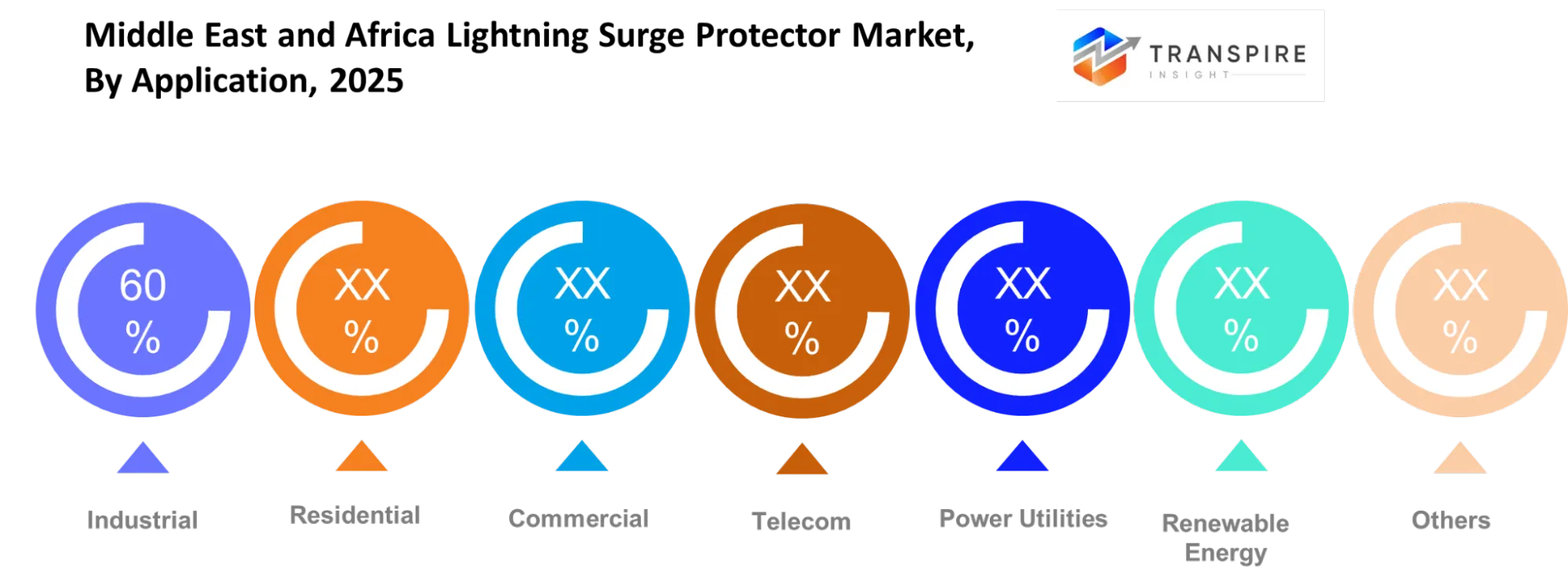
The Middle East and Africa market route for lightning surge protectors shows multiple application areas which depend on electrical load requirements and infrastructure operational requirements. Residential use focuses on protecting home appliances and wiring systems from voltage spikes. Commercial buildings use surge protection to safeguard office equipment, security systems, and building automation systems.
Industrial applications need advanced protection systems because they operate heavy machinery throughout the entire operational period. Surge protectors serve as critical components for telecom infrastructure since they prevent network service disruptions. Power utilities implement these systems to enhance grid stability, while renewable energy systems use protection units for their solar and wind energy components. The system supports multiple applications which include transportation and public infrastructure systems.
To learn more about this report, Download Free Sample Report
By End-User :
The end-user segmentation process demonstrates that customers show different requirements for lightning surge protection systems. Basic protection systems are essential for households because they safeguard their daily electrical devices against damage from voltage changes. Organizations use surge protection systems to guarantee uninterrupted operation of their office networks and IT systems and their associated devices.
Telecommunications companies need uninterrupted electricity because power outages lead to communication failures. Surge protection systems need to be part of construction developments because construction companies need to maintain electrical safety standards. Transport operators and public service organizations represent additional groups who use these services.
By Voltage :
The end-user segmentation process demonstrates that customers show different requirements for lightning surge protection systems. Basic protection systems are essential for households because they safeguard their daily electrical devices against damage from voltage changes. Organizations use surge protection systems to guarantee uninterrupted operation of their office networks and IT systems and their associated devices.
Telecommunications companies need uninterrupted electricity because power outages lead to communication failures. Surge protection systems need to be part of construction developments because construction companies need to maintain electrical safety standards. Transport operators and public service organizations represent additional groups who use these services.
What are the Key Use Cases Driving the Middle East and Africa Lightning Surge Protector Market?
The primary use case for lightning surge protectors across the Middle East and Africa is power transmission and distribution infrastructure. Utilities use these systems throughout substations and transformers and switching stations because voltage surges disrupt regional grid stability and damage valuable electrical equipment which requires protection to maintain operations.
Telecom infrastructure and industrial manufacturing facilities are experiencing widespread growth in their adoption of new technologies. Telecom operators use surge protection to safeguard tower equipment and 5G backhaul systems from lightning-related disruptions, while manufacturing plants rely on it to protect automation controls and prevent costly production stoppages.
New applications are emerging for renewable energy installations and hyperscale data centers. Solar and wind projects increasingly require advanced protection for inverters and storage systems due to fluctuating grid interactions. The Gulf markets are experiencing a surge in new digital infrastructure investments which creates a need for intelligent surge protection systems that include predictive monitoring capabilities.
|
Report Metrics |
Details |
|
Market size value in 2025 |
USD 312.72 Million |
|
Market size value in 2026 |
USD 329.98 Million |
|
Revenue forecast in 2033 |
USD 480.57 Million |
|
Growth rate |
CAGR of 5.52% from 2026 to 2033 |
|
Base year |
2025 |
|
Historical data |
2021 - 2024 |
|
Forecast period |
2026 - 2033 |
|
Report coverage |
Revenue forecast, competitive landscape, growth factors, and trends |
|
Regional scope |
Middle East and Africa (Saudi Arabia, United Arab Emirates, South Africa, Rest of Middle East and Africa) |
|
Key company profiled |
Schneider Electric, Siemens, ABB, Eaton, Legrand, Mitsubishi Electric, Hitachi Energy, Honeywell, Phoenix Contact, Littelfuse, Belkin, Tripp Lite, Raycap, OBO Bettermann, Havells |
|
Customization scope |
Free report customization (country, regional & segment scope). Avail customized purchase options to meet your exact research needs. |
|
Report Segmentation |
By Type (Type 1, Type 2, Type 3, Combined Devices, Hybrid Protectors, Others); By Application (Residential, Commercial, Industrial, Telecom, Power Utilities, Renewable Energy, Others); By End-User (Households, Enterprises, Industrial Firms, Utilities, Telecom Operators, Construction Firms, Others); By Voltage (Low Voltage, Medium Voltage, High Voltage, Others) |
Which Regions are Driving the Middle East and Africa Lightning Surge Protector Market Growth?
The Gulf Cooperation Council region leads the Middle East and Africa lightning surge protector market because of its active development of new infrastructure and its commitment to building modern electrical networks. Countries such as Saudi Arabia and the United Arab Emirates have made smart grid deployment and renewable energy integration and digital industrial zones their top priorities which need advanced surge protection systems to function properly. Strong regulatory enforcement around electrical safety standards further supports sustained adoption across utility, telecom, and commercial sectors. The organization maintains its market leadership through its established supplier network and network of EPC contractors and its ability to obtain funding for ongoing system improvements.
South Africa stands as the second largest regional market after the United States because its market strength stems from different business foundational elements. The South African market operates through a consistent pattern of replacement demand because its electrical systems need to be updated and its customers require dependable power supply. The mining industry and industrial operators and utility companies continue to invest in surge protection systems which help them avoid operational shutdowns caused by grid disturbances. The revenue stream establishes a dependable and continuous income source which enables suppliers to maintain their business operation through economic downturns.
The market in North Africa has developed into its fastest growing phase because of investments that have been made in renewable energy and transmission facilities. Egypt and Morocco have expanded their solar power projects and grid interconnection efforts since 2023, which has created new needs for high-tech electrical protection systems. The regulatory framework has established better support for cross-border power integration, which now directs more attention toward enhancing grid stability and system performance. The growth of the market provides strong expansion potential for investors and market entrants until 2033, especially for companies that provide smart protection solutions and application-specific protection technologies.
Who are the Key Players in the Middle East and Africa Lightning Surge Protector Market and How Do They Compete?
The Middle East and Africa market for lightning surge protection equipment displays moderate competition because established global electrical protection manufacturers control major infrastructure projects and regional distributors compete with engineering firms to secure maintenance and retrofit contracts. The market remains stable because new companies face multiple obstacles which include certification processes and extended procurement times and technical compliance requirements. The main factors that drive competition between companies include their ability to develop distinct technologies as well as their project management skills and their capacity to deliver services in specific locations. Buyers increasingly prioritize suppliers that can combine advanced monitoring capabilities with fast deployment and post-installation diagnostics.
Schneider Electric uses its digital protection platforms which connect surge protection devices to building and grid management systems as its competitive advantage. The company provides predictive diagnostics through its connected electrical infrastructure which helps it to succeed in Gulf region smart city and data center projects. The company continues expanding through regional technology partnerships and stronger channel networks in Saudi Arabia and the UAE.
ABB stands apart from its competitors because it provides complete protection systems which deliver superior performance for both utility-sized substations and renewable energy systems. The company established itself as the industry leader because it meets all international grid standards which makes them suitable for advanced technical projects. ABB has strengthened its position through enhanced engineering partnerships with EPC contractors who work on energy diversification projects throughout the region.
Eaton and Phoenix Contact are gaining traction by focusing on modular designs and rapid-response service models. Industrial clients benefit from Eaton's retrofit-friendly systems which simplify their installation process while Phoenix Contact uses its automation expertise to create surge monitoring systems that work within industrial control systems. The two companies are expanding their operations by establishing local technical support centers and developing closer relationships with their distributors throughout North and Southern Africa.
Company List
- Schneider Electric
- Siemens
- ABB
- Eaton
- Legrand
- Mitsubishi Electric
- Hitachi Energy
- Honeywell
- Phoenix Contact
- Littelfuse
- Belkin
- Tripp Lite
- Raycap
- OBO Bettermann
- Havells
Recent Development News
In April 2026, HAIVO Electric announced that its 3–36kV zinc oxide surge arresters successfully passed KEMA-standard certification testing conducted at the Xi’an High Voltage Apparatus Research Institute. This certification validates product reliability and compliance with international high-voltage safety standards, strengthening its competitiveness in utility and industrial surge protection markets. Source https://www.barchart.com/
In January 2026, Nextpower (formerly Nextracker) and Abunayyan Holding completed the formation of Nextpower Arabia, a joint venture headquartered in Saudi Arabia. The venture establishes local manufacturing capacity for advanced solar tracking systems, indirectly driving demand for integrated surge protection systems in large-scale solar infrastructure across the Middle East and North Africa region. Source https://www.nasdaq.com/
What Strategic Insights Define the Future of the Middle East and Africa Lightning Surge Protector Market?
The Middle East and Africa Lightning Surge Protector Market will develop electric protection systems that combine digital technology with intelligent systems throughout the next five to seven years. The current transformation of the electricity grid system occurs because of three main factors which include increased grid digitization and higher renewable energy adoption together with more critical infrastructure facilities that connect data centers and transport networks and industrial automation systems. Protection systems will evolve to operate as interconnected components in complete energy management systems which function as connected assets.
The increasing use of standardized imported semiconductor components in smart surge protection devices creates a hidden danger for security systems. Any disruption in global chip supply chains or export restrictions will cause product development processes to experience delays which will affect the launch schedules of new products in Africa's developing infrastructure projects. The market currently presents a significant opportunity because AI-based predictive grid protection systems will help protect Gulf hyperscale data center facilities and their associated renewable microgrid systems.
For long-term market success, companies need to focus on localizing their assembly processes while developing software solutions that combine surge protection systems with predictive analytics functions.
Middle East and Africa Lightning Surge Protector Market Report Segmentation
By Type
- Type 1
- Type 2
- Type 3
- Combined Devices
- Hybrid Protectors
By Application
- Residential
- Commercial
- Industrial
- Telecom
- Power Utilities
- Renewable Energy
By End-User
- Households
- Enterprises
- Industrial Firms
- Utilities
- Telecom Operators
- Construction Firms
By Voltage
- Low Voltage
- Medium Voltage
- High Voltage
Frequently Asked Questions
Find quick answers to common questions.
The Middle East and Africa Lightning Surge Protector Market size is USD 480.57 Million in 2033.
Key segments for the Middle East and Africa Lightning Surge Protector Market are By Type (Type 1, Type 2, Type 3, Combined Devices, Hybrid Protectors, Others); By Application (Residential, Commercial, Industrial, Telecom, Power Utilities, Renewable Energy, Others); By End-User (Households, Enterprises, Industrial Firms, Utilities, Telecom Operators, Construction Firms, Others); By Voltage (Low Voltage, Medium Voltage, High Voltage, Others).
Major Middle East and Africa Lightning Surge Protector Market players are Schneider Electric, Siemens, ABB, Eaton, Legrand, Mitsubishi Electric, Hitachi Energy, Honeywell, Phoenix Contact, Littelfuse, Belkin, Tripp Lite, Raycap, OBO Bettermann, Havells.
The Middle East and Africa Lightning Surge Protector Market size is USD 312.72 Million in 2025.
The Middle East and Africa Lightning Surge Protector Market CAGR is 5.52% from 2026 to 2033.
- Schneider Electric
- Siemens
- ABB
- Eaton
- Legrand
- Mitsubishi Electric
- Hitachi Energy
- Honeywell
- Phoenix Contact
- Littelfuse
- Belkin
- Tripp Lite
- Raycap
- OBO Bettermann
- Havells
Recently Published Reports
-
Apr 2026
Active Power Filter Market
Active Power Filter Market Size, Share & Analysis Report By Type (Shunt Active Power Filters, Series Active Power Filter, Hybrid Active Power Filter), By Application (Harmonics Mitigation, Reactive Power Compensation, Voltage Regulation, Power Factor Correction), By Phase (Single Phase, Three Phase), By End-User Industry (Manufacturing, Healthcare, Commercial, Automotive, Oil and Gas, Others), and Geography (North America, Europe, Asia-Pacific, Middle East and Africa, South and Central America), 2021 - 2031
-
Apr 2026
Electrical Transformer Market
Electrical Transformer Market Size, Share & Analysis Report By Core (Closed, Shell, and Berry), By Insulation (Gas, Oil, Solid, Air, and Other), By Phase (Single, and Three), By Rating (100 MVA to 500 MVA, 501 MVA to 800 MVA, and 801 MVA to 1200 MVA), and Geography (North America, Europe, Asia-Pacific, Middle East and Africa, South and Central America), 2021 – 2031
-
Apr 2026
Hydraulic Piston Pumps Market
Hydraulic Piston Pumps Market Size, Share & Analysis Report By Type (Axial Piston Pumps, Radial Piston Pumps), By Operating Pressure (Low Pressure, Medium Pressure, High Pressure), By Application (Construction, Mining, Agriculture, Automotive, Oil & Gas, Industrial Machinery, Others), By End-User (OEMs, Aftermarket), and Geography (North America, Europe, Asia-Pacific, Middle East and Africa, South and Central America), 2021 – 2031
-
Apr 2026
Laboratory Gas Generators Market
Laboratory Gas Generators Market Size, Share & Analysis Report By Product (Nitrogen Gas Generator, Hydrogen Gas Generator, Zero Air Gas Generator, Purge Gas Generator, TOC Gas Generators, Others), By Application (Gas Chromatography, Liquid Chromatography-mass Spectrometry (LC-MS), Gas Analyzers, Others), By End-user (Life Science, Chemical & Petrochemical, Food & Beverage, Others), and Geography (North America, Europe, Asia-Pacific, Middle East and Africa, South and Central America), 2021 – 2031