

Middle East and Africa Legal Services Market Size & Forecast:
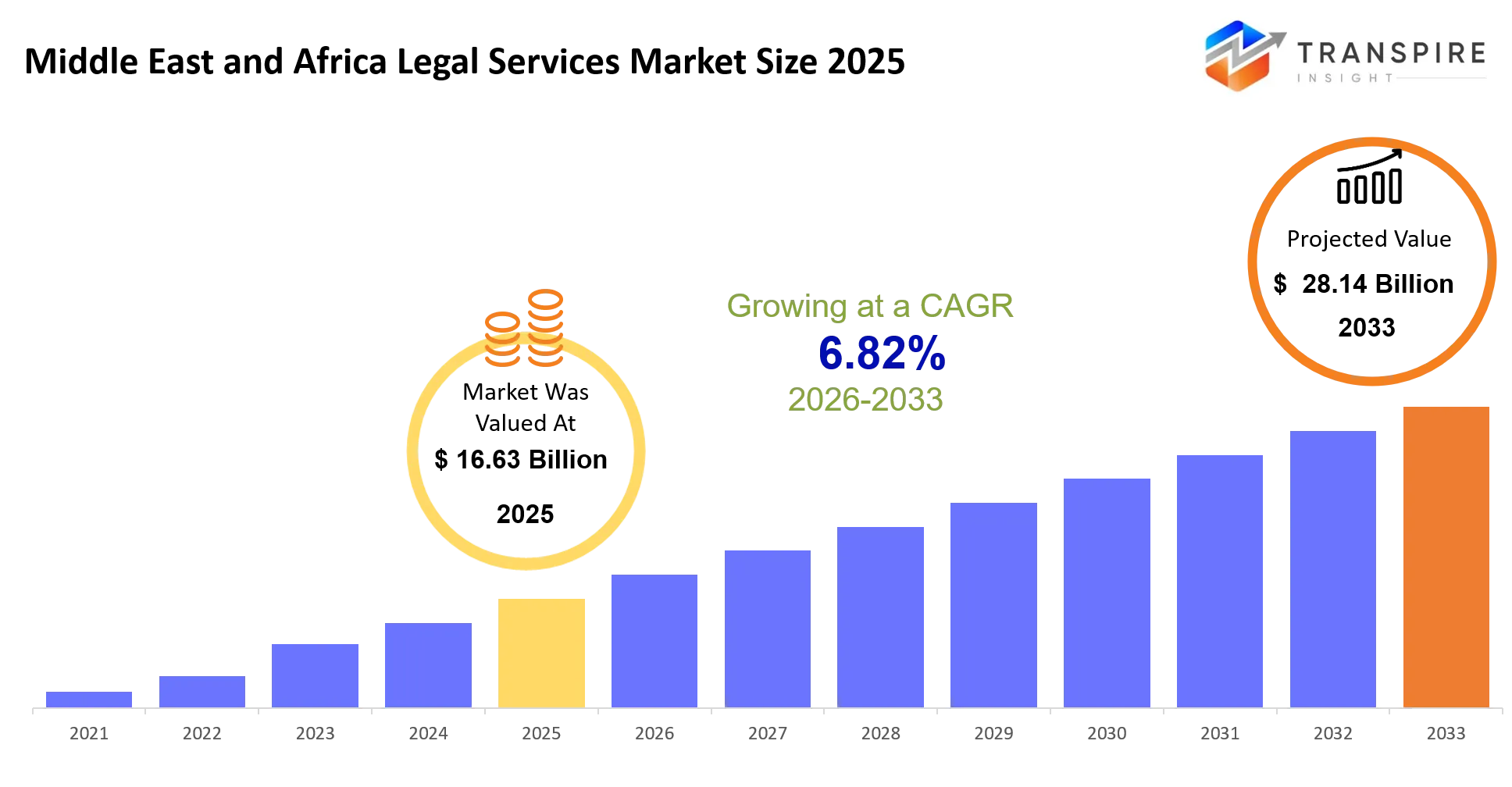
- Middle East and Africa Legal Services Market Size 2025: USD 16.63 Billion
- Middle East and Africa Legal Services Market Size 2033: USD 28.14 Billion
- Middle East and Africa Legal Services Market CAGR: 6.82%
- Middle East and Africa Legal Services Market Segments: By Service Type (Corporate Law, Litigation, Intellectual Property, Tax Law, Employment Law, Real Estate Law, Compliance Services, Others); By Client Type (Corporate Clients, SMEs, Individuals, Government, Others); By Delivery Mode (Traditional Legal Services, Online Legal Services, Hybrid Services, Others); By End User (BFSI, Healthcare, Real Estate, Manufacturing, Government, Others)
Middle East and Africa Legal Services Market Summary
The Middle East and Africa Legal Services Market was valued at USD 16.63 Billion in 2025. It is forecast to reach USD 28.14 Billion by 2033. That is a CAGR of 6.82% over the period.
The market for legal services is pretty crucial for helping businesses , financial institutions, government agencies, and private clients deal with contracts and regulatory duties, handle disputes, think through investments, and manage cross-border dealings. In practice legal advisors help market participants lower commercial risk, make sure everything is in line with compliance rules, safeguard intellectual property, and also enable things like mergers , acquisitions and infrastructure projects across the broader region.
In the past five years there’s been a notable structural change, kind of a shift toward technology-enabled ways of delivering legal support. Digital contract management, AI-assisted legal research, and virtual advisory platforms have changed how firms actually serve clients. This has picked up speed after the pandemic, then got reinforced by fast regulatory reforms in Gulf economies, plus broader foreign investment frameworks and more cross-border trade. At the same time governments across the Middle East and Africa kept issuing added compliance, tax, data protection, and corporate governance requirements, which means more legal work, more documentation, and more ongoing reviews.
As companies expand across different jurisdictions, the need for specialized advisory keeps growing. And this overall movement supports higher-value engagements, helps strengthen recurring compliance revenue, and nudges investments into technology-driven legal operations.
Key Market Insights
- The Middle East and Africa Legal Services market is kinda riding on corporate compliance requirements, especially in GCC countries where new tax rules, plus governance frameworks are getting rolled out.
- Gulf Cooperation Council economies bring in about 45%–50% of the region’s legal services revenue, mostly because corporate activity stays strong, and infrastructure and investment are still moving, at a decent pace.
- AI-assisted legal research , and contract review platforms have cut document handling time roughly 30%–60% for many big international firms from 2024 through 2026, so the timeline is shorter but the workload is still there.
- Corporate law is the biggest demand driver, with an estimated 28%–32% market share in 2025 , mainly tied to ongoing M&A activity and foreign investment work.
- Compliance services are also one of the quickest growing areas, since organizations are responding to ESG pressures, cybersecurity requirements, anti-money laundering expectations and data protection regulations too.
- Corporate clients contribute more than 40% of overall industry revenue, through repeat advisory work, transaction support, plus compliance related engagements.
- Online legal services adoption went up by over 20% since 2022, because clients keep asking for faster answers and also for ways to stay more cost-efficient, even when the scope gets tricky.
- BFSI stays the leading end-user segment, generating close to 25% of legal advisory spending because regulatory supervision is heavy , and financial transactions are constant.
- East Africa is showing up as the fastest-growing regional chance, backed by infrastructure investment, digital economy regulations, and fresh foreign capital inflows.
- Big firms like Baker McKenzie, Dentons, DLA Piper, Clifford Chance, and White & Case are extending AI-enabled legal delivery, and they’re building more regional advisory capabilities, step by step.
What are the Key Drivers, Restraints, and Opportunities in the Middle East and Africa Legal Services Market?
The strongest growth driver kinda comes from expanding regulatory obligations across financial services, energy, telecommunications, and multinational business operations—so yeah, it’s not really a single lever. Governments throughout the Middle East have rolled out corporate tax frameworks, beneficial ownership requirements, ESG reporting obligations, and also tougher anti-money laundering controls. As a result, organizations don’t just need occasional transactional support anymore. Instead they want continuous legal advisory, like ongoing counsel throughout the year. That shift means law firms and legal consultants get recurring revenue streams because the legal work follows operational cycles. On top of that cross-border investment activity makes everything bigger, since transactions often involve multiple jurisdictions, regulatory permissions, and contractual architectures that can’t be handled lightly.
On the other hand a major structural barrier still shows up in the uneven legal and regulatory landscape across African jurisdictions. There are different legal systems, inconsistent enforcement mechanisms,and varying judicial efficiencies too. Together these issues raise transaction complexity and operational costs. And it’s not something that can be fixed quickly, because it depends on institutional reforms, judicial modernization, and regulatory harmonization, all of which take time. For businesses entering multiple markets this usually translates to longer deal timelines and higher legal expenditures. Then investment decisions get delayed, and market revenue potential gets suppressed.
Still there’s a real opportunity in technology-enabled legal services. AI-driven contract analytics, compliance monitoring platforms, and legal workflow automation are becoming commercially viable for both large enterprises and mid-sized businesses. In the Gulf countries, especially the UAE and Saudi Arabia, there’s also heavy investment in digital transformation initiatives, which supports legal technology adoption.
What Has the Impact of Artificial Intelligence Been on the Middle East and Africa Legal Services Market?
Artificial intelligence is, in a way, reshaping legal operations, by automating those document-heavy processes that used to demand a lot of manual effort, and patience. More and more law firms use AI powered systems, especially for things like contract review, due diligence, legal research, document categorization, and regulatory compliance checkups. In many cases these tools can scan thousands of pages in just a few hours, which trims the turnaround windows and boosts day to day efficiency. Some major international firms have already pushed AI deployment across transactional work, litigation, plus compliance teams, aiming to help clients get outcomes sooner.
On the other hand, machine learning models are also backing predictive legal analytics. Organizations rely on evidence based tools to judge litigation risks, spot compliance weak spots, estimate regulatory exposure, and interpret contract obligations. With those capabilities legal teams can sort priorities quicker and make sharper strategic calls. AI legal intelligence platforms are getting more attention too, mainly because businesses are dealing with regulatory environments that are, frankly, more tangled than before.
Operationally, benefits often look like lower document review expenses, swifter deal execution, better compliance surveillance, and more reliable legal research outcomes. Some firms even mention sizable drops in advisory timelines, especially for regulatory and cybersecurity matters, after integrating AI in their workflow.
Still, adoption is not fully smooth. It’s held back by integration costs, data privacy worries and the ongoing requirement for strong, high quality legal datasets. A lot of organizations also have trouble connecting AI systems with the legal workflows they already run today, so the spread of large scale implementation moves slowly, and sometimes stops mid way.
Key Market Trends
- From what I can tell AI-powered contract review adoption jumped quite a bit from 2024 to 2026, and that seems to cut the time spent on legal documents by as much as 60% too.
- The GCC regulatory reforms also kept rolling out, and they expanded compliance related legal engagements by more than 25% since 2022 , which is pretty noticeable.
- Cross border M&A advisory activity then felt more robust ,especially when sovereign wealth funds sped up their international investment programs.
- At the same time digital legal platforms started taking a bigger slice of SME clients, mainly those looking for cheaper and more reachable legal support.
- Corporate legal departments also shifted direction, moving toward subscription based advisory models instead of “just project only” engagements, at least in many cases.
- ESG reporting requirements meanwhile created fresh specialist legal practices, across environmental, governance and sustainability compliance , kind of pulling in a wider mix of expertise.
- Data privacy regulations that came after 2022 increased cybersecurity and technology law mandates across the region , in a pretty direct way.
- International law firms responded by expanding regional alliances and growing local office networks, to strengthen their jurisdiction coverage and keep up.
- Alternative fee arrangements got a lot more traction, because clients wanted cost predictability, and also clearer measurable service outcomes.
- Finally legal technology investments rose across major firms, with AI integration becoming a central competitive differentiator rather than a side feature.
Middle East and Africa Legal Services Market Segmentation
By Service Type
Corporate Law takes a pretty big place here because there is ongoing business formation, mergers , acquisitions, joint ventures, and commercial agreements spreading across regional economies. Litigation is what backs up dispute resolution for things like commercial, contractual, financial, and regulatory issues, so there s a fairly steady need from businesses and institutions. Intellectual Property services safeguard trademarks, patents, copyrights, and brand assets as innovation activity keeps expanding in technology healthcare and manufacturing. Tax Law assistance helps organizations with corporate taxation, cross border dealings, tax strategy, and regulatory compliance duties too.
Employment Law deals with workforce rules, labor disputes, workplace policies, and compensation questions that end up affecting both employers and employees. Real Estate Law supports property transactions, development efforts, leasing arrangements, and infrastructure investments. Compliance Services concentrate on anti money laundering duties, corporate governance expectations, data protection obligations, and also those sector specific regulations that change depending on the field.
Other options still show up, like family law, arbitration, immigration support, estate planning, and specialized advisory work that fits those more unique legal requirements across many industries.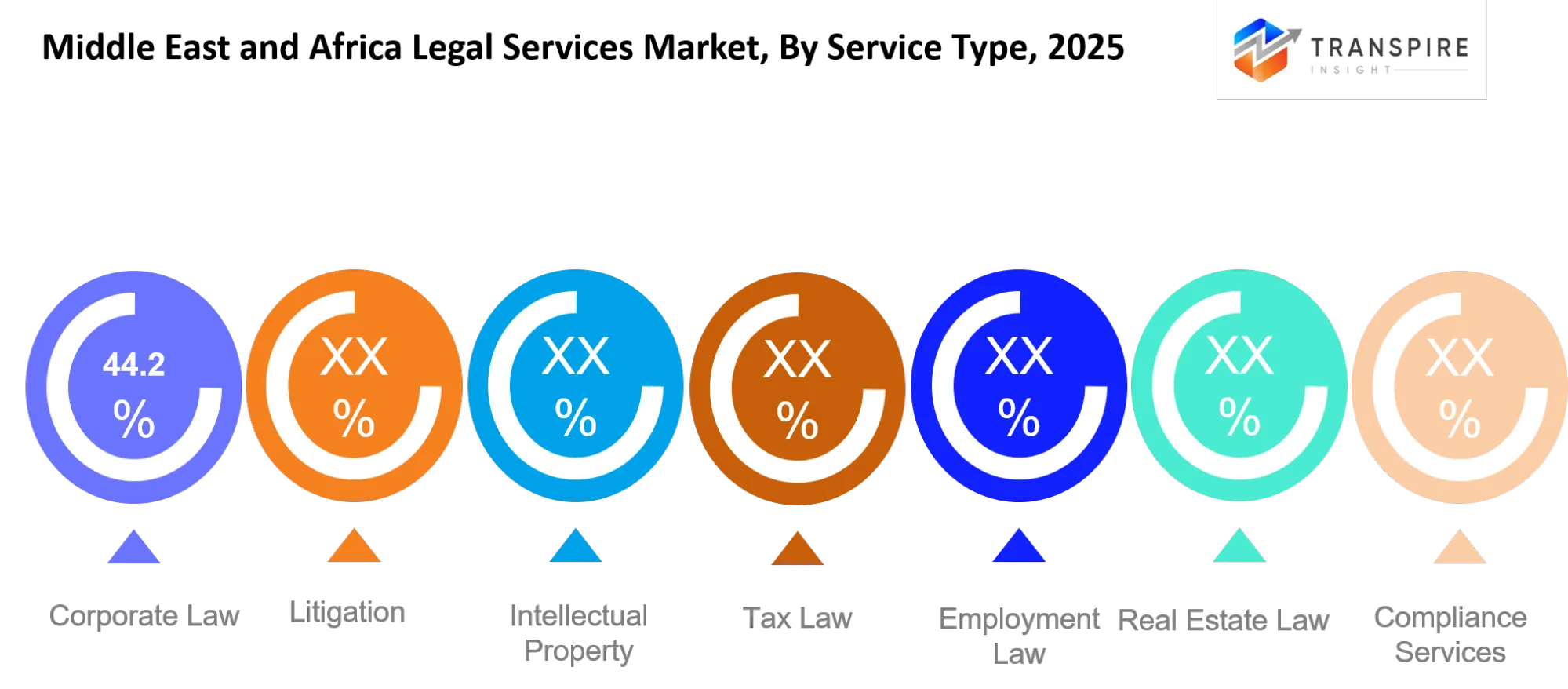
By Client Type
Corporate Clients create a lot of legal work, mostly because of mergers, lending arrangements, business contracts, compliance routines, and also international expansion drives. Big companies usually want ongoing advisory support, partly due to complicated operational structures, plus their regulatory responsibilities. SMEs still need practical legal help for things like company registration, contract preparation, employment issues and risk management tasks, you know. And cost-effective legal solutions really stay important here too, because day to day budgets are often more constrained than the ones large organizations can handle.
Then there are Individuals who look for support with personal legal matters, such as property transactions, family concerns, inheritance planning, and civil disputes. Government entities use legal professionals for policy execution, public infrastructure agreements, procurement steps, and regulatory supervision activities. Other parties include non profit organizations, educational institutions, trade associations, and international agencies, they all require legal guidance for operational work and compliance needs. Every client group brings its own requirements, and that ends up shaping service specialization, plus broader market development.
By Delivery Mode
Traditional Legal Services still serve clients who want direct consultation, in-person representation, courtroom appearances, and face to face negotiation, basically the whole hand-on kind of thing. Complex disputes and high-value transactions often do better with this delivery style because detailed interaction stays important, even when schedules get tight. Online Legal Services have grown a lot via digital platforms that provide consultations, document preparation, contract review, and compliance support, with better accessibility. This technology driven way of delivering also cuts down response time and reduces administrative load for a number of legal tasks, some people really notice it.
Hybrid Services mix physical check-ins with digital tools, so there is flexibility for organizations handling operations across several locations. In practice, it supports faster communication while keeping personal engagement for the more critical legal matters. Others include specialized service arrangements like subscription based legal support, outsourced legal operations, and alternative advisory structures that fit the client needs. In the end, those different delivery approaches will keep shaping how legal expertise reaches businesses and individuals.
By End User
BFSI organizations depend on legal services, for regulatory compliance , but also for financial transactions , lending activities , risk management , and corporate governance duties. Because regulatory updates come a lot, plus the financial structures get complex , there are constant advisory needs in this portion of the market. Healthcare institutions then look for legal guidance around licensing, protection of patient data , medical regulations, partnerships, and day-to-day operational compliance. Real Estate companies on the other hand need help with acquisitions, development arrangements, lease contracts, and investment transactions , all of which often require heavy legal review.
Manufacturing businesses use legal expertise for supply agreements , labor compliance, intellectual property protection, environmental rules, and commercial disagreement handling. Government agencies bring in legal professionals for policy development , procurement frameworks, infrastructure projects, and public sector governance topics. Others might be technology firms, educational institutions, energy companies, and non-profit organizations , all requesting legal support for sector specific challenges. Broad participation by end-users keeps strengthening demand across many legal practice areas.
What are the Key Use Cases Driving the Middle East and Africa Legal Services Market?
The biggest kind of use case, honestly it’s around corporate deals and commercial advisory services. When companies are doing mergers, acquisitions , investment transactions and those cross-border pushes they need a lot of legal backing. Not just for contract responsibilities but also for regulatory clearances, and the whole risk exposure part. This particular application tends to pull the most demand, because big-ticket transactions usually touch multiple jurisdictions and involve real large financial sums.
Then there are other use cases that are moving more quickly into BFSI and healthcare areas. Banks, insurers and other financial organizations need legal help for compliance programs, anti-money laundering duties, lending operations, and regulatory reporting. In parallel, healthcare providers are increasingly looking for assistance with licensing requirements, data privacy rules, partnership arrangements, and making sure they meet healthcare policy requirements. It’s kind of the same theme , just different paperwork.
On top of that, the newer categories are legal advisory tied to digital assets, artificial intelligence governance, and cybersecurity regulations. At the same time, renewable energy projects and major infrastructure investments are creating fresh demand for specialized legal services too. And since regulators are paying more attention here, adoption should broaden during the forecast period as organizations work through shifting operational and compliance expectations, even when the requirements keep changing.
|
Report Metrics |
Details |
|
Market size value in 2025 |
USD 16.63 Billion |
|
Market size value in 2026 |
USD 17.73 Billion |
|
Revenue forecast in 2033 |
USD 28.14 Billion |
|
Growth rate |
CAGR of 6.82% from 2026 to 2033 |
|
Base year |
2025 |
|
Historical data |
2021 - 2024 |
|
Forecast period |
2026 - 2033 |
|
Report coverage |
Revenue forecast, competitive landscape, growth factors, and trends |
|
Regional scope |
United States; Canada; Mexico; United Kingdom; Germany; France; Italy; Spain; Denmark; Sweden; Norway; China; Japan; India; Australia; South Korea; Thailand; Brazil; Argentina; South Africa; Saudi Arabia; United Arab Emirates |
|
Key company profiled |
Baker McKenzie, DLA Piper, Dentons, Clifford Chance, Allen & Overy, Linklaters, Latham & Watkins, White & Case, Freshfields, Hogan Lovells, CMS, Norton Rose Fulbright, Eversheds Sutherland, Ashurst, Pinsent Masons |
|
Customization scope |
Free report customization (country, regional & segment scope). Avail customized purchase options to meet your exact research needs. |
|
Report Segmentation |
By Service Type (Corporate Law, Litigation, Intellectual Property, Tax Law, Employment Law, Real Estate Law, Compliance Services, Others); By Client Type (Corporate Clients, SMEs, Individuals, Government, Others); By Delivery Mode (Traditional Legal Services, Online Legal Services, Hybrid Services, Others); By End User (BFSI, Healthcare, Real Estate, Manufacturing, Government, Others) |
Which Regions are Driving the Middle East and Africa Legal Services Market Growth?
Gulf Cooperation Council region kinda leads the Middle East and Africa Legal Services Market, mostly because there are so many multinational corporations based there, plus big infrastructure projects, and also active foreign investment programs. You can see it clearly in places like Saudi Arabia and the United Arab Emirates, where they keep rolling out corporate reforms, tax reforms, and investment reforms, which in turn keep demand alive for legal advisory services . Meanwhile Dubai, Abu Dhabi, and Riyadh act like financial hubs, they help sustain a pretty mature mix of law firms, arbitration centers, regulators, and a whole set of professional services providers. Strong regulatory enforcement is there too, and the region has frequent cross-border transactions, then on top of that the ongoing economic diversification programs, all of it pushes the region to stay as the biggest contributor to market revenue.
South Africa sits next as the second-largest regional contributor, but it feels different compared to the Gulf markets. It’s more about legal steadiness and institutional maturity, rather than that faster economic shift. With a well-developed judicial system, an established corporate sector, and fairly sophisticated financial markets, there’s a more consistent stream of litigation work, compliance tasks, and transactional support. Legal demand doesn’t really fade because industries like mining, banking, telecommunications, and infrastructure keep operating, so they keep needing guidance and counsel . On the regulatory side, consistent implementation plus resilient business activity means South Africa stays a dependable revenue source for both local and global law firms.
East Africa is showing up as the fastest-growing region, and it seems tied to economic integration initiatives, infrastructure expansion, and regulatory modernization. Kenya, Tanzania, and Rwanda in particular have introduced reforms that improve the overall business climate and pull in more foreign direct investment .
Who are the Key Players in the Middle East and Africa Legal Services Market and How Do They Compete?
Competition across the Middle East and Africa Legal Services market is still kinda moderately fragmented, not fully consolidated, with international firms that compete next to regional specialists, plus domestic practices that hold on to their own niches. In practice, market share seems to hinge less on price, and more on the regulatory know how, the geographic presence, sector specialization, and even the way firms deliver services using technology. Many established players keep defending client relationships through integrated cross-border capabilities, while tech driven providers, and alternative legal service models bring in fresh competitive pressure, you know, in a pretty direct way. Being able to handle intricate transactions across multiple jurisdictions has become a standout factor, not just a nice add-on.
Baker McKenzie is strengthening its footprint mainly via cross-border transaction capability and the integration of modern legal technology. Their use of AI powered legal platforms helps with contract review, legal research, and workflow efficiency, which in turn allows quicker turnaround for multinational clients. Dentons differentiates with a broad regional network that blends local market insight with international advisory resources. That mix supports infrastructure, energy, and government related projects across different jurisdictions, more smoothly than you might expect. DLA Piper tends to focus on multinational corporate clients who want consistent legal support across investment, compliance, and commercial operations, backed by a wide international office footprint.
Company List
- Baker McKenzie
- DLA Piper
- Dentons
- Clifford Chance
- Allen & Overy
- Linklaters
- Latham & Watkins
- White & Case
- Freshfields
- Hogan Lovells
- CMS
- Norton Rose Fulbright
- Eversheds Sutherland
- Ashurst
- Pinsent Masons
Recent Development News
In May 2026, Baker McKenzie entered a strategic partnership with Legora and deployed the AI legal platform across its global network. The initiative expands AI-assisted legal workflows, improves productivity, and strengthens technology-enabled legal service delivery.https://www.bakermckenzie.com
In November 2025, Ashurst announced a merger agreement with Perkins Coie to create a global legal organization with expanded international capabilities. The transaction strengthens cross-border legal services and enhances market reach across technology, infrastructure, and financial services sectors.https://www.reuters.com
What Strategic Insights Define the Future of the Middle East and Africa Legal Services Market?
The market is moving, kinda fast, toward a hybrid model that mixes specialized legal know how with technology enabled service delivery. On top of that the regulatory complexity is not going away, cross border investment activity keeps turning up, and digital business expansion will continue to pull demand for more sophisticated legal backing. The firms that manage to stitch together AI, compliance technology, and regional legal knowledge will likely grab a bigger piece of the higher value advisory work
There is also a less visible risk, like, competitive pressure is growing from legal technology platforms and alternative service providers. With automation taking over routine legal tasks, the traditional billing structures might get disrupted, which can create margin pressure for firms that do not adapt quickly enough, or at all
Still, there’s a promising opening in AI powered compliance and legal operations platforms designed for the emerging regulatory environments across the Middle East and Africa. Many organizations are starting to look for more integrated solutions that blend legal advice with ongoing compliance monitoring, not just “one time” guidance
Market participants should put money into technology partnerships, grow specialized regulatory expertise, and expand regional coverage via alliances or a more local presence. In the end firms that truly combine legal understanding, digital capability, and multi jurisdictional reach will be the ones best placed to benefit from the next step of market development
Middle East and Africa Legal Services Market Report Segmentation
-
By Service Type
Corporate Law
Litigation
Intellectual Property
Tax Law
Employment Law
Real Estate Law
Compliance Services
Others -
By Client Type
Corporate Clients
SMEs
Individuals
Government
Others -
By Delivery Mode
Traditional Legal Services
Online Legal Services
Hybrid Services
Others -
By End User
BFSI
Healthcare
Real Estate
Manufacturing
Government
Others
Frequently Asked Questions
Find quick answers to common questions.
The Expected Middle East and Africa Legal Services Market size for the Market will be USD 28.14 Billion in 2033.
Key Segments for the Middle East and Africa Legal Services Market are By Service Type (Corporate Law, Litigation, Intellectual Property, Tax Law, Employment Law, Real Estate Law, Compliance Services, Others); By Client Type (Corporate Clients, SMEs, Individuals, Government, Others); By Delivery Mode (Traditional Legal Services, Online Legal Services, Hybrid Services, Others); By End User (BFSI, Healthcare, Real Estate, Manufacturing, Government, Others).
Major Middle East and Africa Legal Services Market Players are Baker McKenzie, DLA Piper, Dentons, Clifford Chance, Allen & Overy, Linklaters, Latham & Watkins, White & Case, Freshfields, Hogan Lovells, CMS, Norton Rose Fulbright, Eversheds Sutherland, Ashurst, Pinsent Masons.
The Current Middle East and Africa Legal Services Market size is USD 16.63 Billion in 2025.
The Middle East and Africa Legal Services Market CAGR is 6.82% from 2026 to 2033.
- Baker McKenzie
- DLA Piper
- Dentons
- Clifford Chance
- Allen & Overy
- Linklaters
- Latham & Watkins
- White & Case
- Freshfields
- Hogan Lovells
- CMS
- Norton Rose Fulbright
- Eversheds Sutherland
- Ashurst
- Pinsent Masons
About the Authors

Mayur Shinde
I am Mayur Shinde, a Senior Research Analyst at Transpire Insight, specializing in the Automotive & Transportation and Information & Communication Technology (ICT) Industry. My work focuses on analyzing emerging market trends, technological advancements, competitive landscapes, and industry developments to deliver accurate, data-driven insights. I am passionate about transforming complex market information into clear, actionable content that helps businesses, professionals, and decision-makers stay informed and make confident strategic decisions.

Chakradhar Khansole
Chakradhar serves as the Research Director at Transpire Insight, bringing over 8 years of experience in technology, innovation, and strategic market intelligence. He specializes in transforming complex market data into actionable business insights that enable organizations to make informed, growth-oriented decisions. Recognized for his strategic vision and analytical expertise, Chakradhar leads high-impact research initiatives, delivering comprehensive market assessments, competitive intelligence, and forward-looking industry analysis.
Recently Published Reports
-
Apr 2026
3D Optical Profiler Market
3D Optical Profiler Market Size, Share & Analysis Report By Type (Desktop 3D Optical Profiler, and Portable 3D Optical Profiler), By Technology (Confocal Technology, and White Light Interference), By End-Use Industry (Manufacturing, Research Institutions, Automotive, Aerospace and Defense, Medical Devices, and Other), and Geography (North America, Europe, Asia-Pacific, Middle East and Africa, South and Central America), 2021 - 2031
-
Apr 2026
Depth Sensor Market
Depth Sensor Market Size, Share & Analysis Report By Type (Infrared Depth Sensors, Time-of-Flight (ToF) Sensors, Stereo Vision Sensors, Structured Light Sensors, Ultrasonic Depth Sensors), By Application (Automotive, Robotics, Gaming, Consumer Electronics, Industrial Automation, Healthcare, Security & Surveillance, Others), By End Users (Automotive Manufacturers, Consumer Electronics Companies, Healthcare Providers, Industrial Companies, Security Agencies, Gaming Companies, Robotics Companies, Others), and Geography (North America, Europe, Asia-Pacific, Middle East and Africa, South and Central America), 2021 – 2031
-
Apr 2026
Digital Manufacturing Market
Digital Manufacturing Market Size, Share & Analysis Report By Component (Hardware, Software, and Services), By Technology (Robotics, 3D Printing, Internet of Things (IoT), and Others), By Application (Automotive and Transportation, Aerospace and Defense, Consumer Electronics, Industrial Machinery, and Others), By Process Type (Computer-Based Designing, Computer-Based Simulation, Computer 3D Visualization, Analytics, and Others), and Geography (North America, Europe, Asia-Pacific, Middle East and Africa, South and Central America), 2021 – 2031
-
Apr 2026
Digital Visa Services Market
Digital Visa Services Market Size, Share & Analysis Report By Type (Individual Travelers, Group Travelers), By Application (Tourism, Business Travel, Others), and Geography (North America, Europe, Asia-Pacific, Middle East and Africa, South and Central America), 2021 – 2031