

Asia Pacific Outsourcing Services Market Size & Forecast:
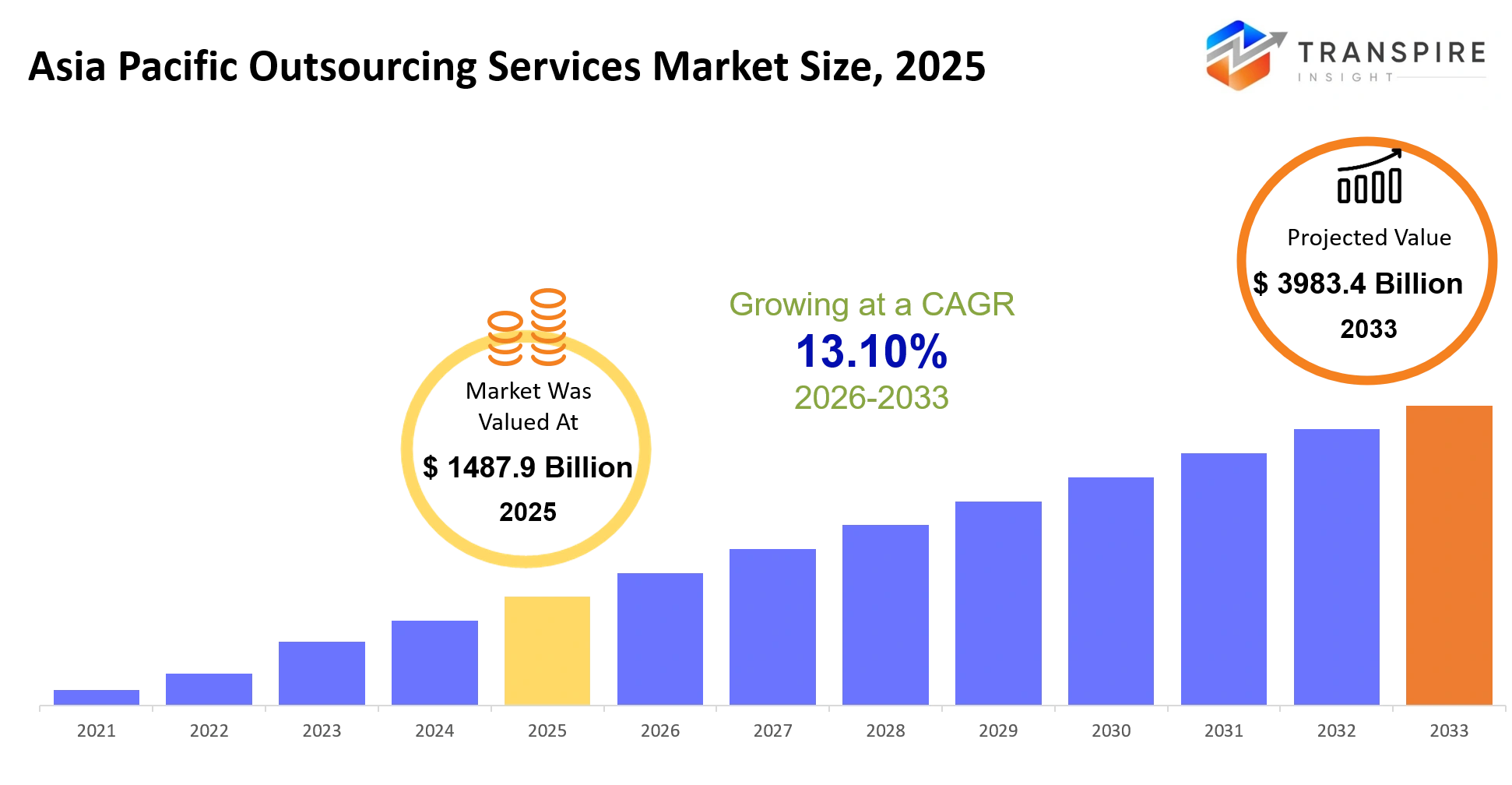
- Asia Pacific Outsourcing Services Market Size 2025: USD 1487.9 Billion
- Asia Pacific Outsourcing Services Market Size 2033: USD 3983.4 Billion
- Asia Pacific Outsourcing Services Market CAGR: 13.10%
- Asia Pacific Outsourcing Services Market Segments: By Service Type (IT Outsourcing, Business Process Outsourcing, Knowledge Process Outsourcing, Legal Process Outsourcing, HR Outsourcing, Finance & Accounting Outsourcing, Others); By Enterprise Size (Large Enterprises, SMEs, Startups, Others); By End User (BFSI, Healthcare, IT & Telecom, Retail, Manufacturing, Government, Others); By Deployment (Onshore, Offshore, Nearshore, Hybrid, Others).
To learn more about this report,  Download Free Sample Report
Asia Pacific Outsourcing Services Market Summary
The Asia Pacific Outsourcing Services Market was valued at USD 1487.9 Billion in 2025. It is forecast to reach USD 3983.4 Billion by 2033. That is a CAGR of 13.10% over the period.
The Asia Pacific outsourcing services market, kind of acts like an operational backbone for shipping operators, manufacturers, and industrial firms, who are now increasingly handing over finance processing IT management, logistics coordination, and customer support to specialized third-party providers. Basically it keeps vessels moving, factories running and supply chains more responsive without having to scale up internal cost structures. Over the last few years the whole thing has been moving in a more structural way toward cloud delivery models, and also toward AI-enabled service automation, which in turn replaces those labor-heavy offshore setups with platform driven workflows.
And this change sort of got pushed faster by pandemic-era supply chain disruptions , plus geopolitical tensions that made it obvious how fragile single-location service hubs can be. So now enterprises tend to diversify outsourcing partners across multiple Asia Pacific locations, aiming to lower operational risk, and keep things going even when the situation gets weird. Growth is therefore driven less by simple cost arbitrage and more by resilience, speed, and digital integration across industrial and maritime value chains, which is honestly where most of the attention is going.
Key Market Insights
- Asia Pacific Outsourcing Services Market seems to sit around 35–40% of the global share, mostly because of the pretty strong IT-BPM ecosystem in India and the Philippines, and yeah it keeps pulling business in.
- Southeast Asia is showing up as the quickest growing region through 2030, largely driven by nearshore demand, plus a push for multilingual service expansion that is pretty visible lately.
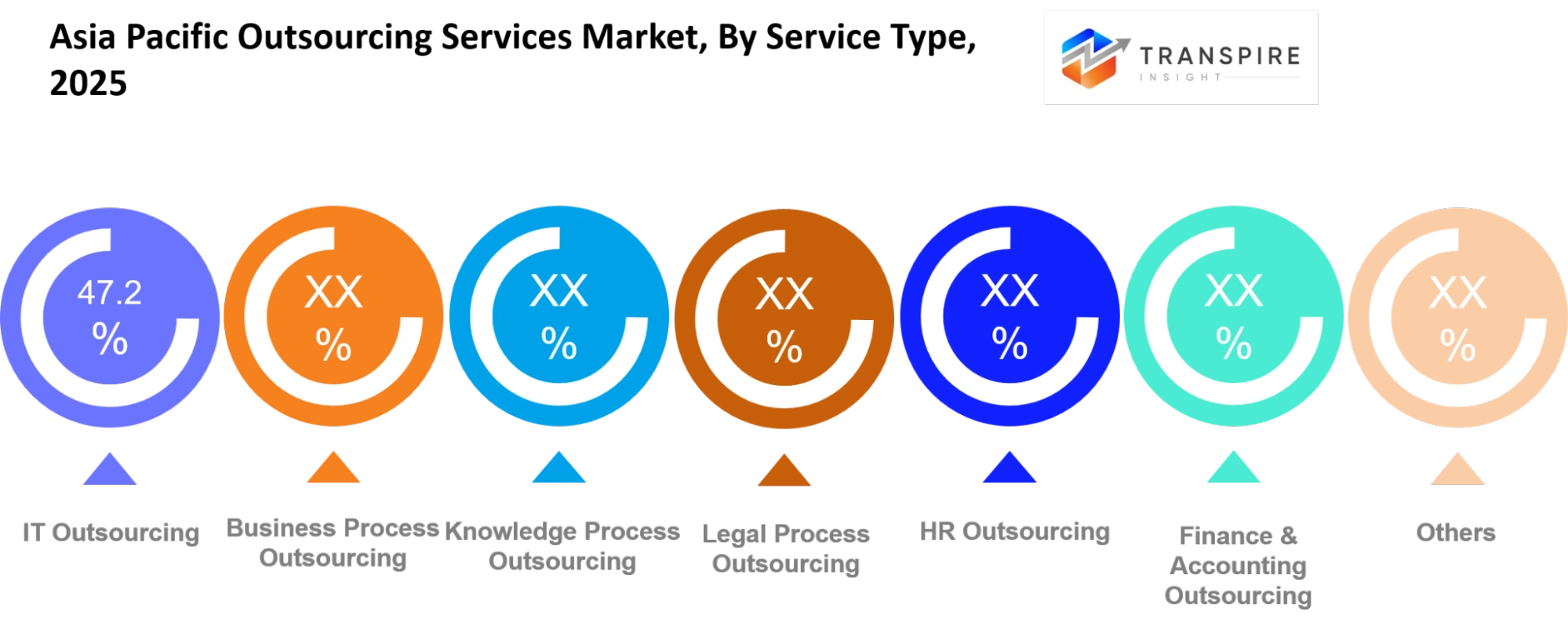
- In the Asia Pacific Outsourcing Services Market, IT outsourcing services take the lead with nearly 45% share, and a lot of that momentum is supported by cloud migration projects, and related digital transitions.
- Business process outsourcing is in the second spot, and it’s being led by finance outsourcing, HR outsourcing, and customer support outsourcing demand, more or less all at once.
- Knowledge process outsourcing is actually the fastest-growing segment, mostly because companies are leaning into analytics, AI modeling, and specialized research services adoption , which is gaining traction.
- BFSI applications take the biggest chunk, roughly 30% , mostly because the back-office work is compliance-heavy and needs more controls than people think.
- Healthcare and life sciences outsourcing seems like it is growing quickest, largely from digital health record keeping and the analytics demand that keeps showing up.
- Manufacturing companies are also leaning into outsourcing, especially for supply chain coordination, and procurement optimization too, in a sort of pragmatic way.
- When it comes to size, big enterprises lead, with more than 60% share across Asia Pacific Outsourcing Services Market, mainly due to multi-process outsourcing agreements that lock things in for a while.
- SMEs are the fastest-moving end-user segment, since cloud platforms lower the entry threshold, and they cut operational costs, which makes it easier to start and scale.
What are the Key Drivers, Restraints, and Opportunities in the Asia Pacific Outsourcing Services Market?
So the main growth driver is kinda that accelerated shift toward cloud-first enterprise architecture, it is basically being pushed by post-pandemic digital transformation mandates and also those rising internal IT cost ceilings. And honestly it makes it hard to ignore, you know, because it’s like, the change just keeps showing up everywhere.A lot of companies across BFSI, manufacturing, and telecom now tend to outsource core processes like finance operations, HR analytics, and customer engagement, but they do it with specialized providers, just to boost scalability and get rid of more fixed overhead. And this shift directly pushes up contract values and recurring service revenue too, because outsourcing is moving away from simple task based support and more into end to end managed service models, that also get integrated with automation platforms.
Now the biggest restraint is data security plus regulatory fragmentation across Asia Pacific jurisdictions. Cross border data transfer rules in places like China, Indonesia, and Australia basically form structural compliance barriers that can’t really be standardized quickly. That means onboarding takes longer for multinational contracts, and it also keeps firms from fully consolidating their outsourcing operations, which then delays revenue realization. On top of that, service providers end up facing higher operational risk premiums.
A real opportunity is starting to show up from AI enabled vertical outsourcing hubs in Southeast Asia, especially Vietnam and the Philippines. Those countries are drawing investments into intelligent back-office platforms, where you get human support combined with machine learning workflows, for finance, healthcare claims, and even multilingual customer operations, which should unlock the next phase of scalable yet higher margin outsourcing growth.
What Has the Impact of Artificial Intelligence Been on the Asia Pacific Outsourcing Services Market?
Artificial intelligence is sort of reshaping the Asia Pacific outsourcing ecosystem, by embedding automation straight into the way services get delivered, rather than acting like some simple add on tool. In enterprise outsourcing operations, AI driven workflow engines now automate invoice processing, resolve customer queries, and handle compliance documentation too, and this is cutting down the manual handling time by as much as 30–50% in big shared service centers.
Predictive analytics models are being used more and more in outsourced IT and industrial support roles, mainly to forecast system failures, tune workload distribution, and also predict where service bottlenecks might pop up next. In manufacturing, and logistics outsourcing as well, machine learning models improve maintenance scheduling accuracy, and they reduce unplanned downtime by spotting early performance deviations in connected assets, which sounds small but it matters a lot.
Operationally, these technologies enhance service efficiency, speed up response times, and help generate measurable cost reductions via process standardization plus real time decision support. A lot of outsourcing providers say they see better SLA compliance rates, because AI assisted monitoring is in place and automated escalation workflows are triggered when needed.
That said adoption is still constrained by integration complexity inside legacy enterprise systems, and by inconsistent data quality across different client environments. Many organizations also run into limited availability of domain specific training datasets, so model accuracy can drop in specialized workflows, like regulatory processing or multilingual customer support, where nuance is everything.
Key Market Trends
- Between 2020 and 2025, outsourcing buyers sort of moved away from labor arbitrage offshore setups toward cloud-native, managed services stuff across the Asia Pacific Outsourcing Services Market, it was noticeable.
- Since 2023, vendors like Accenture and Infosys have also been ramping up AI-led process automation, which cuts down on manual BPO effort a lot and, somehow, lifts SLA compliance rates more often.
- From 2022 onward, many enterprises diversified outsourcing , like they stopped being India-centric only and started using Vietnam and Philippines too, mainly to dampen geopolitical exposure and service continuity risks.
- Between 2021 and 2026, newer and stricter data localization rules in China, Indonesia, and Australia raised compliance costs across Asia Pacific Outsourcing Services Market contracts.
- Since 2024, pricing models sort of slid from hourly billing into outcome based contracts, especially on finance and customer support outsourcing projects, more tied to what actually happens.
- After the 2020 cyberattacks, many orgs kept pushing outsourcing for cybersecurity monitoring and SOC operations, and they started leaning on providers like IBM and Cognizant, because the monitoring burden just feels heavier.
- Global capability centers in India expanded pretty fast after 2021 and that kind of changed outsourcing, moving past simple transactional services into innovation driven engineering work, which sounds far more strategic.
- Then in 2023, wage inflation in India as well as the Philippines squeezed the skilled digital talent pool a bit, so automation adoption picked up across most outsourcing firms.
- Between 2022 and 2025, IBM and Wipro expanded cloud delivery centers across Southeast Asia to capture the enterprise migration demand, you could say they went where the moves were happening.
Asia Pacific Outsourcing Services Market Segmentation
By Service Type :
IT outsourcing leads demand because enterprises sort of move their core infrastructure, application management, and also cloud migration tasks toward external providers. There is strong uptake across banking and telecom too, mainly for cost control, and in practice for doing system upgrades faster. At the same time Business process outsourcing helps with large-scale customer service, payroll, and transaction processing needs , especially for multinational firms that work across Asia Pacific markets.
Then Knowledge process outsourcing keeps expanding as companies ask for data analytics, research support and AI-driven, insight based outputs for decision making. Legal process outsourcing grows steadily as contract reviews become more frequent, along with compliance checks, plus documentation services that rise across cross-border operations. HR and Finance & Accounting outsourcing keep supporting workforce scaling, and also financial accuracy requirements, inside big enterprise environments.
To learn more about this report, Download Free Sample Report
By Enterprise Size :
Big enterprises dominate outsourcing demand , mostly because they run across multiple countries and they face high-volume process work in finance, IT, and customer management. There is also strong reliance on managed service providers which helps lock in longer term contracts and keeps integrated digital transformation programs running across regional headquarters and global capability centers.
SMEs are showing quicker adoption ,a bit more rapidly because cloud platforms lower the entry threshold for outsourcing services like payroll, accounting and IT support. Startups are leaning on outsourced development more and more, plus outsourced customer assistance and outsourced data handling functions too, so that they can keep those early-stage costs under control and, at the same time, focus on product growth in competitive digital markets.
By End User :
BFSI keeps being the main end user group, mostly because they depend so much on secure transaction handling, regulatory write ups, and outsourced customer support. Financial institutions are more and more moving toward automated back-office systems, to boost precision and also lower the day to day running expenses across those huge high-volume workflows.
Healthcare is also catching up, since hospitals, plus insurers tend to hand over claims processing, medical coding, and patient data administration to external teams, aiming for better efficiency. Meanwhile IT and telecom expand their outsourcing spend for network upkeep, and cloud related operations. Retail and manufacturing similarly ramp up outsourcing for supply chain coordination, demand forecasting, and order management, especially when they operate across multiple regions.
By Deployment :
Offshore deployment stays very common, because of the cost side and because it’s easier to reach experienced talent pools in India and the Philippines. Companies lean on offshore centers for big scale processing work, application support, and customer service operations, all of which need constant uptime and the ability to scale quickly.
Nearshore and onshore models are gaining ground too, as organizations focus harder on data safeguards, regulatory adherence, and fast back and forth collaboration with service providers. A hybrid setup becomes the usual choice, because companies blend offshore efficiency with more direct onshore oversight, so they can keep a steadier cost profile while improving operational responsiveness across those distributed business settings.
What are the Key Use Cases Driving the Asia Pacific Outsourcing Services Market?
In the Asia Pacific Outsourcing Services market, a core demand sort of keeps showing up in IT outsourcing and business process support, especially when BFSI and telecom firms are the ones driving it. A lot of enterprises end up outsourcing cloud migration, application management, and transaction processing, basically to trim costs, keep system uptime steadier, and, also to stay on track with regulatory compliance, which is kind of non-negotiable.
At the same time, the expanding applications trend is visible too, like customer support outsourcing, finance operations, and supply chain analytics being rolled out across manufacturing, retail, and healthcare. Many firms are leaning on external providers to handle claims processing, order tracking, and real time logistics visibility, across multi-country operations across the region.
More emerging use cases are also starting to show up, including AI-enabled outsourcing, GenAI contact centers, and automated compliance monitoring for industries that deal with lots of data. These applications are gaining traction as enterprises test more intelligent workflows, and try to reduce manual intervention across the service delivery functions, step by step.
|
Report Metrics |
Details |
|
Market size value in 2025 |
USD 1487.9 Billion |
|
Market size value in 2026 |
USD 1682.8 Billion |
|
Revenue forecast in 2033 |
USD 3983.4 Billion |
|
Growth rate |
CAGR of 13.10% from 2026 to 2033 |
|
Base year |
2025 |
|
Historical data |
2021 - 2024 |
|
Forecast period |
2026 - 2033 |
|
Report coverage |
Revenue forecast, competitive landscape, growth factors, and trends |
|
Regional scope |
Asia Pacific (India, China, Japan, Australia, South Korea, Rest of Asia Pacific) |
|
Key company profiled |
Accenture, TCS, Infosys, Wipro, Cognizant, HCLTech, Capgemini, Genpact, IBM, DXC Technology, Tech Mahindra, Concentrix, Teleperformance, WNS Global, Fujitsu. |
|
Customization scope |
Free report customization (country, regional & segment scope). Avail customized purchase options to meet your exact research needs. |
|
Report Segmentation |
By Service Type (IT Outsourcing, Business Process Outsourcing, Knowledge Process Outsourcing, Legal Process Outsourcing, HR Outsourcing, Finance & Accounting Outsourcing, Others); By Enterprise Size (Large Enterprises, SMEs, Startups, Others); By End User (BFSI, Healthcare, IT & Telecom, Retail, Manufacturing, Government, Others); By Deployment (Onshore, Offshore, Nearshore, Hybrid, Others). |
Which Regions are Driving the Asia Pacific Outsourcing Services Market Growth?
India is still the main region in the Asia Pacific Outsourcing Services Market because it has a deep IT-BPM fabric, a big pool of skilled labor, and supportive government pressure via digital transformation pushes and special economic zones. At the same time, global capability centers keep stretching across cities like Bengaluru, Hyderabad and Pune, so an already mature outsourcing setup keeps getting denser. The high density of engineering talent plus well run service delivery networks helps India manage complicated finance, IT, and analytics outsourcing, all at scale. This whole setup tends to keep long term contracts going and it basically locks in its top spot when it comes to global outsourcing revenue.
Japan, meanwhile, shows up as a steadier and more mature part of the Asia Pacific outsourcing picture, mainly tied to a kind of industrial discipline and ongoing enterprise spending on process refinement. Rather than leaning on very high volume offshore models, Japan leans toward more selective outsourcing for manufacturing help, IT modernization, and back office automation. The region also has a structured regulatory environment, and there’s heavy focus on quality control, so partnerships usually last longer, instead of chasing rapid contract growth. As a result, Japan looks dependable but it grows slower than the offshore heavy economies.
Southeast Asia seems like the fastest-growing region, and it is kinda powered by increasing investments in the Philippines Vietnam and Malaysia. Lately, the upgrades in digital infrastructure, more data center capacity , and new outsourcing park development have made service delivery move faster. In parallel, governments are pushing BPO-friendly policies along with workforce training initiatives, so global enterprises can feel invited rather than uncertain. This whole momentum points to solid opportunities for fresh entrants and investors during 2026 through 2033 , in particular for multilingual customer support and finance outsourcing services.
Who are the Key Players in the Asia Pacific Outsourcing Services Market and How Do They Compete?
In the Asia Pacific Outsourcing Services Market, the competitive terrain stays kinda moderately fragmented, you have big global players and also pretty capable regional providers. What’s driving rivalry a bit more lately is tech integration, the real automation know-how, and where they can actually deliver services from, more than just “cheaper labor” type cost edge. Many established companies are trying to hold onto their share by putting AI-driven platforms into their offerings and rolling out cloud based service models, so enterprises can get faster results and more outcome oriented outsourcing.
Accenture tends to lean into high value digital transformation outsourcing, mixing consulting led engagements with automation tools that help sharpen enterprise workflow efficiency across finance and operations. Their strong point is that they can tie strategy directly to execution, so they’re able to juggle complicated multi country outsourcing contracts without as much friction.
Infosys and Tata Consultancy Services keep tightening their positions using huge global delivery centers in India, and they sell a mix of IT and business process services that are cost efficient at large scale. At the same time, both are pushing ahead with AI led automation, plus creating industry tailored outsourcing approaches for banking, retail, and manufacturing customers.
IBM sets itself apart with hybrid cloud outsourcing along with enterprise grade automation platforms, while Cognizant is more concentrated on industry specific digital operations, especially in healthcare and BFSI. Wipro keeps growing through partnerships and cloud modernization programs across Southeast Asia, which helps widen its regional delivery coverage and makes its services more scalable over time.
Company List
- Accenture
- TCS
- Infosys
- Wipro
- Cognizant
- HCLTech
- Capgemini
- Genpact
- IBM
- DXC Technology
- Tech Mahindra
- Concentrix
- Teleperformance
- WNS Global
- Fujitsu
Recent Development News
In November 2025, Firstsource Solutions invested in AppliedAI. The investment strengthened its AI-driven outsourcing strategy under its UnBPO™ framework, accelerating automation of complex enterprise workflows across regulated industries in Asia Pacific and enhancing next-generation business process management capabilities.
Source: https://www.prnewswire.com/
What Strategic Insights Define the Future of the Asia Pacific Outsourcing Services Market?
The Asia Pacific Outsourcing Services Market is, well, moving toward a structure that is automation-first delivery and platform based service models, where the whole value thing is shifting from manpower scale to digital execution know-how. In the next 5–7 years , you can expect demand to be shaped more and more by enterprises leaning hard on AI enabled workflows and distributed delivery networks that slowly reduce dependency on any one single country outsourcing hub. And this turn is basically pushed by cost pressure plus the need for faster , compliant and always-on operations across global enterprises that run their business across Asia Pacific.
There’s a sneaky risk though, service concentration is rising among a few large providers, and that can end up creating pricing rigidity. It can also reduce buyer flexibility over time for enterprise teams. Also, with rapid AI substitution of routine outsourcing tasks , traditional BPO revenue streams might get squeezed faster than providers can pivot into higher value services.
On the upside, there’s an emerging opportunity in the expansion of sovereign data aligned outsourcing hubs in Southeast Asia where governments are building compliant digital infrastructure to attract regulated workloads. Market players, if they’re smart , will benefit by investing early in hybrid delivery models that mix AI automation with localized compliance frameworks so they can lock in long term enterprise contracts.
Asia Pacific Outsourcing Services Market Report Segmentation
By Service Type
- IT Outsourcing
- Business Process Outsourcing
- Knowledge Process Outsourcing
- Legal Process Outsourcing
- HR Outsourcing
- Finance & Accounting Outsourcing
By Enterprise Size
- Large Enterprises
- SMEs
- Startups
By End User
- BFSI
- Healthcare
- IT & Telecom
- Retail
- Manufacturing
- Government
By Deployment
- Onshore
- Offshore
- Nearshore
- Hybrid
Frequently Asked Questions
Find quick answers to common questions.
The expected Asia Pacific Outsourcing Services Market size is USD 3983.4 Billion in 2033.
Key segments for the Asia Pacific Outsourcing Services Market are By Service Type (IT Outsourcing, Business Process Outsourcing, Knowledge Process Outsourcing, Legal Process Outsourcing, HR Outsourcing, Finance & Accounting Outsourcing, Others); By Enterprise Size (Large Enterprises, SMEs, Startups, Others); By End User (BFSI, Healthcare, IT & Telecom, Retail, Manufacturing, Government, Others); By Deployment (Onshore, Offshore, Nearshore, Hybrid, Others).
Major Asia Pacific Outsourcing Services Market players are Accenture, TCS, Infosys, Wipro, Cognizant, HCLTech, Capgemini, Genpact, IBM, DXC Technology, Tech Mahindra, Concentrix, Teleperformance, WNS Global, Fujitsu.
The Asia Pacific Outsourcing Services Market size is USD 1487.9 Billion in 2025.
The Asia Pacific Outsourcing Services Market CAGR is 13.10% from 2026 to 2033.
- Accenture
- TCS
- Infosys
- Wipro
- Cognizant
- HCLTech
- Capgemini
- Genpact
- IBM
- DXC Technology
- Tech Mahindra
- Concentrix
- Teleperformance
- WNS Global
- Fujitsu
About the Authors

Mayur Shinde
I am Mayur Shinde, a Senior Research Analyst at Transpire Insight, specializing in the Automotive & Transportation and Information & Communication Technology (ICT) Industry. My work focuses on analyzing emerging market trends, technological advancements, competitive landscapes, and industry developments to deliver accurate, data-driven insights. I am passionate about transforming complex market information into clear, actionable content that helps businesses, professionals, and decision-makers stay informed and make confident strategic decisions.

Chakradhar Khansole
Chakradhar serves as the Research Director at Transpire Insight, bringing over 8 years of experience in technology, innovation, and strategic market intelligence. He specializes in transforming complex market data into actionable business insights that enable organizations to make informed, growth-oriented decisions. Recognized for his strategic vision and analytical expertise, Chakradhar leads high-impact research initiatives, delivering comprehensive market assessments, competitive intelligence, and forward-looking industry analysis.
Recently Published Reports
-
Apr 2026
3D Optical Profiler Market
3D Optical Profiler Market Size, Share & Analysis Report By Type (Desktop 3D Optical Profiler, and Portable 3D Optical Profiler), By Technology (Confocal Technology, and White Light Interference), By End-Use Industry (Manufacturing, Research Institutions, Automotive, Aerospace and Defense, Medical Devices, and Other), and Geography (North America, Europe, Asia-Pacific, Middle East and Africa, South and Central America), 2021 - 2031
-
Apr 2026
Depth Sensor Market
Depth Sensor Market Size, Share & Analysis Report By Type (Infrared Depth Sensors, Time-of-Flight (ToF) Sensors, Stereo Vision Sensors, Structured Light Sensors, Ultrasonic Depth Sensors), By Application (Automotive, Robotics, Gaming, Consumer Electronics, Industrial Automation, Healthcare, Security & Surveillance, Others), By End Users (Automotive Manufacturers, Consumer Electronics Companies, Healthcare Providers, Industrial Companies, Security Agencies, Gaming Companies, Robotics Companies, Others), and Geography (North America, Europe, Asia-Pacific, Middle East and Africa, South and Central America), 2021 – 2031
-
Apr 2026
Digital Manufacturing Market
Digital Manufacturing Market Size, Share & Analysis Report By Component (Hardware, Software, and Services), By Technology (Robotics, 3D Printing, Internet of Things (IoT), and Others), By Application (Automotive and Transportation, Aerospace and Defense, Consumer Electronics, Industrial Machinery, and Others), By Process Type (Computer-Based Designing, Computer-Based Simulation, Computer 3D Visualization, Analytics, and Others), and Geography (North America, Europe, Asia-Pacific, Middle East and Africa, South and Central America), 2021 – 2031
-
Apr 2026
Digital Visa Services Market
Digital Visa Services Market Size, Share & Analysis Report By Type (Individual Travelers, Group Travelers), By Application (Tourism, Business Travel, Others), and Geography (North America, Europe, Asia-Pacific, Middle East and Africa, South and Central America), 2021 – 2031