
Middle East and Africa Internet of Things (IoT) Market Size & Forecast:
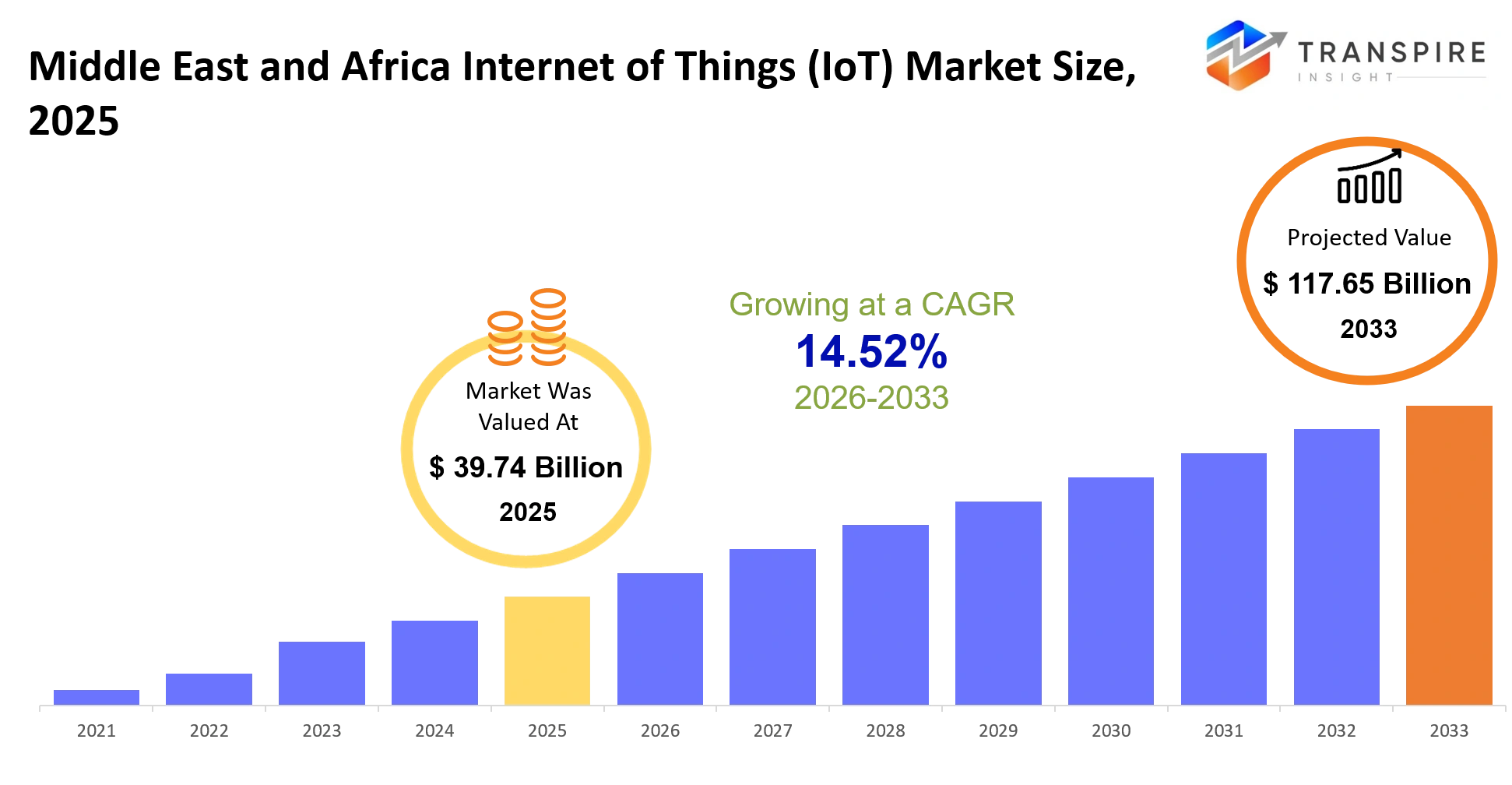
- Middle East and Africa Internet of Things (IoT) Market Size 2025: USD 39.74 Billion
- Middle East and Africa Internet of Things (IoT) Market Size 2033: USD 117.65 Billion
- Middle East and Africa Internet of Things (IoT) Market CAGR: 14.52%
- Middle East and Africa Internet of Things (IoT) Market Segments: By Component (Hardware, Software, Services, Connectivity Solutions, IoT Platforms, Sensors, Gateways, Others); By Application (Industrial IoT, Smart Homes, Smart Cities, Connected Vehicles, Healthcare IoT, Retail IoT, Agriculture IoT, Others); By Connectivity (Wi-Fi, Bluetooth, Cellular, LPWAN, Zigbee, NFC, Satellite, Others); By End User (Industrial, Residential, Commercial, Government, Healthcare, Transportation, Agriculture, Others).
Middle East and Africa Internet of Things (IoT) Market Summary
The Middle East and Africa Internet of Things (IoT) Market was valued at USD 39.74 Billion in 2025. It is forecast to reach USD 117.65 Billion by 2033. That is a CAGR of 14.52% over the period.
The Internet of Things market kind of links physical assets, machines, vehicles, utilities, buildings, and even public infrastructure to digital networks that grab , trade, and assess real-time data. In practical terms, IoT lets manufacturers lower downtime , utilities tune energy distribution, cities steer traffic patterns, and healthcare providers keep an eye on assets and patients in a more efficient way. Across the Middle East and Africa, IoT has moved from small pilot efforts to something like enterprise scale operations, mainly because organizations want clear productivity improvements and better operational visibility, not just experiments.
A big structural change in the last five years was the move away from standalone sensor rollouts, towards full IoT ecosystems that are supported by cloud platforms, edge computing, artificial intelligence, and also private 5G networks. Public sector led digital transformation programs—like Saudi Vision 2030 and smart city programs in the UAE, helped speed up implementation schedules. Also, supply chain disruptions during and after the pandemic , made the gaps in asset tracking and operational monitoring pretty obvious, so many organizations started investing in connected infrastructure. And as more enterprises turn operational data into business intelligence, IoT spending seems to shift from testing mode to mission-critical deployment, which in turn creates repeating revenue streams around platforms, connectivity, analytics, and services across the region.
Key Market Insights
- Saudi Arabia kinda takes the lead in regional IoT spending, sitting around 28–32% market share in 2025, thanks to smart-city style programs along with industrial digitalization efforts.
- The Gulf Cooperation Council is still the biggest regional contributor. It is backed by smart infrastructure spending that passes USD 100 billion across several different projects, some of them are long running though.
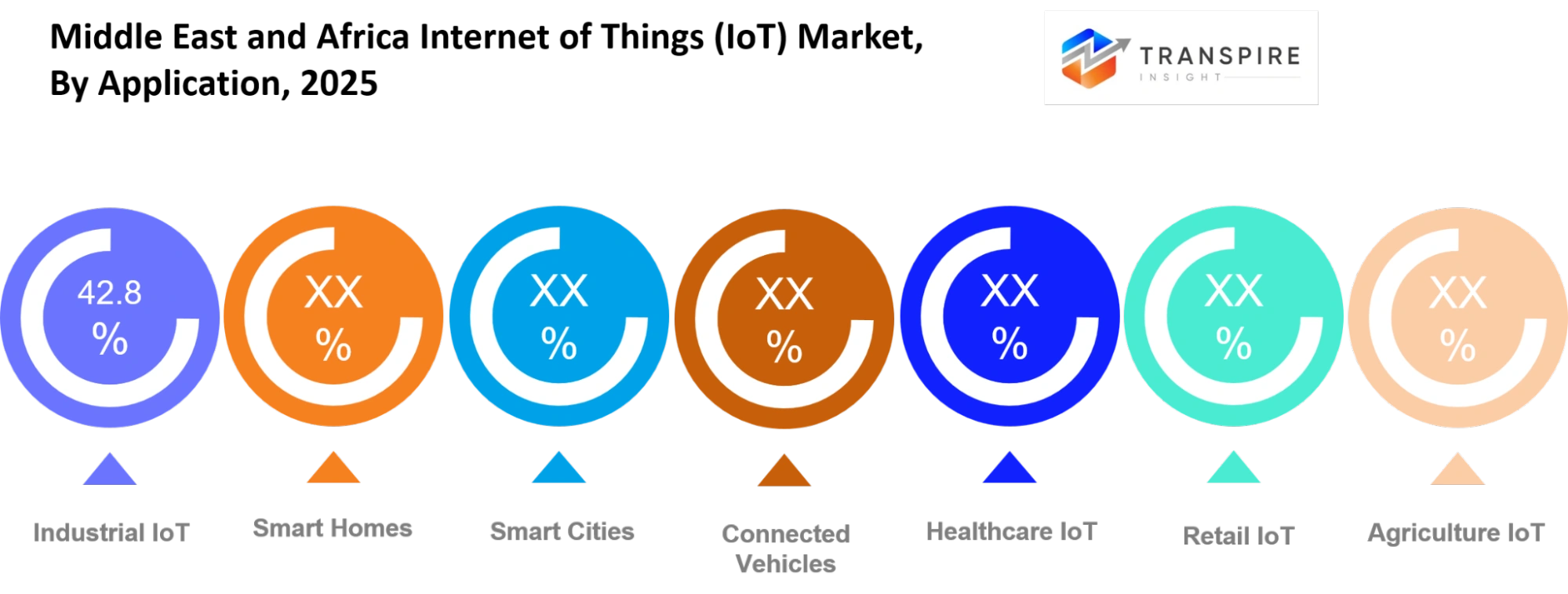
- When you look at applications, Industrial IoT stays in front, roughly 30% market share , mostly because manufacturing, energy, and utility automation keep getting traction.
- Smart Cities are more or less the second biggest slice, and they’re being pushed by places like NEOM and Dubai Smart City , plus intelligent transport setups that feel pretty connected already.
- Healthcare IoT is projected to grow the quickest up through 2033, as hospitals roll out remote monitoring and linked asset management systems, not just pilots but actual rollouts too.
- Cellular connectivity shows up in more than 35% of deployments, mainly because 4G is everywhere and 5G coverage is steadily expanding.
- For LPWAN, adoption has climbed by over 20% since 2022, with utilities and agriculture operators leaning into low-power monitoring approaches rather than anything heavy.
- On the revenue side, industrial end users bring the largest share through things like predictive maintenance, asset tracking, and operational efficiency use-cases.
- Companies like Cisco, IBM, Microsoft, AWS, Huawei, and Siemens keep expanding in a pretty deliberate way, they’re tying cloud-integrated IoT platforms together with AI analytics, plus edge computing abilities.
- Overall, competition is increasingly about end to end ecosystem packages, meaning connectivity + cloud backbone + cybersecurity + analytics + device management, all bundled as one, more or less.
What are the Key Drivers, Restraints, and Opportunities in the Middle East and Africa Internet of Things (IoT) Market?
The strongest force pushing market expansion is, government- backed digital transformation… kind of like a catalyst that keeps going and going. National programs like Saudi Vision 2030, UAE smart city initiatives push forward, and multiple industrial modernization strategies have shifted IoT investment from small siloed trials into something that feels more like national infrastructure priorities. Meanwhile sensor costs keep drifting downward, cloud adoption is getting wider, and 5G coverage keeps stretching, which actually reduces the deployment friction in the real world. In practice organizations can gather operational data at scale and turn it into crisp efficiency wins, which lowers maintenance spending, improves asset utilization, and also backs business continuity. And yes these benefits tend to match higher adoption rates plus recurring spend on platforms, analytics, and managed services.
Still, cybersecurity and infrastructure limitations stay the big structural problem. A lot of African markets deal with uneven connectivity coverage, sometimes patchy power infrastructure, and cybersecurity capabilities that are still limited or just inconsistent. These issues don’t usually get fixed quickly, because they hinge on long term funding for telecommunications networks, data centers, regulatory frameworks, and even technical talent. So organizations often postpone full-scale deployments, which ends up shrinking revenue opportunities and slowing ecosystem development, step by step.
Private 5G-enabled Industrial IoT is a pretty real growth doorway. Manufacturing plants, ports, logistics hubs, and mining operations are increasingly needing secure low latency connectivity that legacy networks can’t reliably provide.Investments in edge computing, AI driven automation, and private wireless infrastructure are setting up the right conditions for broad deployments.
What Has the Impact of Artificial Intelligence Been on the Middle East and Africa Internet of Things (IoT) Market?
Artificial intelligence has kinda transformed the way connected devices create business value across industrial, commercial, and public sector settings. Instead of only gathering raw data, many modern IoT platforms now lean on machine learning models , to basically automate operational choices. Like in manufacturing, AI-driven monitoring systems watch over equipment and spot weirdness or anomalies before a breakdown even shows up, so unplanned downtime goes down and production continuity stays steadier. Utilities then use predictive analytics to estimate energy demand and tune grid performance, while logistics teams apply AI-enabled asset tracking to squeeze better fleet utilization and delivery accuracy.
Predictive maintenance has ended up being one of the most valuable things here. Machine learning algorithms examine vibration, temperature, pressure, and other performance signals from connected machinery to catch recurring failure patterns. With this method organizations can push equipment life further, lower maintenance spending, and keep operational uptime higher. Smart city operators also bring AI in, to adjust traffic control, manage energy use , and improve public infrastructure behavior
And yeah, the mix of AI edge computing and 5G connectivity is pushing faster real time decision making across industrial areas. Still there are hurdles. Costs for integration stay high, legacy infrastructure is often fragmented , and data quality problems pop up. Plus there are shortages of people with specialized AI and IoT skill sets, which slows deployment. In some African markets inconsistent connectivity and not enough training datasets also hurt model precision and make the shift toward fully autonomous IoT operations take longer than expected.
Key Market Trends
- From 2021, enterprise IoT deployments kind of moved away from those pilot efforts and went toward full org wide rollouts, with a big emphasis on operational efficiency and automation.
- Private 5G uptake really ramped up between 2024–2026, which made it easier to keep industrial connectivity secure for manufacturing, logistics, and energy routines.
- Meanwhile, Saudi Arabia smart city investments grew quite a lot, and that opened up wider opportunities for connected infrastructure plus smarter city services.
- Over the last three years, cellular IoT deployments climbed by more than 25% , mainly because enterprises have been modernizing asset monitoring setups.
- AI driven predictive maintenance also shifted, from a kind of narrow deployments to more mainstream industrial use cases sometime between 2022 and 2026.
- Cloud native IoT platforms started taking more share, since organizations wanted quicker deployment cycles, and fewer layers of infrastructure complexity.
- Satellite enabled IoT solutions began showing up as a realistic option for remote industrial locations and transportation networks during 2025–2026.
- Also, tech providers are increasingly bundling cybersecurity, analytics, and connectivity together into one service package, instead of treating them as separate products.
- Open ecosystem partnerships got more common too, as vendors teamed up to push autonomous networks and intelligent automation forward.
- And edge computing adoption moved fast after 2023, because many organizations needed real time processing nearer to the connected devices, not somewhere far off.
Middle East and Africa Internet of Things (IoT) Market Segmentation
By Component
Hardware makes the whole IoT setup feel real, as in it s the physical foundation behind connected devices , embedded systems and all those infrastructure pieces that gather and later transmit operational data. Sensors are pretty central because they’re the ones measuring things like temperature, pressure, movement , location and several other signals across industrial, commercial, and public areas. Gateways help link field devices with the central platforms, so organizations can handle big networks without too much hassle , and generally keep everything flowing. Then there are other hardware groups too, like controllers, modules, plus supporting equipment that sort of bolster both performance and connectivity in practice.
Software, on the other hand , is what turns everything into something usable. It covers data processing, analytics, dashboards/visualization, and device administration tasks that take raw readings and reshape them into insights you can act on. Services usually sit alongside this by handling deployment work, integration, maintenance, consulting, and continuous system tuning for enterprise customers. Connectivity solutions are there to keep communications dependable between devices, networks and cloud environments even when operating conditions get weird. Finally, IoT platforms offer centralized monitoring and application development, while other supporting technologies give more room for flexible deployments across different industry needs.
By Application
Industrial IoT pretty much takes the biggest slice of deployment work, mainly because factories, power sites, warehouses, and utility operators lean on connected setups to get better efficiency and push down unplanned stoppages. Smart Cities are still growing, you know, with more and more projects in traffic coordination , public safety automation, smart illumination, and infrastructure oversight. Smart Homes keep adding connected appliances, security controls, energy management tools, and also home automation routines, which makes daily life feel smoother and helps with how resources get used. Connected Vehicles meanwhile support fleet visibility, route improvements, vehicle diagnostics, and overall transportation control across business operations, not just one segment.
Healthcare IoT helps with patient observation, asset placement, and general hospital efficiency, using connected medical devices plus digital health platforms. Retail IoT backs up inventory awareness, customer analytics, shelf intelligence, and automatic checkout mechanisms, all in service of stronger operations. Agriculture IoT assists with irrigation planning, soil sensing, crop decisions, and livestock supervision by using live data from the field. And then there are other uses too, like environmental monitoring, education technology , and more niche industry solutions, which continue to expand across the regional market, step by step.
By Connectivity
Wi-Fi still stays a pretty popular connectivity choice, mainly because it has strong bandwidth abilities and because it’s deployed almost everywhere, in both commercial places and homes. Bluetooth enables short-distance communication, especially for wearable devices, smart home gadgets, and tracking items, the kind of scenarios where you need minimal power use. Cellular connectivity works well for big enterprise rollouts thanks to wide area coverage, mobility support, plus the growth of 4G and 5G networks. LPWAN in particular is a cost friendly option for equipment that needs long battery endurance and really low levels of data transfer.
Zigbee fits nicely into smart building and automation environments where low-power mesh networking gives steady results. NFC allows nearby, secure interactions for payments, access control, authentication and identification—things that usually must be handled quickly. Satellite connectivity supports remote operations in mining, energy, transport, and in isolated places where terrestrial networks are limited, or just not there. Other connectivity technologies exist too, they tend to handle specialized setup requirements and they make it easier for organizations to choose the communication approach that matches day to day operational needs.
By End User
Industrial organizations end up being the biggest end user group, mainly because they rely so much on automation, predictive maintenance, asset monitoring— plus production optimization tech. Commercial users also roll out connected solutions across retail sites, offices, hospitality spaces and logistics operations, aiming to boost efficiency and that customer experience feeling. On the residential side, adoption keeps getting wider too, from smart home devices, to connected security systems, and even energy management solutions. Meanwhile government agencies pour funding into connected infrastructure, public services, transportation management, and broader urban development efforts , all meant to keep long term digital transformation on track.
Healthcare organizations use connected tools for better patient care, stronger equipment utilization, clearer operational visibility, and smoother clinical workflow management. Transportation operators lean on IoT systems for fleet monitoring, route planning, asset tracking and safety management tasks. Agriculture users implement connected solutions to increase productivity, improve resource efficiency, and keep an eye on environmental conditions across their farming activities. Other end users, like education, utilities, and specialized service providers, keep folding connected technologies into everyday operations, sort of bit by bit, even when it’s not immediately obvious.
What are the Key Use Cases Driving the Middle East and Africa Internet of Things (IoT) Market?
Industrial operations still kind of sit at the center, driving IoT adoption across the region. You see manufacturing facilities, oil and gas sites, utilities, and mining operations relying on connected sensors and monitoring systems to keep an eye on equipment performance, cut down downtime, and boost asset utilization. That real-time operational visibility really does translate into noticeable cost savings, so Industrial IoT stays the biggest source of market demand, for the moment
At the same time smart city initiatives and connected transportation applications keep building momentum. Municipal authorities roll out more intelligent traffic management, smart lighting, and public infrastructure monitoring, while transportation operators are also leaning on connected fleet management platforms to make routing more efficient and to improve vehicle performance. Commercial customers and government end users make up a major slice of these deployments, in practice
Then there are the newer, emerging use cases, like precision agriculture, plus more advanced healthcare monitoring solutions. Connected irrigation systems, soil sensors, and livestock tracking technology help with agricultural productivity in water-constrained environments. Remote patient monitoring, wearable health devices and AI-enabled healthcare platforms show real long-term potential, as digital health infrastructure keeps expanding across the region, slowly but steadily
|
Report Metrics |
Details |
|
Market size value in 2025 |
USD 39.74 Billion |
|
Market size value in 2026 |
USD 45.54 Billion |
|
Revenue forecast in 2033 |
USD 117.65 Billion |
|
Growth rate |
CAGR of 14.52%from 2026 to 2033 |
|
Base year |
2025 |
|
Historical data |
2021 - 2024 |
|
Forecast period |
2026 - 2033 |
|
Report coverage |
Revenue forecast, competitive landscape, growth factors, and trends |
|
Regional scope |
United States; Canada; Mexico; United Kingdom; Germany; France; Italy; Spain; Denmark; Sweden; Norway; China; Japan; India; Australia; South Korea; Thailand; Brazil; Argentina; South Africa; Saudi Arabia; United Arab Emirates |
|
Key company profiled |
Cisco, IBM, Microsoft, AWS, Google, Huawei, Oracle, SAP, Siemens, Bosch, Qualcomm, Intel, Ericsson, Nokia, Schneider Electric. |
|
Customization scope |
Free report customization (country, regional & segment scope). Avail customized purchase options to meet your exact research needs. |
|
Report Segmentation |
By Component (Hardware, Software, Services, Connectivity Solutions, IoT Platforms, Sensors, Gateways, Others); By Application (Industrial IoT, Smart Homes, Smart Cities, Connected Vehicles, Healthcare IoT, Retail IoT, Agriculture IoT, Others); By Connectivity (Wi-Fi, Bluetooth, Cellular, LPWAN, Zigbee, NFC, Satellite, Others); By End User (Industrial, Residential, Commercial, Government, Healthcare, Transportation, Agriculture, Others). |
Which Regions are Driving the Middle East and Africa Internet of Things (IoT) Market Growth?
The Gulf Cooperation Council area is pretty much setting the pace for the Middle East and Africa Internet of Things (IoT) Market and, it takes the biggest portion of regional revenue. Countries like Saudi Arabia and the United Arab Emirates keep putting serious money behind smart city infrastructure, industrial digitalization, newer telecommunications networks, and also connected public services. National shift plans, for example Saudi Vision 2030 and UAE digital government programs, give clear policy backup and longer term funding so IoT deployments can really keep going. And then there’s an ecosystem that’s already fairly seasoned, cloud providers, telecom operators, technology vendors, systems integrators, all of that kind of thing, sustains the leadership position and lets companies roll out IoT at scale across energy, logistics, healthcare, and city related infrastructure.
South Africa ends up being the next, second most important regional contributor, even though the growth triggers don’t look the same as in the Gulf states. Instead of depending on huge government megaprojects, the market is helped by economic diversification, a more mature financial environment, well established telecommunications infrastructure, and steady enterprise technology spending. Mining, manufacturing, utilities, and retail organizations continue to back solutions for connected asset monitoring , and for operational efficiency as well. With steady regulatory progress, plus continued modernization work, adoption stays predictable and it also becomes a dependable channel for recurring revenue in the market.
The remaining part of Africa is showing up as the fastest growing region because connectivity is expanding, and digital transformation programs are speeding up.
Who are the Key Players in the Middle East and Africa Internet of Things (IoT) Market and How Do They Compete?
Competition in the Middle East and Africa Internet of Things (IoT) Market stays kinda moderately consolidated, and it looks like the big global tech companies still steer a lot of what matters: the platform, cloud layers, connectivity, and analytics. What you see most of the time is competition built around technology integration , cybersecurity strength, cloud infrastructure scale, and solutions that are tuned to particular industries, not just “cheaper” pricing. Most established players keep pushing their positions by doing ecosystem partnerships and platform rollouts, while the more specialized vendors usually go for a narrower scope, like specific industrial use cases or infrastructure applications. In practice, winning is more and more about delivering a full set of capabilities—meaning devices, connectivity, analytics, artificial intelligence, and operational management tools , all working together.
Cisco tends to stand out with secure networking architecture and end to end IoT connectivity solutions that pull together devices, edge computing, and enterprise networks. Their strategic partnerships with telecom operators, plus private 5G initiatives, help them deploy across industrial sites and public-sector environments without as much friction.
Microsoft leans hard into cloud-connected IoT via Azure. They combine artificial intelligence, digital twins, cybersecurity, and analytics inside one unified platform. On top of that, they keep investing in regional cloud infrastructure, which supports better performance and helps with regulatory compliance, especially for enterprise customers.
AWS, meanwhile, competes using scalability and a wide catalog of cloud services, so organizations can craft customized IoT ecosystems, and still rely on stronger data analytics and machine learning features.
Huawei uses its telecommunications know-how, plus long standing regional relationships, to grow smart city efforts, industrial automation programs, and intelligent infrastructure projects.
Company List
- Cisco
- IBM
- Microsoft
- AWS
- Huawei
- Oracle
- SAP
- Siemens
- Bosch
- Qualcomm
- Intel
- Ericsson
- Nokia
- Schneider Electric
Recent Development News
In March 2026, Huawei and MTN Group entered a strategic partnership. The agreement focuses on AI-driven intelligent networks, digital infrastructure, and autonomous network evolution across Africa, strengthening regional IoT ecosystem development.
Source: https://www.huawei.com
In March 2026, Nokia and Ericsson strengthened cooperation on autonomous network technologies. The partnership promotes intelligent automation, multivendor interoperability, and AI-enabled network management capabilities that support advanced IoT deployments.
Source: https://www.nokia.com
In February 2026, Cisco and AT&T launched a 5G Standalone-native IoT platform. The platform integrates advanced connectivity management and network slicing capabilities to support enterprise-scale IoT applications.
Source: https://newsroom.cisco.com
What Strategic Insights Define the Future of the Middle East and Africa Internet of Things (IoT) Market?
The market is kind of moving toward smart, autonomous ecosystems where connected gadgets, artificial intelligence, edge compute, and high capability wireless networks work like one unified digital backbone, or well at least that’s the direction. Behind this shift there is a pretty strong structural drive, which is the increasing need for real time operational see-through across areas such as manufacturing, energy, logistics, healthcare, and public infrastructure. So future value creation probably won’t lean so much on raw device rollout numbers, but instead on how well companies can turn connected assets into usable intelligence, something actionable not just data for the sake of it.
There’s also a risk that stays a bit in the background, ecosystem fragmentation. A lot of organizations still run more than one platform, and they mix connectivity standards plus older legacy systems, and that tends to cause interoperability headaches that can delay adoption while also nudging deployment expenses upward. At the same time, there are newer possibilities forming around AI powered edge computing and private 5G networks, especially in places like Saudi Arabia and the UAE, and across industrial corridors throughout Africa.
Market actors should really push for interoperable platforms, fold in cybersecurity across the stack, and build strategic partnerships. The firms that blend connectivity, analytics, automation, and solutions tailored for specific industries into one consistent package are the ones most likely to catch long term growth and recurring revenue streams.
Middle East and Africa Internet of Things (IoT) Market Report Segmentation
By Component
- Hardware
- Software
- Services
- Connectivity Solutions
- IoT Platforms
- Sensors
- Gateways
- Others
By Application
- Industrial IoT
- Smart Homes
- Smart Cities
- Connected Vehicles
- Healthcare IoT
- Retail IoT
- Agriculture IoT
- Others
By Connectivity
- Wi-Fi
- Bluetooth
- Cellular
- LPWAN
- Zigbee
- NFC
- Satellite
- Others
By End User
- Industrial
- Residential
- Commercial
- Government
- Healthcare
- Transportation
- Agriculture
- Others
Frequently Asked Questions
Find quick answers to common questions.
The expected Middle East and Africa Internet of Things (IoT) Market size for the market will be USD 117.65 Billion in 2033.
Key segments for the Middle East and Africa Internet of Things (IoT) Market are By Component (Hardware, Software, Services, Connectivity Solutions, IoT Platforms, Sensors, Gateways, Others); By Application (Industrial IoT, Smart Homes, Smart Cities, Connected Vehicles, Healthcare IoT, Retail IoT, Agriculture IoT, Others); By Connectivity (Wi-Fi, Bluetooth, Cellular, LPWAN, Zigbee, NFC, Satellite, Others); By End User (Industrial, Residential, Commercial, Government, Healthcare, Transportation, Agriculture, Others).
Major Middle East and Africa Internet of Things (IoT) Market players are Cisco, IBM, Microsoft, AWS, Google, Huawei, Oracle, SAP, Siemens, Bosch, Qualcomm, Intel, Ericsson, Nokia, Schneider Electric.
The Middle East and Africa Internet of Things (IoT) Market size is USD 39.74 Billion in 2025.
The Middle East and Africa Internet of Things (IoT) Market CAGR is 14.52% from 2026 to 2033.
- Cisco
- IBM
- Microsoft
- AWS
- Huawei
- Oracle
- SAP
- Siemens
- Bosch
- Qualcomm
- Intel
- Ericsson
- Nokia
- Schneider Electric
About the Authors

Mayur Shinde
I am Mayur Shinde, a Senior Research Analyst at Transpire Insight, specializing in the Automotive & Transportation and Information & Communication Technology (ICT) Industry. My work focuses on analyzing emerging market trends, technological advancements, competitive landscapes, and industry developments to deliver accurate, data-driven insights. I am passionate about transforming complex market information into clear, actionable content that helps businesses, professionals, and decision-makers stay informed and make confident strategic decisions.

Chakradhar Khansole
Chakradhar serves as the Research Director at Transpire Insight, bringing over 8 years of experience in technology, innovation, and strategic market intelligence. He specializes in transforming complex market data into actionable business insights that enable organizations to make informed, growth-oriented decisions. Recognized for his strategic vision and analytical expertise, Chakradhar leads high-impact research initiatives, delivering comprehensive market assessments, competitive intelligence, and forward-looking industry analysis.
Recently Published Reports
-
Apr 2026
3D Optical Profiler Market
3D Optical Profiler Market Size, Share & Analysis Report By Type (Desktop 3D Optical Profiler, and Portable 3D Optical Profiler), By Technology (Confocal Technology, and White Light Interference), By End-Use Industry (Manufacturing, Research Institutions, Automotive, Aerospace and Defense, Medical Devices, and Other), and Geography (North America, Europe, Asia-Pacific, Middle East and Africa, South and Central America), 2021 - 2031
-
Apr 2026
Depth Sensor Market
Depth Sensor Market Size, Share & Analysis Report By Type (Infrared Depth Sensors, Time-of-Flight (ToF) Sensors, Stereo Vision Sensors, Structured Light Sensors, Ultrasonic Depth Sensors), By Application (Automotive, Robotics, Gaming, Consumer Electronics, Industrial Automation, Healthcare, Security & Surveillance, Others), By End Users (Automotive Manufacturers, Consumer Electronics Companies, Healthcare Providers, Industrial Companies, Security Agencies, Gaming Companies, Robotics Companies, Others), and Geography (North America, Europe, Asia-Pacific, Middle East and Africa, South and Central America), 2021 – 2031
-
Apr 2026
Digital Manufacturing Market
Digital Manufacturing Market Size, Share & Analysis Report By Component (Hardware, Software, and Services), By Technology (Robotics, 3D Printing, Internet of Things (IoT), and Others), By Application (Automotive and Transportation, Aerospace and Defense, Consumer Electronics, Industrial Machinery, and Others), By Process Type (Computer-Based Designing, Computer-Based Simulation, Computer 3D Visualization, Analytics, and Others), and Geography (North America, Europe, Asia-Pacific, Middle East and Africa, South and Central America), 2021 – 2031
-
Apr 2026
Digital Visa Services Market
Digital Visa Services Market Size, Share & Analysis Report By Type (Individual Travelers, Group Travelers), By Application (Tourism, Business Travel, Others), and Geography (North America, Europe, Asia-Pacific, Middle East and Africa, South and Central America), 2021 – 2031