
Middle East and Africa Intelligent Transportation Systems (ITS) Market Summary
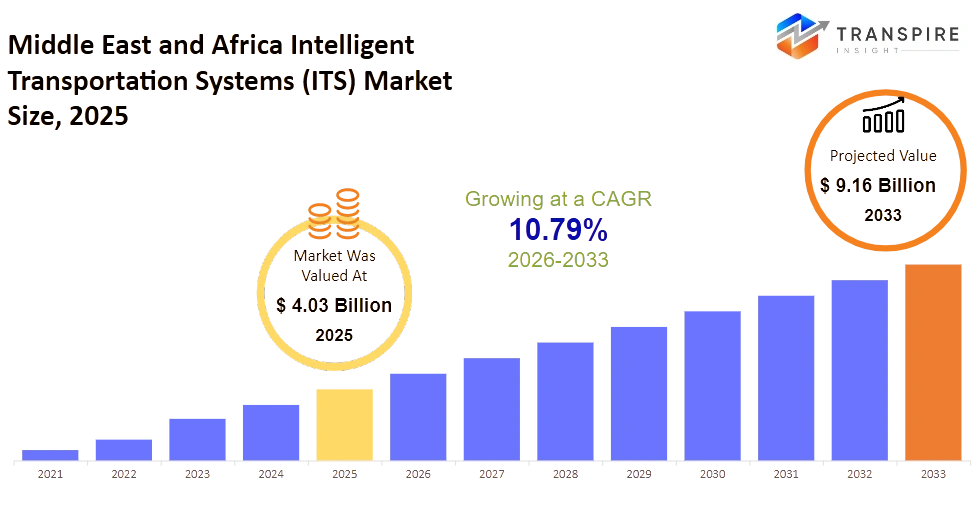
As per Transpire Insight Analysis the Middle East and Africa Intelligent Transportation Systems (ITS) Market size is estimated at USD 4.03 Billion in 2025 and is anticipated to reach USD 9.16 Billion by 2033, growing at a CAGR of 10.79% from 2026 to 2033.
The Middle East and Africa Intelligent Transportation Systems (ITS) Market kind of helps governments transport operators and urban planners, by making it easier to get a clear view of what’s going on on roads, public transit networks and freight corridors . At the same time it supports a more coordinated way to oversee these things, which is sort of the big point. In real life, these setups can lower traffic jam intensity, improve road safety, make movement more steady, and they also make it possible to choose transport actions using evidence, across those fast-growing cities and towns.
In the last 3–5 years , there’s been a noticeable shift , from simpler traffic control types of solutions toward more connected mobility platforms that lean on artificial intelligence, IoT sensors, cloud computing, and real-time analytics. At the same time, government-led smart city programs, digital transformation agendas, and broader transportation modernization efforts have sped up adoption in several major cities .
You can also see fresh revenue openings for technology providers, because investments tied to urban expansion, infrastructure upgrades, and mobility efficiency targets keep moving forward. And since many cities are dealing with rising traffic volumes and daily operational headaches, ITS solutions are turning into something more than “nice to have,” they are becoming essential tools for shaping safer , and more efficient transportation ecosystems overall.
Middle East and Africa Intelligent Transportation Systems (ITS) Market Size & Forecast:
- Middle East and Africa Intelligent Transportation Systems (ITS) Market Size 2025: USD 4.03 Billion
- Expected Market Value 2033: USD 9.16 Billion
- Forecast CAGR: 10.79%
- Leading region in 2025: Middle East
- Fastest Growing region:Africa
- Key Profile: Siemens Mobility, Kapsch TrafficCom, Thales, Cubic Corporation, Cisco, Huawei, IBM, Hitachi Rail, SWARCO, Q-Free, Indra Sistemas, NEC Corporation, Yunex Traffic, Schneider Electric, Iteris
Key Market Insights
- Middle East and Africa Intelligent Transportation Systems (ITS) Market growth is kind of pushed by smart city spending, with figures that go into the billions of dollars across big urban areas, you know like major hubs where everything is always moving.
- In 2025, the Middle East pretty much took the lead, mainly because Saudi Arabia, UAE, and Qatar rolled out large transportation programs , at scale.
- Meanwhile Africa is showing up as the fastest-growing part of the picture , as governments keep upgrading public transport and road safety infrastructure, step by step.
- Since after 2023, AI traffic analytics has been getting more mainstream use, helping with congestion forecasting, spotting incidents quicker, and supporting mobility planning in a more organized way.
- At the same time cloud-based ITS platforms are replacing older setups by allowing centralized monitoring and real time traffic supervision, which is a big deal for day to day operations.
- Public transport operators are also leaning toward intelligent fleet solutions, to raise scheduling accuracy and improve the passenger experience, or at least that’s how they describe it. Smart parking approaches have expanded through many GCC cities as urban populations keep increasing the strain on existing facilities.
- Highway authorities are investing in electronic toll collection systems too, aiming to boost revenue control while reducing traffic slowdowns. Companies like Siemens Mobility, Thales, and Cisco keep expanding, often via partnerships that focus on connected mobility solutions.
- And then there’s the whole angle of private 5G networks plus edge computing, which is opening up fresh chances for faster vehicle to infrastructure communication, especially where timing really matters.
What are the Key Drivers, Restraints, and Opportunities in the Middle East and Africa Intelligent Transportation Systems (ITS) Market?
The main push for the Middle East and Africa Intelligent Transportation Systems (ITS) Market seems to be the fast modernization of transportation infrastructure via smart city programs, and government digital transformation plans. In practice, countries like Saudi Arabia and the UAE are putting money into connected mobility networks, automated traffic management , and road systems that can react more “intelligently” as cities expand. Because of that, ITS vendors get pretty direct chances , especially from big deployments, software integration work, and those long-range service contracts that keep running after launch.
On the other hand, a big drag is the expensive cost of actually rolling this out. A lot of areas still function with transport operations that are kind of split up , plus weak digital connectivity, and not enough local technical skill. So deployment can take longer than planned, and the integration costs rise. In a way, these kinds of structural issues limit adoption, mostly for smaller municipalities and for developing economies where budgets are tighter.
Then there is the main opportunity, which leans toward AI-powered mobility platforms and connected vehicle ecosystems. With 5G network coverage expanding, along with edge computing and IoT-based transportation solutions, there’s more room for predictive traffic control and for automated decision making. Also, when African cities keep building digital infrastructure, it opens new growth routes for technology firms that want an earlier foothold and longer partnerships, rather than just short projects.
What Has the Impact of Artificial Intelligence Been on the Middle East and Africa Intelligent Transportation Systems (ITS) Market?
Artificial intelligence is kind of reshaping transportation management , by pushing automated decision-making, predictive analytics , and real-time optimization throughout urban mobility networks. In practice, AI-powered traffic management platforms look at how vehicles move, what the roads are doing , and the sensor information, then they tune signal timing, flag incidents, and generally calm down congestion. Machine learning models also assist predictive maintenance , by spotting likely equipment failures in traffic controllers, surveillance systems, and connected infrastructure ahead of time, so disruptions happen less often. With these abilities, transport authorities can raise system uptime, cut down operational expenses, and improve overall road safety results
At the same time, advanced digital technologies are moving fleet monitoring and compliance management forward for commercial operators. AI-based analytics follow vehicle performance, driver habits, route efficiency, and fuel consumption—so fleet utilization gets better. Smart mobility platforms use predictive models to map expected traffic patterns and to refine public transport scheduling. Still, AI adoption runs into rough edges, mostly because integration costs are high, data quality is uneven, and connectivity infrastructure is limited in some African regions. Also, the lack of locally focused transportation datasets may make model accuracy worse, and that can slow deployment across the wide range of operating environments.
Key Market Trends
- Smart city programs kinda grew fast after 2020, and in the Middle East, many governments folded intelligent mobility ideas into their city planning a bit more directly than before.
- After 2023 , AI driven traffic surveillance systems started getting lots of attention, mainly because they made incident finding more accurate, and it helped with the usual congestion management headaches too.
- GCC nations also pushed harder into autonomous mobility pilot projects, plus they built connected vehicle infrastructure via public private partnerships, not just contracts but kind of long term cooperation.
- At the same time, cloud based transportation platforms began to replace those more separated, silo style tools, since they could offer centralized oversight across different transport networks.
- Electronic toll collection showed up more widely after 2022, as highway authorities leaned into automated payment, less manual work, quicker throughput, that sort of thing. Public transport operators meanwhile started using real time passenger information systems, so services felt steadier and commuters got updates sooner.
- Edge computing use increased as transportation agencies wanted quicker data handling for safety critical applications, because delays there can be pretty risky. In Africa, cities moved quicker on digital transport initiatives after 2024, often through partnerships with major technology providers.
- Also, companies like Siemens Mobility, Huawei, and Thales expanded regional cooperation for smart transport deployments, so the ecosystem stayed active.
- And finally , cybersecurity solutions became a priority, just because connected infrastructure means more digital exposure, and threats don’t really wait around.
Middle East and Africa Intelligent Transportation Systems (ITS) Market Segmentation
By System Type
Advanced Traffic Management Systems, basically these help transport authorities keep an eye on what the roads are doing, also coordinate traffic signals and manage that congestion in a more or less real time way. They rely on cameras, various sensors, and analytics platforms, and the goal is pretty simple: make traffic move smoother and cut down delays in busy city areas. You can see many large cities across the Middle East and Africa starting to adopt these, since the road network situation is getting more complicated with higher vehicle movement, and broader mobility challenges that aren’t easy to untangle.
Advanced Traveler Information Systems, Electronic Toll Collection Systems, Public Transport Management Systems, Commercial Vehicle Operations, Emergency Vehicle Notification Systems, Parking Management Systems, Others: these kinds of systems fit together to deliver a better travel experience, smoother toll operations, stronger fleet coordination, quicker emergency response, and more organized parking. Advanced Traveler Information Systems give real time announcements, while Electronic Toll Collection Systems speed up payments and support highway efficiency. Public Transport Management Systems and Commercial Vehicle Operations are likely to be adopted more as cities push for dependable transit services, plus logistics optimization. Emergency Vehicle Notification Systems, along with Parking Management Systems will also help with safer roads and smarter urban space use, even when things get hectic.
By Component
Hardware: stuff like cameras, sensors, roadside units, and various communication devices basically make the whole intelligent transportation thing work. They lay down the physical groundwork, collect traffic data, keep an eye on how vehicles move, and also help run automated operations across transportation corridors. In the bigger cities, infrastructure development projects will keep going, so they will keep pulling in demand for more advanced hardware installations.
Software, Services, Sensors, Communication Systems, AI Platforms, Analytics Solutions, Others: Software platforms handle transportation data and let teams do traffic analysis, automation, and operational control, more or less. Services like system integration, maintenance, and technical support are still going to matter a lot when you’re trying to roll it out properly. Sensors plus communication systems make connectivity better between vehicles, roadside infrastructure, and control centers. AI platforms together with analytics solutions will back predictive traffic management, early incident detection, and smarter mobility planning. And in the “others” bucket you’ve got things like cybersecurity tools, mapping technologies, which strengthen reliability and overall performance, even if it sounds like a small detail.
By Application
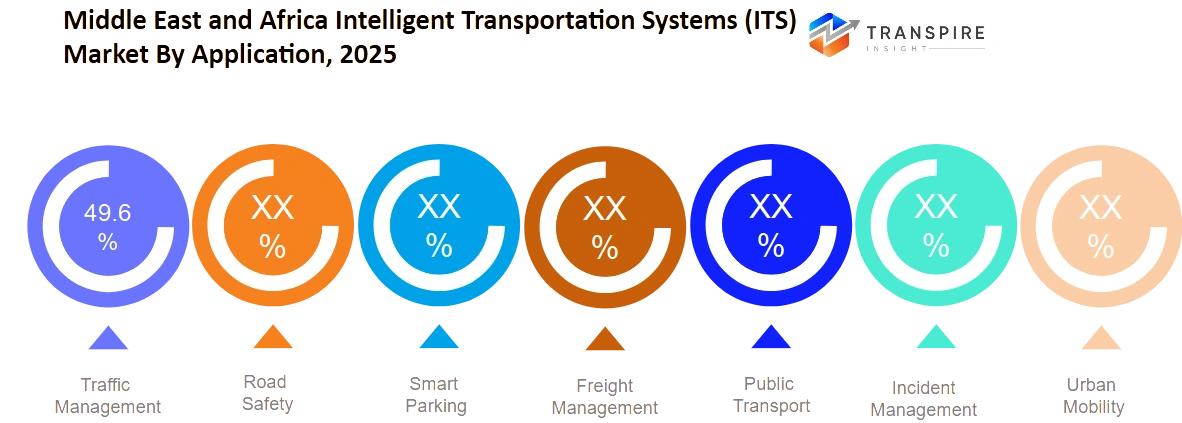
Traffic Management: Traffic Management is a huge application area, because many cities keep trying to cut down congestion and make road use smoother. With intelligent solutions, authorities can dig into traffic patterns, sort of fine tune signal timing, and keep vehicle movement more orderly. As urban infrastructure expands and smart city initiatives grow, they’ll help push broader adoption of advanced traffic-control technologies, even if the rollout takes time.
Road Safety, Smart Parking, Freight Management, Public Transport, Incident Management, Urban Mobility, Others: Road Safety solutions support accident prevention using monitoring systems, plus automated alerts that jump in when something looks odd. Smart Parking handles tight parking capacity by using sensors alongside digital platforms. Freight Management helps logistics providers with route optimization and vehicle tracking so deliveries stay on track. Public Transport and Incident Management systems boost service consistency, and also strengthen emergency response. Urban Mobility is becoming more important as cities blend different transportation modes together, while the “Others” category will still back additional improvements across wider mobility needs.
By End User
Government Agencies are a major end-user group, because public authorities keep pushing transportation modernization programs, like, you know, upgrading how things work in real life. National and municipal governments are leaning into intelligent systems to get better at infrastructure planning, road management , and public safety. In the Middle East and Africa, smart mobility initiatives will keep helping government-led deployments take hold.
Highway Authorities, Smart City Authorities, Logistics Companies, Public Transport Operators, Airports, Seaports, Others: Highway Authorities employ intelligent systems for toll processing, roadside traffic monitoring , and road maintenance optimization. Smart City Authorities put in connected mobility solutions that aim to raise urban transportation efficiency. Logistics Companies typically use fleet tracking along with route management tools, so freight operations move with less friction. Public Transport Operators rely on digital platforms for timetabling and passenger management, which is kind of essential nowadays. Airports and Seaports also integrate transportation technologies, in order to enhance connectivity and improve coordination across operations. Other users will generally adopt specialized solutions depending on their specific mobility needs.
By Deployment
Cloud-Based: Cloud-based deployment is getting a lot of attention right now, mainly because transportation operators want platforms that feel flexible and scalable enough to handle huge amounts of mobility data. With cloud solutions, you can do centralized monitoring, get remote access more easily, and roll out system updates without as much friction. The take up of cloud technology should keep growing as cities drift toward connected transportation ecosystems, you know, the more integrated kind of setups.
On-Premise, Hybrid, Edge Computing, AI-Based Systems, Private Networks, Others: On premise options still matter for organizations that want direct control over transportation data and the underlying infrastructure. A hybrid deployment is basically a mix where you keep local system control but also borrow cloud flexibility , so it fits better for big transportation networks. Edge computing can speed things up, because processing is done nearer to the connected devices instead of sending everything back far away. AI based systems help with automated analysis, forecasting, and optimization of transportation operations, which can be a big deal when traffic patterns move fast. Private networks then make secure communication more practical for critical mobility applications. As for other deployment models, they will likely keep covering more specialized needs across different transportation environments, though the exact fit varies by context.
What are the Key Use Cases Driving the Middle East and Africa Intelligent Transportation Systems (ITS) Market?
Traffic management still ends up being the main use case, since cities need more effective ways to deal with congestion, refine traffic lights or signals, and keep an eye on the road network, in general. Urban authorities are rolling out intelligent systems, to make mobility run smoother and also to back big scale infrastructure projects, at least in many plans.
On the other hand public transport optimization plus freight management are getting more attention, from transport operators and logistics teams. Things like real time fleet tracking, passenger information systems, and route planning tools sort of help raise service dependability and they also support day to day operational performance.
Some of the newer applications show up as connected vehicle platforms, autonomous mobility solutions, and AI based transportation analytics. There are also growing investments in smart city programs and digital infrastructure across GCC countries and across African urban centers, and that should open fresh opportunities throughout the forecast period.
|
Report Metrics |
Details |
|
Market size value in 2025 |
USD 4.03 Billion |
|
Market size value in 2026 |
USD 4.47 Billion |
|
Revenue forecast in 2033 |
USD 9.16 Billion |
|
Growth rate |
CAGR of 10.79% from 2026 to 2033 |
|
Base year |
2025 |
|
Historical data |
2021 - 2024 |
|
Forecast period |
2026 - 2033 |
|
Report coverage |
Revenue forecast, competitive landscape, growth factors, and trends |
|
Regional scope |
Middle East and Africa (Saudi Arabia, United Arab Emirates, South Africa, Rest of Middle East and Africa) |
|
Key company profiled |
Siemens Mobility, Kapsch TrafficCom, Thales, Cubic Corporation, Cisco, Huawei, IBM, Hitachi Rail, SWARCO, Q-Free, Indra Sistemas, NEC Corporation, Yunex Traffic, Schneider Electric, Iteris |
|
Customization scope |
Free report customization (country, regional & segment scope). Avail customized purchase options to meet your exact research needs. |
|
Report Segmentation |
By System Type (Advanced Traffic Management Systems, Advanced Traveler Information Systems, Electronic Toll Collection Systems, Public Transport Management Systems, Commercial Vehicle Operations, Emergency Vehicle Notification Systems, Parking Management Systems, Others); By Component (Hardware, Software, Services, Sensors, Communication Systems, AI Platforms, Analytics Solutions, Others); By Application (Traffic Management, Road Safety, Smart Parking, Freight Management, Public Transport, Incident Management, Urban Mobility, Others); By End User (Government Agencies, Highway Authorities, Smart City Authorities, Logistics Companies, Public Transport Operators, Airports, Seaports, Others); By Deployment (Cloud-Based, On-Premise, Hybrid, Edge Computing, AI-Based Systems, Private Networks, Others) |
Which Regions are Driving the Middle East and Africa Intelligent Transportation Systems (ITS) Market Growth?
Middle East is basically leading regional growth because the governments keep pouring in investments, with advanced infrastructure programs ,and a bunch of smart city development things going on. Like Saudi Arabia and the UAE, they are pushing big transportation modernization projects that rely on digital technologies and connected mobility platforms. You can see how the advanced road networks , plus really high urbanization levels and solid public-private partnerships, together make a kind of good environment for intelligent transport to actually take root .
Meanwhile Africa brings in steady market expansion by upgrading transportation infrastructure and doing a gradual digital shift across several major economies. South Africa, Egypt and Kenya for example are putting money into public transport improvements, traffic management systems and logistics upgrades. The mix of economic development, rising urban population, and government mobility programs means there are consistent openings for tech providers, even when budgets get tight.
Also , Africa feels like the quickest growing regional opportunity because cities are speeding up transportation modernization and picking cost-effective digital solutions. There are newer investments in smart mobility initiatives, public transport upgrades, and connected infrastructure, and they are already generating fresh demand. So between 2026 and 2033, this growth should nudge new market entrants and investors to concentrate on scalable solutions that fit developing transport networks.
Who are the Key Players in the Middle East and Africa Intelligent Transportation Systems (ITS) Market and How Do They Compete?
In the Middle East and Africa Intelligent Transportation Systems (ITS) Market the competitive landscape looks kind of crowded, with global tech firms, transport specialists and infrastructure solution providers all trying to lock in their share. A lot of the rivalry, well it usually boils down to tech know-how, how good they are at integration , which regional allies they have, and whether they can actually roll out full mobility platforms end to end. The more established players tend to blend hardware, software, analytics and services together, while newer providers push in with more narrow but advanced AI and cloud based solutions, sometimes a little too narrow but still attractive.
Siemens Mobility seems to strengthen its stance with rail plus road mobility technologies in one go, leaning hard on connected infrastructure and digital traffic management platforms. Thales, on the other hand, keeps competing by highlighting transportation security and signaling plus communication technologies, the kind that fit big infrastructure programs without a lot of hassle. Kapsch TrafficCom differentiates through electronic toll collection systems alongside traffic management know-how, and they also keep widening partnerships with transport authorities. Cisco plays up secure networking solutions for connected transportation ecosystems, while Huawei brings communication technologies, AI platforms, and smart city solutions to expand regional mobility apps.
Also, companies are forming strategic partnerships more and more, just to improve their regional footprint and tailor offerings. Going forward, technology progress, cybersecurity strength, and the ability to integrate AI driven analytics will still be the major levers behind competitive advantage across the whole market.
Company List
• Siemens Mobility
• Kapsch TrafficCom
• Thales
• Cubic Corporation
• Cisco
• Huawei
• IBM
• Hitachi Rail
• SWARCO
• Q-Free
• Indra Sistemas
• NEC Corporation
• Yunex Traffic
• Schneider Electric
• Iteris
Recent Development News
In March 2025, Huawei launched seven smart transportation solutions at Mobile World Congress 2025. The solutions focused on AI, cloud, connectivity, and intelligent transportation infrastructure across road, rail, and other mobility sectors, supporting digital transformation for transportation operators globally.https://e.huawei.com/
In 2025, Huawei collaborated with Oman authorities and technology partners to develop an intelligent road safety improvement project. The initiative applied AI-based traffic monitoring, vehicle recognition, and data analytics technologies to improve intersection management and strengthen road safety operations in Oman.https://e.huawei.com
In September 2025, Huawei and industry partners introduced an Urban Transportation Model Solution. The solution integrated AI models, sensing technologies, connectivity, and computing capabilities to improve traffic management efficiency through automated monitoring and intelligent decision-making.https://e.huawei.com/
What Strategic Insights Define the Future of the Middle East and Africa Intelligent Transportation Systems (ITS) Market?
The Middle East and Africa Intelligent Transportation Systems (ITS) Market is shifting toward these integrated mobility ecosystems, where AI connected infrastructure and real-time analytics will sort of steer transportation planning. The next phase will basically hinge on government smart city investments, plus more digital infrastructure expansion, and also the growing need for efficient urban mobility solutions. In practice, cities will likely start emphasizing platforms that link traffic management, public transit, and road safety operations, but through one unified system or at least a very tightly connected setup.
There is also a hidden risk for market players, because infrastructure readiness can be pretty fragmented across developing economies. Sometimes connectivity is limited, budgets run tight, and the technology standards don’t stay consistent, and that can slow down large-scale deployments. It can also lead to weird uneven adoption patterns in different areas, even if the overall interest is high. So even with strong investment momentum, the project complexity can still rise, kind of quietly and not right away.
On the other side, there’s an emerging opportunity, particularly around AI enabled autonomous mobility and vehicle-to-infrastructure communication, and this is especially visible across GCC countries that are investing in future transportation systems. Companies might want to concentrate on building scalable, interoperable platforms, and also on regional partnerships with government agencies, so they can secure long-term projects and keep strengthening their market standing.
Middle East and Africa Intelligent Transportation Systems (ITS) Market Report Segmentation
By System Type
• Advanced Traffic Management Systems
• Advanced Traveler Information Systems
• Electronic Toll Collection Systems
• Public Transport Management Systems
• Commercial Vehicle Operations
• Emergency Vehicle Notification Systems
• Parking Management Systems
• Others
By Component
• Hardware
• Software
• Services
• Sensors
• Communication Systems
• AI Platforms
• Analytics Solutions
• Others
By Application
• Traffic Management
• Road Safety
• Smart Parking
• Freight Management
• Public Transport
• Incident Management
• Urban Mobility
• Others
By End User
• Government Agencies
• Highway Authorities
• Smart City Authorities
• Logistics Companies
• Public Transport Operators
• Airports
• Seaports
• Others
By Deployment
• Cloud-Based
• On-Premise
• Hybrid
• Edge Computing
• AI-Based Systems
• Private Networks
• Others
Frequently Asked Questions
Find quick answers to common questions.
The expected Middle East and Africa Intelligent Transportation Systems (ITS) Market size for the market will be USD 9.16 Billion in 2033.
Key segments for the Middle East and Africa Intelligent Transportation Systems (ITS) Market are By System Type (Advanced Traffic Management Systems, Advanced Traveler Information Systems, Electronic Toll Collection Systems, Public Transport Management Systems, Commercial Vehicle Operations, Emergency Vehicle Notification Systems, Parking Management Systems, Others); By Component (Hardware, Software, Services, Sensors, Communication Systems, AI Platforms, Analytics Solutions, Others); By Application (Traffic Management, Road Safety, Smart Parking, Freight Management, Public Transport, Incident Management, Urban Mobility, Others); By End User (Government Agencies, Highway Authorities, Smart City Authorities, Logistics Companies, Public Transport Operators, Airports, Seaports, Others); By Deployment (Cloud-Based, On-Premise, Hybrid, Edge Computing, AI-Based Systems, Private Networks, Others).
Major Middle East and Africa Intelligent Transportation Systems (ITS) Market players are Siemens Mobility, Kapsch TrafficCom, Thales, Cubic Corporation, Cisco, Huawei, IBM, Hitachi Rail, SWARCO, Q-Free, Indra Sistemas, NEC Corporation, Yunex Traffic, Schneider Electric, Iteris.
The Middle East and Africa Intelligent Transportation Systems (ITS) Market size is USD 4.03 Billion in 2025.
The Middle East and Africa Intelligent Transportation Systems (ITS) Market CAGR is 10.79% from 2026 to 2033.
• Siemens Mobility
• Kapsch TrafficCom
• Thales
• Cubic Corporation
• Cisco
• Huawei
• IBM
• Hitachi Rail
• SWARCO
• Q-Free
• Indra Sistemas
• NEC Corporation
• Yunex Traffic
• Schneider Electric
• Iteris
About the Authors

Mayur Shinde
I am Mayur Shinde, a Senior Research Analyst at Transpire Insight, specializing in the Automotive & Transportation and Information & Communication Technology (ICT) Industry. My work focuses on analyzing emerging market trends, technological advancements, competitive landscapes, and industry developments to deliver accurate, data-driven insights. I am passionate about transforming complex market information into clear, actionable content that helps businesses, professionals, and decision-makers stay informed and make confident strategic decisions.

Chakradhar Khansole
Chakradhar serves as the Research Director at Transpire Insight, bringing over 8 years of experience in technology, innovation, and strategic market intelligence. He specializes in transforming complex market data into actionable business insights that enable organizations to make informed, growth-oriented decisions. Recognized for his strategic vision and analytical expertise, Chakradhar leads high-impact research initiatives, delivering comprehensive market assessments, competitive intelligence, and forward-looking industry analysis.
Recently Published Reports
-
Apr 2026
ATV & UTV Market
ATV & UTV Market Size, Share & Analysis Report By Type (ATV, and UTV), By Variants (Less Than 400 CC, 400 CC To 800 CC, and More Than 800 CC), and Geography (North America, Europe, Asia-Pacific, Middle East and Africa, South and Central America), 2021 - 2031
-
Apr 2026
Automotive Central Gateway Module Market
Automotive Central Gateway Module Market Size, Share & Analysis Report By Type (Ethernet Central Gateway Module, CAN Central Gateway Module, LIN Central Gateway Module, and FlexRay), By Application (Powertrain Control, Body Control, Infotainment System, Advanced Driver Assistance Systems (ADAS), and Others), By End User (Passenger Vehicles, and Commercial Vehicles), and Geography (North America, Europe, Asia-Pacific, Middle East and Africa, South and Central America), 2021 - 2031
-
Apr 2026
Automotive Engine Oil Filter Market
Automotive Engine Oil Filter Market Size, Share & Analysis Report By Filter Type (Fuel Filter, Engine Oil Filter, Hydraulic Oil Filter, and Others), By Filter Media (Cellulose, Synthetic, and Micro), By Sales Channel (OEMs, and Aftermarket), By Vehicle Type (Passenger Cars, Light Commercial Vehicles, Heavy Duty Trucks, Buses and Coaches, and Off-road Vehicles), and Geography (North America, Europe, Asia-Pacific, Middle East and Africa, South and Central America), 2021 - 2031
-
Apr 2026
Automotive Parts Aluminium Die Casting Market
Automotive Parts Aluminium Die Casting Market Size, Share & Analysis Report By Production Process (Pressure Die Casting, Vacuum Die Casting, Squeeze Die Casting, Gravity Die Casting), By Application (Body Parts, Engine Parts, Transmission Parts, Battery And Related Components, Other Application Types), and Geography (North America, Europe, Asia-Pacific, Middle East and Africa, South and Central America), 2021 - 2031
Our Clients



