
Asia Pacific Road Safety Market Size & Forecast:
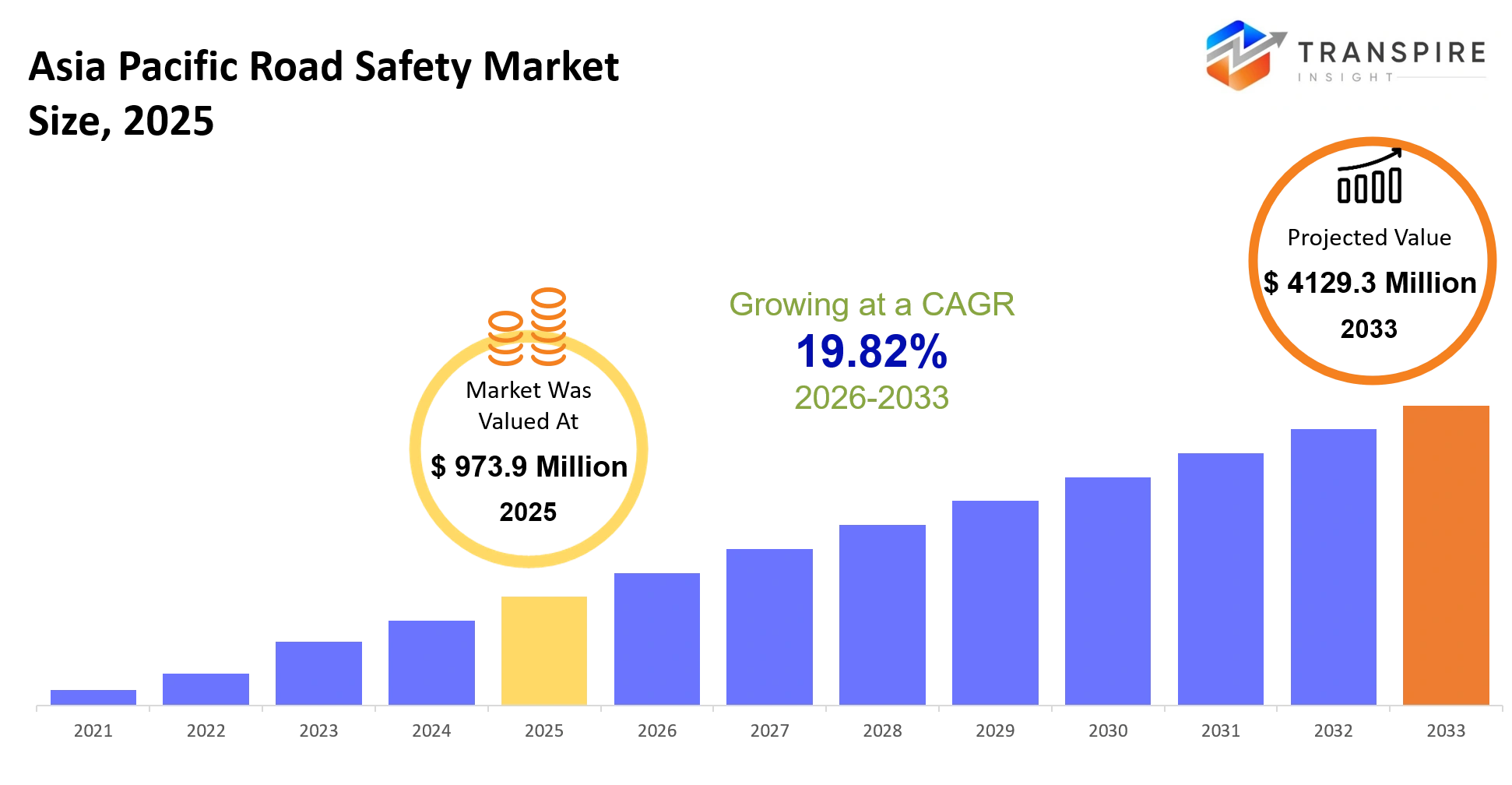
- Asia Pacific Road Safety Market Size 2025: USD 973.9 Million
- Asia Pacific Road Safety Market Size 2033: USD 4129.3 Million
- Asia Pacific Road Safety Market CAGR: 19.82%
- Asia Pacific Road Safety Market Segments: By Solution Type (Traffic Management Systems, Road Signage, Speed Enforcement Systems, Incident Detection Systems, Smart Traffic Lights, Others); By Application (Urban Roads, Highways, Smart Cities, Rural Roads, Others); By End User (Government Authorities, Transportation Agencies, Smart City Projects, Others)
To learn more about this report,  Download Free Sample Report
Asia Pacific Road Safety Market Summary
The Asia Pacific Road Safety Market was valued at USD 973.9 Million in 2025. It is forecast to reach USD 4129.3 Million by 2033. That is a CAGR of 19.82% over the period.
The Asia Pacific road safety market is all about bringing down traffic accidents, but also making sure drivers, passengers cyclists, and pedestrians are protected in the real world. It also helps governments deal with transportation networks that are getting more and more complex, day by day. In practice, the solutions usually mix intelligent traffic management systems with speed enforcement cameras, plus incident detection technologies. There are also connected vehicle platforms and smart roadway infrastructure, which sounds fancy but it’s basically about keeping things coordinated. These tools let transportation authorities move traffic more smoothly, lower road fatalities, react faster when something goes wrong, and make it easier to follow road safety regulations without constant manual effort.
Over the last five years, the market tone has changed a lot. It’s gone from standalone traffic monitoring tools to more connected and smarter transportation systems that rely on artificial intelligence, cloud based platforms, and real time data analysis. Fast urban growth across places like India, China, and quite a few Southeast Asian countries has been a ma in push behind that shift, really. On top of that, government initiatives linked to the United Nations Decade of Action for Road Safety has helped nudge more spending toward modern road safety infrastructure, and it’s not small either. And as road networks expand, while vehicle counts keep climbing, transportation authorities are increasingly leaning on automated enforcement systems and predictive traffic management technologies. That direction should open up longer term revenue opportunities for technology providers, while also driving broader adoption of smart mobility solutions across the region.
Key Market Insights
- Asia Pacific Road Safety Market revenue is forecast to jump from USD 973.9 million in 2025, to about USD 4,129.3 million by 2033.
- In the same time, East Asia pretty much dominates the Asia Pacific Road Safety Market, with around 42% share, mostly driven by China and more advanced urban infrastructure.
- South Asia meanwhile is expected to grow the fastest through 2033 because of highway modernization efforts and smart city programs, also kind of in parallel with broader digitalization.
- When you look at the product side, Intelligent Traffic Management Systems account for roughly 35% of the overall revenue, so they basically sit as the leading segment.
- Automated Enforcement Solutions come right after that, backed by broader rollouts of speed and red-light cameras. Connected Vehicle Infrastructure is also projected to expand above 22% each year throughout the forecast period.
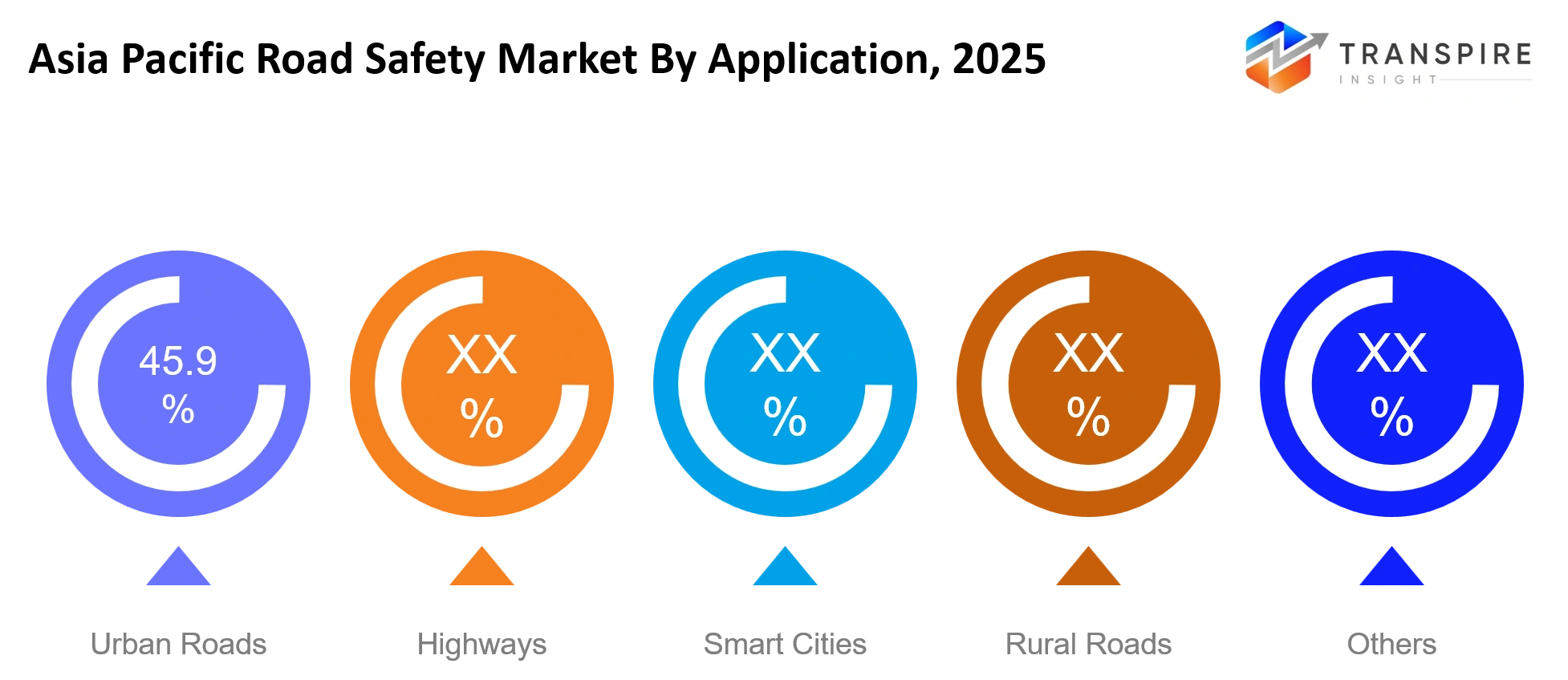
- For applications, urban traffic management applications contribute nearly 40% of market demand, since many cities are trying to hit congestion control and accident reduction targets, at the same time.
- On the other hand, highway safety monitoring is among the quickest-growing application areas, helped by national expressway development projects.
- For end users, government transportation agencies hold more than 55% of spending, showing clear public-sector leadership in safety investments.
- Finally, public-private partnerships have grown notably since 2022, which is helping accelerate the deployment of AI-based road safety platforms, across multiple regions.
What are the Key Drivers, Restraints, and Opportunities in the Asia Pacific Road Safety Market?
The most powerful growth driver is basically the roll out of intelligent transportation policies across many Asia Pacific economies. In general, Governments are shifting more and more transportation funding toward automated enforcement, AI enabled traffic monitoring, and connected infrastructure, since the older style traffic management has not really managed to lower accident rates in tightly packed urban stretches. Regulatory mandates around speed monitoring, electronic enforcement, and smart mobility infrastructure are then building a more predictable procurement rhythm, which directly turns into higher revenues for technology providers, and for system integrators too.
The main obstacle though is still the expense and overall complexity of deploying intelligent transportation infrastructure at a region wide scale. Road safety systems tend to need a lot—communication networks, roadside sensors, cloud platforms, data centers, and long term maintenance agreements. A number of developing economies also have budget limits, multiple and sometimes fragmented transportation authorities, plus uneven digital infrastructure. These structural constraints do not get fixed fast either, because they rely on multi year public investment programs. So, deployment timelines often creep past the first projections, which slows down technology adoption and hurts the near term revenue outlook.
A meaningful future opportunity is in connected vehicle ecosystems, and in vehicle to everything communication networks. Public agencies and transportation bodies are increasingly piloting cooperative intelligent transport systems that let vehicles and roadside assets trade safety insights in real time. Some recent connected mobility initiatives in India and Thailand show how this can lessen collision exposure while also improving day to day traffic flow.
What Has the Impact of Artificial Intelligence Been on the Asia Pacific Road Safety Market?
Artificial intelligence is somehow changing how road safety gets handled, going from reactive traffic control to predictive, and more automated, decision making. Traffic authorities now more and more use AI video analytics to catch speeding vehicles, spot accidents, recognize different traffic violations, and keep an eye on congestion as it happens. In practice these tools just chew through huge amounts of roadway data, which cuts down on manual watching and it makes enforcement feel more efficient.
Also machine learning is getting tucked into intelligent transportation platforms, so they can forecast congestion hotspots, figure out accident likelihood, and fine tune signal timing. When these systems mix old traffic behavior with what is happening on the road right now, transportation agencies can react sooner to incidents, and it generally helps lower travel delays. At the same time, connected vehicle programs are increasingly blending AI with roadside sensors, to send real time hazard alerts and give drivers better situational awareness. A few recent intelligent transport rollouts in Asia have already shown that AI supported traffic analytics can improve safety results and operational efficiency too, not just “numbers on a dashboard”.
There are operational upsides like quicker incident response, better use of the roadway network, lower congestion related expenses, and also stronger regulatory compliance. But AI adoption still has limits. Putting AI platforms into legacy transportation infrastructure often means a lot of money upfront, and on top of that, inconsistent data quality plus road condition differences across countries can make predictions less reliable. Those problems still slow down broad deployment in some emerging markets, even when the intent is there.
Key Market Trends
Since 2021, AI powered traffic analytics has been adopted in a much broader way across big city transportation networks, like really expanded, not just in one place. Connected vehicle trials also kept growing across Asia Pacific, with India saying it will roll out its first C-ITS highway deployment in 2026. Smart camera systems are now pretty often bundled together so they can do automatic incident detection, license plate recognition, plus predictive analytics, all on one platform. Government spending for intelligent transportation infrastructure went up quite a lot too, since road fatalities still stay a major public policy concern, no real change there. In fact more than 60% of the newest smart city transportation projects now seem to include integrated road safety technology components.
Cloud based traffic management platforms have started replacing standalone monitoring systems in many big urban centers. Kapsch TrafficCom also pushed its connected mobility efforts further, through work in Thailand and India during 2025–2026. Public agencies are increasingly asking for interoperability between enforcement systems, traffic control centers, and connected vehicles, so everything can talk together. Transportation authorities are gradually shifting away from reactive enforcement toward predictive safety management, driven by real time analytics, not hindsight. Lastly, strategic partnerships between mobility technology providers and data analytics firms really picked up momentum across 2025 and 2026.
Asia Pacific Road Safety Market Segmentation
By Solution Type
Traffic management systems account for a pretty substantial share of market deployment, because transportation authorities need real time visibility into traffic situations, congestion patterns and roadway performance. They help with coordination of traffic flow, boost route efficiency, and allow quicker action when road conditions shift. With the continued buildout of digital infrastructure, implementation is still spreading across major urban centers, in a kind of steady way.
Road signage is still a core piece of roadway safety, since clear and easy to spot guidance supports driver awareness and navigation. Speed enforcement systems matter too, they reduce violations and nudge compliance with traffic regulations using automated monitoring technologies. Incident detection systems enable faster recognition of accidents and disruptions, while smart traffic lights help traffic move better through adaptive signal control based on live traffic data. Other options include specialized road safety technologies, designed to handle location specific transportation and mobility needs, depending on where they’re deployed.
By Application
Urban Roads basically come out as the largest application segment, mostly because busy, dense traffic flows keep demanding constant monitoring, traffic regulation, and accident avoidance. Municipal authorities are still pouring money into smarter safety technologies to help with mobility, cut down congestion, and overall tighten the way roadways are managed. On top of that, the growth of intelligent transportation infrastructure also makes it easier for these tools to get used throughout city settings, even when conditions change day to day.
Highways still matter a lot as an application area because they require speed regulation, incident surveillance, and coordination for long distance movement. Smart Cities are also pushing higher levels of connected transportation options, and these solutions often blend road safety functions with wider digital infrastructure plans. Rural Roads, meanwhile, are slowly taking up safety technologies aimed at improving how quickly accidents get handled and how road users stay protected. Others cover specialized transportation corridors as well, plus new types of mobility services that need custom safety solutions rather than one generic approach.
To learn more about this report, Download Free Sample Report
By End User
Public Authorities are in a kind of leading role in the market, mostly because public agencies oversee road infrastructure building, traffic regulation, and transportation safety programs at the same time. Big, long-term investments in intelligent transportation initiatives plus regulatory compliance actions keep backing up the purchase of new technology. National and regional road safety goals also push more spending for the long haul in this segment, not just for a short period.
Transportation Agencies, use more advanced setups to coordinate traffic networks, check roadway conditions, and boost day to day operational efficiency. Smart city projects are now more often weaving road safety technologies together with connected mobility platforms, data analytics, and urban governance systems, so you end up with a safer transportation environment. Beyond that, there are infrastructure operators, public-private partnerships, and other groups that handle specialized transportation management along with roadway safety initiatives.
What are the Key Use Cases Driving the Asia Pacific Road Safety Market?
The largest use case kind of involves cities and urban traffic management, plus automated enforcement. A lot of major cities deploy intelligent traffic management systems, adaptive signal controls, speed enforcement cameras, and incident detection platforms to cut down accidents while also improving the overall flow. This application usually ends up with the highest demand because densely populated urban corridors keep dealing with congestion that will not really go away, and safety issues too.
Past the city side of things, highway safety monitoring is getting more traction. Transportation authorities are using intelligent monitoring across expressways to catch accidents earlier, watch vehicle speeds, and deliver real time traffic updates. Commercial logistics operators also get benefits, for example safer freight movement and fewer travel disruptions, overall.
Newer use cases are popping up around connected vehicle infrastructure, and vehicle-to-everything communication networks. In practice, these setups let vehicles get safety alerts right from roadway infrastructure. And as 5G coverage keeps expanding across Asia Pacific, connected mobility applications are expected to turn into a big growth driver through 2033, somehow.
|
Report Metrics |
Details |
|
Market size value in 2025 |
USD 973.9 Million |
|
Market size value in 2026 |
USD 1164.8 Million |
|
Revenue forecast in 2033 |
USD 4129.3 Million |
|
Growth rate |
CAGR of 19.82%from 2026 to 2033 |
|
Base year |
2025 |
|
Historical data |
2021 - 2024 |
|
Forecast period |
2026 - 2033 |
|
Report coverage |
Revenue forecast, competitive landscape, growth factors, and trends |
|
Regional scope |
Asia Pacific (India, China, Japan, Australia, South Korea, Rest of Asia Pacific) |
|
Key company profiled |
Siemens Mobility, Kapsch TrafficCom, Cubic Corporation, Thales Group, Honeywell, Cisco Systems, Bosch, Huawei, Swarco, Jenoptik, Verra Mobility, Q-Free, FLIR Systems, Motorola Solutions, Hitachi |
|
Customization scope |
Free report customization (country, regional & segment scope). Avail customized purchase options to meet your exact research needs. |
|
Report Segmentation |
By Solution Type (Traffic Management Systems, Road Signage, Speed Enforcement Systems, Incident Detection Systems, Smart Traffic Lights, Others); By Application (Urban Roads, Highways, Smart Cities, Rural Roads, Others); By End User (Government Authorities, Transportation Agencies, Smart City Projects, Others) |
Which Regions are Driving the Asia Pacific Road Safety Market Growth?
East Asia still feels like the main regional stage, pretty much driven by China, Japan, and South Korea. Heavy, government-backed spending on smart transportation infrastructure helps make it easier for advanced traffic management tools to roll out almost everywhere. You also have a lot of people living in big cities and a wide spread of roadways, so the need for intelligent safety approaches stays pretty high. On top of that, the region has fairly solid digital systems already, plus strong technology ecosystems, which kind of speeds up the whole implementation process, right away.
South Asia sits in the second spot when you look at market revenue. But here, the “why” is different from East Asia. The momentum comes more from transportation upgrading and the constant build-out of highway networks, not so much from already-established infrastructure maturity. Nations like India are putting real weight behind expressway safety systems, digital enforcement capabilities, and broader intelligent transportation endeavors. Plus, when government budgets stay consistent and long-term mobility programs continue, the market keeps expanding in a steadier way.
Southeast Asia is expected to show the quickest expansion up through 2033. Lately, investments tied to smart cities, road improvement programs, and digital mobility efforts have pushed adoption of intelligent transportation technologies faster than before. Thailand, Indonesia, Vietnam, and Malaysia are all expanding connected traffic infrastructure, and that’s making the whole setup look promising. As a result, there are strong, high-growth windows for technology vendors, software providers, and infrastructure investors who are trying to enter markets with momentum from 2026 to 2033.
Who are the Key Players in the Asia Pacific Road Safety Market and How Do They Compete?
The competitive landscape blends global transportation technology providers, more or less intelligent mobility specialists, and various regional infrastructure firms. Most of the competition seems to land on things like technology abilities, software integration, analytics results, and how well someone can roll out big, large scale transportation projects. Even so, the established players keep their strong market footing mostly due to long term government relationships, but newer, technology focused companies are starting to push AI driven offerings which kind of rewire the competitive situation.
Siemens Mobility, for example, differentiates itself via integrated transportation management platforms, where traffic control, analytics, and smart mobility services get bundled together. The real edge is in building an end to end transportation ecosystem, not just selling one standalone product. Thales Group leans toward secure digital mobility solutions, and it leans on its experience with communications and cybersecurity, to help run mission critical transportation networks.
Kapsch TrafficCom has been growing its influence through connected vehicle efforts and cooperative intelligent transport system deployments. Some recent work in India and Thailand shows it is serious about next generation mobility technologies. Honeywell, meanwhile, puts a spotlight on advanced analytics and tightly integrated traffic operations, while Hitachi leans into data driven infrastructure management and smart city collaborations. Overall, these firms keep moving forward via tech innovation, strategic partnerships, and the kind of regional market penetration initiatives that tend to compound over time.
Company List
- Siemens Mobility
- Kapsch TrafficCom
- Cubic Corporation
- Thales Group
- Honeywell
- Cisco Systems
- Bosch
- Huawei
- Swarco
- Jenoptik
- Verra Mobility
- Q-Free
- FLIR Systems
- Motorola Solutions
- Hitachi
Recent Development News
In March 2026, Kapsch TrafficCom entered a partnership with TomTom. The collaboration integrates TomTom traffic intelligence into the EcoTrafiX platform, strengthening data-driven traffic management and road safety capabilities.https://www.tomtom.com
In May 2026, Kapsch TrafficCom partnered with Superwave Communication And Infrasolution Limited to deploy India's first Cooperative Intelligent Transport Systems project. The initiative introduces AI-supported connected vehicle technology to improve highway safety and traffic efficiency.https://www.kapsch.net
What Strategic Insights Define the Future of the Asia Pacific Road Safety Market?
The Asia Pacific road safety market is moving toward more connected transportation ecosystem stuff where vehicles, infrastructure, and traffic management platforms keep exchanging data, like all the time. The main thing pushing this shift is the meeting point of artificial intelligence, connected mobility, and the public investments in smart transportation infrastructure. In the next ten years, value creation will drift more and more from hardware rollouts to software, data analytics, and those ongoing, recurring digital service revenues.
One risk that seems a bit underappreciated is interoperability fragmentation, or at least it can be. Different countries, plus municipalities, sometimes deploy systems using different technical standards so the “fit” between them gets messy. That can bring on integration difficulties that, in turn, restrict how well regional mobility networks work together. Market players who don’t tackle compatibility needs might see slower expansion even if demand stays strong.
A real opportunity shows up with vehicle-to-everything communication networks, alongside AI-based predictive safety platforms. As connected vehicle deployments move beyond pilot projects into large-scale implementation, providers who can blend connectivity with analytics and infrastructure management will get a noticeable edge. Companies should focus on open platform architectures and strategic partnerships so integration is smooth across transportation ecosystems and future mobility networks, even when things get complicated.
Asia Pacific Road Safety Market Report Segmentation
By Solution Type
- Traffic Management Systems
- Road Signage
- Speed Enforcement Systems
- Incident Detection Systems
- Smart Traffic Lights
- Others
By Application
- Urban Roads
- Highways
- Smart Cities
- Rural Roads
- Others
By End User
- Government Authorities
- Transportation Agencies
- Smart City Projects
- Others
Frequently Asked Questions
Find quick answers to common questions.
The expected Asia Pacific Road Safety Market size for the market will be USD 4129.3 Million in 2033.
Key segments for the Asia Pacific Road Safety Market are By Solution Type (Traffic Management Systems, Road Signage, Speed Enforcement Systems, Incident Detection Systems, Smart Traffic Lights, Others); By Application (Urban Roads, Highways, Smart Cities, Rural Roads, Others); By End User (Government Authorities, Transportation Agencies, Smart City Projects, Others).
Major Asia Pacific Road Safety Market players are Siemens Mobility, Kapsch TrafficCom, Cubic Corporation, Thales Group, Honeywell, Cisco Systems, Bosch, Huawei, Swarco, Jenoptik, Verra Mobility, Q-Free, FLIR Systems, Motorola Solutions, Hitachi.
The Asia Pacific Road Safety Market size is USD 973.9 Million in 2025.
The Asia Pacific Road Safety Market CAGR is 19.82% from 2026 to 2033.
- Siemens Mobility
- Kapsch TrafficCom
- Cubic Corporation
- Thales Group
- Honeywell
- Cisco Systems
- Bosch
- Huawei
- Swarco
- Jenoptik
- Verra Mobility
- Q-Free
- FLIR Systems
- Motorola Solutions
- Hitachi
About the Authors

Mayur Shinde
I am Mayur Shinde, a Senior Research Analyst at Transpire Insight, specializing in the Automotive & Transportation and Information & Communication Technology (ICT) Industry. My work focuses on analyzing emerging market trends, technological advancements, competitive landscapes, and industry developments to deliver accurate, data-driven insights. I am passionate about transforming complex market information into clear, actionable content that helps businesses, professionals, and decision-makers stay informed and make confident strategic decisions.

Chakradhar Khansole
Chakradhar serves as the Research Director at Transpire Insight, bringing over 8 years of experience in technology, innovation, and strategic market intelligence. He specializes in transforming complex market data into actionable business insights that enable organizations to make informed, growth-oriented decisions. Recognized for his strategic vision and analytical expertise, Chakradhar leads high-impact research initiatives, delivering comprehensive market assessments, competitive intelligence, and forward-looking industry analysis.
Recently Published Reports
-
Apr 2026
ATV & UTV Market
ATV & UTV Market Size, Share & Analysis Report By Type (ATV, and UTV), By Variants (Less Than 400 CC, 400 CC To 800 CC, and More Than 800 CC), and Geography (North America, Europe, Asia-Pacific, Middle East and Africa, South and Central America), 2021 - 2031
-
Apr 2026
Automotive Central Gateway Module Market
Automotive Central Gateway Module Market Size, Share & Analysis Report By Type (Ethernet Central Gateway Module, CAN Central Gateway Module, LIN Central Gateway Module, and FlexRay), By Application (Powertrain Control, Body Control, Infotainment System, Advanced Driver Assistance Systems (ADAS), and Others), By End User (Passenger Vehicles, and Commercial Vehicles), and Geography (North America, Europe, Asia-Pacific, Middle East and Africa, South and Central America), 2021 - 2031
-
Apr 2026
Automotive Engine Oil Filter Market
Automotive Engine Oil Filter Market Size, Share & Analysis Report By Filter Type (Fuel Filter, Engine Oil Filter, Hydraulic Oil Filter, and Others), By Filter Media (Cellulose, Synthetic, and Micro), By Sales Channel (OEMs, and Aftermarket), By Vehicle Type (Passenger Cars, Light Commercial Vehicles, Heavy Duty Trucks, Buses and Coaches, and Off-road Vehicles), and Geography (North America, Europe, Asia-Pacific, Middle East and Africa, South and Central America), 2021 - 2031
-
Apr 2026
Automotive Parts Aluminium Die Casting Market
Automotive Parts Aluminium Die Casting Market Size, Share & Analysis Report By Production Process (Pressure Die Casting, Vacuum Die Casting, Squeeze Die Casting, Gravity Die Casting), By Application (Body Parts, Engine Parts, Transmission Parts, Battery And Related Components, Other Application Types), and Geography (North America, Europe, Asia-Pacific, Middle East and Africa, South and Central America), 2021 - 2031
Our Clients



