
Middle East and Africa Industrial Alcohol Market Size & Forecast:
- Middle East and Africa Industrial Alcohol Market Size 2025: -USD 3.84 Billion
- Middle East and Africa Industrial Alcohol Market Size 2033: USD 5.64 Billion
- Middle East and Africa Industrial Alcohol Market CAGR: 4.92%
- Middle East and Africa Industrial Alcohol Market Segments: By Type (Ethanol, Methanol, Isopropyl Alcohol, Butanol, Benzyl Alcohol, Others); By Source (Sugarcane, Corn, Grains, Molasses, Others); By Application (Chemicals, Pharmaceuticals, Fuel, Personal Care, Food Processing, Others); By End User (Chemical Industry, Pharma Industry, Energy Sector, Others)
Middle East and Africa Industrial Alcohol Market Summary
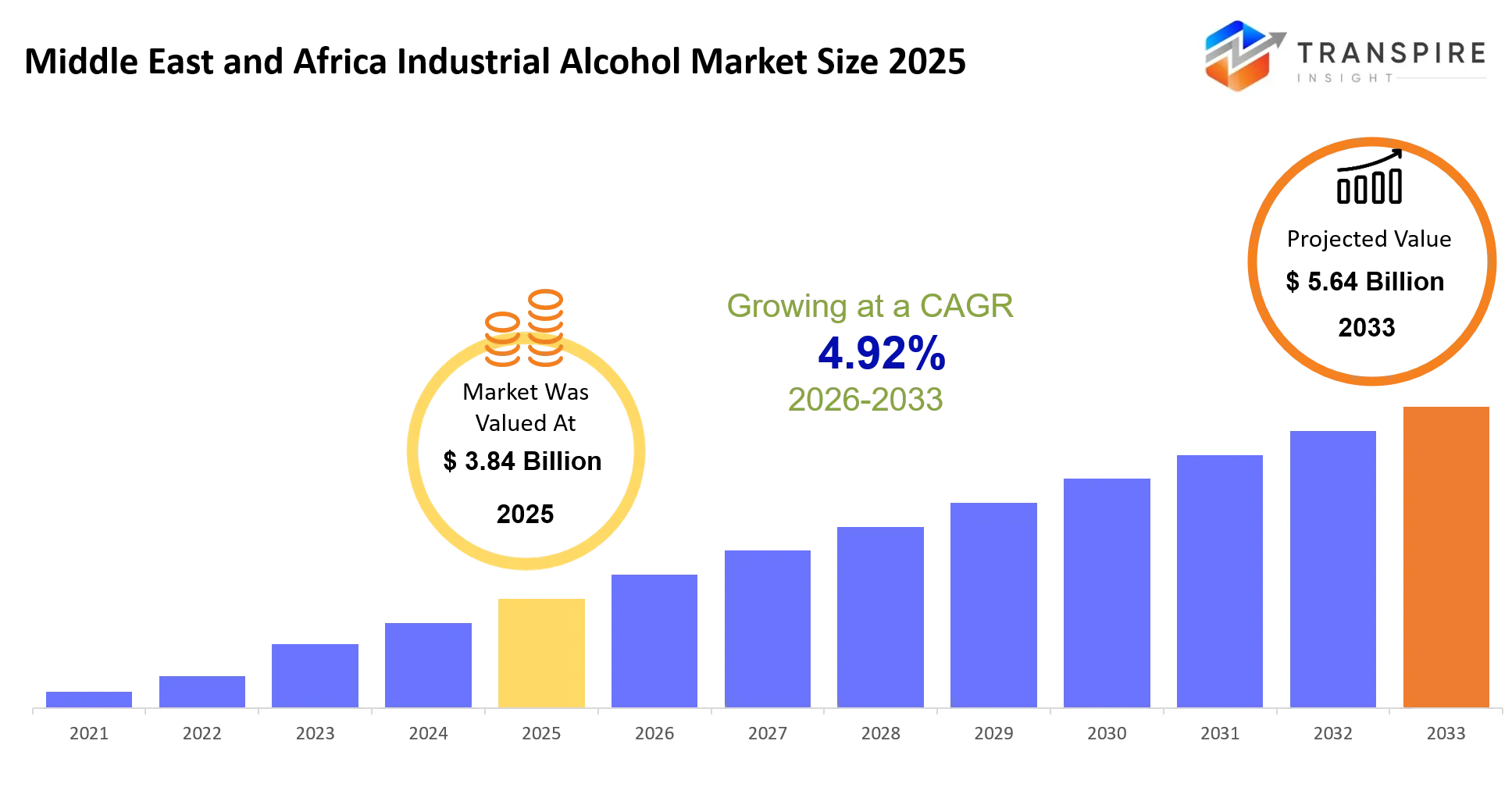
The Middle East and Africa Industrial Alcohol Market was valued at -USD 3.84 Billion in 2025. It is forecast to reach USD 5.64 Billion by 2033. That is a CAGR of 4.92% over the period.
Industrial alcohol in the Middle East and Africa serves as a key input for manufacturing chains, where controlled solvents, disinfectants and chemical intermediates are needed to keep downstream production steady, even when the environment gets weird. It backs industries like pharmaceuticals, paints, personal care, fuel blending and chemical processing, where stable purity and unbroken supply continuity directly affect output quality, and how long operations stay up.
Over the last few years, the market has been shifting in a more structural way toward bio based feedstocks, because sugarcane and grain derived alcohol routes gained preference over petroleum linked options. The reason is partly cost volatility, and partly sustainability tied procurement rules, that some buyers now treat as non negotiable. One major trigger that really pushed the move was the global supply chain disruption during the post pandemic period, that made import dependence painfully visible and encouraged regional producers to grow local fermentation and distillation capacity.
Because of this, investment behavior is moving toward integrated production facilities that sit nearer to raw material sources. That improves margin control and also helps cut logistics exposure, which is not just a small detail. This shift is strengthening regional self sufficiency and speeding up revenue expansion across both industrial grade and pharmaceutical grade alcohol supply chains, at least in the places where demand keeps trending up
Key Market Insights
- Middle East and Africa Industrial Alcohol Market is showing this kind of rising localization trends, with ethanol production capacity that is expanding about 18% between 2022 and 2025 in several Gulf economies, not just one.
- In Africa, the sugarcane feedstock integration is kinda leading, which supports ethanol output and, makes supply reliability more solid for chemical-grade alcohol manufacturing networks too.
- On the demand side methanol seems to dominate industrial consumption patterns, and it keeps the largest share, mainly because it is used in petrochemical synthesis and also for fuel blending applications.
- The pharmaceutical-grade alcohol segment records the fastest growth, and that is happening as stricter hygiene compliance keeps getting enforced in healthcare, and in formulation industries as well.
- For end use, chemical manufacturing stays dominant, contributing over 35% consumption share across the Middle East and Africa Industrial Alcohol Market value chain, so basically it leads the whole thing.
- Meanwhile fuel blending applications keep expanding steadily, since governments push for cleaner combustion fuels and also aim to reduce petroleum dependency.
- BASF, SABIC, Dow, and INEOS are intensifying regional partnerships for capacity expansion, and strategic expansion via joint ventures is increasing production resilience and cutting import dependency across various African industrial hubs.
- Also technology upgrades in fermentation efficiency are improving yield output, which reduces production cost volatility at industrial alcohol plants.
- So the Middle East and Africa Industrial Alcohol Market forecast outlook, it reflects stronger integration of renewable feedstocks, plus chemical processing clusters that are connecting more effectively.
What are the Key Drivers, Restraints, and Opportunities in the Middle East and Africa Industrial Alcohol Market?
The main driver of the Middle East and Africa Industrial Alcohol Market is this growing embedding of industrial alcohol into downstream chemical and pharmaceutical production, where it works as a steady solvent plus intermediate, more or less. You see, demand keeps climbing because several governments in the region have been pushing local manufacturing rules, trying to lessen import dependence for essential chemicals. With that move, domestic production gets more attention, and utilization rates in ethanol and methanol facilities go up too, which then helps regional producers keep revenue steadier.
Still, the biggest restraint feels like a mismatch between feedstock and infrastructure across many parts of Africa, and it’s not subtle. Agricultural output can be erratic, and large scale distillation setups are limited, so continuous production becomes hard to maintain. Because of that, there’s more reliance on imports, and end users in pharmaceuticals and chemical processing face higher price fluctuations. Also, the expense of building integrated fermentation and refining systems is simply high, so even with strong demand signals, capacity expansion slows down.
Meanwhile, an important opportunity is forming via sugarcane and grain led bio-refineries in East Africa, and also some sections of the Gulf. These combined sites link agricultural sourcing with industrial alcohol generation, cutting down logistics costs and improving output efficiency in a way that actually matters. On top of that, pilot investments around ethanol blending for cleaner fuels are opening new demand routes, especially in places where energy diversification policies are speeding up industrial take-up.
What Has the Impact of Artificial Intelligence Been on the Middle East and Africa Industrial Alcohol Market?
Artificial intelligence is slowly getting better at improving how efficiently industrial alcohol production facilities work across the Middle East and Africa. It does this by tuning fermentation cycles, trimming energy use and, kind of smoothing out quality checks, so the whole process stays steadier. In big distillation plants, AI powered monitoring tools are able to look at temperature, pressure and feedstock variability , then adjust operations to keep alcohol purity consistent, which means less manual meddling and fewer process slips.
At the same time predictive analytics models are being used more often to foresee equipment wear in fermentation tanks and distillation columns, so maintenance teams can respond before something actually fails. This has helped plant uptime a lot and also cut down on those unexpected shutdowns, especially in methanol and ethanol units that support chemical and pharmaceutical production. Some operators are also trialing digital twin systems, basically a virtual replica of the line, to imitate how production performs and to improve throughput when feedstock conditions keep changing.
Still, AI take up is not everywhere, because data isn’t always consistent or available. In many smaller plants, digitization is fragmented, and that makes the models weaker in practice. A lot of facilities do not have continuous sensor integration , so model accuracy drops once you move from a controlled setting into real operations. Plus, the cost to integrate systems is high , and technical know how is limited, which delays deployment for mid scale producers, particularly across newer industrial hubs in parts of Africa.
Key Market Trends
- Local ethanol production capacity got expanded pretty much a lot between 2023 and 2025, which in turn lowered import dependency across Gulf chemical clusters.
- Methanol uses started to grow within fuel blending programs, like after the regulatory pushes for lower-emission industrial fuels in 2024–2025, and it kinda kept going.
- Pharmaceutical alcohol demand jumped after 2023 due to tougher hygiene compliance, across healthcare supply chains.
- Sugarcane feedstock adoption increased in Africa, this helped fermentation efficiency a bit more, while also driving down production costs.
- Industrial buyers then started leaning toward long-term supply contracts, to cut down price volatility when sourcing chemical alcohol.
- SABIC and BASF upped their joint chemical processing investments in MEA regions, over the period.
- Renewable alcohol blending initiatives grew, with additional pilot programs showing up across energy sectors in 2025.
- Automation in production got adopted more widely, so yield consistency improved and operational downtime in large scale distillation plants dropped.
- Export-focused methanol facilities also expanded capacity in North Africa, to support European chemical markets.
- Strategic partnerships got stronger between global chemical firms and regional feedstock suppliers, so supply chains would stay more stable.
Middle East and Africa Industrial Alcohol Market Segmentation
By Type
Ethanol helps with fuel blending, and also shows up in pharmaceutical production, you know, it kinda does both. There’s strong demand from chemical processing, and sanitation products as well, without too much delay. Ethanol output tends to rise when sugarcane and grain are available, so the supply rhythm matters. Industrial plants use ethanol as a solvent, also for disinfectants. Methanol then supports chemical synthesis, and fuel related uses, across large scale manufacturing units. It also backs plastics, and formaldehyde production, sort of indirectly but still real. Isopropyl alcohol goes into cleaning workflows, plus medical formulations. Demand increases in healthcare and electronics, even when budgets shift. Butanol supports coatings, and solvent based manufacturing processes. Benzyl alcohol is used for fragrance, pharmaceutical purposes, and preservative applications. Other alcohol types handle niche industrial needs across specialized chemical production systems, with less volume but steady relevance.
The second paragraph for the Middle East and Africa Industrial Alcohol Market, type segment, kind of leans on production balance between feedstocks, and demand cycles. Ethanol, and methanol dominate because of heavy industrial usage, that part is fairly clear. Isopropyl alcohol keeps a stable demand level, especially in hygiene related products. Butanol and benzyl alcohol stay specialized, though their output remains pretty consistent. Other types cover smaller, but still important chemical uses. Production facilities often tune their output using both feedstock availability and industrial demand signals. Chemical and pharmaceutical industries also steer the product mix decisions, sometimes more than distributors do. Market stability is better when regional facilities diversify across alcohol types, so there’s less of a single point stress.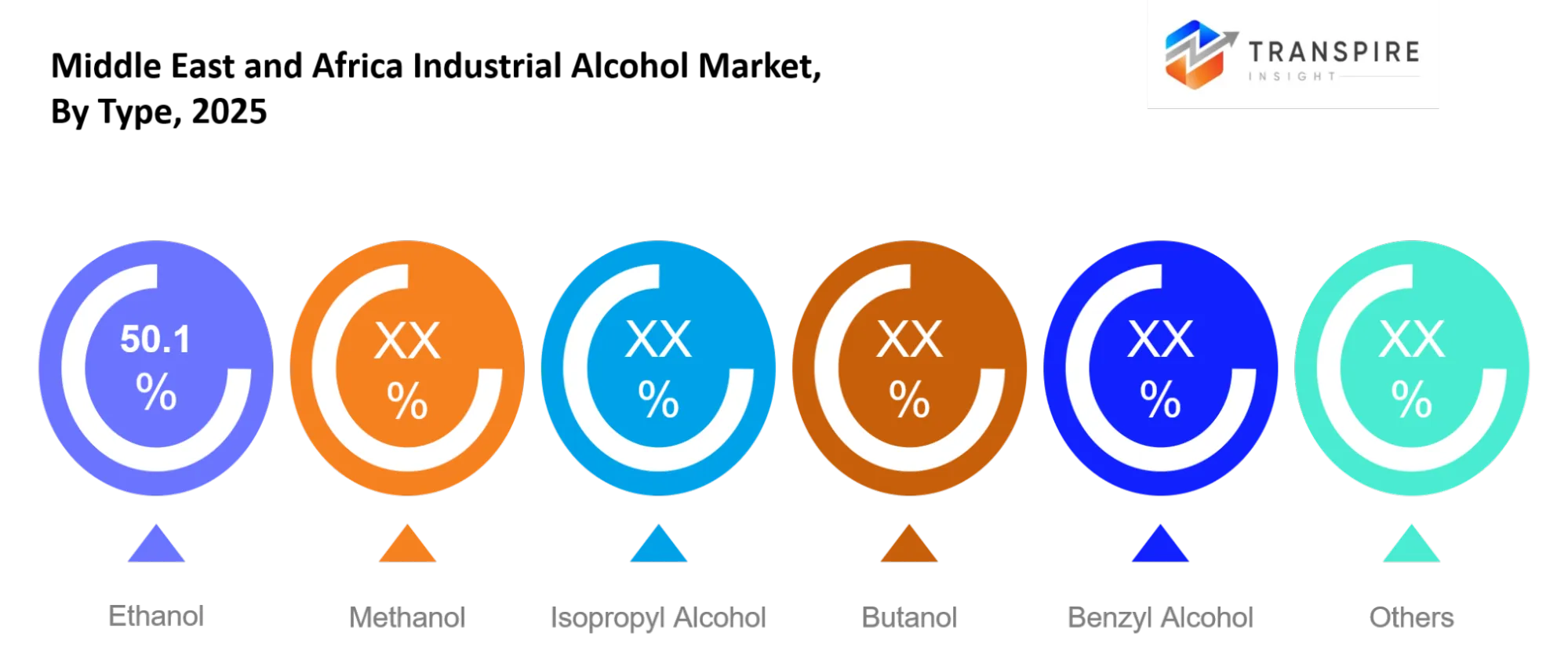
By Source
Sugarcane acts like, a main bio-based feedstock for ethanol production. Solid farm output keeps fermentation based industrial alcohol manufacturing running. Corn offers an alternate raw material pathway for ethanol processing, and grain based sources help keep the fermentation supply chain more steady. Molasses shows up as a cost efficient input for alcohol production sites. Beyond that, other biomass options help drive experimental, plus hybrid production systems. When feedstock diversity is there it improves overall supply stability, and strong regional agriculture also matters a lot for consistent raw material availability in industrial alcohol manufacturing networks.
In the Middle East and Africa Industrial Alcohol Market source segment, the second paragraph kind of emphasizes supply chain integration and overall efficiency. Sugarcane together with molasses dominate most bio-based production approaches. Corn and grain sources are typically used for larger scale fermentation facilities, while other inputs enable more flexible production models. Industrial facilities then try to balance feedstock use, depending on price, and on what is actually available. Agricultural regions end up influencing production capacity across various chemical industries. Supply reliability gets better when diversified sourcing strategies are used. Production setups also tend to adjust for seasonal swings in agricultural output across multiple regions.
By Application
Chemicals stay the main application ,mostly because solvent and intermediate needs are steady. Big scale manufacturing still leans on a steady alcohol supply, consistent year to year. In pharmaceuticals alcohol is used for formulation work, and also sterilization processes. For fuels, the demand keeps pushing forward via blending programs, and these cleaner energy initiatives. In personal care alcohol shows up in hygiene routines as well as cosmetics work. Food processing uses alcohol for extraction and preservation, so it kinda never really stops. Then there are other uses like laboratory cleaning and industrial cleaning ,which are related but not always visible. Overall, having many applications really helps keep industrial alcohol demand more balanced, and makes the structure stronger.
The second paragraph for the Middle East and Africa Industrial Alcohol Market application segment basically comes down to industrial expansion ,plus how regulation affects behavior. Chemical applications keep leading, mainly due to uninterrupted production cycles. Pharmaceutical demand keeps lifting too, alongside healthcare infrastructure growth . Fuel applications keep growing as energy diversification programs get stronger. Personal care and food industries support fairly stable consumption ,even when other parts fluctuate. Other uses remain quiet and stable in smaller niche industrial operations. Regulatory standards also shape the purity requirements across these applications, so the quality bar is not the same everywhere. Industrial demand patterns ,tend to shift based on how each sector grows across regional economies.
By End User
The chemical industry really is the biggest end user, because production keeps running nonstop, so yeah they need alcohol all the time. Big chemical plants really rely on a steady alcohol supply. In pharma, high-purity alcohol is used for drug formulation, plus sanitation and related protocols. The energy sector also takes alcohol for fuel blending, it’s kind of a practical move. Others like food and personal care manufacturers use alcohol-based inputs, for cleaner processing and better handling. Industrial demand stays pretty steady across most manufacturing sectors, and this sort of end-user variety helps keep the market balanced in general. Production planning, basically follows industrial consumption patterns, without much surprise.
For the Middle East and Africa Industrial Alcohol Market, the second part on the end user segment talks about the growth drivers plus the operational needs that come with them. The chemical industry demand is still the leading one across key production hubs. Pharma grows as healthcare development initiatives keep moving forward. The energy sector’s adoption rises, especially with cleaner fuel programs and policy push. Other industries stay on a consistent consumption level, not changing too dramatically. Industrial alcohol usage then depends on purity standards, and also how large the production scale is. Market stability improves as end-user demand stays diversified, so risks don’t stack in one place. Industrial expansion across those sectors then supports long-term consumption growth over time.
What are the Key Use Cases Driving the Middle East and Africa Industrial Alcohol Market?
Industrial alcohol is mostly used in chemical manufacturing , where it works as a solvent and also as an intermediate, helping produce plastics, coatings, and other industrial compounds. In my view this part generates the most demand because processing stays on a large scale, year round in petrochemical hubs.
On another side, pharmaceutical and personal care industries are showing steady expansion, alcohol there is used for formulation stability, sterilization, and hygiene products. These sectors tend to stay tightly connected with regulatory compliance, plus quality assurance expectations , in both healthcare supply and consumer goods production.
There are also newer use cases like biofuel blending and renewable energy projects, where ethanol is treated as supporting a cleaner combustion standard. Extra growth shows up in food processing as well as electronics cleaning, where high purity alcohol supports precision manufacturing needs, and it really matters for those fine steps in production.
|
Report Metrics |
Details |
|
Market size value in 2025 |
-USD 3.84 Billion |
|
Market size value in 2026 |
USD 4.03 Billion |
|
Revenue forecast in 2033 |
USD 5.64 Billion |
|
Growth rate |
CAGR of 4.92% from 2026 to 2033 |
|
Base year |
2025 |
|
Historical data |
2021 - 2024 |
|
Forecast period |
2026 - 2033 |
|
Report coverage |
Revenue forecast, competitive landscape, growth factors, and trends |
|
Regional scope |
Middle East and Africa (Saudi Arabia, United Arab Emirates, South Africa, Rest of Middle East and Africa) |
|
Key company profiled |
LyondellBasell, INEOS, Shell, SABIC, BASF, Dow, Eastman, Green Plains, ADM, Cargill, Raizen, Valero, Mitsubishi Chemical, Reliance Industries, Sasol |
|
Customization scope |
Free report customization (country, regional & segment scope). Avail customized purchase options to meet your exact research needs. |
|
Report Segmentation |
By Type (Ethanol, Methanol, Isopropyl Alcohol, Butanol, Benzyl Alcohol, Others); By Source (Sugarcane, Corn, Grains, Molasses, Others); By Application (Chemicals, Pharmaceuticals, Fuel, Personal Care, Food Processing, Others); By End User (Chemical Industry, Pharma Industry, Energy Sector, Others) |
Which Regions are Driving the Middle East and Africa Industrial Alcohol Market Growth?
In the Middle East, the market keeps moving ahead, mostly because the petrochemical backbone is already in place, the refining capability is quite advanced, and the whole industrial layout feels more connected than elsewhere . Big production sites in Saudi Arabia plus the UAE help keep methanol and ethanol coming at high volume. Also, strong export routes and port connections, sort of lock in quicker delivery, so global chemical supply chains get the distribution efficiency they need.
Africa , meanwhile, acts like a steady contributor, and it’s mainly tied to agricultural feedstock being available, plus a slow but real industrial expansion. But unlike the Middle East, the growth story here leans more toward raw material accessibility and local fermentation initiatives, rather than heavy petrochemical interlinking. So you end up with a supply base that’s reliable, yet limited by infrastructure in a very practical way.
North Africa looks like the fastest mover, driven by fresh industrial investments, renewable fuel policies that keep getting traction, and the steady expansion of chemical processing areas. Recent updates to infrastructure , together with foreign direct investment, are helping production scale up faster. With that momentum, the region is positioned as a major entry point for new market participants during 2026 to 2033 .
Who are the Key Players in the Middle East and Africa Industrial Alcohol Market and How Do They Compete?
The Middle East and Africa Industrial Alcohol market is kinda moderately consolidated, with global chemical manufacturers trading blows alongside regional petrochemical giants. Most of the time, competition comes from feedstock access, process efficiency, and how well they’re stitched into downstream chemical networks, not only from price, or just “cheap” deals. Old hands keep the edge thanks to big scale facilities and long-term supply contracts. New entrants tend to chase bio-based production and tighter regional tie ups, sort of like building credibility faster than volume.
SABIC leans on integrated petrochemical complexes so costs stay controlled and internal demand is effectively tapped from downstream units. INEOS bets more heavily on process innovation, plus cross border supply chains, to reinforce European–MEA trade routes. BASF leans into high purity specialty alcohol production for pharmaceuticals and other advanced chemical uses, using technology led refinement systems.
Dow is pushing ahead via strategic alliances with regional distributors, to boost supply penetration across African markets. LyondellBasell, in the meantime, plays for downstream integration, and then efficiency optimization in alcohol based chemical processes. Overall these firms go at it by tightening supply security, investing in capacity expansion, and upgrading production technologies, rather than just competing at a price level.
Company List
- LyondellBasell
- INEOS
- Shell
- SABIC
- BASF
- Dow
- Eastman
- Green Plains
- ADM
- Cargill
- Raízen
- Valero
- Mitsubishi Chemical
- Reliance Industries
- Sasol
Recent Development News
In June 2025, SABIC expanded its ethanol-linked downstream integration strategy through a strategic collaboration with regional feedstock suppliers to strengthen industrial chemical output capacity in the Gulf region. The initiative improves ethanol-to-chemical conversion efficiency and reduces dependency on imported intermediates, strengthening regional supply security for industrial alcohol applications.https://www.sabic.com (SABIC)
In May 2025, Dow entered a regional partnership with African chemical distributors to improve industrial alcohol supply chain reach across North and Sub-Saharan Africa. The collaboration focuses on optimizing logistics and improving availability of methanol and isopropyl alcohol for pharmaceutical and coatings industries, reducing lead times and import bottlenecks.https://www.dow.com (Dow)
In April 2025, INEOS advanced its industrial alcohol value chain integration by expanding joint operations with Middle Eastern petrochemical partners to enhance methanol production efficiency. The move strengthens feedstock flexibility and supports rising demand from fuel blending and chemical manufacturing sectors across the MEA region.https://www.ineos.com (INEOS)
What Strategic Insights Define the Future of the Middle East and Africa Industrial Alcohol Market?
The Middle East and Africa Industrial Alcohol Market is kind of structurally shifting toward localized, bio-based, and vertically integrated making systems, mostly pushed by industrial diversification plus energy transition rules. In the next 5–7 years, you can see supply chains getting closer to agricultural and petrochemical zones, which should trim import dependence, and also keep producer margins more stable.
There is also a quieter risk that people do not always notice, meaning over reliance on one or two feedstocks. Like if agriculture gets disrupted or if water constraints tighten, ethanol-based production could wobble, even if demand stays steady. At the same time, there is an emerging opening in hybrid bio-refineries, where ethanol output gets paired with renewable fuel blending programs, especially around East Africa, and in the Gulf area too.
So, market players should really focus on integrated production partnerships, and also invest in flexible feedstock technologies, because competition will likely be shaped by how localized and policy led these regional supply chains become.
Middle East and Africa Industrial Alcohol Market Report Segmentation
-
By Type
Ethanol
Methanol
Isopropyl Alcohol
Butanol
Benzyl Alcohol
Others -
By Source
Sugarcane
Corn
Grains
Molasses
Others -
By Application
Chemicals
Pharmaceuticals
Fuel
Personal Care
Food Processing
Others -
By End User
Chemical Industry
Pharma Industry
Energy Sector
Others
Frequently Asked Questions
Find quick answers to common questions.
The Expected Middle East and Africa Industrial Alcohol Market size for the Market will be USD 5.64 Billion in 2033.
Key Segments for the Middle East and Africa Industrial Alcohol Market are By Type (Ethanol, Methanol, Isopropyl Alcohol, Butanol, Benzyl Alcohol, Others); By Source (Sugarcane, Corn, Grains, Molasses, Others); By Application (Chemicals, Pharmaceuticals, Fuel, Personal Care, Food Processing, Others); By End User (Chemical Industry, Pharma Industry, Energy Sector, Others).
Major Middle East and Africa Industrial Alcohol Market Players are LyondellBasell, INEOS, Shell, SABIC, BASF, Dow, Eastman, Green Plains, ADM, Cargill, Raizen, Valero, Mitsubishi Chemical, Reliance Industries, Sasol.
The Current Middle East and Africa Industrial Alcohol Market size is -USD 3.84 Billion in 2025.
The Middle East and Africa Industrial Alcohol Market CAGR is 4.92% from 2026 to 2033.
- LyondellBasell
- INEOS
- Shell
- SABIC
- BASF
- Dow
- Eastman
- Green Plains
- ADM
- Cargill
- Raízen
- Valero
- Mitsubishi Chemical
- Reliance Industries
- Sasol
About the Authors

Pankaj Ghogare Patil
I am Pankaj Ghogare Patil, a Senior Research Analyst at Transpire Insight, specializing in the Pharmaceutical, Chemicals & Materials, Healthcare IT, and Biotechnology industry. My expertise lies in conducting comprehensive market research, analyzing industry trends, evaluating competitive landscapes, and translating complex data into actionable insights. At Transpire Insight, I closely follow emerging technologies, regulatory developments, and market innovations to create accurate, well-researched, and informative content that helps businesses and professionals make informed decisions. I am committed to producing credible, evidence-based articles that reflect industry best practices while making technical topics accessible and valuable for a broad audience.

Chakradhar Khansole
Chakradhar serves as the Research Director at Transpire Insight, bringing over 8 years of experience in technology, innovation, and strategic market intelligence. He specializes in transforming complex market data into actionable business insights that enable organizations to make informed, growth-oriented decisions. Recognized for his strategic vision and analytical expertise, Chakradhar leads high-impact research initiatives, delivering comprehensive market assessments, competitive intelligence, and forward-looking industry analysis.
Recently Published Reports
-
May 2026
Healthcare Polymer Packaging Market
Healthcare Polymer Packaging Market Size, Share & Analysis Report By Packaging Type (Syringes, IV Bottles and Pouches, Clamshells, Blisters, Bottles & Jars, Containers, Tubes, IV Parental Packaging, Others), By Type (Regulated, Non-regulated), By Polymer Type (LDPE (Low-Density Polyethylene), HDPE (High-Density Polyethylene), Homo-polymer (Homo), Random Copolymer (Random), Block Copolymer (Block), PET, Polystyrene, Polyvinyl Chloride, Polyamide/EVOH, Others), and Geography (North America, Europe, Asia-Pacific, Middle East and Africa, South and Central America), 2021 - 2031
-
Apr 2026
Hydrophilic Tape (Waterstop) Market
Hydrophilic Tape (Waterstop) Market Size, Share & Analysis Report By Type (Bentonite-Based Hydrophilic Tape, Rubber-Based Hydrophilic Tape), By Application (Residential Buildings, Commercial Buildings, Infrastructure Projects), and Geography (North America, Europe, Asia-Pacific, Middle East and Africa, South and Central America), 2021 - 2031
-
Apr 2026
Metalens Market
Metalens Market Size, Share & Analysis Report By Type (Visible Light Metalens, and Infrared Metalens), By Application (Consumer Electronics, Automotive Electronics, Industrial, Medical, and Others), and Geography (North America, Europe, Asia-Pacific, Middle East and Africa, South and Central America), 2021 - 2031
-
Apr 2026
PBT Resin Market
PBT Resin Market Size, Share & Analysis Report By Type (Reinforced PBT Resin, Unreinforced PBT Resin), By Processing Method (Injection Molding, Extrusion, Blow Molding, Others), By End-User (Automotive, Electrical & Electronics, Consumer Appliances, Industrial Machinery, Medical Devices, Packaging, Others), and Geography (North America, Europe, Asia-Pacific, Middle East and Africa, South and Central America), 2021 - 2031