
Asia Pacific Sugar Alcohol Market Size & Forecast:
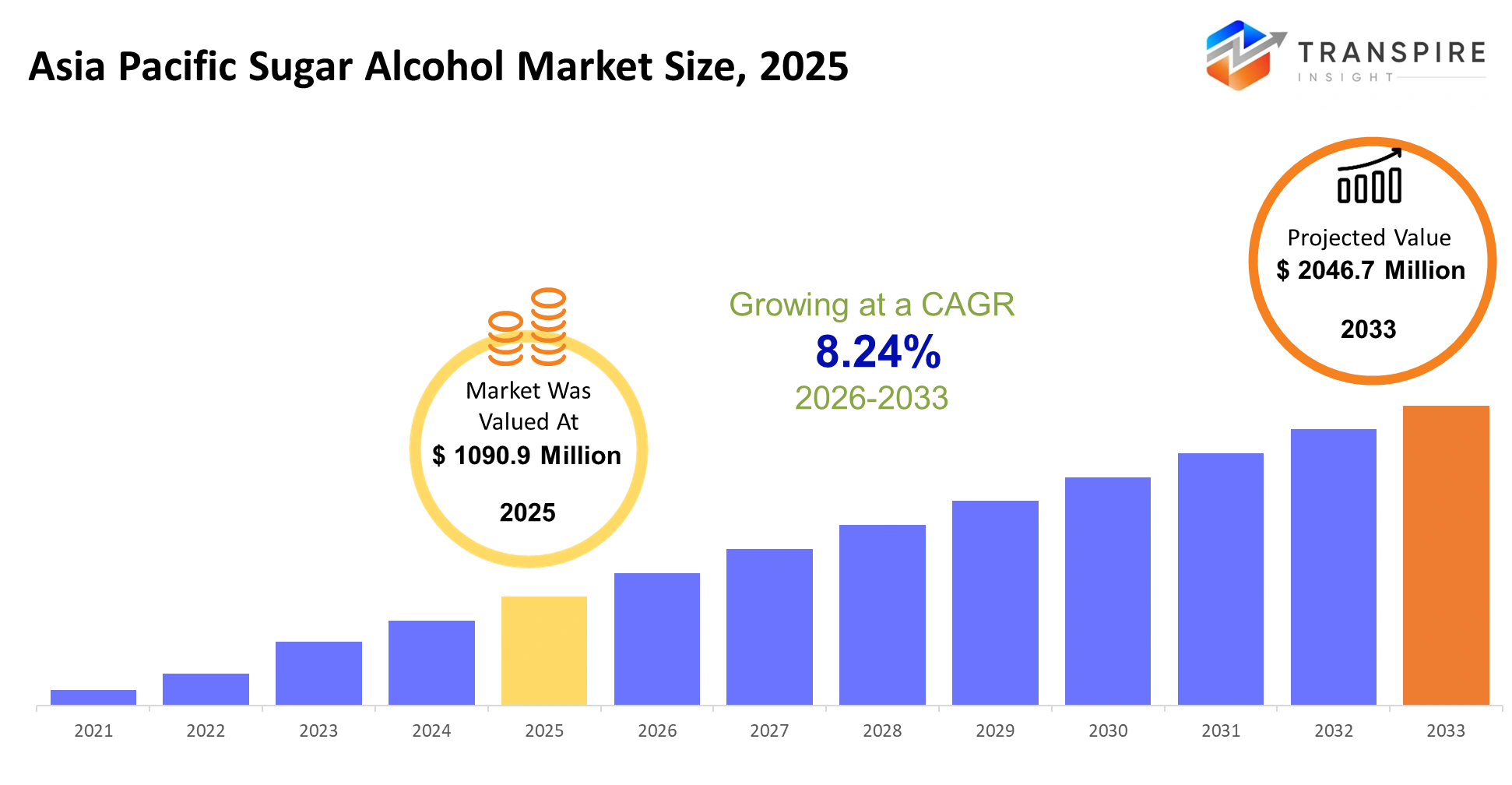
- Asia Pacific Sugar Alcohol Market Size 2025: USD 1090.9 Million
- Asia Pacific Sugar Alcohol Market Size 2033: USD 2046.7 Million
- Asia Pacific Sugar Alcohol Market CAGR: 8.24%
- Asia Pacific Sugar Alcohol Market Segments: By Type (Sorbitol, Xylitol, Maltitol, Erythritol, Mannitol, Others); By Application (Food & Beverages, Pharmaceuticals, Personal Care, Oral Care, Nutraceuticals, Others); By Form (Powder, Liquid, Granules, Crystals, Syrup, Others); By End-User (Food Industry, Pharma, Cosmetics, Healthcare, Industrial, Others)
To learn more about this report,  Download Free Sample Report
Asia Pacific Sugar Alcohol Market Summary:
The Asia Pacific Sugar Alcohol Market size is estimated at USD 1090.9 Million in 2025 and is anticipated to reach USD 2046.7 Million by 2033, growing at a CAGR of 8.24% from 2026 to 2033.
The Asia Pacific sugar alcohol market within the food and beverage ingredients sector will experience continuous growth because manufacturers adapt to changing dietary habits and increasing demand for refined sugar reduction. Consumers in Japan, China and Australia demonstrate higher interest in low-calorie sweeteners which match their wellness-oriented lifestyles, leading companies to develop products which maintain their original taste and texture. The industry will achieve better production results through new fermentation methods and enzymatic processing developments, while product distribution will be affected by new labeling regulations and sugar reduction standards. The market will show a combination of new product development, financial efficiency measures and customer knowledge growth.
What Has the Impact of Artificial Intelligence Been on the Asia Pacific Sugar Alcohol Market ?
The Asia Pacific sugar alcohol market experiences ongoing transformation because artificial intelligence improves data analysis and customer behavior understanding. The Asia Pacific sugar alcohol market analysis uses artificial intelligence to deliver market research results which are both faster and more accurate through its advanced data modeling and real-time insights capabilities. Companies today use machine learning algorithms to study their customers' consumption patterns which helps them discover new market opportunities and develop better product strategies. Artificial intelligence now plays a crucial role in developing Asia Pacific sugar alcohol market business strategies because it enables companies to use predictive analytics instead of traditional forecasting methods which improve their demand estimation accuracy.
Business operations in the Asia Pacific sugar alcohol market experience fundamental changes because smart automation technology extends beyond analytical capabilities to reshape production processes and supply chain management. AI-powered systems use advanced technology to enhance manufacturing accuracy while decreasing waste and maintaining product quality across extensive production operations. Predictive analytics tools currently enhance inventory management processes and logistics operations which result in lower business expenses while ensuring consistent product availability. The Asia Pacific sugar alcohol market uses artificial intelligence to develop customized product formulations that match current dietary trends, which enables companies to gain a competitive edge through measurable benefits in a market that relies on real-time data.
Key Market Trends & Insights:
- The Asia Pacific sugar alcohol market in 2024 will be dominated by China which controls more than 38% of the market because of its strong manufacturing capacity and high domestic consumption requirements.
- The Indian market shows the highest growth potential because it will achieve a compound annual growth rate above 7% from 2024 until 2030 due to increasing health awareness among the population.
- The Asia Pacific sugar alcohol market uses sorbitol as its main ingredient which accounts for approximately 42% of the market share because of its common application in both confectionery and pharmaceutical products.
- The second most popular product xylitol receives growing demand because people use it for both dental products and sugarless chewing gum.
- The market for erythritol will experience its fastest expansion because consumer demand for natural zero-calorie sweeteners is expected to grow until 2030.
- The food and beverage industry controls more than 55% of the market in 2024 because consumers want sugar substitutes for their bakery items and processed food products.
- The pharmaceutical industry grows the fastest because its products now use active ingredients in diabetic medications and syrup and tablet formulations.
- The food industry controls the largest market share in the Asia Pacific sugar alcohol market which will reach 50% demand in 2024.
- The establishment of strategic partnerships together with the expansion in Southeast Asia enables companies to develop stronger distribution systems and enter new markets.
- The introduction of modern processing systems together with automated operations improves production results while decreasing operational expenses.
Asia Pacific Sugar Alcohol Market Segmentation
By Type:
The demand for Sorbitol will maintain its current level because processed food and oral care product manufacturers extensively use this substance. Xylitol will become more popular in dental applications. Maltitol will continue to be the preferred sweetener for confectionery products. Erythritol will experience an increase in demand because of its use in low-calorie diets and mannitol will be used for pharmaceutical product development. The remaining substances will meet specific functional requirements of specialized applications.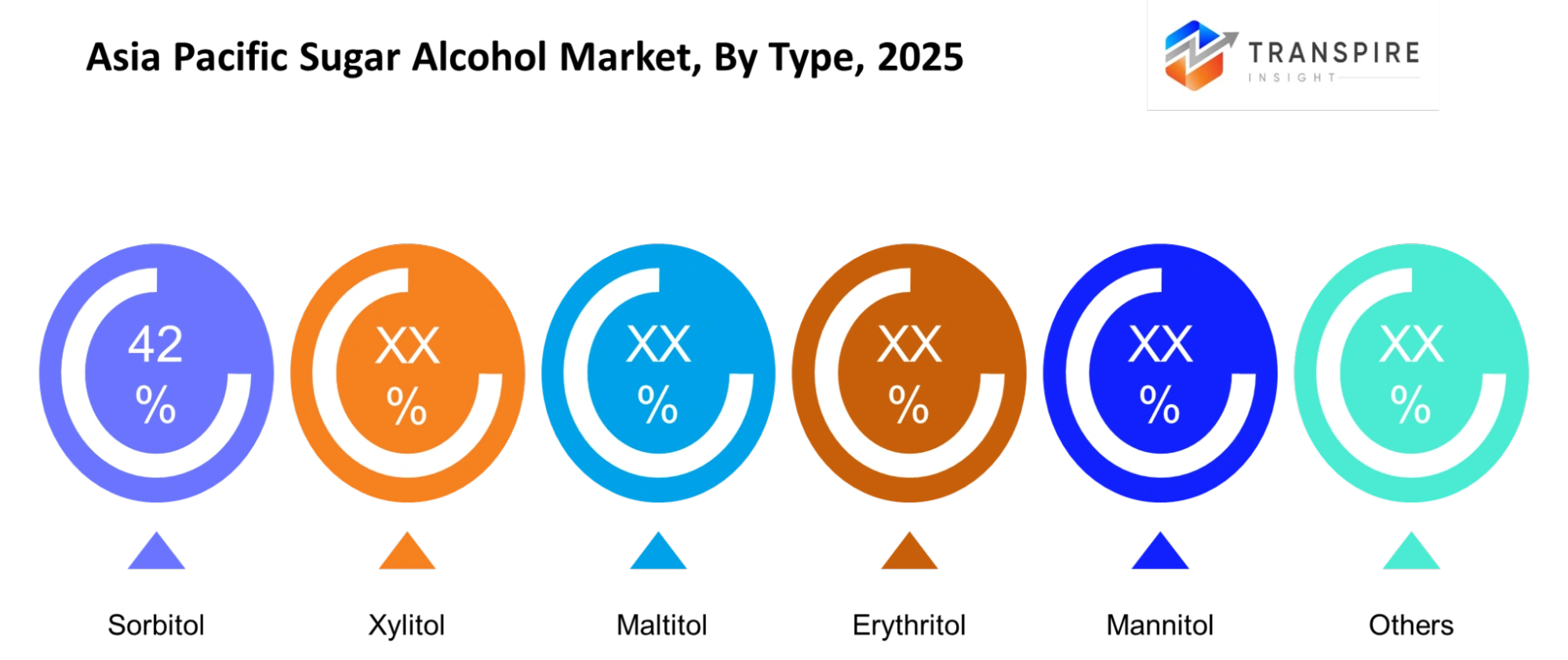
To learn more about this report, Download Free Sample Report
By Application:
The sugar reduction trend will maintain its position as the primary driving force for food and beverage markets. The pharmaceutical industry will expand through the development of diabetes-friendly medical products. The personal care and oral care industries will experience growth because they will use functional ingredients. Nutraceuticals will experience market growth because people increasingly seek wellness products while other sectors will develop special industrial and chemical solutions that meet the needs of changing markets.
The asia pacific sugar alcohol market will show structured segmentation shaped by diverse industrial usage and changing consumption patterns. The demand shift will occur because manufacturers need to develop products that match health guidelines and industry standards while maintaining stable supply and product quality throughout different market sectors.
By Form:
The product exists in multiple forms which include Powder Liquid Granules Crystals Syrup and Others. The powder form will become the primary choice for users because it enables easier handling and provides storage stability. The liquid versions of the product will be used in beverage production. Granules and crystals will suit confectionery and tabletop uses. Syrup forms will remain important in processed foods, while others will address customized industrial processing requirements with flexible formulation options.
By End-User:
The food industry will maintain continuous demand for sugar alternatives which will make it the most consumed product by end-users from the food industry and pharma and cosmetics and healthcare and industrial and other sectors. The pharmaceutical industry will increase its use of these drugs for medical purposes. The cosmetics and healthcare industries will use functional ingredients to improve their product formulations. Industrial users will apply these compounds in specialized processes while others will use them for developing new applications and emerging technologies.
What are the Main Challenges for the Asia Pacific Sugar Alcohol Market Growth?
The Asia Pacific sugar alcohol market needs to overcome multiple technical and operational obstacles which prevent its various industries from achieving stable growth. The quality of raw materials and the efficiency of fermentation processes will determine product quality in large-scale manufacturing operations. The stability of some sugar alcohols will cause digestive tolerance problems which will affect how they are used in product development. The operations of the Asia Pacific sugar alcohol market will face two major problems which include supply chain interruptions and production capacity limitations at new manufacturing locations.
The Asia Pacific sugar alcohol market will experience slower development because of manufacturing and commercialization obstacles. The production processes of the industry will maintain high operational costs because of the need to generate electricity and the costs associated with purification and advanced processing methods. The need to meet strict food safety regulations and pharmaceutical-grade standards will result in higher operational expenses and longer product approval times. The existing growth obstacles will prevent smaller manufacturers from competing in the market which will result in reduced innovation and restricted market access.
Developing countrieswill face persistent adoption challenges because theylack proper infrastructure and necessary technical skills. The asia pacific sugar alcohol market will experience growth limitations because most consumers do not know about the product and tend to avoid purchasing it when prices increase. The less-developed regions will continue to face expansion restrictions because of insufficient funding for modern processing plants and the absence of qualified workers.
The market competition together with upcoming dangers will create additional challenges because alternative sweeteners like stevia and monk fruit become more popular. The market will face uncertainty through pricing pressure and changing regulatory systems which will reinforce current market boundaries while hindering complete business expansion.
Regional Insights
China will dominate production because its manufacturing system and cost benefits enable continuous supply to all industrial sectors. Japan will focus on high-quality applications with strict standards in food and healthcare sectors. India will witness rising demand driven by changing dietary habits, while Southeast Asia will show gradual expansion supported by urbanization and processed food consumption trends.
The sugar alcohol market in Asia Pacific will develop according to different regional factors which include industrial capacity, regulatory frameworks and consumer behavior patterns. Established economies will maintain stable growth through innovation and quality-focused production, while developing regions will continue to build capabilities to meet rising domestic needs without disrupting supply balances across sectors. Established economies will maintain stable growth through innovation and quality-focused production, while developing regions will continue building capabilities to meet rising domestic needs without disrupting supply balance across sectors.
Australia and South Korea will concentrate on developing advanced applications and high-end products through their extensive research capabilities and regulatory systems. The three emerging economies of Indonesia, Vietnam, and Thailand will witness steady demand growth as more people become aware of low-calorie alternatives. The supply distribution and pricing stability across markets will be affected by regional trade dynamics.
Recent Development News
In March 2025, Zhejiang Huakang announced acquisition of Henan Yuxin Sugar Alcohol. The deal made Henan Yuxin an operating subsidiary, strengthening Huakang’s production footprint in China’s sugar alcohol (polyol) segment.https://pitchbook.com
In March 2026, Jungbunzlauer reported acquisition of Alliance Gums & Industries (earlier disclosed but highlighted in 2026 strategic updates), expanding its capabilities to integrate polyols like erythritol into advanced ingredient blends for Asia-Pacific and global markets.https://www.usdanalytics.com
|
Report Metrics |
Details |
|
Market size value in 2025 |
USD 1090.9 Million |
|
Market size value in 2026 |
USD 1176.1 Million |
|
Revenue forecast in 2033 |
USD 2046.7 Million |
|
Growth rate |
CAGR of 8.24% from 2026 to 2033 |
|
Base year |
2025 |
|
Historical data |
2021 - 2024 |
|
Forecast period |
2026 - 2033 |
|
Report coverage |
Revenue forecast, competitive landscape, growth factors, and trends |
|
Regional scope |
Asia Pacific ( China, India, Japan, South Korea, Australia, Rest of Asia Pacific) |
|
Key company profiled |
Roquette, Cargill, Ingredion, Tate & Lyle, ADM, Mitsubishi Chemical, Tereos, SPI Pharma, Gulshan Polyols, Shandong Futaste, Baolingbao, Zhucheng Dongxiao, B Food Science, Danisco, Archer Daniels Midland |
|
Customization scope |
Free report customization (country, regional & segment scope). Avail customized purchase options to meet your exact research needs. |
|
Report Segmentation |
By Type (Sorbitol, Xylitol, Maltitol, Erythritol, Mannitol, Others); By Application (Food & Beverages, Pharmaceuticals, Personal Care, Oral Care, Nutraceuticals, Others); By Form (Powder, Liquid, Granules, Crystals, Syrup, Others); By End-User (Food Industry, Pharma, Cosmetics, Healthcare, Industrial, Others) |
How Can New Companies Establish a Strong Foothold in the Asia Pacific Sugar Alcohol Market ?
New entrants can build a strong position in the asia pacific sugar alcohol market by focusing on niche segments that remain underserved, such as clean-label sweeteners or pharmaceutical-grade formulations. New companies will achieve better results when they concentrate their efforts on developing specific products such as diabetic-friendly foods and oral care products. The approach enables emerging players to respond to consumer demand shifts because it matches current industry trends in the asia pacific sugar alcohol market.
The company will achieve success through its innovation strategies. Advanced fermentation techniques and bio-based production methods provide companies with cost-saving and product consistency advantages. The company will achieve production efficiency and quality control through its technological capabilities that use predictive analytics and process automation. Process innovation enables startups like Zhucheng Dongxiao Biotechnology to enhance their competitive strength in the asia pacific sugar alcohol market while smaller regional businesses test plant-based erythritol alternatives.
Market entry and expansion will receive acceleration through strategic partnerships. The company will establish partnerships with food manufacturers and healthcare organizations and regional distributors to create market access pathways and shorten product launch timelines. New companies will establish local production networks to solve important business problems which include supply chain problems and pricing challenges. The asia pacific sugar alcohol market will reward businesses that combine innovation with strong distribution strategies and a clear understanding of regional demand patterns.
Key Asia Pacific Sugar Alcohol Market Company Insights
The competitive landscape shows that global corporations will achieve sustained market leadership through their extensive operations and existing distribution systems and their ability to deliver reliable product quality across various market sectors. The company will achieve financial stability through its continuous commitment to production efficiency and cost management whereas its strong brand recognition will enable it to retain essential customers in the food and pharmaceutical and personal care markets.
The sugar alcohol market in the Asia Pacific will create a competitive market space which combines worldwide corporations with local manufacturing companies. The market will determine product availability through two main elements: pricing and consistent product delivery. The market participants will implement two main strategies which include cost-efficient operations and innovative product development to maintain market presence during shifting consumer preferences.
The regional market competition will take place as domestic companies provide customers with two main advantages: flexible pricing and the ability to deliver products that match local market needs. The company will achieve stronger market presence through strategic expansion together with its local distributor partnerships and its particular application focus. The implementation of advanced processing techniques will enable smaller businesses to improve their product quality, allowing them to compete successfully against major international companies.
Company List
- Roquette
- Cargill
- Ingredion
- Tate & Lyle
- ADM
- Mitsubishi Chemical
- Tereos
- SPI Pharma
- Gulshan Polyols
- Shandong Futaste
- Baolingbao
- Zhucheng Dongxiao
- B Food Science
- Danisco
- Archer Daniels Midland
What are the Key Use-Cases Driving the Growth of the Asia Pacific Sugar Alcohol Market ?
The Asia Pacific sugar alcohol industry experiences growth because of increased demand from food and beverage companies which use sugar substitutes in their bakery products and confectionery items and functional drinks. Manufacturers use sorbitol and erythritol as dual-purpose ingredients because they enable calorie reduction without compromising food taste and texture. The market experiences growth because users adopt products which contain less sugar and are suitable for people with diabetes in urban areas.
The Asia Pacific sugar alcohol market experiences expansion in pharmaceutical and healthcare markets through its usage in medicinal syrups and chewable tablets and medicinal products. Diabetic patients can safely consume sugar alcohols because these substances do not cause tooth decay and their body absorption rate stays controlled. The practical application of this solution leads to increased usage among people who need safer excipients because they understand healthcare better.
The Asia Pacific sugar alcohol market receives major support from both the oral care and personal care product segments. Xylitol appears in toothpaste and chewing gum products because it promotes dental health, while other polyols serve as moisture-preserving ingredients in skincare products. The existing use cases for these products develop ongoing customer needs while creating new chances for innovation in high-end product categories.
Manufacturers will enhance their production capacity through industrial and nutraceutical uses which will drive their development of specialized formulas and fortified food items. The Asia Pacific sugar alcohol market will maintain its growth through various practical uses which provide health advantages and functional benefits.
Asia Pacific Sugar Alcohol Market Report Segmentation
By Type
- Sorbitol
- Xylitol
- Maltitol
- Erythritol
- Mannitol
- Others
By Application
- Food & Beverages
- Pharmaceuticals
- Personal Care
- Oral Care
- Nutraceuticals
- Others
By Form
- Powder
- Liquid
- Granules
- Crystals
- Syrup
- Others
By End-User
- Food Industry
- Pharma
- Cosmetics
- Healthcare
- Industrial
- Others
Frequently Asked Questions
Find quick answers to common questions.
The Approximate Asia Pacific Sugar Alcohol Market size for the Market will be USD 2046.7 Million in 2033.
Key segments for the Asia Pacific Sugar Alcohol Market are By Type (Sorbitol, Xylitol, Maltitol, Erythritol, Mannitol, Others); By Application (Food & Beverages, Pharmaceuticals, Personal Care, Oral Care, Nutraceuticals, Others); By Form (Powder, Liquid, Granules, Crystals, Syrup, Others); By End-User (Food Industry, Pharma, Cosmetics, Healthcare, Industrial, Others).
Major Asia Pacific Sugar Alcohol Market Players are Roquette, Cargill, Ingredion, Tate & Lyle, ADM, Mitsubishi Chemical, Tereos, SPI Pharma, Gulshan Polyols, Shandong Futaste, Baolingbao, Zhucheng Dongxiao, B Food Science, Danisco, Archer Daniels Midland.
The current Asia Pacific Sugar Alcohol Market size is USD 1090.9 Million in 2025.
The Asia Pacific Sugar Alcohol Market CAGR is 8.24%.
- Roquette
- Cargill
- Ingredion
- Tate & Lyle
- ADM
- Mitsubishi Chemical
- Tereos
- SPI Pharma
- Gulshan Polyols
- Shandong Futaste
- Baolingbao
- Zhucheng Dongxiao
- B Food Science
- Danisco
- Archer Daniels Midland
Recently Published Reports
-
Dec 2024
Healthcare Polymer Packaging Market
Healthcare Polymer Packaging Market Size, Share & Analysis Report By Packaging Type (Syringes, IV Bottles and Pouches, Clamshells, Blisters, Bottles & Jars, Containers, Tubes, IV Parental Packaging, Others), By Type (Regulated, Non-regulated), By Polymer Type (LDPE (Low-Density Polyethylene), HDPE (High-Density Polyethylene), Homo-polymer (Homo), Random Copolymer (Random), Block Copolymer (Block), PET, Polystyrene, Polyvinyl Chloride, Polyamide/EVOH, Others), and Geography (North America, Europe, Asia-Pacific, Middle East and Africa, South and Central America), 2021 - 2031
-
Jan 2025
Hydrophilic Tape (Waterstop) Market
Hydrophilic Tape (Waterstop) Market Size, Share & Analysis Report By Type (Bentonite-Based Hydrophilic Tape, Rubber-Based Hydrophilic Tape), By Application (Residential Buildings, Commercial Buildings, Infrastructure Projects), and Geography (North America, Europe, Asia-Pacific, Middle East and Africa, South and Central America), 2021 - 2031
-
Jan 2025
Metalens Market
Metalens Market Size, Share & Analysis Report By Type (Visible Light Metalens, and Infrared Metalens), By Application (Consumer Electronics, Automotive Electronics, Industrial, Medical, and Others), and Geography (North America, Europe, Asia-Pacific, Middle East and Africa, South and Central America), 2021 - 2031
-
Jan 2025
PBT Resin Market
PBT Resin Market Size, Share & Analysis Report By Type (Reinforced PBT Resin, Unreinforced PBT Resin), By Processing Method (Injection Molding, Extrusion, Blow Molding, Others), By End-User (Automotive, Electrical & Electronics, Consumer Appliances, Industrial Machinery, Medical Devices, Packaging, Others), and Geography (North America, Europe, Asia-Pacific, Middle East and Africa, South and Central America), 2021 - 2031