

Middle East and Africa Gastroesophageal Reflux Disease (GRED) - Gastrointestinal diagnostics Market & Forecast:
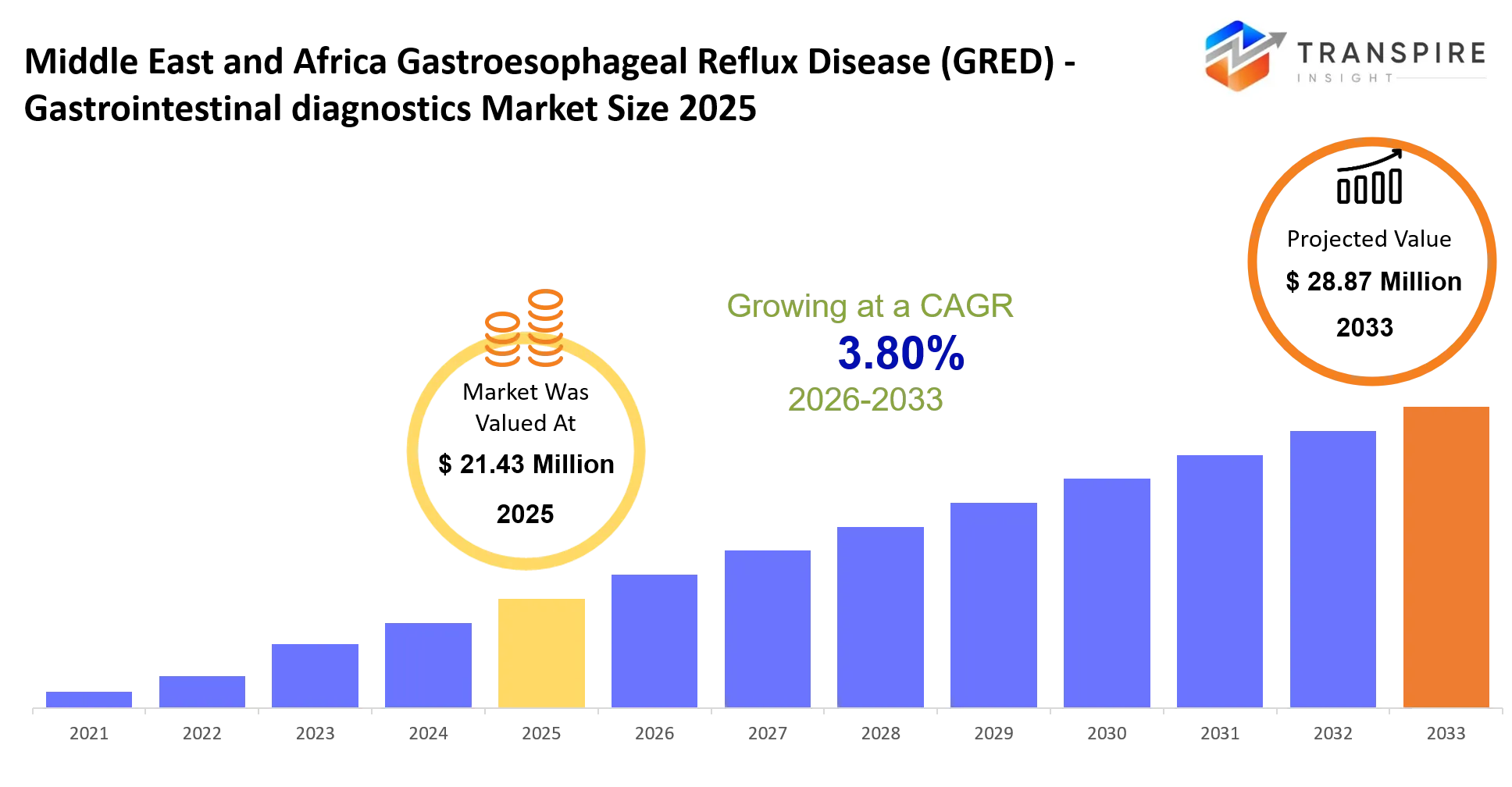
- Middle East and Africa Gastroesophageal Reflux Disease (GRED) - Gastrointestinal diagnostics Market 2025: USD 21.43 Million
- Middle East and Africa Gastroesophageal Reflux Disease (GRED) - Gastrointestinal diagnostics Market 2033: USD 28.87 Million
- Middle East and Africa Gastroesophageal Reflux Disease (GRED) - Gastrointestinal diagnostics Market CAGR: 3.80%
- Middle East and Africa Gastroesophageal Reflux Disease (GRED) - Gastrointestinal diagnostics Market Segments: By Diagnostic Type (Endoscopy, Esophageal pH Monitoring, Manometry, Barium Swallow Test, Biopsy, Capsule Endoscopy, Imaging Tests, Others); By End User (Hospitals, Diagnostic Centers, Specialty Clinics, Research Institutes, Ambulatory Centers, Others); By Technology (Conventional Diagnostics, Digital Diagnostics, AI-Assisted Diagnostics, Wireless Monitoring, Others); By Patient Type (Adults, Pediatrics, Geriatrics, Others)
Middle East and Africa Gastroesophageal Reflux Disease (GRED) - Gastrointestinal diagnostics Market Summary
The Middle East and Africa Gastroesophageal Reflux Disease (GRED) - Gastrointestinal diagnostics Market was valued at USD 21.43 Million in 2025. It is forecast to reach USD 28.87 Million by 2033. That is a CAGR of 3.80% over the period.
The Middle East and Africa Gastroesophageal Reflux Disease (GERD) Gastrointestinal Diagnostics Market plays a critical role in getting to what’s really going on behind chronic acid reflux, trouble swallowing, esophageal harm, and several other GI troubles. Tools such as endoscopy, pH tracking, manometry, and newer imaging approaches help clinicians verify how intense the condition is, guide care choices, and reduce complications that can happen when diagnosis arrives too late.
Over the past five years, the market looks like it has gradually moved away from the older symptom-first way to evaluate patients, and toward more tech driven diagnostic routes. These routes often blend high-definition endoscopy, wireless monitoring setups, and AI assisted interpretation of captured images, so the overall workflow becomes quicker and more targeted. A major driver behind this change is the rising burden of obesity, the lifestyle triggered digestive problems, plus the continued population aging seen across Gulf states and South Africa. Healthcare providers are leaning toward earlier, more precise detection to reduce the long-run cost of therapy, and also to curb hospital admissions. As a result, usage rates for advanced diagnostic platforms are growing, healthcare spending is following, and the whole ecosystem keeps generating repeat income from diagnostic sessions, equipment renewals, and related clinical services in the region.
Key Market Insights
- Gulf Cooperation Council countries basically account for almost 45% of the regional revenue in 2025, and this is backed by advanced healthcare infrastructure , plus high endoscopy procedure volumes too.
- Sub-Saharan Africa looks like it will be the fastest-growing regional market by 2033, yes mostly because of healthcare investments, and broader diagnostic capacity expansion at the same time.
- Endoscopy still takes the lead with more than 35% market share, and that kind of dominance shows how central it is for confirming GERD severity and spotting esophageal complications early.
- Esophageal pH monitoring sits in the second spot as the largest diagnostic segment, helped along by wider use of objective reflux assessment protocols , which is steadily increasing.
- Wireless monitoring technologies are projected to grow above the regional average through 2033, improving patient comfort, and also making diagnostic results a bit more accurate.
- Hospitals contribute about 50% of total market revenue, supported by integrated gastroenterology departments, along with specialized diagnostic units that are already in place.
- Specialty clinics keep expanding their footprint since outpatient gastrointestinal testing is getting more acceptance across many urban healthcare networks
- AI-assisted diagnostic platforms are speeding up adoption as well, with manufacturers building lesion detection, and image enhancement features directly into endoscopy workflows.
- Strategic expansion actions by Olympus, Fujifilm, Medtronic, Boston Scientific, and Philips are also strengthening regional distribution channels.
- In the end, product innovation, AI-enabled imaging, physician training programs, and partnerships with healthcare providers, they all remain the major competitive moves across the regional gastrointestinal diagnostics industry.
What are the Key Drivers, Restraints, and Opportunities in the Middle East and Africa Gastroesophageal Reflux Disease (GRED) - Gastrointestinal diagnostics Market?
The strongest growth driver is kind of a transition toward evidence based gastrointestinal disease management. Healthcare systems, more and more, seem to require objective confirmation of reflux disease before starting long term treatment or going straight into surgery. At the same time expanded access to high definition endoscopy, ambulatory pH monitoring, and esophageal manometry has helped improve diagnostic precision, and also reduces the old reliance on symptom only diagnosis. This whole shift boosts procedure volumes, pushes equipment utilization rates upward, and increases demand for advanced diagnostic platforms, and that basically supports market revenue growth directly.
Limited access to specialized gastrointestinal diagnostic infrastructure stays the biggest structural issue. In several parts of Africa, many facilities still deal with shortages of trained gastroenterologists, advanced endoscopy equipment and dedicated diagnostic centers. To build those capabilities takes a lot of capital spending, workforce training, and long implementation timelines. So, a lot of patients end up receiving empirical treatment without a proper diagnostic evaluation, which limits market penetration and also slows the adoption of advanced technologies.
Wireless and AI assisted diagnostics feel like a major future opportunity. Wireless pH monitoring systems support better patient adherence and they also allow longer observation windows compared with the conventional catheter based approach. Meanwhile AI enhanced endoscopy platforms can help clinicians spot subtle mucosal irregularities with more steadiness and repeatability.
What Has the Impact of Artificial Intelligence Been on the Middle East and Africa Gastroesophageal Reflux Disease (GRED) - Gastrointestinal diagnostics Market?
Artificial intelligence is gradually transforming gastrointestinal diagnostics in a way that makes the workflow more efficient ,the image reading steadier, and the overall diagnostic results more consistent. AI supported endoscopy platforms help clinicians spot faint tissue irregularities, early lesions, and even precancerous changes that might slip past in everyday examinations. With real time image enhancement, physicians can usually pick out clinically meaningful findings faster and with better accuracy
At the same time, machine learning routines are being folded into diagnostic software to sift through very large datasets from pH monitoring setups, esophageal manometry studies, and various imaging procedures. These systems make interpretation quicker, cut down on reporting differences, and strengthen clinical decision-making. As a result hospitals can spend less time on procedure review and use specialist capacity more effectively
Beyond that, advanced digital systems also enable predictive analytics, by flagging recurring patterns linked to how disease progresses, how a patient responds to treatment, and the likelihood of recurrence later. In practice, this kind of foresight may improve patient management and also limit unnecessary repeat procedures
Still, the rollout is not smooth everywhere because adoption is held back by high implementation costs ,complicated integration steps, and a lack of large regional datasets needed to train the AI algorithms properly. Smaller healthcare facilities often run into budget limits which then slow down deployment of these AI enabled diagnostic platforms.
Key Market Trends
- High-definition endoscopy adoption went up a lot, sort of, from 2021 into 2025, as hospitals kept upgrading older imaging systems that were getting outdated, like quickly.
- AI-assisted lesion detection tools moved into routine clinical workflows in major regional healthcare centers during 2024–2026 , and it didn’t stay limited to pilot programs for long.
- Wireless pH monitoring use expanded by over 20% across leading Gulf healthcare networks, since 2022, even though some teams were hesitant at first.
- Healthcare providers started shifting away from symptom-driven GERD evaluation and toward a more objective diagnostic confirmation before any treatment decisions get made, which sounds obvious but it really changed practice.
- Hospital-based gastroenterology units put significant money into digital reporting and image management platforms after 2023 , so less time was wasted hunting for files, or rechecking histories.
- Better imaging features coming from Olympus and Fujifilm improved visualization clarity and overall diagnostic confidence throughout endoscopy procedures, in a way clinicians could feel.
- Outpatient diagnostic procedures gained momentum, mainly because healthcare systems were trying to cut inpatient service costs while still moving patients forward.
- Private regional healthcare investment also accelerated the rollout of dedicated gastrointestinal diagnostic centers between 2022 and 2026 , almost like a domino effect across some markets.
- Cloud-based diagnostic platform integration helped specialists coordinate more smoothly with referral facilities, and this reduced delays in shared decision making.
- Competitive energy increasingly leans toward software innovation, workflow optimization, and AI-enabled diagnostic assistance , rather than focusing only on hardware updates and equipment.
Middle East and Africa Gastroesophageal Reflux Disease (GRED) - Gastrointestinal diagnostics Market Segmentation
By Diagnostic Type
Endoscopy still is the most widely used diagnostic approach, because direct viewing of the esophagus lets clinicians check inflammation, erosions, ulcers, and structural irregularities. Esophageal pH Monitoring also stays crucial for verifying acid exposure, and for lining up symptoms with reflux episodes. Manometry assists in assessing esophageal motility disorders, it even helps clinicians understand swallowing function, prior to any therapeutic move. Meanwhile a Barium Swallow Test keeps some importance for structural assessment especially when more advanced testing is not readily available.
Biopsy procedures give a tissue-level look when Barrett’s esophagus, malignancy, or other pathological states need confirmation. Capsule Endoscopy is a less invasive visualization option, and it can be useful in certain clinical situations. Imaging Tests, like CT and MRI, help with a wider gastrointestinal review when extra anatomical details are needed. There are also other emerging diagnostic methods and complementary assessment tools that collectively support a fuller gastrointestinal workup across different healthcare environments.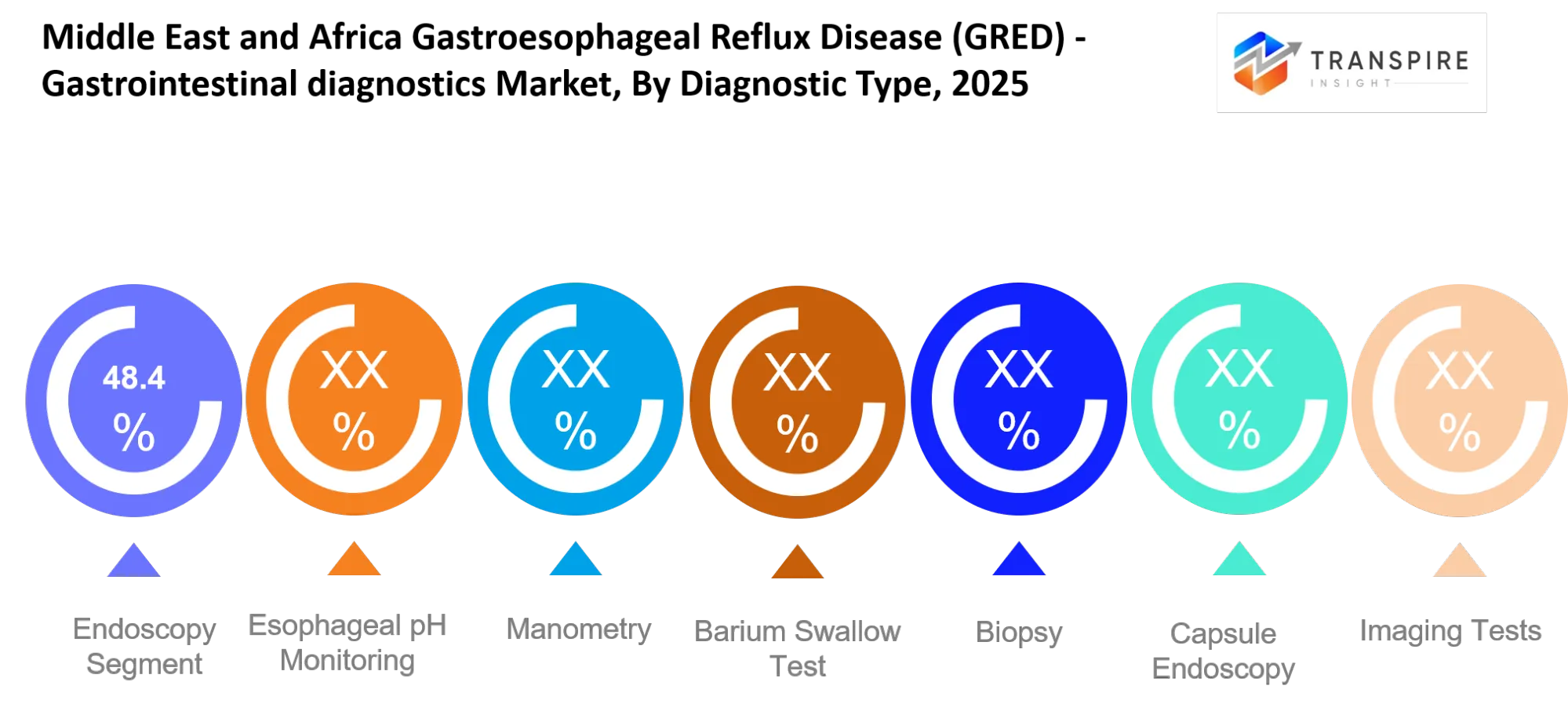
By End User
Hospitals end up taking the largest share, mostly since a solid diagnostic infrastructure , plus specialist know-how and multidisciplinary care pathways helps drive a big amount of procedures. Diagnostic Centers also matter a lot, because they run dedicated testing services, handle scheduling in a quick way, and focus on specialized gastrointestinal assessments. Specialty Clinics keep growing too, as outpatient gastroenterology services become easier to reach across most city healthcare markets.
Research Institutes back clinical studies, validate technology, and push forward newer diagnostic methods. Ambulatory Centers offer more convenient testing set ups, with fewer patient waiting periods and lower operating expenses. Others are basically private healthcare facilities and community based providers that give selected gastrointestinal diagnostic services depending on local healthcare needs and what resources are available.
By Technology
Conventional Diagnostics still end up serving a lot of healthcare facilities, mostly because of already established clinical protocols and pretty wide access. Traditional endoscopy systems, catheter based monitoring, and usual imaging solutions are still some of the key parts used for routine gastrointestinal evaluation. At the same time, Digital Diagnostics are getting more attention ,thanks to better visualization, electronic reporting, and this kind of integrated data management capability.
AI-Assisted Diagnostics are kind of a fast growing area that zooms in on image interpretation, lesion finding, and smoothing out the workflow. Wireless Monitoring technologies can make patients more comfortable, and they help monitoring last longer, especially for reflux assessment. There are also other routes like hybrid diagnostic platforms and newer technologies, those are aiming to sharpen accuracy ,increase efficiency, and add clinical decision support across gastrointestinal diagnostics.
By Patient Type
Adults show up as the biggest patient chunk, largely because lifestyle factors, the spread of obesity, everyday dietary habits, and workplace stress all pile on to reflux disease occurrence. In real-world clinical routes for adult patients, there are often fairly detailed diagnostic evaluations, to figure out how severe it is , and then to shape the treatment approach. Diagnostic use seems strongest in middle-aged groups, especially those stuck with persistent reflux symptoms over time.
Pediatrics, meanwhile, needs more specialized diagnostic approaches, not only for age specific presentations, but also to keep patient comfort front and center. Geriatrics make up a notable portion too, since chronic gastrointestinal disorders are more common, plus the downstream complications can show up more often. There are also other patient cohorts, with their own clinical requirements, where individualized diagnostic assessment and ongoing monitoring really matter.
What are the Key Use Cases Driving the Middle East and Africa Gastroesophageal Reflux Disease (GRED) - Gastrointestinal diagnostics Market?
The main thing seems to be confirming chronic reflux disease when patients have persistent heartburn, regurgitation, and general esophageal discomfort like, constantly. In practice, endoscopic evaluation really creates a lot of diagnostic workload, because physicians need a direct look at tissue changes before they can decide the long term plan.
There are also additional uses, like pre-surgical assessment for anti reflux procedures, and checking into swallowing disorders too. More and more specialty clinics and hospital gastroenterology teams are turning to pH monitoring along with manometry to sort out tricky cases where symptoms by themselves don’t give enough clarity.
And then there are the newer directions, such as AI aided risk stratification and remote monitoring solutions, these help with a more personalized kind of disease management. There are also advanced digital platforms that help flag Barrett’s esophagus and other precancerous findings earlier, so clinicians can create preventive interventions and continue monitoring over time.
|
Report Metrics |
Details |
|
Market size value in 2025 |
USD 21.43 Million |
|
Market size value in 2026 |
USD 22.24 Million |
|
Revenue forecast in 2033 |
USD 28.87 Million |
|
Growth rate |
CAGR of 3.80% from 2026 to 2033 |
|
Base year |
2025 |
|
Historical data |
2021 - 2024 |
|
Forecast period |
2026 - 2033 |
|
Report coverage |
Revenue forecast, competitive landscape, growth factors, and trends |
|
Regional scope |
United States; Canada; Mexico; United Kingdom; Germany; France; Italy; Spain; Denmark; Sweden; Norway; China; Japan; India; Australia; South Korea; Thailand; Brazil; Argentina; South Africa; Saudi Arabia; United Arab Emirates |
|
Key company profiled |
Medtronic, Olympus, Fujifilm, Boston Scientific, Cook Medical, Medtronic GI, Laborie, Diversatek, Pentax Medical, Karl Storz, ConMed, GE HealthCare, Siemens Healthineers, Philips, Canon Medical |
|
Customization scope |
Free report customization (country, regional & segment scope). Avail customized purchase options to meet your exact research needs. |
|
Report Segmentation |
By Diagnostic Type (Endoscopy, Esophageal pH Monitoring, Manometry, Barium Swallow Test, Biopsy, Capsule Endoscopy, Imaging Tests, Others); By End User (Hospitals, Diagnostic Centers, Specialty Clinics, Research Institutes, Ambulatory Centers, Others); By Technology (Conventional Diagnostics, Digital Diagnostics, AI-Assisted Diagnostics, Wireless Monitoring, Others); By Patient Type (Adults, Pediatrics, Geriatrics, Others) |
Which Regions are Driving the Middle East and Africa Gastroesophageal Reflux Disease (GRED) - Gastrointestinal diagnostics Market Growth?
The Gulf Cooperation Council area is basically the main driver in market revenue generation. Saudi Arabia, United Arab Emirates, and Qatar keep going with heavy investment into advanced healthcare infrastructure, plus specialized gastroenterology services. You can see this because solid healthcare spending, favorable reimbursement environments, and the widespread take up of modern endoscopy technologies all back up that leadership. Also, big private hospital networks just reinforce diagnostic strength and make it easier to roll out new technologies.
South Africa is next in line as the second-largest contributor, and it feels a bit different from the Gulf markets, since the mix is more balanced between public and private healthcare investment. There are well established medical institutions, experienced specialists, and diagnostic capabilities that are already somewhat mature. That combination helps keep market performance steady. On top of that, ongoing equipment upgrades and continual modernization efforts help preserve demand for gastrointestinal diagnostic technologies.
Meanwhile, the wider African region is projected to build the strongest growth momentum through 2033. More healthcare investment, international funding programs, and broader access to specialized diagnostic services are making market conditions better. New healthcare facilities are being developed, and trained medical professionals are becoming more available too, so it’s opening new windows for technology providers and investors who want long-term growth.
Who are the Key Players in the Middle East and Africa Gastroesophageal Reflux Disease (GRED) - Gastrointestinal diagnostics Market and How Do They Compete?
Competition sits at a pretty medium-to-high level, mostly around big medical technology companies, especially those with real depth in endoscopy, imaging, and gastrointestinal diagnosis. In practice, the “why” of competition stays pretty tied to technology innovation, though clinical results, physician education, service support, and local distribution abilities also play a role. More and more, companies don’t just sell a standalone device they try to build an integrated diagnostic ecosystem instead.
Olympus kind of stands out with its more advanced endoscopic imaging platforms, including EVIS X1 technologies, which help improve visualization, and make lesion detection more noticeable. It keeps pushing ongoing innovation in things like image enhancement plus workflow optimization, which helps it stay in a strong position with major healthcare providers. Fujifilm leans harder into high-definition imaging, LED-based endoscopy systems and integrated diagnostic options, aimed at improving image quality while speeding up procedures.
Medtronic is expanding through AI-supported gastrointestinal diagnostics, especially GI Genius technology, meant to support real time lesion detection while endoscopy is happening. Boston Scientific, instead, puts more emphasis on therapeutic and diagnostic integration, so clinicians can handle diagnosis and treatment in one unified clinical flow. On top of that, players like Philips, Siemens Healthineers and GE HealthCare add pressure via advanced imaging systems, digital health platforms, and diagnostic approaches that rely on data.
Company List
- Medtronic
- Olympus
- Fujifilm
- Boston Scientific
- Cook Medical
- Medtronic GI
- Laborie
- Diversatek
- Pentax Medical
- Karl Storz
- ConMed
- GE HealthCare
- Siemens Healthineers
- Philips
- Canon Medical
Recent Development News
In February 2026, Medtronic announced CE Mark approval for the next-generation GI Genius™ module and ColonPRO™ software. The development expanded AI-assisted endoscopy capabilities through real-time polyp size estimation and advanced procedural analytics, strengthening diagnostic efficiency and clinical decision support.https://news.medtronic.com
In October 2025, Fujifilm launched the ELUXEO® 8000 Endoscopic Imaging System. The platform introduced enhanced LED multi-light technology, improved image quality, and workflow efficiencies that support more advanced gastrointestinal diagnostic procedures.https://www.fujifilm.com
In October 2025, Olympus launched the NBI+TXI observation mode for its EVIS X1™ endoscopy system. The innovation combined multiple imaging technologies into a single view to improve lesion visualization and diagnostic accuracy during gastrointestinal examinations.https://www.olympus-global.com
What Strategic Insights Define the Future of the Middle East and Africa Gastroesophageal Reflux Disease (GRED) - Gastrointestinal diagnostics Market?
The market seems to be moving toward integrated digital diagnostic ecosystems, where advanced imaging, wireless monitoring, AI-assisted interpretation, and electronic clinical workflows sort of run as one connected platform. This push is being nudged by healthcare systems that want earlier disease detection, better diagnostic consistency, and improved resource use. In the future, competitive edge will likely hinge more on software muscle and data integration than on hardware alone .
There is also a less obvious risk hiding in plain sight: advanced technology supply is concentrating among a smaller group of multinational manufacturers. So if a supply chain hiccups, if regulatory approvals drag, or if pricing pressure hits those same vendors, technology adoption could slow in several countries at once.
On the other hand, there’s a pretty solid opportunity in AI-enabled outpatient diagnostics and remote gastrointestinal monitoring, especially across fast-growing healthcare markets in Africa. Firms that start regional training programs early, build local service infrastructure , and form digital diagnostic partnerships quickly may be better placed to grab the emerging demand. Strategic investment in scalable, cost-effective diagnostic platforms should stay high on the list for both established players and new entrants.
Middle East and Africa Gastroesophageal Reflux Disease (GRED) - Gastrointestinal diagnostics Market Report Segmentation
-
By Diagnostic Type
Endoscopy
Esophageal pH Monitoring
Manometry
Barium Swallow Test
Biopsy
Capsule Endoscopy
Imaging Tests
Others -
By End User
Hospitals
Diagnostic Centers
Specialty Clinics
Research Institutes
Ambulatory Centers
Others -
By Technology
Conventional Diagnostics
Digital Diagnostics
AI-Assisted Diagnostics
Wireless Monitoring
Others -
By Patient Type
Adults
Pediatrics
Geriatrics
Others
Frequently Asked Questions
Find quick answers to common questions.
The Expected Middle East and Africa Gastroesophageal Reflux Disease (GRED) - Gastrointestinal Diagnostics Market for the market will be USD 28.87 Million in 2033.
Key Segments for the Middle East and Africa Gastroesophageal Reflux Disease (GRED) - Gastrointestinal diagnostics Market are By Diagnostic Type (Endoscopy, Esophageal pH Monitoring, Manometry, Barium Swallow Test, Biopsy, Capsule Endoscopy, Imaging Tests, Others); By End User (Hospitals, Diagnostic Centers, Specialty Clinics, Research Institutes, Ambulatory Centers, Others); By Technology (Conventional Diagnostics, Digital Diagnostics, AI-Assisted Diagnostics, Wireless Monitoring, Others); By Patient Type (Adults, Pediatrics, Geriatrics, Others).
Major Middle East and Africa Gastroesophageal Reflux Disease (GRED) - Gastrointestinal diagnostics Market players are Medtronic, Olympus, Fujifilm, Boston Scientific, Cook Medical, Medtronic GI, Laborie, Diversatek, Pentax Medical, Karl Storz, ConMed, GE HealthCare, Siemens Healthineers, Philips, Canon Medical.
The Current Middle East and Africa Gastroesophageal Reflux Disease (GRED) - Gastrointestinal Diagnostics Market is USD 21.43 Million in 2025.
The Middle East and Africa Gastroesophageal Reflux Disease (GRED) - Gastrointestinal diagnostics Market CAGR is 3.80% from 2026 to 2033.
- Medtronic
- Olympus
- Fujifilm
- Boston Scientific
- Cook Medical
- Medtronic GI
- Laborie
- Diversatek
- Pentax Medical
- Karl Storz
- ConMed
- GE HealthCare
- Siemens Healthineers
- Philips
- Canon Medical
About the Authors

Pankaj Ghogare Patil
I am Pankaj Ghogare Patil, a Senior Research Analyst at Transpire Insight, specializing in the Pharmaceutical, Chemicals & Materials, Healthcare IT, and Biotechnology industry. My expertise lies in conducting comprehensive market research, analyzing industry trends, evaluating competitive landscapes, and translating complex data into actionable insights. At Transpire Insight, I closely follow emerging technologies, regulatory developments, and market innovations to create accurate, well-researched, and informative content that helps businesses and professionals make informed decisions. I am committed to producing credible, evidence-based articles that reflect industry best practices while making technical topics accessible and valuable for a broad audience.

Chakradhar Khansole
Chakradhar serves as the Research Director at Transpire Insight, bringing over 8 years of experience in technology, innovation, and strategic market intelligence. He specializes in transforming complex market data into actionable business insights that enable organizations to make informed, growth-oriented decisions. Recognized for his strategic vision and analytical expertise, Chakradhar leads high-impact research initiatives, delivering comprehensive market assessments, competitive intelligence, and forward-looking industry analysis.
Recently Published Reports
-
Jul 2026
Alopecia Treatment Market
Alopecia Treatment Market Size, Share & Analysis Report By Disease Type (Alopecia Areata, Cicatricial Alopecia, Traction Alopecia, Alopecia Totalis, Androgenetic Alopecia, Alopecia Universalis, and Other Disease Types), By Treatment Type (Topical Treatments, Oral Medications, Injectable Therapies, and Hair Transplantation), By Gender (Male, and Female), By Distribution Channel (Hospitals and Clinics, Retail Pharmacies, and Online Retailers), and Geography (North America, Europe, Asia-Pacific, Middle East and Africa, South and Central America), 2021 - 2031
-
Jul 2026
Medical Ultrasound Probe Market
Medical Ultrasound Probe Market Size, Share & Analysis Report By Type (Linear Type, Convex Type, Endocavitary Probe, Phased Array/Cardiac Probe, Transesophageal (TEE) Probe, and Others), By Application (Ophthalmology, Cardiology, Musculoskeletal, Oncology, Obstetrics & Gynecology, General Imaging, and Others), By End User (Hospitals & Clinics, Diagnostic Centers, Ambulatory Surgical Centers, and Others), and Geography (North America, Europe, Asia-Pacific, Middle East and Africa, South and Central America), 2021 – 2031
-
May 2026
Biosimilars Market
Biosimilars Market By Product Type (Monoclonal Antibodies, Recombinant Hormones, Erythropoietin, G-CSF, Others), By Indication (Oncology, Autoimmune Diseases, Blood Disorders, Diabetes, Others), By Manufacturing Type (In-House Manufacturing, Contract Manufacturing), By Distribution Channel (Hospital Pharmacies, Retail Pharmacies, Online Pharmacies), By Industry Analysis, Size, Share, Growth, Trends, and Forecasts 2021-2033
-
Apr 2026
Gastrointestinal Endoscopy Market
Gastrointestinal Endoscopy Market By Type (Rigid Gastrointestinal Endoscope, Flexible Gastrointestinal Endoscopes, Disposable Gastrointestinal Endoscope), By Procedure Type (Colonoscopy, Gastroscopy, Duodenoscopy, Enteroscopy, Flexible Sigmoidoscopy, Others), By Application (Diagnosis, Treatment), By End-Users (Hospitals, Ambulatory Surgical Centers, Specialty Clinics, Laboratories, Others), By Industry Analysis, Size, Share, Growth, Trends, and Forecasts 2021-2033