
Middle East and Africa Environment Health And Safety Market Size & Forecast:
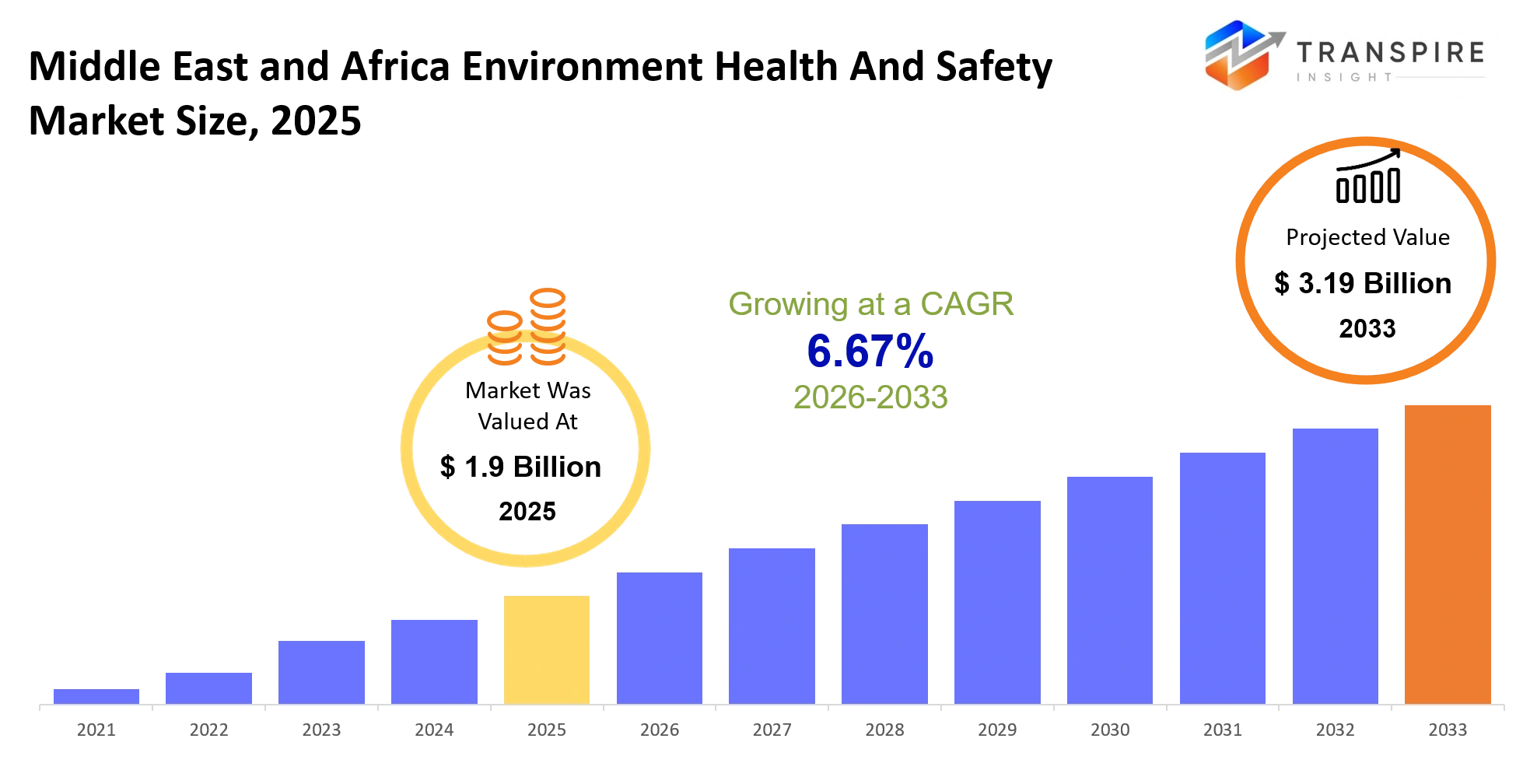
- Middle East and Africa Environment Health And Safety Market Size 2025: USD 1.9 Billion
- Middle East and Africa Environment Health And Safety Market Size 2033: USD 3.19 Billion
- Middle East and Africa Environment Health And Safety Market CAGR: 6.67%
- Middle East and Africa Environment Health And Safety Market Segments: By Component (Software, Services, Hardware, Others); By Deployment (Cloud-based, On-premise, Hybrid, Others); By End User (Oil & Gas, Manufacturing, Construction, Healthcare, Others); By Application (Risk Management, Incident Management, Compliance Management, Occupational Health, Others).
To learn more about this report,  Download Free Sample Report
Middle East and Africa Environment Health And Safety Market Summary
The Middle East and Africa Environment Health And Safety Market was valued at USD 1.9 Billion in 2025. It is forecast to reach USD 3.19 Billion by 2033. That is a CAGR of 6.67%over the period.
The Middle East and Africa Environment Health And Safety (EHS) market helps organizations reduce workplace incidents,handle operational risks, comply with environmental regulations and keep safe industrial operations going across a bunch of sectors, like oil and gas mining, manufacturing utilities and construction. EHS platforms now act as a kind of core business tool, because they tie safety reporting, compliance management,incident tracking and sustainability outcomes together in one digital setup, so people can see things faster.
In the last five years the market sort of moved away from paper-based compliance processes toward cloud based EHS and ESG platforms. These newer tools offer real time visibility into workplace hazards and environmental performance,pretty much in one place. A big reason behind this change has been the tightening occupational safety rules, plus more demanding sustainability disclosure requirements and corporate governance expectations in Gulf Cooperation Council countries and in several African economies. When firms digitize safety management and automate compliance workflows,they tend to cut down on incident related costs,boost audit readiness and also improve operational resilience. The clear business results are driving more adoption, which then opens up long term revenue chances for software providers, consulting organizations and integrated risk management specialists.
Key Market Insights
- The Middle East and Africa Environment Health And Safety market is moving away from those standalone compliance tools, more and more toward integrated EHS and ESG management platforms, kinda like everything in one place.
- Gulf countries are estimated to hold around 45%+ of the market share, mainly because there are huge energy, construction, and industrial infrastructure investments going on.
- South Africa still shows up as a big contributor, backed by mining safety rules and the already in-place industrial compliance frameworks.
- In 2025 cloud-based EHS deployments made up over 60% of the new implementations, which points to the enterprise habit of choosing scalable platforms that can grow with them.
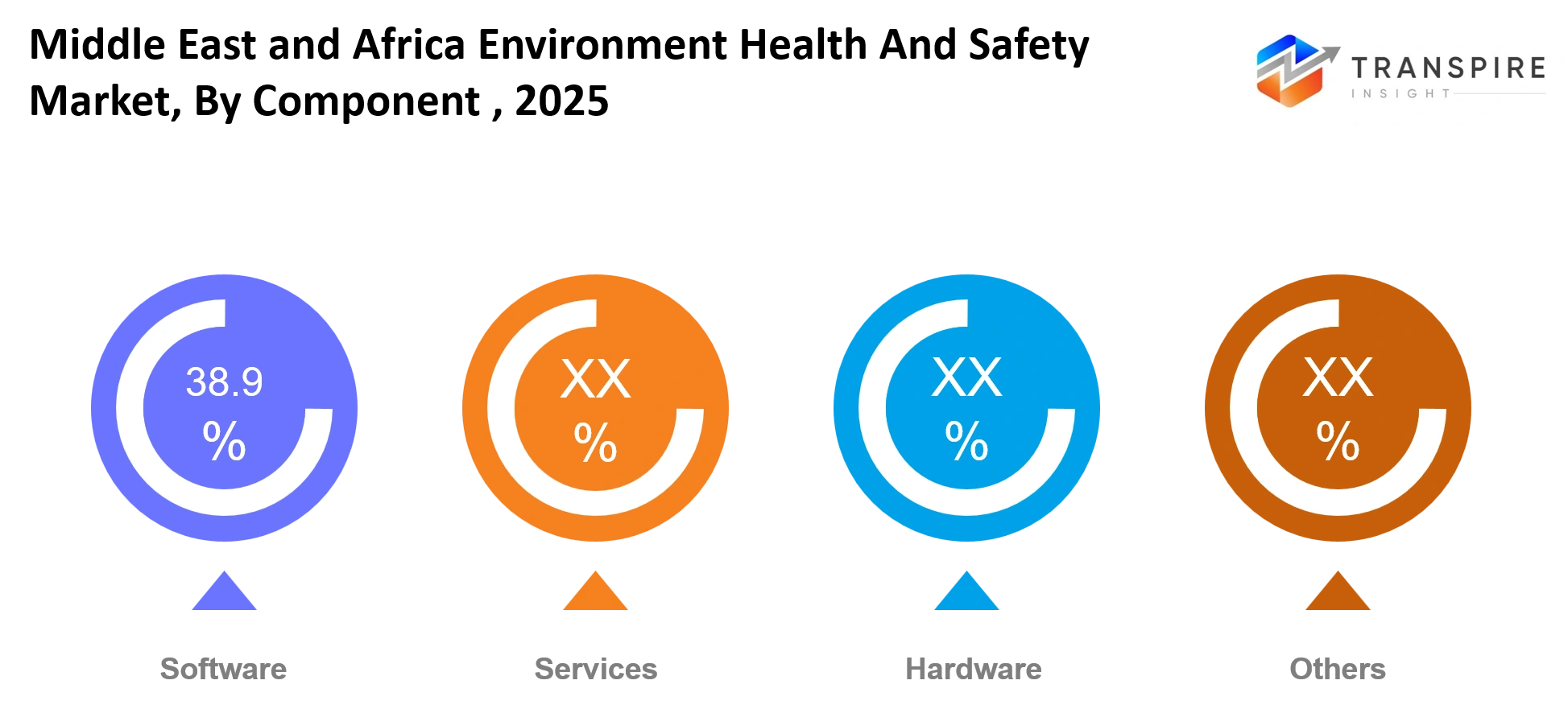
- Software solutions are leading overall with roughly 55% market share, while consulting and managed services sit as the second-largest slice, more like the “support layer” for many firms.
- AI-enabled risk analytics is expected to be the fastest-growing technology segment up through 2033, largely pushed by predictive safety management approaches.
- Manufacturing accounts for close to 30% of total adoption, so it ends up being the top application segment across the region.
- Oil and gas stays in second place, because the operations are high-risk and the environmental compliance needs are strict.
- Big enterprises bring in more than 65% of the market revenue, yet mid-sized organizations are the fastest-growing customer group, which is interesting because demand seems to be spreading outward.
- Key vendors—Enablon, Sphera, Cority, Intelex, SAP, and VelocityEHS—are trying to expand strategically through AI integration and cloud innovation.
What are the Key Drivers, Restraints, and Opportunities in the Middle East and Africa Environment Health And Safety Market?
The main driver behind market growth is mostly the growing regulatory focus on workplace safety, environmental accountability, and corporate sustainability reporting. In the Gulf area, governments have tightened occupational safety rules while bigger multinational orgs keep demanding standardized compliance routines across regional business. That change, honestly, pushes companies to put money into more centralized EHS platforms, the kind that can handle audits, incident logging, training documentation, and environmental performance details. So subscriptions for software, consulting work, and compliance management services keep producing that recurring revenue vibe.
The biggest break though is the patchy digital maturity across many African and emerging Middle Eastern economies. Big firms often have the budget and know how for enterprise wide EHS rollouts, but smaller organizations struggle with implementation costs, workforce upskilling, and also tying everything into older, legacy systems. These gaps slow adoption down, and they also shrink the effective market size in a number of countries. Then you end up seeing delayed software spending and weaker penetration beyond a few well known industrial hubs.
A strong opportunity sits in how EHS is blending with ESG and operational risk management platforms. Organizations are looking for one combined system that links safety outcomes, environmental indicators, climate risk disclosure, and governance duties. Cloud-native options with AI driven analytics, mobile inspection tools, and predictive risk monitoring are therefore in a good spot to take advantage of this.
What Has the Impact of Artificial Intelligence Been on the Middle East and Africa Environment Health And Safety Market?
Artificial intelligence is, kind of, reshaping how organizations handle workplace safety, environmental compliance, and day to day operational risk. EHS platforms are using AI more and more to automate incident classification, surface repeating safety patterns, and sort of quicken compliance reporting. Rather than manually going through thousands of records, safety managers can get automated recommendations based on past events and operational data, which sounds simple but it really helps with the workload.
Then there’s machine learning, and it’s getting better at predicting outcomes too. Industrial operators use predictive analytics to spot equipment failures before they happen, so downtime drops and safety incidents are less likely. AI systems, powered by analysis, look at sensor signals, maintenance histories, inspection results, plus the current operational conditions to forecast risks that might be coming. In areas like oil and gas, mining and manufacturing, these tools contribute to better asset reliability and back proactive maintenance planning.
On the operational side, organizations often see faster incident investigations, better audit readiness, stronger regulatory alignment, and fewer routine administrative tasks. Lots of enterprises say they get measurable gains in reporting precision and quicker response times after deploying intelligent safety management systems.
Still, AI adoption isn’t all smooth. Integration expenses can be high, data lives in disconnected places, and inconsistent data quality blocks wider rollout. Also, some companies don’t have enough historical safety records to properly train predictive models, so the accuracy of AI driven insights goes down, and the usefulness fades.
Key Market Trends
- Since 2021, cloud based EHS software adoption has risen pretty fast, as companies modernize how they manage compliance, kind of end to end.
- AI powered incident prediction tools expanded more than 25% across fresh enterprise deployments between 2023 and 2025, which is a notable jump.
- ESG reporting integration has moved from “nice to have” optional work into something that’s basically a core purchasing requirement for big enterprises now.
- Saudi Arabia and UAE industrial operators are putting more money into digital safety platforms too, especially while major infrastructure developments keep rolling forward.
- Mobile inspection and field reporting applications now back over 50% of newly implemented EHS programs, so it’s not just pilots anymore.
- Vendors like Enablon, Sphera, and Cority are also embedding predictive analytics directly into safety management workflows, rather than leaving it as an extra add-on.
- Environmental reporting modules gained real momentum, after tougher sustainability disclosure requirements started showing up across multiple industries.
- Industrial companies are leaning toward subscription based SaaS platforms instead of older on prem deployments, mainly because maintenance costs stay lower, and headaches feel fewer.
- Strategic acquisitions picked up during 2024–2025, as vendors broadened their offerings in ESG, risk intelligence, and emergency management, all together.
- Buyers are increasingly shopping for integrated platforms that blend worker safety, operational risk, sustainability, and compliance management, in one place.
Middle East and Africa Environment Health And Safety Market Segmentation
By Component
In the Middle East and Africa Environment Health And Safety Market, the component segment sort of shows a mix of digital tools, hands on know-how, and the supporting infrastructure that companies use to make workplace safety better and to stay on track with regulations. There’s a clear pull toward software, and it usually takes the biggest part, mainly because more organizations are rolling out platforms for incident tracking, risk assessment, environmental reporting, and overall compliance oversight. These digital solutions help companies bring data into one place and improve day to day visibility across their safety operations.
Services still matter a lot too, even if software is doing the heavy lifting, because good rollout often depends on consulting, training, auditing, and help with system integration. Hardware also plays a role in real world site activities, through monitoring devices, sensors, and the data gathering equipment used in different industrial facilities. Then there are other pieces as well, like complementary technologies and specialized solutions, set up to handle unusual operational needs in different industries, depending on what’s actually happening on the ground.
To learn more about this report, Download Free Sample Report
By Deployment
The deployment segment sort of shows how organizations pick to put safety and compliance platforms in place, mostly based on operational priorities and how ready their technology is. Cloud based solutions make up a big part of it, since remote accessibility, scalability, and fewer infrastructure burdens generally make adoption simpler for many enterprises. Centralized data handling and real-time dashboards also help with wider internal visibility.
On-premise deployments still pull in organizations that really want direct control over data storage, and security administration too. Hybrid models are getting more attention by blending cloud flexibility with on-site oversight, especially for sensitive data and critical operations. Others go with customized deployment patterns developed to match specific technical needs, regulatory obligations, or day to day operational requirements.
By End User
The end user segment shows, kinda broadly, how safety and environmental management solutions get applied across a number of high risk industries. Oil & Gas holds a big share, mostly because safety standards are strict, working conditions can be hazardous, and the regulatory oversight is extensive. Ongoing monitoring and compliance management still stay as key priorities across exploration, production, and refining actions, even when operations look stable.
Manufacturing drives substantial demand via workplace safety programs, operational risk management, and environmental performance monitoring, all together. Construction uses safety management systems to lower workplace incidents and to strengthen project compliance, and Healthcare facilities lean on these solutions for occupational risks plus regulatory duties. Other areas, like utilities, mining operations, transportation providers, and public sector organizations also lean on structured safety management frameworks, because incident prevention and governance matter.
By Application
The application segment sort of reflects the different, kind of overlapping functions supported by environmental, health and safety solutions across both industrial and commercial activities. Risk Management takes a big share, since organizations basically need ongoing review of operational hazards, environmental risks and workplace safety concerns. With solid risk identification, decision-making becomes more grounded, and overall long-term operational steadiness tends to hold up better.
Incident Management still stays a core application area, because organizations need to log, investigate, and resolve workplace events in a smooth way. Compliance Management helps with regulatory adherence via documentation, reporting, and audit preparation tasks. Occupational Health is more about staff well-being, exposure monitoring, and workplace health initiatives, while Others ends up covering sustainability tracking, emergency readiness, and some specialized operational safety capabilities too.
What are the Key Use Cases Driving the Middle East and Africa Environment Health And Safety Market?
The biggest use case is kinda tied to workplace safety and incident management inside manufacturing plants, oil and gas facilities, mining operations, and those huge construction projects. In general, organizations lean on EHS platforms so they can track incidents, manage corrective actions, run inspections, and stay on top of compliance requirements from regulators. This kind of application tends to get the strongest demand, because safety failures can lead to operational shutdowns, financial penalties,and also that reputational hit that everyone feels.
There is another big one, which is environmental compliance management, and yeah it works like a digital control room for emissions, waste handling, water consumption, plus environmental permits. Mining operators, utilities, and petrochemical facilities are deploying these systems more and more, mainly to satisfy reporting obligations and to sharpen sustainability performance.
And then, newer use cases are showing up too. Think climate risk assessment, ESG disclosure management, and predictive risk analytics. Organizations are starting to blend environmental data and operational information into enterprise risk frameworks, so it opens the door for more advanced analytics, and AI enabled compliance solutions, not just basic tracking.
|
Report Metrics |
Details |
|
Market size value in 2025 |
USD 1.9 Billion |
|
Market size value in 2026 |
USD 2.03 Billion |
|
Revenue forecast in 2033 |
USD 3.19 Billion |
|
Growth rate |
CAGR of 6.67% from 2026 to 2033 |
|
Base year |
2025 |
|
Historical data |
2021 - 2024 |
|
Forecast period |
2026 - 2033 |
|
Report coverage |
Revenue forecast, competitive landscape, growth factors, and trends |
|
Regional scope |
Middle East and Africa (Saudi Arabia, United Arab Emirates, South Africa, Rest of Middle East and Africa) |
|
Key company profiled |
Intelex, Cority, VelocityEHS, Enablon, Sphera, SAP, IBM, Benchmark ESG, EcoOnline, DNV, Wolters Kluwer, UL Solutions, ETQ, Quentic, Ideagen. |
|
Customization scope |
Free report customization (country, regional & segment scope). Avail customized purchase options to meet your exact research needs. |
|
Report Segmentation |
By Component (Software, Services, Hardware, Others); By Deployment (Cloud-based, On-premise, Hybrid, Others); By End User (Oil & Gas, Manufacturing, Construction, Healthcare, Others); By Application (Risk Management, Incident Management, Compliance Management, Occupational Health, Others). |
Which Regions are Driving the Middle East and Africa Environment Health And Safety Market Growth?
The Gulf Cooperation Council region kind of leads the market, with Saudi Arabia and the UAE together making up a substantial portion of regional revenue. There are big energy, petrochemical, construction, and infrastructure projects going on all the time, so they end up needing pretty sophisticated safety and compliance management systems. Also, strong regulatory oversight, plus those ongoing industrial diversification programs, keep backing continuous investment in EHS technologies. On top of that, the region benefits from a pretty mature ecosystem of technology providers, consultants, and industrial operators who really do adopt digital risk management solutions in practice.
South Africa is basically the second-largest contributor. But unlike the Gulf market, its growth is tied more to mining, manufacturing, and heavy industrial operations, not so much to huge infrastructure expansion programs. Still, the country has a well established regulatory environment, and it has had a long-standing emphasis on occupational safety, so that creates a stable demand base. Companies continue to spend on compliance technologies to improve operational performance, and also to match evolving reporting requirements.
The rest of Africa is emerging as the fastest-growing region. More foreign investment, along with mining development, energy projects, and industrial modernization, has sped up the appetite for digital safety solutions. Governments are tightening workplace safety regulations, while businesses are looking for better transparency into day to day operational risks. For investors and technology providers, this type of momentum suggests real opportunities for market expansion, roughly between 2026 and 2033 .
Who are the Key Players in the Middle East and Africa Environment Health And Safety Market and How Do They Compete?
Competition in the market feels moderately concentrated, but global software providers are still all going after the same kinds of advantages—platform capabilities, analytics, regulatory know-how and integration services. The weird part is that the market increasingly seems to reward vendors that can blend EHS together with ESG sustainability reporting and operational risk management, all inside one unified platform. Tech differentiation now matters more than price alone, especially when you’re talking about big enterprise customers.
Sphera sort of stands out with integrated risk management plus sustainability intelligence, and then the advanced analytics piece too. They’ve kept widening their portfolio via acquisitions, and they’re also putting more money into AI powered risk intelligence solutions.
Enablon leans into enterprise scale process safety, operational risk and sustainability management. A lot of their edge comes from serving highly regulated industries, where you really need extensive compliance plus strong risk control features. Some recent industry recognition basically just reinforces that process safety management position.
Cority emphasizes configurable compliance workflows, and it also leans on industry specific solutions . Intelex, meanwhile, competes through flexibility and a more user centric rollout and implementation model. Both of these vendors go after organizations that want scalable compliance management environments, not just one off tools.
EcoOnline keeps expanding too, with acquisitions, AI enabled compliance tools, and regional growth moves. Their focus on climate risk and chemical safety offerings also seems to sharpen its competitive stance across emerging markets.
Company List
- Intelex
- Cority
- VelocityEHS
- Enablon
- Sphera
- SAP
- IBM
- Benchmark ESG
- EcoOnline
- DNV
- Wolters Kluwer
- UL Solutions
- ETQ
- Quentic
- Ideagen
Recent Development News
In June 2025, EcoOnline announced acquisition of D4H. The acquisition expanded EcoOnline's crisis readiness and emergency response capabilities by integrating D4H's incident management technology into its EHS, ESG, and chemical safety platform, strengthening enterprise risk management offerings.
Source: https://www.ecoonline.com
In September 2025, Sphera entered a partnership with Evonik and launched a TÜV-certified automated Life Cycle Assessment (LCA) process. The collaboration enables sustainability assessments up to ten times faster than traditional methods, helping organizations improve environmental reporting accuracy and regulatory compliance.
Source: https://sphera.com
What Strategic Insights Define the Future of the Middle East and Africa Environment Health And Safety Market?
The market seems to be moving toward integrated operational resilience platforms that sort of mash together workplace safety, environmental compliance, sustainability reporting, and enterprise risk management, in one place. Under all that, there is this growing pressure for organizations to juggle different regulatory, operational, and environmental obligations via a single digital ecosystem rather than a bunch of disconnected software tools… and, honestly it’s getting harder to keep everything consistent.
There’s also a not-so-obvious risk that shows up when vendors get too concentrated and you end up platform dependent. When big enterprises start standardizing around a small set of software providers, the implementation complexity can creep up and switching costs may go higher, which in turn reduces flexibility and can create long-term procurement trouble. On top of that, the digital adoption curve is uneven across emerging economies, so even if the market fundamentals look good, regional penetration could still move slower than expected.
But there is a real opportunity too, particularly with AI enabled predictive risk management. More organizations are asking for systems that help prevent incidents instead of only recording them after the fact. Those companies that start early with predictive analytics, mobile-first safety solutions, and ESG integrated reporting features may be the ones that capture the next wave of growth. Market players should also focus on interoperable cloud platforms that link safety, sustainability, and operational performance data into one coherent decision framework, rather than keeping the data siloed.
Middle East and Africa Environment Health And Safety Market Report Segmentation
By Component
- Software
- Services
- Hardware
- Others
By Deployment
- Cloud-based
- On-premise
- Hybrid
- Others
By End User
- Oil & Gas
- Manufacturing
- Construction
- Healthcare
- Others
By Application
- Risk Management
- Incident Management
- Compliance Management
- Occupational Health
- Others
Frequently Asked Questions
Find quick answers to common questions.
The expected Middle East and Africa Environment Health And Safety Market size for the market will be USD 3.19 Billion in 2033.
Key segments for the Middle East and Africa Environment Health And Safety Market are By Component (Software, Services, Hardware, Others); By Deployment (Cloud-based, On-premise, Hybrid, Others); By End User (Oil & Gas, Manufacturing, Construction, Healthcare, Others); By Application (Risk Management, Incident Management, Compliance Management, Occupational Health, Others).
Major Middle East and Africa Environment Health And Safety Market players are Intelex, Cority, VelocityEHS, Enablon, Sphera, SAP, IBM, Benchmark ESG, EcoOnline, DNV, Wolters Kluwer, UL Solutions, ETQ, Quentic, Ideagen.
The Middle East and Africa Environment Health And Safety Market size is USSD 1.9 Billion in 2025.
The Middle East and Africa Environment Health And Safety Market CAGR is 6.67% from 2026 to 2033.
- Intelex
- Cority
- VelocityEHS
- Enablon
- Sphera
- SAP
- IBM
- Benchmark ESG
- EcoOnline
- DNV
- Wolters Kluwer
- UL Solutions
- ETQ
- Quentic
- Ideagen
About the Authors

Mayur Shinde
I am Mayur Shinde, a Senior Research Analyst at Transpire Insight, specializing in the Automotive & Transportation and Information & Communication Technology (ICT) Industry. My work focuses on analyzing emerging market trends, technological advancements, competitive landscapes, and industry developments to deliver accurate, data-driven insights. I am passionate about transforming complex market information into clear, actionable content that helps businesses, professionals, and decision-makers stay informed and make confident strategic decisions.

Chakradhar Khansole
Chakradhar serves as the Research Director at Transpire Insight, bringing over 8 years of experience in technology, innovation, and strategic market intelligence. He specializes in transforming complex market data into actionable business insights that enable organizations to make informed, growth-oriented decisions. Recognized for his strategic vision and analytical expertise, Chakradhar leads high-impact research initiatives, delivering comprehensive market assessments, competitive intelligence, and forward-looking industry analysis.
Recently Published Reports
-
Apr 2026
3D Optical Profiler Market
3D Optical Profiler Market Size, Share & Analysis Report By Type (Desktop 3D Optical Profiler, and Portable 3D Optical Profiler), By Technology (Confocal Technology, and White Light Interference), By End-Use Industry (Manufacturing, Research Institutions, Automotive, Aerospace and Defense, Medical Devices, and Other), and Geography (North America, Europe, Asia-Pacific, Middle East and Africa, South and Central America), 2021 - 2031
-
Apr 2026
Depth Sensor Market
Depth Sensor Market Size, Share & Analysis Report By Type (Infrared Depth Sensors, Time-of-Flight (ToF) Sensors, Stereo Vision Sensors, Structured Light Sensors, Ultrasonic Depth Sensors), By Application (Automotive, Robotics, Gaming, Consumer Electronics, Industrial Automation, Healthcare, Security & Surveillance, Others), By End Users (Automotive Manufacturers, Consumer Electronics Companies, Healthcare Providers, Industrial Companies, Security Agencies, Gaming Companies, Robotics Companies, Others), and Geography (North America, Europe, Asia-Pacific, Middle East and Africa, South and Central America), 2021 – 2031
-
Apr 2026
Digital Manufacturing Market
Digital Manufacturing Market Size, Share & Analysis Report By Component (Hardware, Software, and Services), By Technology (Robotics, 3D Printing, Internet of Things (IoT), and Others), By Application (Automotive and Transportation, Aerospace and Defense, Consumer Electronics, Industrial Machinery, and Others), By Process Type (Computer-Based Designing, Computer-Based Simulation, Computer 3D Visualization, Analytics, and Others), and Geography (North America, Europe, Asia-Pacific, Middle East and Africa, South and Central America), 2021 – 2031
-
Apr 2026
Digital Visa Services Market
Digital Visa Services Market Size, Share & Analysis Report By Type (Individual Travelers, Group Travelers), By Application (Tourism, Business Travel, Others), and Geography (North America, Europe, Asia-Pacific, Middle East and Africa, South and Central America), 2021 – 2031