
Middle East and Africa Endoscopy Equipment Market Summary
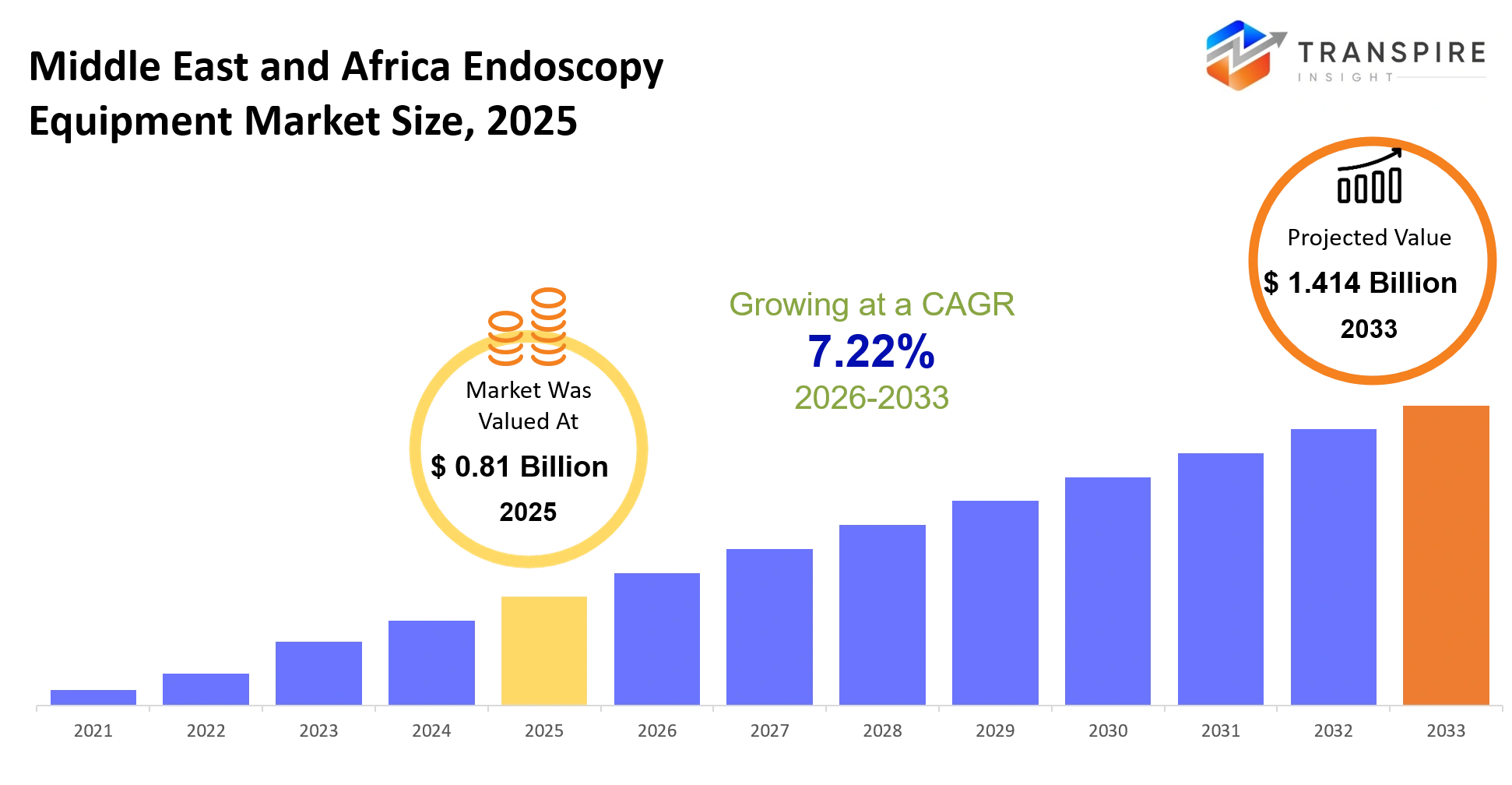
As per Transpire Insight Analysis the Middle East and Africa Endoscopy Equipment Market size is estimated at USD 0.81 Billion in 2025 and is anticipated to reach USD 1.414 Billion by 2033, growing at a CAGR of 7.22% from 2026 to 2033.
The Middle East and Africa Endoscopy Equipment Market sort of plays a major part in how healthcare providers diagnose, manage, and treat GI, pulmonary, urology, gynecology, and orthopedic conditions. Mostly it’s tied to minimally invasive procedures that cut surgical trauma down , keep hospital stays shorter, and help patients bounce back quicker. Over the last five years the whole market seems to drift away from the more old-school conventional reusable arrangements and move toward high-definition imaging platforms, AI-assisted visualization features, and single-use endoscopes, all so infection control is easier and the procedures can run faster , more streamlined.
When COVID-19 first hit, elective procedures slowed a bit, but later it looks like spending got pushed forward again. Especially since hospitals and health systems were trying to work through diagnostic backlogs and they started investing more in modern endoscopy suites , plus broader hospital infrastructure. At the same time, governments across the GCC countries and also South Africa have been rolling out healthcare modernization initiatives which basically nudges hospitals to adopt more advanced visualization technology.
Also, since chronic gastrointestinal disorders are on the rise, colorectal cancer screening programs are expanding, and minimally invasive surgeries are becoming more normal, providers keep upgrading their endoscopy systems. This extra procedure volume then turns into stronger equipment sales, more service contracts, and additional accessory income across the region, too.
Middle East and Africa Endoscopy Equipment Market Size & Forecast:
- Middle East and Africa Endoscopy Equipment Market Size 2025: USD 0.81 Billion
- Expected Market Value 2033: USD 1.414 Billion
- Forecast CAGR: 7.22%
- Leading region in 2025:
- Fastest Growing region:
- Key Profile: Olympus, Fujifilm, Karl Storz, Stryker, Medtronic, Boston Scientific, HOYA (PENTAX Medical), Richard Wolf, B. Braun, ConMed, Smith+Nephew, Cook Medical, Ambu, Johnson & Johnson MedTech, Canon Medical
Key Market Insights
- The Middle East and Africa Endoscopy Equipment Market is forecast to reach USD 1.414 Billion by 2033, basically showing ongoing funding into less invasive diagnostic methods, rather than only bigger surgeries.
- In the region, the Middle East is currently leading with an estimated 65%+ market share in 2025, driven by the gradual expansion of healthcare infrastructure across GCC nations.
- Africa should be the quickest riser through 2033, because both public and private health budgets are growing, which in turn expands diagnostic capacity.
- When it comes to products, flexible endoscopes are taking the lead, with around 42% market share in 2025, since they’re used across many clinical areas.
- For categories, visualization systems together with AI enabled imaging platforms are among the fastest-growing, as hospitals keep upgrading diagnostic accuracy and trying to streamline workflow efficiency.
- Gastrointestinal endoscopy is close to 35% of all procedures, while bronchoscopy and urology uses keep moving upward in tertiary care centers.
- When looking at end users, hospitals are still, kind of the main channel, holding 60%+ market share, yet ambulatory surgical centers are moving a bit faster—mainly because outpatient procedures can be more cost friendly.
- Big names like Olympus, Fujifilm, Karl Storz, Stryker, Medtronic, and Boston Scientific are still making sure they keep their ground in the region, via new technology rollouts and distributor relationships.
- At the same time, manufacturers are embedding more and more features, including 4K imaging, narrow band imaging, AI assisted lesion detection, plus digital workflow platforms, and this overall supports better procedural precision, so clinicians can work quicker.
- Finally, strategic collaborations with healthcare providers in the region, along with medical training programs and the enlargement of service networks, have become a major way to protect long term market share.
What are the Key Drivers, Restraints, and Opportunities in the Middle East and Africa Endoscopy Equipment Market?
Healthcare modernization programs across Saudi Arabia, the UAE , Qatar, and other Gulf countries are quietly ( but still fast ) pushing more advanced endoscopy platforms into routine care. National healthcare transformation initiatives are widening their spending on tertiary hospitals, cancer screening programs and minimally invasive surgery capabilities, so it’s not just one area, it’s a whole chain. Meanwhile the growing burden from gastrointestinal diseases, obesity related disorders, and colorectal cancer has lifted overall procedure volumes. All of that together ends up supporting bigger equipment buys, higher accessory use, maintenance agreements, and tech upgrades. In other words, manufacturers can see more recurring revenue that keeps coming back.
Still, there’s a big structural snag, especially when you look at unequal healthcare infrastructure across many African economies. Advanced endoscopy systems need real capital, skilled specialists, proper sterilization facilities, plus ongoing maintenance support. A lot of hospitals keep running on limited budgets and they simply don’t have enough trained personnel, so equipment replacement cycles get pushed back. As a result, procedure volumes can’t rise as much, and adoption tends to stay mostly inside a few major metropolitan healthcare centers, which naturally slows down broader market expansion.
Looking ahead, AI enabled endoscopy platforms and digital imaging technologies seem like a strong growth lever. More hospitals want computer assisted lesion detection, cloud based image management, and high definition visualization setups that raise diagnostic confidence and also speed up clinical workflow. Plus medical tourism expansion in GCC countries, along with fresh investments in specialized gastrointestinal and oncology centers, is adding extra demand.
What Has the Impact of Artificial Intelligence Been on the Middle East and Africa Endoscopy Equipment Market?
Artificial intelligence is sort of changing the Middle East and Africa endoscopy equipment industry, mainly by boosting diagnostic accuracy , speeding up workflow automation, and offering clinical decision support that feels more “guided”. With AI-assisted image analysis, suspicious polyps and early-stage gastrointestinal lesions can get flagged in real time, plus abnormal tissue patterns may show up during the procedure. This helps physicians improve detection rates while also cutting down on operator-to-operator variation , which is a big deal in day to day practice. At the same time, many hospitals are plugging in digital workflow platforms that sort out image documentation, reporting, scheduling, and even procedure tracking, so clinicians can spend more time directly on patient care, not paperwork.
Machine learning models are also leaning into predictive maintenance , by observing equipment utilization, component wear , and service intervals to prevent those annoying unexpected system failures and to push equipment lifespan longer. And then advanced analytics start doing the operations side too, like endoscopy suite scheduling, better resource utilization, and less downtime . All of this tends to lower operating costs and increase procedural throughput. Some of the bigger manufacturers are now pairing AI with 4K imaging and upgraded visualization tools, which makes clinical assessment more precise and can help clinicians decide on treatment faster.
Still, AI adoption is not fully smooth. It’s held back by high implementation costs, tricky integration with older hospital information systems, and the limited supply of large, region-specific clinical datasets. Smaller healthcare providers often don’t have the required digital infrastructure or specialized know-how to deploy AI-enabled endoscopy platforms at scale, so broader market adoption moves slower, even if interest is there.
Key Market Trends
- Hospitals have been slowly moving away from old standard-definition setup toward 4K and high-definition imaging platforms since 2021 ,and in the process their diagnostic accuracy and clinical confidence both seem to get better, at least in day to day practice.
- AI-assisted polyp detection really picked up speed ,and the big manufacturers keep saying they’re seeing adenoma detection rate gains of about 10% to 20% across clinical studies.
- Single-use endoscopes have also grown in popularity, showing up across bronchoscopy and other infection-sensitive procedures as hospitals tightened up infection prevention protocols after the pandemic ,kind of without pausing.
- Meanwhile, healthcare spending across GCC countries has kept rising, which makes it easier to justify swapping out aging endoscopy systems for digitally connected visualization platforms.
- Since 2022 ,manufacturers have expanded regional service centers and physician training programs, mainly to boost equipment utilization and keep customers sticking around longer.
- Digital image management plus cloud-based reporting platforms are now basically part of the standard purchasing checklist for many large tertiary hospitals that are rolling out smart healthcare strategies.
- Olympus , Fujifilm, Karl Storz ,Boston Scientific, and Medtronic keep investing in AI-enabled visualization ,advanced optics, and workflow integration technologies, so they can hold a stronger competitive place in the market.
- Outpatient and ambulatory surgical centers have been buying compact endoscopy systems faster, because minimally invasive procedures keep replacing conventional surgical approaches.
- Regional distributors are also leaning into more strategic partnerships with international manufacturers, aiming to improve product availability ,technical support, and after-sales service options.
- And more healthcare providers are focusing on integrated endoscopy ecosystems, where imaging documentation, predictive maintenance, and clinical analytics sit together in one digital platform, rather than being scattered around.
Middle East and Africa Endoscopy Equipment Market Segmentation
By Product Type
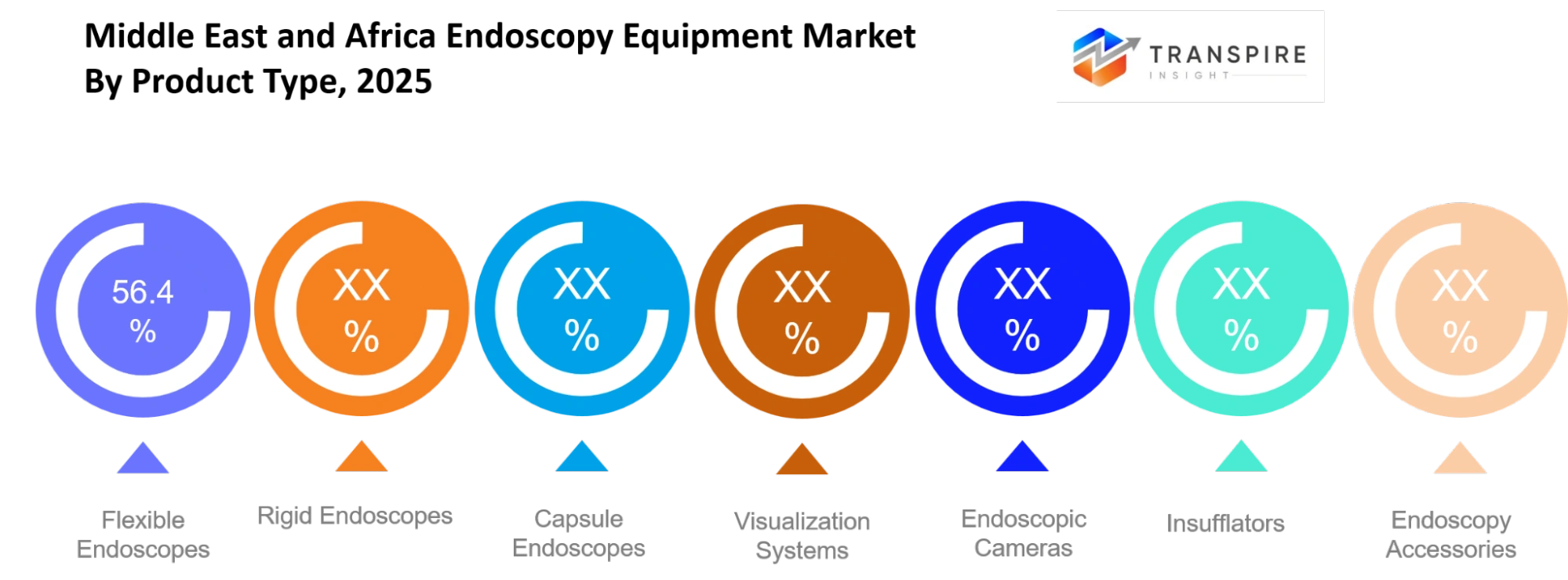
Flexible Endoscopes have the biggest share, since they’re used broadly in real practice, and that helps diagnosis plus treatment across GI , pulmonary, and urology workflows. Meanwhile, Rigid Endoscopes give steadier viewing for orthopedic, gynecology, and laparoscopic operations, because their structural rigidity really does support clear, pinpoint visualization. Capsule Endoscopes come in as a noninvasive alternative, used to look at the small intestine, so clinicians can spot disorders that usual procedures might miss, or at least not catch as easily. Then there are Visualization Systems , which enhance picture quality through newer display and processing methods, and this ends up supporting better clinical choices during the procedure.
For cameras, Endoscopic Cameras gather high definition images that boost procedural precision and also documentation. Insufflators keep a consistent working cavity during minimally invasive surgery, mostly by controlling gas flow and pressure , so the field stays stable. Endoscopy Accessories cover a wide set of items— biopsy forceps, guidewires, snares, stents, and even cleaning products— all of which help enable safer, smoother procedures. And beyond that, Others include specialized devices made for niche clinical applications, plus newer procedural approaches that are still developing over time.
By Application
Gastrointestinal Endoscopy seems to have the biggest procedure volume overall, because early detection and treatment of digestive ailments stays a priority across most healthcare systems. Bronchoscopy kind of backs up the evaluation of respiratory problems, and it also helps clinicians with obtaining tissue samples and handling airways. Arthroscopy lets orthopedic specialists kinda figure out and handle problems inside a joint using smaller incisions, while laparoscopy supports a wider set of abdominal procedures, and in a lot of cases the recovery time is faster , too.
Urology endoscopy helps clinicians find out and manage issues with the kidneys, bladder, and the urinary tract, mostly through minimally invasive approaches. ENT endoscopy makes it possible to look through the nasal passages, the throat, and ear structures in a more detailed manner, so the diagnosis comes out more precise, honestly. Gynecology Endoscopy supports reproductive health by using advanced visualization with less surgical strain. Others are more niche like specialized uses across cardiovascular, pediatric, and oncology based interventions too.
By End User
Hospitals are still kind of the biggest end user, since those more complex surgical procedures, emergency work, and the multidisciplinary approach need advanced endoscopy systems along with supporting stuff and infrastructure. Ambulatory Surgical Centers keep pushing up procedure volumes, mostly by giving cost efficient outpatient services , with a quicker patient turnaround. Specialty Clinics tend to concentrate on specific needs like gastroenterology, pulmonology, urology, and orthopedic care, and they do it via specialized endoscopy platforms. Diagnostic Centers, on the other hand, run routine checkups and screening routines that help with early disease detection.
Academic Institutes use endoscopy gear for medical education, physician practice, and overall clinical skill building. Research Centers check out new technologies, fresh imaging approaches, and minimally invasive treatment methods through clinical studies, so yeah it’s more experimental. Then there are the “other” players, like military healthcare facilities , charitable hospitals, and community health organizations, which offer diagnostic and surgical services based on what the local region actually needs.
By Technology
HD Endoscopy is still widely adopted because the clear image quality helps doctors make more accurate diagnoses across everyday procedures, or at least that’s what everyone seems to say. 4K Endoscopy provides even more fine-grained image detail and it tends to make it easier for physicians to spot slight tissue abnormalities during difficult exams. 3D Endoscopy, on the other hand, strengthens depth perception when procedures get advanced, which can support better hand-eye coordination and more procedural precision. AI-Assisted Endoscopy adds intelligent software applications that enhance lesion detection, assist with image interpretation, and speed up day to day workflow efficiency.
Robot-Assisted Endoscopy helps with controlled instrument guidance during certain minimally invasive procedures. at the same time it improves surgical consistency, which is not a small point. Wireless Endoscopy increases patient comfort since it lessens reliance on traditional cable based setups in selected applications. Other options include newer imaging approaches and digital platforms meant to boost visualization, streamline documentation, and strengthen procedural performance across healthcare facilities.
By Distribution Channel
Direct Sales let manufacturers basically build long term connections with healthcare providers, while also handling installa tion training, and yes, technical support. Medical Device Distributors, in the meantime, increase how easy it is to get the products by using regional networks they already have, and those networks can reach big cities as well as developing healthcare facilities. Then the Hospital Procurement folks buy equipment via capital spending plans, they usually judge things like overall quality, after sales service, and those long term operating costs too, not just the price. Government Procurement tends to back public healthcare growth by providing medical equipment through national health initiatives and centralized purchasing arrangements, so it’s kind of all organized in one place.
Specialty Suppliers usually concentrate on advanced endoscopy products, plus attachments, and maintenance services, aimed at a particular clinical specialty. And then there’s the other set, like online procurement platforms, independent healthcare suppliers, and regional distributors, who help smaller healthcare organizations with more flexible buying options, depending on what they need, and when.
What are the Key Use Cases Driving the Middle East and Africa Endoscopy Equipment Market?
Gastrointestinal procedures pretty much stay as the leading use case, because colorectal cancer screening, ulcer diagnosis, and managing digestive issues all need clear visualization using minimally invasive methods. Big hospitals also tend to run huge daily volumes, so equipment utilization stays pretty steady, plus accessory replacement happens as part of routine care, not just on rare occasions.
Meanwhile, bronchoscopy and laparoscopy keep getting more traction in respiratory care and general surgery too, as specialty clinics and ambulatory surgical centers expand their outpatient work. Then urology and gynecology teams also move toward advanced imaging systems , to improve treatment precision and at the same time shorten recovery time, and reduce hospital stays.
On top of that, AI supported lesion detection and capsule based diagnostics are showing up as emerging ideas, with real longer term value. Oncology programs and academic research centers are still testing advanced imaging technologies for earlier disease finding, and at the same time healthcare modernization efforts across Gulf countries are basically setting up better conditions for broader adoption over the forecast period.
|
Report Metrics |
Details |
|
Market size value in 2025 |
USD 0.81 Billion |
|
Market size value in 2026 |
USD 0.868 Billion |
|
Revenue forecast in 2033 |
USD 1.414 Billion |
|
Growth rate |
CAGR of 7.22% from 2026 to 2033 |
|
Base year |
2025 |
|
Historical data |
2021 - 2024 |
|
Forecast period |
2026 - 2033 |
|
Report coverage |
Revenue forecast, competitive landscape, growth factors, and trends |
|
Regional scope |
Middle East and Africa (Saudi Arabia, United Arab Emirates, South Africa, Rest of Middle East and Africa) |
|
Key company profiled |
Olympus, Fujifilm, Karl Storz, Stryker, Medtronic, Boston Scientific, HOYA (PENTAX Medical), Richard Wolf, B. Braun, ConMed, Smith+Nephew, Cook Medical, Ambu, Johnson & Johnson MedTech, Canon Medical |
|
Customization scope |
Free report customization (country, regional & segment scope). Avail customized purchase options to meet your exact research needs. |
|
Report Segmentation |
By Product Type (Flexible Endoscopes, Rigid Endoscopes, Capsule Endoscopes, Visualization Systems, Endoscopic Cameras, Insufflators, Endoscopy Accessories, Others); By Application (Gastrointestinal Endoscopy, Bronchoscopy, Arthroscopy, Laparoscopy, Urology Endoscopy, ENT Endoscopy, Gynecology Endoscopy, Others); By End User (Hospitals, Ambulatory Surgical Centers, Specialty Clinics, Diagnostic Centers, Academic Institutes, Research Centers, Others); By Technology (HD Endoscopy, 4K Endoscopy, 3D Endoscopy, AI-Assisted Endoscopy, Robot-Assisted Endoscopy, Wireless Endoscopy, Others); By Distribution Channel (Direct Sales, Medical Device Distributors, Hospital Procurement, Government Procurement, Specialty Suppliers, Others) |
Which Regions are Driving the Middle East and Africa Endoscopy Equipment Market Growth?
The Middle East pretty much leads the market, with governments across Saudi Arabia, the United Arab Emirates,and Qatar keep pushing healthcare modernization via long-range national investment initiatives. In practice, strong regulatory guardrails, more tertiary hospitals opening or expanding, and the growing use of less invasive procedures, all motivate providers to swap older endoscopy setups for newer imaging platforms. Also, medical tourism adds extra pull, because it pushes hospitals to buy top tier diagnostic tools that align with international quality requirements. You can see it supported by a fairly well developed web of specialized hospitals, distributor relationships, physician training centers, plus after-sales teams,so regional leadership stays steady.
South Africa shows up as the second-largest contributor, mainly due to a mix of public facilities and private hospital groups that continue to channel funds into diagnostic equipment upgrades. But unlike the Gulf countries, the momentum here relies less on massive government infrastructure projects, and more on consistent replacement cycles, established reimbursement norms, and having skilled clinical specialists in place. Solid medical education, together with dedicated gastroenterology and surgical centers, helps keep procedure volumes reliable across the year. That blend gives manufacturers fairly predictable revenue windows,while also keeping adoption of advanced endoscopy technology moving forward.
Meanwhile, the Rest of Africa is projected to post the fastest growth through 2033. This is tied to improving healthcare access in places such as Egypt, Kenya, Nigeria,and Morocco.
Who are the Key Players in the Middle East and Africa Endoscopy Equipment Market and How Do They Compete?
Competition still looks fairly, like moderately consolidated, mainly because big worldwide medical technology firms supply most of the most advanced endoscopy systems that get used across the region. In practice the edge comes not so much from price but from tech leadership, imaging quality, how the physicians are trained, after-sales support, and also the distributor web. The “old” manufacturers keep defending share via ongoing product evolution and tweaks, while a few others try to stand out with more specific use cases, like GI imaging, bronchoscopy, or minimally invasive surgery, depending on what each market needs.
Olympus for example pushes its position with high definition imaging platforms, narrow-band imaging features, plus digital workflow solutions that, in a way, tighten diagnostic precision. Fujifilm leans on image enhancement tech that goes further, AI-supported visualization, and it keeps investing in next generation endoscopic imaging systems, with the goal of earlier detection of disease. Karl Storz, on the other hand, is more about premium rigid endoscopy systems for laparoscopic work, ENT, and other surgical settings; the combination is optical performance together with durable gear meant for tough operating room conditions.
Boston Scientific keeps expanding by offering therapeutic endoscopy devices that pair up with diagnostic procedures, so clinicians can handle diagnosis and treatment inside one single clinical sequence. HOYA (PENTAX Medical) competes using integrated endoscopic ultrasound solutions, infection prevention technologies, and long term service coverage too, all of which helps equipment reliability over time.
Company List
• Olympus
• Fujifilm
• Karl Storz
• Stryker
• Medtronic
• Boston Scientific
• HOYA (PENTAX Medical)
• Richard Wolf
• B. Braun
• ConMed
• Smith+Nephew
• Cook Medical
• Ambu
• Johnson & Johnson MedTech
• Canon Medical
Recent Development News
In June 2026, PENTAX Medical renewed a long-term collaboration agreement with FUJIFILM Corporation for endoscopic ultrasound solutions. The agreement extends integrated EUS system supply and support through 2038, strengthening advanced diagnostic capabilities in gastrointestinal imaging.https://www.prnewswire.com
In May 2026, Olympus signed an exclusive global distribution agreement with EndoRobotics Co., Ltd. The partnership expands Olympus' robot-assisted endotherapy portfolio and supports wider adoption of minimally invasive gastrointestinal procedures.https://content.medical.olympusamerica.com
In May 2026, Fujifilm launched the EB-710US balloon-less endobronchial ultrasound bronchoscope. The new product strengthens pulmonary endoscopy capabilities through improved imaging performance and supports advanced bronchoscopy procedures.https://healthcaresolutions-us.fujifilm.com
What Strategic Insights Define the Future of the Middle East and Africa Endoscopy Equipment Market?
The market seems to be drifting toward fully integrated digital endoscopy ecosystems, where artificial intelligence, high resolution imaging, predictive servicing, and connected clinical workflows all sort of sit together. Healthcare modernization across Gulf countries, plus the ongoing growth in diagnostic capacity in emerging African economies, will keep nudging buying choices away from standalone devices and more toward whole platform like solutions.
There’s also a less visible risk, sort of tucked in the background. Advanced technology is becoming concentrated among a small set of multinational suppliers, and that could push procurement costs higher. It might also stretch replacement cycles, if supply chain disruptions happen or if regulatory actions hit availability, and then it becomes harder to keep pace.
On the other hand, a key opportunity is the expansion of AI assisted colorectal cancer screening, along with cloud based endoscopy data administration, especially across secondary hospitals that still rely on conventional equipment. For companies that want to enter, they should reinforce regional service infrastructure, run physician training programs, and build stronger digital support options. In the long run, customer loyalty and ongoing relationships may start mattering as much as raw product performance for sustainable market growth.
Middle East and Africa Endoscopy Equipment Market Report Segmentation
By Product Type
• Flexible Endoscopes
• Rigid Endoscopes
• Capsule Endoscopes
• Visualization Systems
• Endoscopic Cameras
• Insufflators
• Endoscopy Accessories
• Others
By Application
• Gastrointestinal Endoscopy
• Bronchoscopy
• Arthroscopy
• Laparoscopy
• Urology Endoscopy
• ENT Endoscopy
• Gynecology Endoscopy
• Others
By End User
• Hospitals
• Ambulatory Surgical Centers
• Specialty Clinics
• Diagnostic Centers
• Academic Institutes
• Research Centers
• Others
By Technology
• HD Endoscopy
• 4K Endoscopy
• 3D Endoscopy
• AI-Assisted Endoscopy
• Robot-Assisted Endoscopy
• Wireless Endoscopy
• Others
By Distribution Channel
• Direct Sales
• Medical Device Distributors
• Hospital Procurement
• Government Procurement
• Specialty Suppliers
• Others
Frequently Asked Questions
Find quick answers to common questions.
The expected Middle East and Africa Endoscopy Equipment Market size for the market will be USD 1.414 Billion in 2033.
Key segments for the Middle East and Africa Endoscopy Equipment Market are By Product Type (Flexible Endoscopes, Rigid Endoscopes, Capsule Endoscopes, Visualization Systems, Endoscopic Cameras, Insufflators, Endoscopy Accessories, Others); By Application (Gastrointestinal Endoscopy, Bronchoscopy, Arthroscopy, Laparoscopy, Urology Endoscopy, ENT Endoscopy, Gynecology Endoscopy, Others); By End User (Hospitals, Ambulatory Surgical Centers, Specialty Clinics, Diagnostic Centers, Academic Institutes, Research Centers, Others); By Technology (HD Endoscopy, 4K Endoscopy, 3D Endoscopy, AI-Assisted Endoscopy, Robot-Assisted Endoscopy, Wireless Endoscopy, Others); By Distribution Channel (Direct Sales, Medical Device Distributors, Hospital Procurement, Government Procurement, Specialty Suppliers, Others).
Major Middle East and Africa Endoscopy Equipment Market players are Olympus, Fujifilm, Karl Storz, Stryker, Medtronic, Boston Scientific, HOYA (PENTAX Medical), Richard Wolf, B. Braun, ConMed, Smith+Nephew, Cook Medical, Ambu, Johnson & Johnson MedTech, Canon Medical.
The Middle East and Africa Endoscopy Equipment Market size is USD 0.81 Billion in 2025.
The Middle East and Africa Endoscopy Equipment Market CAGR is 7.22% from 2026 to 2033.
• Olympus
• Fujifilm
• Karl Storz
• Stryker
• Medtronic
• Boston Scientific
• HOYA (PENTAX Medical)
• Richard Wolf
• B. Braun
• ConMed
• Smith+Nephew
• Cook Medical
• Ambu
• Johnson & Johnson MedTech
• Canon Medical
About the Authors

Pankaj Ghogare Patil
I am Pankaj Ghogare Patil, a Senior Research Analyst at Transpire Insight, specializing in the Pharmaceutical, Chemicals & Materials, Healthcare IT, and Biotechnology industry. My expertise lies in conducting comprehensive market research, analyzing industry trends, evaluating competitive landscapes, and translating complex data into actionable insights. At Transpire Insight, I closely follow emerging technologies, regulatory developments, and market innovations to create accurate, well-researched, and informative content that helps businesses and professionals make informed decisions. I am committed to producing credible, evidence-based articles that reflect industry best practices while making technical topics accessible and valuable for a broad audience.

Chakradhar Khansole
Chakradhar serves as the Research Director at Transpire Insight, bringing over 8 years of experience in technology, innovation, and strategic market intelligence. He specializes in transforming complex market data into actionable business insights that enable organizations to make informed, growth-oriented decisions. Recognized for his strategic vision and analytical expertise, Chakradhar leads high-impact research initiatives, delivering comprehensive market assessments, competitive intelligence, and forward-looking industry analysis.
Recently Published Reports
-
Apr 2026
AI in Diabetic Retinopathy Market
AI in Diabetic Retinopathy Market Size, Share & Analysis Report By Type (Screening AI Systems, Diagnostic AI Systems, and Predictive AI Models), By Application Segment (Hospitals, Ophthalmology Clinics, Diagnostic Centers, and Research and Development), and Geography (North America, Europe, Asia-Pacific, Middle East and Africa, South and Central America), 2021 - 2031
-
Apr 2026
Psychometric Tests Market
Psychometric Tests Market Size, Share & Analysis Report By Type (Personality Tests, Ability/Aptitude Tests, Skill/Knowledge Tests, and Others), By Application (Talent Acquisition and Talent Management), and Geography (North America, Europe, Asia-Pacific, Middle East and Africa, South and Central America), 2021 – 2031
-
Apr 2026
Rare Biological Sample Collection Market
Rare Biological Sample Collection Market Size, Share & Analysis Report By Type (Isolation Kits & Reagent, Blood Collection Tubes, and Others), By Application (Oncology, Transcriptomics, Pharmacogenomics, and Others), and Geography (North America, Europe, Asia-Pacific, Middle East and Africa, South and Central America), 2021 – 2031
-
Jul 2026
Diabetic Retinopathy Market
Diabetic Retinopathy Market Size, Share & Analysis Report By Type (Proliferative Diabetic Retinopathy, and Diabetic Macular Edema (DME)), By Treatment Type (Anti VEGF Drug, Steroid Implants, Laser Surgeries, and Vitrectomy), and Geography (North America, Europe, Asia-Pacific, Middle East and Africa, South and Central America), 2021 – 2031
Our Clients







