
Middle East and Africa Direct-to-Consumer (D2C) Market Size & Forecast:
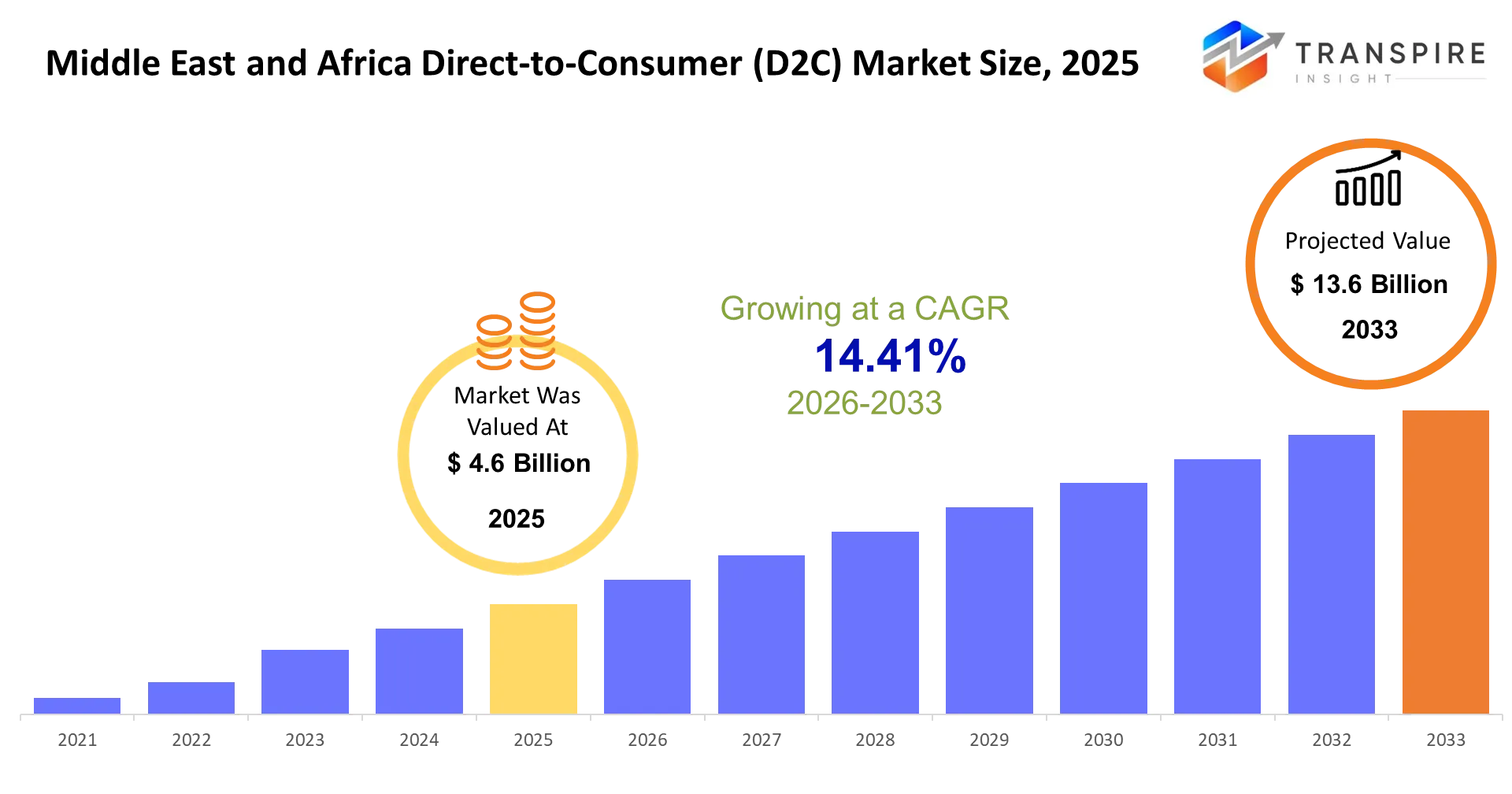
- Middle East and Africa Direct-to-Consumer (D2C) Market Size 2025: USD 4.6 Billion
- Middle East and Africa Direct-to-Consumer (D2C) Market Size 2033: USD 13.6 Billion
- Middle East and Africa Direct-to-Consumer (D2C) Market CAGR: 14.41%
- Middle East and Africa Direct-to-Consumer (D2C) Market Segments: By Type (Apparel, Electronics, Beauty & Personal Care, Food & Beverages, Others); By Application (Online Retail, Subscription Services, Brand Websites, Social Commerce, Others); By End-User (Consumers, Millennials, Gen Z, Enterprises, SMEs, Others); By Channel (Websites, Mobile Apps, Marketplaces, Others)
To learn more about this report,  Download Free Sample Report
Middle East and Africa Direct-to-Consumer (D2C) Market Summary
The Middle East and Africa Direct-to-Consumer (D2C) Market was valued at USD 4.6 Billion in 2025. It is forecast to reach USD 13.6 Billion by 2033. That is a CAGR of 14.41% over the period.
The Middle East and Africa Direct-to-Consumer (D2C) Market lets brands sell more or less straight to the end customer via digital storefronts, you know skipping the usual retail layers, and also filling in those distribution gaps where local retail infrastructure tends to be kinda fragmented. In real terms it connects global as well as regional brands to shoppers through mobile apps, online marketplaces, and social platforms, then it adds payments and last-mile logistics, especially in areas where physical retail coverage is not evenly distributed, and honestly that unevenness makes the whole thing feel more necessary.
Over the last 3–5 years the whole market has been moving more, in a structural way, toward mobile-first and platform-led commerce. Here things like discovery, payment, and fulfillment kinda run inside one digital ecosystem, not split across multiple steps. One major trigger was post-pandemic supply chain disruption, that showed how heavy retail was on imported inventory routes , and it pushed brands to lean into direct digital channels so they can manage demand more closely. Also, quick fintech adoption in the Gulf and in parts of Africa lowered the barriers for cross-border payments which made it easier to monetize online demand sooner
Together these forces have changed the revenue picture by shortening purchase cycles and boosting repeat buys. This is most noticeable in apparel, beauty ,and electronics across urban consumer segments where buyers are more active online and already comfortable with rapid checkouts
Key Market Insights
- Asia-centric GCC trade corridors keep pushing the lead, sort of like everything routes through them, with UAE and Saudi Arabia together making up roughly 38% of regional D2C transaction value in 2025.
- At the same time North Africa is sort of the fastest-growing region for 2026–2033, mostly because fintech is catching on, mobile wallets are everywhere, and cross border e-commerce access keeps widening in a fairly quick way.
- Apparel still sits in the front as the top product segment, it holds more than 32% share in the Middle East and Africa Direct-to-Consumer (D2C) market, and that’s tied to fast-fashion rhythms, plus influencer demand that kinda keeps pulling buyers in.
- Beauty and personal care ends up ranked as the second-largest segment, helped along by halal certification, and also by people moving toward premium skincare across Gulf markets.
- On the application side, social commerce looks like the fastest growing slice, it expands beyond 25% CAGR, as creators build direct conversion lanes, almost like funnels that are always on.
- For application share overall, online retail still dominates at nearly 45%, supported by integrated logistics and marketplace consolidation, which makes the buying journey feel smoother.
- For end users, Gen Z is the fastest-growing group, mainly because short form video commerce sticks, and shopping behavior is clearly mobile-first, not desktop style.
- And consumers remain the biggest end-user base, they take more than 60% share, since high-frequency retail purchases happen across urban areas pretty consistently.
- Lenskart i s pushing regional disruption in the optical retail space, in a kind of uh hybrid way online-to-offline store expansion happens, plus there is a subscription eyewear model, it sort of keeps customers in the flow.
- Alibaba is meanwhile improving cross border trade efficiency, via a platform driven sourcing network setup and it also blends B2B and D2C moves in a more unified strategy, so yeah it feels seamless.
What are the Key Drivers, Restraints, and Opportunities in the Middle East and Africa Direct-to-Consumer (D2C) Market?
Driver:
Mobile-first commerce expansion is pushing the strongest kind of growth in the Middle East and Africa, especially for Direct-to-Consumer. The acceleration kind of started when smartphone penetration got past those affordability floors in urban Africa and the GCC areas, and it also matched low-cost data plans and better last-mile logistics infrastructure. This shift ups transaction frequency pretty directly, since shoppers can skip some physical retail constraints and then interact all the time with app-based storefronts, mainly in apparel, electronics, and beauty, which is where the “always on” behavior shows up
Restraint:
Fragmented cross-border regulation is still the most durable structural blocker though. Different VAT rules, import duties, and even data localization requirements across Saudi Arabia South Africa, and North African economies create that operational drag for D2C expansion at scale. That kind of fragmentation ramps up compliance expenses and pushes firms to keep duplicated infrastructure in place, and that suppresses margin expansion. It also ends up slowing the regional rollout of unified digital storefronts, across the board
Opportunity:
AI-driven hyper-localization looks like the next big growth unlock, and it’s especially strong when you use multilingual personalization engines that are tuned for Arabic English and French consumers. Early deployments in the UAE and Nigeria by platforms have already shown better conversion results, when product recommendations and the interface adapt to language plus cultural cues. Investment energy is building around GCC-based digital commerce hubs too, where integrated logistics zones and cloud infrastructure let D2C brands scale personalized commerce playbooks across markets that are otherwise pretty fragmented
What Has the Impact of Artificial Intelligence Been on the Middle East and Africa Direct-to-Consumer (D2C) Market?
Artificial intelligence is getting more and more stitched into scrubber performance systems, and marine emission control technology, across shipping-linked trade networks that still move consumer goods flows into the Middle East and Africa. Operators are using AI-enabled control systems now, to automate exhaust gas cleaning adjustments in real time. They tune the sulfur capture rates while factoring in fuel type, engine load, and ambient sea conditions. That means less manual calibration needed, and it tends to keep compliance more steady with IMO 2020 sulfur rules across mixed-fuel fleets serving nearby port chains.
On top of that, machine learning models are getting used for predictive maintenance on scrubbers and auxiliary engine systems. They can detect early signals of corrosion, pump efficiency problems, and slurry flow rate deviations, before things turn messy. In practice, this lets operators cut down on surprise downtime and stretch out equipment life cycles. In some digitally monitored fleets, reported outcomes include operational uptime and maintenance planning efficiency improvements in the ballpark of 10 to 20 percent. Emissions forecasting tools also support voyage planning by simulating fuel use and regulatory exposure across different maritime corridors, so teams can make quicker corridor choices.
Even so, adoption is still held back, mostly because there is limited high quality operational data coming from actual marine conditions. This is especially noticeable on vessels running long-haul routes with uneven satellite connectivity. Retrofit integration costs for older fleets also slow the whole rollout, and it hits mid-sized operators particularly hard, the ones serving emerging ports along parts of Africa, where budgets are tight and timelines are compressed.
Key Market Trends
- Mobile-first purchasing kind of surged after 2023, while brands started redesigning storefronts around app based discovery and a one click checkout thing—so buying felt easier, almost too smooth.
- Social commerce then expanded sharply as influencers on Instagram and TikTok converted entertainment content into measurable sales funnels across GCC markets, not just “likes” anymore, it was sales.
- Cross border D2C fulfillment got better after 2024, UAE and Saudi logistics hubs reduced the average delivery times for imported consumer goods, which honestly helped brands not look “slow”.
- Beauty and personal care brands increasingly leaned into halal certification and localized formulations, and this reshaped how people trust products in Gulf and North African markets, a lot more than before.
- Marketplace dominance intensified after 2025, because Amazon and regional platforms started integrating logistics, payments, and seller tools into one unified ecosystem, kinda like end to end.
- Subscription commerce grew steadily in grooming and wellness categories, shifting demand away from one time purchases, toward recurring revenue models that feel more predictable.
- Gen Z consumers showed a higher preference for creator led discovery, so there was less reliance on traditional brand advertising across urban African cities, in practice.
- Regulatory tightening around data localization in Saudi Arabia and South Africa then pushed D2C firms to redesign digital infrastructure, compliance first, even when it slowed iterations.
- AI driven personalization tools became more common after 2025, letting companies run multilingual storefronts across Arabic English and French user segments, with less friction for most shoppers.
Middle East and Africa Direct-to-Consumer (D2C) Market Segmentation
By Type
Apparel seems to take the biggest slice within product-led digital commerce across the Middle East and Africa , mostly because the fast-fashion pull is so strong, plus people buy more often than you would think. Electronics stays close behind, in part from really high smartphone adoption and the general taste for imported devices that still feels kind of “safer” to consumers. Beauty and personal care is a bit strange though, in a good way, it has outsized influence even if the typical basket isn’t as large, since repeat orders and brand affinity remain very consistent in Gulf areas and in a lot of urban African cities.
Apparel keeps moving ahead thanks to rapid stock refresh cycles and social commerce being basically tied in. When shopping becomes trend-led, the conversion rate can jump, it’s like people decide quicker. Electronics does well too, because financing options help, and cross-border availability fills gaps, especially where the local retail assortment is still quite thin. Beauty and personal care grows through influencer discovery, plus a halal-certified stance that builds trust fast in regional consumer groups, even when budgets are tight.
Apparel will probably keep scaling , but margins may get squeezed as discounting gets more intense. Electronics should stabilize as refurbished units and warranty-linked services become more normal. Beauty and personal care, meanwhile, could end up leading on value , drawing attention from investors who like premiumization strategies and repeat-purchase loops.
By Application
Online retail dominates transactional volume because it’s broadly reachable, and it also rides on logistics networks that work well along urban corridors. Brand websites sit in a secondary slot, mostly where premium labels want a more direct customer connection , so they use their own pages rather than just marketplaces.
Social commerce is getting the fastest traction in youth-heavy markets, where discovery and the actual purchase kinda meet on the same platform, more or less. Online retail growth keeps going because marketplaces keep consolidating, and cross-border fulfillment is getting smoother, more efficient. Subscription services are picking up in consumables like grooming kits, wellness products as well, basically where demand is more predictable, so the unit economics get better. Social commerce expands quickly too, thanks to creator-led conversion and platform-native checkout flows, which reduces the usual friction and all that stuff.
Online retail will still be the backbone of digital transactions, but its overall share may slowly dilute as social-led discovery gets stronger. Subscription models will strengthen retention tactics for D2C brands, I mean the ongoing relationship matters. Social commerce will turn into a major acquisition channel, and that will push brands to redo both marketing and fulfillment, around real-time engagement not just old-funnel campaigns.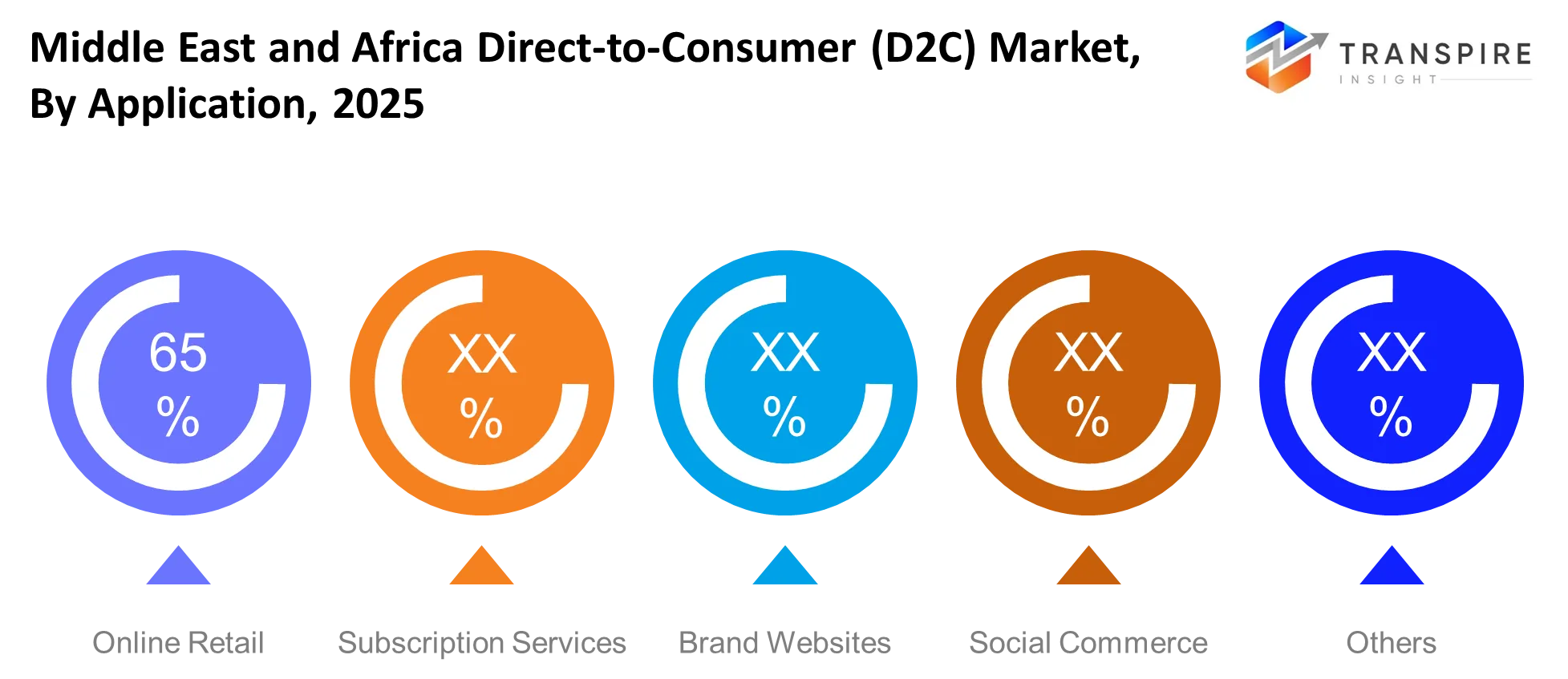
To learn more about this report, Download Free Sample Report
By End-User
Consumers are the biggest slice, mainly because digital shopping is widely adopted across income groups, especially in urban areas. Millennials keep steady buying momentum, with more consistent purchasing power, and higher average order values plus a stronger leaning toward convenience. Gen Z shows the quickest behavioral change, toward mobile-first, social-led buying habits.
Millennials sustain demand through stable income progression, and they tend to prefer trusted brands, and repeat purchases. Gen Z growth is powered by influencer ecosystems and short-form video commerce, plus a more price-sensitive discovery behavior. SMEs contribute mostly indirectly as sellers, using digital storefronts to bypass some traditional retail distribution constraints, that kind of thing.
Millennials will keep providing a kind of revenue steadiness, while Gen Z over the time will end up shaping the acquisition rhythm, or whatever you want to call it. Meanwhile SME participation is set to jump quite sharply because digital tools lower the entry threshold. Enterprise involvement should also edge upward in logistics, retail aggregation, and fulfillment services that help the larger scale teams run more smoothly.
By Channel
Marketplaces are currently in the lead , mostly because of strong aggregation effects, plus the logistics bed that’s already built in. Mobile apps are quickly catching up too, especially where people buy often. Websites still matter , but really more for premium or niche brands that want tighter brand storytelling and presentation.
Marketplaces expand by plugging into wider ecosystems, bringing payments, logistics, and discovery into one place. Mobile apps gain momentum from better device coverage and an easier path to offline payment flows, which can increase the transaction cadence. Website channels, on the other hand, lean heavily on brand differentiation and customer loyalty, not on traffic that’s just scale-driven.
Over time Marketplaces will keep channeling the transaction flow across regions. Mobile apps will turn into the main engagement layer for repeat customers. Websites will stay useful for premium positioning, but they may fall in relative share unless they’re backed by solid loyalty programs and clearly differentiated service models.
What are the Key Use Cases Driving the Middle East and Africa Direct-to-Consumer (D2C) Market?
Cross-border e-commerce and mobile-first retail remain the core use case driving D2C adoption in the Middle East and Africa, especially in apparel, beauty, and consumer electronics. Demand is strongest where consumers seek lower prices, wider assortment, and faster access to global brands that are not consistently available in local retail networks. This use case is reinforced by rising smartphone penetration and improved last-mile logistics in urban corridors across the GCC and major African cities.
Adjacent applications are expanding in subscription-based consumer goods and omnichannel retail integration for premium lifestyle and cosmetics segments. Beauty and personal care brands increasingly combine online storefronts with physical pop-up distribution in UAE and Saudi Arabia, while grocery and FMCG players test recurring delivery models for urban middle-class households. These models rely heavily on integrated payment gateways and regional fulfillment hubs to maintain consistency.
Emerging use cases include social commerce led by creators and AI-driven personalized storefronts tailored to multilingual audiences across Arabic, English, and French. Luxury resale and circular commerce platforms are also gaining traction as younger consumers prioritize affordability and sustainability.
|
Report Metrics |
Details |
|
Market size value in 2025 |
USD 4.6 Billion |
|
Market size value in 2026 |
USD 5.3 Billion |
|
Revenue forecast in 2033 |
USD 13.6 Billion |
|
Growth rate |
CAGR of 14.41% from 2026 to 2033 |
|
Base year |
2025 |
|
Historical data |
2021 - 2024 |
|
Forecast period |
2026 - 2033 |
|
Report coverage |
Revenue forecast, competitive landscape, growth factors, and trends |
|
Regional scope |
Middle East and Africa (Saudi Arabia, United Arab Emirates, South Africa, Rest of Middle East and Africa) |
|
Key company profiled |
Amazon, Shopify, Nike, Warby Parker, Glossier, Casper, Dollar Shave Club, Allbirds, Peloton, Tesla, Lenskart, Mamaearth, Boat, Nykaa, Shein |
|
Customization scope |
Free report customization (country, regional & segment scope). Avail customized purchase options to meet your exact research needs. |
|
Report Segmentation |
By Type (Apparel, Electronics, Beauty & Personal Care, Food & Beverages, Others); By Application (Online Retail, Subscription Services, Brand Websites, Social Commerce, Others); By End-User (Consumers, Millennials, Gen Z, Enterprises, SMEs, Others); By Channel (Websites, Mobile Apps, Marketplaces, Others) |
Which Regions are Driving the Middle East and Africa Direct-to-Consumer (D2C) Market Growth?
Asia Pacific kind of leads the global maritime shipping market, because it has a dense cluster of export-forward manufacturing hubs and ports that are already pretty developed. China, Singapore and South Korea basically anchor huge container throughput, and that helps keep scale efficiencies alive across shipping lines and logistics providers. The integrated port ecosystems , plus deep-water terminal capacity, make it easier for vessels to turn around faster, so per unit shipping costs stay lower than in other regions. There is also strong coordination between state policy and industrial zones , which sort of locks in this structural advantage over time.
Europe sits in second place. It competes less on raw volume and more on regulatory precision and operational stability. The region gets support from mature shipowning firms, fleet modernization programs that are already running, and pretty strict environmental compliance frameworks. These frameworks influence global standards and keep processes predictable. So, unlike Asia Pacific’s scale based model, Europe’s edge is that governance is steady and long term capital investment goes into greener vessel technologies. That stability pulls in consistent institutional financing too, and it helps revenue contributions remain steadier, with lower volatility for global maritime flows.
The fastest moving region is the Middle East, and parts of East Africa. This happens mainly due to aggressive port expansion, along with logistics diversification strategies. Saudi Arabia’s Red Sea infrastructure , the UAE’s transshipment hubs, and upgrades across East African ports are reshaping regional connectivity. At the same time new trade corridor policies and special economic zones reduce friction for vessel docking and cargo handling. For investors, this kind of growth points to a structural shift toward alternative east–west routing nodes, and it could open doors in port services, feeder networks, and logistics technology between 2026 and 2033, especially if demand keeps climbing.
Who are the Key Players in the Middle East and Africa Direct-to-Consumer (D2C) Market and How Do They Compete?
Competition in the Middle East and Africa D2C market still feels kinda structurally fragmented, yet it’s pretty quickly converging around platform ecosystems rather than those standalone brands, you know. Local retailers, global marketplaces, and niche digital-first brands all show up at the same time, and that keeps things from really consolidating cleanly at a regional level. The strongest pressure usually lands on who controls distribution, but also on localized payment integration and the reliability of last-mile delivery… like, the stuff that decides whether the customer actually receives the order on time. Price still plays a big role in mass segments, but differentiation is moving more toward fulfillment speed, an Arabic-first user experience, and the ability to run across multiple regulatory and VAT environments without too much friction, or too many detours.
Amazon builds advantage with an infrastructure-led play that kind of blends marketplace scale with integrated logistics and cloud-enabled tools for merchants. That lets it anchor cross-border demand flows into MEA, and also tighten delivery timelines via regional fulfillment networks. SHEIN goes at it with a data-driven, ultra-fast fashion model that does real-time demand sensing and then pushes hyper localized product iteration, which helps it beat the slower apparel cycle, especially in GCC youth-driven markets. Shopify focuses more on technology enablement, providing D2C merchants with modular storefront and payment capabilities, so MEA sellers can enter quicker and expand cross-border with less hassle. Nykaa, meanwhile, leans into niche beauty specialization, and then extends its ecosystem into GCC through omnichannel retail partnerships, where digital storefronts are blended with physical retail presence, most noticeably in those higher-income Gulf cities.
Company List
- Amazon
- Shopify
- Nike
- Warby Parker
- Glossier
- Casper
- Dollar Shave Club
- Allbirds
- Peloton
- Tesla
- Lenskart
- Mamaearth
- Boat
- Nykaa
- Shein
Recent Development News
“In February 2026, SHEIN Middle East hosted its ‘Beauty Glow Up’ campaign in Dubai, bringing together brands such as Maybelline and Chalhoub Group under its retail and marketplace partnership models. The initiative strengthened SHEIN’s hybrid D2C ecosystem in the GCC by enabling global beauty brands to expand localized digital storefronts and faster regional fulfillment capabilities.”https://www.prnewswire.com
“In September 2025, Nykaa announced accelerated international expansion plans for its in-house beauty brand Kay Beauty, including further rollout in the UK with Space NK and continued evaluation of expansion into the Middle East market via its Nysaa GCC platform. This move signals Nykaa’s transition from India-centric D2C to a cross-border omnichannel beauty retailer targeting GCC demand.”https://m.economictimes.com
What Strategic Insights Define the Future of the Middle East and Africa Direct-to-Consumer (D2C) Market?
Over the next 5–7 years, the Middle East and Africa D2C market is kind of structurally shifting toward a mobile-first, platform-aggregated ecosystem where social commerce and embedded finance are, increasingly, replacing standalone brand storefronts. The push is less about classic e-commerce expansion, and more about rapid fintech penetration, rising smartphone adoption , and the normalization of creator-led discovery pathways. There’s also a risk that is less obvious—regulatory fragmentation, especially the shifting data sovereignty rules, import restrictions, and the ongoing VAT harmonization efforts, which may end up compressing cross-border scalability, even while headline demand growth stays strong.
At the same time, an underexploited opportunity is also showing up: AI-enabled hyper-localization. Here multilingual personalization across Arabic, French, and English can become a real differentiator, like a moat, particularly as social platforms deepen commerce integrations in places such as Saudi Arabia and Nigeria. Strategically, participants should focus on localized fulfillment networks, and pair them with compliant data architectures. That combination supports faster delivery and regulatory resilience while positioning for platform dependency, rather than trying to win purely through direct traffic acquisition.
Middle East and Africa Direct-to-Consumer (D2C) Market Report Segmentation
By Type
- Apparel
- Electronics
- Beauty & Personal Care
- Food & Beverages
- Others
By Application
- Online Retail
- Subscription Services
- Brand Websites
- Social Commerce
- Others
By End-User
- Consumers
- Millennials
- Gen Z
- Enterprises
- SMEs
- Others
By Channel
- Websites
- Mobile Apps
- Marketplaces
- Others
Frequently Asked Questions
Find quick answers to common questions.
The Estimated Middle East and Africa Direct-to-Consumer (D2C) Market size is USD 13.6 Billion in 2033.
Key Segments for the Middle East and Africa Direct-to-Consumer (D2C) Market are By Type (Apparel, Electronics, Beauty & Personal Care, Food & Beverages, Others); By Application (Online Retail, Subscription Services, Brand Websites, Social Commerce, Others); By End-User (Consumers, Millennials, Gen Z, Enterprises, SMEs, Others); By Channel (Websites, Mobile Apps, Marketplaces, Others).
Major Middle East and Africa Direct-to-Consumer (D2C) Market players are Amazon, Shopify, Nike, Warby Parker, Glossier, Casper, Dollar Shave Club, Allbirds, Peloton, Tesla, Lenskart, Mamaearth, Boat, Nykaa, Shein.
The Current Middle East and Africa Direct-to-Consumer (D2C) Market size is USD 4.6 Billion in 2025.
The Middle East and Africa Direct-to-Consumer (D2C) Market CAGR is 14.41% from 2026 to 2033.
- Amazon
- Shopify
- Nike
- Warby Parker
- Glossier
- Casper
- Dollar Shave Club
- Allbirds
- Peloton
- Tesla
- Lenskart
- Mamaearth
- Boat
- Nykaa
- Shein
Recently Published Reports
-
Apr 2026
Bottled Water Market
Bottled Water Market Size, Share & Analysis Report By Product Type (Still Bottled Water, Carbonated Bottled Water, Functional Bottled Water, and Others), By Packaging (PET, Cans, and Others), By Sales Channel (Supermarkets/Hypermarkets, Convenience Stores/Drug Stores, Grocery Stores/Club Stores, Foodservice, and Others) and Geography (North America, Europe, Asia-Pacific, Middle East and Africa, South and Central America), 2021 - 2032
-
Apr 2026
Color Cosmetic Packaging Market
Color Cosmetic Packaging Market Size, Share & Analysis Report By Application (Mascara Packaging, Liquid Packaging, and Liquid Face), By Type (Tubes & Bottles, Pens & Markers, Compacts & Containers, and Droppers & Pumps), and Geography (North America, Europe, Asia-Pacific, Middle East and Africa, South and Central America), 2021 - 2031
-
Apr 2026
External Microphone For Camera Market
External Microphone For Camera Market Size, Share & Analysis Report By Type (Shotgun Microphone, Lavalier Microphone, and Others), By Application (Digital Camera, Professional Video Camera, and Others), and Geography (North America, Europe, Asia-Pacific, Middle East and Africa, South and Central America), 2021 - 2031
-
Apr 2026
Foot Orthotic Insoles Market
Foot Orthotic Insoles Market Size, Share & Analysis Report By Type (Pre-fabricated, and Custom-made), By Material (Thermoplastic, Composite Carbon Fiber, and Others), By Distribution Channel (Drug Stores, Hospitals & Clinics, and Others), and Geography (North America, Europe, Asia-Pacific, Middle East and Africa, South and Central America), 2021 - 2031