
Middle East and Africa Contraband Detector Market Size & Forecast:
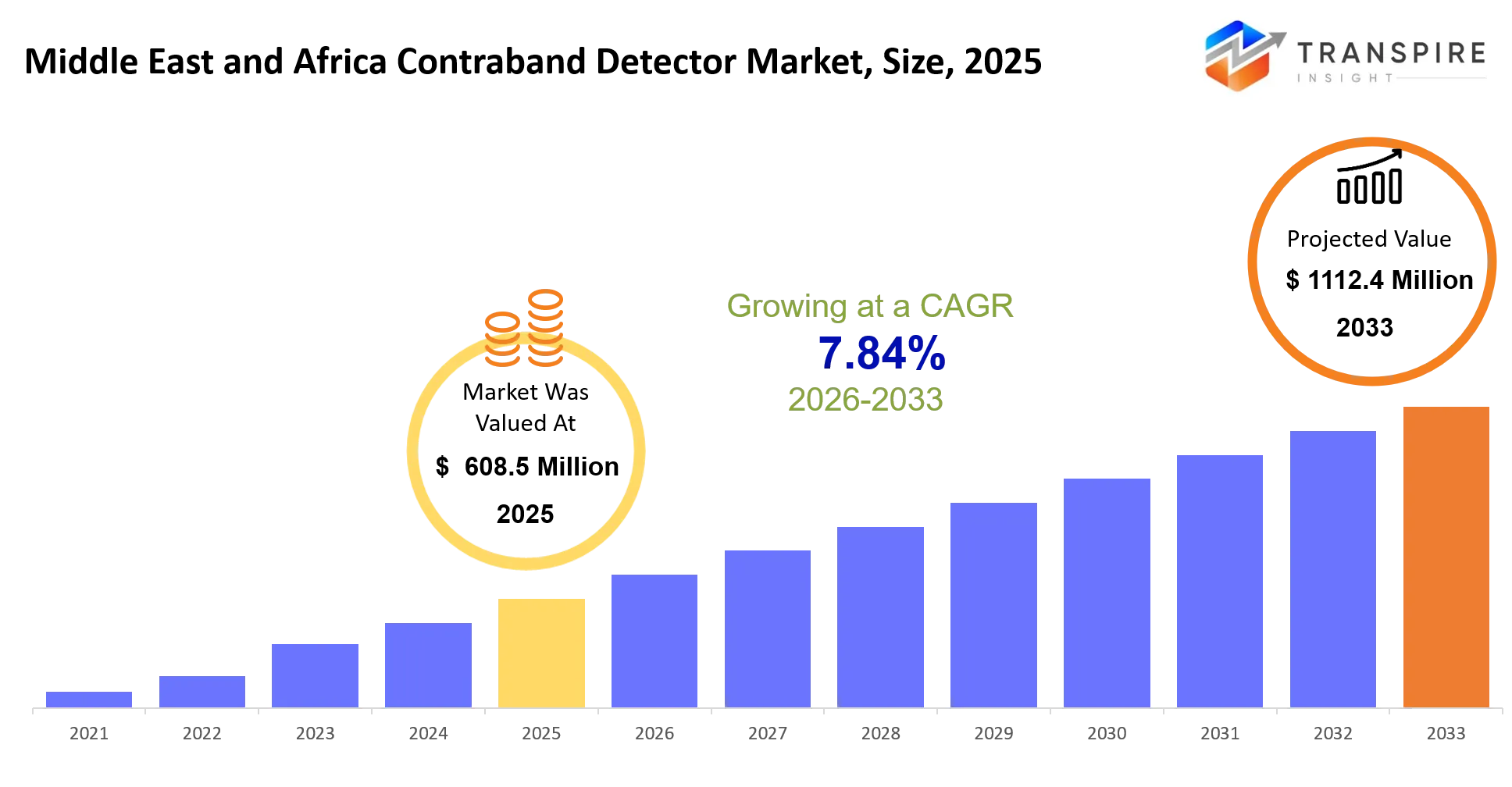
- Middle East and Africa Contraband Detector Market Size 2025: USD 608.5 Million
- Middle East and Africa Contraband Detector Market Size 2033: USD 1112.4 Million
- Middle East and Africa Contraband Detector Market CAGR: 7.84%
- Middle East and Africa Contraband Detector Market Segments: By Product Type (X-ray Detectors, Trace Detectors, Metal Detectors, Narcotics Detectors, Others); By Application (Airports, Border Security, Prisons, Commercial Facilities, Others); By Technology (Imaging, Spectroscopy, AI-based Detection, Others); By End User (Government, Defense, Transportation, Others)
Middle East and Africa Contraband Detector Market Summary
The Middle East and Africa Contraband Detector Market was valued at USD 608.5 Million in 2025. It is forecast to reach USD 1112.4 Million by 2033. That is a CAGR of 7.84% over the period.
Contraband detectors matter a lot when it comes to stopping the movement of illegal items narcotics weapons, explosives, and any unauthorized materials through airports, border crossings, correctional facilities, ports, and also commercial sites. In practice, these systems let security teams spot hidden dangers fast, while still keeping the flow of travelers, freight, and trade stuff moving. And as governments across the Middle East and Africa keep tightening their national security rules, more funding for improved detection tools has turned into a clear priority
Over roughly the last five years, the whole market has kinda drifted away from the old metal screening style, and moved toward a more combined approach like imaging trace detection and AI-assisted inspection platforms that can flag several threat types in one scan. A big reason for this shift is the rising border security worry, the presence of illicit trafficking networks, and frankly the up tick in cross-border commerce. So authorities have leaned into high-throughput screening systems , these increase precision while also cutting down the need for so much hands-on checking. With security expectations getting stricter all the time , many organizations are phasing out older devices and swapping in more capable solutions. That usually means stronger procurement activity , and it helps sustain long-term revenue momentum across the regional market as well
Key Market Insights
- So the Middle East and Africa Contraband Detector Market is kind of riding on big airport modernization schemes across multiple Gulf countries, and also some major African transport hubs… you know, where passenger flow is heavy.
- In 2025, the Gulf Cooperation Council countries brought in almost 45% of the regional revenue, and that happened largely because of continuous investment in security infrastructure , (and stronger perimeter controls overall).
- Between 2022 and 2025, AI-assisted screening systems cut down manual inspection effort by roughly 20–30% at a bunch of high traffic facilities, so staff workload was reduced. Not entirely, but noticeably.
- For technology, imaging-based detection will hold around 38% of the market in 2025, mainly because it gives a clearer threat visualization than older approaches , which matters during fast decisions.
- Looking forward, AI-based detection solutions seem to be the fastest-growing segment through 2033, mostly driven by automated threat identification and analytics , rather than just rule-based screening.
- When it comes to deployment, airports generated more than 35% of the total application revenue in 2025, which basically makes aviation security the biggest runway for adoption.
- On the border side, border security applications are projected to expand the most quickly as governments tighten customs controls and anti trafficking enforcement.
- End users wise, government agencies stayed on top, with an estimated 50%+ market share in 2025, supported by their security modernization programs.
- Key companies including Smiths Detection, Rapiscan Systems, Nuctech, CEIA, and Thales are pushing broader portfolios too, using advanced imaging methods plus automated screening technologies.
- And competitively, strategic partnerships, AI integration, and rolling out computed tomography screening platforms are turning into the main differentiators across the regional security screening space .
What are the Key Drivers, Restraints, and Opportunities in the Middle East and Africa Contraband Detector Market?
The strongest growth driver is kinda the modernization of border and transportation security infrastructure across the Middle East and Africa. Governments have been increasing spending on airport expansion projects, customs modernization programs, and also critical infrastructure protection after these heightened concerns about illicit trafficking, cross border crime , and regional security threats . With more advanced imaging scanners , trace detectors, and AI-supported screening systems, authorities can inspect higher volumes of passengers and cargo without necessarily creating those operational bottlenecks. That kind of ability directly helps procurement activity and makes equipment replacement cycles move faster, which in turn supports market revenue expansion .
The most noticeable restraint is still the high acquisition and lifecycle costs tied to advanced contraband detection systems. Computed tomography scanners, integrated AI platforms, and spectroscopy based detectors need a lot of capital up front, plus specialized installation and continued maintenance. Budget limitations across several African economies makes big scale deployment difficult. Also, since infrastructure funding cycles and public procurement processes can stretch over multiple years , this problem cannot be solved quickly and it keeps delaying adoption in price sensitive markets.
A key opportunity sits in deploying AI-enabled cargo and vehicle inspection systems across emerging trade corridors. There’s growing investment in logistics zones, free trade areas, and smart border initiatives, so the conditions become more favorable for advanced screening technology. Countries like Saudi Arabia , the UAE, and South Africa are expanding transport infrastructure while digitizing customs operations.
What Has the Impact of Artificial Intelligence Been on the Middle East and Africa Contraband Detector Market?
Artificial intelligence has kind of transformed how security agencies and infrastructure operators go about identifying prohibited materials, and honestly it’s changed a lot in a short time. More and more, modern contraband detection systems lean on AI algorithms to look through X-ray images, CT scans, plus other sensor data in real time. With automated threat recognition, security teams can spot suspicious objects quicker, and there’s less reliance on manual interpretation, even if people still double check sometimes.
Machine learning models also support predictive maintenance because they keep track of equipment performance and flag parts that are more likely to fail before a real operational disruption happens. Because of that, system availability gets better and downtime drops down. On top of that, AI improves image analysis by sorting harmless objects from potential threats with steadier consistency, so operators can handle larger screening loads without scaling staffing in the same proportion. It’s kind of a numbers game, but automated pattern noticing helps.
Some advanced screening platforms now combine AI with computed tomography along with trace detection, and that combo improves threat identification accuracy while moving passenger and cargo processing along faster. When facilities deploy automated analysis solutions, they’ve often reported shorter inspection times and fewer cases where secondary screening is needed. Meanwhile research keeps pushing detection accuracy higher by using bigger datasets, plus newer image segmentation models that can outline areas more precisely.
Even so, AI adoption isn’t all smooth edges. There are integration costs, strict data quality needs, and the requirement for extensive training datasets that reflect real-world contraband scenarios. In addition, limited technical expertise, plus infrastructure constraints in certain markets, can slow implementation of AI powered security screening systems.
Key Market Trends
- Since 2021 airports have kind of sped up deployment of CT based screening systems, that let staff see baggage in a more detailed way while doing fewer manual checks.
- AI assisted image analysis was adopted a lot more between 2022 and 2026, and that bumped up threat detection accuracy and also overall operational efficiency, pretty clearly.
- Government purchasing is leaning more toward multi threat detection platforms, able to flag narcotics, explosives, weapons, plus contraband all at once, not in separate passes.
- Border security teams expanded non intrusive vehicle inspections by over 20% across major trade corridors since 2023 or so, with some uneven rollout timing.
- Cloud connected screening systems also showed up as a preferred route for centralized monitoring and remote diagnostics, especially across bigger security networks.
- Cargo screening projects got more momentum as e commerce volumes and cross border freight traffic kept climbing through out the region.
- Smiths Detection expanded the rollout of advanced CT screening tools inside big airport modernization efforts during 2025–2026, and it seems pretty systematic.
- Rapiscan Systems kept landing large inspection and screening contracts while pushing more advanced cargo and vehicle inspection deployments in 2025–2026 as well.
- AI driven analytics, in advanced screening setups reduced the number of false alarms by something like 15–25% compared with older legacy systems.
- Security agencies are increasingly looking for integrated platforms that bundle imaging, trace detection, and data analytics, into one single workflow.
Middle East and Africa Contraband Detector Market Segmentation
By Product Type
X-ray detectors have a pretty major role in security screening, due to the ability to look into baggage, cargo, and parcels without actual physical handling. There is strong uptake across airports, border checkpoints, and transport facilities, and that, in turn, supports the overall market growth. The imaging is clear enough that security staff can spot hidden objects efficiently. Also, ongoing investments in infrastructure security will help future deployment in busy places with high traffic.
Then you’ve got trace detectors, they are used for very small amounts of explosive or chemical residues, and they fit naturally into layered security operations. Metal detectors still get used a lot, mainly because the operation is simple, the performance is reliable, and the deployment is cost friendly. Narcotics detectors help law enforcement detect illegal substances, especially in transportation and border control zones. Other detector types include radiation detection systems and specialized inspection technologies, made for those unique security needs, and situations.
By Application
Airports take up a big chunk of detector installations, mostly because passenger and baggage checks have to be strict. Security agencies keep improving the inspection setup, so safety standards stay solid while passenger flow stays somewhat smooth. New inspection technologies help lower the operational hang ups, and also boost threat detection results. Plus, when airports expand over time, that also means more openings for equipment deployment, sort of continually.
For border security, the main idea is stopping the illegal movement of goods , weapons and controlled substances across national lines. Prisons use screening systems to prevent unwanted items from getting into correctional facilities, and to overall tighten safety measures. In commercial places—like shopping centers, industrial sites, and corporate buildings—detection technologies get adopted to protect visitors, staff and property. There are also other places like government buildings, ports, and critical infrastructure locations, where advanced monitoring is basically required, all the time.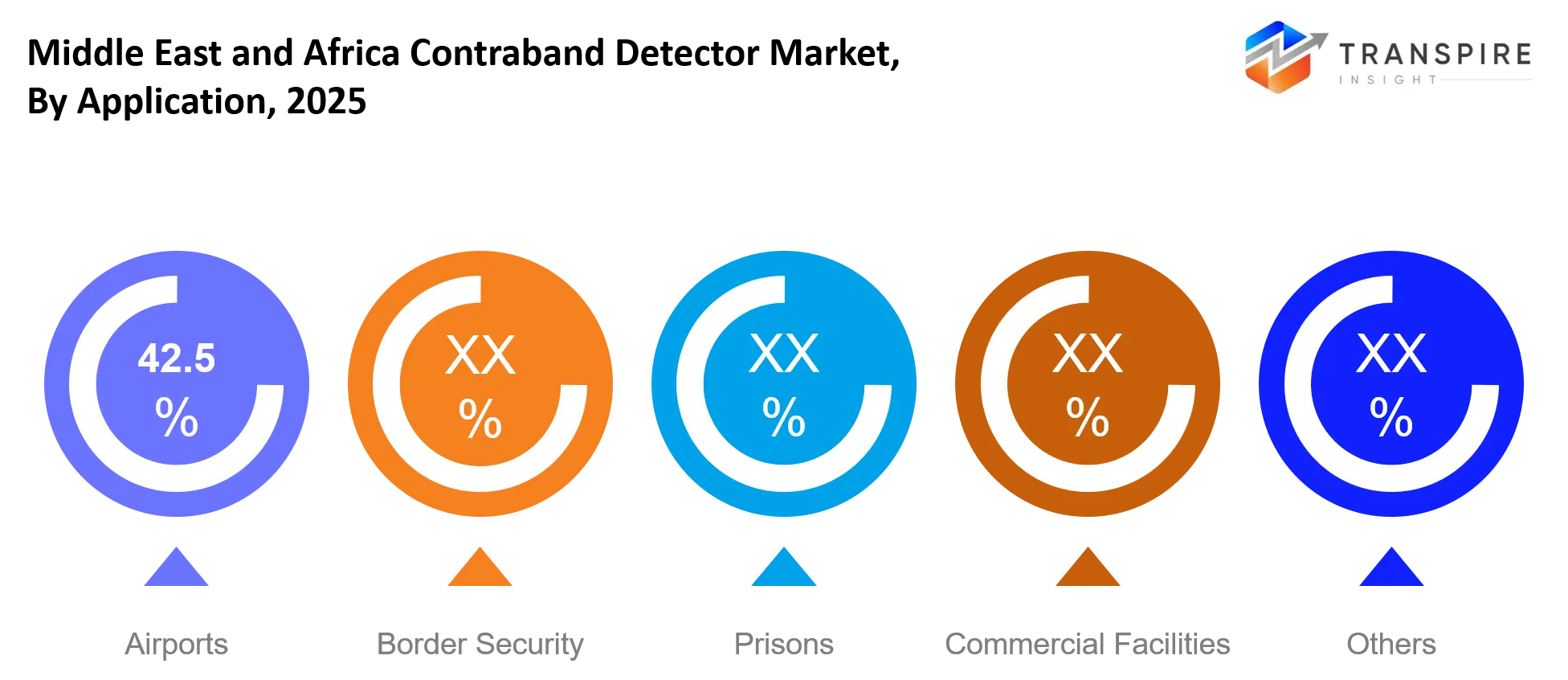
By Technology
Imaging tech still seems to stay the most widely used way, mostly because it can show really detailed views for checking hidden things, so people can see whats going on. X ray and computed tomography setups help with fast screening across transport and security places. When the images are high resolution, threat identification gets better, and inspection accuracy goes up too. If tech keeps moving forward, adoption should get stronger across multiple sectors, I mean it.
Then there is spectroscopy, which helps pin down materials pretty precisely, and it can aid the detection of narcotics, explosives, and other not allowed substances. AI based detection tools take the screening outputs and sort them automatically, and they can speed things up thanks to pattern recognition. As artificial intelligence gets more tightly integrated with the current systems, operations become more efficient, and decisions come out stronger. There are also radiation sensing systems, plus hybrid inspection solutions, kind of built for specialized security requirements, so yeah.
By End User
Government organizations kinda stand out as the biggest end user group because they carry the responsibility for customs enforcement, public safety, and border protection. Big procurement programs back the install of more advanced screening equipment across transport hubs and public infrastructure. Security modernization plans keep nudging budgets toward new technologies, and overall long term national security goals likely keep the investment activity going.
On the defense side, defense organizations deploy detection systems to guard military facilities, logistics centers, and other high-sensitivity operational areas. Transportation operators, meanwhile, use screening technology across airports, rail networks, freight terminals, and logistics facilities so passengers and goods move safely. There are also other end users like commercial enterprises, correctional institutions, and critical infrastructure operators, they’re looking for stronger security capabilities. As security requirements keep expanding across these sectors, it should support a steady, almost uninterrupted, adoption of advanced detection solutions.
What are the Key Use Cases Driving the Middle East and Africa Contraband Detector Market?
Airport security is still the biggest use case, where screening systems actually check passengers' baggage, and cargo for weapons, explosives, narcotics, and other stuff that is not allowed. When you have high passenger volumes, plus those tight aviation security rules, it keeps pushing for newer imaging and trace detection technologies, like it never really slows down.
Then you get border control operations, which is another pretty major area. Here customs agencies rely on vehicle inspection systems , cargo scanners, and narcotics detection equipment to stop smuggling, and to block unauthorized crossing at the border. Also, correctional facilities sometimes put in detection systems so contraband gets caught before it even reaches the secure locations inside.
On top of that, there are emerging applications, including smart logistics hubs, free trade zones, and protection efforts for critical infrastructure. AI enabled cargo inspection platforms are starting to draw more interest, along with automated vehicle screening systems. Governments are basically modernizing their customs operations and, in parallel, expanding regional trade networks so these tools get more traction over time.
|
Report Metrics |
Details |
|
Market size value in 2025 |
USD 608.5 Million |
|
Market size value in 2026 |
USD 655.9 Million |
|
Revenue forecast in 2033 |
USD 1112.4 Million |
|
Growth rate |
CAGR of 7.84% from 2026 to 2033 |
|
Base year |
2025 |
|
Historical data |
2021 - 2024 |
|
Forecast period |
2026 - 2033 |
|
Report coverage |
Revenue forecast, competitive landscape, growth factors, and trends |
|
Regional scope |
United States; Canada; Mexico; United Kingdom; Germany; France; Italy; Spain; Denmark; Sweden; Norway; China; Japan; India; Australia; South Korea; Thailand; Brazil; Argentina; South Africa; Saudi Arabia; United Arab Emirates |
|
Key company profiled |
Smiths Detection, Rapiscan Systems, Leidos, Nuctech, Garrett, CEIA, Thales, Teledyne FLIR, Astrophysics, OSI Systems, Analogic, Rohde & Schwarz, Safran, NEC, Bosch |
|
Customization scope |
Free report customization (country, regional & segment scope). Avail customized purchase options to meet your exact research needs. |
|
Report Segmentation |
By Product Type (X-ray Detectors, Trace Detectors, Metal Detectors, Narcotics Detectors, Others); By Application (Airports, Border Security, Prisons, Commercial Facilities, Others); By Technology (Imaging, Spectroscopy, AI-based Detection, Others); By End User (Government, Defense, Transportation, Others) |
Which Regions are Driving the Middle East and Africa Contraband Detector Market Growth?
The Gulf region takes the lead because there are big, ongoing investments into airport infrastructure, border security modernization, and also national security initiatives. Saudi Arabia , and the United Arab Emirates in particular keep deploying more advanced screening technologies across transport hubs and customs facilities . Government funding stays strong so tech adoption keeps moving. On top of that , a mature security ecosystem kind of keeps the regional leadership steady.
South Africa is still an important secondary market though, mainly backed by established transportation infrastructure and fairly consistent security investment. The growth rhythm is different from the Gulf region because the demand is more tied to trade facilitation, customs modernization, and upgrades to infrastructure itself . Stable institutional frameworks help keep long term procurement activity alive. As a result, technology suppliers can expect more dependable revenue channels.
For the wider African region, the forecast period is expected to show the fastest growth. New border modernization initiatives, broader trade corridors, and investments in transportation infrastructure are opening up fresh deployment chances. At the same time, security agencies increasingly lean toward non-intrusive inspection technologies, to strengthen enforcement capabilities without slowing things down too much. Altogether , these changes should make the market look attractive for new entrants and investors between 2026 and 2033.
Who are the Key Players in the Middle East and Africa Contraband Detector Market and How Do They Compete?
The Gulf region takes the lead because there are big, ongoing investments into airport infrastructure, border security modernization, and also national security initiatives. Saudi Arabia , and the United Arab Emirates in particular keep deploying more advanced screening technologies across transport hubs and customs facilities . Government funding stays strong so tech adoption keeps moving. On top of that , a mature security ecosystem kind of keeps the regional leadership steady.
South Africa is still an important secondary market though, mainly backed by established transportation infrastructure and fairly consistent security investment. The growth rhythm is different from the Gulf region because the demand is more tied to trade facilitation, customs modernization, and upgrades to infrastructure itself . Stable institutional frameworks help keep long term procurement activity alive. As a result, technology suppliers can expect more dependable revenue channels.
For the wider African region, the forecast period is expected to show the fastest growth. New border modernization initiatives, broader trade corridors, and investments in transportation infrastructure are opening up fresh deployment chances. At the same time, security agencies increasingly lean toward non-intrusive inspection technologies, to strengthen enforcement capabilities without slowing things down too much. Altogether , these changes should make the market look attractive for new entrants and investors between 2026 and 2033.
Company List
- Smiths Detection
- Rapiscan Systems
- Leidos
- Nuctech
- Garrett
- CEIA
- Thales
- Teledyne FLIR
- Astrophysics
- OSI Systems
- Analogic
- Rohde & Schwarz
- Safran
- NEC
- Bosch
Recent Development News
"In January 2026, Smiths Detection deployed its HI-SCAN 6040 CTiX 3D X-ray screening technology across all passenger terminals at Heathrow Airport. The rollout strengthened advanced automated screening capabilities and demonstrated growing adoption of CT-based contraband detection systems.https://www.smithsdetection.com
"In February 2026, OSI Systems through Rapiscan Systems received ECAC/EU G1 certification for trace detection solutions used in airport security. The certification enhanced market credibility and supported broader deployment opportunities for advanced contraband screening technologies.https://www.rapiscansystems.com/
What Strategic Insights Define the Future of the Middle East and Africa Contraband Detector Market?
The market is moving, toward intelligent integrated security ecosystems, where AI analytics, advanced imaging, trace detection, and centralized monitoring platforms all sort of work as one unified screening environment. The main driver behind this whole direction is basically that operators need to handle larger passenger and cargo volumes, without reducing security effectiveness , or dropping the ball in that sense. In the future procurement decisions will more and more prefer platforms that can support automated threat recognition and real-time operational analytics.
There is also a quieter risk, one that doesn’t get discussed as much, which is technology concentration across a limited set of specialized suppliers. If everyone depends on only a small number of advanced technology providers, it can lead to procurement bottlenecks , more pricing pressure, and supply chain fragility, especially when demand spikes up.
On the opportunity side, there is something pretty promising in AI-enabled customs modernization programs across emerging African trade corridors. As governments digitize border operations, and as logistics infrastructure keeps expanding, the demand for automated inspection systems should grow a lot stronger over time.
Market participants should focus on interoperable platforms that bring together imaging, AI analytics, and predictive maintenance capabilities. The organizations that design scalable solutions, aligned with shifting regulatory requirements and day-to-day operational needs, are likely to be the ones most ready to capture the next wave of growth chances.
Middle East and Africa Contraband Detector Market Report Segmentation
-
By Product Type
X-ray Detectors
Trace Detectors
Metal Detectors
Narcotics Detectors
Others -
By Application
Airports
Border Security
Prisons
Commercial Facilities
Others -
By Technology
Imaging
Spectroscopy
AI-based Detection
Others -
By End User
Government
Defense
Transportation
Others
Frequently Asked Questions
Find quick answers to common questions.
The Expected Middle East and Africa Contraband Detector Market size for the Market will be USD 1112.4 Million in 2033.
Key Segments for the Middle East and Africa Contraband Detector Market are By Product Type (X-ray Detectors, Trace Detectors, Metal Detectors, Narcotics Detectors, Others); By Application (Airports, Border Security, Prisons, Commercial Facilities, Others); By Technology (Imaging, Spectroscopy, AI-based Detection, Others); By End User (Government, Defense, Transportation, Others).
Major Middle East and Africa Contraband Detector Market Players are Smiths Detection, Rapiscan Systems, Leidos, Nuctech, Garrett, CEIA, Thales, Teledyne FLIR, Astrophysics, OSI Systems, Analogic, Rohde & Schwarz, Safran, NEC, Bosch.
The Current Middle East and Africa Contraband Detector Market size is USD 608.5 Million in 2025.
The Middle East and Africa Contraband Detector Market CAGR is 7.84% from 2026 to 2033.
- Smiths Detection
- Rapiscan Systems
- Leidos
- Nuctech
- Garrett
- CEIA
- Thales
- Teledyne FLIR
- Astrophysics
- OSI Systems
- Analogic
- Rohde & Schwarz
- Safran
- NEC
- Bosch
About the Authors

Avinash Kumar
I’m Avinash Kumar, a Senior Research Analyst at Transpire Insight, with expertise in the Electronics and Semiconductor and Energy & Power industry. My work focuses on analyzing emerging technologies, market trends, industry developments, and innovation across these sectors. I specialize in transforming complex technical and market insights into clear, research-backed content that helps professionals, businesses, and decision-makers stay informed. Through continuous industry research and data-driven analysis, I strive to deliver accurate, reliable, and practical perspectives on the latest advancements shaping the semiconductor and energy landscape.

Chakradhar Khansole
Chakradhar serves as the Research Director at Transpire Insight, bringing over 8 years of experience in technology, innovation, and strategic market intelligence. He specializes in transforming complex market data into actionable business insights that enable organizations to make informed, growth-oriented decisions. Recognized for his strategic vision and analytical expertise, Chakradhar leads high-impact research initiatives, delivering comprehensive market assessments, competitive intelligence, and forward-looking industry analysis.
Recently Published Reports
-
Apr 2026
Fiber Optic Faceplates Market
Fiber Optic Faceplates Market Size, Share & Analysis Report By Type (< 300 mm2, 300-350 mm2, and > 350 mm2, By Application (Night Vision, Holographic Imaging, Medical, and Others), and Geography (North America, Europe, Asia-Pacific, Middle East and Africa, South and Central America), 2021 - 2031
-
Apr 2026
High Temperature Superconductors Market
High Temperature Superconductors Market Size, Share & Analysis Report By Type (1G HTS, and 2G HTS), By Application (Power Cable, Fault Current Limiter, and Transformer), and Geography (North America, Europe, Asia-Pacific, Middle East and Africa, South and Central America), 2021 - 2031
-
Apr 2026
Industrial Plugs and Socket Market
Industrial Plugs and Socket Market Size, Share & Analysis Report By Type (Industrial Plugs, Industrial Sockets), By Current (Up to 32 A, 32 to 125 A, Above 125 A), By Protection (Dustproof and Splash Proof, Waterproof, Explosion Proof), By End User (Heavy Industries, Oil and Gas, Chemicals and Pharmaceuticals, Power Generation, Others), and Geography (North America, Europe, Asia-Pacific, Middle East and Africa, South and Central America), 2021 - 2031
-
Apr 2026
InGaAs Avalanche Photodiodes Market
InGaAs Avalanche Photodiodes Market Size, Share & Analysis Report By Type (1100 - 1700 nm, and 1000 - 1600 nm), By Application (Missile Warning System, Muzzle Flash Detection, Wafer Defect Inspection, Laser Rangefinders, and Others), and Geography (North America, Europe, Asia-Pacific, Middle East and Africa, South and Central America), 2021 - 2031