
Middle East and Africa Concrete Market Size & Forecast:
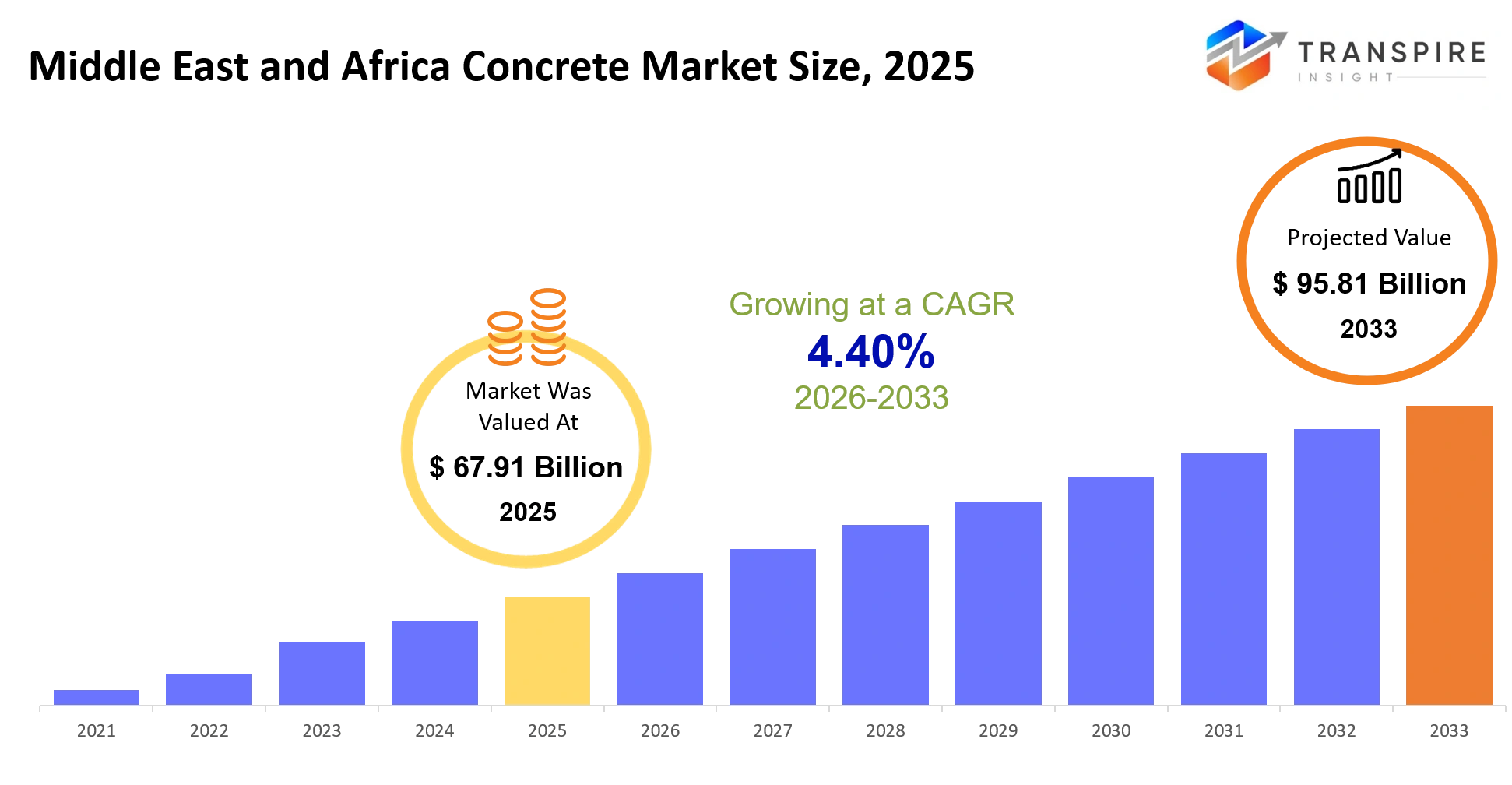
- Middle East and Africa Concrete Market Size 2025: USD 67.91 Billion
- Middle East and Africa Concrete Market Size 2033: USD 95.81 Billion
- Middle East and Africa Concrete Market CAGR: 4.40%
- Middle East and Africa Concrete Market Segments: By Product Type (Ready-Mix Concrete, Precast Concrete, Shotcrete, High-Performance Concrete, Decorative Concrete, Self-Compacting Concrete, Fiber-Reinforced Concrete, Others); By Application (Residential Construction, Commercial Construction, Infrastructure Projects, Industrial Construction, Road Construction, Bridges & Tunnels, Marine Structures, Others); By Strength Type (Standard Strength Concrete, High Strength Concrete, Ultra-High Strength Concrete, Lightweight Concrete, Heavyweight Concrete, Air Entrained Concrete, Rapid Hardening Concrete, Others); By End User (Construction Companies, Infrastructure Developers, Government Projects, Real Estate Developers, Industrial Users, Contractors, Engineering Firms, Others).
Middle East and Africa Concrete Market Summary
The Middle East and Africa Concrete Market was valued at USD 67.91 Billion in 2025. It is forecast to reach USD 95.81 Billion by 2033. That is a CAGR of 4.40% over the period.
Concrete pretty much acts as the quiet backbone of construction everywhere in the Middle East and Africa, letting people build housing , transport links, industrial plants, energy projects , and even the urban stuff that keeps cities running. You can see it from tall apartment towers and high rise projects in Gulf economies to big road and rail corridors across Africa , where concrete still gives the whole build the strength needed, plus durability, and that cost efficient angle for long-life assets.
In the last five years, though, the market has kind of leaned more and more toward low-carbon concrete options, precast construction approaches , and materials that are tweaked for better performance. This is largely because governments and developers want projects finished quicker, but also want lower lifecycle emissions. A big push behind all that change is the speeding up of national infrastructure investment programs , along with sustainability pledges that connect directly to economic diversification plans, especially in Gulf countries.
Those investments are essentially lifting the need for specialized concrete products that can improve wear resistance, cut down maintenance expenses, and still support huge construction timetables. so, manufacturers are not just keeping up— they are expanding production capacity, rolling out updated mix designs, and tightening regional supply chains. That combo then opens up new revenue routes across the entire construction value chain.
Key Market Insights
- In 2025, Saudi Arabia kind of dominated the regional market with around 28% share, largely backed by Vision 2030 megaproject spending, and all those big upgrades.
- Meanwhile Sub-Saharan Africa looks like the fastest-growing regional market, with momentum tied to transport corridors, housing initiatives,and the build-out of industrial zones stretching through 2033.
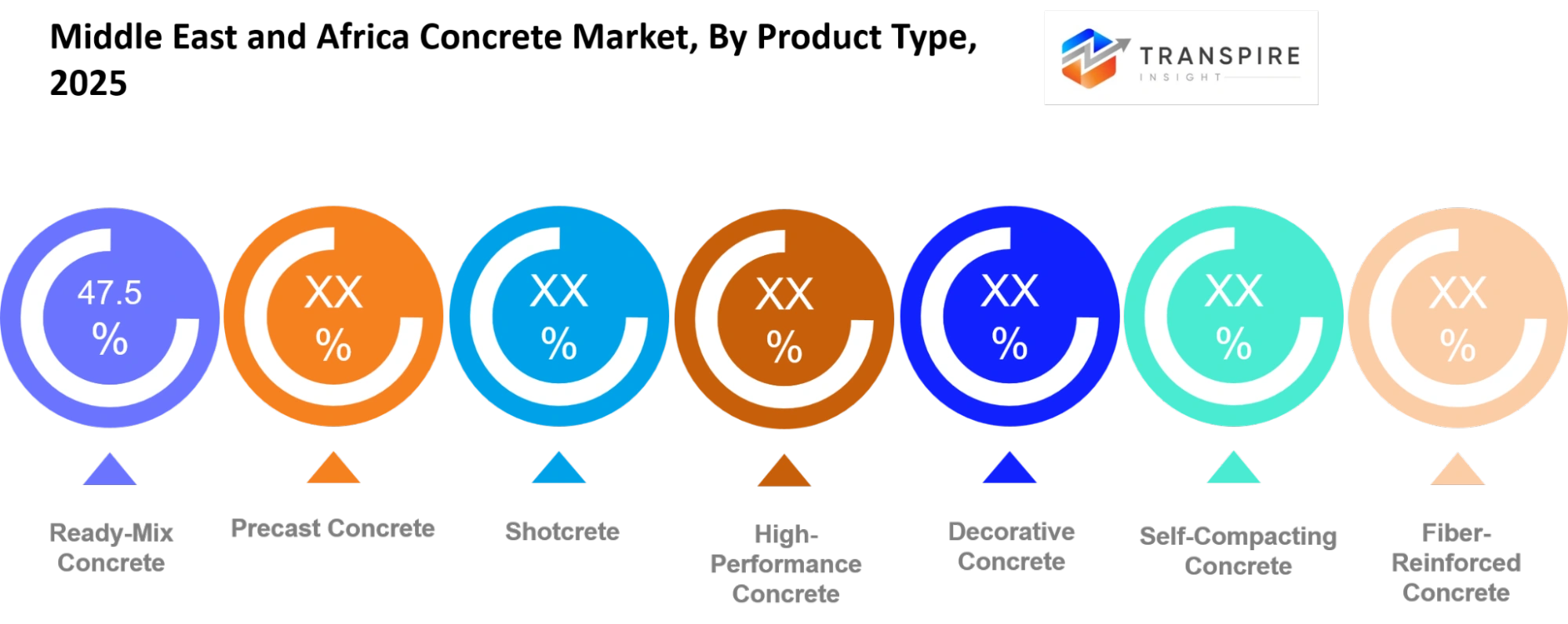
- When it comes to product mix, Ready-Mix Concrete made up about 35% of revenue in 2025, helped by steady quality and the take-up of large-scale projects.
- Precast Concrete was next as the second-largest segment with almost 22%, mostly because of quicker building schedules and more streamlined on-site work.
- High-Performance Concrete is expected to climb at above 6% per year through 2033, driven by the need for infrastructure that stays durable longer.
- On the application side, Infrastructure projects represented nearly 32% of total consumption in 2025 so yes, it’s the leading application area.
- For the forecast period, road, rail, and bridge construction are set to contribute more than 40% of the incremental demand, roughly speaking.
- As end-users, Government-funded projects stayed in front with close to 30% market share in 2025.
- Industrial construction is also showing up as a higher-growth end-user, mainly from manufacturing diversification and the logistics investments that go with it.
- And big players—Holcim, Heidelberg Materials, Cemex, Dangote Cement, and UltraTech Cement —are pursuing low-carbon materials, doing acquisitions, leaning into digital production technologies, plus pushing regional expansion plans.
What are the Key Drivers, Restraints, and Opportunities in the Middle East and Africa Concrete Market?
Honestly the biggest push behind faster market expansion is the very large and kinda unprecedented level of investment in infrastructure and cities across the region. In Saudi Arabia , the UAE, and Egypt for example, government driven diversification programs have kept a steady stream of building works moving, like transportation upgrades, housing projects, tourism builds, plus utilities and industrial facilities. With all that happening, they need huge quantities of ready-mix, precast, and high-performance concrete. And once these project pipelines keep growing, concrete producers tend to get better utilization levels, clearer contract outlooks, and more sales of those value-added mixes which can carry a premium price.
Still, one of the hardest structural issues is volatility in cement, energy, and even transportation costs. Cement making relies a lot on energy heavy processes, while aggregates and finished products usually depend on wide logistics networks. Many African markets remain stuck with infrastructure bottlenecks and a kind of import dependence for equipment, on top of fuel costs that swing around. These realities don’t get fixed overnight, so you end up seeing margin pressure through the entire value chain. When costs stay unpredictable, approvals can slip, construction slows down, and it becomes harder to invest in advanced concrete technologies.
On the other hand, low-carbon and circular building materials look like the most solid long term opportunity. More and more governments, developers, and international financiers are demanding lower embodied carbon for their construction projects. There are technologies like carbon mineralized concrete, recycled aggregates, supplementary cementitious materials, and AI optimized mix designs that are starting to move into commercial use. The Gulf countries seem to be early adopters too, mostly because they have sustainability targets and they’re running massive urban development programs.
What Has the Impact of Artificial Intelligence Been on the Middle East and Africa Concrete Market?
Honestly the biggest push behind faster market expansion is the very large and kinda unprecedented level of investment in infrastructure and cities across the region. In Saudi Arabia , the UAE, and Egypt for example, government driven diversification programs have kept a steady stream of building works moving, like transportation upgrades, housing projects, tourism builds, plus utilities and industrial facilities. With all that happening, they need huge quantities of ready-mix, precast, and high-performance concrete. And once these project pipelines keep growing, concrete producers tend to get better utilization levels, clearer contract outlooks, and more sales of those value-added mixes which can carry a premium price.
Still, one of the hardest structural issues is volatility in cement, energy, and even transportation costs. Cement making relies a lot on energy heavy processes, while aggregates and finished products usually depend on wide logistics networks. Many African markets remain stuck with infrastructure bottlenecks and a kind of import dependence for equipment, on top of fuel costs that swing around. These realities don’t get fixed overnight, so you end up seeing margin pressure through the entire value chain. When costs stay unpredictable, approvals can slip, construction slows down, and it becomes harder to invest in advanced concrete technologies.
On the other hand, low-carbon and circular building materials look like the most solid long term opportunity. More and more governments, developers, and international financiers are demanding lower embodied carbon for their construction projects. There are technologies like carbon mineralized concrete, recycled aggregates, supplementary cementitious materials, and AI optimized mix designs that are starting to move into commercial use. The Gulf countries seem to be early adopters too, mostly because they have sustainability targets and they’re running massive urban development programs.
Key Market Trends
- Since 2021 , the uptake of precast building systems has been going up, at least by roughly 20% or so. This has led to less hands-on work, and yeah it also shortens the overall project timeline , in a pretty practical way.
- Meanwhile low carbon concrete products kind of pushed deeper into the market, because big producers rolled out carbon-cutting approaches and swapped in alternative cement blends.
- In the Gulf, those massive megaprojects quietly redirected procurement toward high performance formulations, able to satisfy durability needs even when the climates get harsh or extreme.
- Also, the use of recycled aggregates rose by about 15% between 2022 and 2025, especially across the bigger urban construction markets where demand is constant.
- Digital batching systems gained more attention too, and they help tighten quality control while dialing down material loss, sometimes by as much as 10% in more advanced facilities.
- On top of that, government infrastructure spending across GCC economies went beyond hundreds of billions of dollars, giving everyone longer term material demand visibility. That part really matters.
- Producers are also increasingly using AI enabled maintenance plus logistics planning tools, not just for show , but to boost plant utilization and improve delivery flow.
- Then during 2025–2026, strategic acquisitions picked up speed , since global manufacturers moved to grow their downstream concrete and building solutions collections.
- Carbon capture, utilization, and mineralization efforts have moved from small pilot type work into actual commercial deployment , which is a noticeable shift.
- Finally, contractors have been leaning more often toward self compacting mixes and fiber reinforced materials, especially for complicated infrastructure and industrial undertakings where higher performance is the main point..
Middle East and Africa Concrete Market Segmentation
By Product Type
Ready-Mix Concrete, pretty much stays the preferred option for big building jobs, mostly because the quality is consistent, delivery is fast and predictable, and there’s less labor needed once you’re on site. For residential developments, commercial buildings, and even infrastructure work, ready-mix solutions get used a lot because they help with speed and reliability. And Precast Concrete is still picking up momentum, since developers are looking for shorter schedules, plus more controlled quality. In a factory setup, production turns out more uniform which means construction waste drops, and weather related headaches are also reduced.
Then there’s Shotcrete, which really matters for tunnel work, mining operations, slope stabilization, and underground infrastructure. High-Performance Concrete also shows up where the demands are high, like when durability, strength, and resistance to environmental stress are non-negotiable. Decorative Concrete tends to be a go-to for urban landscaping, public spaces, retail projects, and those premium residential communities. Self-Compacting Concrete helps with placement efficiency especially in complicated structures, while Fiber-Reinforced Concrete boosts crack resistance and overall structural behavior. Beyond that, other specialty mixes cover smaller specific needs across industrial, marine, and energy projects.
By Application
Residential Construction often generates a lot of consumption from housing developments, apartment complexes, and that general urban expansion stuff. Commercial Construction, meanwhile, keeps demand moving for office towers, retail centers, hotels, healthcare facilities, and educational institutions (it’s sort of a lot at once). Infrastructure Projects are another big source of volume consumption, think airports, rail networks, ports, utilities , and public transportation systems. Industrial Construction tends to lean on sturdy materials for factories , warehouses, processing facilities and logistics centers
Road Construction still stays a critical application, mostly because transportation network expansion never really stops across the region. Bridges & Tunnels really need advanced materials that can handle heavy loads and long service lives even when conditions get rough. Marine Structures use specialized formulations designed to resist corrosion , plus the salty water exposure that comes with coastal environments. Other uses pop up too like agricultural facilities, energy projects sports venues and public infrastructure developments
By Strength Type
Standard Strength Concrete keep doing its job for general purpose building work, when moderate performance traits line up with what the job actually needs. High Strength Concrete gets picked for taller buildings, major infrastructure efforts and for structures that see notable mechanical loading, over and over. Ultra-High Strength Concrete is more and more chosen when the use case is narrow and demanding, like specialized structural needs where exceptional efficiency and durability really matter. Lightweight Concrete helps cut down total structural weight, and it can also nudge thermal performance in certain building layouts.
Heavyweight Concrete is for the jobs that want radiation shielding, or where you simply need enhanced density in the material profile. Air Entrained Concrete tends to boost freeze thaw resistance, and it supports long term behavior when conditions turn difficult. Rapid Hardening Concrete lets teams finish earlier, since it reaches required strength sooner than usual, which sounds simple but speeds scheduling a lot. There are also other strength categories, for specialized engineering demands across industrial projects, infrastructure work and utility installations.
By End User
Construction Companies take up a notable portion of material use, mostly because they are involved in residential, commercial and yes, infrastructure work. Infrastructure Developers in particular lean on big volume concrete buying for transportation corridors, utility systems, and public works type projects. The Government Projects keep pushing meaningful demand too, through national development schemes and those public investment push initiatives. Real Estate Developers also end up mattering a lot, with residential neighborhoods, mixed use developments, and commercial holdings
Industrial Users need specialized types for manufacturing plants, processing spaces, logistics hubs, and energy infrastructure. Contractors depend on a dependable supply of materials so schedules stay on track, and so the performance requirements are met. Engineering Firms shape what gets chosen via design constraints, structural standards, and also lifecycle performance considerations. Other end users are things like institutional organizations, utilities, and private infrastructure investors as well.
What are the Key Use Cases Driving the Middle East and Africa Concrete Market?
Infrastructure construction is still the big one, mostly happening along transportation corridors, metro lines, airports, ports, water networks, and also those big public development programs. I mean these jobs need huge amounts of material, plus a long service life, so there’s this steady need for structural solutions that are actually high quality , not just “good enough”.
More and more, industrial facilities and commercial developments are becoming real demand hubs. Things like manufacturing plants, logistics parks, distribution centers, tourism initiatives, and mixed-use projects depend on improved formulations, the kind that help with durability, build-pace, and day to day operational efficiency. Big contractors and industrial developers keep pushing the uptake of precast plus high-performance solutions, year after year.
And then there are the newer areas too. For example carbon-reduced construction materials, smart infrastructure efforts, and climate-resilient urban growth. Renewable energy sites, hydrogen projects, and advanced industrial districts are expected to open up fresh opportunities for specialized products across the whole forecast period, kind of continuously.
|
Report Metrics |
Details |
|
Market size value in 2025 |
USD 67.91 Billion |
|
Market size value in 2026 |
USD 70.89 Billion |
|
Revenue forecast in 2033 |
USD 95.81 Billion |
|
Growth rate |
CAGR of 4.40% from 2026 to 2033 |
|
Base year |
2025 |
|
Historical data |
2021 - 2024 |
|
Forecast period |
2026 - 2033 |
|
Report coverage |
Revenue forecast, competitive landscape, growth factors, and trends |
|
Regional scope |
United States; Canada; Mexico; United Kingdom; Germany; France; Italy; Spain; Denmark; Sweden; Norway; China; Japan; India; Australia; South Korea; Thailand; Brazil; Argentina; South Africa; Saudi Arabia; United Arab Emirates |
|
Key company profiled |
Holcim, Heidelberg Materials, Cemex, UltraTech Cement, CRH, Buzzi, Vicat, Dangote Cement, PPC Ltd, Lafarge Africa, Saudi Cement, ACC, Shree Cement, CNBM, Taiheiyo Cement. |
|
Customization scope |
Free report customization (country, regional & segment scope). Avail customized purchase options to meet your exact research needs. |
|
Report Segmentation |
By Product Type (Ready-Mix Concrete, Precast Concrete, Shotcrete, High-Performance Concrete, Decorative Concrete, Self-Compacting Concrete, Fiber-Reinforced Concrete, Others); By Application (Residential Construction, Commercial Construction, Infrastructure Projects, Industrial Construction, Road Construction, Bridges & Tunnels, Marine Structures, Others); By Strength Type (Standard Strength Concrete, High Strength Concrete, Ultra-High Strength Concrete, Lightweight Concrete, Heavyweight Concrete, Air Entrained Concrete, Rapid Hardening Concrete, Others); By End User (Construction Companies, Infrastructure Developers, Government Projects, Real Estate Developers, Industrial Users, Contractors, Engineering Firms, Others). |
Which Regions are Driving the Middle East and Africa Concrete Market Growth?
In the Gulf Cooperation Council area, market revenue generation sits at the top, mostly because of big infrastructure spending, pretty ambitious city-building, and that ongoing government budgets kind of thing. Saudi Arabia is pretty much in the middle of it all, driven by mega projects that tie back to economic diversification agendas. There’s also solid financial muscle, modern logistics capabilities, and long-established construction ecosystems, all of which keep the momentum for market leadership. The demand then spills over into residential work, tourism services, transportation projects and industrial programs too.
North Africa comes in as the second-largest contributor, but it kinda behaves differently from the Gulf. Here, the emphasis leans more toward population-driven housing needs and public infrastructure development. Places like Egypt keep putting money into transport corridors , sprawling urban expansion projects, and industrial zones. With a varied construction pipeline, demand becomes more evenly distributed across multiple sectors, rather than clustering too tightly in one area. Plus , stable government investment programs keep the market active for the long haul.
Sub-Saharan Africa looks like the fastest-growing region, mainly due to quickening urbanization, stronger transportation buildouts, and continued industrial investment. Governments are putting more attention on road networks, rail projects, logistics passageways, and affordable housing initiatives. International funding, along with public–private partnerships, has boosted delivery capability in a number of countries. And that overall momentum should open more interesting prospects for manufacturers, investors, and suppliers aiming for exposure to long-term infrastructure expansion between 2026 and 2033.
Who are the Key Players in the Middle East and Africa Concrete Market and How Do They Compete?
Competition is kinda moderately consolidated among big multinational building materials firms and regional producers , especially those with really strong local manufacturing networks. The competitive edge seems to lean more and more on production efficiency, sustainability credentials , where they can reach geographically, and how well they’re positioned around major infrastructure projects. Lots of companies are basically moving off pure commodity materials, and instead they’re rolling out specialized concrete products, digital services , and also low-carbon solutions, which sounds simple but it’s a real shift.
Holcim stands out because it keeps pushing aggressive investment into low-carbon construction technologies, circular materials, and newer advanced concrete solutions. It keeps expanding via acquisitions and sustainability oriented partnerships, while at the same time scaling carbon-mineralization technologies and AI enabled operations, kinda end to end.
Heidelberg Materials is more about operational scale, aggregates integration, and strategic acquisitions that reinforce supply capabilities and broaden regional market reach. The ongoing acquisition pace helps with vertical integration , and it also improves distribution efficiency, in a practical way.
Dangote Cement leans heavily on its broad African manufacturing capacity, export infrastructure , and cost-efficient production networks. With expansion spending and export driven strategies, it tries to lock in a stronger position across multiple African markets, not just one area.
Cemex and UltraTech Cement still emphasize operational efficiency, product innovation, and selective expansion into higher-value construction materials, plus downstream solutions that add more value per project, and not only the basic stuff.
Company List
- Holcim
- Heidelberg Materials
- Cemex
- UltraTech Cement
- CRH
- Buzzi
- Vicat
- Dangote Cement
- PPC Ltd
- Lafarge Africa
- Saudi Cement
- ACC
- Shree Cement
- CNBM
- Taiheiyo Cement
Recent Development News
"In May 2026, Holcim entered a partnership with Paebbl and Goldbeck for the first commercial-scale deployment of carbon-storing concrete technology. The collaboration demonstrated practical use of mineralized CO₂ materials in large logistics infrastructure projects.
Source: https://www.holcim.com
"In January 2026, Holcim completed the acquisition of Alkern, a French precast concrete manufacturer. The transaction expanded Holcim's building solutions portfolio and strengthened its position in infrastructure and construction applications.
Source: https://www.reuters.com
What Strategic Insights Define the Future of the Middle East and Africa Concrete Market?
The market is kind of moving toward a future that’s shaped by infrastructure modernization and all that urban expansion stuff, plus industrial diversification, and decarbonized construction materials too. In a way, growth will be more and more about whether firms can deliver higher performance products while also cutting lifecycle emissions and keeping construction costs down. Sustainability requirements , digital production technologies, and circular material systems are likely to shift from “nice-to-have” into core competitive differentiators, not optional add-ons.
There’s also a risk that is less visible—like exposure to energy price volatility and carbon regulation changes. If a producer leans too much on traditional cement heavy products , they can get squeezed on costs as environmental standards tighten and alternative materials get wider acceptance. At the same time, carbon-mineralized concrete, recycled aggregates, and AI optimized production systems are real emerging openings , especially in Gulf markets where sustainability targets are pretty ambitious.
A practical strategic recommendation is basically this: market players should invest early in low-carbon production technologies and regional supply chains. Firms that manage to combine sustainable products, digital manufacturing know-how, and a solid local distribution network should be the ones most ready to win premium infrastructure and urban development projects during the next ten years.
Middle East and Africa Concrete Market Report Segmentation
By Product Type
- Ready-Mix Concrete
- Precast Concrete
- Shotcrete
- High-Performance Concrete
- Decorative Concrete
- Self-Compacting Concrete
- Fiber-Reinforced Concrete
- Others
By Application
- Residential Construction
- Commercial Construction
- Infrastructure Projects
- Industrial Construction
- Road Construction
- Bridges & Tunnels
- Marine Structures
- Others
By Strength Type
- Standard Strength Concrete
- High Strength Concrete
- Ultra-High Strength Concrete
- Lightweight Concrete
- Heavyweight Concrete
- Air Entrained Concrete
- Rapid Hardening Concrete
- Others
By End User
- Construction Companies
- Infrastructure Developers
- Government Projects
- Real Estate Developers
- Industrial Users
- Contractors
- Engineering Firms
- Others
Frequently Asked Questions
Find quick answers to common questions.
The expected Middle East and Africa Concrete Market size for the market will be USD 95.81 Billion in 2033.
Key segments for the Middle East and Africa Concrete Market are By Product Type (Ready-Mix Concrete, Precast Concrete, Shotcrete, High-Performance Concrete, Decorative Concrete, Self-Compacting Concrete, Fiber-Reinforced Concrete, Others); By Application (Residential Construction, Commercial Construction, Infrastructure Projects, Industrial Construction, Road Construction, Bridges & Tunnels, Marine Structures, Others); By Strength Type (Standard Strength Concrete, High Strength Concrete, Ultra-High Strength Concrete, Lightweight Concrete, Heavyweight Concrete, Air Entrained Concrete, Rapid Hardening Concrete, Others); By End User (Construction Companies, Infrastructure Developers, Government Projects, Real Estate Developers, Industrial Users, Contractors, Engineering Firms, Others).
Major Middle East and Africa Concrete Market players are Holcim, Heidelberg Materials, Cemex, UltraTech Cement, CRH, Buzzi, Vicat, Dangote Cement, PPC Ltd, Lafarge Africa, Saudi Cement, ACC, Shree Cement, CNBM, Taiheiyo Cement.
The Middle East and Africa Concrete Market size is USD 67.91 Billion in 2025.
The Middle East and Africa Concrete Market CAGR is 4.40% from 2026 to 2033.
- Holcim
- Heidelberg Materials
- Cemex
- UltraTech Cement
- CRH
- Buzzi
- Vicat
- Dangote Cement
- PPC Ltd
- Lafarge Africa
- Saudi Cement
- ACC
- Shree Cement
- CNBM
- Taiheiyo Cement
About the Authors

Kartik bhong
I am Kartik Bhong, a Senior Research Analyst at Transpire Insight, specializing in the Packaging, Manufacturing, and Construction industry. My work focuses on analyzing market trends, emerging technologies, industry regulations, and competitive landscapes to deliver accurate, data-driven insights. I am passionate about transforming complex industry information into clear, practical content that helps businesses, professionals, and decision-makers stay informed and make confident strategic decisions. Through continuous research and a strong commitment to accuracy, I strive to create reliable, well-researched content that reflects the latest developments across these dynamic industries and supports the vision of Transpire Insight in delivering valuable market intelligence.

Chakradhar Khansole
Chakradhar serves as the Research Director at Transpire Insight, bringing over 8 years of experience in technology, innovation, and strategic market intelligence. He specializes in transforming complex market data into actionable business insights that enable organizations to make informed, growth-oriented decisions. Recognized for his strategic vision and analytical expertise, Chakradhar leads high-impact research initiatives, delivering comprehensive market assessments, competitive intelligence, and forward-looking industry analysis.
Recently Published Reports
-
Apr 2026
Handling and Lifting Equipment Market
Handling and Lifting Equipment Market Size, Share & Analysis Report By Product (Cranes and Hoists, Forklifts, Conveyor Systems, Aerial Work Platforms, Others), By Application (E-Commerce, Automotive and Railway, Food and Beverages, Aviation, Others), and Geography (North America, Europe, Asia-Pacific, Middle East and Africa, South and Central America), 2021 - 2031
-
Apr 2026
HVAC Equipment Market
HVAC Equipment Market Size, Share & Analysis Report By Heating Equipment Type (Boilers and Furnaces, Heat Pumps, and Unitary Heaters), By Ventilation Equipment (Air Handling Units, Humidifiers and Dehumidifiers, Air Filters, and Fan Coiling Units), By Air Conditioning Equipment (Unitary Air Conditioners, Room Air Conditioners, Packaged Terminal Air Conditioners, and Chillers), By End User (Commercial, Residential, Industrial, and others), and Geography (North America, Europe, Asia-Pacific, Middle East and Africa, South and Central America), 2021 – 2031
-
Apr 2026
Refrigeration Valves Market
Refrigeration Valves Market Size, Share & Analysis Report By Type (Solenoid Valves, Expansion Valves, Check Valves, Service Valves, Others), By Application (Commercial Refrigeration, Industrial Refrigeration, Transport Refrigeration, Residential Refrigeration, Air Conditioning Systems), By End User (Food and Beverage Industry, Pharmaceutical Industry, HVAC Industry, Chemical Industry, Others), and Geography (North America, Europe, Asia-Pacific, Middle East and Africa, South and Central America), 2021 – 2031
-
Apr 2026
E-Commerce Packaging Materials Market
E-Commerce Packaging Materials Market By Material Type (Corrugated Boxes, Paper & Paperboard, Foam & Cushioning Materials, Plastic Packaging, Flexible Packaging, Protective Packaging, Others), By Product(Primary Packaging, Secondary Packaging, Tertiary Packaging), By Packaging Function (Protective Packaging, Branding & Presentation Packaging, Transit & Logistic Packaging, Sustainable Packaging, Tamper Evidence Packaging), By End-User (Retail & Consumer Goods, Electronic Appliances, Food & Beverages, Healthcare & Pharmaceutical, Fashion & Apparel, Home & Furnishing, Others); By Industry Analysis, Size, Share, Growth, Trends, and Forecasts 2021-2033