

Middle East and Africa Carbon Nanotube Applications Market Summary
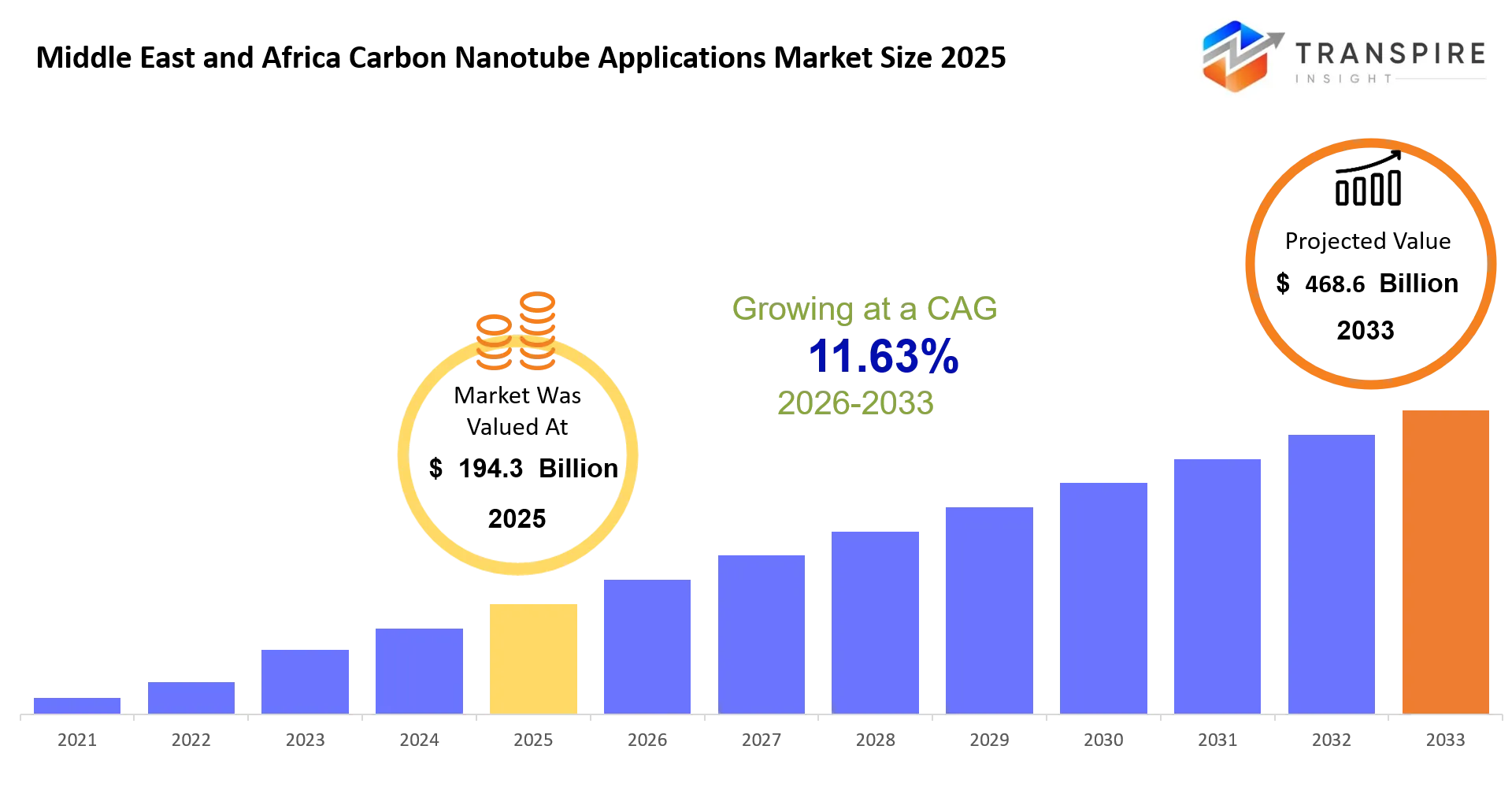
As per Transpire Insight Analysis the Middle East and Africa Carbon Nanotube Applications Market size is estimated at USD 194.3 Million in 2025 and is anticipated to reach USD 468.6 Million by 2033, growing at a CAGR of 11.63% from 2026 to 2033.
The Middle East and Africa Carbon Nanotube Applications Market basically helps industries that need materials that are more lightweight, yet stronger and more conductive. It also fits those “ advanced manufacturing” programs where people want better results without extra bulk . Carbon nanotubes make batteries work better, support electronics, improve automotive parts, strengthen aerospace composites, and even help with coatings and industrial sensors too, because they raise mechanical strength, electrical conductivity, and thermal stability at the same time, and the product weight does not really jump up much.
Over the past five years the market kind of moved away from lab-scale trials and started heading toward real commercial use. This has happened especially in energy storage, electric mobility, and high performance composites, where companies actually want scale. The pace picked up after COVID 19 because supply chain disruptions pushed regional manufacturers to rethink where they buy materials from, and to diversify sourcing, plus in some cases to localize production. On top of that , government spending, and support programs for renewable energy, electric transport, and more expansive industrial diversification have opened up more doors for nanotube enabled products. So now when manufacturers are chasing longer lasting batteries, more resilient composites and lightweight engineering materials, carbon nanotube applications keep sliding into more mainstream adoption. And with that, the revenue trend stays on the stronger side across several industrial sectors too.
Middle East and Africa Carbon Nanotube Applications Market Size & Forecast:
- Middle East and Africa Carbon Nanotube Applications Market Size 2025: USD 194.3 Million
- Expected Market Value 2033: USD 468.6 Million
- Forecast CAGR: 11.63%
- Leading country in 2025: Saudi Arabia
- Fastest-growing country: Saudi Arabia
- Key Profile: OCSiAl, Cabot Corporation, Arkema, LG Chem, Nanocyl, Showa Denko, Kumho Petrochemical, Toray Industries, Raymor Industries, CHASM Advanced Materials, Cnano Technology, Thomas Swan, Nanoshel, Cheap Tubes, Carbon Solutions
Key Market Insights
- Saudi Arabia kind of dominates the Middle East and Africa Carbon Nanotube Applications Market, with an estimated 34–37% regional market share in 2025, and this is backed by industrial diversification, plus advanced manufacturing investments and so on.
- South Africa looks like it’s the fastest mover during the forecast period, mainly because battery materials research is growing, mining innovation is getting stronger,and automotive component manufacturing keeps expanding a bit more each year.
- In the product side, Multi-Walled Carbon Nanotubes (MWCNTs) lead the segment, taking roughly 58–62% of the market share. This happens due to lower production costs, and also wider industrial adoption.
- Functionalized Carbon Nanotubes land as the second-largest segment, since they support better compatibility with polymers, coatings, and even biomedical materials.
- Single-Walled Carbon Nanotubes (SWCNTs) are expected to show the quickest growth through 2033, with momentum from premium electronics and next generation battery technologies.
- For applications, energy storage brings in nearly 29–32% of total revenue, as lithium-ion battery manufacturers keep improving conductivity , and also charging efficiency.
- Electronics applications are expanding quickly too, driven by flexible electronics, conductive films, semiconductor packaging, and printed circuit innovations that are getting more attention lately.
- When it comes to end users, electronics manufacturers stay the largest group with around 30% market share, while automotive manufacturers show the strongest growth as EV programs scale up.
- Some key players including OCSiAl, Cabot Corporation, LG Chem, Nanocyl SA, Arkema SA, and CHASM Advanced Materials keep strengthening regional competitiveness via production expansion, product innovation,and strategic collaborations that keep stacking over time.
What are the Key Drivers, Restraints, and Opportunities in the Middle East and Africa Carbon Nanotube Applications Market?
The strongest growth driver is kinda the rapid commercialization of advanced energy storage and lightweight composite materials. Government-backed industrial diversification initiatives in places like Saudi Arabia and the UAE, plus expanding electric mobility and renewable energy projects, have pushed investment in high-performance materials even faster. Battery manufacturers are increasingly adding carbon nanotubes to boost conductivity, speed up charging, and extend cycle life while also lowering inactive material content. In practice this shift helps manufacturers stand out with more premium products, and supports higher revenue through value-added material solutions.
The biggest constraint is still the high production cost, and the limited regional manufacturing capacity for high-purity carbon nanotubes. Getting consistent nanotube quality needs sophisticated chemical vapor deposition processes, strict quality control, and dedicated purification technologies, which all require substantial capital investment. And because only a small number of suppliers can satisfy industrial quality standards, procurement costs stay elevated, and supply risks remain. These structural limitations, slow adoption among price-sensitive manufacturers and can delay commercialization across several industrial applications.
A major opportunity sits in regional battery manufacturing and advanced composite production, supported by national industrial transformation programs. Investments in electric vehicle supply chains, renewable energy storage systems, aerospace manufacturing, and smart infrastructure are making conditions more favorable for carbon nanotube integration.
What Has the Impact of Artificial Intelligence Been on the Middle East and Africa Carbon Nanotube Applications Market?
Artificial intelligence is kinda transforming carbon nanotube manufacturing , like by stepping in with better process control, quality assurance, and also by pushing material performance optimization across the whole production facilities. In the chemical vapor deposition stage , machine learning algorithms end up analyzing thousands of different manufacturing parameters, to steer catalyst behavior, tweak reaction temperature, adjust gas flow, and fine tune nanotube growth conditions. Because of that, the systems lower production variability a bit, while also helping yield consistency stay steady and cutting down raw material waste. On top of that, AI- enabled computer vision platforms automate defect detection during nanotube purification and dispersion, so inspection time goes down and product quality usually goes up , in a practical way.
More and more manufacturers are using predictive analytics to keep an eye on production equipment, to forecast maintenance needs, and to reduce those annoying unexpected downtime events. Digital twins also get used to simulate nanotube manufacturing conditions before anything physical actually starts , letting engineers optimize formulations for battery electrodes , conductive polymer systems and composite materials too. These kinds of tools raise production efficiency, shorten product development cycles, and lower operating costs, while still delivering more consistent material performance for industrial customers , overall.
Still, even with those gains, AI adoption isn’t fully wide spread, mostly because implementation costs are high, there aren’t enough large industrial datasets available , and integration can be a pain when you have legacy manufacturing equipment. A lot of regional facilities still run at relatively small production scales, so it becomes hard to justify advanced AI investment until manufacturing volumes grow and the digital infrastructure looks more mature , overall.
Key Market Trends
- Carbon nanotube suppliers kind of moved away from the whole research oriented sales pitch, and then toward more industrial contracts, especially once battery manufacturers really started scaling commercial output after 2021, there was this shift.
- Multi-walled nanotubes ended up boosting market leadership too, because many makers leaned on cost effective conductive materials rather than the more premium laboratory grade alternatives.
- Battery developers, more and more, started adding conductive nanotube mixtures to push better charging efficiency, and also to help extend lithium ion battery cycle life, even when production volumes grew.
- Electronics manufacturers also expanded their nanotube use into conductive films, sensing elements and even semiconductor packaging, as miniaturization demands just kept getting stronger.
- Saudi Arabia, through Vision 2030 initiatives, seemed to speed up industrial investments which in turn encouraged local advanced materials production and more technology partnerships.
- Manufacturers then worked closer with automotive suppliers, to develop lightweight composites that support vehicle efficiency, and at the same time improve structural performance, which sounds pretty logical.
- On the production side, technologies gradually shifted toward automated quality monitoring, which in turn lowered batch inconsistency, and improved industrial steadiness across different manufacturing sites.
- Big global producers like Cabot Corporation , OCSiAl, Nanocyl, Arkema, and LG Chem started to broaden their product catalogs kinda fast, with the idea of aiming at battery, aerospace, and electronics needs at the same time .
- After the pandemic disruptions, supply chain diversification became a real strategic priority, since depending on a few advanced material suppliers turned into a pretty obvious risk.
- And then there was sustainability, which pushed manufacturers to build cleaner production methods, trimming down energy use while still keeping nanotube purity right where it should be, so the overall performance stayed intact, more or less.
Middle East and Africa Carbon Nanotube Applications Market Segmentation
By Type
Single-Walled Carbon Nanotubes, kind of let advanced electronics run smoothly and they also show up in premium battery systems and delicate sensor setups… mainly because they have excellent electrical conductivity, and the electron mobility is high. Multi-Walled Carbon Nanotubes tend to take the biggest share, not only because the production costs come out lower, but also for their strong mechanical performance and their fit for large scale industrial manufacturing. When you functionalize Carbon Nanotubes, they become more cooperative with polymers, resins, and specialty coatings, since the surface chemistry gets modified so bonding with the surrounding material improves in a more reliable way.
Double-Walled Carbon Nanotubes sort of sit in the middle, they bring a reasonable electrical output along with structural sturdiness, so they can work well in advanced composites and electronic device type products. Beyond that, other nanotube variants are used for narrower needs where you want tuned electrical , thermal, or mechanical characteristics. What material you choose depends on what conductivity you need, how tight the production cost is, the durability goals you set, and what the final industrial application looks like. And yeah, industrial expansion keeps pushing the market toward broader commercial use across several manufacturing areas.
By Application
Electronics bring in the most revenue, since conductive materials help semiconductors along, plus flexible displays, printed circuit boards, and electronic packaging work better overall, more or less. Energy storage is also a big deal because lithium-ion batteries and supercapacitors still need better electrical flow, higher charging efficiency , and overall steadier operation. Automotive and Aerospace use nanotube materials to cut down component mass while they keep structural strength and also help with energy savings a bit.
Medical devices get a real boost from conductive yet biocompatible materials, these show up in diagnostic tools, sensing systems and other newer medical technologies that people rely on. Coatings and composites strengthen corrosion resistance, durability, and mechanical performance across industrial gear and infrastructure projects. Sensors keep widening in industrial monitoring and smart manufacturing , and besides that there are filtration uses, construction materials, and specialty industrial products with special performance demands.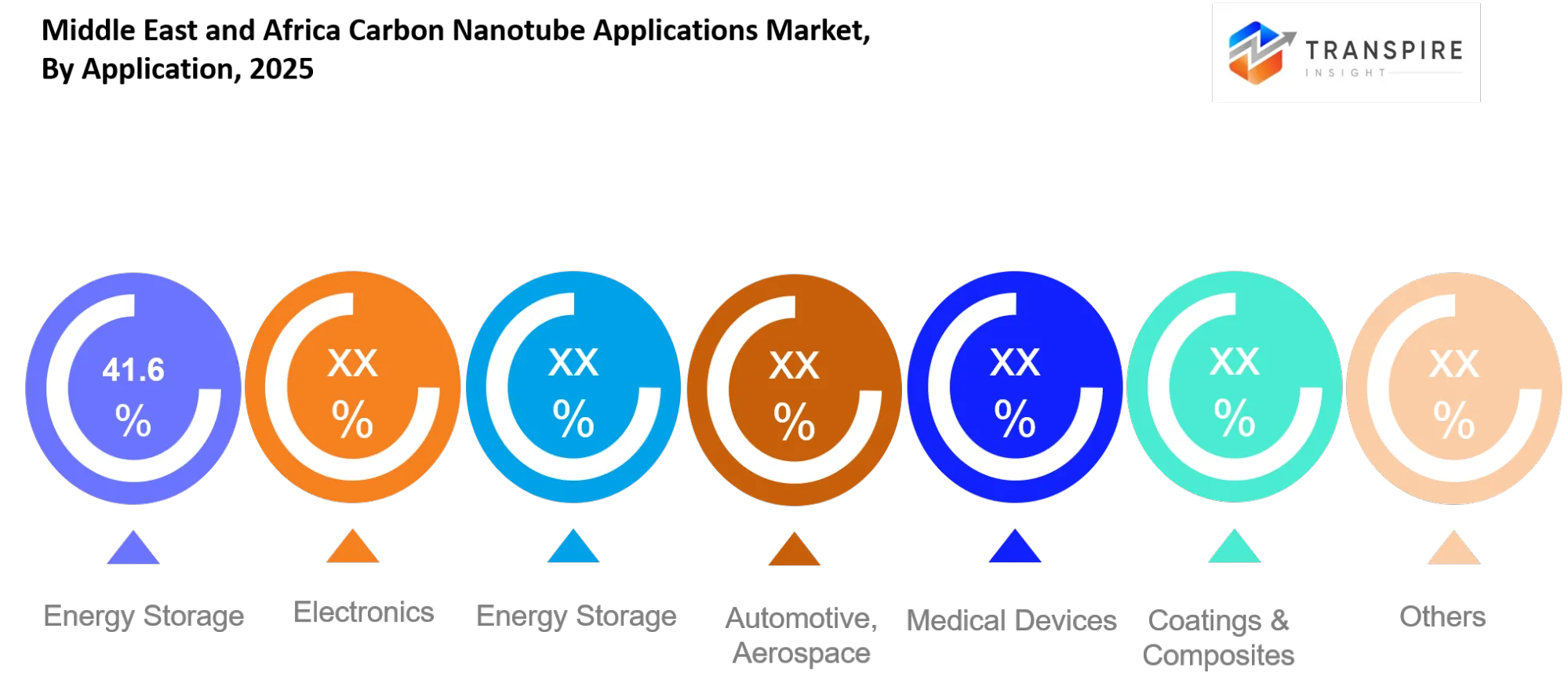
By End User
Electronics Manufacturers are basically the leading end-user group, because advanced electronic devices really need lightweight plus highly conductive materials, to keep performance steady and consistent, all the time. Automotive Companies keep moving forward with adoption especially through electric vehicle batteries, lighter body components, and conductive plastics that help reduce overall weight. Aerospace Companies are already integrating nanotube type materials into aircraft structures, where reduced weight matters a lot together with improved mechanical durability, so the overall structure can hold up longer.
In the Healthcare Industry the demand keeps going through medical devices, biosensors, and laboratory technologies that rely on dependable conductive materials. Energy Companies also make use of nanotubes in batteries, fuel cells, and renewable energy storage systems, trying to boost operational efficiency and output. Meanwhile, the Chemical Industry backs polymer development and specialty materials, while Research Institutes and other organizations keep looking into new commercial applications via product development, and material innovation.
By Form
Powder still seems to be the most widely used form, because production sites can pretty easily mix the material into polymers, composite mixes, batteries, and industrial formulations . Dispersion products help simplify processing , since they improve nanotube dispersion inside liquid systems, like coatings, inks, and resin solutions. Films and Sheets also matter a lot for flexible electronics, transparent conductive layers, and lighter structural setups where you want steady electrical performance, all the way through.
Coatings do more than one job: they boost corrosion resistance, improve electrical conductivity, and add wear protection for industrial equipment and engineered components. Masterbatches make plastic processing easier by giving a consistent nanotube distribution during high-volume manufacturing runs. There are also specialized forms that fit particular use cases across electronics, healthcare, energy storage, and advanced composite manufacturing, with tuned processing behaviors that match each scenario .
By Manufacturing Method
Chemical Vapor Deposition still kind of leads the way , mainly because large-scale production keeps giving steadier quality , better yield, and also nicer process control for commercial use. Arc Discharge makes high-quality nanotubes that work well for research activities , plus also for premium industrial outputs, where structural integrity matters a lot. Laser Ablation can give very pure nanotubes but it tends to get used for specialized applications only, because the production costs are comparatively high, you know.
Catalytic Synthesis helps with efficient production by using optimized catalyst systems. These improve manufacturing flexibility, and they make commercial scalability feel more realistic. The other manufacturing methods still back laboratory research and certain specialized industrial needs, especially when customized material characteristics stay essential. Overall, continuous improvements in production technology should make product consistency better, while also trimming manufacturing costs across commercial supply chains.
What are the Key Use Cases Driving the Middle East and Africa Carbon Nanotube Applications Market?
Energy storage, kind of arguably the strongest commercial use case, because carbon nanotubes help electrical conductivity happen more efficiently inside lithium-ion batteries and supercapacitors. Battery manufacturers are putting nanotube additives in there to speed up charging, extend cycle life, and lift overall energy efficiency, generally. Electric vehicle production and renewable energy storage projects keep pushing forward, supporting wider commercial deployment too.
Electronics manufacturing along with automotive production still keep expanding adoption, using conductive films and electromagnetic shielding, plus lightweight composite materials and sensor systems that are a bit more advanced. Aerospace manufacturers are also bringing nanotube-enhanced composite materials into structural parts that need high strength while keeping mass lower. Industrial sensor makers use conductive networks to make measurement precision better and support long-term durability.
On the newer side, emerging applications include hydrogen storage setups, flexible wearable electronics, and smart medical sensors, they are intended for advanced diagnostics work. Research organizations and specialty manufacturers continue testing nanotubes for next generation semiconductor materials, and advanced filtration approaches. Commercial maturity across these different areas should improve future revenue opportunities as production costs slowly, steadily decline.
|
Report Metrics |
Details |
|
Market size value in 2025 |
USD 194.3 Million |
|
Market size value in 2026 |
USD 216.9 Million |
|
Revenue forecast in 2033 |
USD 468.6 Million |
|
Growth rate |
CAGR of 11.63% from 2026 to 2033 |
|
Base year |
2025 |
|
Historical data |
2021 - 2024 |
|
Forecast period |
2026 - 2033 |
|
Report coverage |
Revenue forecast, competitive landscape, growth factors, and trends |
|
Regional scope |
Middle East and Africa (Saudi Arabia, United Arab Emirates, South Africa, Rest of Middle East and Africa) |
|
Key company profiled |
OCSiAl, Cabot Corporation, Arkema, LG Chem, Nanocyl, Showa Denko, Kumho Petrochemical, Toray Industries, Raymor Industries, CHASM Advanced Materials, Cnano Technology, Thomas Swan, Nanoshel, Cheap Tubes, Carbon Solutions |
|
Customization scope |
Free report customization (country, regional & segment scope). Avail customized purchase options to meet your exact research needs. |
|
Report Segmentation |
By Type (Single-Walled Carbon Nanotubes, Multi-Walled Carbon Nanotubes, Functionalized Carbon Nanotubes, Double-Walled Carbon Nanotubes, Others); By Application (Electronics, Energy Storage, Automotive, Aerospace, Medical Devices, Coatings & Composites, Sensors, Others); By End User (Electronics Manufacturers, Automotive Companies, Aerospace Companies, Healthcare Industry, Energy Companies, Chemical Industry, Research Institutes, Others); By Form (Powder, Dispersion, Films, Sheets, Coatings, Masterbatches, Others); By Manufacturing Method (Chemical Vapor Deposition, Arc Discharge, Laser Ablation, Catalytic Synthesis, Others) |
Which Regions are Driving the Middle East and Africa Carbon Nanotube Applications Market Growth?
The Gulf Cooperation Council, sort of led by Saudi Arabia and the United Arab Emirates, actually makes up the biggest portion of regional revenue, because industrial diversification programs keep pushing advanced materials fabrication and battery value chain development. National efforts like Saudi Vision 2030 are basically meant to draw investments into higher-value manufacturing, cleaner power, and electric mobility , which in turn generates a fairly steady commercial appetite for carbon nanotube use. Also there are well-developed industrial zones, export infrastructure, and logistics systems that help move specialty chemicals and advanced materials with less friction between regional and global markets. On top of that, collaboration between public agencies, research centers and industry manufacturers keeps reinforcing technology commercialization, and then later, large scale adoption follows.
South Africa is the next biggest contributor, though the growth style looks different, it leans more on industrial stability than on quick infrastructure build outs. There’s a mature mining sector, an established automotive manufacturing base, and solid research capabilities , all of which support steady utilization of advanced materials in batteries, composites, and industrial parts. Universities and research organizations work alongside manufacturers to convert concepts into practical commercial uses, strengthening long term innovation muscle. With stable industrial investment and reasonably predictable regulatory rules, South Africa stays a dependable revenue source even if its expansion rate is slower than what you see in the Gulf.
As for the remaining part of the Middle East and Africa, covering Egypt, Morocco, and the newer Gulf economies, they’re expected to show the quickest growth over 2026–2033.
Who are the Key Players in the Middle East and Africa Carbon Nanotube Applications Market and How Do They Compete?
Competition still looks pretty consolidated , mainly because only a handful of companies really have the manufacturing know-how, the production scale, and the quality control that gets you industrial-grade carbon nanotubes. In practice, leadership in technology and production consistency are the main ground rules, while cost efficiency, plus application engineering support, helps keep customers from slipping away. The established players keep pressing forward, building up capacity, working on customized formulations, and offering technical support that matters for battery, electronics, and composite makers.
OCSiAl kind of sets itself apart with industrial-scale single-walled carbon nanotube production , and with specialized dispersions that are tuned for lithium-ion batteries as well as upcoming solid-state battery routes. The firm is still widening its global manufacturing footprint, and it’s also building strategic battery partnerships, to lock in long-term supply reliability. Cabot Corporation concentrates on conductive additives for batteries and engineered composites, and it blends wide-ranging materials expertise with global manufacturing plus customer-specific product development. Nanocyl is more focused on multi-walled carbon nanotube technologies that boost electrical conductivity and mechanical strength across polymers, coatings, and industrial composites, but it also backs clients with tailored dispersion solutions.
Arkema extends advanced materials by folding carbon nanotubes into specialty polymers and high-performance composite offerings, aimed at transportation and industrial use. LG Chem, meanwhile, improves its competitive stance by embedding conductive nanomaterials into battery materials development, which creates a tighter fit between advanced materials , and the actual battery manufacturing process.
Company List
• OCSiAl
• Cabot Corporation
• Arkema
• LG Chem
• Nanocyl
• Showa Denko
• Kumho Petrochemical
• Toray Industries
• Raymor Industries
• CHASM Advanced Materials
• Cnano Technology
• Thomas Swan
• Nanoshel
• Cheap Tubes
• Carbon Solutions
Recent Development News
In April 2026, OCSiAl launched a new portfolio of TUBALL™ single-wall carbon nanotube products for next-generation battery chemistries. The launch supports higher-performance lithium-ion, solid-state, ESS, UPS, and battery backup applications while expanding the company's global production network.
Source:https://ocsial.com/news
In January 2026, Nanocyl entered a strategic distribution partnership with ChemSpec North America. The agreement expanded commercial access to Nanocyl's multi-walled carbon nanotube portfolio across the United States and Canada, strengthening market reach for polymer and elastomer applications.
Source:https://corporate.safic-alcan.com
What Strategic Insights Define the Future of the Middle East and Africa Carbon Nanotube Applications Market?
The market seems to be drifting toward broader industrial integration, like battery manufacturing, advanced electronics, and lightweight composite production are becoming real strategic priorities across the Middle East and Africa. At the core of it there’s this bigger pull from government investment in industrial diversification, plus regional manufacturing capacity that keeps growing for energy storage and high-performance materials. There is also a not so obvious risk, in that global high-quality carbon nanotube production is still pretty concentrated among a limited group of suppliers, which kinda leaves manufacturers exposed to supply disruptions ,and sudden price swings.
Meanwhile, there’s an emerging opportunity that feels more interesting: conductive materials for solid-state batteries and hydrogen energy systems. Commercial adoption is still in an early phase, but investment momentum keeps accelerating, so it’s like the groundwork is being laid before the wave really hits. For companies aiming to enter, they should probably lean hard into regional technical collaborations, on-the-ground application support, and funding dispersion technologies that make customer processing easier. At the same time ,they’ll want sturdier supply networks that can handle the next round of industrial expansion without breaking.
Middle East and Africa Carbon Nanotube Applications Market Report Segmentation
By Type
• Single-Walled Carbon Nanotubes
• Multi-Walled Carbon Nanotubes
• Functionalized Carbon Nanotubes
• Double-Walled Carbon Nanotubes
• Others
By Application
• Electronics
• Energy Storage
• Automotive
• Aerospace
• Medical Devices
• Coatings & Composites
• Sensors
• Others
By End User
• Electronics Manufacturers
• Automotive Companies
• Aerospace Companies
• Healthcare Industry
• Energy Companies
• Chemical Industry
• Research Institutes
• Others
By Form
• Powder
• Dispersion
• Films
• Sheets
• Coatings
• Masterbatches
• Others
By Manufacturing Method
• Chemical Vapor Deposition
• Arc Discharge
• Laser Ablation
• Catalytic Synthesis
• Others
Frequently Asked Questions
Find quick answers to common questions.
The Expected Middle East and Africa Carbon Nanotube Applications Market size for the market will be USD 468.6 Million in 2033.
Key Segments for the Middle East and Africa Carbon Nanotube Applications Market are By Type (Single-Walled Carbon Nanotubes, Multi-Walled Carbon Nanotubes, Functionalized Carbon Nanotubes, Double-Walled Carbon Nanotubes, Others); By Application (Electronics, Energy Storage, Automotive, Aerospace, Medical Devices, Coatings & Composites, Sensors, Others); By End User (Electronics Manufacturers, Automotive Companies, Aerospace Companies, Healthcare Industry, Energy Companies, Chemical Industry, Research Institutes, Others); By Form (Powder, Dispersion, Films, Sheets, Coatings, Masterbatches, Others); By Manufacturing Method (Chemical Vapor Deposition, Arc Discharge, Laser Ablation, Catalytic Synthesis, Others.
Major Middle East and Africa Carbon Nanotube Applications Market players are OCSiAl, Cabot Corporation, Arkema, LG Chem, Nanocyl, Showa Denko, Kumho Petrochemical, Toray Industries, Raymor Industries, CHASM Advanced Materials, Cnano Technology, Thomas Swan, Nanoshel, Cheap Tubes, Carbon Solutions.
The Current Middle East and Africa Carbon Nanotube Applications Market size is USD 194.3 Million in 2025.
The Middle East and Africa Carbon Nanotube Applications Market CAGR is 11.63% from 2026 to 2033.
• OCSiAl
• Cabot Corporation
• Arkema
• LG Chem
• Nanocyl
• Showa Denko
• Kumho Petrochemical
• Toray Industries
• Raymor Industries
• CHASM Advanced Materials
• Cnano Technology
• Thomas Swan
• Nanoshel
• Cheap Tubes
• Carbon Solutions
About the Authors

Chakradhar Khansole
Chakradhar serves as the Research Director at Transpire Insight, bringing over 8 years of experience in technology, innovation, and strategic market intelligence. He specializes in transforming complex market data into actionable business insights that enable organizations to make informed, growth-oriented decisions. Recognized for his strategic vision and analytical expertise, Chakradhar leads high-impact research initiatives, delivering comprehensive market assessments, competitive intelligence, and forward-looking industry analysis.
Recently Published Reports
-
May 2026
Healthcare Polymer Packaging Market
Healthcare Polymer Packaging Market Size, Share & Analysis Report By Packaging Type (Syringes, IV Bottles and Pouches, Clamshells, Blisters, Bottles & Jars, Containers, Tubes, IV Parental Packaging, Others), By Type (Regulated, Non-regulated), By Polymer Type (LDPE (Low-Density Polyethylene), HDPE (High-Density Polyethylene), Homo-polymer (Homo), Random Copolymer (Random), Block Copolymer (Block), PET, Polystyrene, Polyvinyl Chloride, Polyamide/EVOH, Others), and Geography (North America, Europe, Asia-Pacific, Middle East and Africa, South and Central America), 2021 - 2031
-
Apr 2026
Hydrophilic Tape (Waterstop) Market
Hydrophilic Tape (Waterstop) Market Size, Share & Analysis Report By Type (Bentonite-Based Hydrophilic Tape, Rubber-Based Hydrophilic Tape), By Application (Residential Buildings, Commercial Buildings, Infrastructure Projects), and Geography (North America, Europe, Asia-Pacific, Middle East and Africa, South and Central America), 2021 - 2031
-
Apr 2026
Metalens Market
Metalens Market Size, Share & Analysis Report By Type (Visible Light Metalens, and Infrared Metalens), By Application (Consumer Electronics, Automotive Electronics, Industrial, Medical, and Others), and Geography (North America, Europe, Asia-Pacific, Middle East and Africa, South and Central America), 2021 - 2031
-
Apr 2026
PBT Resin Market
PBT Resin Market Size, Share & Analysis Report By Type (Reinforced PBT Resin, Unreinforced PBT Resin), By Processing Method (Injection Molding, Extrusion, Blow Molding, Others), By End-User (Automotive, Electrical & Electronics, Consumer Appliances, Industrial Machinery, Medical Devices, Packaging, Others), and Geography (North America, Europe, Asia-Pacific, Middle East and Africa, South and Central America), 2021 - 2031