

Middle East and Africa Caps and Closures Market Size & Forecast:
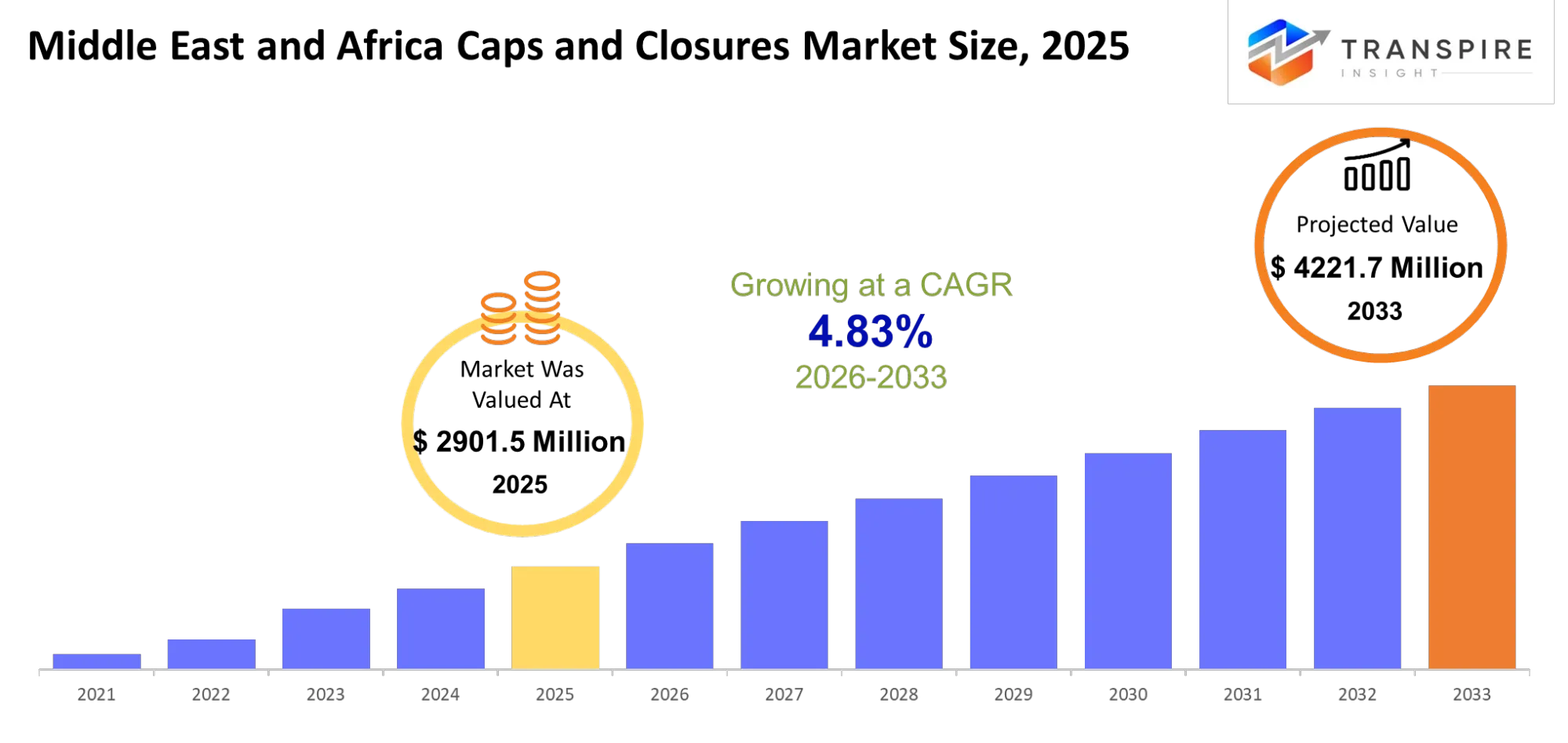
- Middle East and Africa Caps and Closures Market Size 2025: USD 2901.5 Million
- Middle East and Africa Caps and Closures Market Size 2033: USD 4221.7 Million
- Middle East and Africa Caps and Closures Market CAGR: 4.83%
- Middle East and Africa Caps and Closures Market Segments: By Type (Screw Caps, Snap-on Caps, Dispensing Caps, Crown Caps, Child-resistant Caps, Others); By Application (Beverages, Pharmaceuticals, Personal Care, Food Packaging, Chemicals, Household Products, Others); By End-User (Beverage Companies, Pharma Companies, FMCG Companies, Food Industry, Chemical Industry, Packaging Firms, Others); By Material (Plastic, Metal, Rubber, Others)
To learn more about this report,  Download Free Sample Report
Middle East and Africa Caps and Closures Market Summary
The Middle East and Africa Caps and Closures Market was valued at USD 2901.5 Million in 2025. It is forecast to reach USD 4221.7 Million by 2033. That is a CAGR of 4.83% over the period.
The Middle East and Africa Caps and Closures Market uses bottle caps and lids and dispensing closures to protect liquids and chemicals and consumer goods during storage and transport by creating airtight seals that stop leakage and contamination while maintaining product integrity throughout food and beverage and personal care and industrial distribution networks. The past five years have seen a market transition away from traditional multi-material plastic products toward lightweight mono-material closures which have tamper-evidence features and improved recycling characteristics and operate effectively on high-speed automated filling equipment. The
Gulf Cooperation Council countries introduced stricter single-use plastic regulations which were further strengthened by sustainability requirements and the COVID-19 pandemic that caused manufacturers to shift their sourcing to local providers while decreasing their reliance on imported products. The producers are putting money into resin-optimized designs and advanced closure systems because these two factors are generating revenue growth which results from both increased sales volume and improved product specifications and compliance standards and faster market entry of packaged FMCG products and industrial goods to urbanizing distribution networks.
Key Market Insights
- The Gulf Cooperation Council countries maintain a 45 percent market share in 2025 because of their strong demand for beverage products and personal care packaging materials which they use in their urban retail stores.
- The African continent experiences its fastest development during the period until 2030 because of its increasing packaged food consumption and improvements in its retail distribution systems.
- Plastic caps and closures control the market with their 52 percent share because they provide cost savings and lightweight design and fast-moving consumer goods companies choose to use them.
- Dispensing closures rank second because people commonly use them in personal care products and household chemical products to manage product usage and create different product options.
- The tamper-evident closures market will experience its highest growth rate between 2025 and 2030 because of the need for safety regulations and export packaging standards.
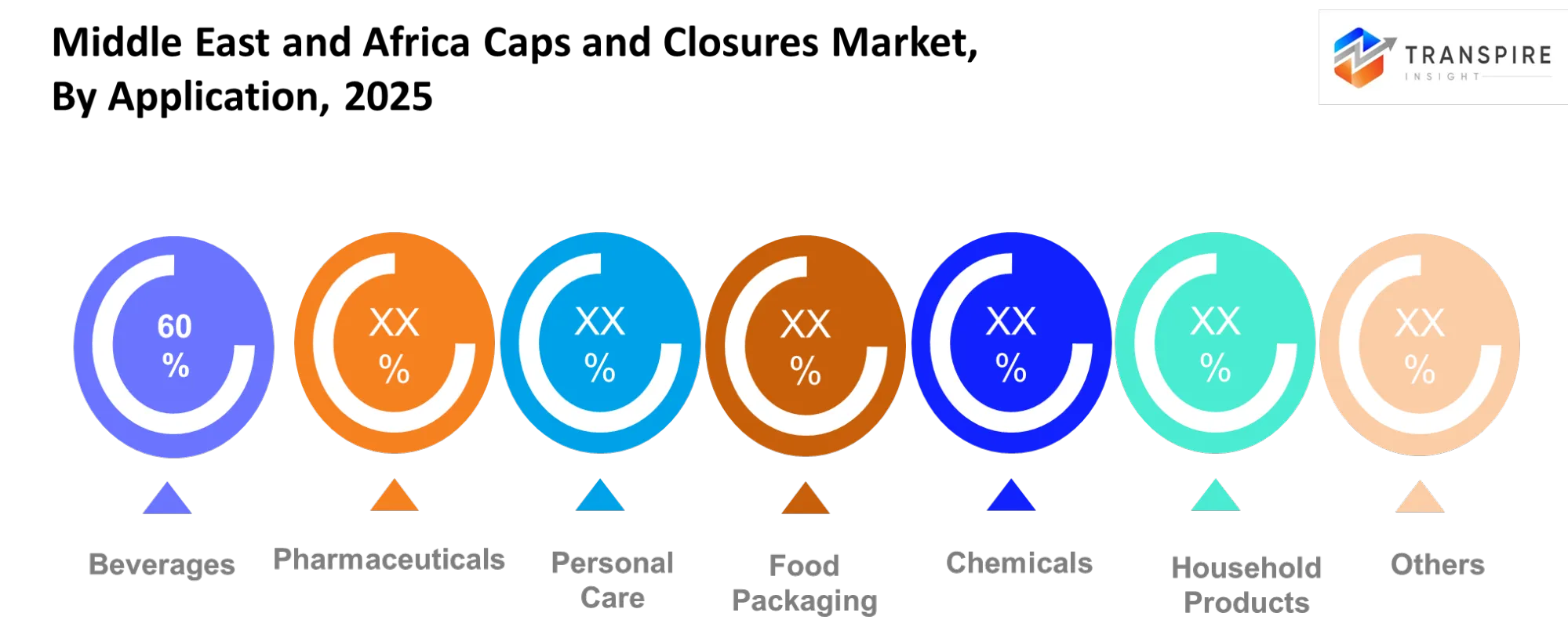
- The beverage packaging sector holds the largest market share which equals 40 percent because consumers buy bottled water and carbonated drinks and ready-to-drink products.
- The personal care and cosmetics market experiences its fastest expansion through premium product development and new branded packaging solutions.
- Food and beverage manufacturers occupy the largest market share in the Middle East and Africa Caps and Closures Market which reaches a total of 48 percent.
- The pharmaceutical packaging segment shows the highest growth because of increasing safety regulations and growing healthcare requirements.
- Companies develop lightweight mono-material closures to achieve better recyclability while they comply with stricter environmental regulations.
What are the Key Drivers, Restraints, and Opportunities in the Middle East and Africa Caps and Closures Market?
The Middle East and Africa Caps and Closures Market functions as the main economic motor for its market because the packaged food industry and bottled beverage sector and personal care manufacturing market need secure sealing systems to protect their products during extended storage times through various distribution methods. The demand for the products increased because supply chain problems that occurred between 2020 and 2022 forced FMCG companies and their contract packaging partners to buy quicker filling machines and protective packaging solutions. The company generates revenue through production growth because customers prefer premium closure designs which enable automated operations and meet international export packaging requirements instead of basic commodity caps.
The region faces a major obstacle to advanced mono-material closure adoption because its recycling systems operate unevenly throughout the region except for GCC markets which have limited waste collection networks and unreliable processing methods. The existing structural gap forces businesses to depend on low-cost mixed-material plastics, which create initial savings but prove difficult to comply with circular economy requirements. The manufacturers encounter extended periods of regulatory uncertainties, which results in slower operational changes that prevent them from achieving complete value benefits across multiple African sub-markets.
Local manufacturing investment in Saudi Arabia and the UAE and South Africa creates a major chance for packaging converters to combine injection molding automation with advanced closure design methods through their ongoing local production initiatives. New industrial zones provide pharmaceutical and personal care export businesses with faster access to high-precision dispensing closure systems, which will lead to enhanced revenue growth in the Middle East and Africa Caps and Closures Market.
What Has the Impact of Artificial Intelligence Been on the Middle East and Africa Caps and Closures Market?
Modern manufacturing processes for caps and closures now use artificial intelligence and advanced digital systems during their high-volume injection molding and high-speed assembly operations. The production facilities now use AI-powered vision inspection systems to automatically find defects in closure threads and sealing liners and tamper-evident bands, which decreases the need for manual testing while enhancing operational stability. The organization applied machine learning models to create predictive maintenance systems, which monitor molding machines and automated tooling systems through sensor data that measures vibration and temperature and cycle time to predict equipment failure before unplanned downtime occurs.
AI-based process control systems use real-time data to manage pressure and cooling time and resin flow, which results in improved operational efficiency through better yield rates and less material waste. The FMCG supply contracts used by large manufacturers generated cost savings through operational upgrades that resulted in better uptime performance and reduced scrap production. The organization uses demand forecasting algorithms to synchronize resin purchases with production schedules, which need to match the fluctuating retail consumption patterns that differ across various regional markets.
The small and mid-sized converters which operate in Africa face challenges because they need to pay expensive integration fees while their digital systems remain disconnected from each other. The Middle East and Africa caps and closures industry faces productivity challenges because traditional molding machines lack the ability to work with modern AI technologies, which results in business operations that suffer from decreased productivity.
Key Market Trends
- Manufacturers adopted single-material packaging solutions at their production facilities because Gulf Cooperation Council packaging rules established in 2022 required them to stop using multiple plastic materials for their beverage packaging operations.
- The period from 2020 to 2025 showed an increase in domestic production of caps and closures because logistics disruptions during the COVID pandemic affected supply chains for African fast-moving consumer goods.
- After 2023 beverage producers started using tamper-evident closures instead of standard screw caps to meet export requirements and protect their products from potential security threats.
- Manufacturers of automated injection molding systems experienced significant growth after 2021 because they began to use real-time monitoring systems for production processes which helped decrease product defects and equipment downtime.
- Companies redesigned their lightweight closures because resin prices fluctuated between 2022 and 2024 which allowed them to decrease material consumption while maintaining their sealing performance.
- The GCC regional operations of Berry Global and Amcor expanded their presence through new manufacturing facilities which enabled faster delivery of products to customers.
- Personal care brands increased dispensing closure adoption after 2023 because premiumization trends required them to use packaging that provided controlled dosage functionality.
- Mid-tier packaging converters changed their pricing strategies because African retail markets expanded since 2021 which increased demand for low-cost closures.
- AI vision technology-based smart inspection systems successfully decreased closure defects through their ability to monitor product quality during high-speed production processes.
Middle East and Africa Caps and Closures Market Segmentation
By Type :
The package market for beverages and pharmaceuticals requires screw caps and snap-on caps because these solutions provide secure seals which can be easily handled during high-production processes. The two formats provide facilities with operational systems which guarantee both constant product delivery and operational efficiency throughout their filling procedures.
Dispensing caps and crown caps and child-resistant caps provide controlled product flow while ensuring safety standards and product safety for food packaging and beverage packaging and healthcare packaging. The three industries maintain their primary focus on three objectives which include preventing leaks and meeting safety requirements and ensuring products maintain extended shelf life.
By Application :
The distribution needs of beverages and pharmaceuticals create a high demand for caps and closures because of their need to maintain hygiene standards and protect products from tampering and ensure their safety during transportation. The reliability of packaging systems creates consumer trust while safeguarding the honesty of products which in turn maintains their market presence.
The specialized closures which personal care products and food packaging and chemical products and household products use function to protect against spills while maintaining product quality and allowing controlled product release through their various packaging systems. The rising demand for packaged products drives multiple end-use segments to adopt new packaging solutions.
To learn more about this report, Download Free Sample Report
By End-User :
The capacity of beverage companies and pharma companies and FMCG companies to create packaging solutions has resulted in their adoption of caps and closures because they need to fulfill their ongoing packaging requirements and maintain their branding objectives. The market maintains a constant consumption rate because products are manufactured at high production levels.
The food industry and chemical industry and packaging companies use advanced closure systems because these systems provide safety features and storage efficiency and fulfill regulatory packaging requirements. Industrial packaging demand keeps growing because companies need to maintain control over packaging quality.
By Material :
The plastic materials used in caps and closures manufacturing provide cost-effective solutions which create lightweight products and permit flexible applications in various mass production packaging scenarios. The material exhibits high adaptability, which allows its application in packaging systems for beverages and food products and personal care items.
The combination of metal and rubber materials provides durable products which maintain their sealing strength and chemical resistance, which makes them suitable for pharmaceutical and chemical and specialty packaging usage. The selection of materials requires evaluation of safety needs and barrier protection needs and product compatibility needs.
What are the Key Use Cases Driving the Middle East and Africa Caps and Closures Market?
The Caps and Closures Market in the Middle East and Africa primarily uses beverage packaging because bottled water and carbonated drinks and ready-to-drink products need secure seals to protect their hygiene during extended distribution. Urban retail and hospitality sectors maintain constant need for dependable closures which stop unauthorized access while stopping spills and product contamination.
The cosmetics industry and detergent manufacturers are developing their operations through personal care and household chemical packaging which includes dispensing closures. Mid-to-premium FMCG producers are now using these applications because they want controlled dosing, better user convenience, and enhanced brand differentiation to compete in retail markets.
The pharmaceutical packaging sector and export-grade agrochemical containers provide new business opportunities because GCC countries and specific African markets are enforcing stricter regulatory requirements. Healthcare supply chains and uniform export packaging standards are driving the adoption of child-resistant and compliance-based closure systems. The particular market segments will transition from initial testing stages to full market acceptance in the future.
|
Report Metrics |
Details |
|
Market size value in 2025 |
USD 2901.5 Million |
|
Market size value in 2026 |
USD 3035.1 Million |
|
Revenue forecast in 2033 |
USD 4221.7 Million |
|
Growth rate |
CAGR of 4.83% from 2026 to 2033 |
|
Base year |
2025 |
|
Historical data |
2021 - 2024 |
|
Forecast period |
2026 - 2033 |
|
Report coverage |
Revenue forecast, competitive landscape, growth factors, and trends |
|
Regional scope |
Middle East and Africa (Saudi Arabia, United Arab Emirates, South Africa, Rest of Middle East and Africa) |
|
Key company profiled |
Amcor, Berry Global, Crown Holdings, Silgan, AptarGroup, Albea, Closure Systems International, RPC Group, Guala Closures, Bericap, O.Berk, Mold-Rite, Pact Group, Tecnocap, CL Smith |
|
Customization scope |
Free report customization (country, regional & segment scope). Avail customized purchase options to meet your exact research needs. |
|
Report Segmentation |
By Type (Screw Caps, Snap-on Caps, Dispensing Caps, Crown Caps, Child-resistant Caps, Others); By Application (Beverages, Pharmaceuticals, Personal Care, Food Packaging, Chemicals, Household Products, Others); By End-User (Beverage Companies, Pharma Companies, FMCG Companies, Food Industry, Chemical Industry, Packaging Firms, Others); By Material (Plastic, Metal, Rubber, Others) |
Which Regions are Driving the Middle East and Africa Caps and Closures Market Growth?
The Middle East and Africa Caps and Closures Market operates under the leadership of the Middle East. The region maintains its status as the market leader because of its strong FMCG manufacturing bases and advanced packaging infrastructure and GCC countries' strict product safety enforcement. The production facilities which manufacture both beverages and personal care products in the UAE and Saudi Arabia create an ongoing requirement for advanced sealing technologies. The integrated industrial zones together with free trade ports create a system which enables businesses to import resins and export their completed packaged products, thus improving their supply chain operations. The industrial diversification programs which governments implement, enable local packaging conversion facilities to develop, which helps the region maintain its market leadership.
North Africa functions as an enduring market which maintains its structural stability because of its regular food processing operations and its ongoing improvements in retail distribution. The region develops through cost-effective packaging solutions instead of premium products which leads to stable consumption patterns that remain unchanged during economic downturns. The agro-processing and beverage bottling sectors in Egypt and Morocco function as established industries which create stable procurement patterns for their respective markets. The implementation of improved food safety regulations has led to increased usage of standardized closures, which provides industrial users with consistent demand throughout their operations.
The fastest expanding area of Sub-Saharan Africa experiences growth because of people moving to cities and rising demand for packaged foods and new retail development projects across Nigeria and Kenya and South Africa. The accessibility of branded FMCG products to inland markets has improved because of recent upgrades to logistics corridors and cold-chain distribution systems. The growing foreign direct investment in local bottling and personal care manufacturing operations has enabled companies to adopt modern closure systems at an accelerated pace. The region provides investors and market entrants with high long-term volume growth potential which will last from 2026 through 2033 especially for cost-efficient and scalable packaging solutions.
Who are the Key Players in the Middle East and Africa Caps and Closures Market and How Do They Compete?
The Middle East and Africa Caps and Closures Market displays a competitive landscape which demonstrates moderate market consolidation because international packaging firms and local converters operate in divided market sectors.The established companies maintain their market position by using large-scale production operations and making investments in automated systems whereas the smaller companies use their pricing strategies together with their ability to meet local customer needs as their main competitive advantage. The competition now focuses on three main areas which include the ability to create lightweight products, the need to meet regulatory requirements, and the establishment of domestic manufacturing facilities that support both fast-moving consumer goods and international packaging deals.
AptarGroup develops high-precision dispensing closures which enable the company to establish its product uniqueness through its dosage control systems that have applications in personal care packaging. Amcor develops recyclable closure solutions which meet sustainability requirements for all GCC markets through its lightweight packaging products. Berry Global establishes new cost-effective injection molding facilities and additional manufacturing sites which enable the company to enhance its delivery times while obtaining major contracts from fast-moving consumer goods customers because of its operational size.
Silgan Holdings operates in the rigid food and beverage closure market, which enables the company to achieve production efficiency through its high-volume manufacturing and establish long-term agreements with retailers. ALPLA Group creates packaging systems that incorporate recycling elements and develops bottle-to-bottle systems, which enhance the company's circular packaging capabilities for South African and European trade operations. Closure Systems International designs tamper-evident closures for beverages, which the company distributes through partnerships with bottling companies throughout the GCC region.
Company List
- Amcor
- Berry Global
- Crown Holdings
- Silgan
- AptarGroup
- Albea
- Closure Systems International
- RPC Group
- Guala Closures
- Bericap
- O.Berk
- Mold-Rite
- Pact Group
- Tecnocap
- CL Smith
Recent Development News
In February 2026, AptarGroup entered a strategic supply partnership with regional FMCG packaging converters in the Middle East to scale dispensing closure solutions for personal care and beverage applications. The collaboration focuses on improving smart dispensing systems and expanding localized production capacity to reduce import dependency.
Source https://dataintelo.com/
In October 2025, Guala Closures entered into a strategic partnership with IKILEADS Ltd to launch the PICCOLO premium closure system for PET bottles in Nigeria and across African spirits markets. The collaboration introduced a two-piece tamper-evident closure designed for small-format spirits packaging, strengthening premium packaging adoption in Africa’s rapidly growing alcoholic beverage segment. Source https://www.sustainabilitymea.com/
What Strategic Insights Define the Future of the Middle East and Africa Caps and Closures Market?
The Middle East and Africa Caps and Closures Market is structurally moving toward higher-value, regulation-aligned closure systems as packaging demand becomes increasingly tied to export compliance, automation compatibility, and material efficiency rather than basic sealing functionality. The GCC economies experience economic growth because FMCG companies expand their operations while African countries develop formal retail and food distribution systems. The manufacturing industry moves toward using standardized high-performance closure systems that work with automated filling technology. A less visible risk lies in raw material concentration, particularly dependence on volatile polypropylene and polyethylene resin supply chains. Price shocks or petrochemical allocation shifts in key producing countries can quickly compress margins and delay capacity expansion, especially for mid-tier converters with limited hedging capability.
Digital traceable closures with QR-linked authentication and batch-level tracking create a new business opportunity in the pharmaceutical and premium beverage export markets from the UAE. The ability to track products using digital technology will become more essential as countries implement stricter anti-counterfeit laws for international trade routes. Market participants should prioritize investments in recyclable mono-material tooling and regional production hubs to reduce logistics exposure while capturing premium packaging contracts across fast-growing African FMCG clusters.
Middle East and Africa Caps and Closures Market Report Segmentation
By Type
- Screw Caps
- Snap-on Caps
- Dispensing Caps
- Crown Caps
- Child-resistant Caps
By Application
- Beverages
- Pharmaceuticals
- Personal Care
- Food Packaging
- Chemicals
- Household Products
By End-User
- Beverage Companies
- Pharma Companies
- FMCG Companies
- Food Industry
- Chemical Industry
- Packaging Firms
By Material
- Plastic
- Metal
- Rubber
Frequently Asked Questions
Find quick answers to common questions.
The Middle East and Africa Caps and Closures Market size is USD 4221.7 Million in 2033.
Key segments for the Middle East and Africa Caps and Closures Market are By Type (Screw Caps, Snap-on Caps, Dispensing Caps, Crown Caps, Child-resistant Caps, Others); By Application (Beverages, Pharmaceuticals, Personal Care, Food Packaging, Chemicals, Household Products, Others); By End-User (Beverage Companies, Pharma Companies, FMCG Companies, Food Industry, Chemical Industry, Packaging Firms, Others); By Material (Plastic, Metal, Rubber, Others).
Major Middle East and Africa Caps and Closures Market players are Amcor, Berry Global, Crown Holdings, Silgan, AptarGroup, Albea, Closure Systems International, RPC Group, Guala Closures, Bericap, O.Berk, Mold-Rite, Pact Group, Tecnocap, CL Smith.
The Middle East and Africa Caps and Closures Market size is USD 2901.5 Million in 2025.
The Middle East and Africa Caps and Closures Market CAGR is 4.83% from 2026 to 2033.
- Amcor
- Berry Global
- Crown Holdings
- Silgan
- AptarGroup
- Albea
- Closure Systems International
- RPC Group
- Guala Closures
- Bericap
- O.Berk
- Mold-Rite
- Pact Group
- Tecnocap
- CL Smith
Recently Published Reports
-
Apr 2026
Pharmaceutical Cold Chain Packaging Market
Pharmaceutical Cold Chain Packaging Market By Material (Plastic,(Polyethylene (PE), Polypropylene (PP), Polyethylene Terephthalate (PET), Expanded Polystyrene (EPS), Polyurethane (PU),Others), Paper, Metal, Others), By Product (Small Boxes, Pallets, Large Sized Pallet Containers, Others), By End Use (Biopharmaceutical Companies, Clinical Research Organizations, Hospitals, Research Institutes, Logistics and Distribution Companies, Others)”, By Industry Analysis, Size, Share, Growth, Trends, and Forecasts 2026-2033
-
Apr 2026
Active & Intelligent Packaging Market
Active & Intelligent Packaging Market By Type (Active Packaging, Smart Packaging), By Material (Polymer-Based, Paper & Board-Based, Metal-Based, Glass-Based), By Technology (Time-Temperature Indicators, Freshness Indicators, RFID, Antimicrobial Packaging, Modified Atmosphere Packaging), By Application (Food & Beverages, Pharmaceutical, Cosmetics & Personal Care, Electronics & Consumer Goods, Others), By Industry Analysis, Size, Share, Growth, Trends, and Forecasts 2026-2033
-
Apr 2026
Biodegradable Cut Flower Packaging Market
Biodegradable Cut Flower Packaging Market By Material Type (Paper & Paperboard, Biodegradable Plastics, Natural Fibers, Molded Pulp, Others), By Product Type (Sleeves, Wraps, Boxes & Cartons, Bags & Pouches, Inserts & Holders), By Application (Roses, Carnations, Tulips, Chrysanthemums, Mixed Flowers, Others) and By Distribution Channel (Direct Sales, Distributors & Wholesalers, Online Channels), By Industry Analysis, Size, Share, Growth, Trends, and Forecasts 2026-2033
-
Apr 2026
Pharmaceutical Packaging Market
Pharmaceutical Packaging Market By Material Type (Plastic, Glass, Metal, Paper & Paperboard, Others), By Packaging Type (Bottles, Blister Packs, Vials, Ampoules, Pouches & Sachets, Others) and By End User (Hospitals & Clinics, Retail Pharmacies, Online Pharmacies, Pharmaceutical Manufacturers), By Industry Analysis, Size, Share, Growth, Trends, and Forecasts 2026-2033