

Middle East and Africa Burner Management System Market Size & Forecast:
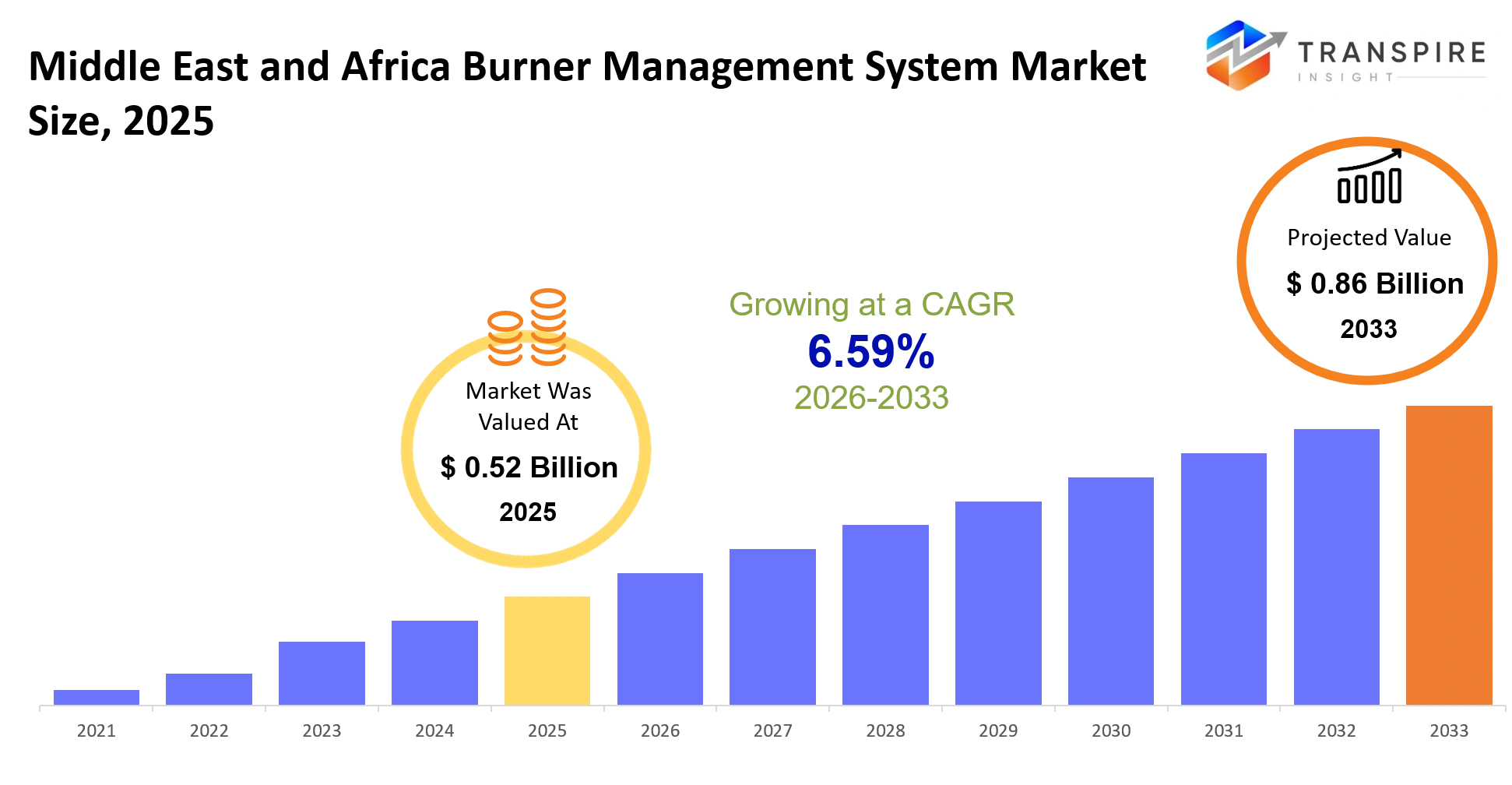
- Middle East and Africa Burner Management System Market Size 2025: USD 0.52 Billion
- Middle East and Africa Burner Management System Market Size 2033: USD 0.86 Billion
- Middle East and Africa Burner Management System Market CAGR: 6.59%
- Middle East and Africa Burner Management System Market Segments: By Component (Controllers, Sensors, Switches, Actuators, Software, Relays, Alarms, Others); By Fuel Type (Natural Gas, Oil, Coal, Biomass, Hydrogen, Dual Fuel, Others); By Application (Boilers, Furnaces, Kilns, Ovens, Heaters, Incinerators, Others); By End User (Oil & Gas, Power Generation, Chemicals, Manufacturing, Food Processing, Others).
Middle East and Africa Burner Management System Market Summary
The Middle East and Africa Burner Management System Market was valued at USD 0.52 Billion in 2025. It is forecast to reach USD 0.86 Billion by 2033. That is a CAGR of 6.59% over the period.
Burner management systems kind of do the heavy lifting in industrial operations, helping with the safe start up, ongoing monitoring, control, and shutdown of combustion equipment like boilers, furnaces, heaters, and a bunch of process plants. In practice, they are there to stop explosions, cut down annoying downtime, and stay aligned with those strict safety rules that many sectors expect. You see them across oil and gas, power generation, chemicals, and manufacturing, so it’s not a niche thing.
Over the last five years , the market has shifted away from standalone safety controls and toward integrated digital platforms. These platforms kind of bundle burner safety, process automation, and remote diagnostics into one coordinated approach. That change sped up when energy producers and industrial operators wanted better operational dependability , especially after supply chain problems, and during energy market swings caused by geopolitical tensions, plus, the constant fuel cost fluctuations.
Meanwhile, facilities are updating older combustion infrastructure and also pushing automation investments. Because of that burner management systems are increasingly viewed as a basic building block in risk reduction strategies. This helps drive higher adoption, bigger retrofit programs, and also stronger recurring income, from software subscriptions , monitoring packages, and lifecycle service agreements.
Key Market Insights
- The Middle East and Africa Burner Management System Market keeps on expanding, kinda as industrial automation spending speeds up across oil, gas, power, and chemical plants .
- In 2025, the Gulf Cooperation Council countries held an estimated 42%+ market share , pushed by massive hydrocarbon processing infrastructure and steady upgrades.
- Meanwhile , Southern Africa looks like the fastest-growing regional area all the way through 2033, mainly because industrial modernization is ongoing and the power sector is getting refreshed.
- When it comes to product type, controllers stayed out front with roughly 28% market share in 2025, which matches the rising preference for integrated combustion safety setups.
- Sensors still landed as the second-largest component segment as operators ramp up real time flame detection, plus broader process monitoring investment.
- On the software side, burner monitoring platforms that are software based are expected to grow at the fastest pace from 2026 to 2033, largely because predictive analytics are being plugged in more and more.
- For application, boilers represented almost 31% of demand in 2025 , supported by widespread usage across utilities and process industries.
- Furnaces also showed up as a quicker expanding application segment as manufacturers replaced older combustion systems, aiming for better efficiency , and tighter safety compliance.
- By end user, Oil & Gas continued to hold more than 35% of revenue share in 2025, supported by refinery expansions and petrochemical projects.
- Key companies—Honeywell, Emerson, Siemens, ABB, Yokogawa, and Schneider Electric—are working to strengthen their footing via digital safety platforms , local partnerships, and more advanced automation technologies .
What are the Key Drivers, Restraints, and Opportunities in the Middle East and Africa Burner Management System Market?
The strongest growth driver really comes from the modernization of industrial combustion infrastructure across oil and gas , power generation ,and chemical processing sites . Governments and industrial operators have tightened operational safety requirements after several high-profile incidents, plus there is more and more scrutiny on process safety management. At the same time , digital transformation efforts have pushed down the cost of linking burner controls with distributed control systems and plant-wide automation platforms. So this mix boosts retrofit work and makes adoption faster in both new-build projects and brownfield facilities. Revenue growth happens not only from physical hardware installations, but also from ongoing software licensing, services , and maintenance contracts.
The main restraint is the big installed base of older plants running legacy combustion equipment. Updating burner management systems often calls for a lot of engineering changes, including plant shutdowns , workforce retraining, and detailed compatibility checks with whatever control architecture is already there. These hurdles become a kind of structural brake, because many industrial assets run for decades and they only replace equipment after long capital investment cycles. When upgrades are postponed, the potential revenue stays suppressed , and cost-sensitive operators tend to adopt more slowly .
A key opportunity sits in tying burner management systems to industrial digitalization agendas, along with predictive maintenance platforms. In the Gulf region , more and more facilities roll out Industrial Internet of Things solutions to gain better operational visibility.
What Has the Impact of Artificial Intelligence Been on the Middle East and Africa Burner Management System Market?
Artificial intelligence and newer digital technologies are reshaping how combustion assets are tracked, and managed, across industrial sites. In many places, modern burner control platforms now lean on machine learning systems, so they can take in flame stability signals, combustion efficiency, fuel consumption behaviors, and equipment health metrics in real time. And then, almost on cue, these platforms tune operating parameters automatically. That helps keep combustion conditions safer and more efficient, plus it reduces the need for too much hands on tuning.
Predictive maintenance has probably turned out to be one of the more usable AI outcomes. Machine learning models can study older sensor values and day to day operating patterns, then spot abnormal burner behavior well before a true failure shows up. That helps the operators cut down unexpected outages, increase equipment availability, and also reduce maintenance expenses. In big power plants and refineries, AI diagnostics can boost uptime while still backing more steady regulatory compliance.
On top of that, advanced analytics are also used for emissions forecasting and combustion optimization. Operators can spot inefficiencies sooner, reduce fuel wastage, and improve thermal results. In certain installations, digital optimization programs have been shown to bring down the number of maintenance interventions that are needed, and help process stability stay steadier.
Still, uptake can be stuck, mainly due to integration headaches and uneven data quality. A lot of industrial sites keep older equipment running that creates inconsistent datasets, so the AI models can become less effective than expected. Plus, the rollout costs are high, and cybersecurity risks aren’t small, either. For smaller industrial facilities, these factors slow the whole deployment process down.
Key Market Trends
- Since 2021, integrated burner control platforms have sorta replaced stand alone safety systems in a lot of large refinery modernization efforts, even when the old approach felt more “standard”, you know.
- Between 2022 and 2025, software-enabled combustion monitoring rollouts climbed by roughly 20%+ across many big Gulf industrial sites.
- Honeywell, Emerson, and Siemens have been expanding their digital safety lineups , and kinda blending burner protection with more advanced analytics features.
- Operators are leaning toward retrofit projects more and more rather than full equipment swaps, mainly to trim capital spend and keep downtime down (it saves a lot of time, basically).
- After 2023, adoption of remote monitoring tools picked up quickly, because facilities wanted centralized operational sight across more than one location.
- At the same time, investments in sensors went up a lot, since real-time flame detection turned into a key piece for predictive maintenance programs.
- Also, new hydrogen and dual fuel combustion undertakings created real demand for safety controls that can deal with changing fuel traits.
- Meanwhile, power generation sites boosted automation budgets during 2024–2025, aiming to strengthen dependability and limit operational exposure.
- In the region, engineering contractors are increasingly teaming up with automation vendors to deliver turnkey combustion safety upgrades , end to end.
- And now industrial buyers are weighing lifecycle support, cybersecurity, and analytics performance right alongside the usual safety benchmark numbers.
Middle East and Africa Burner Management System Market Segmentation
By Component
Controllers act like the main operational layer in burner management systems, basically directing the ignition sequences, shutdown steps and doing the safety checks. In parallel, sensors keep watching flame state, temperature, pressure, and airflow, so combustion stays stable and consistent. Switches also chip in by confirming the conditions are safe, right before any burner activation. Then actuators manage the fuel and air flow, in order to hold everything in a controlled rhythm. When you put it all together, these parts form a sort of coordinated safety net that helps industrial combustion run reliably, even when conditions vary.
On the software side, centralized monitoring is handled along with diagnostics, reporting, and integration with the wider automation landscape, so facilities gain better operational visibility. Relays then transfer signals and wire in safety interlocks, supporting dependable behavior across shifting operating circumstances. Alarms will alert operators when something is abnormal, when equipment faults show up, or when safety concerns pop up that need immediate attention, not later. There are also other bits, like flame scanners, communication modules, and interface devices, which improve overall system capability and back up the more advanced control requirements you often see across industrial sites.
By Fuel Type
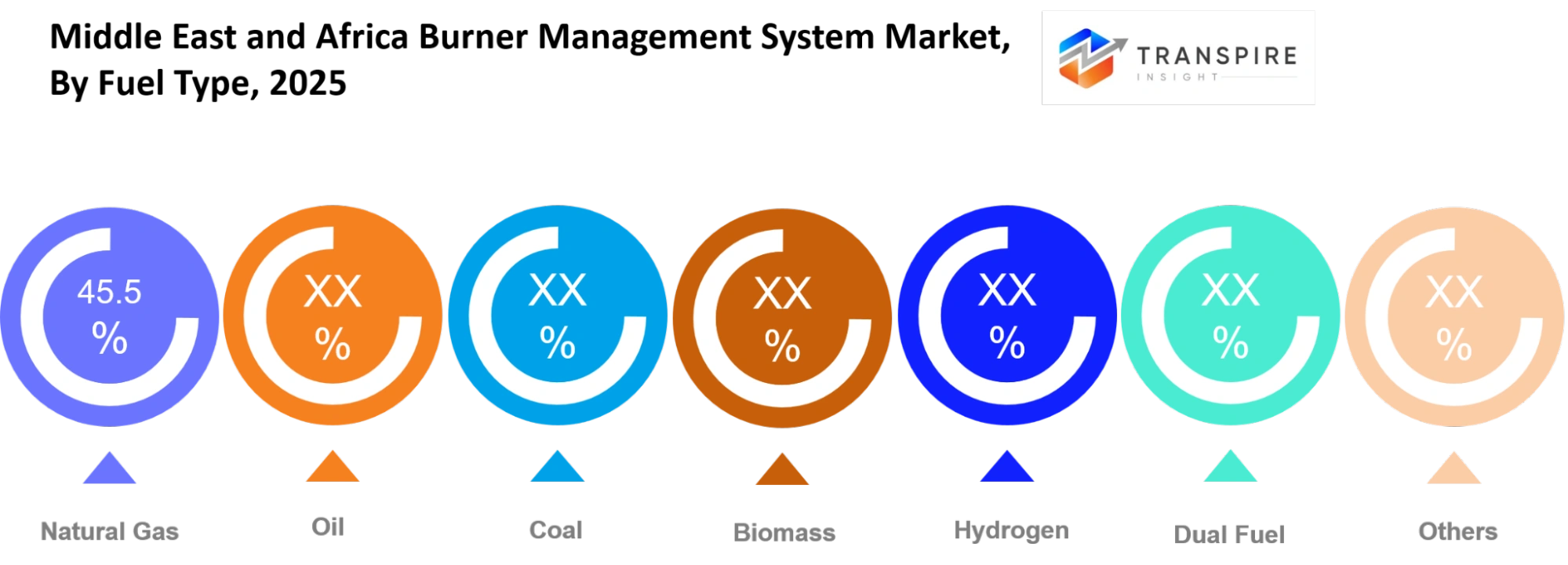
Natural Gas kind of holds a significant position since it has efficient combustion characteristics and it gets used pretty broadly across industrial and power generation facilities. Oil still stays important for refining, petrochemical processing, and industrial heating applications that need dependable burner control, or at least reliable burner regulation. Coal continues to serve selected industrial plus power generation operations where combustion stability and safety monitoring are still essential . Each fuel category really calls for its own burner management abilities, so you can handle safe startup, steady operation, and shutdown procedures in a consistent way.
Biomass applications need flexible control systems because fuel quality, plus combustion behavior can vary a lot between different feedstocks. Hydrogen projects demand advanced flame detection and safety measures, partly due to unique combustion properties and the operational requirements that come with them. Dual Fuel systems bring flexibility since facilities can switch between fuel sources based on availability and operating costs, without too much drama. Other fuel categories cover specialty industrial gases and alternative energy sources that end up needing customized safety plus combustion control strategies, tailored per site.
By Application
Boilers take up a large slice of deployment because steam creation still stays critical across manufacturing, energy production, and processing sectors, yes. Furnaces back up high temperature runs in metal working chemical production and industrial manufacturing settings, they’re pretty central. Kilns also matter a lot in cement ceramics, and mineral handling activities, where consistent burning conditions directly affect the final product quality. In every one of those cases , the whole setup leans on effective burner management to keep things safer, more efficient and also consistent in how the process actually behaves.
Ovens show up everywhere in food processing and industrial heating roles, where you need measured thermal zones, plus dependable performance too. Heaters deliver process warmth across many industries and usually require precise combustion supervision so the output stays steady. Incinerators demand reliable burner management to make waste treatment safer and to meet environmental requirements without drama. Other setups include drying systems and niche thermal processing equipment, where improved combustion safety measures help with reliability and day to day operational control.
By End User
Oil & Gas facilities, you know, they use burner management systems across refineries, petrochemical plants, gas processing units, and the production infrastructure too, where combustion safety is still this big, critical operational requirement. Then in power generation facilities, the burner controls need to stay reliable so electricity production stays stable, and so there are fewer operational interruptions, more uptime, basically. Chemical processing operations also need that kind of exact combustion management, not just “good enough” , to keep the production environment safe and to help maintain process stability. There’s a strong emphasis on safety, efficiency, and regulatory compliance, so it makes sense why these systems are getting adopted across all these industries.
For manufacturing facilities, combustion systems are used for heating, processing, and production activities, and they have to deliver dependable operational performance while protecting the equipment at the same time. In food processing, controlled heating systems are relied on to maintain product quality, consistency, and operational efficiency during production, it’s kind of the whole point. Other end users include mining, cement, pulp and paper, and several industrial sectors that still need reliable thermal processing equipment. And as industrial expansion and modernization initiatives continue, that will support demand across these various end-user categories, with the usual momentum.
What are the Key Use Cases Driving the Middle East and Africa Burner Management System Market?
The biggest use case comes from refinery boilers, process heaters and gas processing facilities where combustion safety, kinda directly, affects operational continuity and worker protection. These places run under tight process safety requirements, so burner management systems become a kind of critical investment, for preventing shutdowns and keeping production efficiency steady.
Power generation plants plus chemical manufacturing facilities are also major secondary applications. In practice, operators lean on advanced combustion controls to boost equipment reliability, cut back on maintenance interruptions, and keep thermal performance stable across messy industrial processes.
Newer applications are starting to show up too, for example hydrogen-ready combustion systems and dual-fuel industrial installations. Energy transition projects, especially across Gulf industrial zones, are opening doors for more advanced burner safety technologies that can handle complex fuel situations and digital monitoring needs.
|
Report Metrics |
Details |
|
Market size value in 2025 |
USD 0.52 Billion |
|
Market size value in 2026 |
USD 0.55 Billion |
|
Revenue forecast in 2033 |
USD 0.86 Billion |
|
Growth rate |
CAGR of 6.59% from 2026 to 2033 |
|
Base year |
2025 |
|
Historical data |
2021 - 2024 |
|
Forecast period |
2026 - 2033 |
|
Report coverage |
Revenue forecast, competitive landscape, growth factors, and trends |
|
Regional scope |
United States; Canada; Mexico; United Kingdom; Germany; France; Italy; Spain; Denmark; Sweden; Norway; China; Japan; India; Australia; South Korea; Thailand; Brazil; Argentina; South Africa; Saudi Arabia; United Arab Emirates |
|
Key company profiled |
Honeywell, Emerson, Siemens, ABB, Yokogawa, Schneider Electric, Rockwell Automation, HIMA, Pilz, Valmet, Mitsubishi Electric, Azbil, Endress+Hauser, Johnson Controls, Phoenix Contact. |
|
Customization scope |
Free report customization (country, regional & segment scope). Avail customized purchase options to meet your exact research needs. |
|
Report Segmentation |
By Component (Controllers, Sensors, Switches, Actuators, Software, Relays, Alarms, Others); By Fuel Type (Natural Gas, Oil, Coal, Biomass, Hydrogen, Dual Fuel, Others); By Application (Boilers, Furnaces, Kilns, Ovens, Heaters, Incinerators, Others); By End User (Oil & Gas, Power Generation, Chemicals, Manufacturing, Food Processing, Others). |
Which Regions are Driving the Middle East and Africa Burner Management System Market Growth?
The Middle East still feels like the main regional market, mostly because it has a huge network of oil and gas infrastructure, big refining capacity, and the fact that industrial diversification programs are still moving along. So countries like Saudi Arabia, the United Arab Emirates, and Qatar keep putting money into process automation and modernization of industrial safety. There is strong regulatory supervision, and the ongoing scale of industrial projects, helps hold up demand for more advanced combustion safety systems. Also, the whole regional set up—engineering contractors, automation suppliers, and industrial operators—kind of locks in a continued leadership position.
Then the Gulf Cooperation Council area basically lands as the second biggest contributor. It’s different from wider Middle Eastern markets, because here the focus is more on technology integration and long term infrastructure planning, not only short-term rollouts. Energy income is fairly steady, which backs up predictable capital spending on plant upgrades and automation investments. Industrial operators are gradually leaning into digital safety frameworks, plus predictive maintenance programs. Because of that, the demand looks dependable across several industrial sectors, and not just one niche.
Africa, meanwhile, looks like the fastest-growing regional option through 2033. Industrial growth, new power generation investments, and manufacturing development initiatives are pushing modernization activity forward. More recent infrastructure improvements, along with rising industrial safety requirements, have turned more attention toward advanced combustion management technologies. That kind of momentum tends to open doors for suppliers who want market entry quickly, and then stay for long-term expansion.
Who are the Key Players in the Middle East and Africa Burner Management System Market and How Do They Compete?
Competition stays kinda moderately consolidated, you know, where global automation firms and industrial safety vendors are taking a sizable share of market revenues. The main competitive stuff is mostly about technology capability, safety certification know how, digital integration, and how strong the regional service support really is. Lately buyers are looking at suppliers in a more lifecycle kind of way—so, lifecycle support, cybersecurity readiness, and whether the solution fits with wider automation architectures—rather than just caring about hardware performance by itself.
Honeywell stands out because of integrated combustion safety platforms that kinda braid burner management, process automation, and industrial cybersecurity features into one overall approach. They keep pushing into digital service capabilities which helps industrial operators get better operational visibility and better predictive maintenance results. Emerson meanwhile tends to focus on advanced automation ecosystems that connect burner safety controls with plant-wide optimization platforms, and they create value by leaning into operational efficiency as well as asset performance improvements.
Siemens is competing through deep integration between industrial software, control systems, and safety technologies. ABB leans more into electrification and automation expertise, which lets customers deploy unified operational technology environments without too much friction. Yokogawa tries to solidify its position through process industry specialization and operational analytics that are more advanced, plus their ability to turn that data into actionable insights. Overall, strategic partnerships, regional engineering collaborations, and continued digital platform investments stay pretty central for competitive expansion across the sector.
Company List
- Honeywell
- Emerson
- Siemens
- ABB
- Yokogawa
- Schneider Electric
- Rockwell Automation
- HIMA
- Pilz
- Valmet
- Mitsubishi Electric
- Azbil
- Endress+Hauser
- Johnson Controls
- Phoenix Contact
Recent Development News
In June 2026, Honeywell launched Experion Cognition, an AI-enabled control system platform for autonomous industrial operations. The platform helps process facilities proactively identify abnormal conditions, improve operational safety, and optimize production performance, strengthening Honeywell's position in industrial automation and combustion-related control applications.
Source: https://www.honeywell.com
In March 2026, Honeywell commercially launched Experion Operations Assistant, an AI-powered control room solution that predicts alarm incidents and supports industrial operators with real-time operational insights. The technology enhances process safety, reduces unplanned downtime, and improves decision-making across industrial facilities using combustion and process control systems.
Source: https://www.honeywell.com
In March 2026, Siemens unveiled its next-generation Sinteso Nova and Cerberus Nova safety portfolio featuring cloud connectivity, remote diagnostics, predictive maintenance, and continuous monitoring capabilities. The launch strengthens Siemens' industrial safety and automation offering, supporting smarter and more connected operational environments.
Source: https://press.siemens.com
What Strategic Insights Define the Future of the Middle East and Africa Burner Management System Market?
Over the next five to seven years, the market is basically going to shift toward a fully integrated combustion safety ecosystem, where burner management , process automation , predictive maintenance, and industrial analytics all kinda work inside one unified platform. This trend is being pushed by industrial digitalization initiatives , plus the whole operational resilience thing , and honestly the constant need to cut unplanned downtime in critical infrastructure.
There’s also a quieter risk that doesn’t get talked about much, which is that advanced technology supply may end up being concentrated among a small set of automation vendors. That could nudge integration costs up, and it can quietly lock industrial operators into vendor dependency.
At the same time, there’s an emerging opportunity with hydrogen-capable combustion systems, especially in Gulf industrial decarbonization projects, where new fuel strategies are picking up speed. The firms that can build safety-certified solutions for multi-fuel conditions should be in a strong place to catch the next round of investment cycles.
For market players, a smart focus is open-architecture platforms that integrate smoothly with what’s already in place across existing automation systems. This supports scalable deployments and, in the long run, helps drive stronger customer retention.
Middle East and Africa Burner Management System Market Report Segmentation
By Component
- Controllers
- Sensors
- Switches
- Actuators
- Software
- Relays
- Alarms
- Others
By Fuel Type
- Natural Gas
- Oil
- Coal
- Biomass
- Hydrogen
- Dual Fuel
- Others
By Application
- Boilers
- Furnaces
- Kilns
- Ovens
- Heaters
- Incinerators
- Others
By End User
- Oil & Gas
- Power Generation
- Chemicals
- Manufacturing
- Food Processing
- Others
Frequently Asked Questions
Find quick answers to common questions.
The expected Middle East and Africa Burner Management System Market size for the market will be USD 0.86 Billion in 2033.
Key segments for the Middle East and Africa Burner Management System Market are By Component (Controllers, Sensors, Switches, Actuators, Software, Relays, Alarms, Others); By Fuel Type (Natural Gas, Oil, Coal, Biomass, Hydrogen, Dual Fuel, Others); By Application (Boilers, Furnaces, Kilns, Ovens, Heaters, Incinerators, Others); By End User (Oil & Gas, Power Generation, Chemicals, Manufacturing, Food Processing, Others).
Major Middle East and Africa Burner Management System Market players are Honeywell, Emerson, Siemens, ABB, Yokogawa, Schneider Electric, Rockwell Automation, HIMA, Pilz, Valmet, Mitsubishi Electric, Azbil, Endress+Hauser, Johnson Controls, Phoenix Contact.
The Middle East and Africa Burner Management System Market size is USD 0.52 Billion in 2025.
The Middle East and Africa Burner Management System Market CAGR is 6.59% from 2026 to 2033.
- Honeywell
- Emerson
- Siemens
- ABB
- Yokogawa
- Schneider Electric
- Rockwell Automation
- HIMA
- Pilz
- Valmet
- Mitsubishi Electric
- Azbil
- Endress+Hauser
- Johnson Controls
- Phoenix Contact
About the Authors

Avinash Kumar
I’m Avinash Kumar, a Senior Research Analyst at Transpire Insight, with expertise in the Electronics and Semiconductor and Energy & Power industry. My work focuses on analyzing emerging technologies, market trends, industry developments, and innovation across these sectors. I specialize in transforming complex technical and market insights into clear, research-backed content that helps professionals, businesses, and decision-makers stay informed. Through continuous industry research and data-driven analysis, I strive to deliver accurate, reliable, and practical perspectives on the latest advancements shaping the semiconductor and energy landscape.

Chakradhar Khansole
Chakradhar serves as the Research Director at Transpire Insight, bringing over 8 years of experience in technology, innovation, and strategic market intelligence. He specializes in transforming complex market data into actionable business insights that enable organizations to make informed, growth-oriented decisions. Recognized for his strategic vision and analytical expertise, Chakradhar leads high-impact research initiatives, delivering comprehensive market assessments, competitive intelligence, and forward-looking industry analysis.
Recently Published Reports
-
Apr 2026
Fiber Optic Faceplates Market
Fiber Optic Faceplates Market Size, Share & Analysis Report By Type (< 300 mm2, 300-350 mm2, and > 350 mm2, By Application (Night Vision, Holographic Imaging, Medical, and Others), and Geography (North America, Europe, Asia-Pacific, Middle East and Africa, South and Central America), 2021 - 2031
-
Apr 2026
High Temperature Superconductors Market
High Temperature Superconductors Market Size, Share & Analysis Report By Type (1G HTS, and 2G HTS), By Application (Power Cable, Fault Current Limiter, and Transformer), and Geography (North America, Europe, Asia-Pacific, Middle East and Africa, South and Central America), 2021 - 2031
-
Apr 2026
Industrial Plugs and Socket Market
Industrial Plugs and Socket Market Size, Share & Analysis Report By Type (Industrial Plugs, Industrial Sockets), By Current (Up to 32 A, 32 to 125 A, Above 125 A), By Protection (Dustproof and Splash Proof, Waterproof, Explosion Proof), By End User (Heavy Industries, Oil and Gas, Chemicals and Pharmaceuticals, Power Generation, Others), and Geography (North America, Europe, Asia-Pacific, Middle East and Africa, South and Central America), 2021 - 2031
-
Apr 2026
InGaAs Avalanche Photodiodes Market
InGaAs Avalanche Photodiodes Market Size, Share & Analysis Report By Type (1100 - 1700 nm, and 1000 - 1600 nm), By Application (Missile Warning System, Muzzle Flash Detection, Wafer Defect Inspection, Laser Rangefinders, and Others), and Geography (North America, Europe, Asia-Pacific, Middle East and Africa, South and Central America), 2021 - 2031