

Middle East and Africa Bulk Chemicals and Inorganics Market Summary
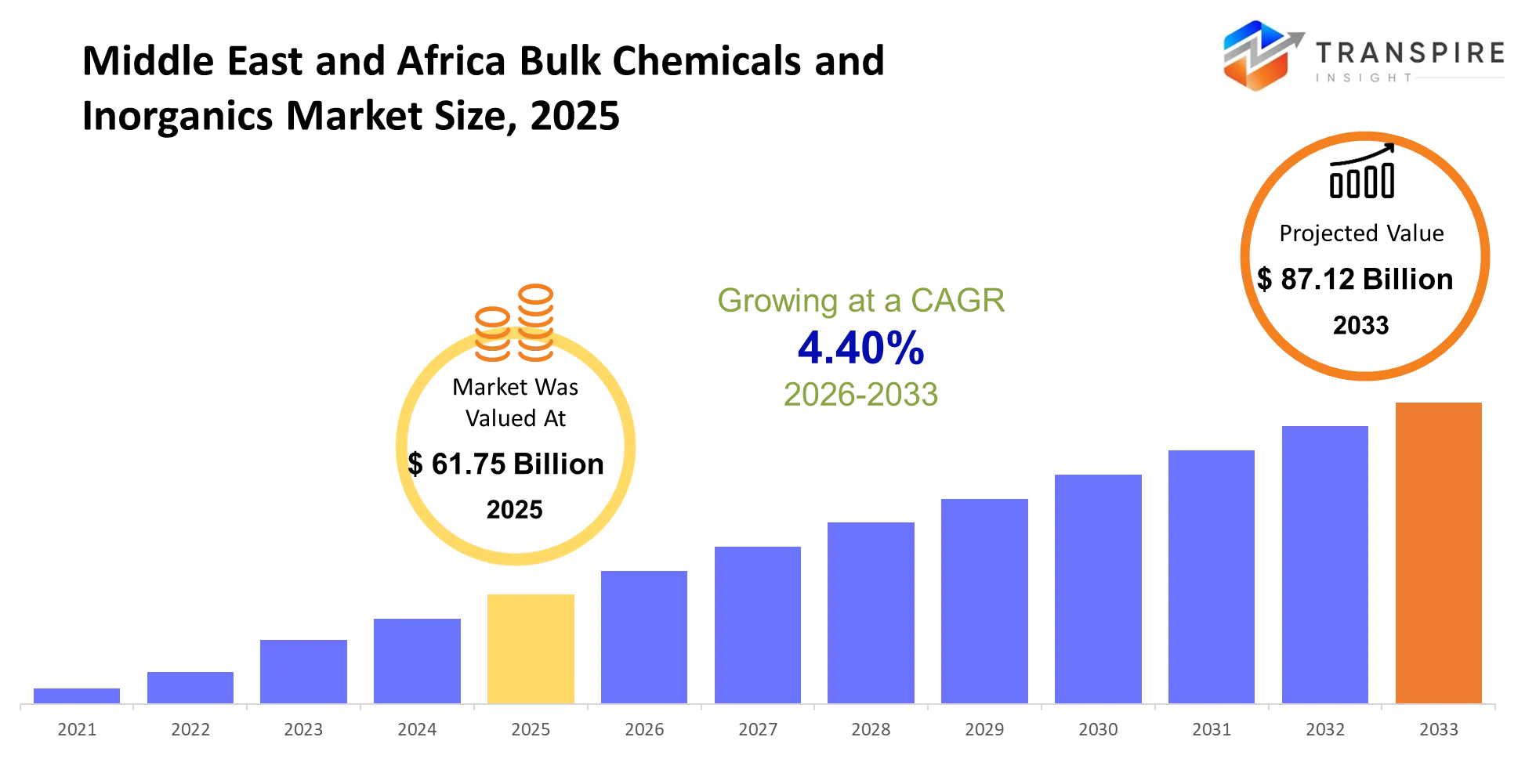
As per Transpire Insight Analysis the Middle East and Africa Bulk Chemicals and Inorganics Market size is estimated at USD 61.75 Billion in 2025 and is anticipated to reach USD 87.12 Billion by 2033, growing at a CAGR of 4.40% from 2026 to 2033.
The Middle East and Africa Bulk Chemicals and Inorganics Market, it basically provides those raw materials that keep industrial value chains moving, like, across construction water treatment agriculture mining oil and gas and manufacturing. It’s kind of the quiet backbone, in a way you do not really notice. You can spot it through industrial salts, chlor alkali chemicals, industrial gases, fertilizers, and inorganic pigments, all of that helps with large scale production, build out infrastructure, and assists in resource processing across most of the region.
Over the last five years, a lot of governments sped up industrial diversification plans, while producers kept pushing deeper into integrated petrochemical and specialty chemical complexes, so they can strengthen domestic manufacturing capability. After the supply chain disruptions tied to the Russia Ukraine conflict, sourcing thinking sort of rerouted, and companies leaned more toward regional production plus longer term purchasing agreements for key chemical inputs. In practice, these changes have meant extra investment into local processing facilities, improved supply resilience, and more support for downstream industries, too.
So, higher industrial utilization, export focused output, and ongoing capacity expansion keep feeding into better revenue results for the regional bulk chemicals and inorganics space.
Middle East and Africa Bulk Chemicals and Inorganics Market Size & Forecast:
- Middle East and Africa Bulk Chemicals and Inorganics Market Size 2025: USD 61.75 Billion
- Expected Market Value 2033: USD 87.12 Billion
- Forecast CAGR: 4.40%
- Leading region in 2025:
- Fastest Growing region:
- Key Profile: SABIC, BASF, Dow, Linde, Yara International, OQ Chemicals, Sasol, Solvay, Evonik, Nouryon, Aditya Birla Chemicals, OCI NV, Kemira, Air Liquide, Arkema
Key Market Insights
- The Middle East and Africa Bulk Chemicals and Inorganics Market is set to climb up to about USD 87.12 Billion by 2033, starting from USD 61.75 Billion in 2025, and this signals a continued push in manufacturing, and yes industrial momentum keeps rolling.
- For 2025 the Middle East leads the regional landscape with roughly over 65% share, mainly tied to integrated petrochemical clusters, plus plenty of hydrocarbon feedstocks that keep operations humming.
- Africa meanwhile is expected to post the fastest momentum all the way through 2033, largely because mining spending is rising, fertilizer output keeps expanding, and industrial backbone infrastructure is getting upgraded in multiple places.
- In terms of products, industrial salts are estimated at around 28% of revenue in 2025, so they’re basically the front-runner category across many industrial uses.
- Chlor alkali chemicals come in as the second major segment, while industrial gases are predicted to be the quickest growing area during the forecast stretch.
- On the application side, chemical processing alone makes up nearly 30% of demand, while water treatment is forecast to show the strongest increase as desalination capacity grows, and keeps drawing attention from operators.
- Looking at end users, the chemical industry is still the top buyer group with about 35% market share, and pharmaceuticals plus food processing keep lifting procurement volumes too, at a steady pace.
- Key names—SABIC, BASF, Dow, Linde, Yara International, and Sasol—are still putting money into capacity buildouts, process streamlining, and regional collaborations, to stay ahead.
- More and more manufacturers are moving toward digital process monitoring, adopting energy saving production technologies and, tighter integrated supply chains, all to protect operating margins and production consistency.
- Finally, strategic expansions into Gulf industrial zones and emerging African manufacturing corridors help producers boost exports, cut down shipping lead times, and strengthen regional competitiveness overall.
What are the Key Drivers, Restraints, and Opportunities in the Middle East and Africa Bulk Chemicals and Inorganics Market?
Industrial diversification policies throughout Saudi Arabia, the UAE, Egypt , and several neighboring economies are still the most convincing trigger for market expansion. National investment programs push downstream manufacturing , petrochemical linkage, fertilizer production , and more value added chemical processing, so not just “exporting raw materials” as the main play. Because of this, new chemical plant builds keep appearing, alongside industrial parks and logistics infrastructure, which help producers widen their output capacity while also meeting domestic demand and export needs. The knock on effect is more local processing, that in turn tends to lift sales volumes and keeps long term revenue generation moving across many chemical categories.
Still , the biggest structural problem for the industry is its reliance on capital heavy production assets, energy frameworks, and imported processing equipment. Setting up chlor alkali units, industrial gas facilities , and big inorganic chemical complexes takes serious upfront money , long regulatory sign off timelines, and very specific engineering know how. A lot of African economies keep running into infrastructure constraints, uneven electricity availability, and transport bottlenecks that cannot be fixed quickly enough. These issues stall capacity growth, raise operating expenses, and slow the commercialization of fresh projects, which then trims the market’s achievable revenue upside.
At the same time, there is a clear opening in regional scale production for water treatment chemicals and more sustainable industrial ingredients. Fast spending on desalination facilities, municipal wastewater treatment , and mining activity across Gulf states and parts of Africa is creating fresh demand for industrial salts, alkalis, and specialized inorganic compounds.
What Has the Impact of Artificial Intelligence Been on the Middle East and Africa Bulk Chemicals and Inorganics Market?
Artificial intelligence, plus more advanced digital technologies, are quietly changing bulk chemical and inorganic manufacturing, mainly by making the plants feel more efficient , more steady in what they do, and better at using assets. In practice, chemical producers are putting AI powered control systems in place to keep an eye on reactors, separation units, compressors, and even industrial gas production facilities all at once, in real time. With automated process tuning, operating settings are continuously nudged to raise product quality, but also to cut energy use and raw material waste.
On top of that, machine learning models help with predictive maintenance by reading vibration signals, tracking temperature movement, watching pressure swings, and comparing equipment behavior, so likely failures show up before they mess up production. This sort of predictive ability tends to lower surprise stop–start events, increases equipment availability, and helps extend the useful life of major assets, across those big scale manufacturing lines. And then AI driven demand forecasting with inventory optimization goes further, strengthening procurement prep. Producers can balance feedstock buys with shifting industrial consumption, while at the same time reducing storage costs that just build up.
Digital twins, paired with advanced analytics, let manufacturers mimic production pathways, improve chemical formulations, and raise plant throughput without having to pause operations. These tools generally lead to smoother operations, lower maintenance spend, and stronger regulatory compliance since process monitoring is closer to continuous rather than occasional. Still, wider AI adoption is kept back by pricey rollout, not enough digital infrastructure in older sites, and a shortage of skilled people who can connect advanced analytics with those complicated chemical manufacturing systems.
Key Market Trends
- After 2022, regional manufacturers kind of shifted toward localized production, so they cut back on relying so much on imported bulk chemicals , and in a way helped supply chain resilience.
- Meanwhile Gulf producers went further into integrated petrochemical and chemical complexes, with investments coming in at more than USD 20 billion across a few industrial projects since 2021.
- Water treatment chemical consumption also sped up, mainly because desalination capacity grew by over 15% across several key Gulf markets in the recent period.
- On the industrial gas side suppliers started using AI enabled predictive maintenance more and more, which reduced unexpected equipment downtime by roughly 20% in advanced facilities.
- For mining, expansion across Africa boosted demand for industrial salts , flotation chemicals, and inorganic compounds that support mineral processing operations.
- Companies like SABIC, BASF, Dow , and Linde stepped up regional partnerships too, aiming to improve manufacturing efficiency and strengthen downstream chemical production.
- Buyers now tend to prefer long term procurement agreements rather than spot purchasing, to curb raw material price swings and keep supply steadier and more secure.
- Manufacturers also leaned into investment in energy efficient production technologies, both to lower operating costs and to meet evolving industrial emission standards, without too much delay.
- Digital process monitoring became pretty common across major chemical plants, supporting continuous quality control and also better production planning, kinda at the same time.
- Finally, export oriented production strategies gained momentum as regional players used modern logistics infrastructure to push shipments into African, and Asian industrial markets.
Middle East and Africa Bulk Chemicals and Inorganics Market Segmentation
By Product Type
Product type segmentation really shows how broad the bulk chemicals are, used over industrial production and processing activities. Acids help with metal processing, fertilizer manufacturing and chemical synthesis, but alkalis kind of matter a lot too for pulp processing, soap production, and even water treatment. Industrial salts get used in chemical manufacturing, deicing, food processing, and oilfield operations too. Meanwhile chlor alkali chemicals provide key inputs for chlorine plus caustic soda production that get used across several industries.
Industrial gases also back welding, healthcare, electronics and manufacturing with oxygen, nitrogen, hydrogen, and carbon dioxide. Fertilizer chemicals support farm output through nitrogen, phosphate, and potash based products. Inorganic pigments give color stability along with durability for paints, plastics, coatings, and construction materials. The others are specialty inorganic compounds used in mining, glass production, ceramics, and other industrial processing, if that makes sense.
By Application
Application segmentation points to this broad industrial push for inorganic chemicals across a variety of output activities. Water treatment is still one of the bigger drivers since purification plants, and desalination facilities need stable chemical supplies for treatment, and disinfection. Construction leans on cement additives, pigment systems and mineral compounds which boost overall product quality as well as structural behavior. Agriculture in turn uses fertilizers plus soil treatment chemicals, to keep crop performance steady and support healthy ground conditions.
In chemical processing, bulk chemicals are taken as feedstocks for later downstream manufacturing, and for industrial synthesis. Mining operations lean on inorganic chemicals for ore extraction, flotation and mineral recovery, while oil and gas installations rely on treatment chemicals during drilling and refining. Manufacturing keeps demand steady through metal work, glass making and industrial fabrication. The rest covers paper manufacture, textiles, and municipal infrastructure projects, where chemical inputs still matter.
By End User
End user segmentation basically shows the wide customer mix that helps sustain long term industrial chemical use across the whole region, even when demand shifts a bit. Chemical industry facilities stay as the main buyers, largely because manufacturing sites need steady inputs, like acids, alkalis, industrial gases, and chlor-alkali output, all the time. Agriculture tends to purchase fertilizer chemicals to push better crop performance, so yields get improved. Meanwhile food processing leans on permitted chemical grades for things like preservation and day to day processing runs. For pharmaceuticals, manufacturers rely on high purity inorganic chemicals to support formulation as well as the overall production workflow.
Mining firms, in practice, use flotation agents and mineral processing chemicals plus other industrial reagents during extraction work. Oil and gas operations also need treatment chemicals, both for drilling, refining and the production systems they run. Utilities buy chemicals for cooling water handling, wastewater management, and the power generation facilities side. “Others” covers electronics, paper making, construction material production, and textile manufacturing, even though the purchasing patterns can be pretty uneven.
By Distribution Channel
Distribution channel segmentation kind of tells you how bulk chemicals actually end up with industrial customers, through separate commercial networks that each behave a little differently. Direct sales still feel like the go to option for big volume buyers, mainly because manufacturers can sit down and negotiate pricing, offer technical support, and set up long term supply agreements, more or less in one place. Industrial distributors, meanwhile, handle inventory management and also regional availability for medium sized customers, even when those customers have pretty varied buying needs. Wholesale suppliers tend to make product access easier across developing industrial areas, mostly by relying on existing logistics networks that are already running smoothly.
Government procurement plays a role in backing public infrastructure efforts, municipal water treatment, and strategic industrial projects, usually via centralized purchasing programs. At the same time online industrial platforms keep expanding since digital procurement helps with easier product comparison, faster quotation requests, and clearer order management for industrial buyers. Other routes include regional trading companies, local suppliers and specialized chemical dealers, sometimes focused on niche industrial applications where timing and specificity matter.
By Grade
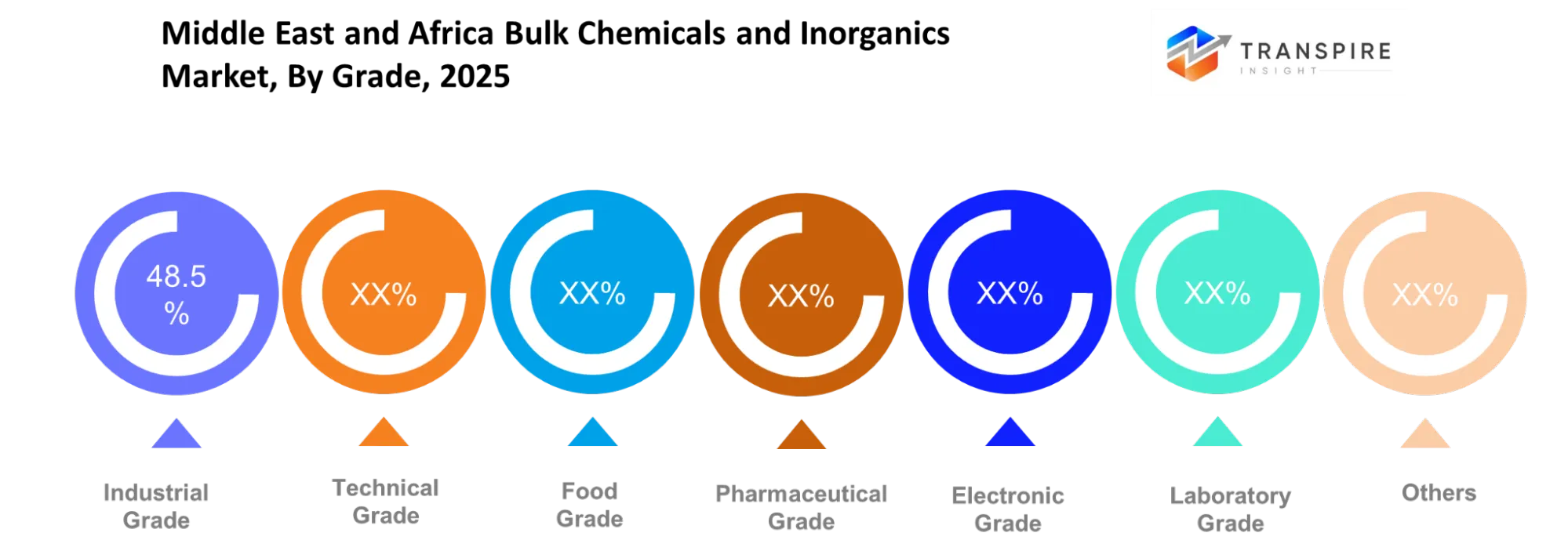
Grade segmentation kind of mirrors the quality thresholds that are expected for various industrial and commercial uses. In general, industrial grade products are built for large scale making things, construction, mining, and chemical processing where the actual operating performance stays the main focus. Technical grade chemicals usually support everyday industrial production, but with controlled specifications, and they can fit more than one manufacturing process without too much fuss. Food grade materials, meanwhile, are required to satisfy strict safety rules for food preparation and beverage making.
Pharmaceutical grade chemicals, on the other hand, are held to very high purity levels, mainly for medicine production and lab work. Electronic grade products are used in semiconductor fabrication and electronic component production, where contamination control is the big deal. Laboratory grade materials allow research, testing, and quality inspection across both industrial and academic locations. There are also other options, like customized purity levels, that get developed for specialized industrial needs—ones that demand unusual performance traits or a more specific chemical profile.
What are the Key Use Cases Driving the Middle East and Africa Bulk Chemicals and Inorganics Market?
Water treatment kind of ends up being the biggest use case since desalination plants, municipal treatment setups, and industrial wastewater systems all still need really big amounts of chlorine, caustic soda and a whole bunch of other inorganic chemicals. Having chemical supply that stays dependable , helps keep safe water production on track, plus it allows utilities to satisfy environmental discharge rules in water stressed areas.
Mining , and oil and gas work keeps pushing chemical consumption higher too, mainly for mineral processing drilling fluids, corrosion control and the refining side of things. Chemical processing plants also rely on bulk inorganic materials , as basic feedstocks for later manufacturing stages, so the demand remains fairly steady because industrial production networks keep moving.
Newer use cases are starting to show up as well, like green hydrogen production, battery material processing, and carbon capture sites that need very high purity industrial gases and specific inorganic compounds. On top of that, advanced semiconductor manufacturing and renewable energy projects are opening up opportunities for electronic grade and laboratory grade chemicals during the forecast period.
|
Report Metrics |
Details |
|
Market size value in 2025 |
USD 61.75 Billion |
|
Market size value in 2026 |
USD 64.47 Billion |
|
Revenue forecast in 2033 |
USD 87.12 Billion |
|
Growth rate |
CAGR of 4.40% from 2026 to 2033 |
|
Base year |
2025 |
|
Historical data |
2021 - 2024 |
|
Forecast period |
2026 - 2033 |
|
Report coverage |
Revenue forecast, competitive landscape, growth factors, and trends |
|
Regional scope |
Middle East and Africa (Saudi Arabia, United Arab Emirates, South Africa, Rest of Middle East and Africa) |
|
Key company profiled |
SABIC, BASF, Dow, Linde, Yara International, OQ Chemicals, Sasol, Solvay, Evonik, Nouryon, Aditya Birla Chemicals, OCI NV, Kemira, Air Liquide, Arkema |
|
Customization scope |
Free report customization (country, regional & segment scope). Avail customized purchase options to meet your exact research needs. |
|
Report Segmentation |
By Product Type (Acids, Alkalis, Industrial Salts, Chlor-Alkali Chemicals, Industrial Gases, Fertilizer Chemicals, Inorganic Pigments, Others); By Application (Water Treatment, Construction, Agriculture, Chemical Processing, Mining, Oil & Gas, Manufacturing, Others); By End User (Chemical Industry, Agriculture, Food Processing, Pharmaceuticals, Mining, Oil & Gas, Utilities, Others); By Distribution Channel (Direct Sales, Industrial Distributors, Wholesale Suppliers, Government Procurement, Online Industrial Platforms, Others); By Grade (Industrial Grade, Technical Grade, Food Grade, Pharmaceutical Grade, Electronic Grade, Laboratory Grade, Others) |
Which Regions are Driving the Middle East and Africa Bulk Chemicals and Inorganics Market Growth?
The Middle East is still kind of the main regional market, because there are plenty hydrocarbon feedstocks, plus integrated petrochemical complexes, and those long term diversification plans help back up large scale chemical output. Places like Saudi Arabia, the United Arab Emirates, and Oman are continuing to push downstream manufacturing via national industry programs, but also by putting money into world class export terminals and the logistics infrastructure around them. Modern ports such as Jubail, Yanbu, Jebel Ali, and Sohar really help regional exports move faster, they connect makers with buyers across Asia, Europe and Africa. There’s also a pretty mature supplier ecosystem, dependable energy availability, and steady re-investment from big chemical producers, and all of that keeps regional leadership in place while backing long term production growth, without so many surprises.
Africa shows up in another way, more through steady industrial progress rather than massive petrochemical integration. Things like mining expansion, fertilizer output, food processing, and municipal water treatment create consistent demand across South Africa, Egypt, Morocco, and other emerging economies too. Ongoing public infrastructure spending, along with slower but noticeable regulatory improvements, is encouraging local manufacturing. At the same time it reduces dependence on imported industrial chemicals. This more balanced industrial foundation brings dependable revenue streams, and it also strengthens Africa’s position inside the wider market even if the production footprint is smaller than what the Middle East delivers.
Looking ahead, Africa should record the quickest growth during the 2026–2033 period, as governments move harder on industrialization plus infrastructure investment. New fertilizer plants, mining projects, desalination facilities, and industrial parks are generating fresh appetite for bulk chemicals and inorganic materials across several sectors.
Who are the Key Players in the Middle East and Africa Bulk Chemicals and Inorganics Market and How Do They Compete?
Competition is still somewhat consolidated, in the sense that only a handful of multinational producers, do most of the heavy lifting with big scale manufacturing capacity , advanced production technologies, and pretty tight integrated supply chains. So even if you hear about pricing a lot, the real edge tends to come from production efficiency, access to feedstock, having manufacturing presence in the right regions, logistics know how, plus those long term customer contracts, not just product pricing by itself. Meanwhile, the established producers keep guarding market share by pushing capacity expansion and squeezing more operational efficiency out of everything, and the regional manufacturers are doubling down too, more on building domestic supply capabilities , bit by bit.
SABIC has the kind of advantage that feels obvious once you look at the supply side: direct access to competitive hydrocarbon feedstocks and integrated production assets in Saudi Arabia , which lets them run cost efficient manufacturing across bulk chemicals and inorganic products. They keep investing , especially in downstream integration, in proprietary production technologies, and in strategic partnerships. This helps their export competitiveness and it also supports regional industrial diversification, even if the messaging sounds slightly broader than that. BASF, on the other hand, leans into differentiation via advanced process technology, specialty product development, and digital manufacturing systems that improve operational efficiency and product consistency. They also keep adding production assets plus sustainability initiatives, and that combination helps sustain customer relationships across multiple industrial sectors.
Linde focuses on industrial gas technologies backed by engineering expertise, long term supply agreements, and customized gas management solutions for manufacturing, healthcare, and energy clients. Yara International stays competitive through integrated fertilizer production, agronomic know how, and strong distribution networks that serve agricultural markets across Africa and the Middle East.
Company List
- SABIC
- BASF
- Dow
- Linde
- Yara International
- OQ Chemicals
- Sasol
- Solvay
- Evonik
- Nouryon
- Aditya Birla Chemicals
- OCI NV
- Kemira
- Air Liquide
- Arkema
Recent Development News
In April 2026, BASF reported first quarter 2026 financial results and reaffirmed its 2026 strategy despite challenging market conditions. The update highlighted continued investment priorities and operational resilience supporting long term chemical production capacity.https://www.basf.com
In April 2026, Air Liquide highlighted the expansion of its industrial gas business following the completed acquisition of NovaAir in India. The acquisition strengthens production capacity and supports long term growth across industrial gas markets serving manufacturing and healthcare industries.https://www.airliquide.com
In November 2025, BASF entered a strategic partnership with Air Liquide and Shenergy to develop a lower carbon MDI value chain using biomethane. The collaboration advances low carbon chemical production and supports industrial decarbonization initiatives.https://www.basf.com
What Strategic Insights Define the Future of the Middle East and Africa Bulk Chemicals and Inorganics Market?
The market seems to be heading toward more regional self sufficiency, as governments push for downstream manufacturing, kind of integrated chemical production, and higher value industrial processing, rather than exporting raw materials. You can also see continued investment—industrial infrastructure, more desalination capacity, mining, and fertilizer production—will probably reinforce this path during the next five to seven years. There is also a less noticeable risk, from feedstock price volatility and the fact that production capacity gets concentrated in a handful of major manufacturing hubs, which could end up annoying regional supply when geopolitical or energy market shocks pop up.
On the flip side, an emerging opportunity is making high purity inorganic chemicals for hydrogen, battery materials, and semiconductor supply chains as industrial diversification moves faster. Market participants should do well if they invest in localized production, pick up digital manufacturing technologies, and build regional distribution partnerships that improve supply resilience ,while also getting operations lined up for whatever industrial demand shows up later.
Middle East and Africa Bulk Chemicals and Inorganics Market Report Segmentation
By Product Type
• Acids
• Alkalis
• Industrial Salts
• Chlor-Alkali Chemicals
• Industrial Gases
• Fertilizer Chemicals
• Inorganic Pigments
• Others
By Application
• Water Treatment
• Construction
• Agriculture
• Chemical Processing
• Mining
• Oil & Gas
• Manufacturing
• Others
By End User
• Chemical Industry
• Agriculture
• Food Processing
• Pharmaceuticals
• Mining
• Oil & Gas
• Utilities
• Others
By Distribution Channel
• Direct Sales
• Industrial Distributors
• Wholesale Suppliers
• Government Procurement
• Online Industrial Platforms
• Others
By Grade
• Industrial Grade
• Technical Grade
• Food Grade
• Pharmaceutical Grade
• Electronic Grade
• Laboratory Grade
• Others
Frequently Asked Questions
Find quick answers to common questions.
The expected Middle East and Africa Bulk Chemicals and Inorganics Market size for the market will be USD 87.12 Billion in 2033.
Key segments for the Middle East and Africa Bulk Chemicals and Inorganics Market are By Product Type (Acids, Alkalis, Industrial Salts, Chlor-Alkali Chemicals, Industrial Gases, Fertilizer Chemicals, Inorganic Pigments, Others); By Application (Water Treatment, Construction, Agriculture, Chemical Processing, Mining, Oil & Gas, Manufacturing, Others); By End User (Chemical Industry, Agriculture, Food Processing, Pharmaceuticals, Mining, Oil & Gas, Utilities, Others); By Distribution Channel (Direct Sales, Industrial Distributors, Wholesale Suppliers, Government Procurement, Online Industrial Platforms, Others); By Grade (Industrial Grade, Technical Grade, Food Grade, Pharmaceutical Grade, Electronic Grade, Laboratory Grade, Others).
Major Middle East and Africa Bulk Chemicals and Inorganics Market players are SABIC, BASF, Dow, Linde, Yara International, OQ Chemicals, Sasol, Solvay, Evonik, Nouryon, Aditya Birla Chemicals, OCI NV, Kemira, Air Liquide, Arkema.
The Middle East and Africa Bulk Chemicals and Inorganics Market size is USD 61.75 Billion in 2025.
The Middle East and Africa Bulk Chemicals and Inorganics Market CAGR is 4.40% from 2026 to 2033.
- SABIC
- BASF
- Dow
- Linde
- Yara International
- OQ Chemicals
- Sasol
- Solvay
- Evonik
- Nouryon
- Aditya Birla Chemicals
- OCI NV
- Kemira
- Air Liquide
- Arkema
About the Authors

Pankaj Ghogare Patil
I am Pankaj Ghogare Patil, a Senior Research Analyst at Transpire Insight, specializing in the Pharmaceutical, Chemicals & Materials, Healthcare IT, and Biotechnology industry. My expertise lies in conducting comprehensive market research, analyzing industry trends, evaluating competitive landscapes, and translating complex data into actionable insights. At Transpire Insight, I closely follow emerging technologies, regulatory developments, and market innovations to create accurate, well-researched, and informative content that helps businesses and professionals make informed decisions. I am committed to producing credible, evidence-based articles that reflect industry best practices while making technical topics accessible and valuable for a broad audience.

Chakradhar Khansole
Chakradhar serves as the Research Director at Transpire Insight, bringing over 8 years of experience in technology, innovation, and strategic market intelligence. He specializes in transforming complex market data into actionable business insights that enable organizations to make informed, growth-oriented decisions. Recognized for his strategic vision and analytical expertise, Chakradhar leads high-impact research initiatives, delivering comprehensive market assessments, competitive intelligence, and forward-looking industry analysis.
Recently Published Reports
-
May 2026
Healthcare Polymer Packaging Market
Healthcare Polymer Packaging Market Size, Share & Analysis Report By Packaging Type (Syringes, IV Bottles and Pouches, Clamshells, Blisters, Bottles & Jars, Containers, Tubes, IV Parental Packaging, Others), By Type (Regulated, Non-regulated), By Polymer Type (LDPE (Low-Density Polyethylene), HDPE (High-Density Polyethylene), Homo-polymer (Homo), Random Copolymer (Random), Block Copolymer (Block), PET, Polystyrene, Polyvinyl Chloride, Polyamide/EVOH, Others), and Geography (North America, Europe, Asia-Pacific, Middle East and Africa, South and Central America), 2021 - 2031
-
Apr 2026
Hydrophilic Tape (Waterstop) Market
Hydrophilic Tape (Waterstop) Market Size, Share & Analysis Report By Type (Bentonite-Based Hydrophilic Tape, Rubber-Based Hydrophilic Tape), By Application (Residential Buildings, Commercial Buildings, Infrastructure Projects), and Geography (North America, Europe, Asia-Pacific, Middle East and Africa, South and Central America), 2021 - 2031
-
Apr 2026
Metalens Market
Metalens Market Size, Share & Analysis Report By Type (Visible Light Metalens, and Infrared Metalens), By Application (Consumer Electronics, Automotive Electronics, Industrial, Medical, and Others), and Geography (North America, Europe, Asia-Pacific, Middle East and Africa, South and Central America), 2021 - 2031
-
Apr 2026
PBT Resin Market
PBT Resin Market Size, Share & Analysis Report By Type (Reinforced PBT Resin, Unreinforced PBT Resin), By Processing Method (Injection Molding, Extrusion, Blow Molding, Others), By End-User (Automotive, Electrical & Electronics, Consumer Appliances, Industrial Machinery, Medical Devices, Packaging, Others), and Geography (North America, Europe, Asia-Pacific, Middle East and Africa, South and Central America), 2021 - 2031