

Middle East and Africa AI in Networks Market Size & Forecast:
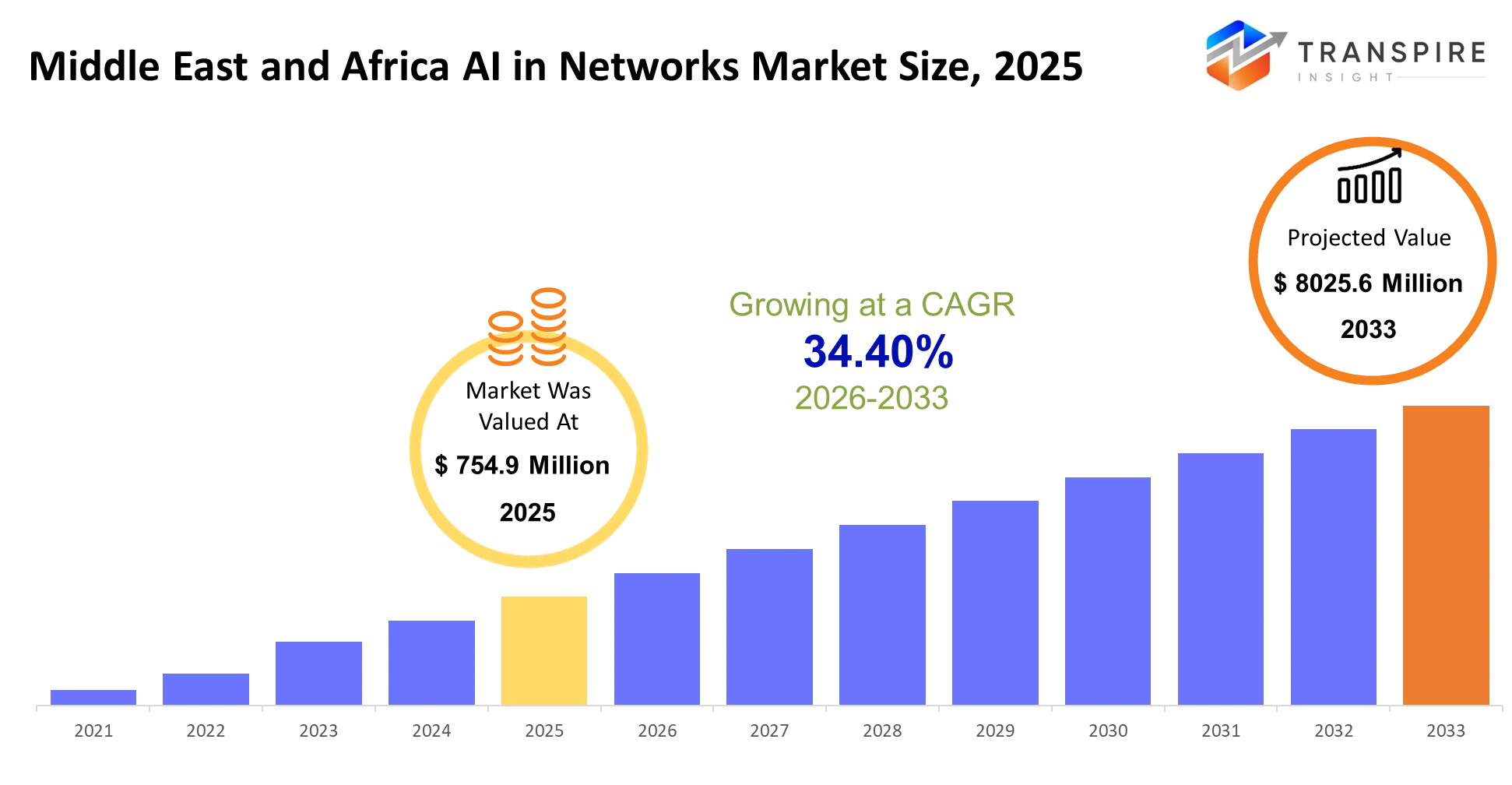
- Middle East and Africa AI in Networks Market Size 2025: USD 754.9 Million
- Middle East and Africa AI in Networks Market Size 2033: USD 8025.6 Million
- Middle East and Africa AI in Networks Market CAGR: 34.40%
- Middle East and Africa AI in Networks Market Segments: By Component (Software, Services, Platforms), By Application (Optimization, Security, Traffic, Automation), By End-User (Telecom, Enterprises, Cloud Providers, ISPs)
To learn more about this report,  Download Free Sample Report
Middle East and Africa AI in Networks Market Summary:
The Middle East and Africa AI in Networks Market size is estimated at USD 754.9 Million in 2025 and is anticipated to reach USD 8025.6 billion by 2033, growing at a CAGR of 34.40% from 2026 to 2033. The AI in networks market which exists in the Middle East and Africa includes Saudi Arabia and United Arab Emirates and South Africa and all other Middle Eastern and African nations. The telecommunications and enterprise networking industry will experience transformation through intelligence-driven infrastructure which will create new methods for data flow management. Gulf economies will need predictive traffic handling because their data consumption levels will increase through the development of smart cities and the implementation of 5G networks. South African businesses will require flexible network security solutions because cyber threats continue to grow. The increasing demand for data localization together with the need for ethical AI implementation will drive vendors to adapt their business strategies according to emerging regulatory requirements. The rising demand for uninterrupted network links will lead service providers to integrate machine learning systems into their core network processes.
What Has the Impact of Artificial Intelligence Been on the Middle East and Africa AI in Networks Market?
Artificial intelligence is transforming organizations' methods for producing insights and making decisions throughout the AI networks market in the Middle East and Africa because it provides new business methods and strategic planning frameworks.
The Middle East and Africa AI in networks market has enhanced its research capabilities through machine learning and predictive analytics which enable stakeholders to process extensive network data more effectively while achieving faster results. AI-driven models will enhance demand forecasting accuracy by identifying usage patterns and traffic spikes and consumer behavior shifts which help telecom providers and enterprises to anticipate future requirements instead of waiting to respond. Artificial intelligence delivers benefits to Middle East and Africa AI in network market environments by improving production processes and granting network management through intelligent automated systems.
Automated fault detection together with self-healing networks and intelligent traffic routing systems will decrease operational expenses while enhancing service delivery through reduced downtime. AI-powered optimization tools now support supply chain processes through better inventory planning and cost control throughout various regional markets which involve network infrastructure deployment. The current market trends show that businesses are moving towards ecosystems which use data for decision making while artificial intelligence technology will continue as their core element for developing long-term strategies.
Key Market Trends & Insights:
- The market for AI networks in the Middle East and Africa reaches a 2025 market share of 45% because Saudi Arabia and the UAE hold dominance in the market through their telecommunications developments.
- The South African market represents the most rapid expansion area which will experience growth at more than 22% CAGR until 2030 because businesses adopt AI technology and upgrade their digital systems.
- Network optimization solutions which use AI technology control more than 40% of the market because customers need systems that can manage current network traffic and conduct predictive equipment maintenance.
- AI solutions for network security control the second-largest market share because organizations face increasing cyber threats and need to meet regional compliance standards.
- The market segment of cloud-based AI networking platforms shows the most rapid growth which will exceed 25% CAGR throughout the forecast period.
- Telecom operators control almost 50% of application usage because they use predictive analytics and machine learning to enhance network performance and system availability.
- The government-backed digital transformation projects together with IoT integration create smart city infrastructure as the fastest expanding application.
- Telecom and IT service providers control more than 55% of the market because they implement artificial intelligence technology in their artificial intelligence networks throughout the Middle East and Africa.
Middle East and Africa AI in Networks Market Segmentation
By Component
Software solutions will drive intelligent decision-making through their capacity for real-time data processing and their ability to generate predictive insights across network systems. The platforms will enable integration through their provision of scalable environments which support efficient operation of machine learning models. Organizations will need the ongoing support of services because deployment and maintenance and consulting will enable them to handle their complex AI-driven infrastructure needs.
The Middle East and Africa AI in Networks Market will maintain its demand for adaptable software solutions that can handle various data volume requirements. Service providers will use their customization capabilities and long-term support options to fulfill the operational requirements of various industries. The platforms will develop cloud-compatible features which enable organizations to deploy their systems more rapidly while conducting their system upgrades without needing major infrastructure modifications. Software innovation will enhance automation accuracy through its capacity to decrease the need for manual work during network operations. The Middle East and Africa AI in Networks Market will demonstrate equal usage of its three main elements because software functions as the primary component while strong service ecosystems provide essential support.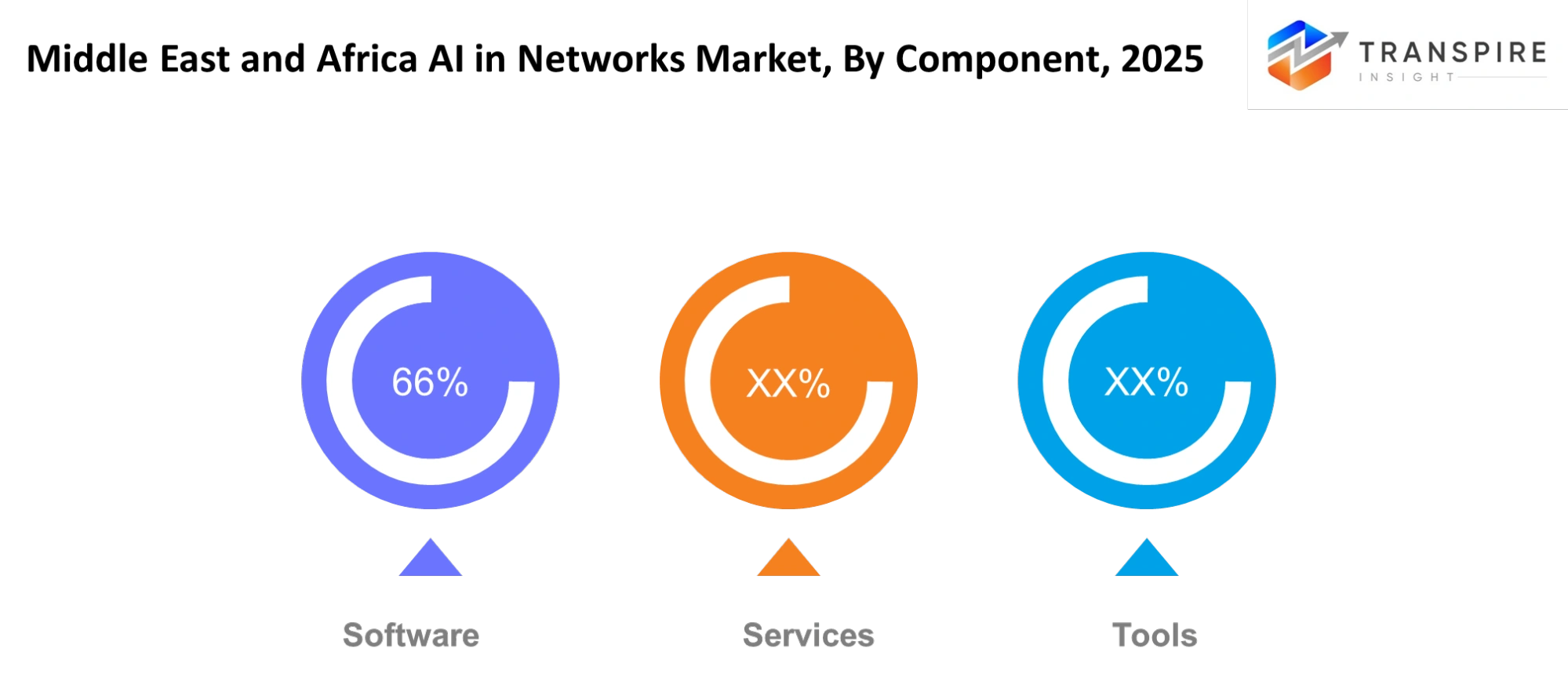
To learn more about this report, Download Free Sample Report
By Application
The process of optimization will enhance network performance through its ability to monitor user behavior and allocate network resources as needed. Security applications will detect threats early through continuous monitoring and intelligent risk assessment. Traffic management will ensure smooth data flow by predicting congestion and rerouting resources efficiently. The AI in Networks Market within the Middle East and Africa region requires these applications to provide continuous reliable network connections.
Automation will reduce manual workload by enabling systems to self-correct and respond without delay. The organization will achieve operational efficiency through optimization tools while security solutions will safeguard against emerging cyber threats. The traffic solutions will handle the increased data requirements generated by digital services and interconnected devices. The Middle East and Africa AI in Networks Market will experience positive growth through the joint effects of these applications which will develop networks that are more intelligent and adaptive.
By End-User
Telecommunications companies will become the main users who utilize artificial intelligence technology for their network operations and service delivery optimization needs. Businesses will spend money on intelligent systems which will help them create safe and effective internal communication networks. Cloud service providers will implement artificial intelligence technology to improve their data center operations while handling growing customer demands.
The AI in Networks Market within the Middle East and Africa region will achieve growth through active involvement from these main customer groups. The ISPs will concentrate on optimizing the customer experience through minimizing outages and increasing connectivity stability. The business organizations will need solutions that are tailored to their needs and digital transformation goals. Telecom operators will continue their network expansion efforts by implementing artificial intelligence technology to enhance their operational capabilities. The AI in Networks Market within the Middle East and Africa region will experience increased growth because network technologies will better meet user requirements.
What are the Main Challenges for the Middle East and Africa AI in Networks Market Growth?
The Middle East and Africa artificial intelligence solutions for network operations face multiple technical and operational obstacles which impede their full implementation. The process of implementing artificial intelligence into current network systems will continue to be difficult because of outdated technology and poorly maintained data systems. The system will lose its ability to function properly because of performance constraints which create delays during real-time operation and decrease model precision. The operational difficulties which exist in the middle east and africa ai in networks market require organizations to perform system updates together with thorough system assessments for maintaining operational stability.
The Middle East and Africa artificial intelligence solutions for network operations market will face additional expansion obstacles because of manufacturing and commercialization restrictions. The combination of high development expenses and the need to meet regional data protection requirements will create obstacles for widespread implementation. Vendors will need to provide affordable products which include sophisticated features because of market pressure. The stringent regulatory requirements and insufficient financial resources in certain regions will extend the time needed for products to reach the market.
The middle east and africa ai in networks market will face its primary challenge through adoption difficulties which will persist throughout emerging economies. The implementation of projects will face obstacles because organizations lack digital infrastructure and trained AI experts and face difficulties in securing funds. Organizations will face difficulties in establishing their initial financial commitment because they cannot predict which results will emerge during the first stages of the project. The growth obstacles will result in different countries and various industries adopting technologies at different rates.
Developing networks through alternative technologies and changing cybersecurity threats will create additional unpredictable factors. The competition between global and regional companies will drive pricing battles which will reduce profit margins while companies must innovate to keep pace with fast technological advancements. The middle east and africa ai in networks market will need to address these risks to maintain long-term sustainability and competitiveness.
Regional Insights
The Gulf economies will drive technology adoption because of their extensive telecom investments and their quick implementation of cutting-edge network systems. The Kingdom of Saudi Arabia and the United Arab Emirates will develop smart infrastructure projects together with digital connectivity initiatives, which their governments will finance through dedicated programs.
Market demand will increase as industrial sectors consume more data and their digital systems expand to more enterprise locations.
South Africa will achieve steady development as businesses require more secure and efficient network solutions. The market will experience gradual growth through digital transformation initiatives and the increasing adoption of cloud-based services. Although connectivity gaps will persist, cities and towns will benefit from improved network access which enables deployment of smart network solutions.
The Middle East and Africa regions will witness unequal economic growth due to varied degrees of economic development and advancements in technology by various nations. The regions will adopt technology at a much slower pace due to lack of adequate financing and skilled manpower. The combination of infrastructure development and government support will motivate businesses to use advanced networking systems.
Recent Development News
In March 2026, Huawei Technologies launched enhanced AI-centric network solutions at MWC 2026, introducing intelligent infrastructure designed to support 5G-Advanced and future 6G ecosystems.https://www.huawei.com/
In April 2026, Cisco Systems published its 2026 State of Wireless Report and expanded its AI infrastructure collaboration with Nvidia, highlighting AI-driven enterprise network automation and efficiency gains.https://network-switch.com/
|
Report Metrics |
Details |
|
Market size value in 2025 |
USD 754.9 Million |
|
Market size value in 2026 |
USD 1013.1 Million |
|
Revenue forecast in 2033 |
USD 8025.6 Million |
|
Growth rate |
CAGR of 34.40% from 2026 to 2033 |
|
Base year |
2025 |
|
Historical data |
2021 - 2024 |
|
Forecast period |
2026 - 2033 |
|
Report coverage |
Revenue forecast, competitive landscape, growth factors, and trends |
|
Regional scope |
Middle East and Africa (Saudi Arabia, United Arab Emirates, South Africa, Rest of Middle East and Africa) |
|
Key company profiled |
Cisco, IBM, Microsoft, Google, Nokia, Ericsson, Huawei, Juniper, VMware, Netcracker, HPE, Accenture, Infosys, TCS, Wipro |
|
Customization scope |
Free report customization (country, regional & segment scope). Avail customized purchase options to meet your exact research needs. |
|
Report Segmentation |
By Component (Software, Services, Platforms), By Application (Optimization, Security, Traffic, Automation), By End-User (Telecom, Enterprises, Cloud Providers, ISPs) |
How Can New Companies Establish a Strong Foothold in the Middle East and Africa AI in Networks Market?
New companies aiming to enter the middle east and africa ai in networks market will need a focused and strategic approach rather than broad competition with established players. Targeting niche segments such as smart city infrastructure, healthcare networks, or industrial IoT will allow new entrants to address specific pain points like latency, security gaps, and real-time data processing. The middle east and Africa ai in networks market will reward companies that design solutions tailored to local challenges, including uneven connectivity and regulatory diversity across regions.
Technology differentiation will play a central role in building early credibility. Startups that develop lightweight AI models for low-bandwidth environments or offer edge-based predictive analytics will gain faster acceptance. Innovation strategies that combine machine learning with automation will improve network efficiency and reduce operational costs for end users. In the middle east and Africa ai in networks market, demand for scalable and cost-effective solutions will continue to shape product development decisions.
Strategic partnerships will further strengthen market entry by providing access to infrastructure and customer networks. Collaborations with telecom operators, cloud providers, and government-backed digital programs will accelerate deployment and trust. Emerging players such as South Africa-based Rain Networks and UAE-based G42 have demonstrated how localized innovation and partnerships can create strong positioning. These examples highlight how aligning with regional industry trends and focusing on practical use cases will help new companies establish a lasting presence.
Key Middle East and Africa AI in Networks Market Company Insights
Global technology companies will continue to operate within their markets because they provide innovative solutions together with their extensive infrastructure capabilities. Firms like Cisco Systems and Huawei Technologies will concentrate on automation via artificial intelligence and traffic management systems. The firm will strengthen its position in the market by constantly investing in research and developing partnerships regionally.
Regional players will expand influence by offering cost-effective and locally adapted solutions that align with specific network demands. The company will use telecom operator and enterprise client partnerships to achieve faster service delivery and better customer relationships. The company will use flexible pricing models together with service customization to develop competitive strategies that meet the different infrastructure needs of different regions.
The company will use innovation as its main competitive advantage to deliver advanced machine learning capabilities and edge-based processing tools. Product development will focus on improving efficiency, security, and scalability of network systems. Organizations will need to implement ongoing system upgrades because market demands for data and connectivity continue to grow.
Company List
- Cisco
- IBM
- Microsoft
- Nokia
- Ericsson
- Huawei
- Juniper
- VMware
- Netcracker
- HPE
- Accenture
- Infosys
- TCS
- Wipro
What are the Key Use-Cases Driving the Growth of the Middle East and Africa AI in Networks Market?
The Middle East and Africa AI in networks market is growing because telecom operators use artificial intelligence for their network optimization and predictive maintenance needs. Intelligent systems will analyze traffic patterns and detect faults at an early stage which will decrease system downtime to enhance service reliability. Operators need to adopt this use-case because they want to manage increasing data demands that 5G technology and connected devices bring.
Artificial intelligence applications in network operations within the middle east and africa ai in networks market enable businesses to implement more advanced security systems and automation processes. AI-powered threat detection will identify unusual activity in real time, helping sectors such as banking and healthcare protect sensitive data. Automation tools will enable organizations to run their network systems without human assistance which will result in better productivity for their workforce.
Gulf region smart city projects are driving growth within the Middle East and Africa AI in networks market. AI-based traffic management systems and surveillance technologies and smart infrastructure will need advanced network intelligence to operate. The deployments will create a need for networking solutions that can scale up and down while handling large data traffic and supporting instantaneous decision-making.
Both the manufacturing and logistics industries are implementing AI-powered networks for their industrial IoT systems and supply chain monitoring needs. Predictive analytics will improve operational efficiency by optimizing production lines and enhancing interdepartmental cooperation. The practical use cases will boost market adoption because they demonstrate both immediate operational efficiency improvements and enduring operational effectiveness.
Middle East and Africa AI in Networks Market Report Segmentation
By Component
- Software
- Services
- Platforms
By Application
- Optimization
- Security
- Traffic
- Automation
By End-User
- Telecom
- Enterprises
- Cloud Providers
- ISPs
Frequently Asked Questions
Find quick answers to common questions.
The Approximate Middle East and Africa AI in Networks Market size for the Market will be USD 8025.6 Million in 2033.
Key Segments for the Middle East and Africa AI in Networks Market are By Component (Software, Services, Platforms), By Application (Optimization, Security, Traffic, Automation), By End-User (Telecom, Enterprises, Cloud Providers, ISPs).
Major Middle East and Africa AI in Networks Market Players are Cisco, IBM, Microsoft, Google, Nokia, Ericsson, Huawei, Juniper, VMware, Netcracker, HPE, Accenture, Infosys, TCS, Wipro.
The Current Middle East and Africa AI in Networks Market size is USD 754.9 Million in 2025.
The Middle East and Africa AI in Networks Market CAGR is 34.40%.
- Cisco
- IBM
- Microsoft
- Nokia
- Ericsson
- Huawei
- Juniper
- VMware
- Netcracker
- HPE
- Accenture
- Infosys
- TCS
- Wipro
Recently Published Reports
-
Dec 2024
3D Optical Profiler Market
3D Optical Profiler Market Size, Share & Analysis Report By Type (Desktop 3D Optical Profiler, and Portable 3D Optical Profiler), By Technology (Confocal Technology, and White Light Interference), By End-Use Industry (Manufacturing, Research Institutions, Automotive, Aerospace and Defense, Medical Devices, and Other), and Geography (North America, Europe, Asia-Pacific, Middle East and Africa, South and Central America), 2021 - 2031
-
Feb 2025
Depth Sensor Market
Depth Sensor Market Size, Share & Analysis Report By Type (Infrared Depth Sensors, Time-of-Flight (ToF) Sensors, Stereo Vision Sensors, Structured Light Sensors, Ultrasonic Depth Sensors), By Application (Automotive, Robotics, Gaming, Consumer Electronics, Industrial Automation, Healthcare, Security & Surveillance, Others), By End Users (Automotive Manufacturers, Consumer Electronics Companies, Healthcare Providers, Industrial Companies, Security Agencies, Gaming Companies, Robotics Companies, Others), and Geography (North America, Europe, Asia-Pacific, Middle East and Africa, South and Central America), 2021 – 2031
-
Feb 2025
Digital Manufacturing Market
Digital Manufacturing Market Size, Share & Analysis Report By Component (Hardware, Software, and Services), By Technology (Robotics, 3D Printing, Internet of Things (IoT), and Others), By Application (Automotive and Transportation, Aerospace and Defense, Consumer Electronics, Industrial Machinery, and Others), By Process Type (Computer-Based Designing, Computer-Based Simulation, Computer 3D Visualization, Analytics, and Others), and Geography (North America, Europe, Asia-Pacific, Middle East and Africa, South and Central America), 2021 – 2031
-
Feb 2025
Digital Visa Services Market
Digital Visa Services Market Size, Share & Analysis Report By Type (Individual Travelers, Group Travelers), By Application (Tourism, Business Travel, Others), and Geography (North America, Europe, Asia-Pacific, Middle East and Africa, South and Central America), 2021 – 2031