
Middle East and Africa Aggregate Base Course Market Size & Forecast:
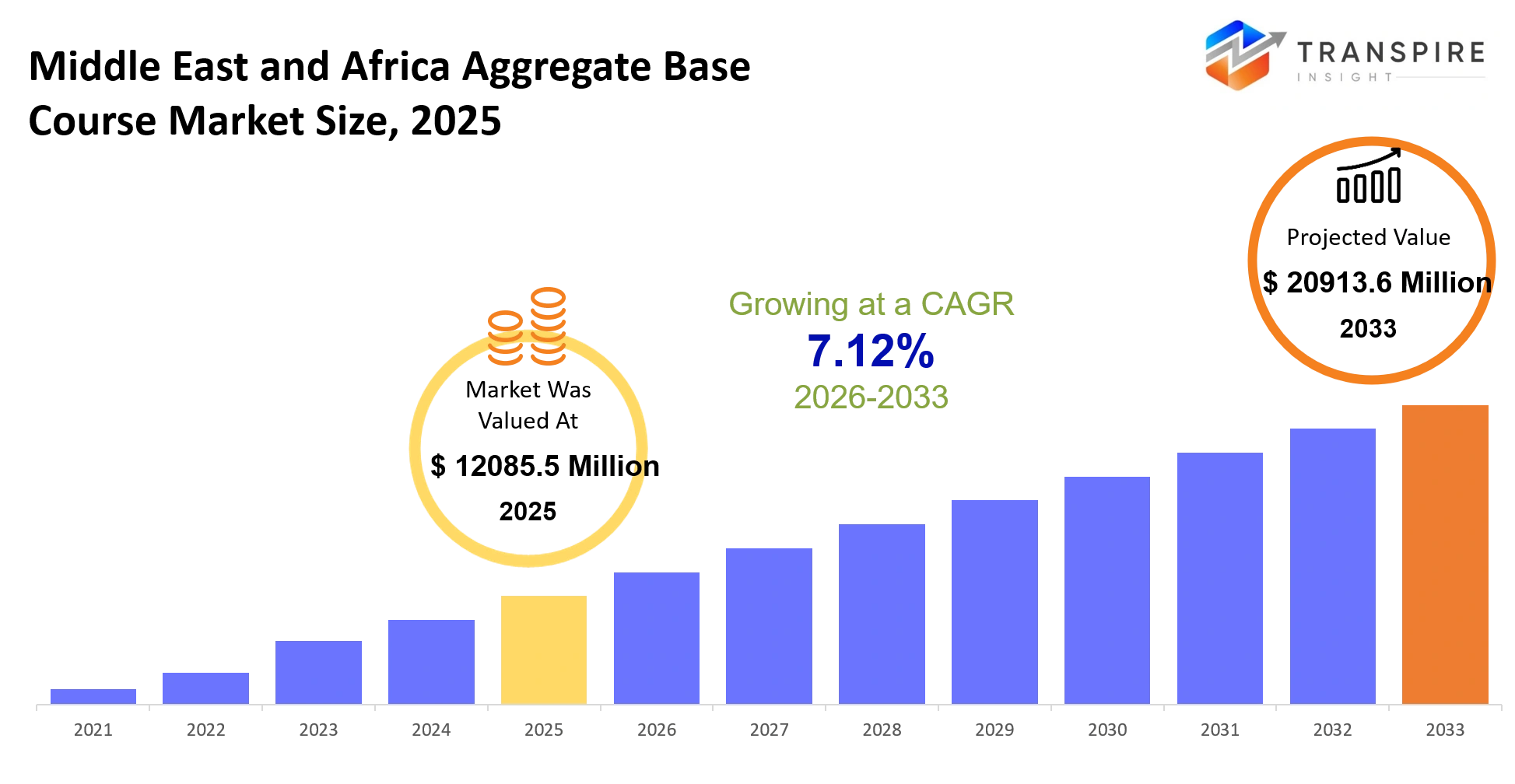
- Middle East and Africa Aggregate Base Course Market Size 2025: USD 12085.5 Million
- Middle East and Africa Aggregate Base Course Market Size 2033: USD 20913.6 Million
- Middle East and Africa Aggregate Base Course Market CAGR: 7.12%
- Middle East and Africa Aggregate Base Course Market Segments: By Material Type (Crushed Stone, Gravel, Recycled Aggregates, Sand & Gravel Mix, Others); By Application (Road Construction, Highways, Airports, Railways, Others); By End User (Infrastructure Developers, Contractors, Government Projects, Others); By Grade (Standard, Premium, Others)
To learn more about this report,  Download Free Sample Report
Middle East and Africa Aggregate Base Course Market Summary
The Middle East and Africa Aggregate Base Course Market was valued at USD 12085.5 Million in 2025. It is forecast to reach USD 20913.6 Million by 2033. That is a CAGR of 7.12% over the period.
Aggregate base course materials basically form this structural kind of foundation under roads, highways, airport runways and rail corridors, in a way that helps with load distribution, drainage support, and keeping the surface stable for a long time. In the Middle East and Africa these materials matter a lot for big infrastructure programs, because durable transportation networks are needed for economic diversification, city growth, and trade connectivity. Over the last five years, the market has been bending a bit toward recycled aggregates and performance graded base materials, since governments are trying to grow infrastructure but also stay more resource efficient. One of the biggest drivers, or maybe you could say triggers, that affects how the market behaves is the speed-up in national infrastructure investment plans across the Gulf countries and across Africa’s transport corridor modernization efforts. This happened after supply chain disruptions made people notice how crucial domestic logistics networks really are. That whole wave of investment has pulled up demand for road building materials, pushed quarry output higher, and made it easier for private-sector involvement. Now as transportation and industrial projects move from the planning stage into execution, aggregate base course usage keeps turning into bigger material volumes, project revenues and broader market growth.
Key Market Insights
- The Middle East and Africa Aggregate Base Course Market is riding the wave of infrastructure spending that keeps climbing past USD 500 billion across Gulf and African transport projects.
- In 2025, GCC countries probably made up about 42% of the regional market revenue, largely because of big scale highway upgrades and smart city deployments, which is also why it keeps looking steady.
- Meanwhile East Africa is showing up as the fastest-growing regional market through 2033, driven by railway modernization, plus cross border logistics corridor investments, and honestly that combo seems hard to slow down.
- When it comes to materials, Crushed Stone took the lead with nearly 48% market share in 2025, mainly due to stronger load-bearing traits for road construction schemes.
- Gravel stayed in the #2 position as well, helped by more affordable sourcing and its wide adoption across regional infrastructure builds.
- Recycled Aggregates, however, are expected to post the quickest growth pace through 2033, because sustainability targets keep reshaping procurement rules and who buys what.
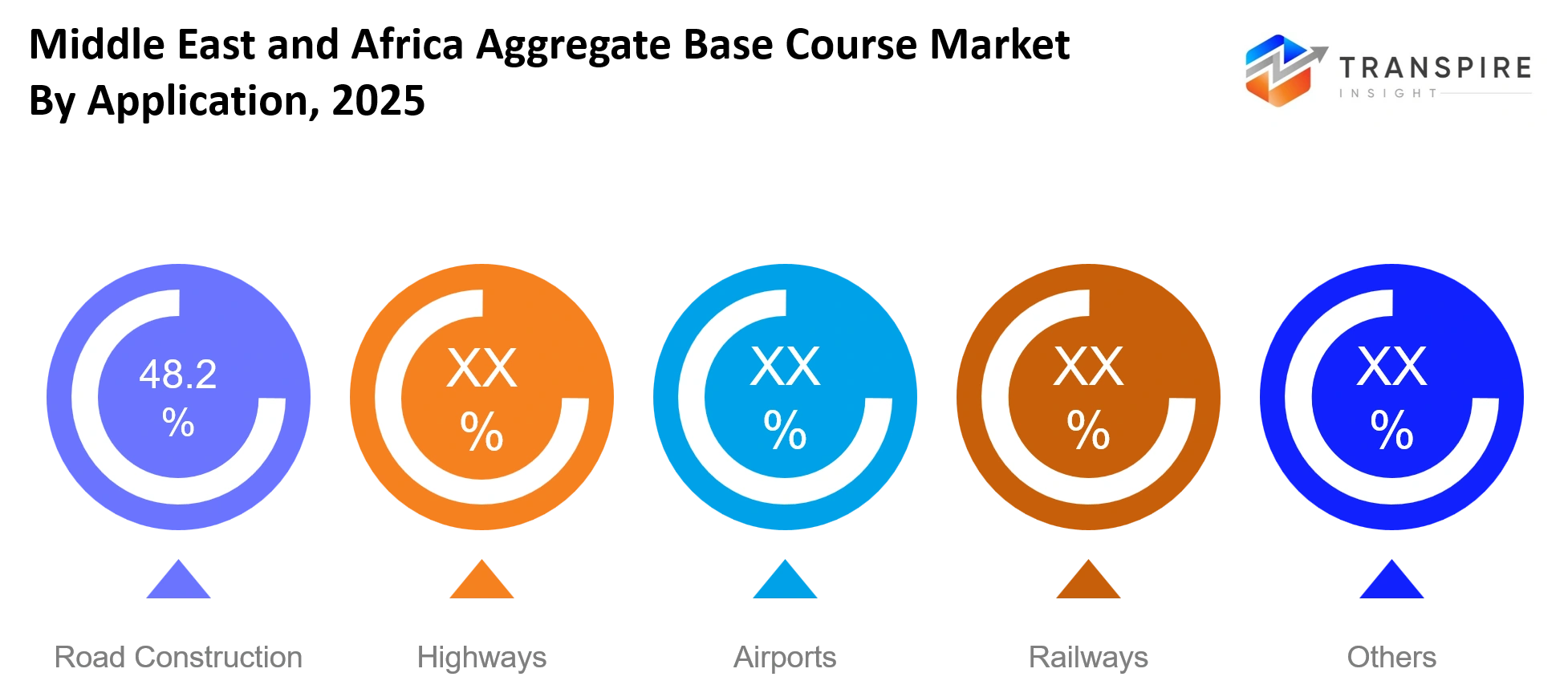
- On the application side, Road Construction was over 45% of total demand in 2025, so yeah it became the biggest application segment across the region.
- At the same time airport infrastructure projects in Saudi Arabia, UAE, Egypt and South Africa are beginning to pull in new needs for premium-grade base materials.
- Infrastructure Developers also accounted for around 39% of end user consumption in 2025, mainly from their involvement in mega transport initiatives and urban projects.
- Big players including Vulcan Materials, Heidelberg Materials, Holcim, CRH, and Cemex are pushing forward with strategic expansion, using material innovation, quarry optimization, and regional alliances, to stay in front while demand spreads out.
What are the Key Drivers, Restraints, and Opportunities in the Middle East and Africa Aggregate Base Course Market?
The strongest growth catalyst seems to come from government-backed infrastructure investment initiatives that focus on transportation linkages and economic diversification. Big road networks, industrial areas, logistics hubs and even airport expansions all need sizable volumes of aggregate base materials for the builds. National development plans in Saudi Arabia, the UAE, Egypt, and a number of African economies have effectively sped up procurement activity and then, somehow, locked in longer-term project pipelines. This ongoing build-out tends to turn straight into more aggregate intake, bigger contract sizes, and stronger revenue generation throughout the whole supply chain.
Still the biggest obstacle is the uneven availability of good-quality aggregate resources, plus the fact that transportation infrastructure isn’t consistent across a lot of Africa. Aggregate materials are bulky and their value per ton is relatively modest. So transport cost becomes a major part of the final pricing math. Rail connections are limited, quarry development is not enough in several places, and logistical bottlenecks don’t get fixed fast because they demand heavy capital and multiple regulatory approvals. Those structural limits push project timelines out, and they also dampen market potential in regions that are underserved.
Looking ahead, one major opportunity sits in recycled aggregate production and circular building practices. More governments and contractors are searching for substitutes for virgin materials as quarry permitting gets harder and sustainability requirements become more prominent. At the same time, investments in construction and demolition waste processing facilities are creating a fresh supply source that can be used for base course applications.
What Has the Impact of Artificial Intelligence Been on the Middle East and Africa Aggregate Base Course Market?
Artificial intelligence is kind of slowly transforming aggregate production, quarry operations, and even infrastructure project management across the Middle East and Africa, in a real practical way. More and more quarry operators are rolling out AI-enabled monitoring systems, to make blasting schedules work better, to tune crushing performance, and to manage the material grading process… like, more precisely. On top of that, automated quality control platforms can check aggregate size distribution in real time, so producers keep specification compliance steadier while also cutting down on material waste.
Then there’s the machine learning side, which is basically backing predictive maintenance programs for crushers, conveyors, loaders, and screening equipment. The idea is to spot weird or abnormal equipment behavior before breakdowns actually happen. That reduces unplanned downtime, and it boosts how much the asset is actually used. Digital twin technologies, along with AI-driven construction planning tools, are also giving infrastructure developers a stronger way to forecast material requirements, more accurately, which can reduce procurement delays, and sometimes even trim inventory costs.
The operational upsides usually look like improved production efficiency, lower maintenance spending, better quarry asset utilization, and more consistent material quality. Even logistics planning gets a boost, since AI-supported route selection helps contractors move aggregate more reliably, while reducing fuel consumption, and improving timing.
Still though, adoption isn’t really everywhere yet. It gets limited by things like high setup costs, fragmented digital infrastructure, and shortages of operational data from many quarry sites. Smaller producers often do not have the connectivity or technical know-how needed to fully integrate advanced AI platforms into the way they already run operations.
Key Market Trends
- Since 2021, recycled aggregate adoption has been going up, by over 20% in several GCC infrastructure projects or so it seems.
- Quarry operators are more often using digital monitoring systems to boost production efficiency and also limit that equipment downtime, which nobody wants.
- Meanwhile investments in transport corridors across East Africa sped up aggregate consumption for road and rail building work.
- Infrastructure developers started leaning into long term supply contracts after disruptions, they saw in 2021–2023.
- Premium grade aggregate demand grew together with airport modernization programs in Saudi Arabia, Egypt and the UAE.
- Heidelberg Materials and Holcim have been putting more emphasis on circular building solutions between 2024 and 2026.
- Public private partnerships picked up steam as well, adding to bigger multi year infrastructure project pipelines across the region.
- Contractors are now judging suppliers more on logistics reliability, instead of just material cost alone.
- Sustainable procurement frameworks rolling out in multiple markets also encouraged wider use of recycled construction materials.
- Advanced crushing and screening technologies improved output consistency by roughly 10–15%, at modern quarry operations in practice.
Middle East and Africa Aggregate Base Course Market Segmentation
By Material Type
Crushed Stone kind of holds a big place because it brings strong load bearing capability, plus it tends to stay durable for a long time in transport infrastructure work. In highway developments, industrial corridors and airport construction activities, crushed stone is very often named as a preferred foundation material . The particle size that stays consistent and the structural strength are what help it get used across a lot of demanding situations, you know, where the requirements are not “simple”.
Gravel is still used a lot too, mostly where cost efficiency and local availability end up deciding what gets procured. A Sand & Gravel Mix supports drainage performance and helps with stabilization needs in several types of construction environments. Recycled Aggregates keep getting more acceptance as construction firms look for resource efficient alternatives and try to line up with sustainability goals. Other material categories exist as well, they cover specialized engineering requirements where project specifications end up differing from the standard infrastructure needs, sometimes a lot.
By Application
Road Construction honestly creates the biggest volume consumption because there’s continuous investment in urban connectivity and regional transportation networks . The aggregate base materials are used as sort of stable foundations, so pavement performance gets better and the service life is extended. On top of that, municipal expansion projects plus industrial developments, also tend to push material demand higher.
Highways need high-performance aggregate layers, that can carry heavy traffic loads for long stretches of time . Airports lean on premium-grade materials so runway stability and safety standards stay on track. Railways make use of aggregate foundations for track support, drainage, and even vibration control. Other uses pop up too, like industrial yards, logistics hubs, ports, and utility infrastructure developments where ground stabilization is still essential or at least very important in practice.
To learn more about this report, Download Free Sample Report
By End User
Infrastructure Developers kind of drive big material procurement amounts, mainly because they’re tied in with transport networks, industrial parks, and that broader urban development momentum. With long-range project roadmaps in place, buyers end up leaning into big sourcing arrangements and supplier relationships, more or less continuously. Still, when it comes time to purchase, material grade and the dependability of arrival dates or delivery timing stays as the main focus.
Contractors are another big customer set, since they’re directly on the hook for building the project, and for hitting construction schedules. Government Projects also keep things steady through national infrastructure initiatives and public spending. Beyond that, other end users show up too, like industrial operators, private developers, and engineering firms doing site preparation, logistics spaces, and those specialized construction jobs that require extra coordination.
By Grade
Standard grade materials keep a pretty broad market grip, because they meet the usual performance needs for most roadworks and infrastructure tasks. Their cost efficiency, plus the easy availability, helps them stay in use across both public building plans and private developments too. A lot of municipal and regional construction activity leans on standard grade specs, like it’s the default choice.
Premium grade materials are for setups that need more, like higher strength, better resilience, and stronger engineering performance overall. Airport runways, major highways, and strategic transport corridors often go for the premium label. Then, the other grades exist for niche project needs, where site conditions, environmental factors, or the actual loading demands shift away from conventional construction expectations.
What are the Key Use Cases Driving the Middle East and Africa Aggregate Base Course Market?
Road infrastructure still feels like the main use case, and it pretty much pulls the largest consumption volumes across the whole region. Aggregate base materials end up being structural backbone under the pavement layers, they help roads handle traffic loads, those temperature swings,and the slow wear over time. The national transportation programs, along with ongoing urban expansion projects, keep reinforcing this, in a pretty steady way.
Alongside that, other use cases are starting to show up more clearly, especially with railway modernization and airport development. On the rail side, operators rely on aggregate foundations to push track stability and drainage behavior in the right direction, while airport authorities look for high-strength base layers that can actually take aircraft operations without issues. Because of this, infrastructure developers and contractors are more and more specifying engineered materials for those exact applications.
Looking ahead, there are future opportunities forming around logistics parks,industrial corridors,and smart city developments. Big economic zones need serious site preparation and also internal transportation networks, so the demand pattern stays there. At the same time recycled aggregate applications are showing strong potential too,as circular construction practices keep spreading and being accepted within regional infrastructure programs.
|
Report Metrics |
Details |
|
Market size value in 2025 |
USD 12085.5 Million |
|
Market size value in 2026 |
USD 12920.1 Million |
|
Revenue forecast in 2033 |
USD 20913.6 Million |
|
Growth rate |
CAGR of 7.12% from 2026 to 2033 |
|
Base year |
2025 |
|
Historical data |
2021 - 2024 |
|
Forecast period |
2026 - 2033 |
|
Report coverage |
Revenue forecast, competitive landscape, growth factors, and trends |
|
Regional scope |
Middle East and Africa (Saudi Arabia, United Arab Emirates, South Africa, Rest of Middle East and Africa) |
|
Key company profiled |
Vulcan Materials, Martin Marietta, Heidelberg Materials, Holcim, CRH, Cemex, Eurovia, Granite Construction, Rogers Group, Hanson, Breedon Group, Luck Stone, Lehigh Hanson, Lafarge, Adelaide Brighton |
|
Customization scope |
Free report customization (country, regional & segment scope). Avail customized purchase options to meet your exact research needs. |
|
Report Segmentation |
By Material Type (Crushed Stone, Gravel, Recycled Aggregates, Sand & Gravel Mix, Others); By Application (Road Construction, Highways, Airports, Railways, Others); By End User (Infrastructure Developers, Contractors, Government Projects, Others); By Grade (Standard, Premium, Others) |
Which Regions are Driving the Middle East and Africa Aggregate Base Course Market Growth?
The Gulf Cooperation Council region is basically leading the market, thanks to heavy infrastructure spend, bigger transportation undertakings, and long-run economic diversification efforts. Saudi Arabia and the United Arab Emirates, especially, are still pushing forward—expanding highways, logistics hubs, airports and also urban developments. There’s strong funding availability, and what seems like a mature construction ecosystem, helps keep aggregate consumption moving in a steady way. Even quarry operations are becoming more capable, with efficient supply chains that really bolster the regional position.
North Africa sits as the second-largest contributor, mostly backed by transport modernization, and those industrial development programs that keep getting repeated in new cycles. Market growth looks a bit different compared with the GCC, mainly because public infrastructure planning, plus population-driven urbanization, take up more space in the material demand equation. Egypt, Morocco, and Algeria continue putting money into roads, ports, and logistics infrastructure. Overall, consistent government spending creates a stable setting for aggregate suppliers, and that matters more than people assume.
Sub-Saharan Africa is expected to bring the strongest growth momentum all the way through 2033. A lot of the push is coming from newer investments in cross-border transport corridors, railway networks, and broader economic development initiatives, which have clearly increased construction activity. At the same time, international financing backing and regional trade integration programs are opening up fresh project opportunities. This path forward ends up being quite appealing for producers, investors, and quarry operators who want long-term expansion without constantly chasing the next short term wave.
Who are the Key Players in the Middle East and Africa Aggregate Base Course Market and How Do They Compete?
Competition is still kind of moderately fragmented, you know, with multinational building materials firms showing up right next to regional quarry operators and those construction material suppliers. In practice, the main battle comes down to cost efficiency, production scale, logistics capability, and being able to access high quality aggregate reserves. The bigger companies tend to push operational efficiency and more integrated supply chains, while smaller regional players compete via local market reach and project specific relationships.
Heidelberg Materials does a lot of differentiating by keeping integrated aggregate cement and construction materials operations under one umbrella, which gives some real supply chain advantages for big infrastructure projects. They also invest in recycled material technologies and circular construction solutions, so it supports longer term competitiveness. Holcim leans more heavily into sustainability oriented construction materials and resource optimization strategies, letting them join environmentally focused infrastructure programs without feeling out of place.
CRH leans on operational scale plus a broader construction materials know-how to back up major transport and industrial projects. Cemex places emphasis on digital supply chain management and production efficiency initiatives, which helps raise customer service quality and delivery performance, especially over time. Vulcan Materials keeps its position strong through quarry management expertise, operational productivity and consistent material quality. At the same time, strategic investments in processing technologies, sustainability measures, and regional partnerships continue to shape how the competition moves around across the market.
Company List
- Vulcan Materials
- Martin Marietta
- Heidelberg Materials
- Holcim
- CRH
- Cemex
- Eurovia
- Granite Construction
- Rogers Group
- Hanson
- Breedon Group
- Luck Stone
- Lehigh Hanson
- Lafarge
- Adelaide Brighton
Recent Development News
In May 2026, Heidelberg Materials North America signed a binding agreement to acquire a 10% minority stake in AmeriTex Pipe & Products. The investment expands Heidelberg Materials' infrastructure materials portfolio and strengthens its presence in transportation and utility construction markets.https://www.heidelbergmaterials.com/
In March 2026, Holcim completed the acquisition of a majority stake in Cementos Pacasmayo and signed an agreement to acquire building materials operations in Colombia. The transactions expanded Holcim's footprint in high-growth construction markets and supported its regional growth strategy.https://www.holcim.com
In July 2025, CRH announced the acquisition of Eco Material Technologies for approximately USD 2.1 billion. The deal strengthened CRH's position in low-carbon construction materials and expanded access to supplementary cementitious materials across North America.https://www.reuters.com
What Strategic Insights Define the Future of the Middle East and Africa Aggregate Base Course Market?
The market seems to be moving (kind of) toward a bigger, more blended approach between infrastructure building, resource efficiency, and digital quarry operations. Big transportation investments will still be the main growth driver, yet the edge in competition will depend more and more on how steady the supply is, how efficient day to day operations get, and whether firms can tap sustainable material sources. Recycled aggregates look ready to shift from “something only specialists use” into more normal, mainstream procurement, as the rules keep tightening and environmental performance expectations keep getting clearer.
There’s also a quieter risk that doesn’t get as much attention. Long term limitations around quarry permitting, plus access to high-grade aggregate reserves, could end up being the constraint. If materials run short in key locations, then project expenses can jump and supply bottlenecks may show up, even if infrastructure spending stays strong. Meanwhile, advanced recycling plants and construction waste processing technologies offer a real opening, especially across GCC countries and in major urban areas throughout Africa.
What market players should do is basically set priorities around recycling capacity, digital production management, and smarter logistics planning. Getting in early across circular construction ecosystems will probably help margins, and it may also lock in more durable differentiation, since procurement requirements keep evolving for infrastructure projects.
Middle East and Africa Aggregate Base Course Market Report Segmentation
By Material Type
- Crushed Stone
- Gravel
- Recycled Aggregates
- Sand & Gravel Mix
- Others
By Application
- Road Construction
- Highways
- Airports
- Railways
- Others
By End User
- Infrastructure Developers
- Contractors
- Government Projects
- Others
By Grade
- Standard
- Premium
- Others
Frequently Asked Questions
Find quick answers to common questions.
The expected Middle East and Africa Aggregate Base Course Market size for the market will be USD 20913.6 Million in 2033.
Key segments for the Middle East and Africa Aggregate Base Course Market are By Material Type (Crushed Stone, Gravel, Recycled Aggregates, Sand & Gravel Mix, Others); By Application (Road Construction, Highways, Airports, Railways, Others); By End User (Infrastructure Developers, Contractors, Government Projects, Others); By Grade (Standard, Premium, Others)
Major Middle East and Africa Aggregate Base Course Market players are Vulcan Materials, Martin Marietta, Heidelberg Materials, Holcim, CRH, Cemex, Eurovia, Granite Construction, Rogers Group, Hanson, Breedon Group, Luck Stone, Lehigh Hanson, Lafarge, Adelaide Brighton
The Middle East and Africa Aggregate Base Course Market size is USD 12085.5 Million in 2025.
The Middle East and Africa Aggregate Base Course Market CAGR is 7.12% from 2026 to 2033.
- Vulcan Materials
- Martin Marietta
- Heidelberg Materials
- Holcim
- CRH
- Cemex
- Eurovia
- Granite Construction
- Rogers Group
- Hanson
- Breedon Group
- Luck Stone
- Lehigh Hanson
- Lafarge
- Adelaide Brighton
About the Authors

Kartik bhong
I am Kartik Bhong, a Senior Research Analyst at Transpire Insight, specializing in the Packaging, Manufacturing, and Construction industry. My work focuses on analyzing market trends, emerging technologies, industry regulations, and competitive landscapes to deliver accurate, data-driven insights. I am passionate about transforming complex industry information into clear, practical content that helps businesses, professionals, and decision-makers stay informed and make confident strategic decisions. Through continuous research and a strong commitment to accuracy, I strive to create reliable, well-researched content that reflects the latest developments across these dynamic industries and supports the vision of Transpire Insight in delivering valuable market intelligence.

Chakradhar Khansole
Chakradhar serves as the Research Director at Transpire Insight, bringing over 8 years of experience in technology, innovation, and strategic market intelligence. He specializes in transforming complex market data into actionable business insights that enable organizations to make informed, growth-oriented decisions. Recognized for his strategic vision and analytical expertise, Chakradhar leads high-impact research initiatives, delivering comprehensive market assessments, competitive intelligence, and forward-looking industry analysis.
Recently Published Reports
-
Apr 2026
Handling and Lifting Equipment Market
Handling and Lifting Equipment Market Size, Share & Analysis Report By Product (Cranes and Hoists, Forklifts, Conveyor Systems, Aerial Work Platforms, Others), By Application (E-Commerce, Automotive and Railway, Food and Beverages, Aviation, Others), and Geography (North America, Europe, Asia-Pacific, Middle East and Africa, South and Central America), 2021 - 2031
-
Apr 2026
HVAC Equipment Market
HVAC Equipment Market Size, Share & Analysis Report By Heating Equipment Type (Boilers and Furnaces, Heat Pumps, and Unitary Heaters), By Ventilation Equipment (Air Handling Units, Humidifiers and Dehumidifiers, Air Filters, and Fan Coiling Units), By Air Conditioning Equipment (Unitary Air Conditioners, Room Air Conditioners, Packaged Terminal Air Conditioners, and Chillers), By End User (Commercial, Residential, Industrial, and others), and Geography (North America, Europe, Asia-Pacific, Middle East and Africa, South and Central America), 2021 – 2031
-
Apr 2026
Refrigeration Valves Market
Refrigeration Valves Market Size, Share & Analysis Report By Type (Solenoid Valves, Expansion Valves, Check Valves, Service Valves, Others), By Application (Commercial Refrigeration, Industrial Refrigeration, Transport Refrigeration, Residential Refrigeration, Air Conditioning Systems), By End User (Food and Beverage Industry, Pharmaceutical Industry, HVAC Industry, Chemical Industry, Others), and Geography (North America, Europe, Asia-Pacific, Middle East and Africa, South and Central America), 2021 – 2031
-
Apr 2026
E-Commerce Packaging Materials Market
E-Commerce Packaging Materials Market By Material Type (Corrugated Boxes, Paper & Paperboard, Foam & Cushioning Materials, Plastic Packaging, Flexible Packaging, Protective Packaging, Others), By Product(Primary Packaging, Secondary Packaging, Tertiary Packaging), By Packaging Function (Protective Packaging, Branding & Presentation Packaging, Transit & Logistic Packaging, Sustainable Packaging, Tamper Evidence Packaging), By End-User (Retail & Consumer Goods, Electronic Appliances, Food & Beverages, Healthcare & Pharmaceutical, Fashion & Apparel, Home & Furnishing, Others); By Industry Analysis, Size, Share, Growth, Trends, and Forecasts 2021-2033