
Middle East and Africa Soda Maker Market Size & Forecast:
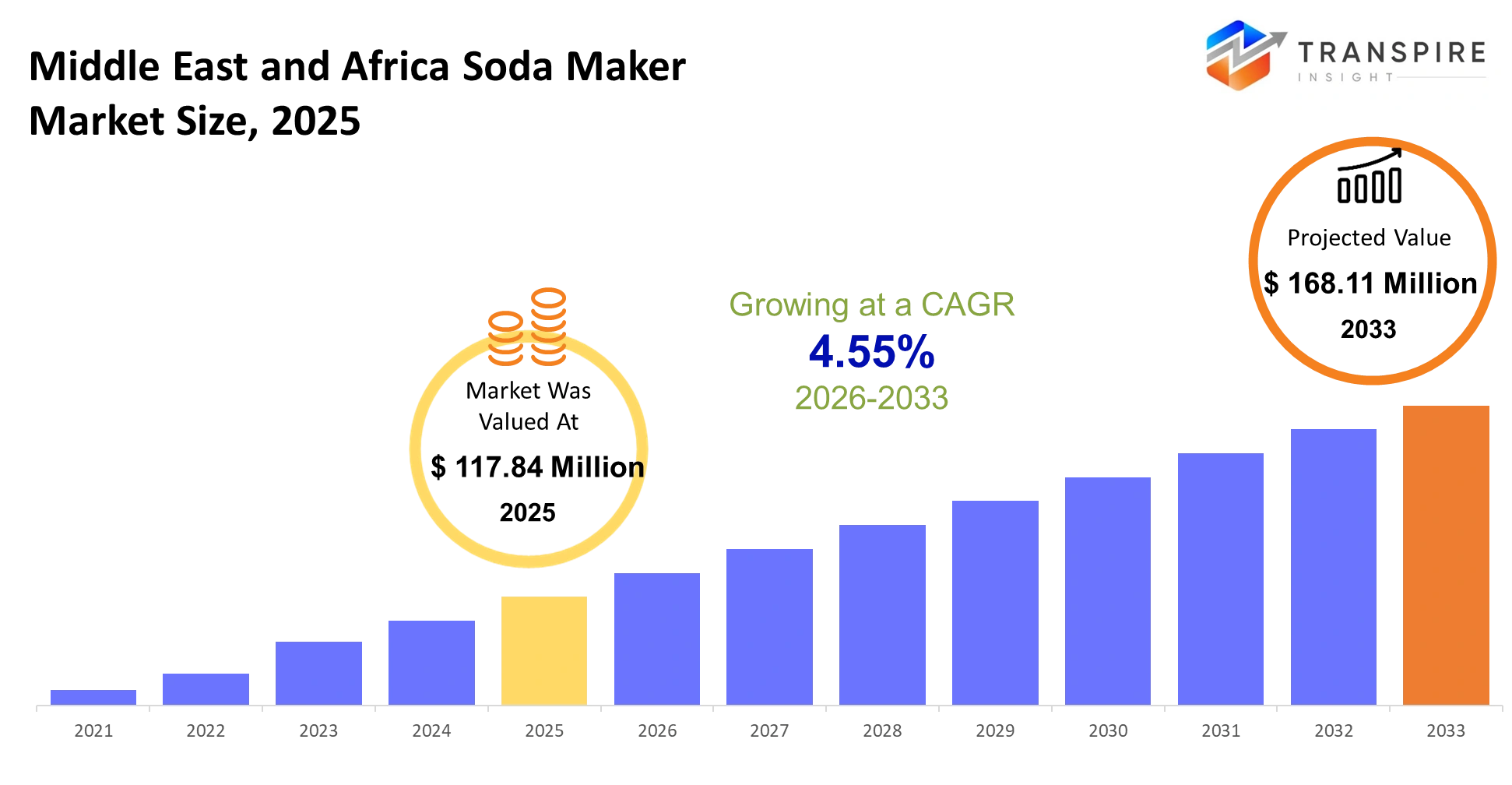
- Middle East and Africa Soda Maker Market Size 2025: USD 117.84 Million
- Middle East and Africa Soda Maker Market Size 2033: USD 168.11 Million
- Middle East and Africa Soda Maker Market CAGR: 4.55%
- Middle East and Africa Soda Maker Market Segments: By Product Type (Electric Soda Makers, Manual Soda Makers, Portable Soda Makers, Others); By Distribution Channel (Online Retail, Specialty Stores, Hypermarkets, Others); By End User (Residential, Commercial, Hospitality, Others); By Bottle Type (Plastic Bottles, Glass Bottles, Stainless Steel Bottles, Others)
To learn more about this report,  Download Free Sample Report
Middle East and Africa Soda Maker Market Summary
The Middle East and Africa Soda Maker Market was valued at USD 117.84 Million in 2025. It is forecast to reach USD 168.11 Million by 2033. That is a CAGR of 4.55% over the period.
The soda maker market kind of serves both everyday consumers and commercial beverage folks, by letting people create carbonation on demand for water and flavored drinks, mostly at home, offices, hospitality spots, and foodservice type locations. In practice, these systems cut down reliance on bottled sparkling beverages, they help with less dependence on shipping and storage hassles, and they give users more real control over how the flavoring is tuned, and even when and how often people drink it. Over the last five years, things moved from a kind of niche kitchen gadget lane to a wider beverage prep segment, pushed by premium lifestyle products, plus reusable bottle ecosystems that just feel more sustainable.
One noticeable structural change is the shift toward premium stainless-steel soda makers, also smart beverage accessories, and refillable CO₂ cylinder networks. After the pandemic, supply chain disruptions, and yes also higher packaging and logistics costs made this trend speed up, so more consumers started looking at home carbonation solutions. When bottled beverage prices went up across parts of the Middle East and in Africa , households and hospitality operators searched for alternatives that were more budget-friendly, basically cost-efficient. This change then widened adoption beyond the early enthusiasts, and now it supports recurring revenue through cylinder exchanges, flavor concentrates, and accessory add-ons. At the same time, it strengthens long-term market penetration, kind of steadily, rather than in a sudden spike.
Key Market Insights
- The Middle East and Africa Soda Maker Market keeps moving away from sort of entry-level plastic machines toward better premium stainless steel carbonation units, now priced roughly 25–40% higher.
- In 2025, Gulf countries are expected to take about 38%–42% of the market, mainly because people have stronger purchasing power and premium kitchen appliances are being adopted faster than before.
- South Africa still seems like the biggest country-level driver, helped by the retail distribution that’s already in place, plus wide beverage appliance penetration.
- Most demand is residential, around 65% of the total, so households stay the main revenue engine.
- On the other hand, commercial hospitality use is projected to grow at more than 6% each year through 2033, and that pace should outstrip residential growth.
- Premium countertop soda makers likely make up close to 45% of industry revenue, supported by higher average selling prices and a general shift in consumer preferences.
- Refillable CO₂ cylinder programs also matter a lot, because they can cut ongoing beverage packaging costs by as much as 50% versus buying packaged sparkling water.
- Smart kitchen integration options have been spreading since 2022, especially among premium brands aimed at affluent urban buyers.
- Online sales channels now represent over 30% of unit sales, which fits the current change in how appliances are purchased.
- Finally, manufacturers are increasingly bundling carbonation devices with reusable bottles and flavor systems, just to strengthen those recurring revenue pathways, even further.
What are the Key Drivers, Restraints, and Opportunities in the Middle East and Africa Soda Maker Market?
The strongest growth driver is kinda the economic edge you get from preparing sparkling beverages right there at the point of consumption, instead of buying packaged stuff. Retail prices for bottled drinks keep climbing, plus transportation costs, and imported consumer goods are getting pricier, and that has boosted the whole value idea behind home carbonation systems. Premium hospitality venues and many households more and more see soda makers as long-term cost-control tools. So the change supports higher unit sales, while also bringing back recurring money streams from CO₂ refills, flavor concentrates and accessories, sort of an ongoing consumption cycle.
The biggest restraint is the limited availability of CO₂ cylinder exchange and refill infrastructure across a lot of African markets. In contrast to mature markets where refill networks are generally easy to access, distribution systems are still fragmented in several places. This is more structural than it sounds, because it means you need investment in logistics retail partnerships, cylinder safety compliance, and after-sales service networks. If refill access is thin, then customer convenience drops and repeat purchases get slower, so revenue expansion is capped even if demand for the appliances stays strong.
A real opportunity shows up in hospitality, premium offices, and foodservice operations. Hotels, resorts, cafés and corporate workplaces are increasingly searching for beverage preparation systems that reduce storage needs and packaging waste. Gulf countries are also putting significant funds into hospitality infrastructure tied to tourism and business development initiatives, and that momentum can spill over into adjacent product categories. If premium carbonation systems are integrated into these environments, they can drive recurring commercial demand, and also open higher-margin sales paths beyond traditional household users, which is usually where people first look.
What Has the Impact of Artificial Intelligence Been on the Middle East and Africa Soda Maker Market?
Artificial intelligence is starting to nudge manufacturing, inventory management, and customer engagement stuff across the soda maker value chain, kinda all at once. Appliance manufacturers, more and more, are leaning on machine learning models for demand pattern forecasting, smarter inventory allocation, and better supply chain responsiveness. In practice these approaches help cut down stock shortages, and also ease warehousing costs over regional distribution routes
On top of that, advanced analytics platforms are getting better at boosting day to day efficiency inside manufacturing sites. AI enabled quality control systems can catch production defects, track assembly consistency, and generally raise product reliability before anything ships out. Predictive maintenance algorithms also matter here, they can spot likely equipment failures ahead of time, which trims unplanned downtime and supports higher production throughput
Meanwhile digital technologies are reshaping the customer experience too, in a more visible way. Connected retail platforms, for instance, look at purchasing behavior and suggest compatible accessories, refill cylinders, or even flavor products. This kind of targeted guidance tends to lift customer retention and opens more recurring revenue chances. Some manufacturers say they have seen real, measurable dips in inventory holding expenses, plus better forecast precision once they moved to AI supported planning systems
Still, adoption stays kinda restricted because of integration expenses, plus fragmented data availability. A lot of regional distributors and retailers run disconnected systems, which makes the predictive models less useful than they could be. And smaller players often don’t have enough historical records, so their forecasts aren’t as sharp, that slows down wider deployment of AI driven operational tools.
Key Market Trends
- Since 2021 the premium stainless steel models kind of increased market visibility and grabbed a more valuable consumer group, overall it looks like.
- By 2025 online appliance sales were above 30% of the category volume in a few major markets, not exactly everywhere but still.
- Hospitality operators, lately, started switching from bottled sparkling water service to on site carbonation systems, just to reduce logistics expenses, yes.
- Refillable CO2 cylinder programs expanded roughly 20% across major urban distribution networks since 2022 too.
- Premium brands then introduced reusable metal bottles which reduced reliance on conventional plastic accessories.
- And the whole product ecosystem seems to have moved away from standalone devices, toward bundled flavors, cylinder sets and reusable bottle offerings, more like a package deal.
- In the Gulf countries premium appliance adoption rates were stronger than in many African markets between 2022 and 2025.
- Manufacturers also increased direct to consumer sales investments after supply chain disruptions that happened after the pandemic period.
- New premium launches from SodaStream and Aarke during 2025 showed a stronger focus on product differentiation.
- Consumers too, gradually preferred durable beverage preparation appliances that allow longer replacement cycles.
Middle East and Africa Soda Maker Market Segmentation
By Product Type
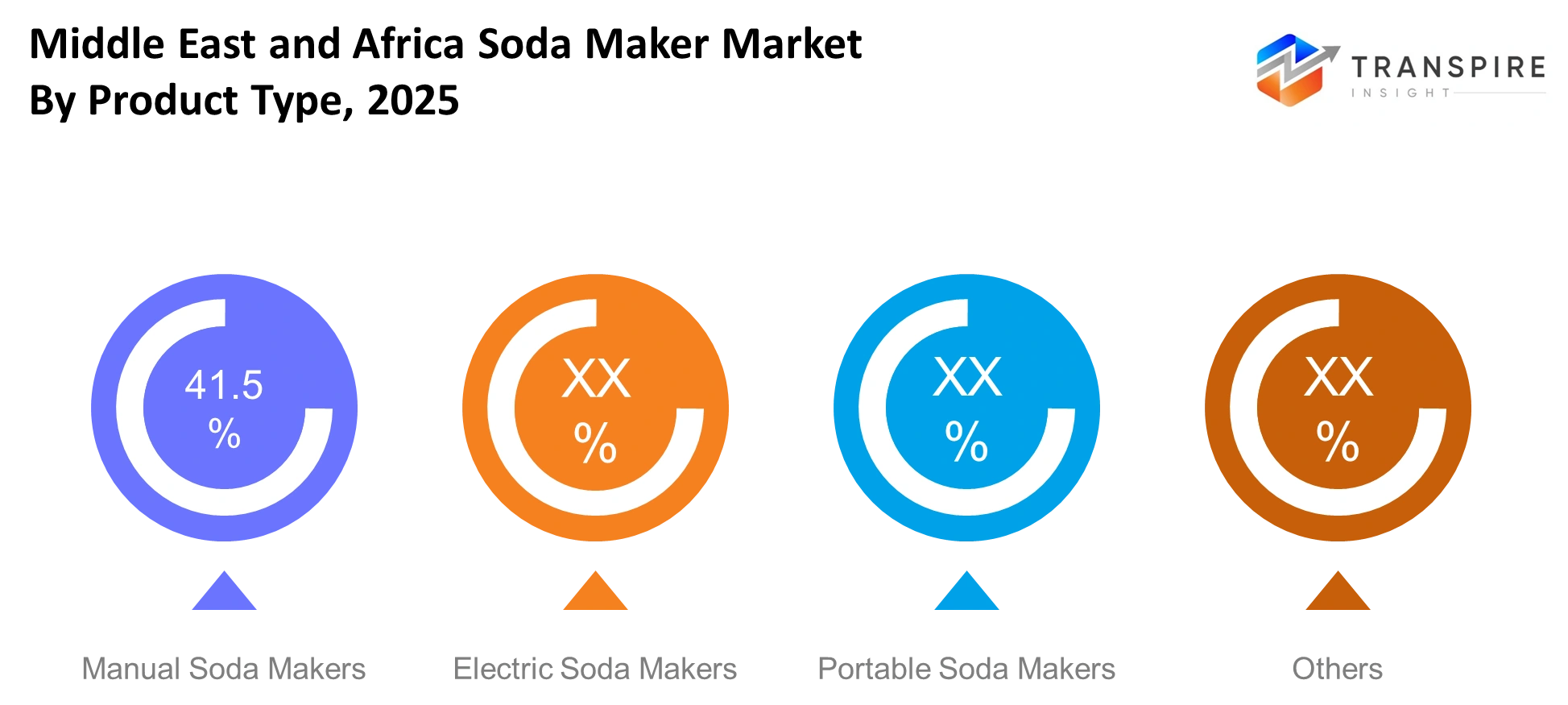
Electric Soda Makers let people get quick carbonation with automated controls, and somehow still keep performance pretty consistent. There’s also growing interest in convenience and time saving kitchen gadgets , so adoption keeps spreading through urban households as well as commercial areas. More advanced ideas like adjustable carbonation strength and modern looks add extra appeal for consumers who want a more premium experience.
Meanwhile Manual Soda Makers are still popular, mostly because they’re easy to use, they cost less , and they don’t rely on electricity. Portable Soda Makers also do well with outdoor users, travelers, and anyone wanting compact solutions that squeeze into smaller spaces. Then there are other types too, like specialty carbonation devices built for particular tastes, and niche beverage preparation needs. With this kind of product variety, manufacturers can aim at different budgets, different day to day usage routines, and different lifestyle needs across the market.
To learn more about this report, Download Free Sample Report
By Distribution Channel
Online Retail keeps expanding, partly because product availability is broad , prices are competitive, and home delivery feels easy and quick. Digital platforms let people sift through specifications, read reviews, and tap into a bigger mix of brands. Also there is strong growth in e-commerce infrastructure, so sales can move smoothly across developed markets and emerging markets too.
Specialty Stores, meanwhile, give hands on product demonstrations and practical expert guidance, which really helps shoppers make better buying decisions. Hypermarkets pull customers in with huge product displays, promotional offers, and a convenient shopping flow. Then you have other players like independent retailers and regional distribution networks that help keep items reachable in places where big retail chains have limited presence.
By End User
Residential demand is still pretty significant, mostly because households want healthier beverage alternatives and also a bit more control over how their drinks are made. Home carbonation systems sort of help cut down on those repeated purchases of packaged soft drinks, and at the same time they let people customize the final taste, carbonation level, and all that. Their compact designs , and the fact they’re easy to use, also keep supporting adoption among families, and yes individual consumers too, even when counter space is limited.
For commercial use, it covers offices , cafés, and food service establishments that serve sparkling beverages for both employees and customers. Hospitality businesses like hotels, resorts, and event venues use soda makers to speed up beverage service efficiency , while at the same time reducing packaging waste. There are also institutions and specialty facilities that really need on-site beverage preparation options, for day to day operations.
By Bottle Type
Plastic Bottles are still widely used, mainly because they stay light in weight , they hold up well, and they’re generally affordable too. They’re easy to manage and carry so the plastic choices tend to fit everyday household routines. Also, ongoing product upgrades have improved safety a bit and they seem to extend the useful life of the bottle itself.
Glass Bottles attract people who want a more premium look, and they also like the neutral taste experience. Stainless Steel Bottles tend to get picked for durability , plus they resist damage well and keep temperatures steady for longer, so they make sense for long term use. There are also other bottle materials that have been developed for particular preferences, sustainability priorities , and compatibility needs with different products.
What are the Key Use Cases Driving the Middle East and Africa Soda Maker Market?
The main use case is sort of household sparkling water preparation. Residential consumers tap carbonation systems to make sparkling water and also flavored drinks, right when they want them, which helps cut down on packaged beverage purchases a bit and supports long-term cost control, in a more steady way
Commercial adoption is growing, and you see it happening in hotels, cafés, restaurants, and also higher tier office setups. Those places use carbonation systems to speed up the beverage service, while at the same time keeping storage needs for bottled drinks low
Newer ideas are showing up too, like wellness centric beverage prep, and even tailored functional drink creation. In particular, premium hospitality spaces and corporate wellness programs are increasingly interested in personalized drink offerings, so this is turning into a new chance for more advanced carbonation solutions over the forecast period
|
Report Metrics |
Details |
|
Market size value in 2025 |
USD 117.84 Million |
|
Market size value in 2026 |
USD 123.13 Million |
|
Revenue forecast in 2033 |
USD 168.11 Million |
|
Growth rate |
CAGR of 4.55% from 2026 to 2033 |
|
Base year |
2025 |
|
Historical data |
2021 - 2024 |
|
Forecast period |
2026 - 2033 |
|
Report coverage |
Revenue forecast, competitive landscape, growth factors, and trends |
|
Regional scope |
Middle East and Africa (Saudi Arabia, United Arab Emirates, South Africa, Rest of Middle East and Africa) |
|
Key company profiled |
SodaStream, Aarke, Drinkmate, Philips, KitchenAid, Breville, Cuisinart, Hamilton Beach, Mysoda, iSi, Ninja, Whirlpool, LG Electronics, Panasonic, Smeg |
|
Customization scope |
Free report customization (country, regional & segment scope). Avail customized purchase options to meet your exact research needs. |
|
Report Segmentation |
By Product Type (Electric Soda Makers, Manual Soda Makers, Portable Soda Makers, Others); By Distribution Channel (Online Retail, Specialty Stores, Hypermarkets, Others); By End User (Residential, Commercial, Hospitality, Others); By Bottle Type (Plastic Bottles, Glass Bottles, Stainless Steel Bottles, Others) |
Which Regions are Driving the Middle East and Africa Soda Maker Market Growth?
The Middle East ends up leading regional revenue generation because of strong consumer purchasing power , a pretty big retail setup, and also quick adoption of premium kitchen appliances , you know. The Gulf Cooperation Council countries back this demand via modern retail networks and a hospitality sector that keeps growing. When households spend more on lifestyle focused goods, market penetration gets boosted even more. There’s also this well established distribution system that makes it easier to reach refillable cylinder programs and all the related accessories.
Africa brings in more steady revenue as urban populations keep expanding and retail access keeps getting better. The growth path is a bit different from the Middle East , mainly because affordability and product availability weigh heavier in the buy decision. South Africa stays a key market due to its well-known appliance distribution channels and because consumers there are more familiar with products for home beverage preparation. Plus, the continual expansion of organized retail keeps things stable in the market.
Sub-Saharan Africa looks like the fastest growing regional opportunity. Urbanization , more people moving into middle income levels , and broader e-commerce adoption have made products easier to spot in multiple markets. New infrastructure investments and retail modernization programs are building decent conditions for appliance sales expansion. Overall, growth in this area offers interesting chances for manufacturers who want fresh customer acquisition sometime between 2026 and 2033.
Who are the Key Players in the Middle East and Africa Soda Maker Market and How Do They Compete?
Competition sits at a moderate level of concentration, around established appliance and carbonation system manufacturers, even so a few premium niche brands are steadily getting more attention. When it comes down to it, product design, ecosystem strength , refill network availability, and pricing strategy are still the main competitive levers. More and more companies are leaning into recurring revenue patterns tied to CO₂ cylinders, accessories, and beverage concentrates, rather than treating hardware sales as the whole story.
SodaStream kind of keeps pushing ecosystem expansion with proprietary flavors, cylinder exchange infrastructure and fairly notable premium product releases. In 2025 they seemed to shore up the lineup via new flavor introductions plus additional premium appliance options, which in turn helps customer engagement and repeat purchases.Aarke differentiates in a cleaner way, premium stainless-steel build plus a design driven positioning. Launches like special edition Carbonator models, along with stainless-steel bottle accessories, keep the brand attractive to shoppers who lean toward higher-end choices.
Drinkmate goes for flexibility, basically enabling carbonation for a wider variety of beverages beyond just water. Philips and Breville meanwhile lean on broad appliance distribution channels, and on brand recognition too, to keep expanding their presence across multiple household appliance categories.
Company List
- SodaStream
- Aarke
- Drinkmate
- Philips
- KitchenAid
- Breville
- Cuisinart
- Hamilton Beach
- Mysoda
- iSi
- Ninja
- Whirlpool
- LG Electronics
- Panasonic
- Smeg
Recent Development News
"In April 2025, Aarke launched a limited-edition Burgundy version of its Carbonator 3 soda maker. The launch strengthened the company's premium product positioning and expanded consumer choice within the home carbonation category.https://prtimes.jp
"In January 2025, SodaStream launched PEPSI Wild Cherry and PEPSI Zero Sugar Wild Cherry drink mixes for its carbonation platform. The launch expanded the company's flavor ecosystem and supported recurring revenue opportunities from consumable products.https://www.prnewswire.com/
"In June 2025, Aarke introduced the stainless-steel To-Go Bottle compatible with Carbonator 3 and Carbonator Pro systems. The product expanded the brand's reusable accessory portfolio and reinforced its focus on premium sustainable beverage solutions.https://www.hfndigital.com
What Strategic Insights Define the Future of the Middle East and Africa Soda Maker Market?
The market is kinda moving toward integrated beverage ecosystems, instead of just selling stand alone appliances. Next year’s growth will likely depend more on recurring income stuff, like refill cylinders, flavor concentrates, subscription programs, and those premium add-ons that people keep buying. In other words, firms that manage to build a strong customer retention loop, will probably beat hardware centered competitors over the next seven years, or so.
There’s also a risk that’s less obvious. The refill infrastructure might end up too concentrated. If access to cylinder exchange networks is limited across several African markets, that could quietly limit customer retention and lower repeat purchases, even if appliance sales are still doing well. Basically without broader service coverage, long term market penetration may slip under what it could have been.
On the flip side, there’s an emerging chance in hospitality, tourism, and upscale workplace beverage services. Hotels, resorts, and commercial sites across Gulf countries are getting invested in fast. That creates the right conditions for commercial grade carbonation solutions. Market players should go after partnerships with hospitality operators and regional distributors, while also expanding the refill infrastructure. A balanced approach, meaning premium hardware plus recurring consumables, along with localized service networks, should give the best competitive edge through 2033.
Middle East and Africa Soda Maker Market Report Segmentation
By Product Type
- Electric Soda Makers
- Manual Soda Makers
- Portable Soda Makers
- Others
By Distribution Channel
- Online Retail
- Specialty Stores
- Hypermarkets
- Others
By End User
- Residential
- Commercial
- Hospitality
- Others
By Bottle Type
- Plastic Bottles
- Glass Bottles
- Stainless Steel Bottles
- Others
Frequently Asked Questions
Find quick answers to common questions.
The expected Middle East and Africa Soda Maker Market size for the market will be USD 168.11 Million in 2033.
Key segments for the Middle East and Africa Soda Maker Market are By Product Type (Electric Soda Makers, Manual Soda Makers, Portable Soda Makers, Others); By Distribution Channel (Online Retail, Specialty Stores, Hypermarkets, Others); By End User (Residential, Commercial, Hospitality, Others); By Bottle Type (Plastic Bottles, Glass Bottles, Stainless Steel Bottles, Others).
Major Middle East and Africa Soda Maker Market players are SodaStream, Aarke, Drinkmate, Philips, KitchenAid, Breville, Cuisinart, Hamilton Beach, Mysoda, iSi, Ninja, Whirlpool, LG Electronics, Panasonic, Smeg.
The Middle East and Africa Soda Maker Market size is USD 117.84 Million in 2025.
The Middle East and Africa Soda Maker Market CAGR is 4.55% from 2026 to 2033.
- SodaStream
- Aarke
- Drinkmate
- Philips
- KitchenAid
- Breville
- Cuisinart
- Hamilton Beach
- Mysoda
- iSi
- Ninja
- Whirlpool
- LG Electronics
- Panasonic
- Smeg
About the Authors

Chetan Dhatrak
I’m Chetan Dhatrak, a Senior Research Analyst at Transpire Insight, specializing in the Consumer Goods, Foods and Beverages industry. I focus on analyzing market trends, consumer behavior, competitive landscapes, and industry developments to deliver accurate, data-driven insights. My research at Transpire Insight is built on credible sources and in-depth analysis, helping businesses and readers better understand market dynamics, emerging opportunities, and evolving consumer preferences. I’m committed to creating reliable, well-researched content that supports informed decision-making and reflects the latest developments in the consumer goods and food & beverage sectors.

Chakradhar Khansole
Chakradhar serves as the Research Director at Transpire Insight, bringing over 8 years of experience in technology, innovation, and strategic market intelligence. He specializes in transforming complex market data into actionable business insights that enable organizations to make informed, growth-oriented decisions. Recognized for his strategic vision and analytical expertise, Chakradhar leads high-impact research initiatives, delivering comprehensive market assessments, competitive intelligence, and forward-looking industry analysis.
Recently Published Reports
-
Apr 2026
Bottled Water Market
Bottled Water Market Size, Share & Analysis Report By Product Type (Still Bottled Water, Carbonated Bottled Water, Functional Bottled Water, and Others), By Packaging (PET, Cans, and Others), By Sales Channel (Supermarkets/Hypermarkets, Convenience Stores/Drug Stores, Grocery Stores/Club Stores, Foodservice, and Others) and Geography (North America, Europe, Asia-Pacific, Middle East and Africa, South and Central America), 2021 - 2032
-
Apr 2026
Color Cosmetic Packaging Market
Color Cosmetic Packaging Market Size, Share & Analysis Report By Application (Mascara Packaging, Liquid Packaging, and Liquid Face), By Type (Tubes & Bottles, Pens & Markers, Compacts & Containers, and Droppers & Pumps), and Geography (North America, Europe, Asia-Pacific, Middle East and Africa, South and Central America), 2021 - 2031
-
Apr 2026
External Microphone For Camera Market
External Microphone For Camera Market Size, Share & Analysis Report By Type (Shotgun Microphone, Lavalier Microphone, and Others), By Application (Digital Camera, Professional Video Camera, and Others), and Geography (North America, Europe, Asia-Pacific, Middle East and Africa, South and Central America), 2021 - 2031
-
Apr 2026
Foot Orthotic Insoles Market
Foot Orthotic Insoles Market Size, Share & Analysis Report By Type (Pre-fabricated, and Custom-made), By Material (Thermoplastic, Composite Carbon Fiber, and Others), By Distribution Channel (Drug Stores, Hospitals & Clinics, and Others), and Geography (North America, Europe, Asia-Pacific, Middle East and Africa, South and Central America), 2021 - 2031