

Medium Voltage Transformer Market Summary:
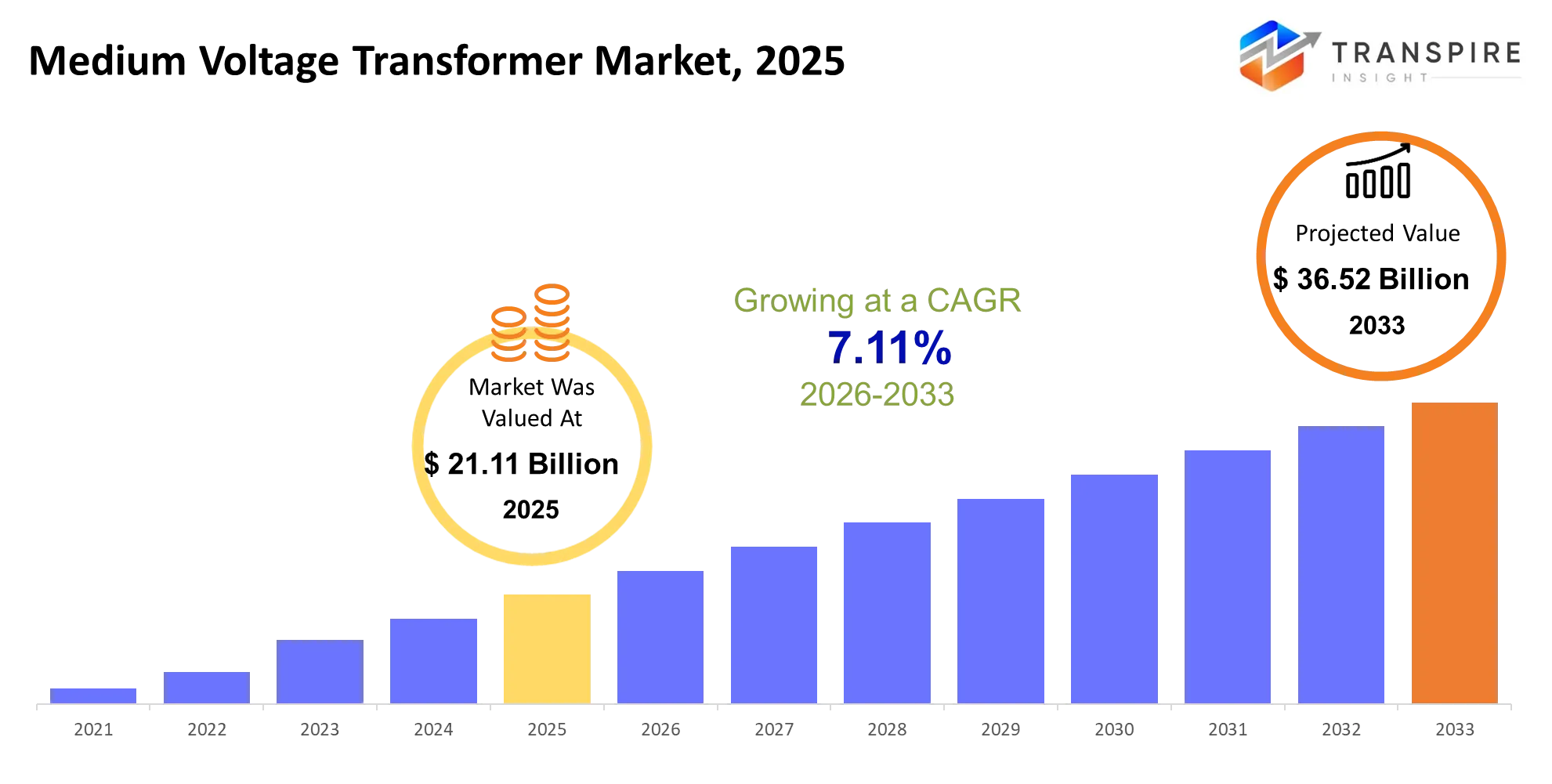
As per the Transpire Insight, The Medium Voltage Transformer Market size is estimated at USD 21.11 billion in 2025 and is anticipated to reach USD 36.52 billion by 2033, growing at a CAGR of 7.11% from 2026 to 2033.
The medium voltage transformer market is essential to efficiently channel the flow of electricity from substations or distributed generation assets to industrial plants, commercial premises, or local distribution networks. In the past three to five years, investors and utilities have shifted away from capacity replacement investments and towards grid reinforcement, renewables connections and more flexible power grids. The rapid expansion of solar and wind generation capacity combined with battery storage and EV charging has created new requirements for voltage regulation and bidirectional flow. Digitally monitored transformers with sensors and connected systems that help operators detect abnormal operating conditions earlier are the key structural change. Extreme weather events and grid congestion further exposed the high costs of ageing distribution infrastructure. Modernisation of electrical networks and electrification of industrial processes is expected to drive persistent replacement, connection and outage reduction investment, which enables the integration of diverse and increasingly variable electricity generation.
Medium Voltage Transformer Market Size & Forecast:
- Market Size 2025: USD 21.11 Billion
- Expected Market Value (2033): USD 36.52 Billion
- Forecast CAGR (2026–2033): 7.11%
- Leading Region in 2025: Asia Pacific
- Fastest Growing Region: Middle East & Africa
- Key Company Profiles: Hitachi Energy, Siemens Energy, Schneider Electric, Eaton, GE Vernova, ABB, Mitsubishi Electric, Toshiba Energy Systems, CG Power, SGB-SMIT, Wilson Power Solutions, Hammond Power Solutions, Virginia Transformer, Howard Industries, TMC Transformers.
Key Medium Voltage Transformer Market Insights:
The market is moving from the standard transformer supply to the ability to monitor and deliver grid assets that are ready for renewable energy, where monitoring capability and delivery reliability are as much a part of the purchase decision as the unit price.
- Distribution transformers account for 60.2% of the market, and Hitachi Energy is developing hybrid transformers that integrate traditional designs with power electronics, particularly for renewable-rich grids.
- Renewable energy developers are the fastest-growing end user at 12.29% CAGR, which is driving suppliers to create units that are compact and bidirectional-ready for solar-storage interconnection.
- Asia Pacific is expected to grow at 7.63% CAGR, with 48.90% of revenue, due to the industrialisation and renewable capacity additions in the region.
- Europe accounts for 23.28% of the demand, with Hitachi Energy's deal with E. to back it up. The value of the grid infrastructure is in the range of USD 700 million.
- North America accounts for 21.91%, with Siemens Energy localising winding and core fabrication in Virginia to minimise logistics time.
- The Middle East & Africa market is expected to grow at 9.0% CAGR, with a 7.76% share, due to investments in digital substation and renewable integration.
- Latin America represents 5.24% and is tied to electrification and grid-reinforcement programs.
- Siemens, ABB and Schneider Electric share 57% of the market with AI monitoring, eco-efficient insulation and integrated grid platforms.
- ABB has launched its first biodegradable-insulation transformers, and Schneider Electric has announced its plans to continue developing medium voltage platforms free of SF₆.
What are the Key Drivers, Restraints, and Opportunities in the Medium Voltage Transformer Market?
Driver:
Grid modernisation and renewable integration are driving growth in the medium voltage transformer market. Ageing distribution networks, stricter reliability requirements, and expanding solar, wind, battery storage, and EV charging infrastructure are prompting utilities to replace conventional units with efficient, digitally monitored transformers. This shift is accelerating adoption of smart sensors, natural-ester insulation, and higher-capacity designs. Consequently, infrastructure investment is generating sustained demand for transformer equipment, installation, maintenance, and lifecycle services, while improving grid reliability and operational efficiency.
Restraint:
High upfront capital cost and long delivery cycles continue to limit deployment. Copper, electrical steel, and specialised insulation inputs remain cost-volatile, while transformer manufacturing capacity and skilled installation labour have not expanded quickly enough to match interconnection demand. These structural constraints delay project approvals, extend lead times, and make smaller utilities and developers cautious about large-scale upgrades.
Opportunity:
Digital monitoring, efficient transformer designs, and renewable-linked distribution infrastructure offer opportunities for manufacturers. India's grid-modernisation programmes and expanding renewable-energy corridors create scope for compact, high-efficiency units with remote monitoring capabilities. Manufacturers that combine condition monitoring, modular designs, and dependable local servicing can differentiate their offerings, secure recurring maintenance contracts, and improve margins. Renewable energy developers, projected to grow at 12.29% in the supplied market estimates, represent an attractive customer group for application-specific transformer solutions.
Driver Impact Analysis – Medium Voltage Transformer Market
|
Driver |
Relative Impact on Growth (%) |
Geographic Relevance |
Impact Timeline |
Demand Strength |
Growth Mechanism |
Key Beneficiaries |
Major Constraint |
|
Grid modernization and aging transformer replacement |
28% |
North America, Europe, Asia-Pacific |
Medium-term (2–4 years) |
High |
Replaces aging units and strengthens distribution reliability |
Transformer manufacturers, utilities, grid contractors |
High equipment costs and extended procurement lead times |
|
Renewable energy integration and distributed power generation |
24% |
China, India, Europe, North America |
Long-term (≥4 years) |
High |
Connects solar, wind, and storage to distribution networks |
Transformer OEMs, renewable developers, EPC contractors |
Interconnection delays and renewable output variability |
|
Industrial electrification and infrastructure expansion |
20% |
Asia-Pacific, Middle East, North America |
Medium-term (2–4 years) |
High |
Supplies medium-voltage power to expanding industrial facilities |
Industrial transformer suppliers, EPC firms, utilities |
Capital expenditure constraints and project approval delays |
|
Rising electricity demand from data centers and EV charging |
16% |
North America, China, Europe, India |
Short-term (≤2 years) |
High |
Supports concentrated loads and expanding charging infrastructure |
Transformer manufacturers, data center developers, charging operators |
Grid connection bottlenecks and transformer supply shortages |
|
Energy efficiency regulations and smart transformer technologies |
12% |
Europe, North America, Asia-Pacific |
Long-term (≥4 years) |
Medium |
Encourages low-loss designs and digitally monitored transformer deployment |
Smart transformer vendors, utilities, industrial end users |
Higher upfront costs and integration complexity |
|
Total |
100% |
Global |
— |
— |
— |
— |
— |
What Has the Impact of Artificial Intelligence Been on the Medium Voltage Transformer Market?
AI is becoming a game-changer for medium voltage transformers-transforming them from electrical assets to digital systems. Utilities can combine sensor-based measurements of transformer temperature, dissolved-gas content, load, and vibration with machine learning algorithms that can identify developing faults, monitor for signs of equipment failure, and recommend the right time to schedule maintenance to avoid outages. Through these predictive capabilities, AI reduces outage risk, improves transformer utilisation and reduces lifecycle maintenance costs. AI can also contribute to load forecasting and optimisation, real-time load balancing and voltage optimisation to allow distribution networks to accommodate variable solar and wind feed-in while keeping heating-up and fatigue to the transformers to a minimum. Digital twins allow operators to simulate grid conditions and stress loading scenarios, as well as perform asset replacement planning more effectively. The full benefits of AI are only achievable if it can be integrated with existing grid management systems and if there is digital monitoring in place, which many older transformers do not have, alongside issues over high costs and cybersecurity exposure.
In October 2026, Gridsight raised a $26 million Series B funding round led by Insight Partners to expand its AI grid-software and digital twin platform into the United States, unlocking hidden network capacity by evaluating real-time regional and seasonal feeder data.
Key Medium Voltage Transformer Market Trends:
Grid operators are moving from a reactive approach to equipment replacement to a planned approach to network investment, with the network being monitored digitally. Transformer specifications and buying priorities are evolving due to renewable integration, electrification, and supply-chain pressures.
- Sensors, communications, and cybersecurity are being added to transformer replacement services.
- In fire- and environment-sensitive installations, natural-ester fluids are being used instead of the traditional mineral oil.
- Dry-type and air-cooled transformers are taking market share in dense urban and indoor applications.
- For hybrid solar-storage projects, renewable developers are now naming bidirectional, voltage-support-capable transformers.
- High reliability, compact medium voltage distribution equipment is being demanded for data centre expansion.
- Manufacturers are re-engineering products for reduced no-load losses and meeting the efficiency standards.
- Buyers are being driven to early procurement and supplier diversification due to extended lead times.
- Digital twins and predictive analytics are no longer seen as an add-on but are increasingly becoming part of the procurement process.
- Rugged, high-duty transformers for manufacturing and transport networks are driving the shift in demand for industrial electrification.
Medium Voltage Transformer Market Segmentation
Transformer Type:
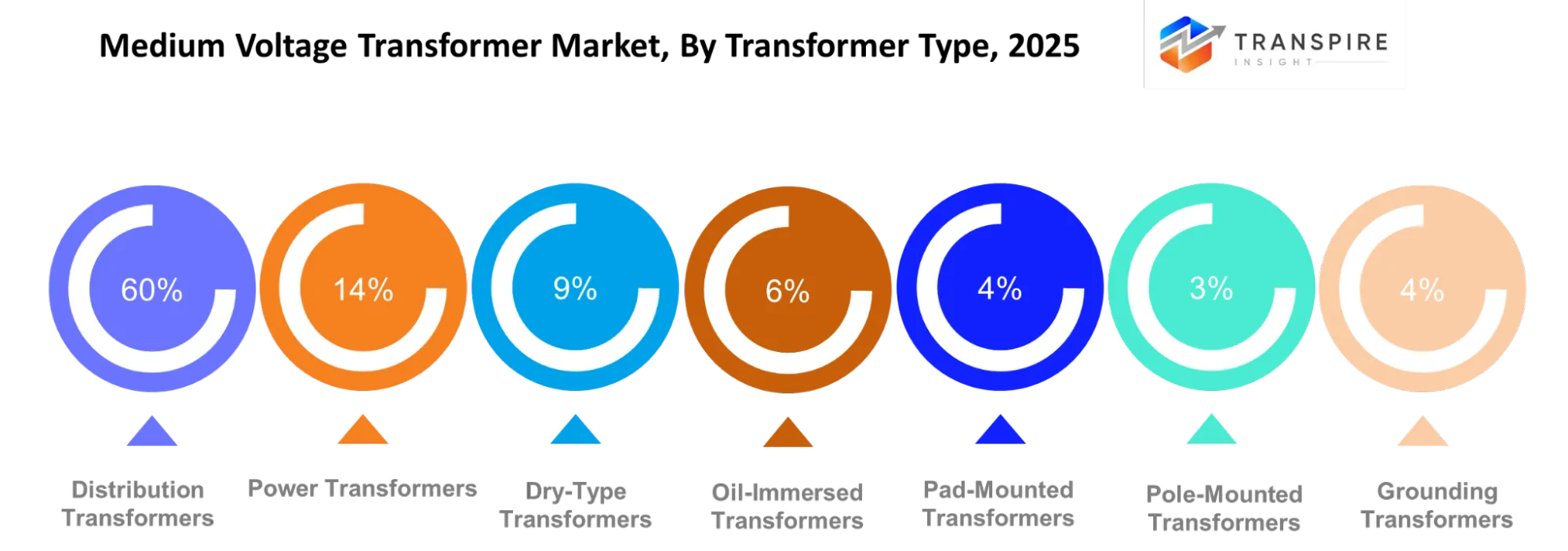
Distribution transformers dominate the market with a 60.2% share of the market, representing the electrically hungry world. These transformers represent the final distribution to substations, residential, and commercial areas. Power transformers make up 14.0% of the market, feeding renewable energy connections and serving industrial substations. The dry-type transformers market is 9.0% overall, with applications for fire safety and indoor installation requirements, such as in data centres. Oil-immersed market share makes up 6.5% of the market for power distribution, with high-capacity use cases and effective thermal performance of oil within the enclosure. Pad-mounted makes up 4.0%, pole-mounted 3.0%, ground 2.0%, and other transformer types 1.3%, ranging from local power distribution to protection applications.
Voltage Rating:
1–5 kV, 5–15 kV, and 15–35 kV support distribution and industrial applications, while 35–40 kV, 40–50 kV, and 50–72.5 kV serve specialised network requirements. Custom ratings accommodate unique project specifications and operating conditions. Future demand will depend on grid expansion, renewable connections, and equipment standardisation, encouraging manufacturers to offer flexible designs that meet diverse electrical requirements while maintaining operational efficiency and compliance with applicable technical standards.
Phase:
Utility networks, industrial plants, and commercial facilities requiring balanced power distribution. Single-phase units support lighter loads, while two-phase and split-phase configurations address specialised distribution needs. Three-winding and multi-winding transformers enable multiple voltage outputs, whereas traction transformers support railway electrification. Demand across these configurations depends on application-specific engineering, load characteristics, and installation requirements. Future opportunities will emerge from industrial electrification, transportation upgrades, and increasingly complex power distribution systems.
Cooling Type:
Oil-cooled, air-cooled, natural-air, forced-air, ONAN, ONAF, dry-cooling, and other configurations. Selection depends on transformer capacity, thermal performance, installation environment, safety requirements, and maintenance costs. Oil-based systems support effective heat dissipation, while air-cooled and dry-type solutions suit installations with specific fire-safety constraints. Forced cooling helps manage heavier loads. Manufacturers are increasingly prioritising energy efficiency, environmental performance, and reliable thermal management to improve equipment longevity and reduce operating expenditure.
End User:
Alongside industrial facilities, commercial buildings, renewable energy developers, data centres, railways, and infrastructure operators. Renewable energy developers are projected to record 12.29% growth in the supplied estimates, supported by solar and wind connections and battery storage deployment. Industrial customers require reliable power for production equipment, while data centres prioritise continuity and load management. Future adoption will depend on electrification investment, network capacity upgrades, and increasingly demanding reliability requirements across these customer groups.
Application:
Power distribution, renewable integration, industrial power, commercial buildings, grid modernisation, data centres, transportation, and specialised infrastructure. Conventional distribution remains essential for delivering electricity to end users, while renewable integration requires transformers capable of handling variable generation and changing power flows. Data centres need dependable supply arrangements, and transportation projects require reliable electrification infrastructure. Grid modernisation supports replacement of ageing assets. Future investment will increasingly favour efficient equipment, digital monitoring, operational flexibility, and designs tailored to specific network conditions.
What are the Key Use Cases Driving the Medium Voltage Transformer Market?
This is consistent with the medium voltage transformer segment, which is the core application of utility power distribution, stepping the electricity down to power factories, commercial buildings and residential feeders, accounting for 60.2% of the distribution transformer market.
The renewable developer segment is growing at 12.29% CAGR, with more applications taking renewable energy to the grid, including renewable plant interconnection, where solar and wind developers need step-up and collection transformers.
New applications are AI-optimised data-centre power distribution, EV charging stations, battery storage interconnection, railway electrification, and microgrids. These applications prefer small, dry-type and pad-mounted transformers, which can support bidirectional circulation and rapid load changes, as well as digital monitoring.
|
Report Metrics |
Details |
|
Market size value in 2025 |
USD 21.11 Billion |
|
Market size value in 2026 |
USD 22.58 Billion |
|
Revenue forecast in 2033 |
USD 36.52 Billion |
|
Growth rate |
CAGR of 7.11% from 2026 to 2033 |
|
Base year |
2025 |
|
Historical data |
2021 - 2024 |
|
Forecast period |
2026 - 2033 |
|
Report coverage |
Revenue forecast, competitive landscape, growth factors, and trends |
|
Regional scope |
United States; Canada; Mexico; United Kingdom; Germany; France; Italy; Spain; Denmark; Sweden; Norway; China; Japan; India; Australia; South Korea; Thailand; Brazil; Argentina; South Africa; Saudi Arabia; United Arab Emirates |
|
Key companies profiled |
Hitachi Energy, Siemens Energy, Schneider Electric, Eaton, GE Vernova, ABB, Mitsubishi Electric, Toshiba Energy Systems, CG Power, SGB-SMIT, Wilson Power Solutions, Hammond Power Solutions, Virginia Transformer, Howard Industries, TMC Transformers. |
|
Customization scope |
Free report customization (country, regional & segment scope). Available customized purchase options to meet your exact research needs. |
|
Report Segmentation |
Transformer Type (Distribution Transformers, Power Transformers, Dry-Type Transformers, Oil-Immersed Transformers, Pad-Mounted Transformers, Pole-Mounted Transformers, Grounding Transformers, Others)Voltage Rating (1–5 kV, 5–15 kV, 15–35 kV, 35–40 kV, 40–50 kV, 50–72.5 kV, Custom Ratings, Others)Phase (Single-Phase, Three-Phase, Two-Phase, Split-Phase, Three-Winding, Multi-Winding, Traction, Others)Cooling Type (Oil-Cooled, Air-Cooled, Natural Air, Forced Air, ONAN, ONAF, Dry Cooling, Others)End User (Utilities, Industrial, Commercial, Renewable Energy Developers, Data Centers, Railways, Infrastructure, Others)Application (Power Distribution, Renewable Integration, Industrial Power, Commercial Buildings, Grid Modernization, Data Centers, Transportation, Others) |
Which Regions are Driving the Medium Voltage Transformer Market Growth?
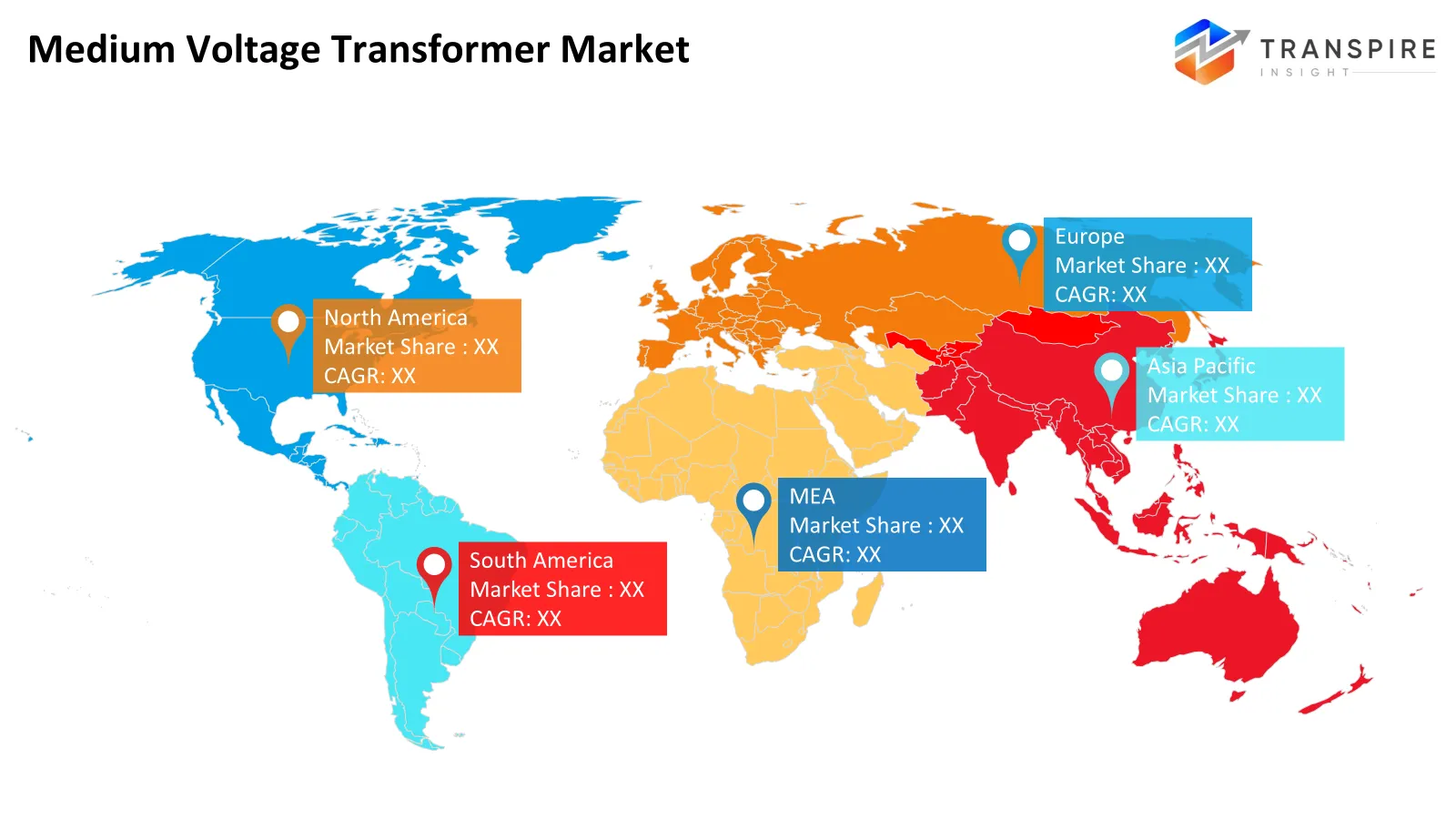
Asia Pacific remains the largest region, accounting for 48.90% of the revenue with a CAGR of 7.63% in the forecast period. Driven by rapid urban electrification and industrialization, as well as rapid renewable capacity additions, market players have scale advantage in the APAC region. China, India, Japan and South Korea have simultaneously expanded manufacturing, transmission and distribution capacity to enable continued demand for replacement and new projects; favourable industrial policies, government-driven grid investment and consumption growth by data centers and electric vehicles support scale advantage.
In February 2026, Siemens Energy India Limited approved a ₹2,060 crore capital expenditure to establish a brand-new power transformer manufacturing facility.
The Europe segment has a market share of 23.28% and is distinct from the Asia Pacific market as its growth is driven by system replacement, energy security, and decarbonization, not by new capacity build-up. Utilities upgrade ageing networks with infrastructure for cross-border power exchange, offshore wind, and distributed generation. Due to a well-established regulatory environment, efficiency regulations, as well as multi-year utility procurement plans, demand is forecast, as demonstrated by Hitachi Energy's contract with E.ON for up to USD 700 million.
In September 2026, Hitachi Energy signed long-term framework agreements worth €350 million ($398 million USD) with Enedis to secure the delivery of distribution and power transformers. This partnership will modernise France's distribution grid to accelerate the integration of renewable energy, support electric mobility, and ease grid component shortages.
Middle East and Africa (MEA) are at the 7.76% supplied market share mark and are forecasted to grow at a 9.0% compound annual growth rate. Current funding opportunities for grid modernisation, renewable generation projects, and interconnection projects in the region are expected to unlock investments that go well beyond conventional power infrastructure. The European Union and Egypt announced the presence of up to a €690M financing package in June 2026 to modernise the electricity grid and enable renewable energy integration, for instance, a threat to station transformers, renewable projects, and distribution improvements.
In October 2026, the Egyptian Electricity Transmission Company (EETC) signed a contract with Elsewedy Electric to supply, install, and test three 175 MVA transformers for the Sadat Main and Tahrir Badr substations.
https://powerline.net.in/news/egypts-eetc-signs-contract-for-three-175-mva-transformers-12624269
Who are the Key Players in the medium-voltage transformer market, and how do they compete?
The market is moderately consolidated, with Siemens, ABB, and Schneider Electric accounting for 57% of the market share. Regional-specialist players compete on customisation, speed of delivery, and value-added services. Buyers are increasingly evaluating the one-time capital cost of transformers against lifecycle performance, digital-readiness, and lead-time certainty.
Hitachi Energy has an innovation-based strategy, investing USD 250 million across several natural-ester and digital-ready transformer manufacturing sites and developing hybrid transformer technology with ENEL. It differentiates through a fusion of traditional transformer design and power electronics for grids rich in renewable energy. Siemens Energy competitively invests in localised manufacturing of optimised wind- and solar-compatible generator transformers and digital adoption by co-locating winding and core production in Virginia, linking to its Xcelerator digital-twin platform. Schneider Electric pursues a solutions-based strategy by combining an offering of transformers, switchgear, analytics, and predictive-maintenance services in annuity contracts. ABB differentiates itself by introducing environmentally-friendly products like transformers containing biodegradable insulation. GE Vernova focuses on cloud-integrated diagnostics and voltage regulation. Mitsubishi Electric and Toshiba emphasise high-reliability products for Asian projects. Similarly, CG Power, SGB-SMIT, Wilson Power Solutions, Hammond Power Solutions, Virginia Transformer, Howard Industries, and TMC Transformers compete on regional production, niche specifications, and fast project completion.
Key Players are:
- Hitachi Energy
- Siemens Energy
- Schneider Electric
- Eaton
- GE Vernova
- ABB
- Mitsubishi Electric
- Toshiba Energy Systems
- CG Power
- SGB-SMIT
- Wilson Power Solutions
- Hammond Power Solutions
- Virginia Transformer
- Howard Industries
- TMC Transformers
Medium Voltage Transformer Market — Enhanced Competitive Benchmarking
|
Company |
Est. Revenue Share Range |
Key Offerings |
Strategic Positioning |
Geographic Strength |
Technology Focus |
|
Hitachi Energy |
Estimated 9–14% |
Liquid-filled distribution transformers, dry-type transformers, unit substations, digital-enabled transformers |
leadership through reliability, scale, and grid expertise |
Europe, Asia Pacific, North America |
Natural-ester insulation, digital monitoring, high-efficiency designs |
|
Siemens Energy |
Estimated 7–12% |
Distribution transformers, industrial transformers, renewable integration transformers, substation transformers |
Premium engineering for utilities and complex power infrastructure |
Europe, North America, Asia Pacific |
Advanced insulation, thermal optimization, digital asset monitoring |
|
Schneider Electric |
Estimated 6–10% |
Distribution transformers, Trihal dry-type transformers, cast-resin transformers, packaged substations |
Integrated electrification solutions with strong customer ecosystem |
Europe, North America, Asia Pacific |
Cast-resin insulation, energy efficiency, connected power management |
|
Eaton |
Estimated 5–9% |
Distribution transformers, dry-type transformers, liquid-filled transformers, unit substation solutions |
Strong distribution-channel reach and application-specific customization |
North America, Europe, Asia Pacific |
Thermal management, energy-efficient designs, integrated distribution |
|
GE Vernova |
Estimated 4–8% |
Distribution transformers, industrial transformers, renewable project transformers, substation transformers |
Utility-scale projects supported by grid equipment integration |
North America, Europe, Asia Pacific |
Grid integration, transformer monitoring, reliability-focused engineering |
|
Mitsubishi Electric |
Estimated 3–6% |
Distribution transformers, industrial transformers, substation transformers, specialized power transformers |
Engineering-led differentiation for demanding industrial applications |
Asia Pacific, North America, Europe |
Low-loss magnetic cores, insulation engineering, thermal performance |
|
TBEA Co., Ltd. |
Estimated 3–6% |
Distribution transformers, industrial transformers, renewable-energy transformers, substation transformers |
Manufacturing scale and competitive pricing across infrastructure projects |
Asia Pacific, Middle East & Africa, Latin America |
Core-loss reduction, high-capacity manufacturing, insulation optimization |
|
CG Power and Industrial Solutions |
Estimated 2–5% |
Distribution transformers, power transformers, industrial transformers, renewable-energy transformers |
Regional manufacturing strength with expanding international reach |
Asia Pacific, Middle East & Africa |
Energy-efficient cores, customized designs, process automation |
|
Hyosung Heavy Industries |
Estimated 2–4% |
Distribution transformers, industrial transformers, renewable integration transformers, substation transformers |
Specialized engineering for utilities and industrial power systems |
Asia Pacific, Middle East & Africa, Europe |
High-efficiency magnetic circuits, insulation systems, digital diagnostics |
|
WEG S.A. |
Estimated 2–4% |
Distribution transformers, dry-type transformers, oil-immersed transformers, industrial transformers |
Broad industrial customer access and regional manufacturing expansion |
Latin America, North America, Europe |
Low-loss cores, compact designs, energy-efficient transformer systems |
Recent Development News
- In August 2026, Waaree Transpower Private Limited secured an order worth approximately ₹160 crore to supply 8.3 MVA medium-voltage skids for battery energy storage system applications. The order supports the company’s international expansion and strengthens the deployment of integrated, containerised electrical infrastructure for renewable energy storage and grid flexibility. https://www.waaree.com/usa/ar/press-release/waaree-transpower-private-limited-expands-global-reach-into-supply-of-medium-voltage-skids-%28compact-sub-stations%29-to-the-bess-segment-with-%E2%82%B9160-crore-single-order
- In August 2026, Siemens and Maschinenfabrik Reinhausen announced a partnership to develop and industrialise a solid-state transformer for AI-ready data centres, supporting grid voltages of up to 36 kV. The technology aims to enable direct conversion to 800 V DC, reduce equipment footprint and costs, and improve power availability for high-density computing infrastructure. https://press.siemens.com/global/en/pressrelease/siemens-and-reinhausen-are-developing-power-solutions-ai-data-centers
- In October 2026, Eaton partnered with Infineon Technologies to integrate advanced Silicon Carbide (SiC) power devices into Eaton's upcoming Medium-Voltage Solid-State Transformer (MVSST) 2.0 platform. This high-tech collaboration directly optimises grid-to-load electrical conversion efficiency, providing a highly scalable 800VDC power distribution solution tailored for intensive AI data centre architectures and dense industrial applications. https://www.infineon.com/
What Strategic Insights Define the Future of the Medium Voltage Transformer Market?
The market is moving toward capacity-secure, digitally monitored and application-specific transformer offerings rather than price-led equipment purchases. A capacity expansion combined with design standardisation for utilities, renewables, and data centres may be a more market-validated approach for expanding manufacturing for new business. Yet the risk remains that manufacturing growth will not offset bottlenecks in electrical steel, specialist components, labour, and testing capacity. Rystad Energy estimates grid investment will total over US$650 billion by 2026, but equipment projects are already two to three years delayed.
This opens a window for modular designs, predictive maintenance, and regional service networks. The focus should be on capacity investments in high-growth regions, long-term material sourcing agreements, and digital monitoring as a premium service. Buyers should consider lifecycle costs, delivery reliability, ease of repair, and interoperability along with purchase price. Execution, not capacity announcements, will determine any market benefit.
Key Segmentations are:
Transformer Type
- Distribution Transformers
- Power Transformers
- Dry-Type Transformers
- Oil-Immersed Transformers
- Pad-Mounted Transformers
- Pole-Mounted Transformers
- Grounding Transformers
- Others
Voltage Rating
- 1–5 kV
- 5–15 kV
- 15–35 kV
- 35–40 kV
- 40–50 kV
- 50–72.5 kV
- Custom Ratings
- Others
Phase
- Single-Phase
- Three-Phase
- Two-Phase
- Split-Phase
- Three-Winding
- Multi-Winding
- Traction
- Others
Cooling Type
- Oil-Cooled
- Air-Cooled
- Natural Air
- Forced Air
- ONAN
- ONAF
- Dry Cooling
- Others
End User
- Utilities
- Industrial
- Commercial
- Renewable Energy Developers
- Data Centers
- Railways
- Infrastructure
- Others
Application
- Power Distribution
- Renewable Integration
- Industrial Power
- Commercial Buildings
- Grid Modernisation
- Data Centres
- Transportation
- Others
By Regional Analysis
North America
- US
- Canada
- Mexico
Europe
- Germany
- UK
- France
- Italy
- Spain
- Russia
- Rest of Europe
Asia Pacific
- China
- Japan
- India
- South Korea
- Australia
- Rest of Asia Pacific
South America
- Brazil
- Argentina
- Rest of South America
Middle East & Africa
- UAE
- Saudi Arabia
- Qatar
- South Africa
- Rest of the Middle East & Africa
Frequently Asked Questions
Find quick answers to common questions.
The medium voltage transformer market size was valued at USD 21.11 billion in 2025 and is poised to reach USD 36.52 billion by 2033, expanding at a 7.11% CAGR.
Key segments for the medium voltage transformer market are Transformer Type (Distribution Transformers, Power Transformers, Dry-Type Transformers, Oil-Immersed Transformers, Pad-Mounted Transformers, Pole-Mounted Transformers, Grounding Transformers, Others)Voltage Rating (1–5 kV, 5–15 kV, 15–35 kV, 35–40 kV, 40–50 kV, 50–72.5 kV, Custom Ratings, Others)Phase (Single-Phase, Three-Phase, Two-Phase, Split-Phase, Three-Winding, Multi-Winding, Traction, Others)Cooling Type (Oil-Cooled, Air-Cooled, Natural Air, Forced Air, ONAN, ONAF, Dry Cooling, Others)End User (Utilities, Industrial, Commercial, Renewable Energy Developers, Data Centers, Railways, Infrastructure, Others)Application (Power Distribution, Renewable Integration, Industrial Power, Commercial Buildings, Grid Modernization, Data Centers, Transportation, Others).
Growth is primarily driven by grid modernisation, renewable energy integration, ageing infrastructure replacement, industrial electrification, EV charging expansion, and demand for energy-efficient, digitally monitored transformers.
The medium voltage transformer market is led by major manufacturers, including Hitachi Energy, Siemens Energy, Schneider Electric, Eaton, GE Vernova, ABB, Mitsubishi Electric, Toshiba Energy Systems, CG Power, SGB-SMIT, Wilson Power Solutions, Hammond Power Solutions, Virginia Transformer, Howard Industries, TMC Transformers.
Asia Pacific dominates with a 48.90% market share, supported by rapid industrialisation, urban electrification, renewable energy investments, expanding power infrastructure, and strong regional manufacturing capabilities.
Key opportunities include smart transformer monitoring, AI-enabled predictive maintenance, energy-efficient designs, renewable energy integration, battery storage connections, and regional manufacturing expansion.
- Hitachi Energy
- Siemens Energy
- Schneider Electric
- Eaton
- GE Vernova
- ABB
- Mitsubishi Electric
- Toshiba Energy Systems
- CG Power
- SGB-SMIT
- Wilson Power Solutions
- Hammond Power Solutions
- Virginia Transformer
- Howard Industries
- TMC Transformers
About the Authors

Avinash Kumar
I’m Avinash Kumar, a Senior Research Analyst at Transpire Insight, with expertise in the Electronics and Semiconductor and Energy & Power industry. My work focuses on analyzing emerging technologies, market trends, industry developments, and innovation across these sectors. I specialize in transforming complex technical and market insights into clear, research-backed content that helps professionals, businesses, and decision-makers stay informed. Through continuous industry research and data-driven analysis, I strive to deliver accurate, reliable, and practical perspectives on the latest advancements shaping the semiconductor and energy landscape.

Chakradhar Khansole
Chakradhar serves as the Research Director at Transpire Insight, bringing over 8 years of experience in technology, innovation, and strategic market intelligence. He specializes in transforming complex market data into actionable business insights that enable organizations to make informed, growth-oriented decisions. Recognized for his strategic vision and analytical expertise, Chakradhar leads high-impact research initiatives, delivering comprehensive market assessments, competitive intelligence, and forward-looking industry analysis.
Recently Published Reports
-
Apr 2026
Active Power Filter Market
Active Power Filter Market Size, Share & Analysis Report By Type (Shunt Active Power Filters, Series Active Power Filter, Hybrid Active Power Filter), By Application (Harmonics Mitigation, Reactive Power Compensation, Voltage Regulation, Power Factor Correction), By Phase (Single Phase, Three Phase), By End-User Industry (Manufacturing, Healthcare, Commercial, Automotive, Oil and Gas, Others), and Geography (North America, Europe, Asia-Pacific, Middle East and Africa, South and Central America), 2021 - 2031
-
Apr 2026
Electrical Transformer Market
Electrical Transformer Market Size, Share & Analysis Report By Core (Closed, Shell, and Berry), By Insulation (Gas, Oil, Solid, Air, and Other), By Phase (Single, and Three), By Rating (100 MVA to 500 MVA, 501 MVA to 800 MVA, and 801 MVA to 1200 MVA), and Geography (North America, Europe, Asia-Pacific, Middle East and Africa, South and Central America), 2021 – 2031
-
Apr 2026
Hydraulic Piston Pumps Market
Hydraulic Piston Pumps Market Size, Share & Analysis Report By Type (Axial Piston Pumps, Radial Piston Pumps), By Operating Pressure (Low Pressure, Medium Pressure, High Pressure), By Application (Construction, Mining, Agriculture, Automotive, Oil & Gas, Industrial Machinery, Others), By End-User (OEMs, Aftermarket), and Geography (North America, Europe, Asia-Pacific, Middle East and Africa, South and Central America), 2021 – 2031
-
Apr 2026
Laboratory Gas Generators Market
Laboratory Gas Generators Market Size, Share & Analysis Report By Product (Nitrogen Gas Generator, Hydrogen Gas Generator, Zero Air Gas Generator, Purge Gas Generator, TOC Gas Generators, Others), By Application (Gas Chromatography, Liquid Chromatography-mass Spectrometry (LC-MS), Gas Analyzers, Others), By End-user (Life Science, Chemical & Petrochemical, Food & Beverage, Others), and Geography (North America, Europe, Asia-Pacific, Middle East and Africa, South and Central America), 2021 – 2031