

Marine Antifouling Coatings Market Summary:
According to Transpire Insight, a detailed research report on the market reflects that the hull coatings application segment dominates the Marine Antifouling Coatings Market, accounting for approximately 81.82% of the total market share worldwide, driven by the widespread use of antifouling systems to reduce marine biofouling, improve vessel fuel efficiency, minimize hull resistance, and extend maintenance intervals. AkzoNobel N.V. leads the market with an estimated 18% market share, while the company generated approximately USD 11.89 billion in revenue in 2025 across its overall business, making it a leading contributor to market development, innovation, advanced marine antifouling coating technologies, expanding manufacturing capabilities, sustainable foul-release solutions, and overall growth dynamics.
Market Snapshot
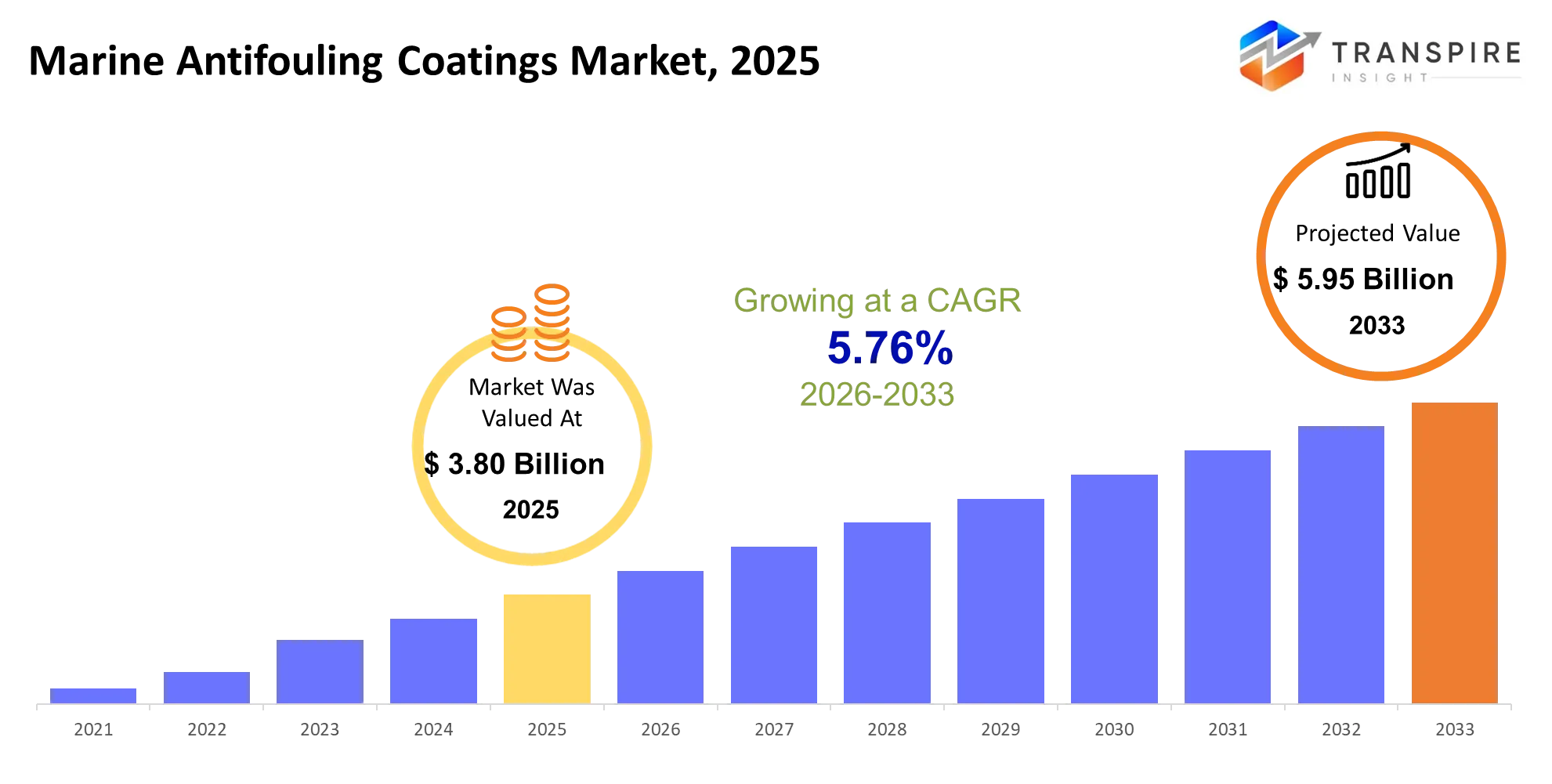
- Market Value (2025): USD 3.80 Billion.
- Expected Market Value (2026): USD 4.02 Billion.
- Estimated Market Value (2033): USD 5.95 Billion.
- Forecast CAGR (2026-2033): 5.76%.
- Leading Region in 2025: North America
- Second-largest Region: Europe
- Fastest Growing Region: Asia Pacific
Introduction
Marine Antifouling Coating Market consists of advanced anti-foulant coating systems which are used on the submerged surface of ships, boats, offshore structures, and other marine equipment in order to mitigate biofouling issues. Such coatings are designed for preventing the adhesion of algae, barnacles, slime, mussels, and other marine life on the ship’s hull, thus providing reduced hydrodynamic drag and fuel efficiency. The rise in maritime traffic, shipbuilding, need for ship maintenance and sustainable marine operations is contributing to market growth. Innovations in silicon-based foul release systems, self-polishing, low toxicity and advanced surface technologies are driving technological developments. Some of the applications of this market are cargo and container ships, cruise ships, passenger ships, fishing boats, offshore structures, and naval ships, among others.
For instance:-
- Asia Pacific: Investment is centered around the development of shipbuilding, dry-docking, vessel maintenance, and marine coating manufacturing capacity mainly in China, South Korea, Japan, and the developing maritime nations.
- Europe: Investment is geared towards the development of sustainable marine antifouling coatings, low toxicity coatings, and the development of foul release technology systems and regulatory compliant coatings.
Key Market Highlights: -
- Asia Pacific is expected to grow at a rapid CAGR in the Marine Antifouling Coatings Market by holding around 70% of the share during the forecast period.
- Europe is anticipated to hold roughly 30% share of the Marine Antifouling Coatings Market over the predicted timeframe.
- North America is anticipated to hold nearly 43% share of the Marine Antifouling Coatings Market over the predicted timeframe.
- 4 By Resin, the acrylic resins dominated the market and holds nearly 34% share in 2025 and is projected to grow at a substantial CAGR during the forecast period.
- By Product type, the Copper-based coatings dominated the market and holds close to 57% share in 2025 and is projected to grow at a substantial CAGR during the forecast period.
- By Vessel Type, the Multinational Corporations dominated the market and holds about 69.90% share in 2025 and is projected to grow at a substantial CAGR during the forecast period.
- There is an increasing trend where government regulations and IMO regulations limit the use of harmful antifouling coatings like organotins and cybutryne.
How is Technology Driving Growth in the Marine Antifouling Coatings Market?
Technology is one of the key catalysts for growth in the Marine Antifouling Coatings Market as it ensures development of environmentally compliant, efficient and fuel saving hull coatings. Biocide Free Formulations: Silicone based foul release coatings along with other eco-friendly coatings are designed to minimize organism adhesion as well as ensure compliance with the environment. Advanced Surface Technologies: These are nano-enhanced surface technologies which help in providing smoother, durable and biofouling resistant surfaces. Smart Coating Technologies: These include self-polishing and hybrid coating formulations. Digital Hull Monitoring: This includes performance monitoring along with hull coating.
|
Report Metrics |
Details |
|
Market size value in 2025 |
USD 3.80 Billion |
|
Market size value in 2026 |
USD 4.02 Billion |
|
Revenue forecast in 2033 |
USD 5.95 Billion |
|
Growth rate |
CAGR of 5.76% from 2026 to 2033 |
|
Base year |
2025 |
|
Historical data |
2021 - 2024 |
|
Forecast period |
2026 - 2033 |
|
Report coverage |
Revenue forecast, competitive landscape, growth factors, and trends |
|
Regional scope |
United States; Canada; Mexico; United Kingdom; Germany; France; Italy; Spain; Denmark; Sweden; Norway; China; Japan; India; Australia; South Korea; Thailand; Brazil; Argentina; South Africa; Saudi Arabia; United Arab Emirates |
|
Key company profiled |
AkzoNobel, PPG Industries, Jotun, Hempel, Kansai Paint Marine, Nippon Paint Marine, Chugoku Marine Paints, Sherwin-Williams, RPM International, BASF, Axalta, International Paint, KCC Corporation, Carboline, Boero |
|
Customization scope |
Free report customization (country, regional & segment scope). Avail customized purchase options to meet your exact research needs. |
|
Report Segmentation |
By Resin (Epoxy, Acrylic, Polyurethane, Silicone, Vinyl, Alkyd, Fluoropolymer, Others); By Product Type (Self-polishing, Ablative, Hard Matrix, Foul-release, Hybrid, Tin-free, Copper-based, Others); By Vessel Type (Commercial Ships, Tankers, Bulk Carriers, Container Ships, Naval Vessels, Offshore Support Vessels, Yachts & Leisure Boats, Others); By Application (Hull, Propellers, Rudders, Sea Chests, Offshore Structures, Piping, Tanks, Others); By Technology (Biocide-based, Non-biocide, Silicone-based, Fluoropolymer, Nanotechnology, Low-friction, Self-cleaning, Others); By End User (Shipping Companies, Shipyards, Marine Operators, Naval Forces, Offshore Companies, Fishing Fleets, Yacht Owners, Others); By Coating Layer (Primer, Tie Coat, Anticorrosive, Antifouling, Topcoat, Foul-release, Sealer, Others) |
Market Drivers
Major factors responsible for growth in the Marine Antifouling Coatings Market around the world include rising need for fuel-efficient ships, stringent regulations regarding environmental safety, increased maritime trade activity, increased construction of ships, and technological developments in hull protection. Fuel Efficiency & Cost Effectiveness: Antifouling coating helps to save fuel usage in vessels through efficient management of biofouling and hydrodynamic drag. Environmental Regulations: Increasing standards and regulations related to marine pollution, biocide usage, and emission of greenhouse gases have resulted in adoption of environmentally sustainable coating technologies. Maritime Trade & Shipbuilding: Growing number of commercial vessels and vessels operations raise the need for hull protection and coatings.
For instance:- North America: Investment capital focuses on advanced antifouling coatings technology, vessel maintenance systems, hull coating for fuel efficiency and compliance with environmental requirements.
Restrain
Key Constraints: The stringent environmental regulations on the use of biocides and marine pollution cause compliance costs to rise as well as cost of testing and reformulation of the product by manufacturers. The volatility in resin, polymer, pigment, solvent, and biocide material costs can lead to an increase in the cost of production. The high initial cost of silicone-based and foul-release antifouling coating can also be another barrier to entry into the market.
|
Driver |
Relative Impact on Growth (%) |
Geographic Relevance |
Impact Timeline |
Demand Strength |
Growth Mechanism |
Key Beneficiaries |
Major Constraint |
|
Fuel Efficiency and Biofouling Control |
28% |
Global; Asia Pacific, Europe, North America |
Short-term |
High |
Reduces hull drag and vessel fuel consumption |
Coating manufacturers, shipowners, marine operators |
Higher advanced-coating acquisition costs |
|
Maritime Trade and Shipbuilding Expansion |
24% |
Asia Pacific, Europe, Middle East |
Medium-term |
High |
Expands vessel fleets requiring protective hull coatings |
Coating producers, shipyards, maintenance providers |
Cyclical shipping and construction activity |
|
Environmental Regulations and Sustainable Coatings |
20% |
Europe, North America, Asia Pacific |
Long-term |
High |
Accelerates compliant low-toxicity coating adoption |
Sustainable coating manufacturers, technology developers |
Reformulation and certification costs |
|
Advanced Foul-Release and Coating Technologies |
16% |
Europe, North America, Asia Pacific |
Medium-term |
High |
Improves durability, surface performance, and fouling resistance |
Technology vendors, coating manufacturers, vessel operators |
High R&D and application complexity |
|
Growing Vessel Maintenance and Retrofit Demand |
12% |
Global; Asia Pacific, Europe, North America |
Short-term |
Medium |
Increases recurring demand for recoating and hull protection |
Marine service providers, coating suppliers, shipyards |
Dry-docking downtime and maintenance budgets |
Analysis of Prices and Consumer Behaviour
The market for marine antifouling coating comprises mainly of the high-performance coating formulation (68% of the total market share; due to the demand in the commercial shipping, shipbuilding, offshore vessel and marine maintenance industries). It will cost 35% more than other marine coatings, due to its advanced coating formulation technology, certified quality materials and high performance of the coating. 45% of all unit sales of marine antifouling coatings are sold in the liquid coating form. Sales volumes are driven by the versatility of applications on vessel hulls and marine constructions along with the longevity of the coating system. Commercial marine and offshore industries represent 70% of demand from these industries. The customer buying behaviors show that 55% of customers prioritize the performance, durability, corrosion resistance and consistent antifouling performance of the coating. Another 33% of the customers buy their products through the bulk buying or long-term agreements because they try to lower down their costs in procuring marine antifouling coatings and make sure about the consistent supply of the product in the vessel operations and marine customers in different regions of the world.
|
Company |
Est. Revenue Share Range |
Key Offerings |
Strategic Positioning |
Geographic Strength |
Technology Focus |
|
AkzoNobel N.V. |
12-16% |
International Intersmooth, Interswift, copper-free antifouling, fouling-release systems |
Premium marine-coatings leadership |
Europe, Asia Pacific, North America |
Silyl copolymer and low-friction antifouling |
|
Jotun A/S |
10-14% |
SeaQuantum, SeaQuest, SeaForce, Hull Performance Solutions |
Energy-efficiency-led marine coating differentiation |
Europe, Asia Pacific, Middle East |
Silyl acrylate and biocide-free foul-release |
|
Hempel A/S |
9-13% |
Hempaguard, Hempaguard X7, antifouling, fouling-defence coatings |
High-performance fuel-saving coating systems |
Europe, Asia Pacific, Middle East |
Hydrogel silicone and ActiGuard technology |
|
PPG Industries |
7-11% |
PPG marine antifouling, fouling-release, HydroReset, copper-free systems |
Sustainable technology and application innovation |
North America, Europe, Asia Pacific |
Silicone foul-release and electrostatic application |
|
Chugoku Marine Paints Ltd. |
7-10% |
SEAFLO NEO, SEAFLO NEO SL ZX, CF PREMIUM, CMP BIOCLEAN PLUS |
Specialized high-performance marine innovation |
Asia Pacific, Europe, North America |
Silyl methacrylate and ultra-low-friction coatings |
|
Nippon Paint Marine Coatings |
5-8% |
FASTAR XI, AQUATERRAS, BIOFLEX 66, ECOLOSILK AXEL |
Broad vessel coverage and sustainable hull solutions |
Asia Pacific, Europe, North America |
Nano-domain and biocide-free self-polishing |
|
Kansai Paint Marine Co. |
4-7% |
Marine antifouling, anticorrosive, hull-protection coatings |
Diversified marine coating portfolio |
Asia Pacific, Europe, Middle East |
Advanced polymer and low-friction formulations |
|
The Sherwin-Williams Company |
3-6% |
SeaGuard Ablative Antifoulant, commercial marine coatings, MIL-spec systems |
Broad marine portfolio and technical service |
North America, Europe, Asia Pacific |
Ablative antifouling and protective coating systems |
|
KCC Corporation |
2-5% |
EgisPacific, EgisArrow, METACRUISE NS, marine antifouling |
Regional innovation with cost-efficient marine solutions |
Asia Pacific, Middle East |
Silyl antifouling and silicone technologies |
|
Gruppo Boero |
1-4% |
Marine antifouling, foul-release, underwater hull coatings |
Specialty marine coatings and regional expertise |
Europe, Mediterranean, Asia Pacific |
Advanced antifouling and foul-release chemistry |
Who are the Key Players in the Marine Antifouling Coatings Market and how do they compete?
The competitiveness of the market of Marine Antifouling Coatings Market is defined by those companies which focus on innovation in terms of technology, solutions tailored for marine applications, as well as development of distribution network worldwide. Competing not through pricing but by relying on innovative and effective coating systems, antifouling technologies, sustainable solutions, and digital integration, such strategy for competing will lead to ongoing development of the products as well as will help companies to reach the higher vessel performance, fuel savings, biofouling management, efficiency, and transparency.
By developing the latest marine antifouling coatings, foul-release technologies, sustainable coating solutions, and high-performance hull protection systems, AkzoNobel becomes stronger in this market. By developing high-performance marine coating solutions for commercial vessels, shipbuilding, offshore, and other marine applications, PPG Industries distinguishes itself among other competitors. The differentiation strategy of Jotun in terms of the latest solutions in marine coatings, antifouling technologies, hull protection, and sustainable marine coating systems allows Jotun to support shipowners and operators in achieving better vessel performance.
Top Companies in the Marine Antifouling Coatings Market
- AkzoNobel
- PPG Industries
- Jotun
- Hempel
- Kansai Paint Marine
- Nippon Paint Marine
- Chugoku Marine Paints
- Sherwin-Williams
- RPM International
- BASF
- Axalta
- International Paint
- KCC Corporation
- Carboline
- Boero
|
16.Investment Factor |
Why It Matters to Investors |
Opportunity |
Investment Implication |
|
Fuel-Efficiency Driven Demand |
Hull biofouling increases resistance and vessel fuel consumption, supporting demand for performance-oriented coating systems. |
Low-friction and advanced foul-release coatings for commercial fleets. |
Attractive for medium- to long-term technology investments. |
|
Environmental Compliance |
Restrictions on harmful antifouling substances are accelerating formulation changes and replacement demand. |
Copper-reduced, copper-free, biocide-free, and sustainable coating technologies. |
Supports long-term investment in compliant coating innovation. |
|
Asia Pacific Shipbuilding Expansion |
Concentrated shipbuilding and vessel maintenance activity creates recurring coating requirements across newbuild and retrofit projects. |
Localized manufacturing, distribution, technical services, and shipyard partnerships. |
Strong regional expansion opportunity for scalable suppliers. |
|
Premium Foul-Release Technologies |
Advanced silicone and low-friction systems can compete through vessel performance and lifecycle economics rather than commodity pricing. |
High-performance coatings targeting fuel savings and longer maintenance intervals. |
Creates potential for technology-led premium positioning. |
|
Recurring Recoating Demand |
Vessel maintenance, dry-docking, and hull refurbishment generate repeat requirements throughout asset lifecycles. |
Integrated coating supply, inspection, application, and maintenance services. |
Provides relatively resilient recurring B2B revenue opportunities. |
|
Advanced Coating Innovation |
Self-polishing, hybrid, and engineered surface technologies are expanding performance differentiation within marine coatings. |
Development of durable, low-friction, environmentally compliant formulations. |
Favors R&D-focused companies with differentiated technical capabilities. |
Marine Antifouling Coatings Market Segmentation
The Marine Antifouling Coatings Market share is divided into seven categories: By Resin, By Product Type, By Vessel Type, By Application, By Technology, By End User, By Coating Layer
The acrylic resins dominated the market, accounting for nearly 34% in 2025 and is expected to rise at a significant CAGR during the forecast period.
The Marine Antifouling Coatings Market is by resin into epoxy, acrylic, polyurethane, silicone, vinyl, alkyd, fluoropolymer, others. Among these, the acrylic resins dominated the market, accounting for nearly 34% in 2025 and expected to increase at a significant CAGR during the forecast period. Acrylic resins prevail because of their outstanding hardness, adhesive properties, corrosion resistance, weathering, and suitability in advanced marine anti-fouling paint formulations.
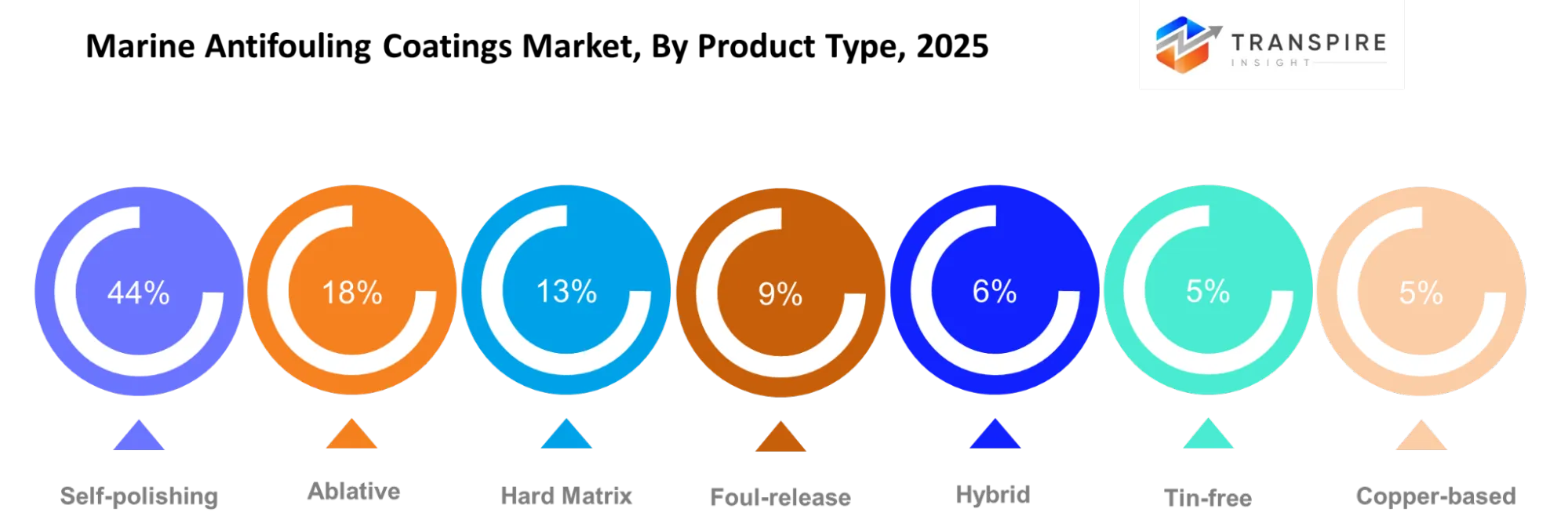
The Copper-based coatings dominated the market, accounting for close to 57% in 2025, and is expected to rise at a significant CAGR during the forecast period
The Marine Antifouling Coatings Market is segmented by product type into self-polishing, ablative, hard matrix, foul-release, hybrid, tin-free, copper-based, others. Among these, the Copper-based coatings dominated the market, accounting for close to 57% in 2025 and expected to increase at a significant CAGR during the forecast period. Copper-containing paints prevail because of their efficiency in antifouling, durability, widespread compatibility in marine environment, and effectiveness in fighting with biofouling organisms.
The Bulk Carrier dominated the market, accounting for about 43% in 2025 and is expected to rise at a significant CAGR during the forecast period.
The Marine Antifouling Coatings Market by vessel type into commercial ships, tankers, bulk carriers, container ships, naval vessels, offshore support vessels, yachts & leisure boats, others. Among these, theMultinational Corporations dominated the market, accounting for about 69.90% in 2025 and expected to increase at a significant CAGR during the forecast period. Bulk carriers prevail because of huge exposed hull surface area and frequent marine activities.
Regional Segment Analysis of the Marine Antifouling Coatings Market
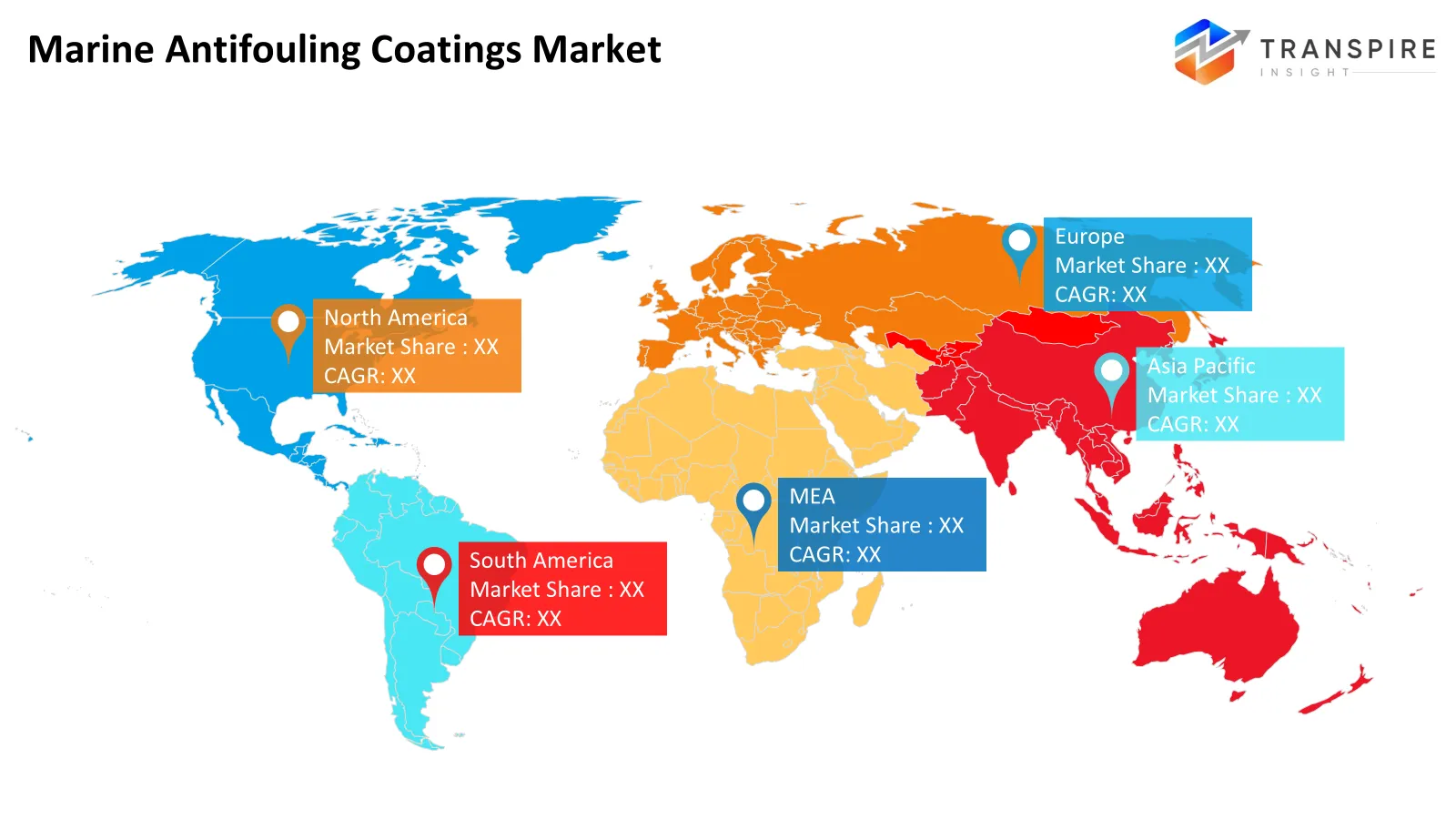
- Europe (Germany, France, U.K., Italy, Spain, Rest of Europe)
- North America (U.S., Canada, Mexico)
- Asia-Pacific (China, Japan, India, Rest of APAC)
- South America (Brazil and the Rest of South America)
- The Middle East and Africa (UAE, South Africa, Rest of MEA)
Asia Pacific is expected to grow at a rapid CAGR in the Marine Antifouling Coatings Market, holding around 70% of the share during the forecast period.
It is anticipated that the Asia Pacific will experience fast CAGR in the Marine Antifouling Coatings Market with around 70% market share in the forecast period owing to shipbuilding, commercial shipping, ports construction, and maintenance of ships in this region. High growth in maritime trade, increase in shipbuilding capacities, and rising use of advanced hull protection systems are boosting the market in this region. Moreover, investments in fuel-efficient ships, biofouling control, and development of green coatings are contributing to the market expansion in Asia Pacific.
Europe is the high-growth region in the Marine Antifouling Coatings Market during the period, holding roughly 30% share.
Europe is an important high-growth region in the Marine Antifouling Coatings Market due to its huge commercial shipping fleets, shipbuilding industry, and well-developed maritime infrastructure. The stringent environmental regulations and sustainability goals have been promoting the adoption of low-toxic, reduced-copper, and advanced foul-release coatings. Besides, increasing investments in ship maintenance, hull efficiency, and biofouling control are aiding the market expansion. Further, presence of leading marine coating companies and advanced R&D activities in Europe are contributing to the growth of the regional market.
North America is the fastest-growing region in the Marine Antifouling Coatings Market during the period, holding nearly 57% share.
The Marine Antifouling Coatings Market in North America is witnessing robust growth, which is driven by an increase in commercial shipping, offshore operations, shipbuilding, and vessel maintenance in the region. There is increasing focus on efficiency in terms of energy consumption, performance of the hull, and biofouling management. Strict environmental laws and regulations are also driving the demand for environmentally sustainable products that contain less toxicity and are copper-free.
Strategies for Market Growth in Non-Leading Regions:
Creation of non-core areas via the effective and scalable technologies for producing marine antifouling coatings is helpful for small- and medium-sized coating manufacturers and maritime service providers. Local production and formulating marine antifouling coatings and also creating regional coating manufacturing plants can reduce import dependence and cut costs for production and distribution of products. Creating partnership relations with regional shipyards, shipowners, maritime operators, vessel maintenance organizations, and coating distributors will help to facilitate market entry of marine antifouling coating providers. Increasing the level of expertise in relation to advanced antifouling formulations, application techniques, biofouling management, compliance issues, quality assurance, and coating performance is necessary through training courses and technical skills upgrading. In addition, flexible financing schemes, long-term supply agreements, contract manufacturing, and local distribution networks will improve the accessibility and encourage the use of marine antifouling coatings in developing maritime markets. The creation of cooperative programs between governments, maritime authorities, shipbuilding projects, port operators, maritime research organizations, and also digital platforms for selling and providing technical support will facilitate the accessibility of advanced marine antifouling coatings and promote sustainable world-wide market growth in developing regions.
Future Market Trends for the Marine Antifouling Coatings Market: -
- Formulations of Environmentally Friendly Antifoulings: Tougher environmental regulations have contributed to an increased need for less toxic, non-biocide, low copper, and silicone based antifoulings that exhibit better environmental performance.
- Technologies of Advanced Hull Coatings: The growing attention to fuel efficiency and hull performance have led to development of foul release, low friction, nano-technological and other advanced marine coatings.
- Management of Biofouling and Maintenance of Hulls: Rising concern with biofouling management and maintenance of hulls and coatings have been creating an increasing demand for antifouling systems.
Recent Development
- In June 2026: Expansion of capacity in electrostatic coating undertaken by PPG Industries Inc., with a new production line for large dry-dock programs to decrease cycle time and pollution.
- In March 2024: Introduction of PPG NEXEON 810 by PPG Industries Inc., a high-performance copper-free marine anti-fouling coating that meets strict local discharge criteria.
- In November 2025: Strategic alliance between I-Tech AB and Guangdong Havey Advanced Materials Technology Co., Ltd., for Selektope use in biodegradable resin binders.
Market Segment
This study forecasts revenue at global, regional and country levels from 2020 to 2033. Transpire Insight has segmented the Marine Antifouling Coatings Market based on the below-mentioned segments:
Marine Antifouling Coatings Market, By Resin
- Epoxy
- Acrylic
- Polyurethane
- Silicone
- Vinyl
- Alkyd
- Fluoropolymer
- Others
Marine Antifouling Coatings Market, By Product Type
- Self-polishing
- Ablative
- Hard Matrix
- Foul-release
- Hybrid
- Tin-free
- Copper-based
- Others
Marine Antifouling Coatings Market, By Vessel Type
- Commercial Ships
- Tankers
- Bulk Carriers
- Container Ships
- Naval Vessels
- Offshore Support Vessels
- Yachts & Leisure Boats
- Others
Marine Antifouling Coatings Market, By Application
- Hull
- Propellers
- Rudders
- Sea Chests
- Offshore Structures
- Piping
- Tanks
- Others
Marine Antifouling Coatings Market, By Technology
- Biocide-based
- Non-biocide
- Silicone-based
- Fluoropolymer
- Nanotechnology
- Low-friction
- Self-cleaning
- Others
Marine Antifouling Coatings Market, By End User
- Shipping Companies
- Shipyards
- Marine Operators
- Naval Forces
- Offshore Companies
- Fishing Fleets
- Yacht Owners
- Others
Marine Antifouling Coatings Market, By Coating Layer
- Primer
- Tie Coat
- Anticorrosive
- Antifouling
- Topcoat
- Foul-release
- Sealer
- Others
Window Coverings Market, By Regional Analysis
North America
- US
- Canada
- Mexico
Europe
- Germany
- UK
- France
- Italy
- Spain
- Russia
- Rest of Europe
Asia Pacific
- China
- Japan
- India
- South Korea
- Australia
- Rest of Asia Pacific
South America
- Brazil
- Argentina
- Rest of South America
Middle East & Africa
- UAE
- Saudi Arabia
- Qatar
- South Africa
- Rest of the Middle East & Africa
Frequently Asked Questions
Find quick answers to common questions.
Fuel-efficiency requirements, recurring vessel maintenance, environmental regulations, and advanced coating technologies create diverse long-term investment opportunities globally.
Eco-friendly foul-release, low-friction, silicone-based, and advanced self-polishing technologies offer attractive opportunities amid tightening environmental requirements and efficiency demands.
Asia Pacific offers significant opportunities through expanding shipbuilding, vessel maintenance, maritime trade, localized manufacturing, and increasing demand for advanced hull protection.
Environmental regulations accelerate replacement of harmful formulations, encouraging investment in copper-free, biocide-free, low-toxicity, and sustainable marine antifouling coating technologies.
Investors should evaluate regulatory changes, raw-material price volatility, high research costs, established competitors, application complexity, and technology substitution risks.
- AkzoNobel
- PPG Industries
- Jotun
- Hempel
- Kansai Paint Marine
- Nippon Paint Marine
- Chugoku Marine Paints
- Sherwin-Williams
- RPM International
- BASF
- Axalta
- International Paint
- KCC Corporation
- Carboline
- Boero
About the Authors

Pankaj Ghogare Patil
I am Pankaj Ghogare Patil, a Senior Research Analyst at Transpire Insight, specializing in the Pharmaceutical, Chemicals & Materials, Healthcare IT, and Biotechnology industry. My expertise lies in conducting comprehensive market research, analyzing industry trends, evaluating competitive landscapes, and translating complex data into actionable insights. At Transpire Insight, I closely follow emerging technologies, regulatory developments, and market innovations to create accurate, well-researched, and informative content that helps businesses and professionals make informed decisions. I am committed to producing credible, evidence-based articles that reflect industry best practices while making technical topics accessible and valuable for a broad audience.

Chakradhar Khansole
Chakradhar serves as the Research Director at Transpire Insight, bringing over 8 years of experience in technology, innovation, and strategic market intelligence. He specializes in transforming complex market data into actionable business insights that enable organizations to make informed, growth-oriented decisions. Recognized for his strategic vision and analytical expertise, Chakradhar leads high-impact research initiatives, delivering comprehensive market assessments, competitive intelligence, and forward-looking industry analysis.
Recently Published Reports
-
May 2026
Healthcare Polymer Packaging Market
Healthcare Polymer Packaging Market Size, Share & Analysis Report By Packaging Type (Syringes, IV Bottles and Pouches, Clamshells, Blisters, Bottles & Jars, Containers, Tubes, IV Parental Packaging, Others), By Type (Regulated, Non-regulated), By Polymer Type (LDPE (Low-Density Polyethylene), HDPE (High-Density Polyethylene), Homo-polymer (Homo), Random Copolymer (Random), Block Copolymer (Block), PET, Polystyrene, Polyvinyl Chloride, Polyamide/EVOH, Others), and Geography (North America, Europe, Asia-Pacific, Middle East and Africa, South and Central America), 2021 - 2031
-
Apr 2026
Hydrophilic Tape (Waterstop) Market
Hydrophilic Tape (Waterstop) Market Size, Share & Analysis Report By Type (Bentonite-Based Hydrophilic Tape, Rubber-Based Hydrophilic Tape), By Application (Residential Buildings, Commercial Buildings, Infrastructure Projects), and Geography (North America, Europe, Asia-Pacific, Middle East and Africa, South and Central America), 2021 - 2031
-
Apr 2026
Metalens Market
Metalens Market Size, Share & Analysis Report By Type (Visible Light Metalens, and Infrared Metalens), By Application (Consumer Electronics, Automotive Electronics, Industrial, Medical, and Others), and Geography (North America, Europe, Asia-Pacific, Middle East and Africa, South and Central America), 2021 - 2031
-
Apr 2026
PBT Resin Market
PBT Resin Market Size, Share & Analysis Report By Type (Reinforced PBT Resin, Unreinforced PBT Resin), By Processing Method (Injection Molding, Extrusion, Blow Molding, Others), By End-User (Automotive, Electrical & Electronics, Consumer Appliances, Industrial Machinery, Medical Devices, Packaging, Others), and Geography (North America, Europe, Asia-Pacific, Middle East and Africa, South and Central America), 2021 - 2031