

Manufacturing Execution Systems (MES) Market Summary:
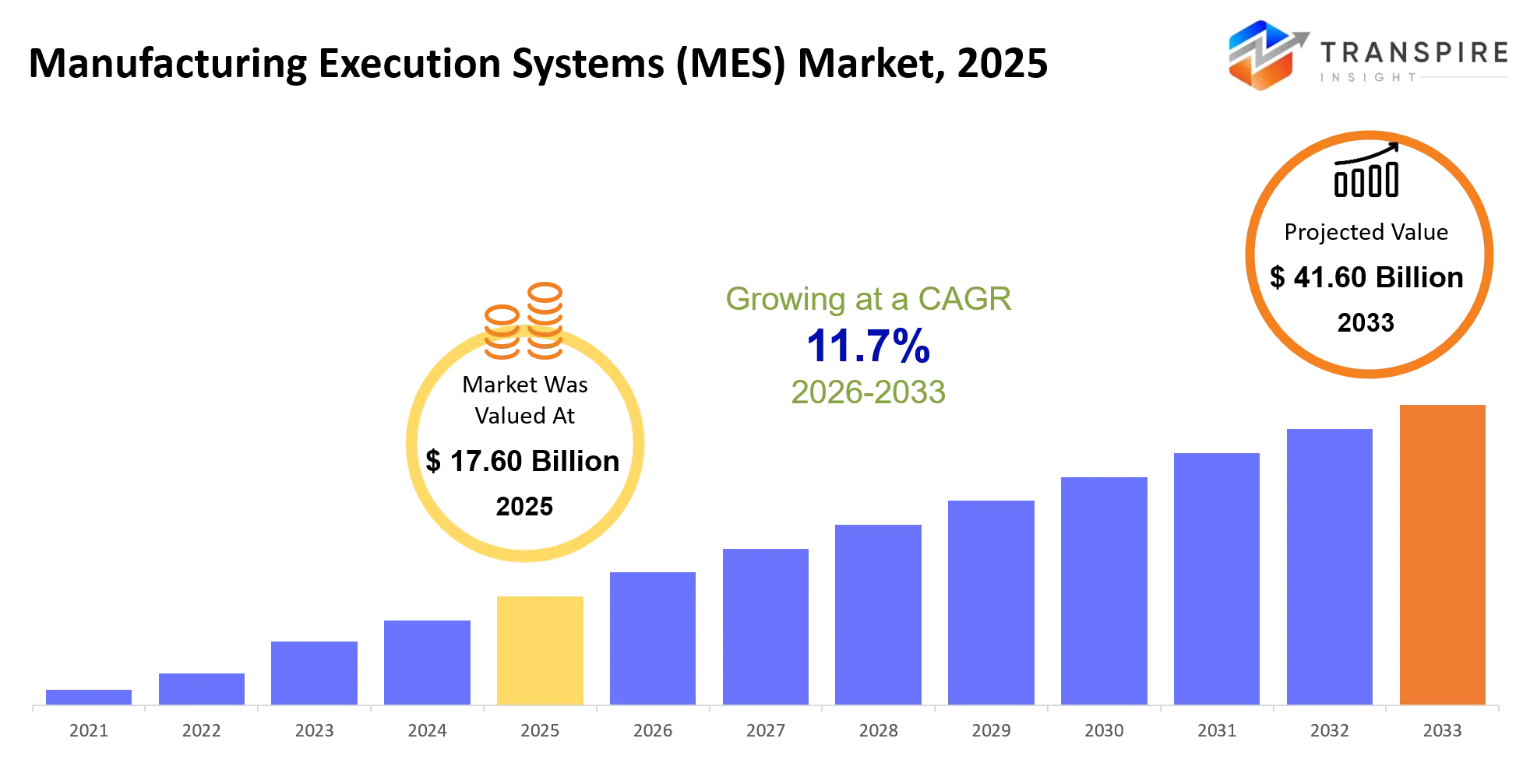
As per Transpire Insight Analysis, the Manufacturing Execution Systems (MES) Market size is estimated at USD 17.60 billion in 2025 and is anticipated to reach USD 41.60 billion by 2033, growing at a CAGR of 11.7% from 2026 to 2033.
The Manufacturing Execution Systems (MES) Market is becoming increasingly important as manufacturers search for more efficient means of managing production activities, tracking equipment performance, ensuring product quality, and avoiding operation delays. In the last 3-5 years, the market of the MES changed from mere shop-floor monitoring to more connected and data-driven manufacturing. In relation to changes in the structure of the market of the MES, the first significant shift is related to the implementation of cloud MES systems that are integrated with artificial intelligence and IoT. With the increase in the amount of data provided by production plants, MES helps organizations discover flaws and make decisions.
Manufacturing Execution Systems (MES) Market Size & Forecast:
- Market Size 2025: USD 17.60 Billion
- Expected Market Value (2033): USD 41.60 Billion
- Forecast CAGR (2026–2033): 11.7%
- Leading Region in 2025: North America
- Fastest Growing Region: Asia Pacific
- Key Company Profiles: Siemens, Rockwell Automation, Dassault Systèmes, SAP, Honeywell, Schneider Electric, Emerson, ABB, AVEVA, GE Digital, Critical Manufacturing, Werum, iTAC Software, Körber, Plex Systems
Key Market Insights:
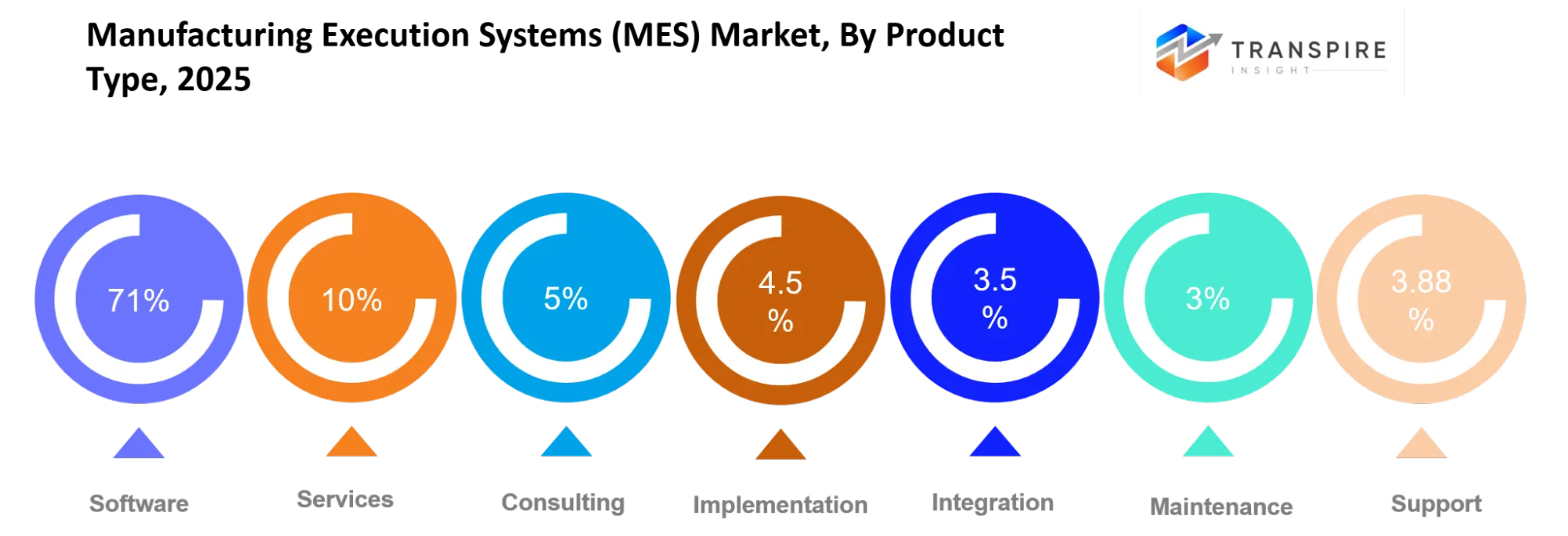
market is moving towards smart connected factories and factories with cloud capability. Software forms the majority of the offering category, whereas companies are increasingly preferring platforms that facilitate real-time monitoring, complex analytics, and manufacturing facilities across locations.
- The cloud-based MES is growing at around 14% CAGR as companies move to flexible deployment options and become less dependent on the legacy IT environment.
- Services constitute 10.0% of the offering segment as there is an increasing need for system configuration and technical support.
- Consulting constitutes 5.0% of the segment as companies look for professional help to implement MES systems in an existing production environment.
- Implementation forms 4.5% of the segment, wherein firms like Siemens are improving their implementation through Opcenter solutions.
- Integration forms 3.5% of the segment, as companies are looking for the integration of MES, ERP, PLM and industrial automation systems.
- Maintenance and constitues 3.0% of the offering segment, emphasising the need for reliable software, upgrades, and a secure environment for uninterrupted manufacturing process.
What are the Key Drivers, Restraints, and Opportunities in the Manufacturing Execution Systems (MES) Market?
Drivers
The increasing trend towards the introduction of smart manufacturing is another significant driver of MES adoption. Companies are opting to replace their paper-based production records and systems with digital platforms that offer real-time information on equipment performance, raw materials consumption, and production outputs. The growth of Industry 4.0 programs and connected factory developments has contributed to this trend. As a result, MES systems are being adopted by automotive and electronics companies in order to eliminate production disruptions, ensure product consistency of products, and increase equipment utilization. This will allow companies to manage their operational costs and enhance their production efficiency.
Restraints
The high cost of implementation and integration remains one of the key barriers to market growth, especially for small and medium-sized enterprises. Integration of MES software with old equipment, ERP systems, and production systems can require considerable technical efforts. The lack of skilled personnel and issues related to cybersecurity are other complicating factors of MES implementation.
Opportunities
There are opportunities in cloud-based and AI-driven MES systems. More companies are looking at the possibility of subscription software, which is scalable and easily accessible remotely. There are also opportunities for vendors who provide industry-specific solutions due to the growth in semiconductors, electric vehicles, pharmaceuticals, and electronics manufacturing in the Asia-Pacific region.
|
Driver |
Relative Impact on Growth (%) |
Geographic Relevance |
Impact Timeline |
Demand Strength |
Growth Mechanism |
Key Beneficiaries |
Major Constraint |
|
Industry 4.0 and Smart Factory Adoption |
28% |
North America, Europe, Asia Pacific |
Medium-term |
High |
Connects shop-floor equipment with real-time production management. |
MES vendors, automation providers, smart factory manufacturers. |
High implementation costs and legacy equipment integration. |
|
Real-Time Production Monitoring and Operational Efficiency |
22% |
North America, Europe, Asia Pacific |
Short-term |
High |
Improves production visibility, throughput, and equipment utilization. |
Automotive, electronics, aerospace, and industrial manufacturers. |
Limited interoperability across existing manufacturing systems. |
|
Integration of AI, IIoT, and Advanced Analytics |
18% |
North America, Europe, Asia Pacific |
Medium-term |
High |
Enables predictive maintenance and intelligent production optimization. |
Industrial software vendors, AI providers, equipment manufacturers. |
Data quality issues and shortage of skilled professionals. |
|
Regulatory Compliance, Quality Control, and Product Traceability |
17% |
North America, Europe, Asia Pacific |
Short-term |
High |
Automates quality documentation, batch records, and traceability. |
Pharmaceutical, food processing, automotive, and medical manufacturers. |
Complex validation requirements and changing regulatory standards. |
|
Cloud-Based MES and Manufacturing Digitalization Investments |
15% |
Asia Pacific, North America, Europe |
Long-term |
High |
Reduces infrastructure costs and enables multi-site scalability. |
Cloud providers, MES vendors, SMEs, manufacturing enterprises. |
Cybersecurity concerns and industrial data sovereignty requirements. |
|
Total |
100% |
— |
— |
— |
— |
— |
— |
What Has the Impact of Artificial Intelligence on the Manufacturing Execution Systems (MES) Market?
AI is revolutionising how MES manages the production process through analytics, automation, and predictive capabilities of the software. An MES platform powered by AI would be able to analyse the data collected by production equipment and sensors to detect problems and make fast decisions. Through machine learning algorithms, companies can spot anomalies in the behaviour of the machinery used in their factories, predict potential malfunctions and carry out preventive maintenance before any unplanned breakage affects the production process. n. If it comes to the electronics or semiconductor manufacturing process, computer vision may help identify defective components and improve product traceability. An intelligent scheduling system will be able to consider the availability of the equipment, labour force, and material situation when making production schedules. These tools will help companies avoid any unnecessary downtime, save materials, keep production constant and efficiently use production equipment. The problem of implementing AI in an existing MES system would be complicated because of the presence of legacy systems, poor quality of data, cybersecurity issues, and high cost of implementation of such solution. The accuracy of the AI recommendations will greatly depend on the quality of production data as well.
Instance
In January 2026, Siemens added artificial intelligence-driven industrial copilots to its Opcenter portfolio to improve manufacturing execution systems. It shows that MES platforms have become more intelligent due to the increasing involvement of AI in such platforms.
Key Market Trends:
The MES Market is gradually evolving into more interconnected and intelligent manufacturing ecosystems where production software will become a more important part of the decision-making process.
- Industrial companies are gradually switching to the digitalisation of production processes and the substitution of paper-based records for digital workflows that allow managers to track production data and detect any issues more quickly.
- The cloud deployment of MES is becoming more popular due to the need for flexible software architecture capable of remote monitoring and expansion to several manufacturing sites.
- MES solutions are becoming more advanced and incorporate more AI and machine learning capabilities, thus transforming from simply tracking production processes to predictive maintenance and process optimisation.
- Cybersecurity is becoming an important issue for connected manufacturing environments where more systems and devices need to be protected.
- Suppliers are developing more flexible integration options that would connect MES solutions with ERP, PLM, and warehouse
Manufacturing Execution Systems (MES) Market Segmentation
By Offering
The offering segment is represented by software with a market share of 71.0%. This is mainly due to the fact that software is used in production monitoring, quality control, and management of manufacturing information. In addition, the second largest market share is occupied by services at 10.0%, while consulting is 5.0%, implementation is 4.5%, integration is 3.5%, and maintenance and support are 3.0% each. This is facilitated by the need for regular software updates and support. The software segment will retain its leadership thanks to the continuous adoption of digital production platforms.
By Deployment
The deployment segment includes on-premises, cloud, hybrid, private cloud, public cloud, SaaS, and hosted solutions. On-premises solutions will still be in demand among manufacturers that require direct control of production facilities and data. Meanwhile, cloud MES is currently the most rapidly growing one, with about a 14% CAGR high flexibility, scalability, and lower requirements in terms of infrastructure.
By Enterprise Level
The enterprise size segment includes large enterprises, medium enterprises, small enterprises, SMEs, Multinational corporations, government-owned plants, and startups. Large enterprise customers are considered one of the largest customer bases because of their multiple manufacturing facilities and complex production operations. Medium enterprise and SME customers are adopting the manufacturing software platform to gain more control over production and to diminish manual processes. Cloud-enabled applications have further led to SMEs and startup companies adopting the manufacturing software in a flexible way.
By Industry
The industry segment includes automotive, electronics and semiconductor, pharmaceutical, food and beverage, chemical, aerospace and defence, and industrial manufacturing. Automotive and electronics manufacturers take advantage of MES platforms for production tracking, quality, and assembly. Pharmaceutical and food processing companies utilise the software for batch processing, compliance and traceability. Chemical, aerospace, and industrial manufacturers employ these solutions for process monitoring and production efficiency.
By Function
Other software modules available in the function section include: production tracking, quality management, inventory management, scheduling, performance analysis, document management, and traceability. Production tracking is used by manufacturers to track production and equipment performance; quality management provides defect detection and measurement for production quality control; inventory management and scheduling provide material availability optimisation and manufacturing scheduling; performance analysis, document management, and traceability provide additional control for manufacturing operations.
By Architecture
Architectures include standalone MES, integrated MES, MOM platform, cloud-native MES, edge MES, IIoT-enabled MES, and AI-enabled MES. Standalone MES provides independent production management, whereas integrated MES integrates manufacturing processes with enterprise systems. Cloud-native and edge architectures provide agility, scalability, and faster data processing capabilities. IIoT-enabled and AI-enabled architectures are trending, and solutions that use real-time monitoring of equipment and autonomous production optimisation are emerging.
What are the Key Use Cases Driving the Manufacturing Execution Systems (MES) Market?
Manufacturing Monitoring & Process Control are the use cases that have been fueling the Manufacturing Execution Systems (MES) Market, especially in the largest software segment. MES platforms are used by manufacturers for manufacturing monitoring, equipment performance monitoring, work order management, and consistent manufacturing processes. These uses are particularly relevant in the automotive, electronics, and industrial manufacturing settings. The other application use case is related to quality management, inventory management, and product tracking. Pharmaceutical, food and beverage, and chemical manufacturers use digital manufacturing records for material tracking, batch management, and compliance. Such use cases help minimise documentation errors and improve manufacturing accountability. There are new use cases being identified that leverage artificial intelligence for predictive maintenance, intelligent manufacturing scheduling, digital work instructions, and the Industrial Internet of Things for shop-floor monitoring.
|
Report Metrics |
Details |
|
Market size value in 2025 |
USD 17.60 Billion |
|
Market size value in 2026 |
USD 19.20 Billion |
|
Revenue forecast in 2033 |
USD 41.60 Billion |
|
Growth rate |
CAGR of 11.7% from 2026 to 2033 |
|
Base year |
2025 |
|
Historical data |
2021 - 2024 |
|
Forecast period |
2026 - 2033 |
|
Report coverage |
Revenue forecast, competitive landscape, growth factors, and trends |
|
Regional scope |
United States; Canada; Mexico; United Kingdom; Germany; France; Italy; Spain; Denmark; Sweden; Norway; China; Japan; India; Australia; South Korea; Thailand; Brazil; Argentina; South Africa; Saudi Arabia; United Arab Emirates |
|
Key company profiled |
Siemens, Rockwell Automation, Dassault Systèmes, SAP, Honeywell, Schneider Electric, Emerson, ABB, AVEVA, GE Digital, Critical Manufacturing, Werum, iTAC Software, Körber, Plex Systems |
|
Customization scope |
Free report customization (country, regional & segment scope). Avail customized purchase options to meet your exact research needs. |
|
Report Segmentation |
Offering (Software, Services, Consulting, Implementation, Integration, Maintenance, Support); Deployment (On-Premises, Cloud, Hybrid, Private Cloud, Public Cloud, SaaS, Hosted); Enterprise Size (Large Enterprises, Medium Enterprises, Small Enterprises, SMEs, Multinational Corporations, Government-Owned Plants, Startups); Industry (Automotive, Electronics & Semiconductor, Pharmaceuticals, Food & Beverage, Chemicals, Aerospace & Defense, Industrial Manufacturing); Function (Production Tracking, Quality Management, Inventory Management, Scheduling, Performance Analysis, Document Management, Traceability); Architecture (Standalone MES, Integrated MES, MOM Platform, Cloud-Native MES, Edge MES, IIoT-Enabled MES, AI-Enabled MES) |
Which Regions are Driving the Manufacturing Execution Systems (MES) Market Growth?
North America
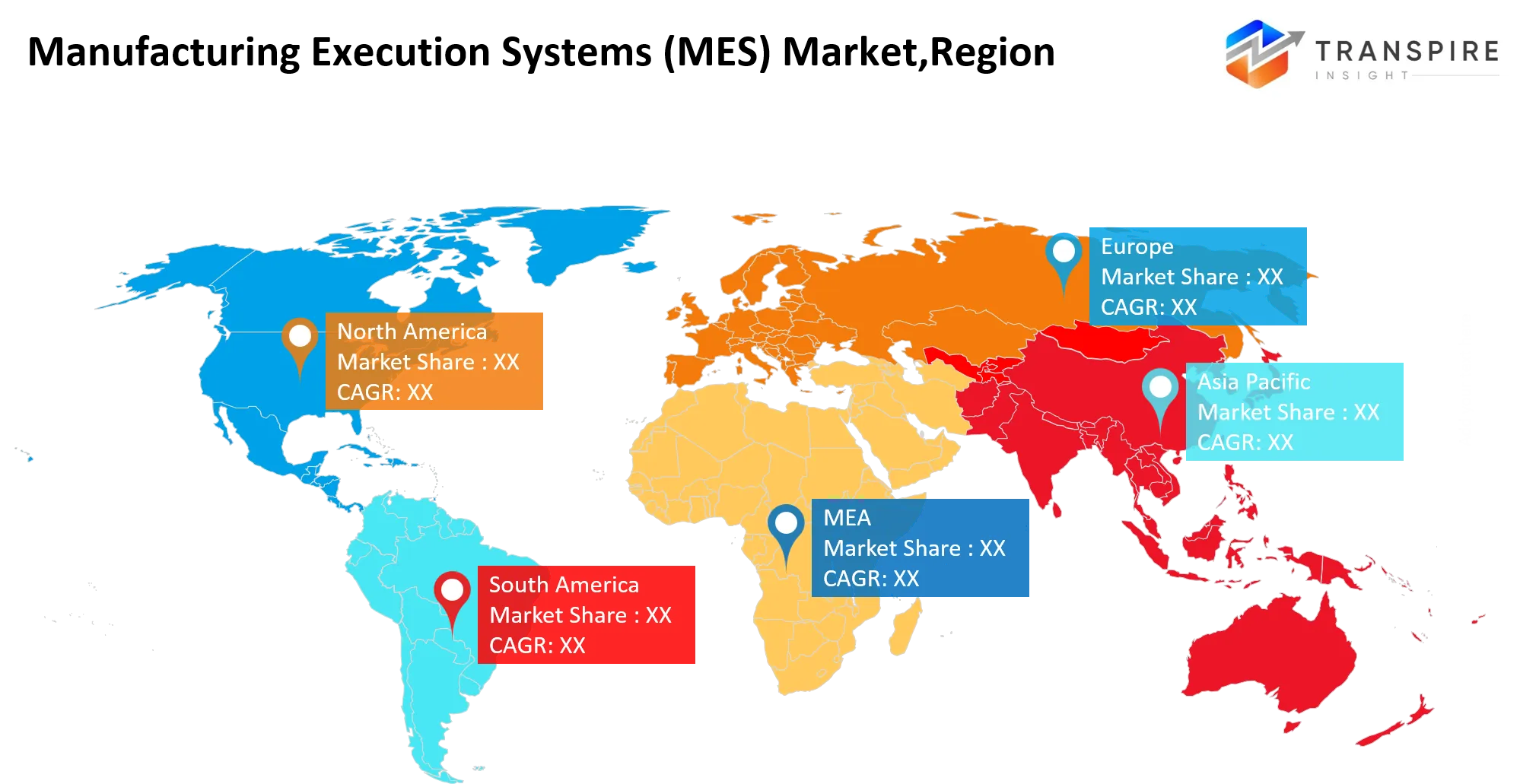
North America leads in the Manufacturing Execution Systems (MES) Market with 35.6% of market share, due to the existing industrial automation and manufacturing software provider infrastructure. The US is involved in manufacturing through investments in advanced manufacturing, semiconductors, the aerospace industry and automobile technologies. Manufacturers from this region prefer MES solutions to gain production transparency, maintain quality and to connect factory processes with enterprise applications. Government efforts to support local semiconductor production and industrial modernisation help build an MES adoption ecosystem.
In October 2026, Rockwell Automation launched the selection of its Plex Manufacturing Execution System (MES) by Dennen Manufacturing for better production visibility, quality management, and efficiency.
Europe
Europe holds a 23.0% share of the MES market, with its automotive, pharmaceuticals, chemicals and other industries benefiting from their manufacturing efficiency, sustainability and digitalisation. Many countries in Europe have established infrastructure of industrial automation and manufacturers with production technologies. Pharmaceutical, food processing and many other industries require strict compliance with regulations, which makes producers invest in MES solutions.
In February 2025, Siemens entered into collaboration with the pharmaceutical company Polpharma to deploy its Opcenter Execution Pharma MES for production monitoring, quality control, and digital manufacturing.
Asia-Pacific
The Asia Pacific region represents 30.5% of the market globally, with growth occurring at a rate of CAGR of 12.8%. Asia Pacific region represents the fastest growing market of all the other regions. Countries in the region such as China, Japan, South Korea, India, and Taiwan are improving their manufacturing capabilities due to investments in electronics, semiconductors, automotives, and automation technologies. This, coupled with increased investments from outside and efforts by government to improve manufacturing, has caused the manufacturers to improve their production process.
In July 2025, Rockwell Automation partnered with Taiwanese machinery company Tien Yuen Machinery (TYC) to deploy its Plex Cloud MES for improved production visibility and smart manufacturing.
Who are the Key Players in the Manufacturing Execution Systems (MES) Market and how do they compete?
The Manufacturing Execution Systems (MES) Market is characterised by intense competition among industrial automation, enterprise software providers, and specialised manufacturing technologies suppliers. Competitive factors are defined mainly by software capabilities, flexible integration, industry knowledge base, implementation models, and service support offered. Portfolio expansion is taking place through cloud-based solutions, AI integration, and advanced production analytics. Opcenter portfolio of Siemens provides integration capabilities for manufacturing operations, production planning, and multi-site solutions. Rockwell Automation specialises in FactoryTalk and Plex solutions for manufacturing execution in the context of industrial automation with cloud-enabled manufacturing. Dassault Systèmes differentiates through its DELMIA Apriso portfolio, providing the link between manufacturing execution and product lifecycle and digital manufacturing.SAP enhances its market position through enterprise manufacturing applications, which are connected to ERP systems. Honeywell specialises in industrial and regulated manufacturing applications. AVEVA competes through industrial data management and operational intelligence. Other competitors are represented in the market by Schneider Electric, Emerson, Infor, and Critical Manufacturing.
Manufacturing Execution Systems (MES) Market companies
- Siemens
- Rockwell Automation
- Dassault Systèmes
- SAP
- Honeywell
- Schneider Electric
- Emerson
- ABB
- AVEVA
- GE Digital
- Critical Manufacturing
- Werum
- iTAC Software
- Körber
- Plex Systems
|
Company |
Est. Revenue Share Range |
Key Offerings |
Strategic Positioning (5–10 words) |
Geographic Strength |
Technology Focus (5–10 words) |
|
Siemens AG |
5–7% |
Opcenter Execution, Opcenter X, Opcenter Intelligence, Opcenter APS |
leader in integrated digital manufacturing execution |
Europe, North America, Asia Pacific |
Digital twins, AI analytics, cloud MES, automation |
|
Rockwell Automation |
4–6% |
FactoryTalk MES, Plex MES, ProductionCentre, Plex Platform |
Automation-led provider with integrated cloud manufacturing solutions |
North America, Europe, Asia Pacific |
Industrial IoT, cloud MES, edge computing, analytics |
|
SAP SE |
3–5% |
SAP Digital Manufacturing, Manufacturing Execution, Resource Orchestration |
Enterprise manufacturing execution through ERP integration |
Europe, North America, Asia Pacific |
Cloud architecture, AI analytics, ERP integration |
|
Dassault Systèmes |
2–4% |
DELMIA Apriso, DELMIA MES, DELMIA MOM, 3DEXPERIENCE |
Digital manufacturing specialist with integrated PLM capabilities |
Europe, North America, Asia Pacific |
Digital twins, virtual manufacturing, PLM integration |
|
Schneider Electric (AVEVA) |
2–4% |
AVEVA MES, Batch Management, Operations Management |
Industrial software provider focused on operational integration |
Europe, North America, Asia Pacific |
Industrial AI, cloud analytics, real-time monitoring |
|
Honeywell International |
1.5–3.5% |
Honeywell Forge, Manufacturing Excellence, batch execution solutions |
Process manufacturing specialist with automation-led differentiation |
North America, Middle East, Asia Pacific |
Process automation, industrial analytics, production optimization |
|
ABB Ltd. |
1.5–3% |
ABB Ability Manufacturing Operations Management, production management solutions |
Automation-focused provider of connected manufacturing operations |
Europe, Asia Pacific, North America |
Industrial IoT, robotics integration, process analytics |
|
GE Vernova |
1.5–3% |
Proficy Plant Applications, Proficy MES, Operations Hub |
Industrial software specialist focused on production intelligence |
North America, Europe, Asia Pacific |
Industrial IoT, real-time analytics, predictive intelligence |
|
Emerson Electric Co. |
1–2.5% |
DeltaV MES, Syncade, batch management, electronic batch records |
Process industry specialist serving regulated manufacturers |
North America, Europe, Asia Pacific |
Electronic batch records, quality management, process automation |
|
Körber AG |
1–2.5% |
PAS-X MES, PAS-X Manufacturing Intelligence, PAS-X Savvy |
Pharmaceutical MES specialist with compliance-led differentiation |
Europe, North America, Asia Pacific |
Electronic batch records, serialization, data integrity |
Recent Development News
In July 2026, The Scaling MES Across the Enterprise industry study was conducted by Rockwell Automation. This study was carried out based on the outcomes of the research performed among 1,560 manufacturing decision makers in 17 different countries. The study discusses the challenges faced by manufacturers while implementing MES at the enterprise level.
In May 2025, the agreement was made between Siemens and Cybord through an OEM partnership in order to incorporate visual AI technology in their Opcenter MES platform. This collaboration is geared towards the automatic detection of defects in electronic parts while they are being manufactured.
What Strategic Insights Define the Future of the Manufacturing Execution Systems (MES) Market?
The future of the Manufacturing Execution Systems (MES) Market will witness the emergence of connected, cloud-enabled, and Artificial Intelligence-based manufacturing ecosystems. The vendors that provide manufacturing software that comprises of production monitoring, quality management, predictive analytics, and enterprise integration will gain competitive advantages in the future. Cloud manufacturing execution systems offer a significant growth opportunity as manufacturers seek scalable solutions without making any large investments in infrastructure. The risk that is not very obvious here is the challenges involved in implementing MES solutions along with legacy production machinery and non-connected enterprise systems. Poor quality of data and cybersecurity will hamper the benefits of digital manufacturing investments by manufacturers. It will be wise for vendors to emphasise interoperability, specific industry solutions, and proper data management instead of concentrating only on software capabilities. There is a growth opportunity in the expansion of the market in the Asia-Pacific region for semiconductor, electronics, automotive, and pharmaceutical manufacturing industries.
Offering
- Software
- Services
- Consulting
- Implementation
- Integration
- Maintenance
- Support
Deployment
- On-Premises
- Cloud
- Hybrid
- Private Cloud
- Public Cloud
- SaaS
- Hosted
Enterprise Size
- Large Enterprises
- Medium Enterprises
- Small Enterprises
- SMEs
- Multinational Corporations
- Government-Owned Plants
- Startups
Industry
- Automotive
- Electronics & Semiconductor
- Pharmaceuticals
- Food & Beverage
- Chemicals
- Aerospace & Defense
- Industrial Manufacturing
Function
- Production Tracking
- Quality Management
- Inventory Management
- Scheduling
- Performance Analysis
- Document Management
- Traceability
Architecture
- Standalone MES
- Integrated MES
- MOM Platform
- Cloud-Native MES
- Edge MES
- IIoT-Enabled MES
- AI-Enabled MES
Frequently Asked Questions
Find quick answers to common questions.
The Manufacturing Execution Systems (MES) Market size was valued at USD 17.60 Billion in 2025 and is poised to reach USD 41.60 Billion by 2033, expanding at a 11.7% CAGR.
Key segments for the Manufacturing Execution Systems (MES) Market are Offering (Software, Services, Consulting, Implementation, Integration, Maintenance, Support); Deployment (On-Premises, Cloud, Hybrid, Private Cloud, Public Cloud, SaaS, Hosted); Enterprise Size (Large Enterprises, Medium Enterprises, Small Enterprises, SMEs, Multinational Corporations, Government-Owned Plants, Startups); Industry (Automotive, Electronics & Semiconductor, Pharmaceuticals, Food & Beverage, Chemicals, Aerospace & Defense, Industrial Manufacturing); Function (Production Tracking, Quality Management, Inventory Management, Scheduling, Performance Analysis, Document Management, Traceability); Architecture (Standalone MES, Integrated MES, MOM Platform, Cloud-Native MES, Edge MES, IIoT-Enabled MES, AI-Enabled MES)
Growth is primarily driven by increasing adoption of Industry 4.0, rising demand for smart manufacturing and industrial automation, growing need for real-time production monitoring, integration of AI and IoT technologies, and increasing focus on improving operational efficiency, product quality, and manufacturing traceability
The market is led by major manufacturers including Siemens, Rockwell Automation, Dassault Systèmes, SAP, Honeywell, Schneider Electric, Emerson, ABB, AVEVA, GE Digital, Critical Manufacturing, Werum, iTAC Software, Körber, Plex Systems
The North American region dominates the MES Market with its 35.6% market share, owing to the high-level presence of advanced manufacturing sectors, technology vendors, and Industry 4.0 solutions. The rising investments in smart factories, industrial automation,
- Siemens
- Rockwell Automation
- Dassault Systèmes
- SAP
- Honeywell
- Schneider Electric
- Emerson
- ABB
- AVEVA
- GE Digital
- Critical Manufacturing
- Werum
- iTAC Software
- Körber
- Plex Systems
About the Authors

Mayur Shinde
I am Mayur Shinde, a Senior Research Analyst at Transpire Insight, specializing in the Automotive & Transportation and Information & Communication Technology (ICT) Industry. My work focuses on analyzing emerging market trends, technological advancements, competitive landscapes, and industry developments to deliver accurate, data-driven insights. I am passionate about transforming complex market information into clear, actionable content that helps businesses, professionals, and decision-makers stay informed and make confident strategic decisions.

Chakradhar Khansole
Chakradhar serves as the Research Director at Transpire Insight, bringing over 8 years of experience in technology, innovation, and strategic market intelligence. He specializes in transforming complex market data into actionable business insights that enable organizations to make informed, growth-oriented decisions. Recognized for his strategic vision and analytical expertise, Chakradhar leads high-impact research initiatives, delivering comprehensive market assessments, competitive intelligence, and forward-looking industry analysis.
Recently Published Reports
-
Apr 2026
3D Optical Profiler Market
3D Optical Profiler Market Size, Share & Analysis Report By Type (Desktop 3D Optical Profiler, and Portable 3D Optical Profiler), By Technology (Confocal Technology, and White Light Interference), By End-Use Industry (Manufacturing, Research Institutions, Automotive, Aerospace and Defense, Medical Devices, and Other), and Geography (North America, Europe, Asia-Pacific, Middle East and Africa, South and Central America), 2021 - 2031
-
Apr 2026
Depth Sensor Market
Depth Sensor Market Size, Share & Analysis Report By Type (Infrared Depth Sensors, Time-of-Flight (ToF) Sensors, Stereo Vision Sensors, Structured Light Sensors, Ultrasonic Depth Sensors), By Application (Automotive, Robotics, Gaming, Consumer Electronics, Industrial Automation, Healthcare, Security & Surveillance, Others), By End Users (Automotive Manufacturers, Consumer Electronics Companies, Healthcare Providers, Industrial Companies, Security Agencies, Gaming Companies, Robotics Companies, Others), and Geography (North America, Europe, Asia-Pacific, Middle East and Africa, South and Central America), 2021 – 2031
-
Apr 2026
Digital Manufacturing Market
Digital Manufacturing Market Size, Share & Analysis Report By Component (Hardware, Software, and Services), By Technology (Robotics, 3D Printing, Internet of Things (IoT), and Others), By Application (Automotive and Transportation, Aerospace and Defense, Consumer Electronics, Industrial Machinery, and Others), By Process Type (Computer-Based Designing, Computer-Based Simulation, Computer 3D Visualization, Analytics, and Others), and Geography (North America, Europe, Asia-Pacific, Middle East and Africa, South and Central America), 2021 – 2031
-
Apr 2026
Digital Visa Services Market
Digital Visa Services Market Size, Share & Analysis Report By Type (Individual Travelers, Group Travelers), By Application (Tourism, Business Travel, Others), and Geography (North America, Europe, Asia-Pacific, Middle East and Africa, South and Central America), 2021 – 2031