

Managed MPLS Market Summary:
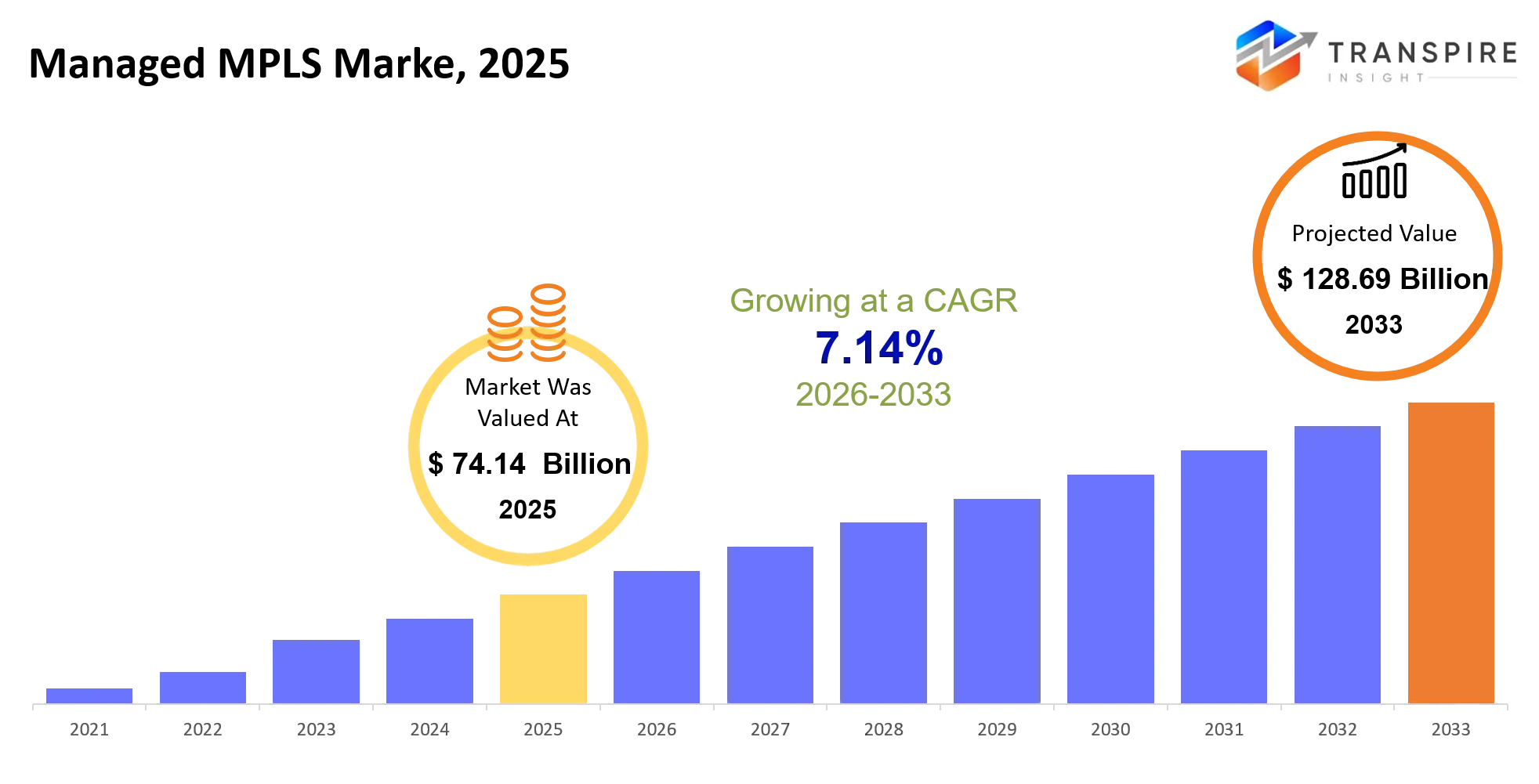
As per the Transpire Insight Analysis, The Managed MPLS Market size is estimated at USD 74.14 billion in 2025 and is anticipated to reach USD 128.69 billion by 2033, growing at a CAGR of 7.14% from 2026 to 2033.
The Managed MPLS Market offers the reassurance of a cost-effective, centrally managed secure connection between locations, data centres, the cloud, and other facilities for companies with critical traffic needs. Service providers are managing routing, traffic prioritisation, monitoring, and SLAs for enterprises, which helps ensure predictable performance for mission-critical applications. In the past three to five years, the market has shifted from point-to-point private networking to hybrid WANs and managed MPLS that incorporate broadband, DIA, and SD-WAN. This is driven by cloud adoption, distributed operations, and the pandemic-driven paradigm shift around cyber risk. Another key shift is the decoupling of network transport from application-aware traffic management so that companies can maintain MPLS for business-critical applications and shift low-value, non-sensitive traffic to lower-cost, broadband connections. TeleGeography's 2026 enterprise WAN study focuses on SD-WAN and DIA adoption trends, forcing managed MPLS providers to compete more on network availability, security, and application insight.
Managed MPLS Market Size & Forecast:
- Market Size 2025: USD 74.14 Billion
- Expected Market Value (2033): USD 128.69 Billion
- Forecast CAGR (2026–2033): 7.14%
- Leading Region in 2025: North America
- Fastest Growing Region: Asia Pacific
- Key Company Profiles: AT&T, Verizon, BT Group, Orange Business, Deutsche Telekom, NTT, Vodafone, Tata Communications, Lumen Technologies, Telefonica, Cisco, Colt Technology Services, Orange, Masergy, Hughes Network Systems.
Key Managed MPLS Market Insights:
Managed MPLS is evolving away from a private circuit and into a guaranteed underlay of AI-driven, security-embedded hybrid WANs where competitive advantage has less to do with owning a circuit, and more to do with orchestration, cloud reach, and application-level assurance.
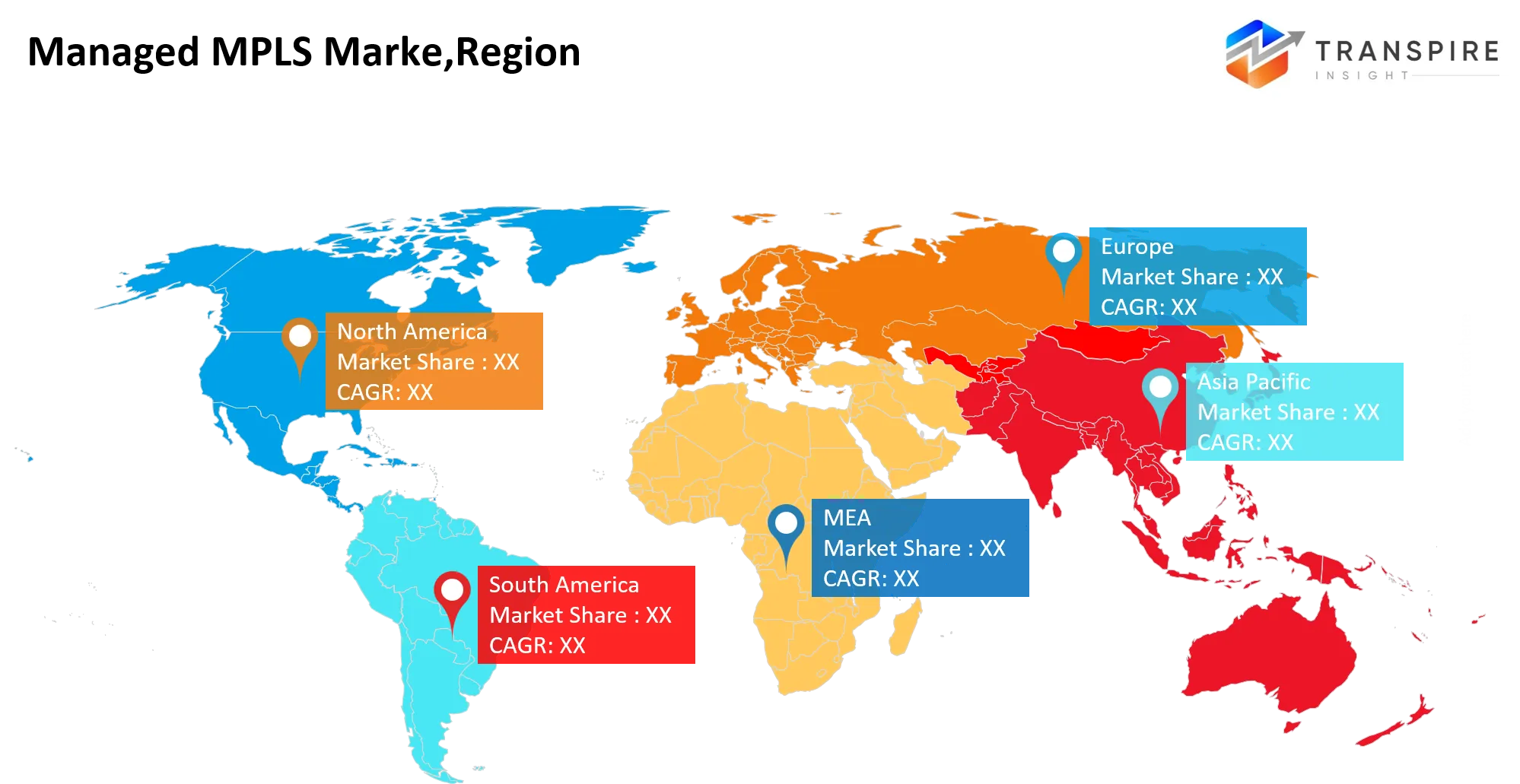
- North America holds the largest market share at 35.22%, bolstered by a robust enterprise network density and a strong growth rate for hybrid SD-WAN site expansion of 20.3%.
- Europe has 29.50% of the market, and BT's vendor-agnostic approach supports over 180 countries and 5,400+ points of presence.
- Asia-Pacific is the fastest-growing region, with a 7.61% CAGR, followed by manufacturing, digital public infrastructure, and cloud adoption.
- Latin America accounts for 6.20% of demand, focused on banking, retail, and cross-border enterprise connectivity.
- Middle East & Africa accounts for 5.08%, with new demand for managed-connectivity arising from government digitisation and energy-sector networks.
- AT&T differentiates with a single-contract portfolio for MPLS, internet, 5G and SD-WAN, and offers Cisco and Palo Alto Prisma options.
- Verizon differentiates itself with co-managed flexibility, multi-vendor support for Cisco and Versa, and integrated Zscaler or proprietary threat protection.
- Tata Communications is delivering cost-led innovation through MPLS-like SLAs, bandwidth on demand, and a network that spans over 150 countries with a 25-30% lower cost.
- The modernization, automation, and lifecycle-managed connectivity of the network-as-a-service model, provided by NTT DATA through SPEKTRA, are the key factors in the company's growth.
What are the Key Drivers, Restraints, and Opportunities in the Managed MPLS Market?
Driver:
Business continuity requirements and predictable application performance remain central growth drivers. Banks, government agencies and multinational businesses need controlled traffic paths for transactions, enterprise applications and voice communications. Hybrid work, cloud migration and the retirement of older telecommunications infrastructure have encouraged organisations to reassess network architectures. MPLS offers prioritised traffic handling and contractual performance commitments, while managed services reduce the need for internal teams to maintain complex, geographically distributed networks. This supports recurring service contracts and adoption among organisations with stringent uptime requirements.
Restraint:
High recurring circuit, maintenance, and management costs remain the key constraint. Roughly 49% of enterprises cite operational cost as a limitation, while SD-WAN and business broadband offer lower-cost alternatives for non-critical traffic. The issue persists because MPLS depends on carrier infrastructure, skilled engineering, and long-term contracts, making it difficult to reduce price without eroding service quality or provider margins.
Opportunity:
Hybrid WAN integration creates a practical expansion route. Providers can combine MPLS with SD-WAN, cloud interconnects, and automated traffic policies, preserving predictable performance for critical applications while directing other workloads through economical connections. Asia-Pacific offers opportunities as enterprises modernise regional networks and connect distributed operations. AI-assisted monitoring and flexible bandwidth provisioning can further improve service differentiation. Providers that offer unified management, transparent performance reporting and security integration are better positioned to retain existing customers and capture network-modernisation budgets.
Managed MPLS Market – Driver Impact Analysis
|
Driver |
Relative Impact on Growth (%) |
Geographic Relevance |
Impact Timeline |
Demand Strength |
Growth Mechanism |
Key Beneficiaries |
Major Constraint |
|
Hybrid SD-WAN and MPLS deployments for mission-critical traffic |
25% |
North America, Europe, Asia-Pacific |
Short-term (≤2 years) |
High |
Preserves predictable latency while optimizing hybrid WAN traffic |
Telecom operators, managed network providers, large enterprises |
Lower-cost internet alternatives reduce dedicated MPLS circuits |
|
Rising cloud applications and data-centre interconnectivity |
23% |
North America, Europe, Asia-Pacific |
Short-term (≤2 years) |
High |
Connects enterprise sites securely with cloud and data centres |
MPLS providers, cloud operators, multinational enterprises |
Cloud-native connectivity and direct internet access substitution |
|
Demand for secure, reliable enterprise WAN connectivity |
20% |
North America, Europe, Asia-Pacific |
Short-term (≤2 years) |
High |
Supports private routing, traffic prioritization, and contractual SLAs |
Financial institutions, healthcare networks, telecom operators |
High service costs and expanding alternative security architectures |
|
Expansion of 5G transport, mobile backhaul, and industrial IoT |
18% |
Asia-Pacific, Middle East, Europe |
Medium-term (2–4 years) |
High |
Carries aggregated mobile traffic with controlled latency and reliability |
Telecom carriers, infrastructure vendors, industrial enterprises |
Fibre deployment costs and competing IP transport technologies |
|
Outsourcing network operations and adopting automated managed services |
14% |
North America, Europe, Asia-Pacific |
Medium-term (2–4 years) |
Medium |
Reduces internal network-management workloads through outsourced expertise |
Managed service providers, network vendors, resource-constrained enterprises |
Budget constraints and migration toward managed SD-WAN services |
|
Total |
100% |
Global |
— |
— |
— |
— |
— |
What Has the Impact of Artificial Intelligence Been on the Managed MPLS Market?
AI is elevating managed MPLS from a manually directed and monitored transport service to an intelligent, dynamic policy-based network layer. Service providers use machine learning to gain insights from circuit utilisation, latency, jitter, or packet loss before a customer experience issue occurs by remotely adjusting quality-of-service policies or providing path change recommendations.
Automation has helped decrease operational friction. AI-enabled provisioning and zero-touch configuration speed up service activation, and anomaly detection offers earlier detection for congestion, bad links, or abnormal traffic volumes than rule-based monitoring. A predictive model can preemptively monitor to avoid capacity pressure, recommend path reroutes, and increase time to repair. Operationally, this takes provider teams out of ticket-based maintenance and into a closed-loop assurance structure that covers detection, decision, remediation, and validation. Enterprises benefit from fewer outages, a better application experience, and more transparent performance levels. The serious issue is the integration and accuracy of the models. Telemetry must be reliable and available from multi-vendor routers, SD-WAN controllers, cloud gateways, and security solutions; legacy gear or incomplete data can produce false positives or unreliable recommendations. Deployment costs and the expertise needed for network AI limit success among mid-sized companies.
In October 2026, Hewlett Packard Enterprise (HPE) announced the integration of its HPE Networking EdgeConnect SASE and SD-WAN platform into its HPE Mist and HPE Aruba Central management platforms. This deployment incorporates the Marvis AI engine across the full WAN stack, allowing enterprise IT teams to aggregate telemetry such as link utilisation, latency, jitter, and packet loss into a unified context.
Key Managed MPLS Market Trends:
Managed MPLS is developing from a standalone connectivity service to a part of an integrated enterprise WAN. Providers differentiate themselves with intelligent operations, flexible connectivity, and measurable application performance.
- As enterprises shift more traffic to broadband or SD-WAN links, they are keeping latency-sensitive and regulated traffic on MPLS.
- Hybrid MPLS-SD-WAN designs are the commercial standard, and providers are offering traffic steering, not just individual circuits.
- Security is becoming more similar to connectivity with the integration of security elements into managed services, such as firewalls, secure web gateways, and zero-trust controls.
- Multi-cloud interconnection is changing the demand landscape and forcing carriers to create direct and predictable links to hyperscaler environments.
- AI Assurance is shifting from dashboards to traffic rerouting and congestion prediction.
- Zero-touch provisioning is cutting activation time, with BT completing such automation.
- As carriers upgrade their backbones to support scalable, cloud-based networks, segment routing and SR-MPLS are coming to the fore.
- Compliance and uptime are still paramount in regulated sectors such as BFSI, healthcare, government, and manufacturing, where lowest-cost transport is less significant.
- Providers are increasing the number of regional partnerships to ensure uniform SLAs in Asia-Pacific, MEA, and Africa.
- The shift of the contract structure from "lock-in" to "managed services" is becoming more flexible and consumption-aware.
Managed MPLS Market Segmentation
Service Type:
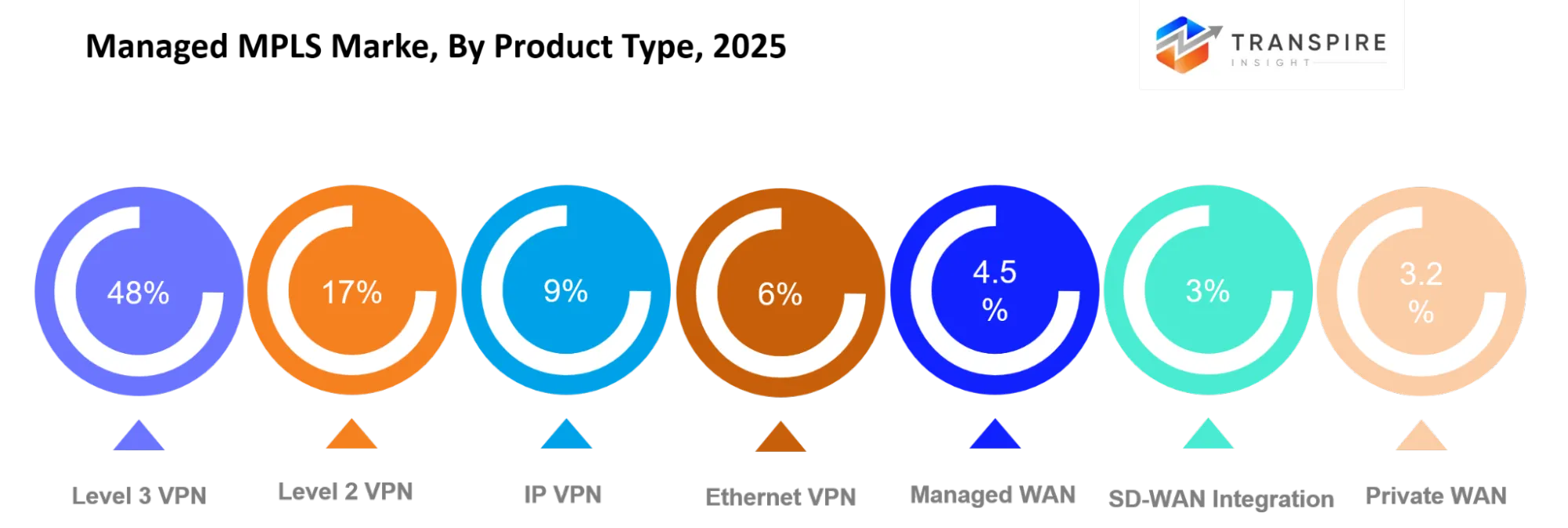
Level 3 VPN remains the market leader with a 57.48% share, mainly due to its evolution in supporting scalable IP-based site-to-site connectivity, multi-branch networking, and cloud access. Level 2 VPN constitutes 17.0% of the market share, although it is growing in use cases in which enterprises ask for Layer 2 transparency, such as connecting data centres or financial trading markets. IP VPN shares 9.0%, Ethernet VPN 6.0%, Managed WAN 4.5%, SD-WAN Integration 3.0%, Private WAN 2.0%, and Others 1.02%. These data clearly suggest that there is still a demand for customised solutions in terms of connectivity and not necessarily an engineering solution with one transport type.
Deployment:
On-premise solutions remain important for organizations requiring direct infrastructure control, customised configurations, and predictable performance. Cloud-based deployment supports flexible management, while hybrid architectures combine private network infrastructure with cloud connectivity. Hosted services reduce internal maintenance responsibilities, whereas private-cloud and public-cloud models address different security and scalability requirements. Edge deployment supports applications requiring local processing and low latency. Together, these options allow enterprises to modernise network operations gradually while balancing performance, operational control, and infrastructure expenditure.
Organization Size:
Large enterprises remain important customers because their geographically dispersed operations require reliable connectivity, centralised management, and contractual service commitments. Multinational corporations need consistent network performance across international offices and data centres. Mid-sized enterprises and SMEs can access managed networking without maintaining extensive specialist teams. Startups benefit from scalable service packages, while government bodies and public institutions prioritise availability, procurement requirements and information security. Providers combining MPLS with SD-WAN, managed security and simplified administration can address these differing operational and budgetary needs.
End User:
BFSI organisations depend on reliable connections for transaction processing, payment systems and sensitive financial information. IT and telecom companies require dependable infrastructure for enterprise applications and service delivery. Healthcare providers connect clinical systems, administrative platforms and multiple facilities, making network availability particularly important. Manufacturing businesses need stable connectivity between production sites and operational systems, while retailers link stores, payment platforms, and inventory databases. Government, education, and energy and utilities organisations use managed MPLS to support distributed operations, controlled information exchange and essential services.
Application:
Branch connectivity remains fundamental because enterprises need consistent communication between offices, headquarters, and shared business systems. Data-centre connectivity supports application access and information exchange, while cloud connectivity enables access to hosted platforms and distributed workloads. Secure networking helps protect communications, and voice and video applications require appropriate traffic prioritisation. IoT connectivity links connected equipment and monitoring systems, particularly across industrial environments. Remote access supports distributed workforces and external teams. These applications are encouraging providers to combine private connectivity with software-controlled routing and centralised performance monitoring.
Network Type:
IP MPLS remains important for routed enterprise traffic requiring predictable performance and controlled connectivity. Ethernet MPLS supports transport requirements between sites and infrastructure locations, while VPNs provide logical separation for business communications. Carrier Ethernet and private networks address specific connectivity and control requirements. Hybrid WAN combines MPLS with broadband or internet access, helping enterprises balance reliability and cost. SD-WAN-MPLS architectures add application-aware traffic management across multiple connections. This evolution positions MPLS as a component of flexible, centrally managed enterprise networking rather than an isolated transport solution.
What are the Key Use Cases Driving the Managed MPLS Market?
The core use case is multi-branch enterprise connectivity, closely associated with Level 3 VPN and the segment’s 57.48% share. Banks, government agencies and large retailers use managed MPLS to connect branches with central systems while prioritising transaction traffic and maintaining predictable application performance.
Expanding applications include data-centre interconnection, cloud access and voice-video communications. Healthcare providers and manufacturers benefit from reliable links between operational sites, central databases and business applications, while managed WAN services simplify monitoring across distributed facilities.
Emerging use cases combine MPLS with SD-WAN, edge infrastructure and IoT platforms. Manufacturers can retain controlled connectivity for operational systems while routing routine traffic through alternative links. This hybrid approach helps enterprises balance performance, resilience and connectivity costs without replacing critical infrastructure immediately.
|
Report Metrics |
Details |
|
Market size value in 2025 |
USD 74.14 Billion |
|
Market size value in 2026 |
USD 79.43 Billion |
|
Revenue forecast in 2033 |
USD 128.69 Billion |
|
Growth rate |
CAGR of 7.14% from 2026 to 2033 |
|
Base year |
2025 |
|
Historical data |
2021 - 2024 |
|
Forecast period |
2026 - 2033 |
|
Report coverage |
Revenue forecast, competitive landscape, growth factors, and trends |
|
Regional scope |
United States; Canada; Mexico; United Kingdom; Germany; France; Italy; Spain; Denmark; Sweden; Norway; China; Japan; India; Australia; South Korea; Thailand; Brazil; Argentina; South Africa; Saudi Arabia; United Arab Emirates |
|
Key companies profiled |
AT&T, Verizon, BT Group, Orange Business, Deutsche Telekom, NTT, Vodafone, Tata Communications, Lumen Technologies, Telefonica, Cisco, Colt Technology Services, Orange, Masergy, Hughes Network Systems. |
|
Customization scope |
Free report customization (country, regional & segment scope). Available customized purchase options to meet your exact research needs. |
|
Report Segmentation |
Service Type (Level 3 VPN, Level 2 VPN, IP VPN, Ethernet VPN, Managed WAN, SD-WAN Integration, Private WAN, Others)Deployment (On-Premise, Cloud-Based, Hybrid, Hosted, Private Cloud, Public Cloud, Edge, Others)Organization Size (Large Enterprises, SMEs, Government, Multinational Corporations, Mid-Sized Enterprises, Startups, Public Institutions, Others)End User (BFSI, IT & Telecom, Healthcare, Manufacturing, Retail, Government, Education, Energy & Utilities)Application (Branch Connectivity, Data Center Connectivity, Cloud Connectivity, Voice & Video, Secure Networking, IoT Connectivity, Remote Access, Others)Network Type (IP MPLS, Ethernet MPLS, VPN, Carrier Ethernet, Hybrid WAN, Private Network, SD-WAN-MPLS, Others) |
Which Regions are Driving the Managed MPLS Market Growth?
North America generated a major share in the Managed MPLS Market with a 35.22% share. North America is a mature telecom market with a high number of enterprise users and has a well-developed telecom ecosystem that caters to multinational corporations with wide fibre deployments and highly evolved carrier ecosystems providing enterprise-grade connectivity among office locations, data centres, and cloud environments. Several leading players like AT&T and Verizon offer their customers bundled services like managed SD-WAN, network automation, and connectivity. North America-based companies rely on their managed network solution for business continuity, predictable application performance, and outsourced network operations.
In October 2026, Verizon signed an AI infrastructure deal worth more than $2 billion with Amazon Web Services. This initiative will allow the carrier to provide high-capacity fibre-optic connectivity for AWS data centres, enabling faster, more reliable data transfers to support growing enterprise AI computing workloads.
Europe accounted for 29.50% of the market and benefited from cross-border enterprise activity, existing telecom providers, and the need for standardised governance of the network. Relative to North America, the competitive factors that are more prioritised in Europe include service coverage, regional connectivity, and compliance. BT Group, Orange Business, and Deutsche Telekom combine connectivity with cloud networking and managed security, leveraging their infrastructure and enterprise relationships to maintain stable demand when customers refresh their WAN environment.
In September 2026, Deutsche Telekom entered into a strategic partnership with Cloudflare to strengthen the security and resilience of digital infrastructure for enterprises across Europe.
Asia-Pacific stood at 24.00% and will grow at a CAGR of 7.61%. Growth in manufacturing and digital investments, as well as a more distributed business model, is creating demand for highly reliable connections between regional sites. Enterprise digitalisation in India and the evolving nature of Asia's cross-border supply chain are creating new opportunities for managed networks based on cloud-connected SD-WAN, where service providers with local network depth, combined with scalable quality-of-service management for cross-border networking, can thrive.
In October 2026, Vi Business, the enterprise arm of Vodafone Idea, partnered with Cisco to integrate Cisco Meraki’s cloud-managed networking capabilities into its Hybrid SD-WAN portfolio.
Who are the Key Players in the Managed MPLS Market, and how do they compete?
The competitive landscape is primarily centred on international network availability, service reliability, pricing and flexibility, and the ability to combine Multiprotocol Label Switching (MPLS) with cloud connectivity, SD-WAN, and security offerings. Carriers including AT&T and Verizon lean on extensive network presence and managed routing; BT Group, Orange Business, Deutsche Telekom, and NTT focus on multinational coverage, enterprise customer support, and combined digital services. Vodafone, Tata Communications, and Telefónica are positioned to enable distributed enterprise locations with international connectivity and regional network reach. Lumen Technologies emphasises enterprise connectivity and network modernisation; Colt Technology Services emphasises enterprise connectivity in key business centres; Hughes Network Systems offers a second option for sites where terrestrial network deployment is challenging; and leverage is based on coverage alliances, enterprise agreements, and combinations of private and internet-based connectivity.
Cisco emphasises competition in the networking technology, orchestration, and SD-WAN integration space rather than solely carrier infrastructure. Masergy (acquired by Comcast Business) is known for managed networking and security, emphasising competition through application-aware routing, automation, cloud access, and management. Newer market entrants and low-cost providers are increasingly competing based on cost and bandwidth flexibility and streamlined operations; premium offerings are positioning around performance guarantees, security, and support.
Key Players are:
- AT&T
- Verizon
- BT Group
- Orange Business
- Deutsche Telekom
- NTT
- Vodafone
- Tata Communications
- Lumen Technologies
- Telefonica
- Cisco
- Colt Technology Services
- Orange
- Masergy
- Hughes Network Systems
Managed MPLS Market — Enhanced Competitive Benchmarking
|
Company |
Est. Revenue Share Range |
Key Offerings |
Strategic Positioning |
Geographic Strength |
Technology Focus |
|
AT&T |
Estimated 8–12% |
Managed IP VPN, MPLS VPN, Ethernet VPN, WAN services |
Enterprise-scale leadership with integrated connectivity |
North America, Latin America, Europe |
MPLS traffic engineering, SD-WAN, cloud networking |
|
BT Group |
Estimated 7–10% |
MPLS VPN, IP Connect, Fabric, managed WAN |
enterprise networking with service-led differentiation |
Europe, Asia Pacific, North America |
Software-defined networking, network automation, cloud interconnect |
|
Verizon Business |
Estimated 6–9% |
Private IP, IP VPN, managed WAN, network services |
Reliability-led enterprise and multinational connectivity |
North America, Europe, Asia Pacific |
MPLS QoS, SD-WAN, secure hybrid networking |
|
Orange Business |
Estimated 5–8% |
Business VPN, IP VPN, Evolution Platform, managed WAN |
Integrated connectivity and managed services |
Europe, Africa, Middle East |
Network automation, cloud networking, SD-WAN |
|
NTT DATA |
Estimated 5–8% |
Managed IP VPN, WAN, managed network services, cloud connectivity |
Multinational network integration and managed operations |
Asia Pacific, North America, Europe |
Network orchestration, SD-WAN, cloud and hybrid WAN |
|
Vodafone Business |
Estimated 4–7% |
IP VPN, managed WAN, international connectivity, SD-WAN |
Multinational connectivity with strong European reach |
Europe, Africa, Asia Pacific |
Software-defined WAN, network virtualization, IoT connectivity |
|
Tata Communications |
Estimated 3–6% |
IZO managed WAN, IZO Internet WAN, IP VPN, cloud connectivity |
reach and cost-effective international networking |
Asia Pacific, Europe, North America |
Network-as-a-Service, SD-WAN, cloud interconnect |
|
Deutsche Telekom |
Estimated 3–5% |
Company IP VPN, managed WAN, international IP services, SD-WAN |
Enterprise networking anchored by European infrastructure |
Europe, North America, Asia Pacific |
Hybrid WAN, network virtualization, cloud integration |
|
Lumen Technologies |
Estimated 3–5% |
IP VPN, MPLS connectivity, managed network services, Ethernet WAN |
Fiber-backed enterprise connectivity and network modernization |
North America, Europe, Asia Pacific |
Private fiber, SD-WAN, network automation |
|
Colt Technology Services |
Estimated 2–4% |
IP VPN, Ethernet VPN, IP Access, managed WAN |
Metro-fiber specialization and enterprise-focused connectivity |
Europe, Asia Pacific |
Software-defined networking, Ethernet, cloud connectivity |
Recent Development News
In April 2026, Spectrotel and AireSpring announced a merger to combine their managed network services, connectivity, and network infrastructure capabilities. The transaction is expected to expand their service scale and strengthen their ability to deliver integrated enterprise connectivity solutions.
In July 2026, GTT Communications expanded its partnership with HPE to introduce additional managed SASE and LAN/WLAN services for enterprise customers. The expansion broadens GTT’s managed networking portfolio by combining secure access, centralized network management, and cloud-to-edge connectivity capabilities.
In July 2026, Lumen Technologies completed its acquisition of Alkira, integrating cloud-native networking software with its physical network infrastructure and programmable connectivity capabilities. The combination strengthens on-demand enterprise networking across hybrid-cloud and multi-cloud environments, supporting more flexible management of complex corporate networks.
What Strategic Insights Define the Future of the Managed MPLS Market?
The Managed MPLS Market is 9 evolving towards hybrid connectivity, in which private network connectivity continues alongside SD-WAN and cloud interconnects, together with intelligent traffic management. Providers will be increasingly challenged to deliver tangible application and operational value, rather than compete solely on bandwidth. A hidden threat lies in the potential for Enterprises to underutilise expensive legacy circuits, holding onto them for longer than necessary and thereby incurring costs while delaying digital transformation initiatives. In addition, server sprawl, inconsistent telemetry and the use of disparate carriers can enable automation challenges and increase operational exposure.
Providers can look to improve customer loyalty through flexible migration plans that retain critical MPLS routes but migrate appropriate workloads to a different connect. Strategic investments should be made towards interoperable management platforms, predictive fault detection, service level transparency, and cloud interoperability partnerships. Enterprises should evaluate total lifecycle costs, alongside resilience, security, and application performance, in order to safeguard current revenue streams, while beginning to adopt a more flexible, agile service.
Key Segmentations are:
Service Type
- Level 3 VPN
- Level 2 VPN
- IP VPN
- Ethernet VPN
- Managed WAN
- SD-WAN Integration
- Private WAN
- Others
Deployment
- On-Premise
- Cloud-Based
- Hybrid
- Hosted
- Private Cloud
- Public Cloud
- Edge
- Others
Organization Size
- Large Enterprises
- SMEs
- Government
- Multinational Corporations
- Mid-Sized Enterprises
- Startups
- Public Institutions
- Others
End User
- BFSI
- IT & Telecom
- Healthcare
- Manufacturing
- Retail
- Government
- Education
- Energy & Utilities
Application
- Branch Connectivity
- Data Centre Connectivity
- Cloud Connectivity
- Voice & Video
- Secure Networking
- IoT Connectivity
- Remote Access
- Others
Network Type
- IP MPLS
- Ethernet MPLS
- VPN
- Carrier Ethernet
- Hybrid WAN
- Private Network
- SD-WAN-MPLS
- Others
Frequently Asked Questions
Find quick answers to common questions.
The managed MPLS market size was valued at USD 74.14 billion in 2025 and is poised to reach USD 128.69 billion by 2033, expanding at a 7.14% CAGR.
Key segments for the managed MPLS market are Service Type (Level 3 VPN, Level 2 VPN, IP VPN, Ethernet VPN, Managed WAN, SD-WAN Integration, Private WAN, Others)Deployment (On-Premise, Cloud-Based, Hybrid, Hosted, Private Cloud, Public Cloud, Edge, Others)Organization Size (Large Enterprises, SMEs, Government, Multinational Corporations, Mid-Sized Enterprises, Startups, Public Institutions, Others)End User (BFSI, IT & Telecom, Healthcare, Manufacturing, Retail, Government, Education, Energy & Utilities)Application (Branch Connectivity, Data Center Connectivity, Cloud Connectivity, Voice & Video, Secure Networking, IoT Connectivity, Remote Access, Others)Network Type (IP MPLS, Ethernet MPLS, VPN, Carrier Ethernet, Hybrid WAN, Private Network, SD-WAN-MPLS, Others).
Growth is primarily driven by enterprise network modernisation, demand for reliable multi-site connectivity, cloud adoption, secure data transmission, hybrid WAN integration, and outsourced network management.
The managed MPLS market is led by major manufacturers including AT&T, Verizon, BT Group, Orange Business, Deutsche Telekom, NTT, Vodafone, Tata Communications, Lumen Technologies, Telefonica, Cisco, Colt Technology Services, Orange, Masergy, Hughes Network Systems.
North America holds a 35.22% market share, supported by mature telecommunications infrastructure, strong enterprise connectivity requirements, established service providers, and widespread adoption of managed networking solutions.
Key opportunities include SD-WAN integration, AI-enabled network management, hybrid WAN modernisation, cloud connectivity and managed security services.
- AT&T
- Verizon
- BT Group
- Orange Business
- Deutsche Telekom
- NTT
- Vodafone
- Tata Communications
- Lumen Technologies
- Telefonica
- Cisco
- Colt Technology Services
- Orange
- Masergy
- Hughes Network Systems
About the Authors

Mayur Shinde
I am Mayur Shinde, a Senior Research Analyst at Transpire Insight, specializing in the Automotive & Transportation and Information & Communication Technology (ICT) Industry. My work focuses on analyzing emerging market trends, technological advancements, competitive landscapes, and industry developments to deliver accurate, data-driven insights. I am passionate about transforming complex market information into clear, actionable content that helps businesses, professionals, and decision-makers stay informed and make confident strategic decisions.

Chakradhar Khansole
Chakradhar serves as the Research Director at Transpire Insight, bringing over 8 years of experience in technology, innovation, and strategic market intelligence. He specializes in transforming complex market data into actionable business insights that enable organizations to make informed, growth-oriented decisions. Recognized for his strategic vision and analytical expertise, Chakradhar leads high-impact research initiatives, delivering comprehensive market assessments, competitive intelligence, and forward-looking industry analysis.
Recently Published Reports
-
Apr 2026
3D Optical Profiler Market
3D Optical Profiler Market Size, Share & Analysis Report By Type (Desktop 3D Optical Profiler, and Portable 3D Optical Profiler), By Technology (Confocal Technology, and White Light Interference), By End-Use Industry (Manufacturing, Research Institutions, Automotive, Aerospace and Defense, Medical Devices, and Other), and Geography (North America, Europe, Asia-Pacific, Middle East and Africa, South and Central America), 2021 - 2031
-
Apr 2026
Depth Sensor Market
Depth Sensor Market Size, Share & Analysis Report By Type (Infrared Depth Sensors, Time-of-Flight (ToF) Sensors, Stereo Vision Sensors, Structured Light Sensors, Ultrasonic Depth Sensors), By Application (Automotive, Robotics, Gaming, Consumer Electronics, Industrial Automation, Healthcare, Security & Surveillance, Others), By End Users (Automotive Manufacturers, Consumer Electronics Companies, Healthcare Providers, Industrial Companies, Security Agencies, Gaming Companies, Robotics Companies, Others), and Geography (North America, Europe, Asia-Pacific, Middle East and Africa, South and Central America), 2021 – 2031
-
Apr 2026
Digital Manufacturing Market
Digital Manufacturing Market Size, Share & Analysis Report By Component (Hardware, Software, and Services), By Technology (Robotics, 3D Printing, Internet of Things (IoT), and Others), By Application (Automotive and Transportation, Aerospace and Defense, Consumer Electronics, Industrial Machinery, and Others), By Process Type (Computer-Based Designing, Computer-Based Simulation, Computer 3D Visualization, Analytics, and Others), and Geography (North America, Europe, Asia-Pacific, Middle East and Africa, South and Central America), 2021 – 2031
-
Apr 2026
Digital Visa Services Market
Digital Visa Services Market Size, Share & Analysis Report By Type (Individual Travelers, Group Travelers), By Application (Tourism, Business Travel, Others), and Geography (North America, Europe, Asia-Pacific, Middle East and Africa, South and Central America), 2021 – 2031