

Continuing Education Market Summary:
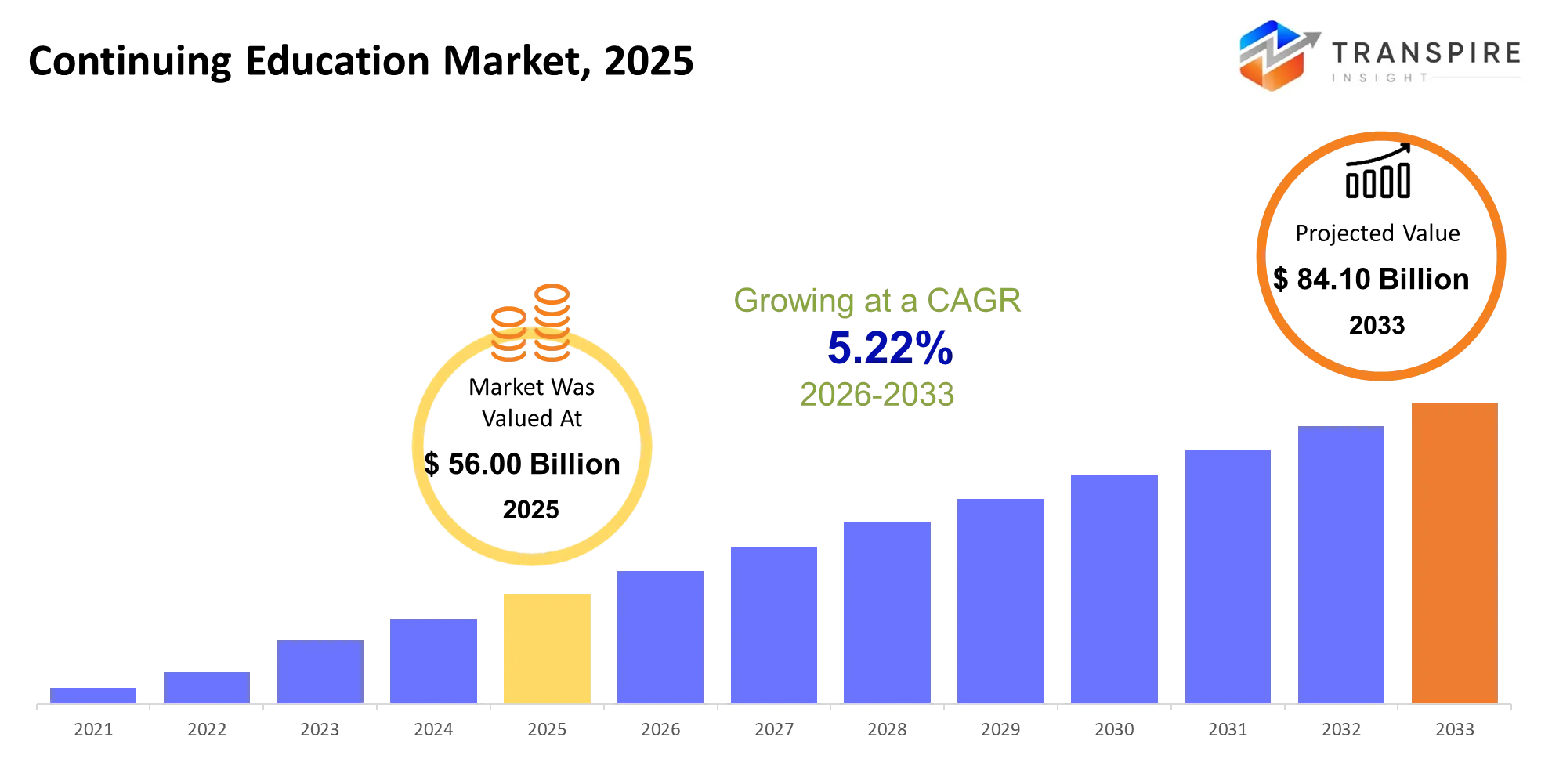
As per Transpire Insight, the Continuing Education Market size is estimated at USD 56.00 billion in 2025 and is anticipated to reach USD 84.10 billion by 2033, growing at a CAGR of 5.22% from 2026 to 2033.
The continuing education market is changing. People who work for the companies they work for and the schools they attend are looking for ways to make sure their skills stay useful during their whole working life. In the past three to five years, learning has gone beyond regular classrooms. Now it includes classes, professional certificates, virtual classrooms and learning that you can do on your own time. A big change is the increasing use of learning platforms. These tools let people learn while they keep their jobs. Fast progress in intelligence, automation and cloud computing has made it even more important to have updated technical and management skills. Employers are also focusing more on showing that someone has the skills when they hire or promote workers. These changes are making universities, training companies and online education providers create career-focused programs. Because of this, the market is moving toward learning models that fit with work needs, career growth and what industries expect.
Continuing Education Market Size & Forecast:
- Market Size 2025: USD 56.00 Billion
- Expected Market Value (2033): USD 84.10 Billion
- Forecast CAGR (2026–2033): 5.22%
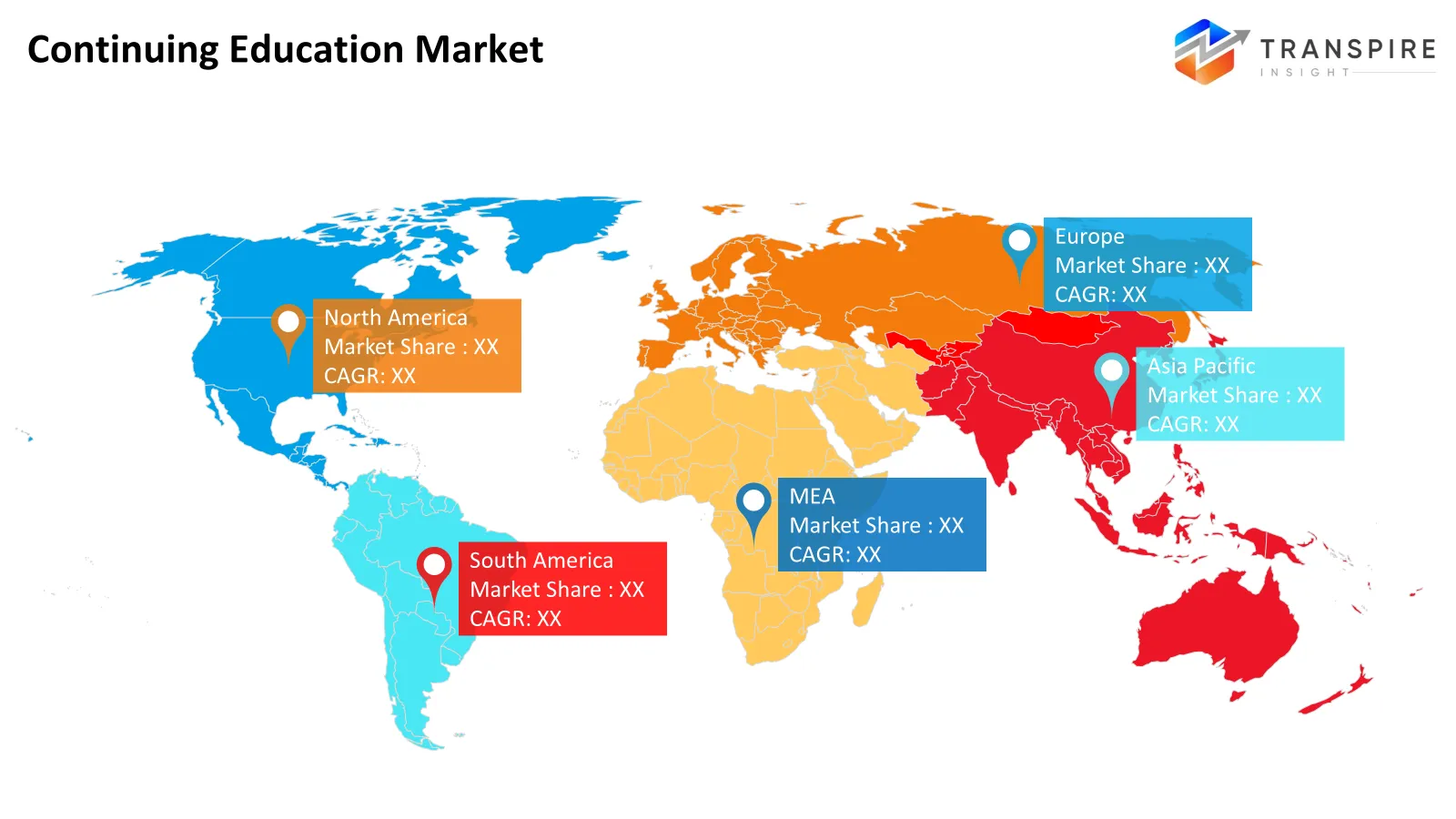
- Leading Region in 2025: North America
- Fastest Growing Region: Asia Pacific
- Key Company Profiles: Coursera, edX, Udemy, LinkedIn Learning, Pearson, Kaplan, Wiley, McGraw Hill, Skillsoft, Pluralsight, 2U, Udacity, FutureLearn, Blackboard, Instructure
Key Market Insights:
The market is moving towards flexible delivery methods, work-based credentials, and technology-enabled learning; these increasingly influence the continuing education market.
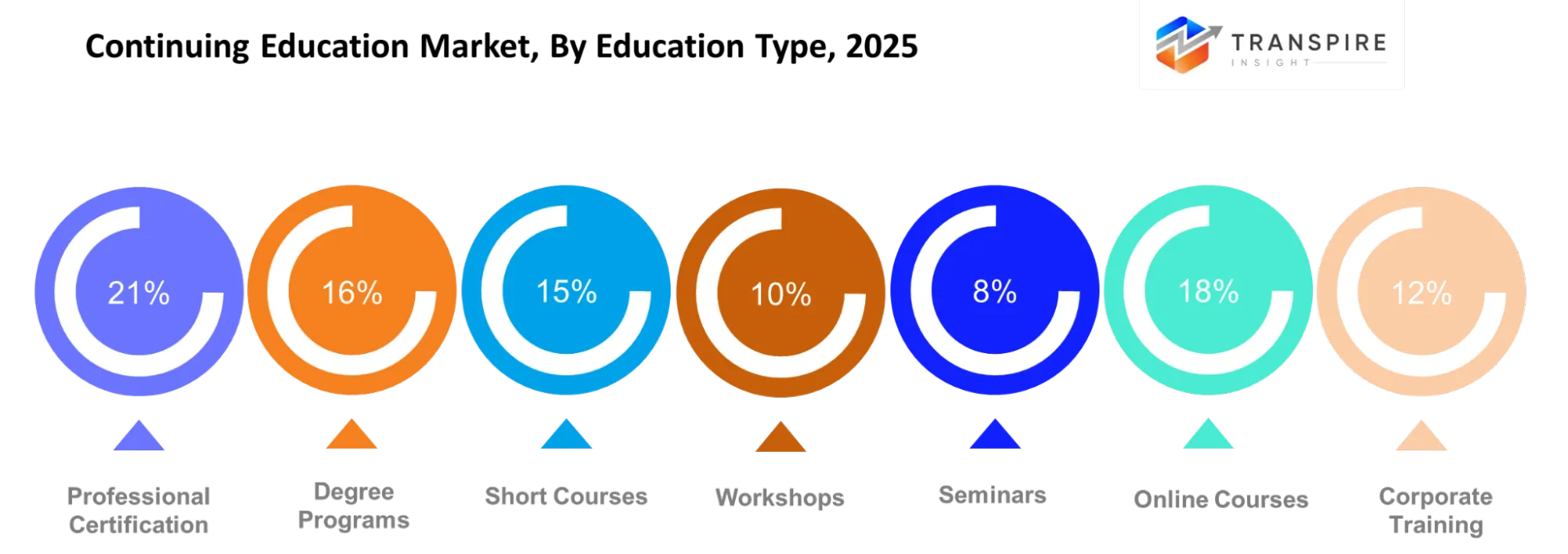
- Certification holds 21.00% of the total education categories given above, as certifications play an important role when advancing in a career.
- Degree programs represent 16.00% of the market share as people will always be looking for academic qualification programs that could help them grow in the long run.
- Short courses represent 15.00% of the total distribution, allowing professionals to acquire specialised skills without having to enrol in lengthy academic programs.
- Workshops account for 10.00% of the total market distribution, helping people learn through live demonstrations, practice, and feedback from trainers.
- Seminars hold 8.00% of the total education categories, helping professionals learn about changes in their industries and share knowledge.
- Corporate training represents 7.00% of the distribution, helping companies address skill gaps in the workforce and prepare for technology change.
What are the Key Drivers, Restraints, and Opportunities in the Continuing Education Market?
Drivers:
In the workplace, fast-paced adoption of new technologies is also motivating workers to 're-skill' more often. As generative AI, cloud, cybersecurity, and data analysis grow, there's a demand for 'learning' that extends beyond academic degree-based education; corporate training and professional certification courses are on the rise. Education providers can capitalise on this trend through learning courses, subscriptions, enterprise licenses and certifications. Online delivery of training courses can also be geographically agnostic, allowing for a larger market.
Restraints:
Cost of courses, disparities in internet access, low learner involvement, and clarity on what the credential means are still barriers to participation. Employers may lack the resources to pay for training, and working adults may be unsure how they can fit it around their job. Providers may not be able to update courses to meet changing skills requirements, and learners may be reluctant to undertake further courses if the credential doesn't provide tangible employment advantages.
Opportunities:
Personalised learning through technology-enabled education and certification with employers can be scaled. AI-powered mentoring can make it possible for providers to personalise learning for each learner. The collaboration with universities and technology firms can validate courses. In APAC, there are new market areas where providers can reach new, rapidly-growing professional segments of audiences through a low-cost and mobile-friendly platform. The providers who go beyond the learning and link the certification with employability will be better placed to retain learners and earn revenues.
|
Driver |
Relative Impact on Growth (%) |
Geographic Relevance |
Impact Timeline |
Demand Strength |
Growth Mechanism |
Key Beneficiaries |
Major Constraint |
|
Workforce upskilling and reskilling requirements |
30% |
North America, Europe, Asia-Pacific |
Short-term |
High |
Addresses skill gaps caused by AI and automation |
Corporate trainers, online platforms, working professionals |
Limited training budgets and employee learning time |
|
Expansion of online and hybrid learning platforms |
25% |
Asia-Pacific, North America |
Short-term |
High |
Expands flexible access through scalable digital courses |
EdTech firms, universities, technology vendors, learners |
Unequal internet access and inconsistent course quality |
|
Rising demand for professional certifications and micro-credentials |
18% |
North America, Europe, Asia-Pacific |
Medium-term |
High |
Validates job-ready skills and supports career advancement |
Certification bodies, universities, employers, professionals |
Variable employer recognition and credential credibility |
|
Government initiatives and lifelong learning policies |
15% |
Asia-Pacific, Europe |
Medium-term |
Medium |
Public funding expands affordable adult education opportunities |
Public institutions, training providers, underserved learners |
Funding uncertainty and fragmented programme implementation |
|
AI-powered personalized learning and industry-specific training |
12% |
North America, Asia-Pacific, Europe |
Long-term |
High |
Personalizes learning pathways and improves training relevance |
AI vendors, learning platforms, employers, learners |
Data privacy risks and high implementation costs |
|
Total |
100% |
— |
— |
— |
— |
— |
— |
What Has the Impact of Artificial Intelligence Been on the Continuing Education Market?
The use of artificial intelligence is reshaping the approach to the creation of courses, helping learners, and evaluating the results of the training process. The AI-powered platforms are capable of suggesting courses in accordance with the skills, career aims, test scores and the speed of learning of the learners. Such an approach enables continuing education providers to create individual learning plans rather than the course plans that are uniform for all learners. Automation is useful when completing such administrative tasks as creating tests, giving feedback, answering the questions of the learners, and tracking their progress. Predictive analysis is able to identify at-risk learners and thus give an opportunity to instructors to give additional assistance before the rates of dropout start growing. Coursera and Udemy have already implemented AI-powered solutions for learning. These examples demonstrate that the approach to the learning process is becoming interactive and personalised. Although such tools may help providers become more efficient in delivering courses, there are certain drawbacks of the use of AI in the process of training. It might be expensive and difficult to implement AI in existing learning management systems. The explanations generated by AI might be false or not clear.
Instance:
in September 2026, Project Helix, which was launched by Coursera, is a platform that employs artificial intelligence to assist companies in discovering gaps in employee skills, creating personalised training programs, and verifying employee skills. The launch of this project has been making more professionals value technological learning.
Key Market Trends:
The continuing education industry is evolving from sporadic training to lifelong, career-based learning. Instructors have been integrating e-learning with practical evaluation, certifications, and skills that employers look for.
- Short-term learning. Suppliers are developing learning modules that offer more learning opportunities within a shorter time period to suit individuals’ busy work and personal schedules.
- Learners have become concerned about acquiring qualifications as proof of particular skills and not only course completion.
- Learning platforms are integrating intelligent recommendations and automated feedback and practice.
- Learning content is increasingly made available via employers' subscriptions and corporate LMS as well as via training integrated into the daily work process.
- Flexibility offered by learning platforms allows individuals to continue training even during the workday without having to leave their place of employment.
- Educational institutions collaborate with industry representatives to develop a curriculum that would reflect contemporary workplace needs.
- Simulations and practical assignments have become an essential addition to traditional teaching methodologies such as recorded classes and assessments in the form of tests.
Continuing Education Market Segmentation
By education type:
Professional certification constitutes 21% of the given categories, becoming the largest category in the provided distribution. Degree programs constitute 16%, and short courses 15%. Workshops make 10%, seminars 8%, corporate training 7% and continuing professional development 5%. Online courses make up 18% of the distribution. Professional certifications can become a magnet for students wishing to prove competence, whereas short courses can be a faster way to learn some special skills and techniques. Degree programs will always be needed for academic advancement. In the future, providers offering not only recognition but also practical assessment will increase the appeal of their offerings.
By delivery mode:
Online is the largest segment for delivering accredited courses, with online and self-paced learning expected to grow at a CAGR of 12.60%. The other delivery options for the broader landscape are online, offline, hybrid, mobile learning, virtual classroom, self-paced learning and instructor-led. Providing online delivery enables the provider to be geographically independent, without the need for a physical location. Self-paced courses satisfy learners needing flexibility, while instructor-led learning offers chat and immediate feedback; hybrid courses offer the best of both worlds. Competition in the future can be expected to revolve around access, engagement, certification and demo of real competency.
By subject area:
The skills learned in the market include healthcare, business, technology, education, engineering, finance, law, and personal development. There is no percentage score for each subject in the data available, so it is impossible to create a scale from 1 to 10. For instance, technology learning can also assist them in staying updated with the needs of AI, software development, cloud computing, and cybersecurity. Healthcare professionals are always undergoing training to ensure that they stay updated with clinical practice and professional standards, and finance and law learners should also know about the new technical and regulatory specifications. Niche industry curricula offered by the providers, responding to changing needs by updating their curriculum, and consistent delivery of training to individuals who want to learn new skills will be more successful in persuading the customers to enrol in the classes again.
By learner type:
The market is catering for working professionals, students, executives, healthcare professionals, teachers, government professionals and career changers. No separate shares by respective percentage have been given in these sections. Working professionals may look for shorter, more flexible options to improve current job performance or advancement potential. Students might be interested in augmenting their formal education with practical skill training. Executives might want leadership and strategic management concepts. Healthcare professionals and teachers are likely to require continued professional development at work. Future growth potential would depend on providing the appropriate duration, cost and certification options for each submarket, instead of developing a one size fits all strategy.
By provider type:
The market comprises universities, colleges, professional associations, training companies, corporate universities, online providers and government entities. The uploaded document does not show the percentages attributable to each type of provider. Universities and colleges bring academic expertise and prescribed qualifications, while professional associations offer development and recognition against occupational standards. Commercial training companies are more able to adapt to changing employer needs. Online providers can make courses available across many regions. . Providers can build their market share through partnerships, recognised credentials, relevant course offerings and learner support.
By end user:
The market involves individuals, corporate customers, governmental organisations, educational organisations, professional organisations, healthcare organisations, and non-profit organisations. No information on the percentage breakdown of customers is provided within the report. Individuals will possibly pay for obtaining certification or specialised training courses so that they can improve their career prospects. The corporates may have to pay for training programs that can assist their employees to acquire proficiency in a new system. The government organization will be required to finance continuing education programs that will support public sector development and work force development programs. The healthcare organisations will be in need of training to comply with new professional requirements.
What are the Key Use Cases Driving the Continuing Education Market?
Professional certification is one of the use cases of the continuing education market, based on the provided education type distribution. Professionals turn to certification programs to show their competencies, enhance their job application process, and prepare for future opportunities. Short courses also provide a means for learners to gain certain skills without the need to go through the whole degree program. Another important use case is corporate training, particularly for new software, digital processes, or regulations adoption. Customised programs can be developed by healthcare organizations, banks, educational establishments, and IT companies to address the learning requirements of certain professions. Other use cases of the market include AI-driven work environment simulations, personalized reskilling courses, mobile learning, and responsible AI adoption training. Such use cases give providers the opportunity to create adaptable programs connected with workplace outcomes.
|
Report Metrics |
Details |
|
Market size value in 2025 |
USD 56.00 Billion |
|
Market size value in 2026 |
USD 58.91 Billion |
|
Revenue forecast in 2033 |
USD 84.10 Billion |
|
Growth rate |
CAGR of 5.22% from 2026 to 2033 |
|
Base year |
2025 |
|
Historical data |
2021 - 2024 |
|
Forecast period |
2026 - 2033 |
|
Report coverage |
Revenue forecast, competitive landscape, growth factors, and trends |
|
Regional scope |
United States; Canada; Mexico; United Kingdom; Germany; France; Italy; Spain; Denmark; Sweden; Norway; China; Japan; India; Australia; South Korea; Thailand; Brazil; Argentina; South Africa; Saudi Arabia; United Arab Emirates |
|
Key company profiled |
Coursera, edX, Udemy, LinkedIn Learning, Pearson, Kaplan, Wiley, McGraw Hill, Skillsoft, Pluralsight, 2U, Udacity, FutureLearn, Blackboard, Instructure |
|
Customization scope |
Free report customization (country, regional & segment scope). Avail customized purchase options to meet your exact research needs. |
|
Report Segmentation |
Education Type (Professional Certification, Degree Programs, Short Courses, Workshops, Seminars, Online Courses, Corporate Training, Continuing Professional Development); Delivery Mode (Online, Offline, Hybrid, Mobile Learning, Virtual Classroom, Self-Paced, Instructor-Led); Subject Area (Healthcare, Business, Technology, Education, Engineering, Finance, Law, Personal Development); Learner Type (Working Professionals, Students, Executives, Healthcare Professionals, Teachers, Government Employees, Career Changers); Provider Type (Universities, Colleges, Professional Associations, Training Companies, Corporate Universities, Online Platforms, Government Institutions); End User (Individuals, Corporates, Government, Healthcare Organizations, Educational Institutions, Professional Bodies, Nonprofits) |
Which Regions are Driving the Continuing Education Market Growth?
North America:
North America accounts for the largest share, with 36.50% of the market. The region has a well-developed university sector, professional certification organisations, existing corporate learning programs, and digital education providers. Developing in-house skills and expertise among the wider workforce and technological skills among employees can lead to demand from employers for skills training providers among business, healthcare, financial services, and tech sectors. The existing institutional and commercial structures support demand for both formal and flexible forms of professional learning.
In February 2026, Google launched an AI Professional Certificate via Coursera to assist professionals in acquiring practical skills related to generative AI. This initiative also offered free access to selected U.S. small businesses to promote workforce upskilling and create more demand for flexible and career-focused continuing education programs.
Europe:
Europe represents 29.00% of the worldwide market for providing continuing education, the second-largest area from which distribution is supplied. Europe's market is based on mature higher education systems, professional associations, employers' training programs, and continuing development requirements for regulated occupations. In contrast to North America, the prospects of the European market lie in one another across-border education, professional requirements, and multilingual distribution of educational courses. Education providers that localise their courses into regional languages and meet professional requirements achieve a greater industry presence in Europe.
In July 2026, EIT Culture & Creativity launched a funding scheme for continuing professional development courses for the audiovisual media industry in Europe. This initiative is designed to help professionals learn new skills related to artificial intelligence, intellectual property, and digital storytelling.
Asia Pacific:
Asia Pacific accounts for 24.00% of the total market share of the continuing education Market and is Asia-Pacific's fastest-growing region. CAGR 10.80%. Digital penetration and mobile access, along with workforce upskilling programs and growing talent needs for digital skills, may drive online education providers that serve learners in both education and skills development. The variety of learners in the region could urge providers to build competitive and affordable courses and content local to the learners.
In January 2026, Singapore launched its Workfare Skills Support Level-Up program to assist eligible workers in pursuing further education and gaining skills relevant to their careers. The program promotes long-term training and qualifications, such as diploma courses and career change programs.
Who are the Key Players in the Continuing Education Marketand how do they compete?
The competition in the continuing education market across the world is among online learning portals, universities, professional education companies, and enterprise education providers. Firms compete based on their course affordability, credential recognition, coverage, learning experience, and enterprise learning solutions. The combination of Coursera and Udemy, which is to be completed by the serves as an example of a strategy where university-sponsored programs and a wide-ranging network of courses and instructors can be leveraged. Coursera and Udemy cater to flexible digital learning and developing career-related skills. They have partnered with universities and tech firms to offer professional certificates and structured learning paths. LinkedIn Learning is set apart from other firms by virtue of career-oriented education within a professional network. On the other hand, Pearson competes with the help of educational content creation, assessments and professional learning programs. Universities and Professional Associations rely on academic reputation and specialised education. The trend in the industry is for companies to expand through employer relationships, localisation of course catalogues, assessments, and certification, and communication skills.
Continuing Education Market companies
- Coursera
- edX
- Udemy
- LinkedIn Learning
- Pearson
- Kaplan
- Wiley
- McGraw Hill
- Skillsoft
- Pluralsight
- 2U
- Udacity
- FutureLearn
- Blackboard
- Instructure
|
Company |
Est. Revenue Share Range |
Key Offerings |
Strategic Positioning |
Geographic Strength |
Technology Focus |
|
Coursera Inc. |
Estimated 2–4% |
Coursera Plus, Coursera for Business, Coursera for Campus, Professional Certificates |
platform connecting universities, employers, and learners |
North America, Europe, Asia Pacific |
AI recommendations, cloud delivery, skills analytics |
|
LinkedIn Learning |
Estimated 2–4% |
Professional courses, AI skill pathways, role-based learning, enterprise training |
Career-focused learning integrated with professional networking |
North America, Europe, Asia Pacific |
AI personalization, skills intelligence, career-data integration |
|
Udemy Inc. |
Estimated 1.5–3% |
Udemy Business, individual courses, enterprise learning, technical training |
Flexible course marketplace with scalable enterprise subscriptions |
North America, Europe, Asia Pacific |
Generative AI, adaptive recommendations, learning analytics |
|
Pearson plc |
Estimated 2–4% |
Professional qualifications, enterprise learning, digital assessments, online programs |
Established education provider combining credentials and assessments |
North America, Europe, Asia Pacific |
AI-enabled learning, digital assessments, skills measurement |
|
Skillsoft Corporation |
Estimated 1–3% |
Percipio, Codecademy, leadership development, compliance training |
Enterprise-focused workforce skills and compliance education provider |
North America, Europe, Middle East & Africa |
AI-driven skills development, learning analytics, cloud platforms |
|
Pluralsight LLC |
Estimated 0.5–1.5% |
Technology courses, cloud training, certification preparation, skills assessments |
Specialized technology learning for enterprise digital transformation |
North America, Europe, Asia Pacific |
Cloud skills analytics, technical assessments, AI learning tools |
|
Kaplan Inc. |
Estimated 1–3% |
Professional licensing, financial certifications, healthcare training, continuing education |
Credential-led training for regulated professional occupations |
North America, Europe, Asia Pacific |
Digital exam preparation, adaptive practice, online classrooms |
|
Simplilearn |
Estimated 0.5–1.5% |
Professional certifications, bootcamps, AI courses, corporate upskilling |
Career-oriented training combining certifications and practical projects |
North America, Asia Pacific, Europe |
AI-enabled learning, virtual labs, performance analytics |
|
FutureLearn |
Estimated 0.2–0.8% |
Short courses, microcredentials, professional certificates, online programs |
University-partner ecosystem serving lifelong and professional learners |
Europe, North America, Asia Pacific |
Online course delivery, digital credentials, learner engagement |
|
D2L Corporation |
Estimated 0.3–1% |
Brightspace, continuing education portals, workforce learning, professional development |
Learning infrastructure provider for institutional and corporate education |
North America, Europe, Asia Pacific |
Cloud-based LMS, learning analytics, adaptive learning |
Recent Development News
- In May 2026, Coursera and Udemy merged their operations successfully. The firms combined their learning platforms, university network, professional certificate program, and the catalogue of instructor-led courses. The merged firm was said to have access to 290 million learners and 18,000 enterprise clients. https://about.udemy.com/udemy-news/coursera-udemy-merger-skills-platform/
- in September 2025, Pearson and Cognizant announced their strategic partnership in the area of workforce learning. The partnership emphasises AI-based education, early-career development, reskilling of workers, and workforce readiness. Through the partnership, the firms seek to come up with customised training and career development solutions. https://investors.cognizant.com/news-and-events/news/news-details/2025/Pearson-and-Cognizant-Announce-Global-Strategic-Partnership-to-Enhance-Learning-Support-Early-Career-Development-and-Build-Workforce-Readiness-in-the-AI-Era/default.aspx
What Strategic Insights Define the Future of the Continuing Education Market?
The continuing education market across the globe is now shifting towards an innovative method where learners' success in completing the courses is linked to career outcomes. This is achieved via online course delivery and self-learning programs. Professional certifications could also be used by learners to prove their competence in certain areas. Personalisation through artificial intelligence and simulated workplaces might further enhance the relevance of training. A concealed threat in the market is the disconnection between completing the courses and enhancing learners' skills. The providers who are more concerned about attracting learners and less about assessing their success and recognition by employers would have difficulty retaining them. Rapid advancement of technologies would require frequent updates of course materials. A good opportunity is the development of affordable and localised learning programs in Asia Pacific, which appears to be a market leader, according to the supplied information. Cooperation with employers, universities, and technological organisations could help providers design courses and increase the credibility of the credentials offered. From a strategic perspective, the focus of market players should be on the following factors: contemporary curriculum, learning outcomes measurement, course delivery, and proper AI application.
Key Segmentations are:
Education Type
- Professional Certification
- Degree Programs
- Short Courses
- Workshops
- Seminars
- Online Courses
- Corporate Training
- Continuing Professional Development
Delivery Mode
- Online
- Offline
- Hybrid
- Mobile Learning
- Virtual Classroom
- Self-Paced
- Instructor-Led
Subject Area
- Healthcare
- Business
- Technology
- Education
- Engineering
- Finance
- Law
- Personal Development
Learner Type
- Working Professionals
- Students
- Executives
- Healthcare Professionals
- Teachers
- Government Employees
- Career Changers
Provider Type
- Universities
- Colleges
- Professional Associations
- Training Companies
- Corporate Universities
- Online Platforms
- Government Institutions
End User
- Individuals
- Corporates
- Government
- Healthcare Organizations
- Educational Institutions
- Professional Bodies
- Nonprofits
By Regional Analysis
North America
- US
- Canada
- Mexico
Europe
- Germany
- UK
- France
- Italy
- Spain
- Russia
- Rest of Europe
Asia Pacific
- China
- Japan
- India
- South Korea
- Australia
- Rest of Asia Pacific
South America
- Brazil
- Argentina
- Rest of South America
Middle East & Africa
- UAE
- Saudi Arabia
- Qatar
- South Africa
- Rest of the Middle East & Africa
Frequently Asked Questions
Find quick answers to common questions.
The continuing education market size was valued at USD 56.00 billion in 2025 and is poised to reach USD 84.10 billion by 2033, expanding at a 5.22%CAGR.
Key segments for the continuing education market are Education Type (Professional Certification, Degree Programs, Short Courses, Workshops, Seminars, Online Courses, Corporate Training, Continuing Professional Development); Delivery Mode (Online, Offline, Hybrid, Mobile Learning, Virtual Classroom, Self-Paced, Instructor-Led); Subject Area (Healthcare, Business, Technology, Education, Engineering, Finance, Law, Personal Development); Learner Type (Working Professionals, Students, Executives, Healthcare Professionals, Teachers, Government Employees, Career Changers); Provider Type (Universities, Colleges, Professional Associations, Training Companies, Corporate Universities, Online Platforms, Government Institutions); End User (Individuals, Corporates, Government, Healthcare Organizations, Educational Institutions, Professional Bodies, Nonprofits).
Growth is primarily driven by an increase in demand for professional training, technological changes, the use of virtual classrooms, changes in skill requirements in the industry, and increased spending by corporations on training their employees.
The market is led by major manufacturers including Coursera, edX, Udemy, LinkedIn Learning, Pearson, Kaplan, Wiley, McGraw Hill, Skillsoft, Pluralsight, 2U, Udacity, FutureLearn, Blackboard, and Instructure.
North America accounts for a 36.50% share of the world’s continuing education industry owing to robust digital learning systems, high requirements for professional certification, company training programs, top online learning platforms, and workforce development.
Opportunities in the market for continuing education include expanding online learning portals, designing personalised training programs using AI, offering industry-specific certifications, forming more corporate training alliances, and providing cost-effective skill development courses for emerging markets.
- Coursera
- edX
- Udemy
- LinkedIn Learning
- Pearson
- Kaplan
- Wiley
- McGraw Hill
- Skillsoft
- Pluralsight
- 2U
- Udacity
- FutureLearn
- Blackboard
- Instructure
About the Authors

Mayur Shinde
I am Mayur Shinde, a Senior Research Analyst at Transpire Insight, specializing in the Automotive & Transportation and Information & Communication Technology (ICT) Industry. My work focuses on analyzing emerging market trends, technological advancements, competitive landscapes, and industry developments to deliver accurate, data-driven insights. I am passionate about transforming complex market information into clear, actionable content that helps businesses, professionals, and decision-makers stay informed and make confident strategic decisions.

Chakradhar Khansole
Chakradhar serves as the Research Director at Transpire Insight, bringing over 8 years of experience in technology, innovation, and strategic market intelligence. He specializes in transforming complex market data into actionable business insights that enable organizations to make informed, growth-oriented decisions. Recognized for his strategic vision and analytical expertise, Chakradhar leads high-impact research initiatives, delivering comprehensive market assessments, competitive intelligence, and forward-looking industry analysis.
Recently Published Reports
-
Apr 2026
3D Optical Profiler Market
3D Optical Profiler Market Size, Share & Analysis Report By Type (Desktop 3D Optical Profiler, and Portable 3D Optical Profiler), By Technology (Confocal Technology, and White Light Interference), By End-Use Industry (Manufacturing, Research Institutions, Automotive, Aerospace and Defense, Medical Devices, and Other), and Geography (North America, Europe, Asia-Pacific, Middle East and Africa, South and Central America), 2021 - 2031
-
Apr 2026
Depth Sensor Market
Depth Sensor Market Size, Share & Analysis Report By Type (Infrared Depth Sensors, Time-of-Flight (ToF) Sensors, Stereo Vision Sensors, Structured Light Sensors, Ultrasonic Depth Sensors), By Application (Automotive, Robotics, Gaming, Consumer Electronics, Industrial Automation, Healthcare, Security & Surveillance, Others), By End Users (Automotive Manufacturers, Consumer Electronics Companies, Healthcare Providers, Industrial Companies, Security Agencies, Gaming Companies, Robotics Companies, Others), and Geography (North America, Europe, Asia-Pacific, Middle East and Africa, South and Central America), 2021 – 2031
-
Apr 2026
Digital Manufacturing Market
Digital Manufacturing Market Size, Share & Analysis Report By Component (Hardware, Software, and Services), By Technology (Robotics, 3D Printing, Internet of Things (IoT), and Others), By Application (Automotive and Transportation, Aerospace and Defense, Consumer Electronics, Industrial Machinery, and Others), By Process Type (Computer-Based Designing, Computer-Based Simulation, Computer 3D Visualization, Analytics, and Others), and Geography (North America, Europe, Asia-Pacific, Middle East and Africa, South and Central America), 2021 – 2031
-
Apr 2026
Digital Visa Services Market
Digital Visa Services Market Size, Share & Analysis Report By Type (Individual Travelers, Group Travelers), By Application (Tourism, Business Travel, Others), and Geography (North America, Europe, Asia-Pacific, Middle East and Africa, South and Central America), 2021 – 2031