

Global LTE Market Summary:
According to Transpire Insights, a detailed research report on the market reflects that the telecommunications application segment dominates the Global LTE Market, accounting for approximately 47% of the total market share worldwide. Ericsson leads the market with approximately USD 25–26 billion in annual revenue and an estimated 18–22% global market share, making it the leading contributor to global LTE market development, network innovation, advanced LTE infrastructure deployment, expanding telecom manufacturing and network capabilities, accelerating 4G LTE adoption, enhancing broadband connectivity, supporting digital transformation initiatives, and driving long-term market growth dynamics.
Market Snapshot
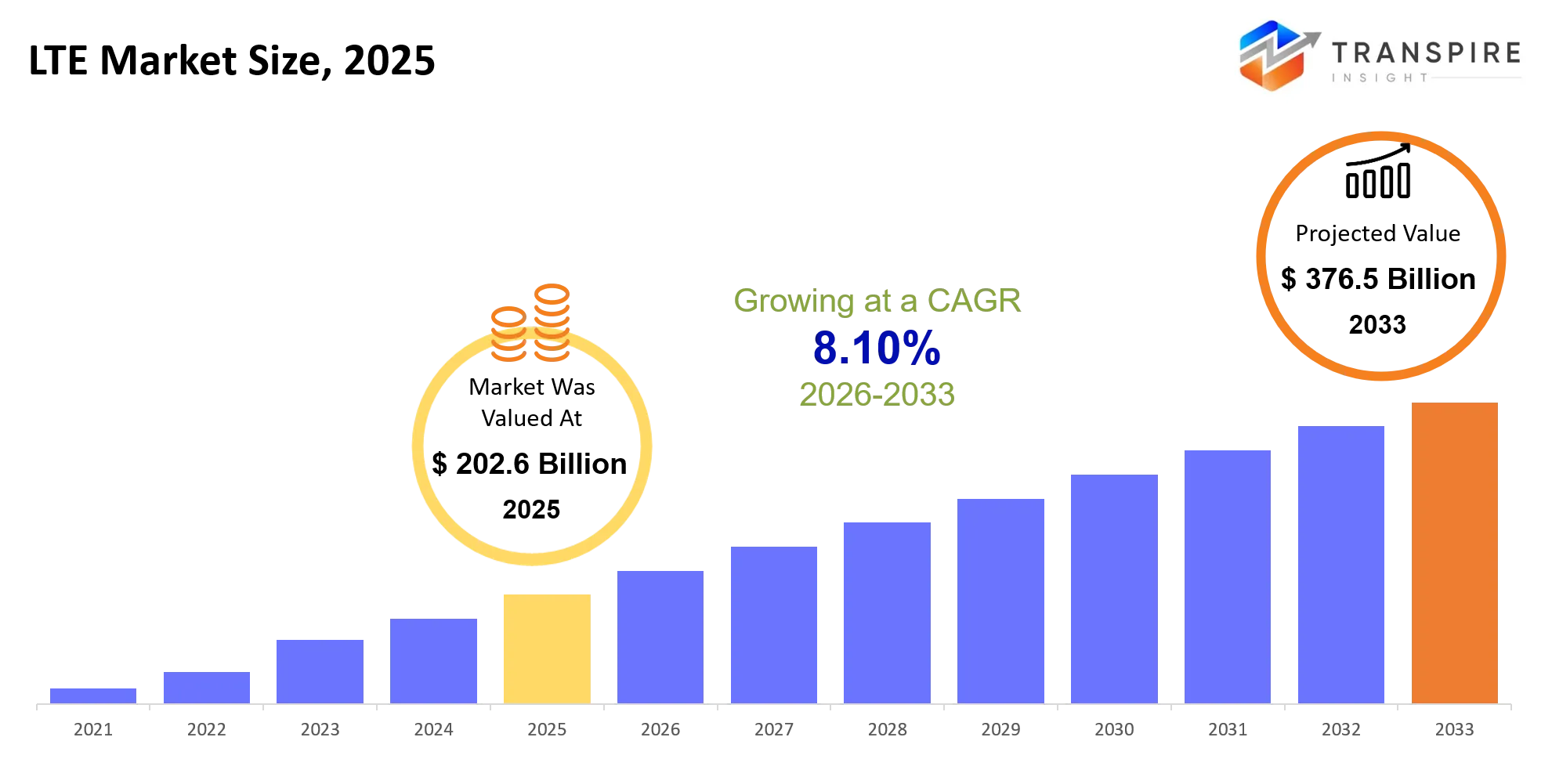
- Market Value (2025): USD 202.6 Billion.
- Expected Market Value (2026): USD 218.7 Billion.
- Estimated Market Value (2033): USD 376.5 Billion.
- Forecast CAGR (2026–2033): 8.10%.
- Leading Region in 2025: Asia-Pacific
- Second-largest Region: North America
- Fastest Growing Region: Europe
Introduction
The global LTE market includes the development, deployment and commercialization of Long-Term Evolution (LTE) technologies, infrastructure, devices and related communication services that deliver high speed wireless broadband connectivity. The market comprises radio access networks, mobile core networks, network management solutions, LTE-enabled devices and related support and maintenance services for consumer, enterprise and industrial applications. The growth of the market is driven by the growing demand for reliable mobile connectivity, seamless voice and data communication, growing adoption of Internet of Things (IoT), and enterprise digital transformation. Market growth is further supported by the additional investments in network modernization, private LTE deployments, and advanced broadband infrastructure. As organizations and service providers are focused on secure, scalable and high-performance wireless communications, the Global LTE Market continues to be an important part of the evolving digital connectivity ecosystem.
For instance:-
- North America is the leading region in the Global LTE Market, owing to its sophisticated telecommunications infrastructure, wide enterprise LTE implementations, significant investments by operators and growing uptake of private LTE networks for industrial and critical communication uses.
- Europe: Growth in Europe is driven by increasing investments in network modernization, increasing private LTE adoption in manufacturing and logistics, tower infrastructure optimization, and regulatory initiatives to enable next-generation mobile connectivity.
Key Market Highlights: -
- Asia Pacific is expected to grow at a rapid CAGR in the Global LTE Market by holding around 40% of the share during the forecast period.
- North America is anticipated to hold nearly 35% share of the Global LTE Market over the predicted timeframe.
- Europe is anticipated to hold close to 25% share of the Global LTE Market over the predicted timeframe.
- By Technology, the LTE FDD dominated the market and holds approximately 60% share in 2025 and is projected to grow at a substantial CAGR during the forecast period.
- By Component, the Hardware/Infrastructure Equipment dominated the market and holds approximately 75% share in 2025 and is projected to grow at a substantial CAGR during the forecast period.
- 6 By Application, the Mobile Broadband dominated the market and holds approximately 47% share in 2025 and is projected to grow at a substantial CAGR during the forecast period.
- Government initiatives, spectrum liberalization, telecom manufacturing incentives, investment in network infrastructure, have resulted in deployment of LTE, strengthening domestic production capabilities, expanding broadband connectivity and supporting long-term growth of the Global LTE Market.
How is Technology Driving Growth in the Global LTE Market?
Technology is one of the major growth drivers in the Global LTE Market. It enables wireless communications that are faster, more reliable and highly efficient. Continuous improvements such as carrier aggregation, network densification, LTE FDD and TDD optimization and private LTE infrastructure dramatically improve network capacity, coverage and data transmission performance. The LTE deployment in various fields is also driven by the increasing deployment of Internet of Things (IoT) applications, industrial automation and public safety communication networks. The LTE Market is bolstered by the long-term growth and international expansion of the LTE Market, driven by increased demand for high-speed mobile broadband, seamless video streaming and enterprise connectivity.
Market Drivers
The global LTE market is driven by growing investments in telecom infrastructure, ongoing network upgrades, and the rising adoption of private LTE solutions in industrial and enterprise settings. As the demand for high speed mobile broadband, reliable wireless connectivity and seamless digital communication grows, network operators are driven to improve LTE coverage and capacity. Further market growth is propelled by the rising number of IoT-enabled devices, smart manufacturing, connected transportation, and public safety communication networks. In addition, optimizing tower infrastructure, improving spectrum policies, and strategic investments by telecommunications providers allow for efficient network expansion. These factors collectively improve service quality, increase operational efficiency and propel steady growth of the Global LTE Market.
For Instance:
Asia-Pacific: The Asia-Pacific region is witnessing rapid growth in the LTE market owing to increasing mobile broadband penetration, massive investments in telecom infrastructure, increasing adoption of smartphones, accelerating digitalization in industries, and increasing deployment of private LTE networks for enterprises.
Restrain
The Global LTE Market is hindered by high infrastructure deployment costs, complex spectrum licensing regulations and limited availability of radio frequency bands. Legacy communication systems integration and inter-operability across multi-vendor networks further increase deployment complexity. Furthermore, the operational challenges are due to increasing network congestion in urban areas and expanding cybersecurity concerns related to wireless communication infrastructure. These factors can impede deployment of LTE networks and raise deployment and maintenance costs for telecom operators and enterprises.
Analysis of Prices and Consumer Behaviour
The LTE Infrastructure Equipment and Network Deployment Services segment is estimated to hold the largest share of the Global LTE Market, at about 65% of the total market share, primarily due to the rise in investments from telecom operators, enterprises and government-led broadband expansion initiatives. Advanced LTE infrastructure solutions, such as carrier aggregation, network densification, and private LTE deployments, cost approximately 30% more than traditional LTE network equipment. The higher cost is attributed to enhanced performance, increased network capacity, advanced security capabilities, and improved deployment efficiency. Driven by increasing demand for high speed mobile broadband and enterprise connectivity, about 60% of LTE deployments are based on LTE-Advanced and LTE-Advanced Pro. These sectors are driven by continued digital transformation, industrial automation and IoT connectivity, and account for nearly 72% of the total LTE demand.Consumer buying behavior shows that 58% of network operators and enterprise customers select LTE solutions due to network reliability, coverage, data speed and security, while 35% select long term infrastructure contracts and managed service agreements to optimize operational costs, ensure continuous network performance and secure long term technology support.
Top Companies in the Global LTE Market
- Ericsson
- Nokia
- Huawei
- ZTE
- Samsung Electronics
- Qualcomm
- Cisco Systems
- NEC Corporation
- Fujitsu
- Mavenir
- CommScope
- Intel
- Juniper Networks
- Airspan Networks
- Telefonaktiebolaget LM Ericsson
Global LTE Market Segmentation
The Global LTE Market share is divided into five categories: By Technology, By Component, By Application, By End User, By Deployment.
The LTE FDD dominated the market, accounting for nearly 60% in 2025 and is expected to rise at a significant CAGR during the forecast period.
The global LTE Market is segmented by technology into lte fdd, lte tdd, lte advanced, lte advanced pro, lte-m, nb-iot, private lte, others. Among these, the LTE FDD dominated the market, accounting for nearly 60% in 2025 and expected to increase at a significant CAGR during the forecast period. due to its widespread adoption by operators, improved coverage, higher spectral efficiency, seamless mobility support and mature ecosystem.
The Hardware/Infrastructure Equipment dominated the market, accounting for nearly 75% in 2025, and is expected to rise at a significant CAGR during the forecast period.
The global LTE Market is segmented by component into infrastructure equipment, user equipment, core network, small cells, antennas, chipsets, network software, others. Among these, the Hardware/Infrastructure Equipment dominated the market, accounting for nearly 75% in 2025 and expected to increase at a significant CAGR during the forecast period. Hardware and Infrastructure Equipment continue to dominate the Global LTE Market as the network continues to expand and upgrade with the deployment of base stations, spectrum upgrades and increased investments in enterprise connectivity.
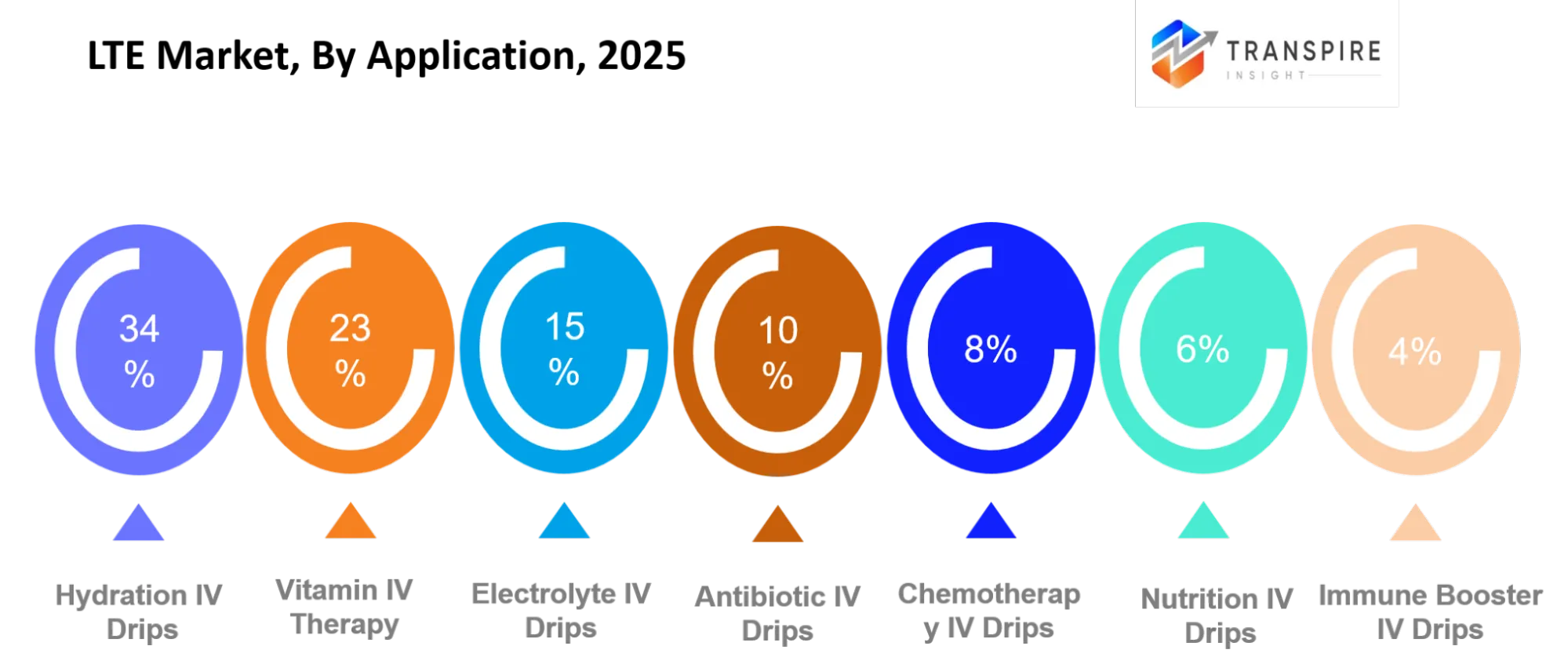
The Mobile Broadband dominated the market, accounting for nearly 47% in 2025 and is expected to rise at a significant CAGR during the forecast period.
The global LTE Market is segmented by application into mobile broadband, iot connectivity, public safety networks, smart cities, industrial automation, connected vehicles, healthcare connectivity, others. Among these, the Mobile Broadband dominated the market, accounting for nearly 47% in 2025 and expected to increase at a significant CAGR during the forecast period. Households hold the largest share of Global LTE Market driven by the increasing adoption of smartphones, growing mobile broadband penetration, remote working trends, and rising demand for digital entertainment.
Regional Segment Analysis of the Global LTE Market (H2)
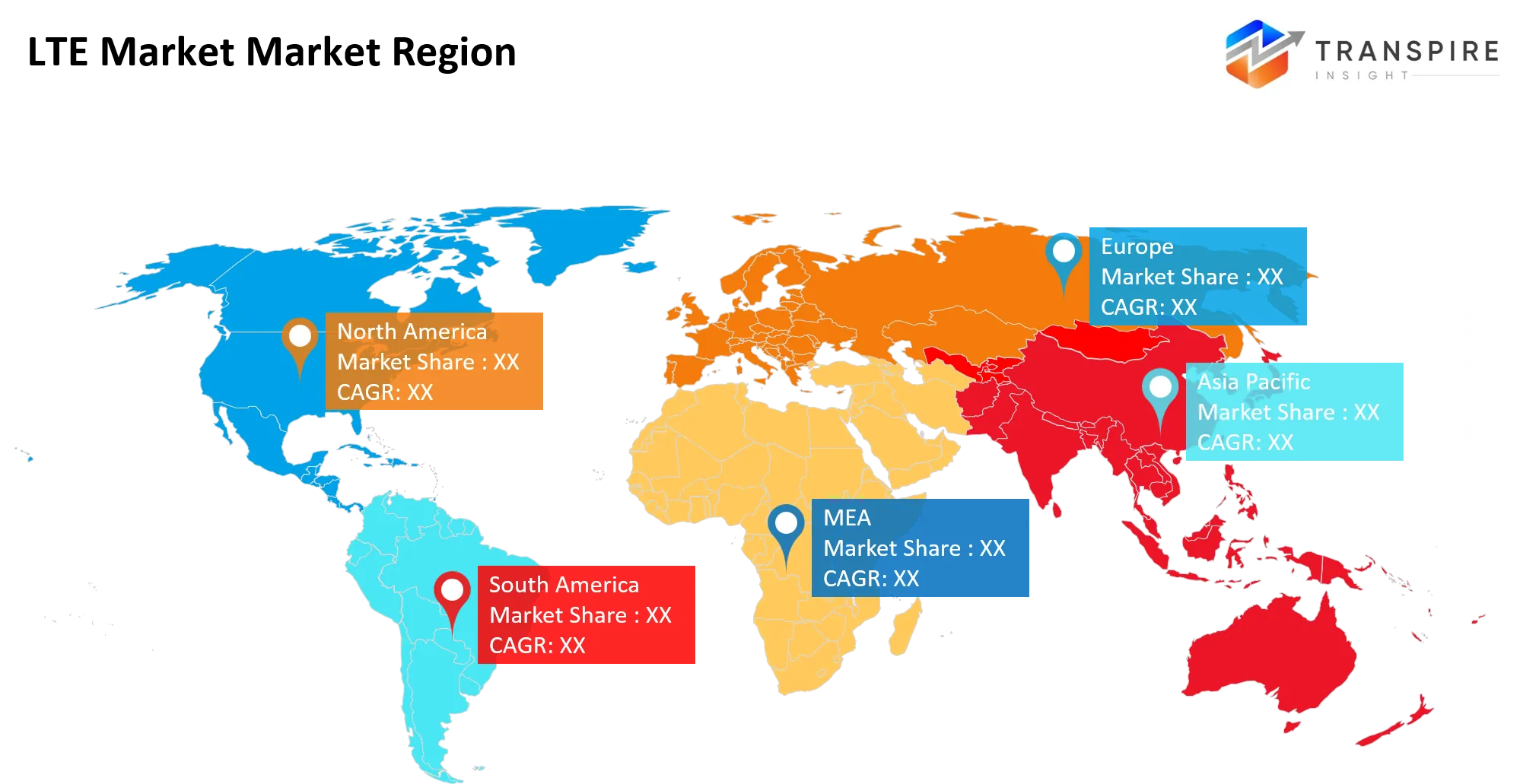
- Europe (Germany, France, U.K., Italy, Spain, Rest of Europe)
- North America (U.S., Canada, Mexico)
- Asia-Pacific (China, Japan, India, Rest of APAC)
- South America (Brazil and the Rest of South America)
- The Middle East and Africa (UAE, South Africa, Rest of MEA)
Asia Pacific is expected to grow at a rapid CAGR in the global LTE Market, holding approximately 40% of the share during the forecast period.
Asia Pacific is expected to grow at a rapid CAGR in the Global LTE Market, holding approximately 40% of the market share during the forecast period, driven by rapid smartphone adoption, expanding mobile broadband subscriptions, large-scale telecom infrastructure investments, increasing private LTE deployments, and strong government support for digital connectivity. Increasing industrial automation, smart city initiatives, IoT integration and continuous network upgradation in major economies such as China, India, Japan and South Korea are also driving LTE adoption, boosting the long-term market growth in the region.
North America is the fastest-growing region in the global LTE Market during the period, holding approximately 35% share.
North America is the fastest-growing region in the Global LTE Market during the forecast period, holding approximately 35% market share, driven by advanced telecommunications infrastructure, continuous investments in LTE network modernization, widespread adoption of private LTE solutions, and strong demand for high-speed mobile broadband. Increasing deployment of IoT-enabled applications, connected enterprises, smart manufacturing, and public safety communication networks further accelerate market growth. Additionally, supportive regulatory frameworks, extensive spectrum availability, and the presence of leading telecom operators and technology providers strengthen the region's LTE ecosystem and long-term market expansion.
Europe is the fastest-growing region in the global LTE Market during the period, holding approximately 25% share.
Europe is the fastest growing region in the Global LTE Market during the forecast period with a market share of approximately 25%. The growth is supported by increasing investments in telecom infrastructure modernization, expanding private LTE deployments and strong demand for secure enterprise connectivity. This is being driven by increased adoption across manufacturing, transportation, energy and public safety and reinforced by positive spectrum policies, digital transformation initiatives and ongoing network upgrades. The existence of well-established telecom players and sophisticated industrial ecosystems boosts regional market growth.
Strategies for Market Growth in Non-Leading Regions:
Affordable and expandable use of LTE network infrastructure, private LTE solutions and advanced broadband technologies would develop non-leading regions to enhance telecommunications capabilities across emerging economies. Expansion of local telecom equipment manufacturing, network infrastructure deployment and system integration facilities can help reduce import dependence and lower the overall deployment costs. Collaborate strategically with telecom operators, network equipment manufacturers, cloud service providers, enterprise solution providers and system integrators to increase market penetration and speed up LTE adoption. The deployment efficiency, infrastructure maintenance and quality of service will be facilitated by enhanced technical training, workforce development and network management skills. Flexible finance models, long-term infrastructure agreements, managed network services and public-private partnerships will also improve affordability and promote broader LTE adoption.The government’s support through digital connectivity initiatives, spectrum allocation policies, investments in telecom infrastructure and rural broadband expansion programs, digital distribution channels, and enterprise connectivity solutions will improve the accessibility of LTE and allow for sustainable long-term growth in developing regions.
Future Market Trends for the Global LTE Market: -
- With the growing need for secure, reliable and low-latency enterprise wireless connectivity, private LTE adoption will speed up across manufacturing, energy, transportation and logistics industries.
- Hybrid integration of LTE with 5G networks will enhance operational flexibility, improve network performance, and support advanced industrial automation, smart infrastructure, and mission-critical communication applications.
- Artificial intelligence, network automation, and LTE-Advanced Pro technologies will optimize network management, improve spectrum efficiency, enhance service quality, and strengthen the long-term growth of the Global LTE Market.
Recent Development
- In January 2026: Telecom operators accelerated LTE-Advanced Pro network upgrades to improve spectrum efficiency, network capacity, and smooth integration with emerging 5G infrastructure for enterprise and consumer applications.
- In March 2026: NB-IoT and LTE Cat 1 bis product portfolios from major module vendors expanded, accelerating cost-effective IoT connectivity for smart metering, asset tracking, environmental monitoring and industrial automation.
Market Segment
This study forecasts revenue at global, regional and country levels from 2020 to 2033. Transpire Insights has segmented the LTE Market based on the below-mentioned segments:
Global LTE Market, By Technology
- LTE FDD
- LTE TDD
- LTE Advanced
- LTE Advanced Pro
- LTE-M
- NB-IoT
- Private LTE
- Others
Global LTE Market, By Component
- Infrastructure Equipment
- User Equipment
- Core Network
- Small Cells
- Antennas
- Chipsets
- Network Software
- Others
Global LTE Market, By Application
- Mobile Broadband
- IoT Connectivity
- Public Safety Networks
- Smart Cities
- Industrial Automation
- Connected Vehicles
- Healthcare Connectivity
- Others
Global LTE Market, By End User
- Telecom Operators
- Enterprises, Government
- Manufacturing, Transportation
- Utilities
- Healthcare
- Others
Global LTE Market, By Deployment
- Macro Cells
- Small Cells
- Distributed Antenna Systems
- Private Networks
- Rural Networks
- Urban Networks
- Indoor Networks
- Others
Global LTE Market, By Regional Analysis
North America
- US
- Canada
- Mexico
Europe
- Germany
- UK
- France
- Italy
- Spain
- Russia
- Rest of Europe
Asia Pacific
- China
- Japan
- India
- South Korea
- Australia
- Rest of Asia Pacific
South America
- Brazil
- Argentina
- Rest of South America
Middle East & Africa
- UAE
- Saudi Arabia
- Qatar
- South Africa
- Rest of the Middle East & Africa
Frequently Asked Questions
Find quick answers to common questions.
Growing telecom infrastructure investments, expanding IoT adoption, private LTE deployments, network modernization, and rising demand for reliable high-speed broadband connectivity drive growth
Asia-Pacific leads the Global LTE Market through rapid smartphone adoption, telecom infrastructure expansion, industrial digitalization, private LTE deployment, and supportive government initiatives
LTE FDD dominates the market due to extensive operator adoption, wider network coverage, superior spectral efficiency, seamless mobility, and a well-established ecosystem
Infrastructure equipment leads because continuous network expansion, base station deployments, spectrum upgrades, and enterprise connectivity investments require advanced LTE hardware solutions
Private LTE expansion, AI-powered network management, LTE-Advanced Pro enhancements, hybrid LTE-5G integration, and industrial IoT adoption will shape future market growth
- Ericsson
- Nokia
- Huawei
- ZTE
- Samsung Electronics
- Qualcomm
- Cisco Systems
- NEC Corporation
- Fujitsu
- Mavenir
- CommScope
- Intel
- Juniper Networks
- Airspan Networks
- Telefonaktiebolaget LM Ericsson
About the Authors

Mayur Shinde
I am Mayur Shinde, a Senior Research Analyst at Transpire Insight, specializing in the Automotive & Transportation and Information & Communication Technology (ICT) Industry. My work focuses on analyzing emerging market trends, technological advancements, competitive landscapes, and industry developments to deliver accurate, data-driven insights. I am passionate about transforming complex market information into clear, actionable content that helps businesses, professionals, and decision-makers stay informed and make confident strategic decisions.

Chakradhar Khansole
Chakradhar serves as the Research Director at Transpire Insight, bringing over 8 years of experience in technology, innovation, and strategic market intelligence. He specializes in transforming complex market data into actionable business insights that enable organizations to make informed, growth-oriented decisions. Recognized for his strategic vision and analytical expertise, Chakradhar leads high-impact research initiatives, delivering comprehensive market assessments, competitive intelligence, and forward-looking industry analysis.
Recently Published Reports
-
Apr 2026
3D Optical Profiler Market
3D Optical Profiler Market Size, Share & Analysis Report By Type (Desktop 3D Optical Profiler, and Portable 3D Optical Profiler), By Technology (Confocal Technology, and White Light Interference), By End-Use Industry (Manufacturing, Research Institutions, Automotive, Aerospace and Defense, Medical Devices, and Other), and Geography (North America, Europe, Asia-Pacific, Middle East and Africa, South and Central America), 2021 - 2031
-
Apr 2026
Depth Sensor Market
Depth Sensor Market Size, Share & Analysis Report By Type (Infrared Depth Sensors, Time-of-Flight (ToF) Sensors, Stereo Vision Sensors, Structured Light Sensors, Ultrasonic Depth Sensors), By Application (Automotive, Robotics, Gaming, Consumer Electronics, Industrial Automation, Healthcare, Security & Surveillance, Others), By End Users (Automotive Manufacturers, Consumer Electronics Companies, Healthcare Providers, Industrial Companies, Security Agencies, Gaming Companies, Robotics Companies, Others), and Geography (North America, Europe, Asia-Pacific, Middle East and Africa, South and Central America), 2021 – 2031
-
Apr 2026
Digital Manufacturing Market
Digital Manufacturing Market Size, Share & Analysis Report By Component (Hardware, Software, and Services), By Technology (Robotics, 3D Printing, Internet of Things (IoT), and Others), By Application (Automotive and Transportation, Aerospace and Defense, Consumer Electronics, Industrial Machinery, and Others), By Process Type (Computer-Based Designing, Computer-Based Simulation, Computer 3D Visualization, Analytics, and Others), and Geography (North America, Europe, Asia-Pacific, Middle East and Africa, South and Central America), 2021 – 2031
-
Apr 2026
Digital Visa Services Market
Digital Visa Services Market Size, Share & Analysis Report By Type (Individual Travelers, Group Travelers), By Application (Tourism, Business Travel, Others), and Geography (North America, Europe, Asia-Pacific, Middle East and Africa, South and Central America), 2021 – 2031