

Europe Crushing Screening Mineral Processing Equipment Market Summary
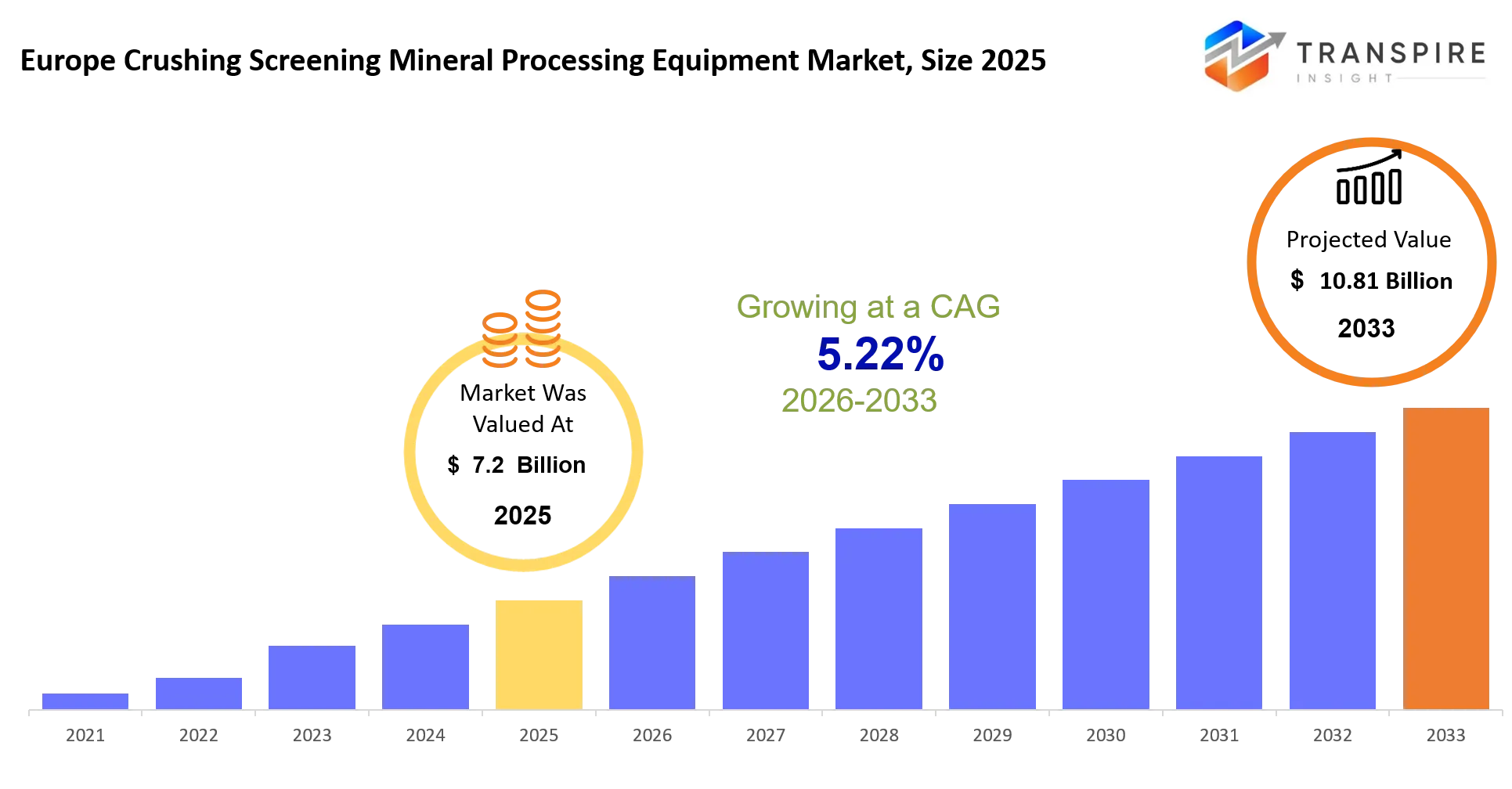
As per Transpire Insight Analysis, the Europe Crushing Screening Mineral Processing Equipment Market size is estimated at USD 7.2 Billion in 2025 and is anticipated to reach USD 10.81 Billion by 2033, growing at a CAGR of 5.22% from 2026 to 2033.
The Europe Crushing Screening Mineral Processing Equipment Market kind of supports mining, quarrying, building works, and recycling activities by turning out rock and mineral deposits into more uniform feedstock, ready for downstream industrial use. With efficient crushing, sorting, and processing systems in place, the operators can push up material recovery, trim waste ,and keep product quality consistent for infrastructure projects as well as manufacturing supply chains. In the past five years, the whole market trend sort of moved toward automated, digitally connected equipment, since producers want higher output, reduced running expenses, and also better environmental results. Tighter European emissions rules and circular economy programs ,plus the supply chain disruptions after the Russia-Ukraine conflict, basically sped up spending aimed at resource efficiency and domestic mineral processing know-how. Because of this, many sites have felt encouraged to modernize old fleets, choose energy-saving technologies, and add recycling throughput. That in turn creates stronger replacement cycles for hardware, while also opening new revenue chances for manufacturers delivering intelligent, high-performance processing solutions.
Europe Crushing Screening Mineral Processing Equipment Market Size & Forecast:
- Europe Crushing Screening Mineral Processing Equipment Market Size 2025: USD 7.2 Billion
- Expected Market Value 2033: USD 10.81 Billion
- Forecast CAGR: 5.22%
- Leading country (2025): Germany
- Fastest-growing country: United Kingdom
- Key Profile: Metso, Sandvik, Terex Corporation, FLSmidth, Weir Group, Astec Industries, McCloskey International, Komatsu, Thyssenkrupp, Kleemann (Wirtgen Group), SBM Mineral Processing, Eagle Crusher, Tesab Engineering, Powerscreen, Rubble Master
Key Market Insights
- Western Europe is kind of dominating, with roughly 55% market share in 2025, mainly because Germany, France, UK, Italy, and Spain kind of keep pushing industrial activity forward.
- Eastern Europe meanwhile looks like the fastest-growing region during 2025–2033, and that seems driven by mining upgrades in Poland, Romania and Bulgaria, sort of in a steady flow.
- In terms of product segments, crushing equipment takes the lead with almost 45% share, which shows up in the strong use for aggregates and mineral extraction.
- Next comes screening equipment, it holds the second-largest position, since infrastructure projects need more precise material classification across Europe, all the time.
- Mobile crushing and screening systems are the fastest-growing segment through 2033 because requirements for flexible deployment are becoming increasingly demanding.
- For applications, quarrying is leading with around 40% share in 2025, supported by the need to process construction materials.
- Recycling applications are moving the fastest, because circular economy policies keep expanding across European countries, and they are not slowing down.
- On end users, mining companies lead adoption with about 50% share, investing in more efficient mineral processing operations.
- Construction and recycling operators are the quickest growing end-user category through 2033, largely due to material recovery targets that keep tightening.
- Metso has expanded digital crushing solutions too, through automation investments, which improves remote monitoring and helps with equipment performance management, more or less.
What are the Key Drivers, Restraints, and Opportunities in the Europe Crushing Screening Mineral Processing Equipment Market?
European crushing and screening adoption is ramping up pretty fast, at least that’s what operators say when they move away from conventional systems and toward automated, more energy-efficient platforms. Stricter European emissions rules , plus the carbon reduction targets, have nudged mining and quarrying firms to lean more into electric drives, hybrid setups, and “smart” control logic. And yeah, this tech shift tends to help with fuel usage and also lowers operating costs, while letting companies push faster equipment replacement cycles. On top of that, digital monitoring solutions are kind of opening up fresh revenue paths, like service contracts and performance-led maintenance models, where you know the outcomes matter more.
The bigger, structural snag is still the high capital spending needed for these advanced processing units, and then there’s the limited supply of skilled operators. A lot of smaller and medium quarry businesses often postpone upgrades, because automation integration, site changes , and training really do come with a heavy initial price tag. From the Transpire Insight review of regional procurement notices and go-to-market timelines, supply chain concentration stays the main execution risk. If key components are tight , or deliveries stretch out longer than expected, modernization efforts can slide, which in turn delays revenue realization, at least in the near term.
The next growth phase is gonna show up out of connected processing ecosystems, with artificial intelligence taking the lead, plus remote diagnostics and automated material sorting too. In that sense Germany, Sweden and Finland are especially positioned for adoption because they already have mining technology networks in place, and they keep putting sustainability investments on the table. Also manufacturers working on modular systems, with predictive analytics and less energy consumption, will see more opportunities as European operators push for better productivity and firmer regulatory compliance, kind of everything at once, really.
What Has the Impact of Artificial Intelligence Been on the Europe Crushing Screening Mineral Processing Equipment Market?
Artificial intelligence and digital technologies are reshaping crushing and screening operations, kind of, by enabling automated monitoring, real time equipment control , and better compliance management. Advanced sensors linked with AI platforms keep watching vibration temperature , material flow, plus overall machine performance, so the operator can tweak parameters before productivity losses show up. Digital control systems are also assisting European processing facilities in holding regulatory requirements steady, mainly by strengthening emissions tracking and operational visibility.
At the same time, machine learning use cases are growing predictive maintenance abilities. They look through past equipment records to spot failure sequences, then they help tune maintenance routines. This kind of approach reduces unexpected downtime, lifts asset utilization, and supports more exact production planning across mining and quarrying sites . Connected platforms further allow operators to reach higher uptime and reduced maintenance costs, because decisions are made from data instead of reactive repairs that arrive too late.
Still, AI adoption stays somewhat constrained by steep integration expenses, uneven data availability coming from older equipment , and connectivity trouble at remote processing locations. Quite a few operators, for now, need infrastructure upgrades first, before rolling out intelligent solutions across their current fleets in a full way.
Key Market Trends
- After 2021 automation adoption kinda accelerated, as European operators started integrating smart controls, remote monitoring, and connected equipment platforms without much delay, well mostly.
- From 2022 to 2025 mobile crushing systems saw more traction too, contractors were leaning toward flexible solutions for infrastructure work, in a pretty practical sense.
- European emissions regulations also got stricter after 2020, so manufacturers were nudged to develop lower-energy processing technologies, which makes sense if you think about compliance.
- At the same time, demand for recycling-focused equipment expanded after 2021, driven by EU circular economy targets that pushed higher material recovery investments.
- In 2023, Metso rolled out enhanced digital services, which in turn strengthened predictive maintenance capabilities across crushing and screening operations.
- Sandvik, meanwhile, increased its automation investments during 2022–2024, aiming at safer and more efficient mineral processing workflows, though internally the focus was more on streamlining.
- Electrification trends really picked up after 2023, as mining operators tested battery-powered and hybrid processing equipment.
- And during 2021–2023 supply chain disruptions, European buyers ended up diversifying suppliers, plus trying to strengthen regional equipment sourcing.
- Finally AI-enabled monitoring solutions started getting wider adoption from 2024, since operators wanted to reduce downtime, and improve asset efficiency overall.
Europe Crushing Screening Mineral Processing Equipment Market Segmentation
By Equipment Type :
Crushers hold a really big role in mining and quarrying, because those places need efficient size reduction before anything else can really happen. In newer crusher setups the focus shifts to less energy use, better wear resistance ,and more overall throughput, so basically the whole thing runs smoother. Screens also play into that by helping with accurate material sorting, and that lets processing facilities keep a more consistent output quality, not just a random mix.
Then you have feeders and conveyors, they make material handling less chaotic by keeping production flows steady across industrial sites. Grinding mills and mineral processing equipment back up the more complicated extraction work by supporting higher recovery rates and better resource use overall. Equipment manufacturers, meanwhile, keep introducing automated systems aimed at boosting productivity, cutting downtime ,and helping operations stay cost-effective over time.
By Mobility :
Stationary equipment is still very common on large mining sites and at fixed processing facilities, mainly due to the high capacity demands and the long operating cycles involved. A lot of large-scale projects end up choosing stationary systems for continuous production and stable performance during those long runs. At the same time, mobile equipment adoption has been growing, since contractors want flexible solutions when the job site changes.
Portable and mobile systems support quicker installation ,less hauling or transport effort, and they also help with efficient processing right near the extraction areas. Construction and recycling sectors are leaning into compact equipment for short-term work, plus urban material recovery activities. In response, equipment suppliers will likely push more modular designs that improve mobility, cut setup time, and deal better with different operating conditions, even when conditions shift day to day.
By Application :
Mining applications are a major usage area because mineral extraction activities do need reliable crushing screening and processing systems, all of that. Quarrying operations often rely on more advanced equipment in order to produce construction materials with steady size and quality. And then construction projects use those processed aggregates for roads, buildings, and wider infrastructure development, basically.
Recycling applications are getting more attention too since European regulations push material recovery and less waste. Aggregate processing facilities are upgrading their equipment to boost resource efficiency and also reduce losses, little by little. The technology improvements will support higher recovery rates, plus they will open up stronger opportunities across recycling and secondary material processing actions.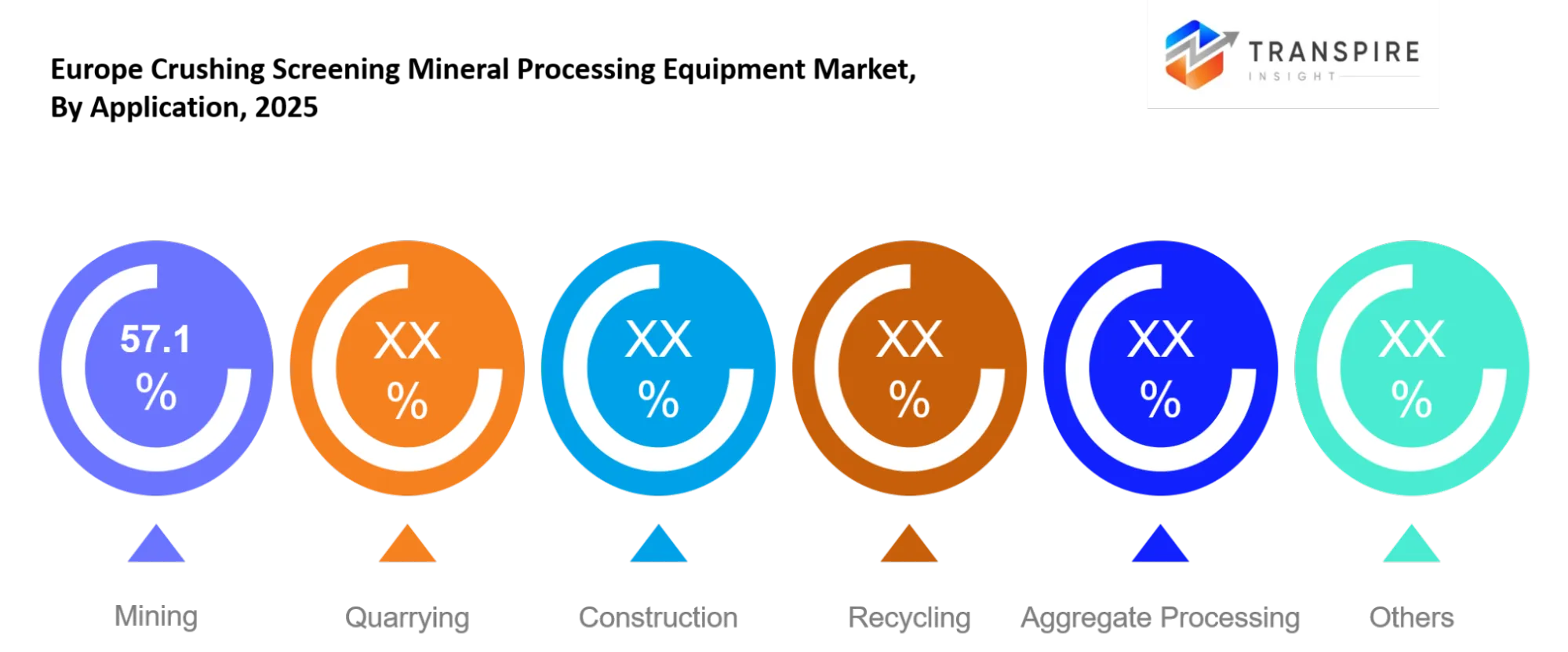
By End User :
Mining companies still stay as leading users since mineral extraction is continuous work, so the processing capacity must keep going and the equipment has to be durable. Construction companies are also expanding their equipment usage because infrastructure projects need a dependable aggregate supply. Quarry operators are putting money into newer systems, aiming for higher production efficiency and trying to satisfy shifting material requirements.
Recycling companies are turning toward advanced processing equipment to match circular economy goals, and to raise recovered material volumes as well. Equipment suppliers are building customized solutions for distinct operational needs among industrial users. Strategic investments in automation and digital monitoring will help drive higher equipment utilization among major end users, day by day.
By Power Source :
Diesel fueled equipment keeps working in remote mining and quarry sites where connection to the grid is still pretty limited. Meanwhile electric powered systems are starting to show up more often, since operators are aiming for less pollution, lower fuel expenses, and a more solid sustainability score. Hybrid powered machines sit in the middle too, they deliver a kind of operational flexibility along with energy efficiency, so it’s not only one extreme.
Manufacturers are also widening their electric and hybrid product lines to match the tougher environmental rules across Europe. Better battery technology, plus charging infrastructure development, should make it easier for these systems to spread in processing facilities. And honestly, the choice of energy source will affect when equipment gets replaced, because operators tend to look closely at lower operating costs and also regulatory compliance, sometimes even before performance updates.
What are the Key Use Cases Driving the Europe Crushing Screening Mineral Processing Equipment Market?
Mining operations are basically the central use case behind the Europe Crushing Screening Mineral Processing Equipment Market, with mineral producers buying crushers and screening systems so they can do ore preparation more efficiently, like without all the extra pauses. Big mining operators really need equipment that stays tough and durable, because they want to push throughput, reduce processing delays ,and keep the material quality steady while extraction is going on.
Then we have quarrying and recycling applications which are starting to pick up speed too, as construction firms and recycling companies upgrade their processing capacity. Quarry operators turn to newer, more advanced setups for aggregate production, while recycling organizations adopt these tools to back European material recovery goals ,and to align with waste reduction rules that are getting stricter over time.
Other emerging use cases are automated processing facilities and, more and more, electrified equipment deployment across greener mining sites. European operators are running trials with AI-enabled monitoring and low emission systems, not just for compliance, but also to support better long-term operational efficiency ,and yeah to be a bit more future proof.
|
Report Metrics |
Details |
|
Market size value in 2025 |
USD 7.2 Billion |
|
Market size value in 2026 |
USD 7.57 Billion |
|
Revenue forecast in 2033 |
USD 10.81 Billion |
|
Growth rate |
CAGR of 5.22% from 2026 to 2033 |
|
Base year |
2025 |
|
Historical data |
2021 - 2024 |
|
Forecast period |
2026 - 2033 |
|
Report coverage |
Revenue forecast, competitive landscape, growth factors, and trends |
|
Country scope |
Europe (Germany, United Kingdom, France, Italy, Spain and Rest of Europe) |
|
Key company profiled |
Metso, Sandvik, Terex Corporation, FLSmidth, Weir Group, Astec Industries, McCloskey International, Komatsu, Thyssenkrupp, Kleemann (Wirtgen Group), SBM Mineral Processing, Eagle Crusher, Tesab Engineering, Powerscreen, Rubble Master . |
|
Customization scope |
Free report customization (country, regional & segment scope). Avail customized purchase options to meet your exact research needs. |
|
Report Segmentation |
By Equipment Type (Crushers, Screens, Feeders, Conveyors, Grinding Mills, Mineral Processing Equipment, Others); By Mobility (Stationary Equipment, Mobile Equipment, Portable Equipment, Others); By Application (Mining, Quarrying, Construction, Recycling, Aggregate Processing, Others); By End User (Mining Companies, Construction Companies, Quarry Operators, Recycling Companies, Others); By Power Source (Diesel Powered, Electric Powered, Hybrid Powered, Others) |
Which Regions are Driving the Europe Crushing Screening Mineral Processing Equipment Market Growth?
Western Europe kind of holds the main role in the Europe Crushing Screening Mineral Processing Equipment Market, with an estimated 55% market share by 2025 . The drivers are like, strong infrastructure investment , strict environmental rules, and upgraded mining equipment requirements that keep everything moving forward . Germany, France, the United Kingdom, Italy, and Spain form that solid ecosystem where equipment manufacturers , engineering firms , and industrial users cooperate pretty closely. This leadership should keep going through 2033 as operators swap out older machines for more automated , energy-efficient processing setups, and honestly that replacement cycle matters a lot.
Northern Europe comes next, more as a dependable revenue source , because mining activity stays steady , regulatory frameworks remain consistent, and long-term industrial investment is still present. Sweden, Finland, and Norway help keep demand reliable through mineral extraction , quarrying, and also those sustainable processing projects . The area leans into advanced mining technology adoption, plus there is regular collaboration between equipment suppliers and resource companies. With stable investment rhythms , and environmental compliance requirements, the market contribution should remain steady enough.
Eastern Europe is the fastest-growing region, mostly because mining modernization is ramping up, infrastructure expansion is pushing ahead, and domestic resource development keeps accelerating equipment uptake . Poland, Romania, Czech Republic, and Bulgaria are upgrading processing facilities to boost productivity and to align with changing efficiency expectations. There are also government-supported infrastructure initiatives and industrial upgrades, that are basically opening up new entry points for equipment suppliers. The growth period across 2026–2033 should pull in investors who care about automation , replacement schedules, and cost-aware processing technologies .
Who are the Key Players in the Europe Crushing Screening Mineral Processing Equipment Market and How Do They Compete?
The Europe Crushing Screening Mineral Processing Equipment Market has a sort of moderate consolidation vibe, where big players keep on squaring up through technology updates, service reach , equipment reliability, and digital tools. Meanwhile the more specialized suppliers are kinda slipping in and making openings with automation , mobile setups, plus more sustainable equipment directions. It’s like everyone is trying to hold positions, but not in the same way.
Metso competes via advanced crushing technologies , digital monitoring platforms, and lifecycle service offerings that aim to lift equipment uptime. Also they tend to lean into automation tools and energy-efficient systems , which in turn help mining and quarry operators lower their operating bills.
Sandvik differentiates with intelligent rock processing equipment, automation features, and connected maintenance solutions. Their growth in digital mining technologies, makes it easier for European operators to adopt these systems , especially when they want safer workflows and higher output.
Kleemann leans hard on mobile processing systems, mainly built for construction and recycling uses. The key strengths are equipment flexibility, transport efficiency , and how well it plugs into recycling workflows , which gives contractors an edge in their day to day.
Epiroc is expanding through electrification, automation, and more sustainable mining technologies. Battery-powered solutions and digital platforms support customers as they move toward lower-emission processing operations , step by step .
Company List
- Metso
- Sandvik
- Terex Corporation
- FLSmidth
- Weir Group
- Astec Industries
- McCloskey International
- Komatsu
- Thyssenkrupp
- Kleemann (Wirtgen Group)
- SBM Mineral Processing
- Eagle Crusher
- Tesab Engineering
- Powerscreen
- Rubble Master
Recent Development News
In April 2026, Sandvik advanced its electric crushing and screening solution with its fully integrated “electric train” system. The solution combines electric-drive crushing and screening units to support lower-emission operations and improve sustainability performance for mining and quarry customers. Source https://www.home.sandvik/
In June 2026, Sandvik secured a major order from LKAB for crushing and screening equipment at a new sorting plant in Sweden. The SEK 175 million order includes crushers, screens, vibrating feeders, and automation systems that will strengthen advanced mineral processing capabilities in Europe. Source https://www.home.sandvik/
What Strategic Insights Define the Future of the Europe Crushing Screening Mineral Processing Equipment Market?
Over the next five to seven years, the Europe Crushing Screening Mineral Processing Equipment Market is set to slowly shift toward more intelligent, low-emission, and highly automated processing setups, mostly because operators are trying to push productivity up, tighten resource efficiency a bit and also meet stricter environmental rules. There’s also this kind of hidden risk that’s climbing faster than people expect, it’s about supplier concentration for advanced components, and if that keeps getting more clustered it can lead to equipment delivery delays ,and it might also stall modernization programs when supply disruptions happen.
At the same time, there’s a real emerging opening in AI-driven autonomous processing and electrified mobile equipment, especially in Eastern Europe where mining and recycling activities are speeding up fleet upgrades. Market players may want to reinforce their competitive position by leaning into modular equipment designs, building digital service platforms, and forming regional partnerships that reduce supply chain dependence while still improving what the customers actually get. The firms that blend strong equipment performance with predictive analytics plus sustainability-minded solutions may end up capturing more of the future growth.
Europe Crushing Screening Mineral Processing Equipment Market Report Segmentation
By Equipment Type
- Crushers
- Screens
- Feeders
- Conveyors
- Grinding Mills
- Mineral Processing Equipment
By Mobility
- Stationary Equipment
- Mobile Equipment
- Portable Equipment
By Application
- Mining
- Quarrying
- Construction
- Recycling
- Aggregate Processing
By End User
- Mining Companies
- Construction Companies
- Quarry Operators
- Recycling Companies
By Power Source
- Diesel Powered
- Electric Powered
- Hybrid Powered
Frequently Asked Questions
Find quick answers to common questions.
The Expected Europe Crushing Screening Mineral Processing Equipment Market size for the Market will be USD 10.81 Billion in 2033.
Key segments for the Europe Crushing Screening Mineral Processing Equipment Market are By Equipment Type (Crushers, Screens, Feeders, Conveyors, Grinding Mills, Mineral Processing Equipment, Others); By Mobility (Stationary Equipment, Mobile Equipment, Portable Equipment, Others); By Application (Mining, Quarrying, Construction, Recycling, Aggregate Processing, Others); By End User (Mining Companies, Construction Companies, Quarry Operators, Recycling Companies, Others); By Power Source (Diesel Powered, Electric Powered, Hybrid Powered, Others).
Major Europe Crushing Screening Mineral Processing Equipment Market players are Metso, Sandvik, Terex Corporation, FLSmidth, Weir Group, Astec Industries, McCloskey International, Komatsu, Thyssenkrupp, Kleemann (Wirtgen Group), SBM Mineral Processing, Eagle Crusher, Tesab Engineering, Powerscreen, Rubble Master.
The Current Europe Crushing Screening Mineral Processing Equipment Market size is USD 7.2 Billion in 2025.
The Europe Crushing Screening Mineral Processing Equipment Market CAGR is 5.22% from 2026 to 2033
- Metso
- Sandvik
- Terex Corporation
- FLSmidth
- Weir Group
- Astec Industries
- McCloskey International
- Komatsu
- Thyssenkrupp
- Kleemann (Wirtgen Group)
- SBM Mineral Processing
- Eagle Crusher
- Tesab Engineering
- Powerscreen
- Rubble Master
About the Authors

Kartik bhong
I am Kartik Bhong, a Senior Research Analyst at Transpire Insight, specializing in the Packaging, Manufacturing, and Construction industry. My work focuses on analyzing market trends, emerging technologies, industry regulations, and competitive landscapes to deliver accurate, data-driven insights. I am passionate about transforming complex industry information into clear, practical content that helps businesses, professionals, and decision-makers stay informed and make confident strategic decisions. Through continuous research and a strong commitment to accuracy, I strive to create reliable, well-researched content that reflects the latest developments across these dynamic industries and supports the vision of Transpire Insight in delivering valuable market intelligence.

Chakradhar Khansole
Chakradhar serves as the Research Director at Transpire Insight, bringing over 8 years of experience in technology, innovation, and strategic market intelligence. He specializes in transforming complex market data into actionable business insights that enable organizations to make informed, growth-oriented decisions. Recognized for his strategic vision and analytical expertise, Chakradhar leads high-impact research initiatives, delivering comprehensive market assessments, competitive intelligence, and forward-looking industry analysis.
Recently Published Reports
-
Apr 2026
Handling and Lifting Equipment Market
Handling and Lifting Equipment Market Size, Share & Analysis Report By Product (Cranes and Hoists, Forklifts, Conveyor Systems, Aerial Work Platforms, Others), By Application (E-Commerce, Automotive and Railway, Food and Beverages, Aviation, Others), and Geography (North America, Europe, Asia-Pacific, Middle East and Africa, South and Central America), 2021 - 2031
-
Apr 2026
HVAC Equipment Market
HVAC Equipment Market Size, Share & Analysis Report By Heating Equipment Type (Boilers and Furnaces, Heat Pumps, and Unitary Heaters), By Ventilation Equipment (Air Handling Units, Humidifiers and Dehumidifiers, Air Filters, and Fan Coiling Units), By Air Conditioning Equipment (Unitary Air Conditioners, Room Air Conditioners, Packaged Terminal Air Conditioners, and Chillers), By End User (Commercial, Residential, Industrial, and others), and Geography (North America, Europe, Asia-Pacific, Middle East and Africa, South and Central America), 2021 – 2031
-
Apr 2026
Refrigeration Valves Market
Refrigeration Valves Market Size, Share & Analysis Report By Type (Solenoid Valves, Expansion Valves, Check Valves, Service Valves, Others), By Application (Commercial Refrigeration, Industrial Refrigeration, Transport Refrigeration, Residential Refrigeration, Air Conditioning Systems), By End User (Food and Beverage Industry, Pharmaceutical Industry, HVAC Industry, Chemical Industry, Others), and Geography (North America, Europe, Asia-Pacific, Middle East and Africa, South and Central America), 2021 – 2031
-
Apr 2026
E-Commerce Packaging Materials Market
E-Commerce Packaging Materials Market By Material Type (Corrugated Boxes, Paper & Paperboard, Foam & Cushioning Materials, Plastic Packaging, Flexible Packaging, Protective Packaging, Others), By Product(Primary Packaging, Secondary Packaging, Tertiary Packaging), By Packaging Function (Protective Packaging, Branding & Presentation Packaging, Transit & Logistic Packaging, Sustainable Packaging, Tamper Evidence Packaging), By End-User (Retail & Consumer Goods, Electronic Appliances, Food & Beverages, Healthcare & Pharmaceutical, Fashion & Apparel, Home & Furnishing, Others); By Industry Analysis, Size, Share, Growth, Trends, and Forecasts 2021-2033