
Asia Pacific Base Metal Mining Market Summary
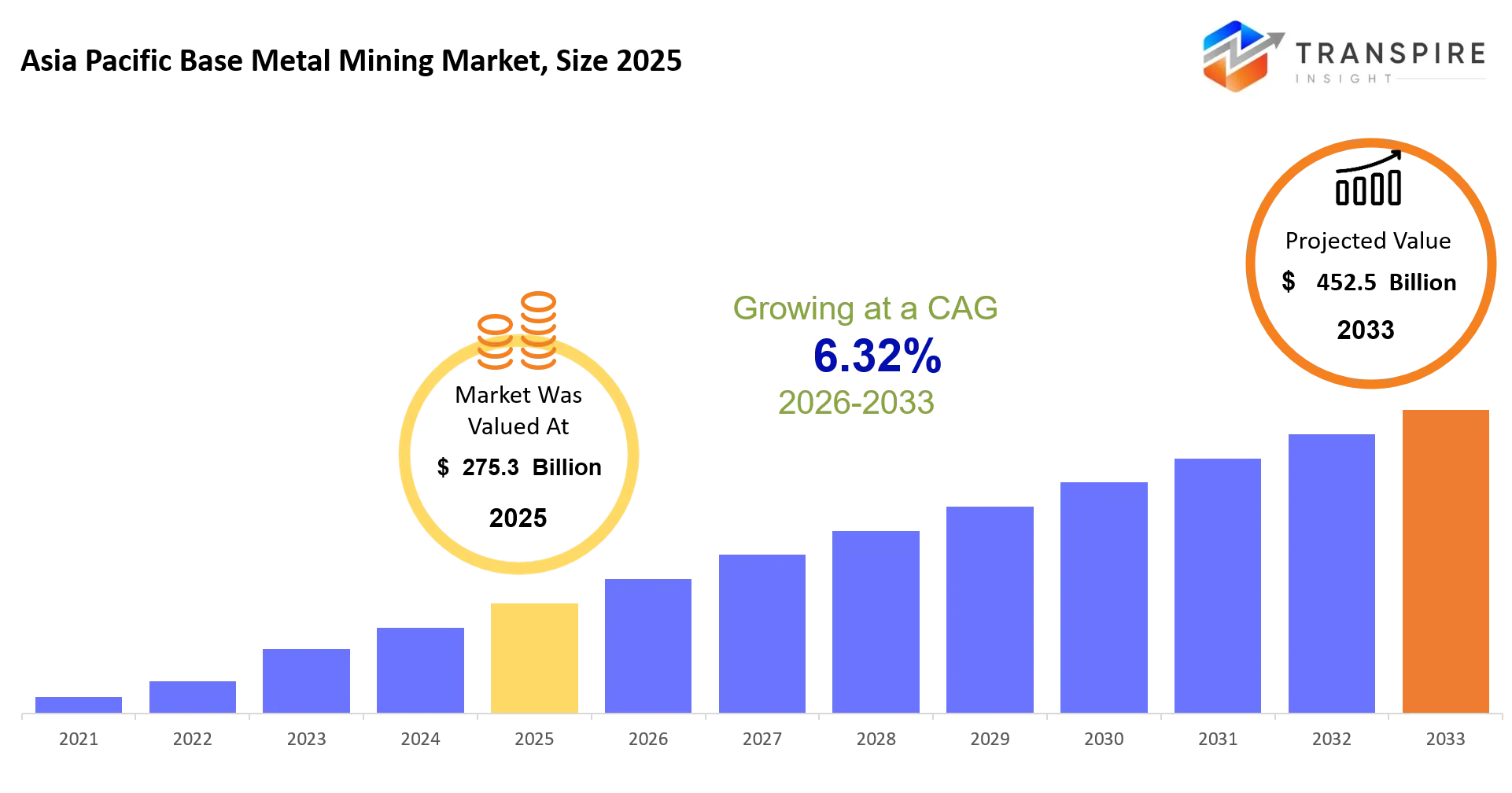
As per Transpire Insight Analysis, the Asia Pacific Base Metal Mining Market size is estimated at USD 275.3 Billion in 2025 and is anticipated to reach USD 452.5 Billion by 2033, growing at a CAGR of 6.32% from 2026 to 2033.
The Asia Pacific Base Metal Mining Market basically provides essential metals such as copper, nickel, zinc and lead ,that end up supporting power networks, electric vehicles , construction systems, and the whole industrial equipment manufacturing scene. Mining activities give the raw material foundation required to grow infrastructure and keep critical supply chains steady across manufacturing economies. In the last 3–5 years, the sector has been moving toward technology-led extraction ,using automation, remote monitoring, and digital mine management—kinda improving productivity and resource efficiency. A key catalyst was the worldwide push toward an energy transition, which cranked up the need for battery and grid related minerals, but also made a few weak points pretty visible in mineral supply chains, especially after some geopolitical disruptions. As governments and industries put more weight on supply security , mining companies are now channeling budgets into exploration, into processing capacity, and into more cleaner operations. All of this ought to support revenue growth as well, because when output reliability improves, and long term metal availability stays bolstered, it tends to translate into steadier results later on.
Asia Pacific Base Metal Mining Market Size & Forecast:
- Asia Pacific Base Metal Mining Market Size 2025: USD 275.3 Billion
- Expected Market Value 2033: USD 452.5 Billion
- Forecast CAGR: 6.32%
- Leading region in 2025: East Asia
- Fastest Growing region: Southeast Asia
- Key Profile: BHP, Rio Tinto, Glencore, Anglo American, Vale, Freeport-McMoRan, Teck Resources, Zijin Mining, Hindustan Zinc, Vedanta Resources, South32, MMG Limited, Boliden, First Quantum Minerals, Sumitomo Metal Mining
Key Market Insights
- East Asia kind of dominates the market, with around 55% share in 2025, mainly because China’s mining output as well as its processing ability sort of keeps things moving.
- Southeast Asia meanwhile is the fastest riser during 2025–2033 , pushed by investments around nickel , copper, and battery related materials .
- Copper ends up leading the product segments with nearly 35% share as electrification projects accelerate and, in turn, global metal consumption grows.
- Nickel takes the number two spot, backed by battery manufacturing needs and also the expansion of stainless-steel production.
- Lithium connected base metal projects are the quickest movers from 2025–2033 , largely due to energy storage supply chain investment activity.
- In applications, construction and infrastructure dominate with about 40% share in 2025 across emerging economies , even if demand patterns vary.
- Renewable energy applications are also the fastest-growing segment as grids plus storage projects expand after 2025.
- For end users, industrial manufacturing stays in front, holding roughly 45% share , because metal-intensive production keeps expanding.
- Battery and electric mobility companies make up the fastest-growing end-user category, driven by strategic mineral sourcing decisions.
- BHP expanded its copper investments, aiming for long-term supply security through technology led mining operations .
What are the Key Drivers, Restraints, and Opportunities in the Asia Pacific Base Metal Mining Market?
The main “engine” behind growth in the Asia Pacific Base Metal Mining Market is sort of the energy transition, but in particular the move toward critical mineral security. Government incentives, renewable energy targets and electric vehicle policies have, in practice, nudged mining companies to ramp up copper and nickel extraction initiatives. In the end this mix of technology and policy change helps exploration get more funding, it expands processing capacity, and it also opens up fresh monetization paths across battery and infrastructure related supply chains.
At the same time, the biggest structural hurdle still feels like environmental compliance being complicated, plus mine approvals taking a long time. For a new project to actually start, it can take years of permitting, feasibility work, and community discussions, before anything produces. From the Transpire Insight angle, using regional procurement announcements and launch schedules, the supply chain concentration issue stays the key execution risk. And sure, those delays may cap output expansion, push back capacity additions, and reduce revenue timing when commodity demand is really strong.
The next growth opportunity is digital mining platforms, paired with renewable powered extraction systems. Places like Indonesia and Australia are putting more money into automation, remote operations, and cleaner processing options. These approaches can raise productivity, trim operating expenses, and also let mining companies align with tougher sustainability expectations, while still expanding regional production capability.
What Has the Impact of Artificial Intelligence Been on the Asia Pacific Base Metal Mining Market?
Artificial intelligence plus digital technologies are kind of reshaping mining across the Asia Pacific region by pushing efficiency along, raising safety levels, and improving the way resources are managed. Mining firms are moving toward AI monitoring systems, autonomous machinery controls, and also digital compliance platforms, so the extraction workflow can be optimized with less manual involvement, and yeah fewer unnecessary steps. With real time sensors teamed up with machine learning models, crews can often spot equipment problems early, before a breakdown happens, which then helps with maintenance timing and cuts down on expensive production stoppages.
Predictive analytics are also being used for ore grading forecasting, production scheduling, and demand modeling. This approach lets operators adjust extraction tactics using geological signals, shifting market conditions, and observed operational trends. When analytics get more advanced, they can support stronger equipment utilization, more solid decision making, and more accurate resource allocation across large mining areas.
Still, AI uptake has limits, mainly because deployment costs can be high, data quality and availability are inconsistent, and connectivity becomes a headache in remote sites. A lot of operators need major infrastructure upgrades before they can reach a full scale digital transformation throughout their mining operations, which slows progress in practice.
Key Market Trends
- From 2020–2025, mining firms sort of sped up automation adoption, with autonomous vehicles and remote monitoring coming into bigger, day to day operations.
- China then tightened mineral supply control after the 2022 disruptions, and it started pushing more strategic money into domestic processing, basically trying to get the whole pipeline closer together.
- Indonesia, after 2020, also rolled out more nickel processing projects, and it kinda turned into a major hub for battery material supply chains.
- Copper exploration gained traction after 2023, since renewable energy infrastructure kept growing and put extra pressure on global supplies, not just demand.
- After 2021, many mining companies began using AI based geological analysis tools, to make exploration precision better and also to cut expenses.
- Australia increased spending on critical minerals between 2022–2025 through government backed supply chain initiatives, it was not subtle.
- After 2023, more renewable powered mining projects appeared, operators aimed for reduced emissions and smoother regulatory compliance, sometimes at the same time.
- Equipment manufacturers, starting from 2020, introduced more advanced automation solutions that were meant to improve both mine safety and productivity outcomes.
- And after 2022, with geopolitical tensions, supply chain diversification strategies accelerated , exposing how risky regional dependency could be.
- Finally, digital twin tech usage rose after 2021, which helped with predictive operations and better asset management across the mines, more or less.
Asia Pacific Base Metal Mining Market Segmentation
By Metal Type :
Copper still takes a big role mainly because it shows up in power networks, renewable energy systems, and the general industrial gear people rely on. Nickel mining is getting more attention too, tied closely to battery production and stainless steel manufacturing, particularly throughout many major industrial economies. Zinc, and lead keep backing construction work , automotive parts, and coating protection uses, day to day in a lot of places.
Aluminum plus tin output also backs packaging, transport, and electronic product manufacturing. Mining companies are now stretching their exploration reach to lock in longer term metal availability and, well, to match the way industrial needs keep shifting. Spreading investment across multiple metals should lower reliance on single commodity swings and help supply stability for regional businesses.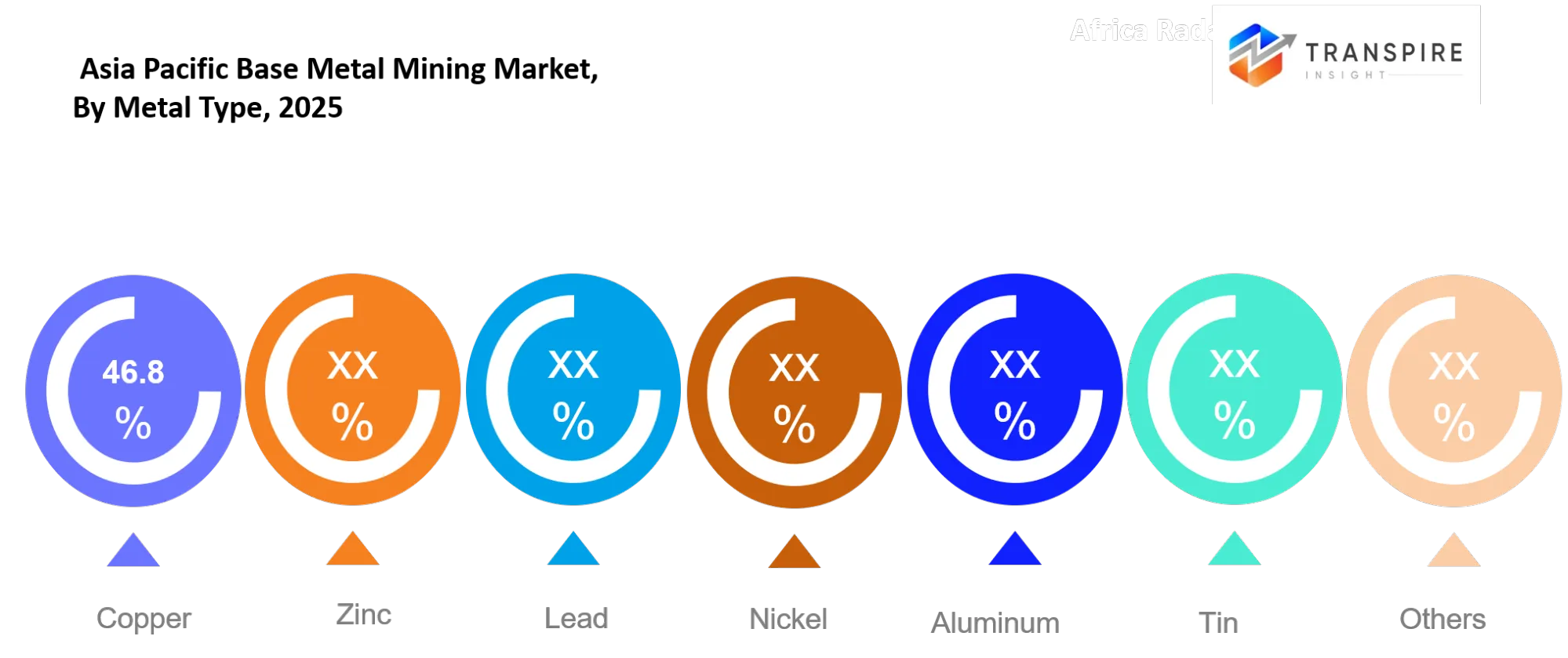
By Mining Method :
Open pit mining stays broadly used because it is cost efficient-ish, it supports large scale production capacity, and it fits surface mineral deposits pretty well too. Big mining operations lean on modern excavation equipment, automation systems, and digital monitoring tools too, to push output higher and keep safety standards steadier . Overall it tends to work with the way these pits are laid out, even when the material extraction pace gets intense.
Underground mining is also getting more traction for deeper mineral reserves, where taking minerals from the surface stops being so practical. Placer mining and solution mining help with more specialized recovery work, but only when certain geological conditions line up right. With more technology investment, operators can tighten control, improve resource recovery rates, and strengthen environmental management across mining projects.
By Application :
Construction is one of those pretty big application areas where base metals really show up supporting buildings, transport routes, and general urban infrastructure growth. Copper, aluminum, and zinc are still essential materials, used in structural systems, electrical installations, and for durable construction parts. In practice, they kind of become the backbone even when projects look different
At the same time automotive and electrical industries are creating fresh chances, especially with electric vehicle production, charging networks, and more advanced electronic systems. Machinery and infrastructure projects also need a steady metal supply for equipment manufacturing and those large scale development programs. Industrial expansion across Asia Pacific countries will keep shaping how applications are set up, and where investment attention is placed
By End User :
Construction companies stay among the major consumers, because infrastructure work never really stops, plus urban development programs and commercial building activities keep running. Automotive manufacturers are also ramping up metal procurement, since electric vehicles and lightweight vehicle designs are getting broader adoption. Electronics companies in turn really rely on copper, aluminum, and other metals, for high-graded devices and electrical components that people use every day.
Industrial manufacturers depend on steady metal access for machinery, production systems, and equipment fabrication , because if the materials stall, everything slows down. Government initiatives linked with infrastructure buildup, the energy transition, and resource security will also shape how procurement approaches look like later on , in practice.Strategic partnerships between mining companies and end users will help improve supply planning, and also cut down material availability risks, a bit more than before
By Ore Type :
Sulfide ores are a pretty important source for copper, nickel, and other basic metals, mainly because those valuable mineral concentrations are there. Mining operators typically use advanced processing techniques, to boost recovery rates and also to keep up with the complicated extraction requirements, you know. Oxide ores can give alternative extraction opportunities, especially when the deposits are closer to surface areas.
Then there are mixed ores which kind of force operators into advanced separation technologies so they can get the most out of the available resources and still keep the economic feasibility on track. More research investments into processing methods will hopefully improve efficiency across the different ore categories, without too much trouble. And of course, sustainable mining practices plus better resource management will end up shaping the future ore processing decisions for regional mining operations.
What are the Key Use Cases Driving the Asia Pacific Base Metal Mining Market?
Construction projects kind of are the core use case, with base metals backing up buildings, transport routes, and utility infrastructure too. Construction firms buy copper, aluminum, zinc , and other materials because durability, conductivity and structural performance stay essential for big development projects.
Electric vehicle manufacturing and electronics production are also growing, and this is backed by automotive manufacturers and electronics companies that are still wanting copper and nickel for batteries, wiring layouts , and components. On the industrial side, manufacturers similarly use base metals for machining production, equipment fabrication, and other related needs.
Newer directions are showing up too, like renewable energy systems and advanced energy storage initiatives. Government energy transition programs and private funding will probably create fresh opportunities for specialized mineral usage during the forecast period, in other words, it’s not slowing down.
|
Report Metrics |
Details |
|
Market size value in 2025 |
USD 275.3 Billion |
|
Market size value in 2026 |
USD 294.7 Billion |
|
Revenue forecast in 2033 |
USD 452.5 Billion |
|
Growth rate |
CAGR of 6.32% from 2026 to 2033 |
|
Base year |
2025 |
|
Historical data |
2021 - 2024 |
|
Forecast period |
2026 - 2033 |
|
Report coverage |
Revenue forecast, competitive landscape, growth factors, and trends |
|
Regional scope |
Asia Pacific (India, China, Japan, Australia, South Korea, Rest of Asia Pacific) |
|
Key company profiled |
BHP, Rio Tinto, Glencore, Anglo American, Vale, Freeport-McMoRan, Teck Resources, Zijin Mining, Hindustan Zinc, Vedanta Resources, South32, MMG Limited, Boliden, First Quantum Minerals, Sumitomo Metal Mining . |
|
Customization scope |
Free report customization (country, regional & segment scope). Avail customized purchase options to meet your exact research needs. |
|
Report Segmentation |
By Metal Type (Copper, Zinc, Lead, Nickel, Aluminum, Tin, Others); By Mining Method (Open Pit Mining, Underground Mining, Placer Mining, Solution Mining, Others); By Application (Construction, Automotive, Electrical & Electronics, Machinery, Infrastructure, Others); By End User (Construction Companies, Automotive Manufacturers, Electronics Companies, Industrial Manufacturers, Government, Others); By Ore Type (Sulfide Ores, Oxide Ores, Mixed Ores, Others) |
Which Regions are Driving the Asia Pacific Base Metal Mining Market Growth?
China kind of represents the dominant region, with roughly 55% market share in 2025, because there is a lot of mining capacity and pretty advanced metal processing infrastructure. Also, government policies that back industrial output, resource security, and clean energy supply chains really help it stay on top. You can see a wide ecosystem too, not just mining firms, but processing facilities , equipment suppliers and then downstream manufacturers all together, so investment keeps moving, kind of nonstop. With strong domestic demand and deliberate mineral planning, China should hold its position through the forecast window, even if it changes at the margins.
Australia comes in as a steadier revenue market, mainly due to mature mining practices, regulatory consistency and strong export networks. There are clear environmental standards, a capable workforce available, plus long-term resource commitments, so operators get reliable conditions to run. The country’s copper, nickel, and other mineral exports also keep global supply chains supplied, while maintaining dependable buyer relationships. If companies keep leaning into automation and more sustainable extraction methods, then Australia’s importance should remain intact through 2033.
Then Southeast Asia is the fastest-growing area, especially as Indonesia, Vietnam, and a few more countries build up mineral processing and infrastructure capacity. After 2020, the pace noticeably increased thanks to new investment policies, nickel downstream projects, and battery material initiatives. More industrialization there is pulling in international mining companies, since they want diversified sourcing locations. This kind of expansion will open up fresh chances for investors and technology providers, roughly from 2026–2033, and that’s expected to keep building over time.
Who are the Key Players in the Asia Pacific Base Metal Mining Market and How Do They Compete?
The Asia Pacific Base Metal Mining Market looks like it has a moderately consolidated setup, where the big mining groups basically hold onto major production assets, but the smaller regional operators still go after specific mineral categories. What really drives competition is more about operational efficiency, automation take up, access to resources and processing know-how than just chasing production volume. The well established companies seem to keep their footing by doing technology upgrades , while new players often try to land specialized mineral opportunities that tie into energy transition industries, you know, that whole shift happening right now.
BHP competes with large scale resource operations and money going into copper and nickel assets. It leans on digital mining tools , productivity improvements, and longer term supply agreements which help it stay strong in those strategic mineral markets. Rio Tinto is more about autonomous mining systems, advanced processing methods and sustainable production efforts across several major mining regions, even when conditions get tough.
Vale tends to focus on scaling nickel supply and building partnerships that support electric vehicle material demand. Glencore relies on an integrated approach, mixing mining and trading capabilities so it can manage supply networks and smooth out commodity flows. China Minmetals improves regional competitiveness through mineral resource investments, expanding processing capability, and tightening supply chain integration across Asia.
Company List
- BHP
- Rio Tinto
- Glencore
- Anglo American
- Vale
- Freeport-McMoRan
- Teck Resources
- Zijin Mining
- Hindustan Zinc
- Vedanta Resources
- South32
- MMG Limited
- Boliden
- First Quantum Minerals
- Sumitomo Metal Mining
Recent Development News
In October 2025, Rio Tinto and China’s State Power Investment Corporation (SPIC) Qiyuan launched a battery swap electric haul truck trial fleet at the Oyu Tolgoi copper mine in Mongolia. The technology partnership introduced eight 91-tonne battery swap trucks and supporting infrastructure, advancing lower-emission mining operations and demonstrating electrification solutions for large-scale base metal extraction. Source https://www.riotinto.com/
In January 2025, BHP awarded an engineering, procurement and construction management contract to the Fluor Australia and Hatch joint venture for the proposed Copper SA smelter and refinery expansion. The more than AUD 40 million initial investment commitment supports future copper processing capacity in South Australia and strengthens regional base metal supply infrastructure. Source https://www.bhp.com/
What Strategic Insights Define the Future of the Asia Pacific Base Metal Mining Market?
The Asia Pacific Base Metal Mining Market is kinda shifting, structurally speaking, toward a more technology-driven supply-secure kind of model in the next 5–7 years, mainly because the demand for copper, nickel, lithium-associated minerals and other metals needed for electrification, renewable energy infrastructure and advanced manufacturing keeps rising. There’s also a sort of hidden risk, like market concentration, because relying on a small number of mining regions and processing hubs could make the whole supply chain more vulnerable to geopolitical shocks, and sudden policy changes. At the same time, there’s an emerging opportunity in digital mine transformation, with autonomous equipment, AI-based exploration, and low-carbon extraction technologies becoming more important as environmental regulations get tighter. Market participants should, in practice, put focus on resource-efficient operations, build diversified supply networks, and set up strategic partnerships with technology providers, all of that to strengthen resilience , and to better capture long-term value
Asia Pacific Base Metal Mining Market Report Segmentation
By Metal Type
- Copper
- Zinc
- Lead
- Nickel
- Aluminum
- Tin
By Mining Method
- Open Pit Mining
- Underground Mining
- Placer Mining
- Solution Mining
By Application
- Construction
- Automotive
- Electrical & Electronics
- Machinery
- Infrastructure
By End User
- Construction Companies
- Automotive Manufacturers
- Electronics Companies
- Industrial Manufacturers
- Government
By Ore Type
- Sulfide Ores
- Oxide Ores
- Mixed Ores
Frequently Asked Questions
Find quick answers to common questions.
The Expected Asia Pacific Base Metal Mining Market size for the Market will be USD 452.5 Billion in 2033.
Key segments for the Asia Pacific Base Metal Mining Market are By Metal Type (Copper, Zinc, Lead, Nickel, Aluminum, Tin, Others); By Mining Method (Open Pit Mining, Underground Mining, Placer Mining, Solution Mining, Others); By Application (Construction, Automotive, Electrical & Electronics, Machinery, Infrastructure, Others); By End User (Construction Companies, Automotive Manufacturers, Electronics Companies, Industrial Manufacturers, Government, Others); By Ore Type (Sulfide Ores, Oxide Ores, Mixed Ores, Others.
Major Asia Pacific Base Metal Mining Market players are BHP, Rio Tinto, Glencore, Anglo American, Vale, Freeport-McMoRan, Teck Resources, Zijin Mining, Hindustan Zinc, Vedanta Resources, South32, MMG Limited, Boliden, First Quantum Minerals, Sumitomo Metal Mining.
The Current Asia Pacific Base Metal Mining Market size is USD 275.3 Billion in 2025.
The Asia Pacific Base Metal Mining Market CAGR is 6.32% from 2026 to 2033.
- BHP
- Rio Tinto
- Glencore
- Anglo American
- Vale
- Freeport-McMoRan
- Teck Resources
- Zijin Mining
- Hindustan Zinc
- Vedanta Resources
- South32
- MMG Limited
- Boliden
- First Quantum Minerals
- Sumitomo Metal Mining
About the Authors

Pankaj Ghogare Patil
I am Pankaj Ghogare Patil, a Senior Research Analyst at Transpire Insight, specializing in the Pharmaceutical, Chemicals & Materials, Healthcare IT, and Biotechnology industry. My expertise lies in conducting comprehensive market research, analyzing industry trends, evaluating competitive landscapes, and translating complex data into actionable insights. At Transpire Insight, I closely follow emerging technologies, regulatory developments, and market innovations to create accurate, well-researched, and informative content that helps businesses and professionals make informed decisions. I am committed to producing credible, evidence-based articles that reflect industry best practices while making technical topics accessible and valuable for a broad audience.

Chakradhar Khansole
Chakradhar serves as the Research Director at Transpire Insight, bringing over 8 years of experience in technology, innovation, and strategic market intelligence. He specializes in transforming complex market data into actionable business insights that enable organizations to make informed, growth-oriented decisions. Recognized for his strategic vision and analytical expertise, Chakradhar leads high-impact research initiatives, delivering comprehensive market assessments, competitive intelligence, and forward-looking industry analysis.
Recently Published Reports
-
May 2026
Healthcare Polymer Packaging Market
Healthcare Polymer Packaging Market Size, Share & Analysis Report By Packaging Type (Syringes, IV Bottles and Pouches, Clamshells, Blisters, Bottles & Jars, Containers, Tubes, IV Parental Packaging, Others), By Type (Regulated, Non-regulated), By Polymer Type (LDPE (Low-Density Polyethylene), HDPE (High-Density Polyethylene), Homo-polymer (Homo), Random Copolymer (Random), Block Copolymer (Block), PET, Polystyrene, Polyvinyl Chloride, Polyamide/EVOH, Others), and Geography (North America, Europe, Asia-Pacific, Middle East and Africa, South and Central America), 2021 - 2031
-
Apr 2026
Hydrophilic Tape (Waterstop) Market
Hydrophilic Tape (Waterstop) Market Size, Share & Analysis Report By Type (Bentonite-Based Hydrophilic Tape, Rubber-Based Hydrophilic Tape), By Application (Residential Buildings, Commercial Buildings, Infrastructure Projects), and Geography (North America, Europe, Asia-Pacific, Middle East and Africa, South and Central America), 2021 - 2031
-
Apr 2026
Metalens Market
Metalens Market Size, Share & Analysis Report By Type (Visible Light Metalens, and Infrared Metalens), By Application (Consumer Electronics, Automotive Electronics, Industrial, Medical, and Others), and Geography (North America, Europe, Asia-Pacific, Middle East and Africa, South and Central America), 2021 - 2031
-
Apr 2026
PBT Resin Market
PBT Resin Market Size, Share & Analysis Report By Type (Reinforced PBT Resin, Unreinforced PBT Resin), By Processing Method (Injection Molding, Extrusion, Blow Molding, Others), By End-User (Automotive, Electrical & Electronics, Consumer Appliances, Industrial Machinery, Medical Devices, Packaging, Others), and Geography (North America, Europe, Asia-Pacific, Middle East and Africa, South and Central America), 2021 - 2031