
LNG Terminal Market Summary:
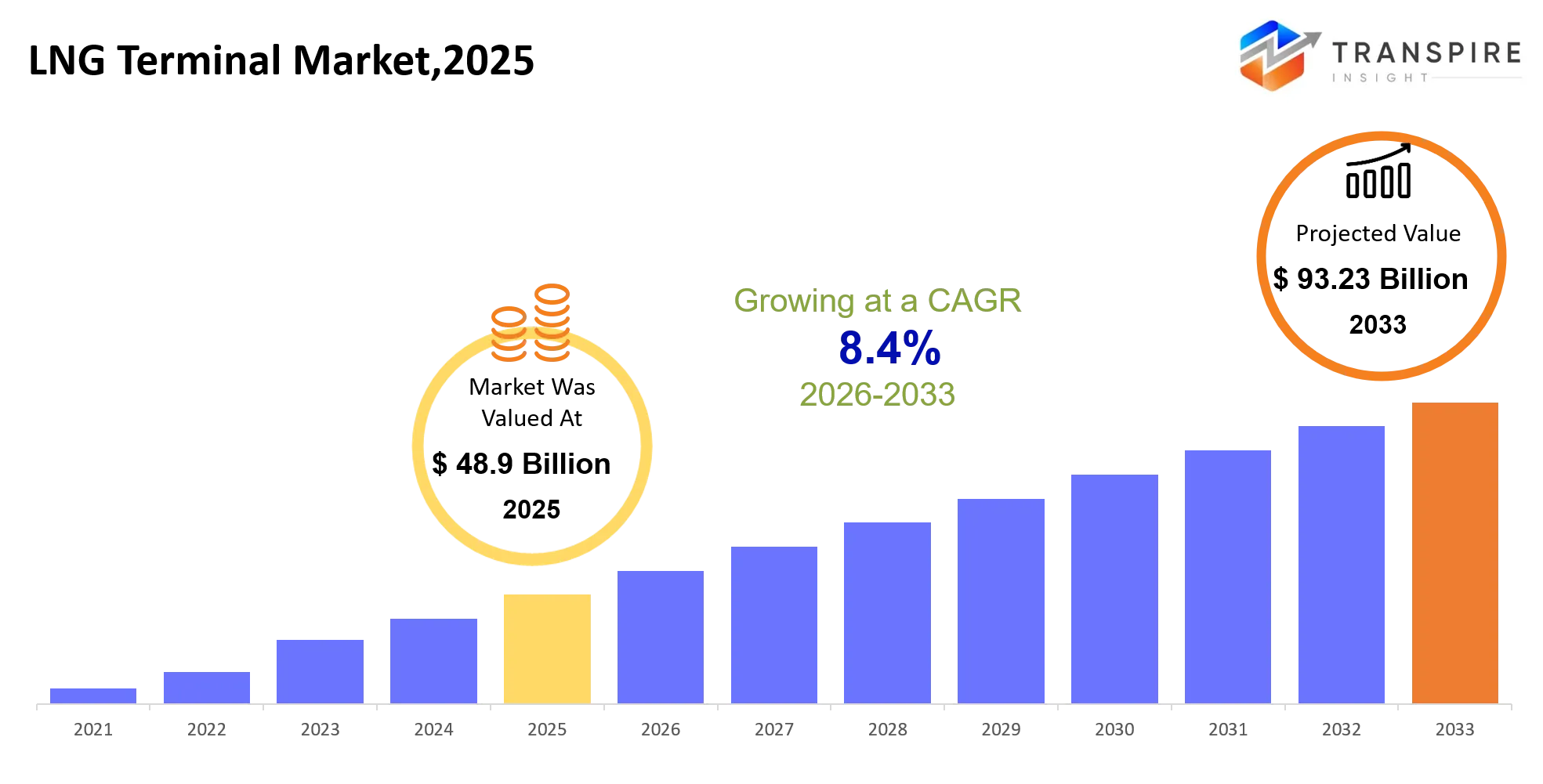
As per Transpire Insight Analysis, the LNG Terminal Market size is estimated at USD 48.9 billion in 2025 and is anticipated to reach USD 93.23 billion by 2033, growing at a CAGR of 8.4% from 2026 to 2033.
The worldwide LNG terminals market is growing due to the construction of facilities that can receive, store, regasify, liquefy, and transport LNG to customers. Over the last three to five years, building terminals has moved towards flexible locations, floating units that can turn LNG back into gas, smaller facilities for moving gas around and projects made to react faster when gas supply changes. A big change has been the use of floating and modular ways because they take less time to build and need less land than some big onshore projects. A real example of why this happened is when normal gas supply routes got broken, which made countries that depend on gas look for ways to get LNG. This made terminals important as a way to keep energy safe. So growth is connected to ways to bring gas in to meet the needs of power plants, use of gas, by factories and having more ways to get gas. Companies are also using automation, checking with computers and guessing when things might need fixing to make everything work better and cost less.
LNG Terminal Market Size & Forecast:
- Market Size 2025: USD 48.9 Billion
- Expected Market Value (2033): USD 93.23 Billion
- Forecast CAGR (2026–2033): 8.4%
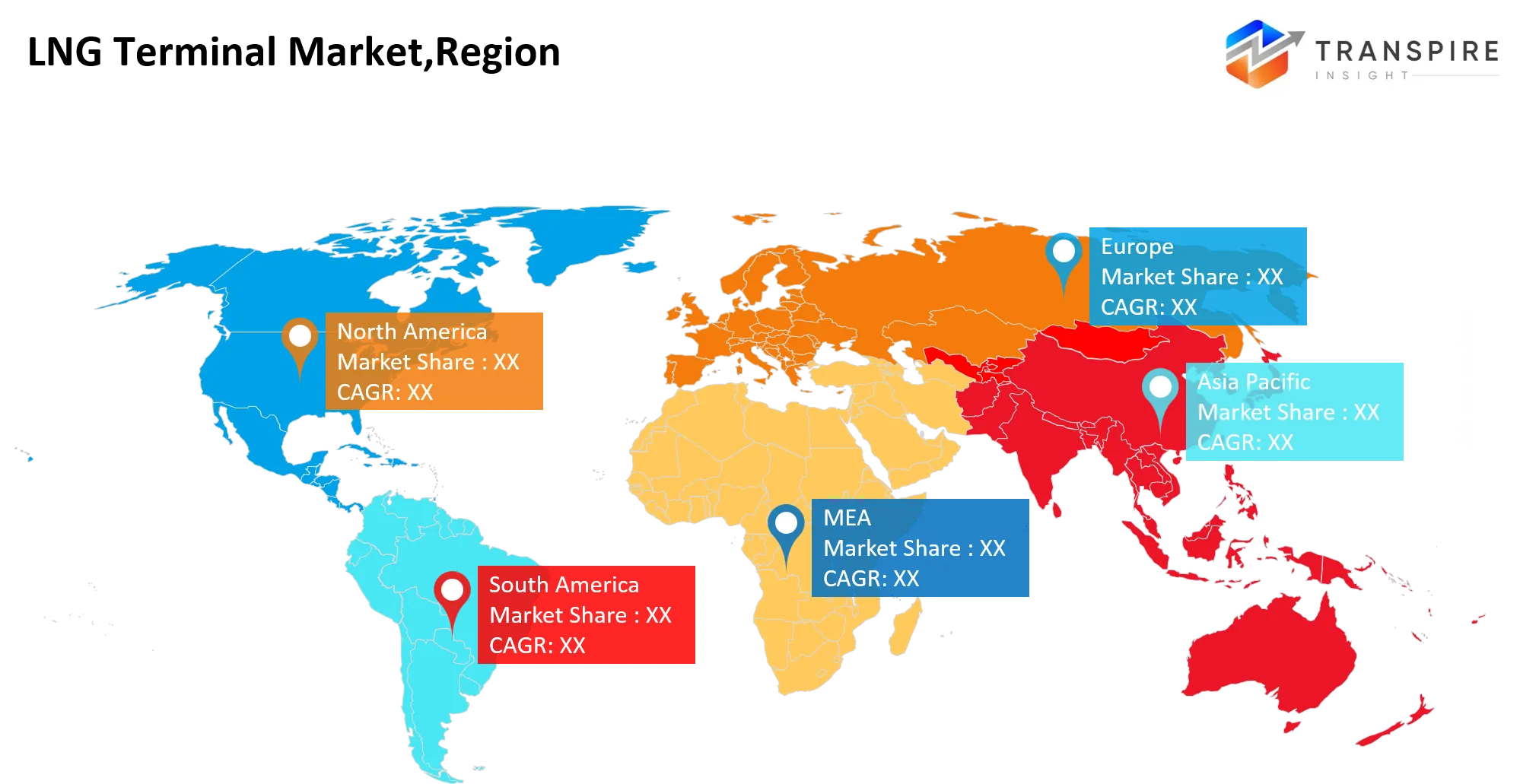
- Leading Region in 2025: Asia-Pacific
- Fastest Growing Region: Europe
- Key Company Profiles: Shell, ExxonMobil, TotalEnergies, Chevron, BP, QatarEnergy, ADNOC, Cheniere Energy, Venture Global, Sempra Infrastructure, Kinder Morgan, Höegh Evi, Excelerate Energy, Golar LNG, Fluxys
Key Market Insights:
market is moving towards more flexible systems, with traditional onshore terminals still holding the greatest market share. Floating technology, digitisation, and increased import capacity are altering the way terminal providers approach supply security and infrastructure needs.
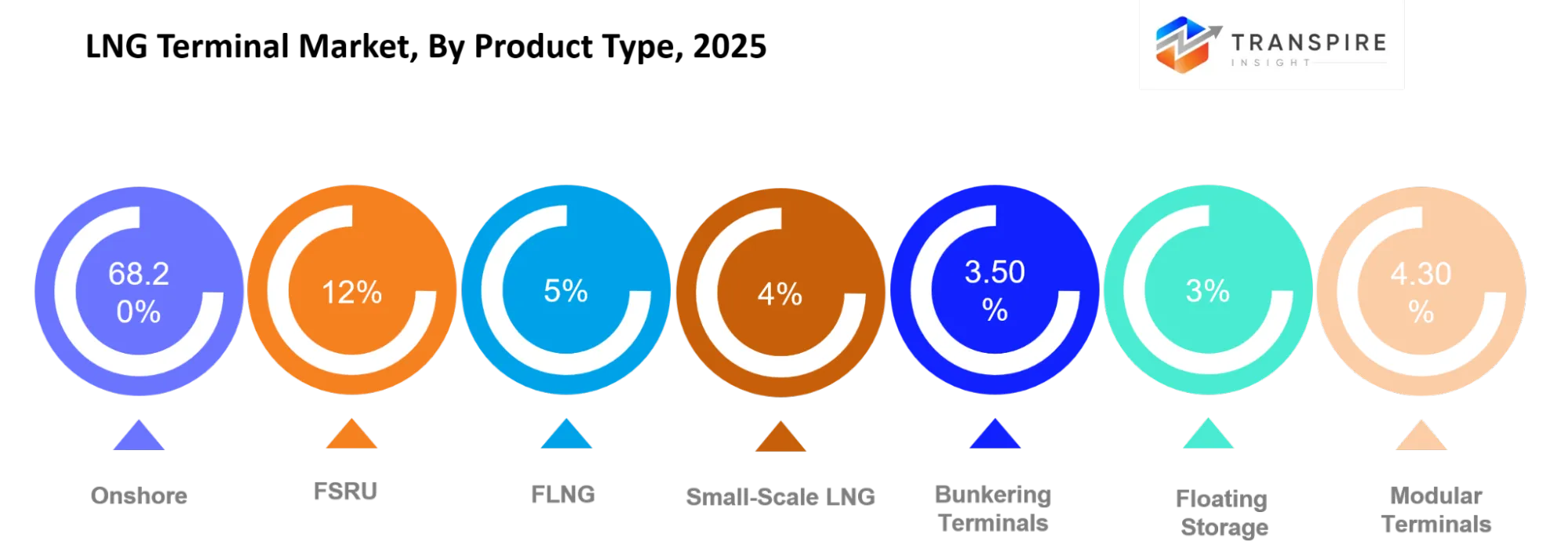
- Onshore terminals constitute 68.20%, remaining the largest as a result of already existing infrastructure enabling massive volumes of LNG.
- Floating terminals are forecasted to see a 14.18% CAGR due to higher attention towards infrastructure involving FSRU solutions where developers require more flexible regasification capabilities.
- FSRUs hold 12.00% of segment share due to the capabilities of providing LNG import capacities without the need for such large-scale onshore infrastructure.
- FLNG makes up 5.00% due to the tendency of the industry to offshore liquefaction infrastructure connecting stranded gas sources with the international LNG market.
- Small-scale LNG accounts for 4.00% as a result of applications requiring distribution of LNG to smaller industrial users, remote locations or transportation consumers.
- Bunkering terminals account for 3.50% as marine transport providers are increasingly considering infrastructure related to LNG fuel.
What are the Key Drivers, Restraints, and Opportunities in the LNG Terminal Market?
Drivers
The growth in the LNG terminal market will be driven by the necessity of flexible gas infrastructure following disruptions in pipelines and international energy trading. Countries that import energy are increasing their capacity for regasification since the use of LNG offers utilities and industrial companies another alternative in case of low domestic production and pipeline delivery. This will have an impact on terminal earnings through increased usage, service contracts, storage and handling. Floating storage and regasification vessels will be helpful when governments require rapid capacity addition or in places where a bigger terminal takes more time and money to build.
Restraints
limitation is the considerable initial cost involved in building terminals, pipelines, storage tanks, marine terminals, and safety installations. The projects may take a long time to obtain permits, conduct environmental impact studies, build, and finance, and usage may be difficult to determine if there are fluctuations in the demand for the gas.
Opportunities
Opportunity in the creation of modular, floating, smaller, and reduced-emission terminals. Digital controls, electrification, heat recovery, and carbon management preparedness could help to make projects economically viable and easier to comply with in the future. There are also recent developments within emerging import markets that show potential for infrastructure where LNG can be used to produce electricity and fuel.
What Has the Impact of Artificial Intelligence Been on the LNG Terminal Market?
AI is useful in LNG terminals through its capacity to assist operators in making timely decisions using large quantities of information regarding assets and processes at the terminals. The use of analytics through AI can assist operators to monitor compressors, pumps, vaporisers, storage tanks, loading systems, among others and identify abnormal behaviour before it turns into a significant failure. AI-assisted predictive maintenance can allow operators to make arrangements for equipment inspection and component replacement based on the condition of the equipment. With respect to process management, optimisation technology can be helpful in assisting operators in inventory planning, send-out scheduling, berth planning, energy management and forecasting of gas demand. Automated monitoring can also enhance safety by providing alerts about abnormal pressure, temperature, vibration or flow levels and drawing operators' attention to those areas that require inspection. Digital twins and machine learning models can enable testing of operational scenarios without the need for changing the actual equipment. This technology can minimise downtime, increase the efficiency of the assets, and improve consistency in the operation of the terminal. But its adoption is constrained by integration costs, legacy control systems, cybersecurity considerations, poor quality of data and shortage of skilled people.
Instance
In November 2025, ADNOC Gas collaborated with AIQ and Gecko Robotics for the inspection and maintenance of its assets using AI-powered robotics and predictive analytics. This technology is intended to enhance equipment reliability, minimise unexpected shutdowns, and cut down maintenance expenses, underscoring the importance of AI in LNG and gas terminals’ operation.
Key Market Trends:
There is a trend within the LNG terminal industry that is shifting from a traditional fixed infrastructure concept towards more flexible terminal concepts. Digitalisation, floating technology, distributed systems, and efficiency enhancements have become increasingly important for project planning.
- Floating terminals have been increasingly discussed as a viable alternative to the construction of traditional terminals with the help of FSRUs.
- The design of terminals is becoming more flexible in terms of modular infrastructure capable of being adjusted to future demands for LNG.
- Digital monitoring is becoming a more common element of terminal management when operators use connected systems to monitor equipment operation.
- Predictive maintenance is becoming more important as maintenance is shifting from routine practices towards intervention before any disruptions occur based on data.
- LNG storage is changing its approaches as there is an increasing need to manage inventories in case of diverse international shipping routes.
- Small-scale LNG is becoming a reality as operators seek to link their infrastructure with industrial consumers, transport systems, distant markets, and marine uses.
LNG Terminal Market Segmentation
By Terminal Types
the onshore terminals dominate with a share of 68.20% due to existing infrastructure for high-capacity receipt, storage, regasification, and delivery of the fuel. The FSRU category makes up 12.00%, and the FLNG constitutes 5.00%, which reflects the need for floating and offshore terminals. The Small-Scale LNG type has a 4.00% share, the Bunkering Terminals hold 3.50%, the Floating Storage 3.00%, and the Modular Terminals account for 2.00% of all. The "Other" terminals take 2.30% of the total volume.
By Services
LNG terminals are designed for such operations as liquefaction export, regasification import, bunkering, storage, transhipment, reloading, small-scale distribution and others. Of course, regasification plays a key role in the context of LNG importing markets because this process allows converting delivered LNG into the form of natural gas, which can be used by power plants, industrial consumers and city-gas pipelines. The terminals for export continue to play an important role in gas-producing areas, but now the bunkering and small-scale distribution are able to open new sources of income. In the future, it is possible to expect the further development of terminals which will be able to work under several different functions.
By Capacity
terminal capacities are varied and include both small facilities of below 1 MMTPA and big facilities of above 10 MMTPA. It should be noted that smaller capacity categories, which include below 1 MMTPA and 1-3 MMTPA, can be applied to satisfy regional, industrial, remote or specialised needs when a large facility would be redundant. The mid-size facilities of 3-5 MMTPA and 5-10 MMTPA can create a good compromise between the investment costs and covered market.
By End User
power generation is an important application due to the provision of gas to electricity producers who need a reliable fuel source. Demand will be created by industrial and manufacturing end users through their use of the gas as an alternative fuel for production purposes. There is rising importance of transportation and marine applications with the advent of LNG bunkering. The city gas becomes an alternative for the distribution of regasified LNG. Residences, commercial facilities, petrochemicals, and others become beneficiaries of gas network connections to the terminals. The future composition will be based on regional demand for gas, interconnection possibilities and alternative fuels.
By Technology
conventional terminal technologies are still significant because of their proven track record and extensive deployment. Floating technologies are making progress since they are capable of reducing the time for deployment and offering increased flexibility with regard to location. Module technologies offer the possibility of staged construction, whereas electrified and hybrid solutions may enhance energy efficiency. The low-carbon and CCS-compatible technologies are becoming increasingly pertinent since the developers are taking into account future emissions requirements. It seems that the union of conventional technologies and digital control, electrification, hybrids, and carbon management compatibility will determine the next generation of LNG terminals.
What are the Key Use Cases Driving the LNG Terminal Market?
On-shore LNG terminal use continues to dominate as it facilitates the large-scale LNG reception, storage, regasification, and delivery. The infrastructure links the received LNG with power plants, industries, city gas grids, and other major consumers. In line with the market dominance of the onshore terminal segment, the growing applications are those of floating regasification, small-scale LNG delivery, LNG bunkering, and LNG delivery to the industrial clusters. The growing application is appropriate where there is less pipeline infrastructure, geographic spread of demand, or where buyers require more flexibility in terms of reception and delivery of LNG. The emerging applications include the digital optimisation of LNG hubs, LNG back-up power generation, remote fuel delivery to industries, lower-emission marine fuel transportation, and modular infrastructure that scales up to meet the demand. These emerging applications are making LNG terminals flexible energy hubs, rather than mere import/export stations.
|
Report Metrics |
Details |
|
Market size value in 2025 |
USD 48.9 Billion |
|
Market size value in 2026 |
USD 53.01 Billion |
|
Revenue forecast in 2033 |
USD 93.23 Billion |
|
Growth rate |
CAGR of 8.4% from 2026 to 2033 |
|
Base year |
2025 |
|
Historical data |
2021 - 2024 |
|
Forecast period |
2026 - 2033 |
|
Report coverage |
Revenue forecast, competitive landscape, growth factors, and trends |
|
Regional scope |
United States; Canada; Mexico; United Kingdom; Germany; France; Italy; Spain; Denmark; Sweden; Norway; China; Japan; India; Australia; South Korea; Thailand; Brazil; Argentina; South Africa; Saudi Arabia; United Arab Emirates |
|
Key company profiled |
Shell, ExxonMobil, TotalEnergies, Chevron, BP, QatarEnergy, ADNOC, Cheniere Energy, Venture Global, Sempra Infrastructure, Kinder Morgan, Höegh Evi, Excelerate Energy, Golar LNG, Fluxys |
|
Customization scope |
Free report customization (country, regional & segment scope). Avail customized purchase options to meet your exact research needs. |
|
Report Segmentation |
Terminal Type (Onshore, FSRU, FLNG, Floating Storage Units, Small-Scale LNG, Bunkering Terminals, Modular Terminals, Others); Service (Liquefaction Export, Regasification Import, Bunkering, Storage, Transshipment, Reloading, Small-Scale Distribution, Others); Capacity (Below 2 MMTPA, 2–5 MMTPA, Above 5 MMTPA, Below 1 MMTPA, 1–3 MMTPA, 3–5 MMTPA, 5–10 MMTPA, Above 10 MMTPA); End User (Power Generation, Industrial & Manufacturing, Transportation & Marine, City Gas, Residential, Commercial, Petrochemicals, Others); Technology (Conventional, Floating, Modular, Electrified, Hybrid, Low-Carbon, CCS-Ready, Others) |
Which Regions are Driving the LNG Terminal Market Growth?
North America
North America accounts for 17.00% of the market and has a distinct composition due to the integration of LNG exporting capacities with domestic gas networks. The region enjoys abundant natural gas reserves, pipeline interconnectivity, port infrastructure, and advanced engineering capacity. Facilities such as export-related liquefaction, storage and marine terminal facilities are key players in this market. The well-established energy infrastructure makes it possible for LNG projects to link up well with upstream supplies and international consumers.
In June 2025, Cheniere Energy made a positive Final Investment Decision on the Corpus Christi LNG Midscale Trains 8 & 9 project in Texas, with full notice to proceed with construction. This development will increase the LNG capacity at the facility by approximately 5 MTPA.
Europe
Europe accounts for 24.00% of the market and is the fastest-growing segment, recording a CAGR of 12.85%. Shifts in patterns of gas supplies have heightened the interest in LNG import capacities, floating terminals, interconnections, and alternative gas supply routes. There is also a focus on the resilience of infrastructure in the face of changing energy policies in Europe. The future looks bright in terms of flexible regasification, gas balancing and terminals.
In January 2026, the Zeebrugge LNG Terminal was given additional commercial capacity by Fluxys LNG, with the firm providing 16,000 truck-loading slots for 2026, compared to 2,000 fewer in 2025. This development will enhance the operations of the terminal in terms of delivering LNG and gas to the European market.
Asia-Pacific
Asia-Pacific constitutes a 48.10% share of the LNG terminal market and is therefore the leading regional category. This region enjoys favourable conditions with high LNG imports, well-established LNG receiving systems and power generation and industrial demand. China, Japan, South Korea and many other Asian countries have built a comprehensive LNG network as well as LNG buying arrangements. All these aspects contribute to a favourable environment to link up LNG terminals with power generation and industry.
In May 2026, the Japanese Ministry of Economy, Trade and Industry (METI) inspected the Batangas LNG Terminal in the Philippines, which is a joint venture between Tokyo Gas and companies in the Philippines.
https://www.meti.go.jp/english/press/2026/0507_004.html
Who are the Key Players in the LNG Terminal Market and how do they Compete?
The competition in the LNG terminals market involves developers, infrastructure providers, LNG suppliers, engineering companies, and specialist floating terminal operators. Companies compete on how they implement their projects, what LNG supply options they have, how they can finance projects, what technologies they use, what type of assets they provide, and what kind of relationships they maintain with utilities or governments. Increasingly, companies compete on speed of delivery, integrated solutions, and infrastructure connections to the long-term supply. Excelerate Energy has positioned itself based on the provision of floating storage and regasification solutions and integrated LNG services. Excelerate Energy's project in Iraq is a good example of the expanding nature of the company because it involves developing the terminal and providing regasification services and LNG supply. Additionally, Excelerate Energy purchased an LNG carrier that would be used in the company's first FSRU conversion project. Baker Hughes competes in the market through supplying equipment and technology, not the terminals themselves. Collaboration with Venture in 2026 includes the provision of gas compression systems and a modular liquefaction solution for the infrastructure of U.S. LNG.
LNG Terminal Market companies
- Shell
- ExxonMobil
- TotalEnergies
- Chevron
- BP
- QatarEnergy
- ADNOC,
- Cheniere Energy
- Venture Global
- Sempra Infrastructure
- Kinder Morgan
- Höegh Evi
- Excelerate Energy
- Golar LNG
- Fluxys
Recent Development News
In March 2025, Excelerate Energy announced plans to purchase New Fortress Energy's LNG and power infrastructure business in Jamaica, which included the Montego Bay LNG Terminal and Old Harbour LNG Terminal. This deal was a major step in building up the downstream LNG infrastructure presence of Excelerate.
In September 2026, Baker Hughes and Venture deepened their partnership with orders relating to gas compression equipment for the Cloud Connector Pipeline Project and a modular liquefaction plant for the Plaquemines LNG expansion project.
What Strategic Insights Define the Future of the LNG Terminal Market?
The future developments in the LNG terminal industry move towards greater flexibility, rapid deployment, digitalisation, and enhanced connectivity between terminals and broader energy systems. Onshore large-scale facilities will continue playing a crucial role. Floating, modular, small-scale and multi-purpose terminals will be able to benefit from opportunities where quick or flexible location is needed. A latent challenge that exists is related to the possibility of terminals becoming stranded due to changes in the long-term outlook for natural gas consumption, pipeline connections, and the policy environment. Another growing trend within this area is the emergence of digital LNG hubs, which will offer regasification, storage, bunkering, industrial supply, and regional distribution of energy resources. Finally, the future-proofing of terminals in order to ensure that they are capable of operating on an electricity-based model and with lower emissions is another trend.
Terminal Type
- Onshore
- FSRU
- FLNG
- Floating Storage Units
- Small-Scale LNG
- Bunkering Terminals
- Modular Terminals
- Others
Service
- Liquefaction Export
- Regasification Import
- Bunkering
- Storage
- Transshipment
- Reloading
- Small-Scale Distribution
- Others
Capacity
- Below 2 MMTPA
- 2–5 MMTPA
- Above 5 MMTPA
- Below 1 MMTPA
- 1–3 MMTPA
- 3–5 MMTPA
- 5–10 MMTPA
- Above 10 MMTPA
End User
- Power Generation
- Industrial & Manufacturing
- Transportation & Marine
- City Gas
- Residential
- Commercial
- Petrochemicals
- Others
Technology
- Conventional
- Floating
- Modular
- Electrified
- Hybrid
- Low-Carbon
- CCS-Ready
- Others
Frequently Asked Questions
Find quick answers to common questions.
The LNG terminal market size was valued at USD 48.9 Billion in 2025 and is poised to reach USD 93.23 Billion by 2033, expanding at an 8.4% CAGR.
Key segments for the LNG terminal market are Terminal Type (Onshore, FSRU, FLNG, Floating Storage Units, Small-Scale LNG, Bunkering Terminals, Modular Terminals, Others); Service (Liquefaction Export, Regasification Import, Bunkering, Storage, Transshipment, Reloading, Small-Scale Distribution, Others); Capacity (Below 2 MMTPA, 2–5 MMTPA, Above 5 MMTPA, Below 1 MMTPA, 1–3 MMTPA, 3–5 MMTPA, 5–10 MMTPA, Above 10 MMTPA); End User (Power Generation, Industrial & Manufacturing, Transportation & Marine, City Gas, Residential, Commercial, Petrochemicals, Others); Technology (Conventional, Floating, Modular, Electrified, Hybrid, Low-Carbon, CCS-Ready, Others)
Growth is primarily driven by Increasing demand for LNG globally, investments in LNG import/export terminals, regasification capacities, increase in energy usage, and the trend towards clean fuel use.
The market is led by major manufacturers including Shell, ExxonMobil, TotalEnergies, Chevron, BP, QatarEnergy, ADNOC, Cheniere Energy, Venture Global, Sempra Infrastructure, Kinder Morgan, Höegh Evi, Excelerate Energy, Golar LNG, Fluxys
The Asia-Pacific region dominates the LNG terminal market with a market share of 48.10%. The dominance is facilitated by the growing demand for LNG, an increase in imports and regasification facilities, increasing industrialisation, energy consumption and new investments in LNG terminals in countries like China, India, Japan and South Korea.
Opportunities in the LNG terminal market include developing LNG terminals for importing and regasifying LNG, building small and floating LNG terminals, an increasing need for LNG bunkering terminals, upgrading old LNG terminals, and investing in flexible storage and transhipment terminals.
- Shell
- ExxonMobil
- TotalEnergies
- Chevron
- BP
- QatarEnergy
- ADNOC,
- Cheniere Energy
- Venture Global
- Sempra Infrastructure
- Kinder Morgan
- Höegh Evi
- Excelerate Energy
- Golar LNG
- Fluxys
About the Authors

Avinash Kumar
I’m Avinash Kumar, a Senior Research Analyst at Transpire Insight, with expertise in the Electronics and Semiconductor and Energy & Power industry. My work focuses on analyzing emerging technologies, market trends, industry developments, and innovation across these sectors. I specialize in transforming complex technical and market insights into clear, research-backed content that helps professionals, businesses, and decision-makers stay informed. Through continuous industry research and data-driven analysis, I strive to deliver accurate, reliable, and practical perspectives on the latest advancements shaping the semiconductor and energy landscape.

Chakradhar Khansole
Chakradhar serves as the Research Director at Transpire Insight, bringing over 8 years of experience in technology, innovation, and strategic market intelligence. He specializes in transforming complex market data into actionable business insights that enable organizations to make informed, growth-oriented decisions. Recognized for his strategic vision and analytical expertise, Chakradhar leads high-impact research initiatives, delivering comprehensive market assessments, competitive intelligence, and forward-looking industry analysis.
Recently Published Reports
-
Apr 2026
Active Power Filter Market
Active Power Filter Market Size, Share & Analysis Report By Type (Shunt Active Power Filters, Series Active Power Filter, Hybrid Active Power Filter), By Application (Harmonics Mitigation, Reactive Power Compensation, Voltage Regulation, Power Factor Correction), By Phase (Single Phase, Three Phase), By End-User Industry (Manufacturing, Healthcare, Commercial, Automotive, Oil and Gas, Others), and Geography (North America, Europe, Asia-Pacific, Middle East and Africa, South and Central America), 2021 - 2031
-
Apr 2026
Electrical Transformer Market
Electrical Transformer Market Size, Share & Analysis Report By Core (Closed, Shell, and Berry), By Insulation (Gas, Oil, Solid, Air, and Other), By Phase (Single, and Three), By Rating (100 MVA to 500 MVA, 501 MVA to 800 MVA, and 801 MVA to 1200 MVA), and Geography (North America, Europe, Asia-Pacific, Middle East and Africa, South and Central America), 2021 – 2031
-
Apr 2026
Hydraulic Piston Pumps Market
Hydraulic Piston Pumps Market Size, Share & Analysis Report By Type (Axial Piston Pumps, Radial Piston Pumps), By Operating Pressure (Low Pressure, Medium Pressure, High Pressure), By Application (Construction, Mining, Agriculture, Automotive, Oil & Gas, Industrial Machinery, Others), By End-User (OEMs, Aftermarket), and Geography (North America, Europe, Asia-Pacific, Middle East and Africa, South and Central America), 2021 – 2031
-
Apr 2026
Laboratory Gas Generators Market
Laboratory Gas Generators Market Size, Share & Analysis Report By Product (Nitrogen Gas Generator, Hydrogen Gas Generator, Zero Air Gas Generator, Purge Gas Generator, TOC Gas Generators, Others), By Application (Gas Chromatography, Liquid Chromatography-mass Spectrometry (LC-MS), Gas Analyzers, Others), By End-user (Life Science, Chemical & Petrochemical, Food & Beverage, Others), and Geography (North America, Europe, Asia-Pacific, Middle East and Africa, South and Central America), 2021 – 2031