

Liquid Handling System Market Summary:
According to Transpire Insight, a detailed research report on the market reflects that the Automated Liquid Handling Systems segment dominates the Liquid Handling System Market, accounting for approximately 75% of the total market share. Tecan Group AG leads the market with approximately CHF 882.5 million in annual revenue in 2025 and an estimated 10-15% market share, making it a leading contributor to market development, innovation, advanced liquid handling system technologies, expanding automation capabilities, and overall market growth dynamics.
Market Snapshot
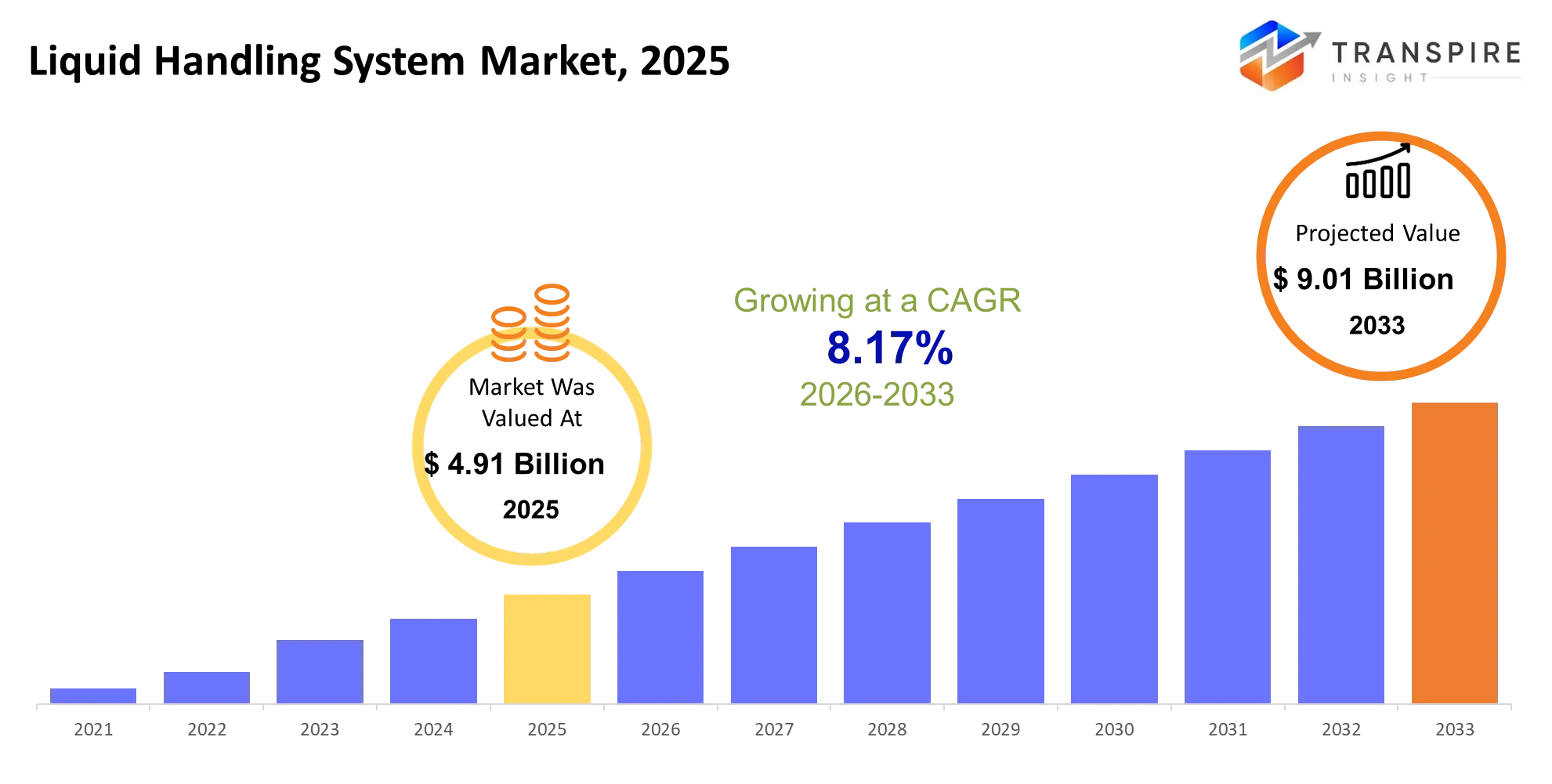
- Market Value (2025): USD 4.91 Billion.
- Expected Market Value (2026): USD 5.20 Billion.
- Estimated Market Value (2033): USD 9.01 Billion.
- Forecast CAGR (2026-2033): 9.5%
- Leading Region in 2025: North America
- Second-largest Region: Europe
- Fastest Growing Region: Asia Pacific
Introduction
The liquid handling system industry includes various instruments, equipment, and software employed in laboratories for transferring, dispensing, diluting, or analyzing exact volumes of liquids. Such systems may include simple manual or electronic pipettes as well as fully robotic systems. Applications of liquid handling systems include life sciences, drug discovery, genomics, proteomics, and clinical diagnostics. A liquid handling system is an ensemble of devices and instruments employed in laboratories and which is intended for measuring, transferring, dispensing, diluting, or mixing exact volumes of liquids. Such systems include simple handheld manual pipettes as well as fully robotic systems employed in life sciences. There are many operational advantages offered by liquid handling systems in pharmaceutical, biotechnology, diagnostic, and research laboratories through improving accuracy, efficiency, safety, and consistency of work. Pipetting automation avoids any possible mistakes made by human operators and provides very consistent micro-volume liquid dispensing for tests. Laboratory automation increases the efficiency of laboratory work and facilitates high-throughput sample processing. Modern dispensing systems help to optimize liquid volume and avoid unnecessary wasting of reagents, which makes operational cost decrease possible. Liquid handling systems also avoid direct exposure of an operator to harmful substances, thus making the laboratory environment safer. Moreover, decreasing manual pipetting decreases the risk of ergonomic injuries in laboratory workers.
For instance:- North America Leads the North America Liquid Handling System Market Heavy investment in biotech R&D, life sciences, and lab automation propels growth; driven by pharmaceutical drug discovery.
Market Highlights: -
- North America is anticipated to hold almost 39% share of the Liquid Handling System Market over the predicted timeframe.
- Europe is expected to grow at a rapid CAGR in the Liquid Handling System Market by holding almost 28% of the share during the forecast period.
- Asia Pacific is anticipated to hold almost 24% share of the Liquid Handling System Market over the predicted timeframe.
- By product, the Automated Workstations segment dominated the market and holds nearly 38% share in 2025 and is projected to grow at a substantial CAGR during the forecast period.
- By application, the Genomics segment dominated the market and holds nearly 40% share in 2025 and is projected to grow at a substantial CAGR during the forecast period.
- By end user, the Biotechnology Companies segment dominated the market and holds nearly 35% share in 2025 and is projected to grow at a substantial CAGR during the forecast period.
- Healthcare Initiatives: The development of healthcare facilities, laboratories, and research institutions by the government is facilitating the advancement of automation technologies and creating an indirect demand for automated liquid handling instruments. Growth in the number of laboratories, surveillance infrastructure, and diagnostic facilities is anticipated to contribute toward the growth of laboratory automation technology.
How is Technology Driving Growth in the Liquid Handling System Market?
The Liquid Handling Systems Market is witnessing rapid innovation through the use of Artificial Intelligence (AI), Machine Learning, and Laboratory Software to help in optimizing workflows, standardizing protocols, automated error detection, and improving data traceability. Automation and robotics are revolutionizing the process of pipetting, dispensing, and sample preparation by minimizing human interventions and providing high-throughput capabilities for pharmaceutical and genomics applications. Miniaturization and non-contact dispensing technologies are helping achieve precision at the nanoliter scale along with reduced use of reagents and dead volume. The sensors-enabled smart technologies include liquid level detection and modular system architecture. Growing importance of sustainability and minimization of waste is adding to the need for efficient consumable management and dispensing.
|
Report Metrics |
Details |
|
Market size value in 2025 |
USD 4.91 Billion |
|
Market size value in 2026 |
USD 5.20 Billion |
|
Revenue forecast in 2033 |
USD 9.01 Billion |
|
Growth rate |
CAGR of 9.5% from 2026 to 2033 |
|
Base year |
2025 |
|
Historical data |
2021 - 2024 |
|
Forecast period |
2026 - 2033 |
|
Report coverage |
Revenue forecast, competitive landscape, growth factors, and trends |
|
Regional scope |
United States; Canada; Mexico; United Kingdom; Germany; France; Italy; Spain; Denmark; Sweden; Norway; China; Japan; India; Australia; South Korea; Thailand; Brazil; Argentina; South Africa; Saudi Arabia; United Arab Emirates |
|
Key company profiled |
Thermo Fisher Scientific, Danaher, Eppendorf, Sartorius, Agilent Technologies, Hamilton Company, Tecan, Gilson, Mettler Toledo, Corning, Bio-Rad Laboratories, PerkinElmer, QIAGEN, Roche, Merck |
|
Customization scope |
Free report customization (country, regional & segment scope). Avail customized purchase options to meet your exact research needs. |
|
Report Segmentation |
By Product (Pipettes, Liquid Handlers, Burettes, Dispensers, Automated Workstations, Microplate Washers, Pumps, Others); By Type (Manual, Semi-automated, Automated, Robotic, Electronic, Digital, Disposable, Others); By Application (Drug Discovery, Genomics, Proteomics, Clinical Diagnostics, Biotechnology, Cell Culture, Chemical Analysis, Others); By End User (Pharmaceutical Companies, Biotechnology Companies, Hospitals, Diagnostic Laboratories, Academic Research, CROs, Food & Beverage, Others); By Technology (Air Displacement, Positive Displacement, Acoustic, Microfluidic, Robotic, Automated, Gravimetric, Others); By Volume (Microliter, Milliliter, Liter, Nanoliter, Picoliter, High-volume, Low-volume, Others); By Automation Level (Manual, Semi-automated, Fully Automated, Robotic, High-throughput, Low-throughput, Integrated, Others) |
Market Drivers
Market drivers in the Liquid Handling Systems Market include the quick proliferation of laboratory automation. There is an increased trend of using automated and robotics-based systems to enhance accuracy and speed while reducing any errors that might occur manually. The growth in various pharmaceuticals and biotechnological industries through investments in drug discovery and personalized medicine has been contributing to an increase in demands for high-throughput screening and sample preparation systems. The inclusion of technology like artificial intelligence, machine learning, and laboratory information systems has contributed to increased real-time monitoring and process automation. Furthermore, there has been a rise in the demand for precision dispensing systems and liquid handling systems due to nanoliter sample preparation and assays. There are numerous advantages offered by liquid handling systems in terms of improved laboratory productivity, reliability, and efficiency. High precision and accuracy help in reducing any manual pipetting mistakes, making the experiments more consistent and reproducible. Throughput can be increased to make high-throughput screening possible and process large volumes of samples in short periods of time. Reagents waste is reduced by virtue of dispensing technology, miniaturization, and accurate volumes. Traceability becomes easy through incorporation into Laboratory Information Management Systems (LIMS). Furthermore, better safety helps in reducing the risk of technicians’ exposure to biological hazards.
For Instance: -
- The market for automated liquid handling in South Africa shows consistent growth, fuelled by the investment in life sciences, genomics, and clinical diagnostics, increased capital investment in laboratory automation and modernizing health care, and the proliferation of high-throughput workstations.
- The market for liquid handling systems in Europe will be as per MarketsandMarkets. Investments in pharmaceutical research, laboratory automation, and genomics drive this growth in the region.
Restrain
The Liquid Handling Systems Market is constrained by high upfront cost, difficult installation, and system integration along with maintenance and validation expenses. The use of advanced automated platforms necessitates heavy investments that pose a challenge for small-scale laboratories and newly established biotech companies. Installation of such a system also demands expertise. Furthermore, the expenses related to calibration, maintenance, and validation become higher. This prolongs the period of return on investment and discourages small-scale laboratories from switching from traditional liquid handling to automated systems.
|
Driver |
Relative Impact on Growth (%) |
Geographic Relevance |
Impact Timeline |
Demand Strength |
Growth Mechanism |
Key Beneficiaries |
Major Constraint |
|
Driver 1: Rising Laboratory Automation and High-Throughput Workflows |
28% |
North America, Europe, Asia Pacific |
Short-term |
High |
Automates repetitive workflows, increasing throughput and reproducibility |
Liquid handling manufacturers, pharmaceutical firms, CROs |
High upfront automation investment |
|
Driver 2: Expanding Pharmaceutical and Biotechnology R&D |
24% |
North America, Europe, Asia Pacific |
Medium-term |
High |
Accelerates automated sample preparation for drug discovery and genomics |
Pharma companies, biotech firms, CROs, equipment vendors |
R&D budget volatility and lengthy development cycles |
|
Driver 3: AI, Robotics, and Smart Laboratory Integration |
19% |
North America, Europe, East Asia |
Medium-term |
High |
Enables adaptive pipetting, error detection, optimization, and predictive maintenance |
Robotics vendors, software providers, automation manufacturers |
Integration complexity and validation requirements |
|
Driver 4: Growth of Genomics, Precision Medicine, and Molecular Diagnostics |
17% |
North America, Europe, Asia Pacific |
Long-term |
High |
Increases demand for precise, scalable, reproducible sample preparation |
Genomics laboratories, diagnostic firms, biotech companies |
Complex workflows and specialized consumable requirements |
|
Driver 5: Miniaturization and Sustainable Liquid Handling |
12% |
Europe, North America, Asia Pacific |
Long-term |
Medium |
Reduces reagent consumption, waste, and operating costs through smaller volumes |
Precision dispensing vendors, laboratories, consumables manufacturers |
Disposable-plastic waste and technology costs |
|
Total |
100% |
— |
— |
— |
— |
— |
— |
Analysis of Prices and Consumer Behaviour
The leading segment of the liquid handling systems market is automated liquid handling systems (50.6% of total market revenue in 2025; mainly driven by the need for efficient, precise, and reproducible laboratory processes in pharmaceutical, biotechnology, and diagnostic applications). The drug discovery application segment constituted around 40.4% of the total market revenue in 2025, facilitated by the wide usage of automated liquid handling for high-throughput screening, assays development, and pharmaceutical research. The biotechnology and pharmaceutical companies end-user segment constituted around 43.88% of market revenue in 2025, driven by increasing research and development activities, drug pipelines, and need for automated laboratory processes. Around 38.4% of market revenue was accounted for by liquid handling workstations in 2025, facilitated by the high adoption of automation systems for high-throughput laboratory processes. The purchasing decisions of laboratories are being increasingly impacted by accuracy, precision, automation, throughput, reproducibility, and integration, especially for pharmaceutical and biotechnology companies, which need high-throughput processes. Pharmaceutical and biotechnology companies constituted around 43.88% of end-user revenue in 2025, and hence form an important customer segment for liquid handling system suppliers.
|
Investment Factor |
Why It Matters to Investors |
Opportunity |
Investment Implication |
|
Laboratory Automation Adoption |
Automation is replacing repetitive manual pipetting across laboratories. |
Automated workstations, robotic pipetting, integrated platforms |
Supports scalable equipment and software revenue. |
|
Pharmaceutical & Biotechnology R&D |
Drug discovery requires reproducible, high-throughput sample processing. |
Automated screening, genomics, proteomics, cell-based research |
Creates sustained demand from high-value R&D customers. |
|
AI-Enabled Laboratory Automation |
Intelligent software can optimize workflows and detect operational errors. |
AI-driven scheduling, monitoring, optimization, predictive maintenance |
Favors technology-led platforms with software differentiation. |
|
Genomics & Molecular Diagnostics |
Complex genomic workflows require precise, repeatable sample preparation. |
NGS preparation, molecular testing, precision medicine |
Expands opportunities in specialized high-precision applications. |
|
Low-Volume Precision Dispensing |
Miniaturized assays reduce reagent usage and improve process economics. |
Nanoliter dispensing, acoustic systems, microfluidic platforms |
Enables premium positioning and specialized laboratory applications. |
|
Asia Pacific Expansion |
Growing research infrastructure supports laboratory automation adoption. |
Local manufacturing, distribution, service, and affordable automation |
Creates medium- and long-term geographic expansion opportunities. |
Who are the Key Players in the Liquid Handling System Market and how do they compete?
The competitiveness of the international market of liquid handling systems is provided by firms that specialize in automation technologies, solutions designed for laboratory and life sciences, and creation of distribution channels. The competitiveness based not only on price but also on the precision, throughput, automation, software, and integration of laboratory information management systems will help companies compete and create continuous innovations and accuracy, efficiency, reproducibility, and optimization of workflows.
The creation of the automated liquid handling platform and pipetting technologies allows Tecan Group to improve its market position. High-performance automated liquid handling systems designed for pharmaceutical research, biotechnology, clinical diagnostics, and academic laboratories allow firms to distinguish themselves from their competitors. Hamilton Company improves its market position through the creation of liquid handling solutions, automated pipetting systems, and laboratory automation technologies.
Top Companies in the Liquid Handling System Market
- Thermo Fisher Scientific
- Danaher
- Eppendorf
- Sartorius
- Agilent Technologies
- Hamilton Company
- Tecan
- Gilson
- Mettler Toledo
- Corning
- Bio-Rad Laboratories
- PerkinElmer
- QIAGEN
- Roche
- Merck
|
Company |
Est. Revenue Share Range |
Key Offerings |
Strategic Positioning |
Geographic Strength |
Technology Focus |
|
Tecan Group Ltd. |
8-12% |
Fluent, Freedom EVO, Spark Cyto, HydroFlex |
Premium automation and integrated workflow platforms |
Europe, North America, Asia Pacific |
Modular robotics and automated liquid handling |
|
Thermo Fisher Scientific Inc. |
8-11% |
Multidrop dispensers, electronic pipettes, automated liquid handlers, Momentum software |
Broad portfolio and end-to-end laboratory ecosystem |
North America, Europe, Asia Pacific |
High-throughput dispensing and connected automation |
|
Danaher Corporation (Beckman Coulter Life Sciences) |
7-10% |
Biomek i-Series, Biomek NGeniuS, Echo acoustic systems |
Integrated automation for genomics and drug discovery |
North America, Europe, Asia Pacific |
Robotics, acoustic dispensing, software integration |
|
Hamilton Company |
6-9% |
Microlab STAR, Microlab Prep, Microlab VANTAGE |
High-precision customizable laboratory automation |
North America, Europe, Asia Pacific |
Precision pipetting, machine vision, liquid-level detection |
|
Agilent Technologies Inc. |
5-8% |
Bravo, Bravo NGS, Bravo BenchCel, VWorks |
Compact flexible automation for sample preparation |
North America, Europe, Asia Pacific |
Robotic pipetting and workflow integration |
|
Eppendorf SE |
4-7% |
epMotion 5075, epMotion 96/96xl, electronic pipettes |
Precision-focused liquid handling and laboratory workflows |
Europe, North America, Asia Pacific |
Automated pipetting, precision dispensing, NGS automation |
|
Revvity, Inc. |
4-6% |
JANUS G3, JANUS workstations, liquid-handling consumables |
Application-specific automation and configurable workstations |
North America, Europe, Asia Pacific |
Modular robotics and automated sample preparation |
|
Sartorius AG |
3-5% |
Automated pipetting, liquid-handling platforms, laboratory automation solutions |
Bioprocess and life-science workflow integration |
Europe, North America, Asia Pacific |
Digital laboratory integration and automation |
|
Gilson, Inc. |
2-4% |
PIPETMAX, GX-Series, electronic pipettes |
Specialist precision pipetting and benchtop automation |
North America, Europe, Asia Pacific |
Precision pipetting and compact automation |
|
SPT Labtech Ltd. |
2-4% |
Firefly, Mosquito, Dragonfly |
Niche high-precision dispensing and genomics automation |
Europe, North America, Asia Pacific |
Nanoliter dispensing and miniaturized workflows |
Market Segmentation
The Liquid Handling System Market share is divided into seven categories: By product, type, application, end user, technology, volume and automation level.
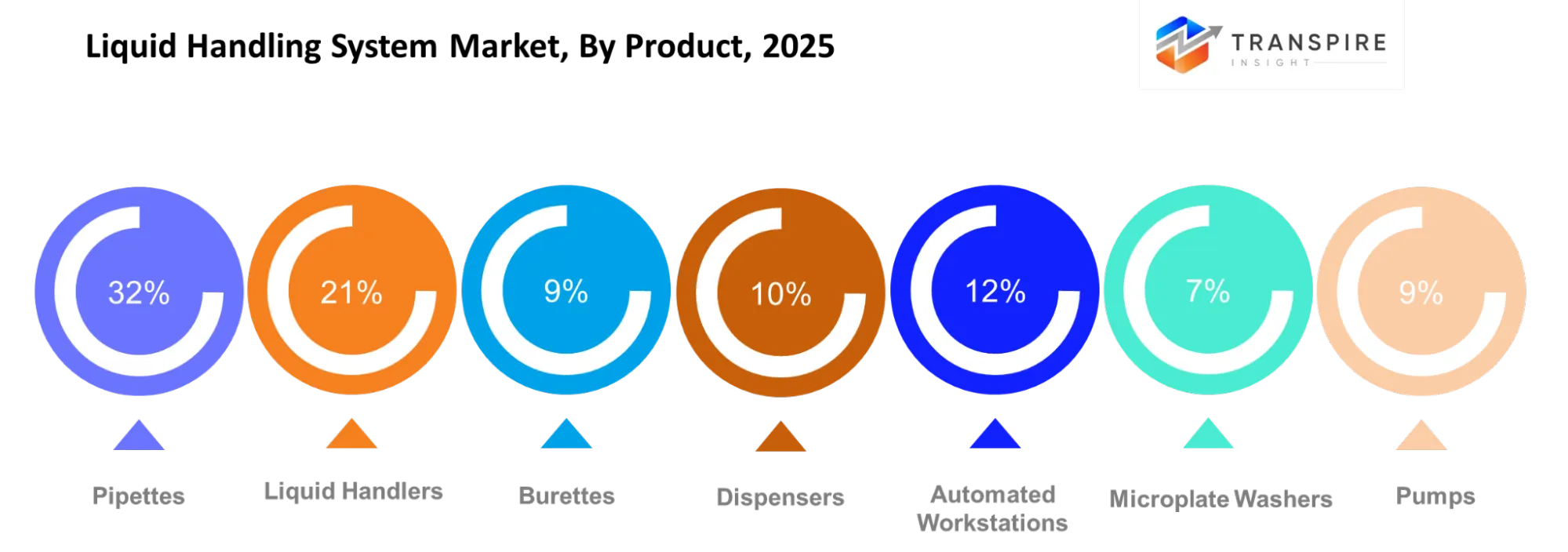
The Automated Workstations dominated the market, accounting for nearly 38% in 2025 and is expected to rise at a significant CAGR during the forecast period.
The Liquid Handling System Market is segmented by product into Pipettes, Liquid Handlers, Burettes, Dispensers, Automated Workstations, Microplate Washers, Pumps, Others. Among these, the Automated Workstations segment dominated the market, accounting for nearly 38% in 2025 and expected to increase at a significant CAGR during the forecast period. The Automated Workstations segment has captured a market share of close to 38% in 2025 owing to its capabilities to perform automation for difficult liquid handling processes, increase pipetting accuracy, minimize manual errors, and facilitate high throughput lab processes. The rising popularity of automated workstations across various applications, such as pharmaceutical, biotech, clinical diagnostics, and research labs, is expected to aid in the substantial growth of the segment.
The Genomics dominated the market, accounting for nearly 40% in 2025, and is expected to rise at a significant CAGR during the forecast period.
The Liquid Handling System Market is segmented by application into Drug Discovery, Genomics, Proteomics, Clinical Diagnostics, Biotechnology, Cell Culture, Chemical Analysis, Others. Among these, the Genomics segment dominated the market, accounting for nearly 40% in 2025 and expected to increase at a significant CAGR during the forecast period. Genomics was the largest share of the segment in 2025, capturing almost 40%, driven by rising use of next generation sequencing technologies, molecular diagnostics, and high-throughput genomic research. Rising investments in precision medicine, biomarker discovery, and personalized healthcare have led to higher demand for automation liquid handlers, enabling precise, consistent, and scalable sample preparation.
The Biotechnology Companies dominated the market, accounting for nearly 35% in 2025 and is expected to rise at a significant CAGR during the forecast period.
The Liquid Handling System Market is segmented by end user into Pharmaceutical Companies, Biotechnology Companies, Hospitals, Diagnostic Laboratories, Academic Research, CROs, Food & Beverage, Others. Among these, the Biotechnology Companies segment dominated the market, accounting for nearly 35% in 2025 and expected to increase at a significant CAGR during the forecast period. In terms of market share, the segment 'Biotechnology Companies' led the market in 2025, capturing around 35% of the total market value, owing to rising drug discovery, genomics, cell/gene therapy, and molecular research initiatives. The rising research investments along with increasing demand for sample preparation processes that are high-throughput, precise, and reproducible are aiding growth of the market.
Regional Segment Analysis of the Liquid Handling System Market:
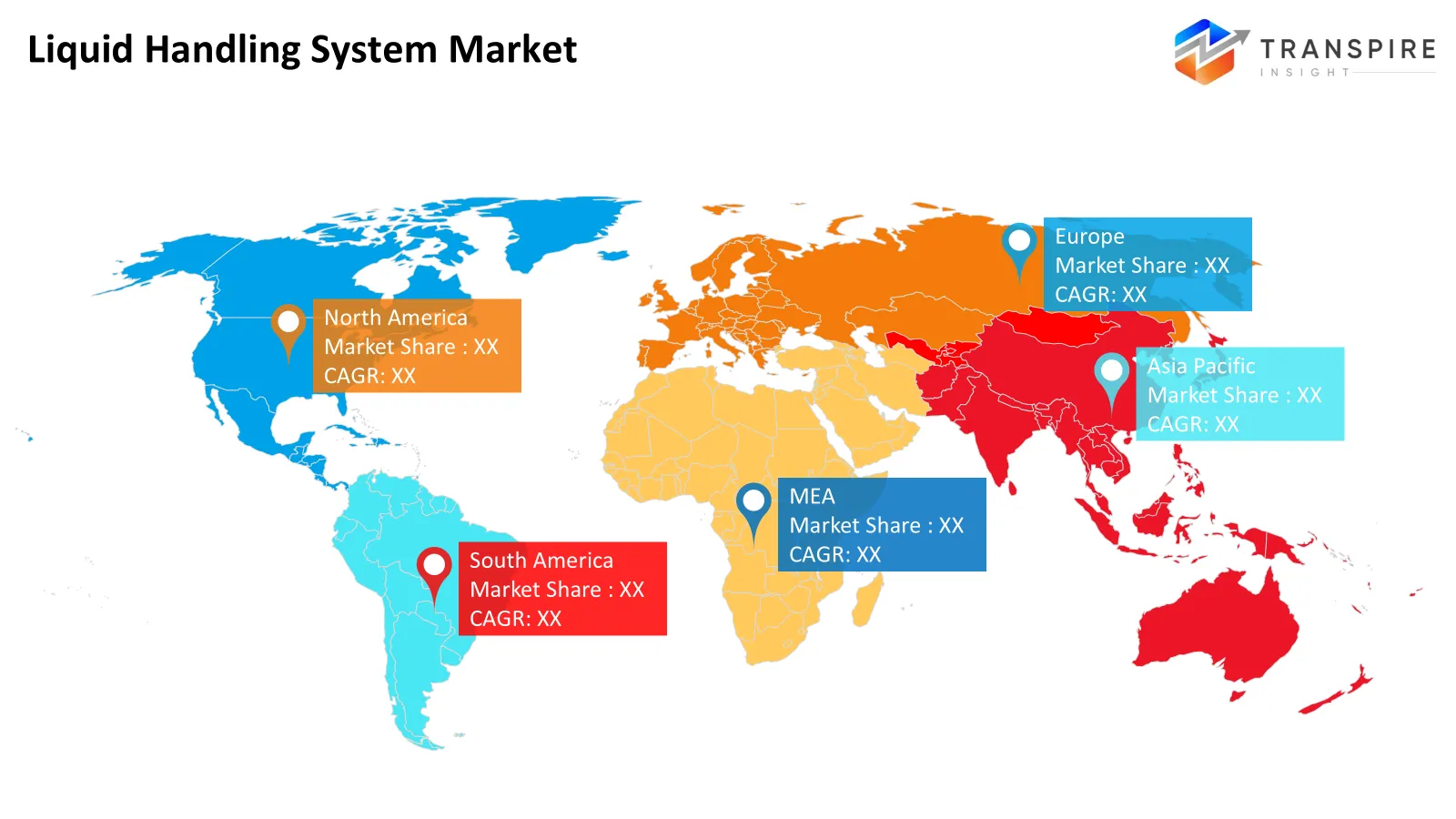
- North America (U.S., Canada, Mexico)
- Europe (Germany, France, U.K., Italy, Spain, Rest of Europe)
- Asia-Pacific (China, Japan, India, Rest of APAC)
- South America (Brazil and the Rest of South America)
- The Middle East and Africa (UAE, South Africa, Rest of MEA)
North America is the fastest-growing region in the Liquid Handling System Market during the period, holding almost 39% share.
North America is expected to grow at a rapid CAGR in the Liquid Handling System Market holding almost 39% share during the forecast period. North America is the region with the highest growth rate in the Liquid Handling Systems market, accounting for about 39% of the market share, due to robust research and development activities in the field of pharmaceutical and biotechnology, well-developed laboratory facilities, growing preference for laboratory automation, and huge investment in the area of genomics and drug discovery.
Europe is expected to grow at a rapid CAGR in theLiquid Handling System Market, holding almost 28% of the share during the forecast period.
Europe is expected to grow at a rapid CAGR in the Liquid Handling System Market holding almost 28% share during the forecast period. Europe will witness significant growth in terms of CAGR in the Liquid Handling System market, capturing nearly 28% of market shares in the forecasted period due to increasing pharmaceutical and biotech research activities along with the increasing usage of high throughput screening systems. Increasing expenditure on genomics, precision medicines, and laboratory equipment and instruments are other driving factors for the market.
Asia Pacific is the fastest-growing region in the Liquid Handling System Market during the period, holding almost 24% share.
Asia Pacific is the fastest-growing region in the Liquid Handling System Market during the forecast period, holding almost 24% share during the forecast period. During the forecast period, Asia Pacific is the fastest-growing regional market for the Liquid Handling System Market with a market share of about 24%. The rapid growth in the region can be attributed to factors such as the growth in the pharmaceutical and biotechnology industry, healthcare investments, and rising adoption of laboratory automation technologies.
Strategies for Market Growth in Non-Leading Regions:
Non-leading areas' growth due to the implementation of the efficient and scalable technology of liquid handling systems will positively impact small and medium-sized laboratories, research facilities and biotechnology firms. Local installation and maintenance of liquid handling systems along with the creation of regional laboratories automation and equipment facilities will help decrease the dependence on imports and lower the expenses related to procurement and maintenance. Strategic alliances with regional laboratories, pharmaceutical firms, biotechnology firms, diagnostics laboratories and research facilities will positively impact the market penetration rate of liquid handling systems. Training programs and technical competencies upgrade will be required to increase the awareness about liquid handling automation, pipetting technologies, system integration, quality control and workflow standardization. Flexible financing solutions, long-term equipment agreements and contract automation services will help make liquid handling systems more accessible and promote their use among laboratories and research facilities. The creation of cooperative projects with the government, healthcare and biotechnological projects and application of the digital selling techniques and remote support will help improve the access to liquid handling systems and stimulate sustainable worldwide market growth in developing countries.
Future Market Trends for the Liquid Handling System Market: -
- Lab Automation Trends: There is an increasing trend towards automation in laboratories, which helps save time and cut down on human error when conducting tests during drug discovery.
- Smart and Electronic Pipettes: An increasing need is emerging for multi-channel electronic pipettes, which have digital logging capacity, programmable dispensing capabilities, and LIMS capability.
- Minimization: The need for nanoliter liquid handling systems has increased in recent years because of the research taking place in genomics and drug discovery to ensure that there is reduced usage of expensive reagents.
- Merchandising with Advanced Technology: Artificial intelligence, machine learning, and sensor-based technology to detect liquid level are some technologies being integrated into manufacturing systems for precision.
- Eco-Friendly Systems: Systems that are eco-friendly are becoming popular due to sustainability constraints.
Recent Development
- In May 2023: Agilent Technologies launched OpenLab Sync which is an artificial intelligence-based Lab Execution System that helps to bridge laboratory processes, instrumentation, and software. OpenLab Sync facilitates standardization, traceability, and digitization of laboratory activities thereby enhancing laboratory automation and instrument connectivity. It goes a long way in facilitating technology connectivity in terms of liquid handling system automation.
- In March 2026: The Thermo Fisher Scientific Company has recently exhibited its Multidrop Pico 8 digital dispenser along with the FluidEase ClipTip electronic pipette at the SLAS 2026 conference. These advances increase the accuracy of liquid dispensing and contribute to workflow automation, thus helping with research purposes and boosting the technological progress of the Liquid Handling System Market.
This study forecasts revenue at global, regional and country levels from 2020 to 2033. Transpire Insight has segmented the Liquid Handling System Market based on the below-mentioned segments:
Liquid Handling System Market, By Product
- Pipettes
- Liquid Handlers
- Burettes
- Dispensers
- Automated Workstations
- Microplate Washers
- Pumps
- Others
Liquid Handling System Market, By Type
- Manual
- Semi-automated
- Automated
- Robotic
- Electronic
- Digital
- Disposable
- Others
Liquid Handling System Market, By Application
- Drug Discovery
- Genomics
- Proteomics
- Clinical Diagnostics
- Biotechnology
- Cell Culture
- Chemical Analysis
- Others
Liquid Handling System Market, By End User
- Pharmaceutical Companies
- Biotechnology Companies
- Hospitals
- Diagnostic Laboratories
- Academic Research
- CROs
- Food & Beverage
- Others
Liquid Handling System Market, By Technology
- Air Displacement
- Positive Displacement
- Acoustic
- Microfluidic
- Robotic
- Automated
- Gravimetric
- Others
Liquid Handling System Market, By Volume
- Microliter
- Milliliter
- Liter
- Nanoliter
- Picoliter
- High-volume
- Low-volume
- Others
Liquid Handling System Market, By Automation Level
- Manual
- Semi-automated
- Fully Automated
- Robotic
- High-throughput
- Low-throughput
- Integrated
- Others
Liquid Handling System Market, By Regional Analysis
North America
- US
- Canada
- Mexico
Europe
- Germany
- UK
- France
- Italy
- Spain
- Russia
- Rest of Europe
Asia Pacific
- China
- Japan
- India
- South Korea
- Australia
- Rest of Asia Pacific
South America
- Brazil
- Argentina
- Rest of South America
Middle East & Africa
- UAE
- Saudi Arabia
- Qatar
- South Africa
- Rest of the Middle East & Africa
Frequently Asked Questions
Find quick answers to common questions.
The market is projected to reach USD 9.01 billion by 2033, growing at an 8.17% CAGR during 2026-2033.
Automated Workstations dominated in 2025, accounting for nearly 38% share, driven by precision, automation, efficiency, and high-throughput laboratory workflows.
Genomics dominated in 2025, accounting for nearly 40% share, supported by sequencing, precision medicine, and high-throughput genomic research.
North America held nearly 39% share, supported by pharmaceutical R&D, biotechnology investments, advanced laboratories, and increasing automation adoption.
Key drivers include laboratory automation, pharmaceutical R&D, AI integration, high-throughput screening, precision dispensing, miniaturization, and reproducible laboratory workflows.
- Thermo Fisher Scientific
- Danaher
- Eppendorf
- Sartorius
- Agilent Technologies
- Hamilton Company
- Tecan
- Gilson
- Mettler Toledo
- Corning
- Bio-Rad Laboratories
- PerkinElmer
- QIAGEN
- Roche
- Merck
About the Authors

Pankaj Ghogare Patil
I am Pankaj Ghogare Patil, a Senior Research Analyst at Transpire Insight, specializing in the Pharmaceutical, Chemicals & Materials, Healthcare IT, and Biotechnology industry. My expertise lies in conducting comprehensive market research, analyzing industry trends, evaluating competitive landscapes, and translating complex data into actionable insights. At Transpire Insight, I closely follow emerging technologies, regulatory developments, and market innovations to create accurate, well-researched, and informative content that helps businesses and professionals make informed decisions. I am committed to producing credible, evidence-based articles that reflect industry best practices while making technical topics accessible and valuable for a broad audience.

Chakradhar Khansole
Chakradhar serves as the Research Director at Transpire Insight, bringing over 8 years of experience in technology, innovation, and strategic market intelligence. He specializes in transforming complex market data into actionable business insights that enable organizations to make informed, growth-oriented decisions. Recognized for his strategic vision and analytical expertise, Chakradhar leads high-impact research initiatives, delivering comprehensive market assessments, competitive intelligence, and forward-looking industry analysis.
Recently Published Reports
-
Apr 2026
AI in Diabetic Retinopathy Market
AI in Diabetic Retinopathy Market Size, Share & Analysis Report By Type (Screening AI Systems, Diagnostic AI Systems, and Predictive AI Models), By Application Segment (Hospitals, Ophthalmology Clinics, Diagnostic Centers, and Research and Development), and Geography (North America, Europe, Asia-Pacific, Middle East and Africa, South and Central America), 2021 - 2031
-
Apr 2026
Psychometric Tests Market
Psychometric Tests Market Size, Share & Analysis Report By Type (Personality Tests, Ability/Aptitude Tests, Skill/Knowledge Tests, and Others), By Application (Talent Acquisition and Talent Management), and Geography (North America, Europe, Asia-Pacific, Middle East and Africa, South and Central America), 2021 – 2031
-
Apr 2026
Rare Biological Sample Collection Market
Rare Biological Sample Collection Market Size, Share & Analysis Report By Type (Isolation Kits & Reagent, Blood Collection Tubes, and Others), By Application (Oncology, Transcriptomics, Pharmacogenomics, and Others), and Geography (North America, Europe, Asia-Pacific, Middle East and Africa, South and Central America), 2021 – 2031
-
Jul 2026
Diabetic Retinopathy Market
Diabetic Retinopathy Market Size, Share & Analysis Report By Type (Proliferative Diabetic Retinopathy, and Diabetic Macular Edema (DME)), By Treatment Type (Anti VEGF Drug, Steroid Implants, Laser Surgeries, and Vitrectomy), and Geography (North America, Europe, Asia-Pacific, Middle East and Africa, South and Central America), 2021 – 2031
Our Clients







