
Less-Than Container Load Market Summary:
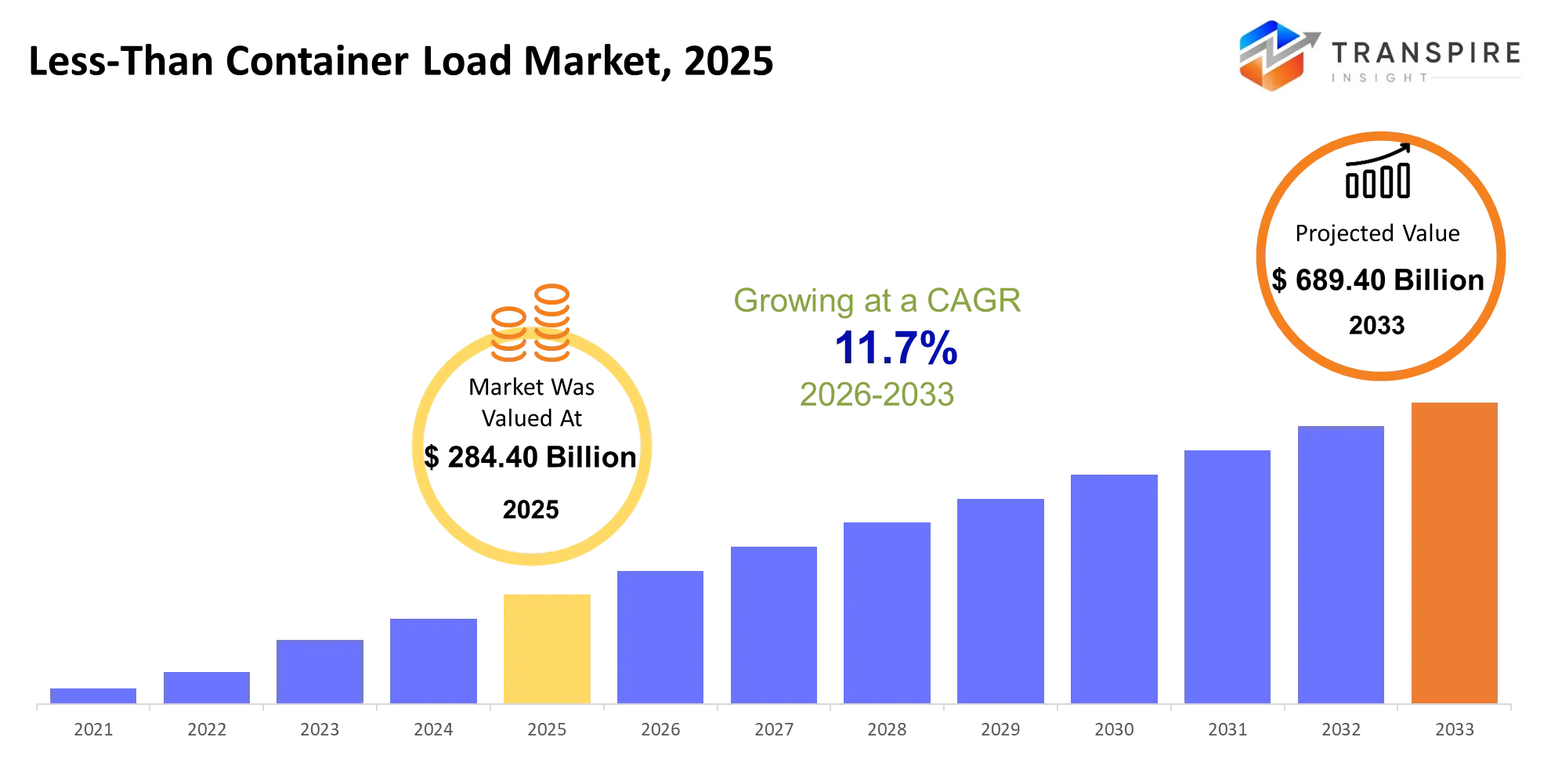
As per Transpire Insight, the Less-Than Container Load Market size is estimated at USD 284.40 billion in 2025 and is anticipated to reach USD 689.40 billion by 2033, growing at a CAGR of 11.7% from 2026 to 2033.
The Less-Than Container Load market provides businesses with a way to move cargo that does not need a shipping container by putting several shipments together into one combined load. Over the last three to five years, the market trend has been towards smaller and more frequent shipments due to the evolution of how firms have been sourcing their products, holding inventory close to themselves and responding to new trade routes. One of the notable trends in the freight industry has been the adoption of digital bookings, visibility and consolidation platforms that allow small shippers access to international shipping services. At the time, disruptions in the supply chain, evolution in the sourcing trends and fluctuations in full-container availability were among some of the factors pushing firms to employ LCL service for certain cargo instead of filling up a full container before shipping. It is an advantage to them since they will ship smaller amounts on demand rather than holding excess inventory.
Less-Than Container Load Market Size & Forecast:
- Market Size 2025: USD 284.40 Billion
- Expected Market Value (2033): USD 689.40 Billion
- Forecast CAGR (2026–2033): 11.7%
- Leading Region in 2025: Asia Pacific
- Fastest Growing Region: Middle East & Africa
- Key Company Profiles: DHL, Kuehne+Nagel, DSV, DB Schenker, Expeditors, CEVA Logistics, Sinotrans, Nippon Express, Hellmann Worldwide Logistics, DACHSER, Rhenus Logistics, Bolloré Logistics, UPS Supply Chain Solutions, Maersk Logistics, GEODIS
Key Market Insights
The international LCL industry is moving towards flexibility in shipment, freight management, and new trends in sourcing. Ocean LCL continues to dominate in the international LCL market, while Intra-Asia LCL is forecast to be the fastest-growing trade lane.
- Ocean LCL holds 72.40%, representing the prevailing need for consolidated ocean shipping in cases where cargo quantity is too little to fill up the whole container.
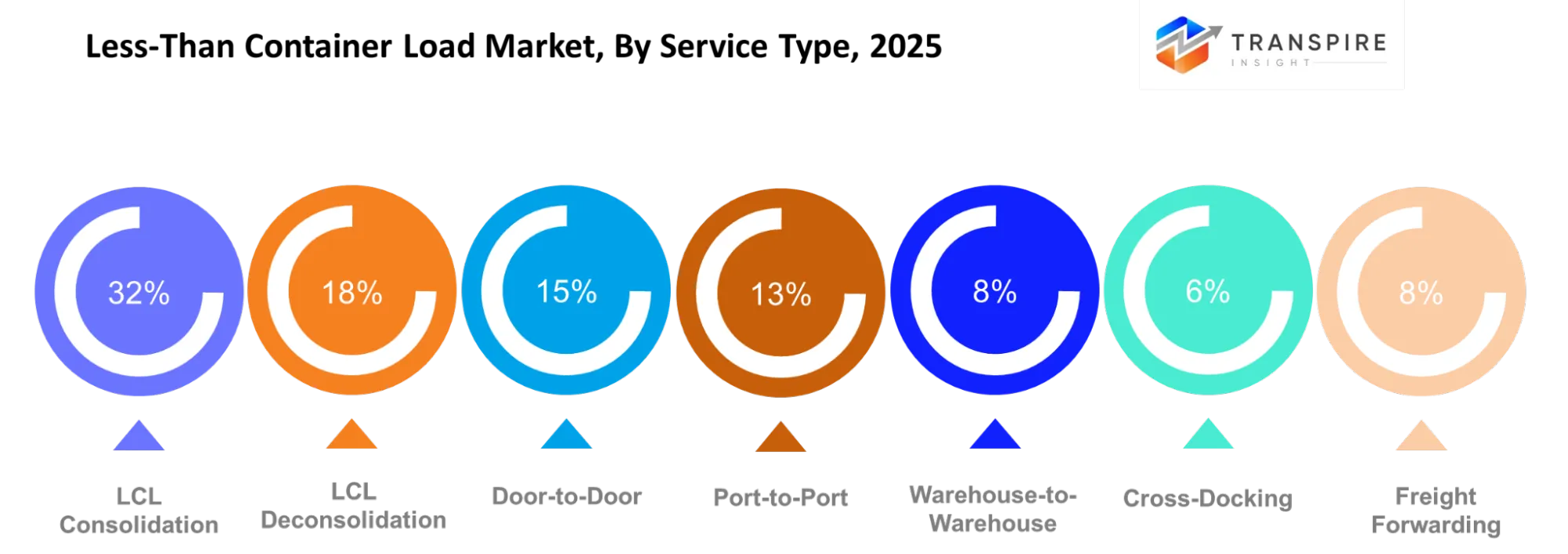
- LCL Consolidation constitutes 32.00%, indicating the significance of consolidating several cargos for efficient use of containers.
- LCL Deconsolidation makes up 18.00% of this service mix because it is important to segregate the goods at the destination to ensure delivery of the consolidated cargo.
- Door-to-Door services account for 15.00% of the specified service mix because of a trend towards integration in logistics compared to port logistics only.
- Port-to-Port services consist of 13.00%, providing services for businesses controlling their logistics and related to the inland part of the process.
- Warehouse-to-Warehouse services constitute 8.00%, enabled by companies interested in consolidated delivery of their cargo to warehouses.
- Cross-Docking services account for 6.00%, indicating increased focus on reducing cargo storage periods.
What are the Key Drivers, Restraints, and Opportunities in the Less-Than Container Load Market?
Drivers:
The growth of the LCL market worldwide is largely driven by the trend toward smaller, more frequent international shipments. Companies are less willing to wait until they have a full container of cargo because it can delay restocking and tie up working capital. LCL enables businesses to ship just what is needed, thus enabling quick stock turnover and better management of cash flow. The use of digital freight platforms is also making it easier to quote prices, compare schedules, book cargo, and follow up on the shipment process.
Restraints:
limitation is that of difficulty in consolidating cargoes belonging to various customers. The freight needs proper documentation, packaging, separation, handling, and delivery based on specific destination specifications. Delays may also occur because of insufficient volume and complexities in customs and transhipment operations. Such structural limitations may discourage LCL services in case of very sensitive and special cargo.
Opportunities:
The opportunity arises in digital LCL operations and the expansion of regional trade. More intra-Asia supply chains are becoming important in logistics as organisations seek to spread out their sourcing and production processes to other regions apart from manufacturing regions. According to Maersk, the use of LCL was becoming common among shippers diversifying their trade flow from China to Southeast Asia. It presents a window for expanding regional operations through digital logistics and integrating LCL with warehousing, customs, and last-mile deliveries.
What Has the Impact of artificial intelligence on the Less-Than Container Load Market?
The use of artificial intelligence technology impacts LCL markets through shipment planning, cargo consolidation, forecasting, and decisions related to logistics. Logistics companies have more than the possibility of scheduling and using simple computations. They can utilise data analysis to evaluate the level of shipping, destinations, capacity, transit time, and much more. All the above-mentioned possibilities would help logistics companies choose which shipments need to be consolidated and which route will be used for better utilization. Forecasting through AI would allow logistics companies to evaluate changes in the number of shipments and make decisions about the capacity of warehouses, containers, and transportation. It is especially useful for LCL since its efficiency largely depends on the combination of compatible shipments within suitable time intervals. Such opportunities could minimise empty container space without additional storage and handling costs. There are some limitations in the use of artificial intelligence technology. The integration of AI solutions into existing systems for transportation management, warehouse, customs, and carrier services may be very costly. Moreover, the accuracy of forecasting largely depends on data about shipment volume. Thus, any unexpected events would lead to inaccurate recommendations.
Instance:
In January 2026, Flexport launched innovative AI-based logistics features that analyse bookings of full containers, less-than-container loads, and buyers' consolidations by analysing real-time information about pricing, capacity, timing, and container fill rate. The AI optimisation tool offers suggestions with the goal of optimising container fill rate and providing 10% freight cost savings. It is an example of how AI is being applied to LCL logistics directly to make better consolidation decisions and save costs.
https://www.flexport.com/technology/product-release/winter-2026/
Key Market Trends:
The international LCL market is shifting from being dominated by the freight consolidation approach to a more integrated logistics service.
- Online booking has grown. Customers prefer quotations, scheduling, bookings, and tracking to be provided online in addition to manual communication.
- Companies are shipping in smaller batches more often to lessen their inventory investments and react quickly to any changes in their customers' needs.
- Businesses are creating new sources of manufacture and sourcing, resulting in higher demands for flexible regional LCL solutions.
- Interlinks in production and sourcing of Asian economies cause new demands for regional consolidated freight services.
- Logistics is becoming end-to-end. LCL companies are providing a combination of ocean freight and warehouse operations, customs clearance, inland freight, and deliveries more often.
- Visibility becomes a factor in buying decisions. Shipment information, estimated schedules, and exception reporting become a must-have throughout the whole transportation process.
- Sustainability becomes an element of LCL procurement. Logistics providers offer their customers lower carbon emissions and biofuel-based ocean freight consolidations.
Less-Than Container Load Market Segmentation
By Service Type:
The LCL Less-Than-Container Load market worldwide may be analysed based on service type, transport mode, type of goods, end-use, shipment volume, and geography of business. LCL Consolidation constitutes the largest specific service category at 32.00% because consolidating several small shipments leads to better use of the container capacity, making it a more practical choice than using an oversized and thus underutilised container. It is followed by LCL Deconsolidation at 18.00% due to the necessity to segregate combined shipments upon arrival at their destination point. Door-to-Door shipping constitutes 15.00% because of customer demand for integrated logistics services, and Port-to-Port services account for 13.00%. Warehouse-to-Warehouse makes up 8.00%, Cross-Docking 6.00%, Freight Forwarding 5.00%, and Value-Added Services 3.00%. Service types imply that future success will be determined by companies’ ability to offer consolidation along with logistics solutions.
By Transport Mode:
LCL by Sea mode holds a 72.40% share and is the prevailing transportation mode in the LCL shipping industry. Inland cargo movement uses road and rail modes, and air mode is used in case of urgency. Multimodal, inland waterways, and intermodal modes give extra shipping flexibility. Increased use of different transportation modes will increase the connectivity among ports, warehousing, and destination locations.
By Cargo Type:
General Cargo constitutes a key cargo type that requires LCL shipping, whereas LCL shipping for cargoes like consumer goods, electronics, machinery, automotive parts, and textiles occurs regularly. Food and beverages and chemicals need extra precautions and documentation. With increased flexibility in the supply chain, LCL providers equipped with the ability to manage different cargo types can secure a greater number of shipments.
By End User:
Manufacturing represents a key market segment due to the fact that plants regularly ship parts, materials, and replacement items in different quantities. Retail/E-commerce drives demand through inventory shipments. Automotive, Electronics, Food and Beverage, Chemicals, Pharmaceuticals and Industrial are other end-users that create opportunities. Industry-specific cargo handling and compliance services will enhance LCL use among specific industries.
By Shipment Size:
Small Shipments naturally lend themselves to LCL since businesses can ship limited cargo without having to reserve the whole shipping container. Medium/Large LCL shipments represent other forms of consolidation, while Palletized, Loose, and Mixed cargo need separate handling. Project Cargo is a special kind of cargo due to its size and transportation needs.
By Region of Trade:
Intra-Asia LCL is the most dynamic at an 8.10% compound annual growth rate, driven by manufacturing and sourcing within that region. Asia-Europe and Transpacific are critical for long-haul LCL shipments, whereas the Europe-North America route serves as the base of commercial connections. Latin America, the Middle East/Africa, and intra-European shipping represent other possibilities of developing commercial connections.
What are the Key Use Cases Driving the less-than-container-load market?
The key use case for LCL involves the movement of smaller cargo amounts that do not require an entire container and is consistent with the prevailing Ocean LCL. It will be possible for manufacturers and suppliers to consolidate smaller shipments in order to save money and not have to wait until there is enough cargo to ship in FCL. Usage includes replenishment of stock, shipment of spare parts, e-commerce deliveries, automotive parts and components, electronics, textiles, and raw materials for manufacturing. The benefit of door-to-door service will be even greater when customers want all their logistics handled by one company from pick-up through international shipment and delivery. Future use cases become increasingly linked to procurement diversification and intra-regional trade. Intra-Asian LCL cargo shipments are forecasted to expand, thus allowing smaller manufacturers and distributors to take part in cross-border supply chains. Also, the use of LCL becomes increasingly common when there is insufficient capacity in full containers or in cases where businesses require shipment of priority inventory.
|
Report Metrics |
Details |
|
Market size value in 2025 |
USD 284.40 Billion |
|
Market size value in 2026 |
USD 317.67 Billion |
|
Revenue forecast in 2033 |
USD 689.40 Billion |
|
Growth rate |
CAGR of 11.7% from 2026 to 2033 |
|
Base year |
2025 |
|
Historical data |
2021 - 2024 |
|
Forecast period |
2026 - 2033 |
|
Report coverage |
Revenue forecast, competitive landscape, growth factors, and trends |
|
Regional scope |
United States; Canada; Mexico; United Kingdom; Germany; France; Italy; Spain; Denmark; Sweden; Norway; China; Japan; India; Australia; South Korea; Thailand; Brazil; Argentina; South Africa; Saudi Arabia; United Arab Emirates |
|
Key company profiled |
DHL, Kuehne+Nagel, DSV, DB Schenker, Expeditors, CEVA Logistics, Sinotrans, Nippon Express, Hellmann Worldwide Logistics, DACHSER, Rhenus Logistics, Bolloré Logistics, UPS Supply Chain Solutions, Maersk Logistics, GEODIS |
|
Customization scope |
Free report customization (country, regional & segment scope). Avail customized purchase options to meet your exact research needs. |
|
Report Segmentation |
Service Type (LCL Consolidation, LCL Deconsolidation, Door-to-Door, Port-to-Port, Warehouse-to-Warehouse, Cross-Docking, Freight Forwarding, Value-Added Services); Transport Mode (Ocean, Road, Rail, Air, Multimodal, Inland Waterway, Intermodal); Cargo Type (General Cargo, Consumer Goods, Machinery, Electronics, Automotive Parts, Chemicals, Food & Beverages, Textiles); End User (Manufacturing, Retail & E-Commerce, Automotive, Electronics, Food & Beverage, Chemicals, Pharmaceuticals, Industrial); Shipment Size (Small Shipments, Medium Shipments, Large LCL Shipments, Palletized Cargo, Loose Cargo, Mixed Cargo, Project Cargo); Region of Trade (Asia-Europe, Transpacific, Intra-Asia, Europe-North America, Latin America, Middle East-Africa, Intra-Europe) |
Who are the Key Players in the less-than-container-load market, and how do they compete?
North America:
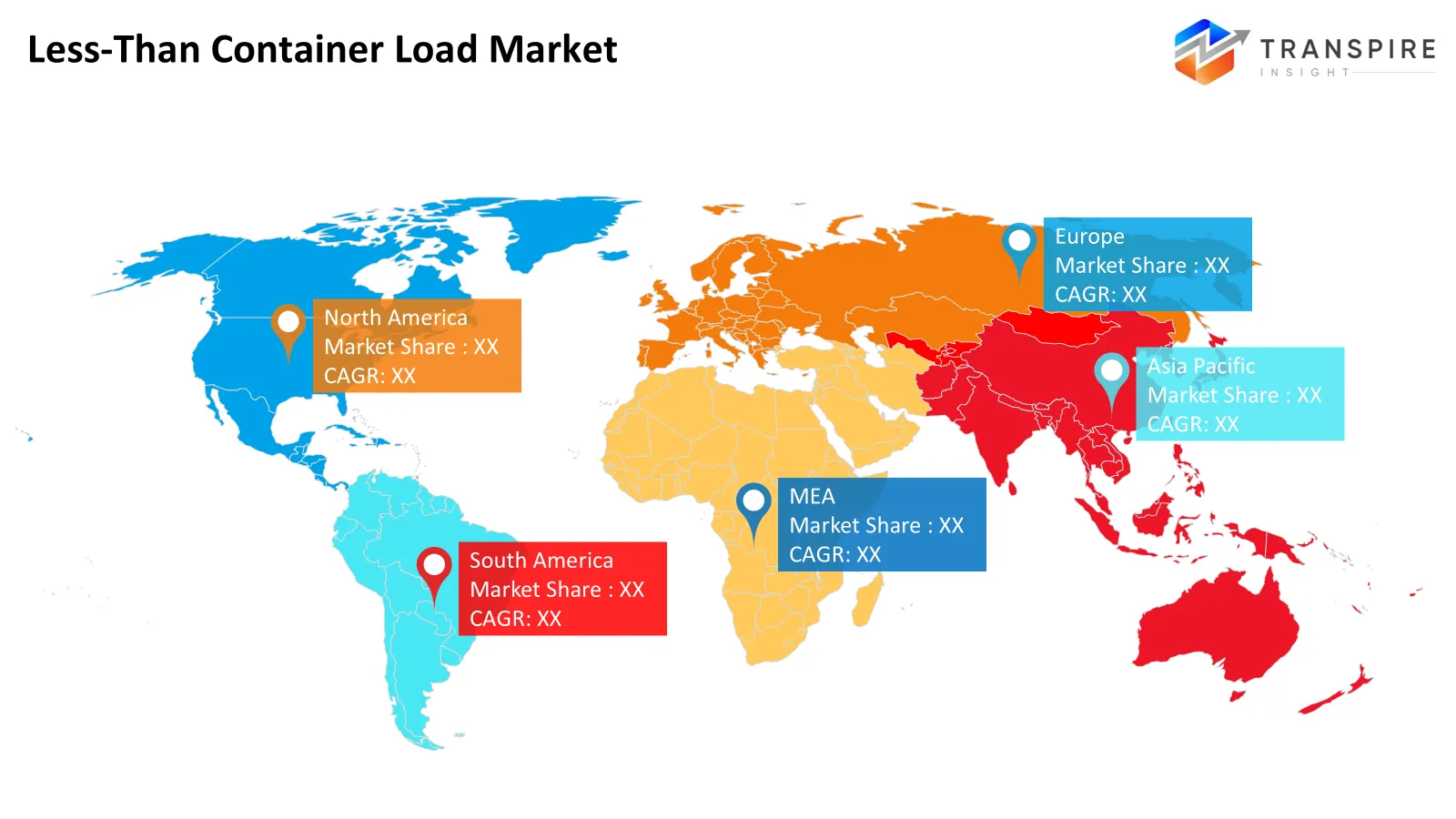
North America constitutes 20.00% of the world market in LCL, due to the significant manufacturing, retail, e-commerce and distribution presence. The region has good port, warehousing, road, rail and freight forwarding facilities, which help in consolidating international cargo. Demand is also affected by the desire of companies to achieve better flexibility in inventory replenishment and sourcing. The current market conditions have led some shippers to choose LCL in situations where container capacity is limited or in situations where small cargoes do not have to wait for FCL volume. According to Maersk in 2026, North American LCL demand was affected by reliability needs, sourcing diversification and inventory management.
In July 2026, CEVA Logistics emphasised the increasing importance of Less-than-Container Load (LCL) shipping in North America due to the increased pressure of tariffs, higher air-freight charges, diversification of supply chains, and cross-border e-commerce. According to CEVA, LCL provides an additional option for small consignments of North American companies, which do not have enough cargo for the complete filling of a container. This event reflects the increased importance of LCL in North America.
Europe:
Europe hold 25.00% of the world market, making it larger than North America and well-positioned in international LCL. The region has established ports, distribution centres, road connections and cross-border business links, helping to consolidate international cargo. There is also an increasing demand for low-carbon transportation in the region, which gives it a sustainability aspect that differentiates it from other markets that are expanding based on production and sourcing changes.
In September 2026, Maersk announced a new surcharge related to carbon emissions on LCL shipments involving EU and EEA member states, which came into force. Maersk explained that this surcharge was associated with the costs of compliance with the EU Emissions Trading System (EU ETS) and FuelEU Maritime regulations. This event demonstrates how Maersk adapts its LCL rates and practices to the tightening emissions requirements in Europe.
https://www.maersk.com/news/articles/2026/09/18/lcl-emissions-surcharge-q4-2026-eu-eea
Asia Pacific:
The Asia Pacific region leads in terms of regional market share at 46.20%, due to the manufacturing industry being more dominant in this region, export-oriented economies, ports and significant intra-regional trade activities. China, Southeast Asia, Japan, South Korea, along with many other regional economies, constitute a production and distribution network that creates substantial LCL shipments. Other factors contributing to the significance of the region include diversified procurement, wherein LCL was increasingly becoming an entry mode of transport for shipments from China to Southeast Asia in 2026, as noted by Maersk. This region shows the fastest growth at 7.00% CAGR and hence, represents an opportunity for development of links, logistics infrastructure and distribution network.
In September 2026, Maersk updated its Peak Season Surcharge (PSS) for LCL shipments from Far East Asia and China to India and Sri Lanka. The updated surcharges became applicable and apply to LCL shipments from Far East Asia and China to Northwest India, Southeast India, Nepal, Sri Lanka, and the Maldives.
https://www.maersk.com/news/articles/2026/09/17/lcl-peak-season-surcharge-fea-china-india-sri-lanka
Who are the Key Players in the Less-Than Container Load Market and how do they Compete?
The competition in the LCL market is driven by network presence, consolidation density, digitization, pricing, sustainability, and capability of delivering integrated logistics services. The companies are going beyond basic ocean transport services by providing booking services, tracking services, warehousing, customs services, inland transport, and consolidation solutions. Network scale is becoming critical, but digital convenience and reliability of services are just as critical.Maersk offers an integrated logistics solution that includes ocean transport, connections inland, digital visibility, and consolidation services. Maersk's recent market updates reveal that it still focuses on expanding its consolidation network and improving container handling and domestic connections. The company's expansion strategy is focused on integrating LCL into the whole chain of end-to-end logistics services.Kuehne+Nagel offers differentiation in terms of coverage of LCL and digital customer services. The company's platform enables customers to request quotes, book LCL cargo, and track LCL shipments online. It helps to make quicker decisions around the clock. The company's strategy focuses on service reliability and digital convenience rather than the cost of freight.
Less-Than Container Load Market companies
- DHL
- Kuehne+Nagel
- DSV
- DB Schenker
- Expeditors
- CEVA Logistics
- Sinotrans
- Nippon Express
- Hellmann Worldwide Logistics
- DACHSER
- Rhenus Logistics
- Bolloré Logistics
- UPS Supply Chain Solutions
- Maersk Logistics
- GEODIS
Recent Development News
- In September 2026, Maersk published updates on revised peak season LCL rates from the Indian Subcontinent to the USA and Canada East Coast & Gulf. This clearly highlights the impact of changes in trade patterns on LCL rates and routes. https://www.maersk.com/news/articles/2026/09/17/lcl-pss-indian-subcontinent-usa-canada
- In October 2025, DP World inaugurated its new freight forwarding office in Porto Alegre, Brazil, further enhancing its logistics operations in Southern Brazil. It offers FCL & LCL ocean freight, air freight, inland transport, warehousing, insurance and customs clearance, among other logistics services. https://www.dpworld.com/en/news/usa/dpw-expands-logistics-footprint-with-new-ff-office-in-porto-alegre-brazil
What Strategic Insights Define the Future of the Less-Than Container Load Market?
The future for the market of LCL transport will be characterised by smaller shipments, more frequent shipments, digitised visibility and consolidation, and a higher level of integration. Strong prospects lie ahead in the consolidation logistics providers’ ability to link ocean freight, warehousing, customs clearance, transportation, and shipment details. Asia-Pacific region will retain importance due to the region’s focus on manufacturing and development of inter-Asia transport links. LCL inter-Asia shipping will offer increased regional consolidation opportunities. The hidden threat lies in the potential complication of logistics due to shipment breakdowns when there is no ability to properly organize multiple consignments due to a poor digital management system. One more problem is an increase in expenditures related to sustainability initiatives. The upcoming prospect is the application of predictive analytics in cargo optimisation and container consolidation, resulting in more optimal routes and better use of space. Thus, it is necessary for logistics companies to implement digital solutions, create consolidation centres, inland logistics systems, and environmentally friendly shipping methods while retaining operational discipline. The key strategy must be a combination of a dense network with technological solutions and quality services, not just cheap freight.
Service Type
- LCL Consolidation
- LCL Deconsolidation
- Door-to-Door
- Port-to-Port
- Warehouse-to-Warehouse
- Cross-Docking
- Freight Forwarding
- Value-Added Services
Transport Mode
- Ocean
- Road
- Rail
- Air
- Multimodal
- Inland Waterway
- Intermodal
Cargo Type
- General Cargo
- Consumer Goods
- Machinery
- Electronics
- Automotive Parts
- Chemicals
- Food & Beverages
- Textiles
End User
- Manufacturing
- Retail & E-Commerce
- Automotive
- Electronics
- Food & Beverage
- Chemicals
- Pharmaceuticals
- Industrial
Shipment Size
- Small Shipments
- Medium Shipments
- Large LCL Shipments
- Palletized Cargo
- Loose Cargo
- Mixed Cargo
- Project Cargo
Region of Trade
- Asia-Europe
- Transpacific
- Intra-Asia
- Europe-North America
- Latin America
- Middle East-Africa
- Intra-Europe
By Regional Analysis
North America
- US
- Canada
- Mexico
Europe
- Germany
- UK
- France
- Italy
- Spain
- Russia
- Rest of Europe
Asia Pacific
- China
- Japan
- India
- South Korea
- Australia
- Rest of Asia Pacific
South America
- Brazil
- Argentina
- Rest of South America
Middle East & Africa
- UAE
- Saudi Arabia
- Qatar
- South Africa
- Rest of the Middle East & Africa
Frequently Asked Questions
Find quick answers to common questions.
The less-than container load market size was valued at USD 284.40 billion in 2025 and is poised to reach USD 689.40 billion by 2033, expanding at a 11.7% CAGR.
Key segments for the less-than container load market are Service Type (LCL Consolidation, LCL Deconsolidation, Door-to-Door, Port-to-Port, Warehouse-to-Warehouse, Cross-Docking, Freight Forwarding, Value-Added Services); Transport Mode (Ocean, Road, Rail, Air, Multimodal, Inland Waterway, Intermodal); Cargo Type (General Cargo, Consumer Goods, Machinery, Electronics, Automotive Parts, Chemicals, Food & Beverages, Textiles); End User (Manufacturing, Retail & E-Commerce, Automotive, Electronics, Food & Beverage, Chemicals, Pharmaceuticals, Industrial); Shipment Size (Small Shipments, Medium Shipments, Large LCL Shipments, Palletized Cargo, Loose Cargo, Mixed Cargo, Project Cargo); Region of Trade (Asia-Europe, Transpacific, Intra-Asia, Europe-North America, Latin America, Middle East-Africa, Intra-Europe).
Growth is primarily driven by Increasing demands for cost-effective cargo transport and the rise in small and medium-sized companies. The creation of port infrastructure, utilization of digital freight networks, and increasing demands for flexible and efficient cargo consolidation services also contribute to the growth in the industry.
The market is led by major manufacturers including DHL, Kuehne+Nagel, DSV, DB Schenker, Expeditors, CEVA Logistics, Sinotrans, Nippon Express, Hellmann Worldwide Logistics, DACHSER, Rhenus Logistics, Bolloré Logistics, UPS Supply Chain Solutions, Maersk Logistics, GEODIS.
Asia Pacific holds 46.20% of the less-than-container-load market, supported by strong manufacturing activity, expanding international trade, rapid e-commerce growth, and well-developed port and logistics infrastructure. Rising cross-border shipments and demand for flexible, cost-efficient cargo consolidation further strengthen the region’s market dominance.
Opportunities for the market arise from growth in cross-border e-commerce, international trade, and demand for cost-effective means of transportation. Investments in the development of ports, warehouses, and multimodal transport infrastructure are helping to expand the market. Moreover, the use of digital freight networks, real-time tracking, and sustainable transportation solutions is providing opportunities for logistics firms to increase efficiency and gain new small and medium-sized clients.
- DHL
- Kuehne+Nagel
- DSV
- DB Schenker
- Expeditors
- CEVA Logistics
- Sinotrans
- Nippon Express
- Hellmann Worldwide Logistics
- DACHSER
- Rhenus Logistics
- Bolloré Logistics
- UPS Supply Chain Solutions
- Maersk Logistics
- GEODIS
About the Authors

Mayur Shinde
I am Mayur Shinde, a Senior Research Analyst at Transpire Insight, specializing in the Automotive & Transportation and Information & Communication Technology (ICT) Industry. My work focuses on analyzing emerging market trends, technological advancements, competitive landscapes, and industry developments to deliver accurate, data-driven insights. I am passionate about transforming complex market information into clear, actionable content that helps businesses, professionals, and decision-makers stay informed and make confident strategic decisions.

Chakradhar Khansole
Chakradhar serves as the Research Director at Transpire Insight, bringing over 8 years of experience in technology, innovation, and strategic market intelligence. He specializes in transforming complex market data into actionable business insights that enable organizations to make informed, growth-oriented decisions. Recognized for his strategic vision and analytical expertise, Chakradhar leads high-impact research initiatives, delivering comprehensive market assessments, competitive intelligence, and forward-looking industry analysis.
Recently Published Reports
-
Apr 2026
ATV & UTV Market
ATV & UTV Market Size, Share & Analysis Report By Type (ATV, and UTV), By Variants (Less Than 400 CC, 400 CC To 800 CC, and More Than 800 CC), and Geography (North America, Europe, Asia-Pacific, Middle East and Africa, South and Central America), 2021 - 2031
-
Apr 2026
Automotive Central Gateway Module Market
Automotive Central Gateway Module Market Size, Share & Analysis Report By Type (Ethernet Central Gateway Module, CAN Central Gateway Module, LIN Central Gateway Module, and FlexRay), By Application (Powertrain Control, Body Control, Infotainment System, Advanced Driver Assistance Systems (ADAS), and Others), By End User (Passenger Vehicles, and Commercial Vehicles), and Geography (North America, Europe, Asia-Pacific, Middle East and Africa, South and Central America), 2021 - 2031
-
Apr 2026
Automotive Engine Oil Filter Market
Automotive Engine Oil Filter Market Size, Share & Analysis Report By Filter Type (Fuel Filter, Engine Oil Filter, Hydraulic Oil Filter, and Others), By Filter Media (Cellulose, Synthetic, and Micro), By Sales Channel (OEMs, and Aftermarket), By Vehicle Type (Passenger Cars, Light Commercial Vehicles, Heavy Duty Trucks, Buses and Coaches, and Off-road Vehicles), and Geography (North America, Europe, Asia-Pacific, Middle East and Africa, South and Central America), 2021 - 2031
-
Apr 2026
Automotive Parts Aluminium Die Casting Market
Automotive Parts Aluminium Die Casting Market Size, Share & Analysis Report By Production Process (Pressure Die Casting, Vacuum Die Casting, Squeeze Die Casting, Gravity Die Casting), By Application (Body Parts, Engine Parts, Transmission Parts, Battery And Related Components, Other Application Types), and Geography (North America, Europe, Asia-Pacific, Middle East and Africa, South and Central America), 2021 - 2031
Our Clients