
Japan System In Package (SIP) Market Summary:
According to Transpire Insight, a detailed research report on the market reflects that the Consumer Electronics application segment dominates the Japan System-in-Package (SiP) Market, accounting for approximately 51% of the total share in 2025. Renesas Electronics Corporation is a key participant in Japan’s semiconductor ecosystem, contributing to market development, innovation, advanced semiconductor integration, packaging technologies, manufacturing capabilities, and overall growth dynamics.
Market Snapshot
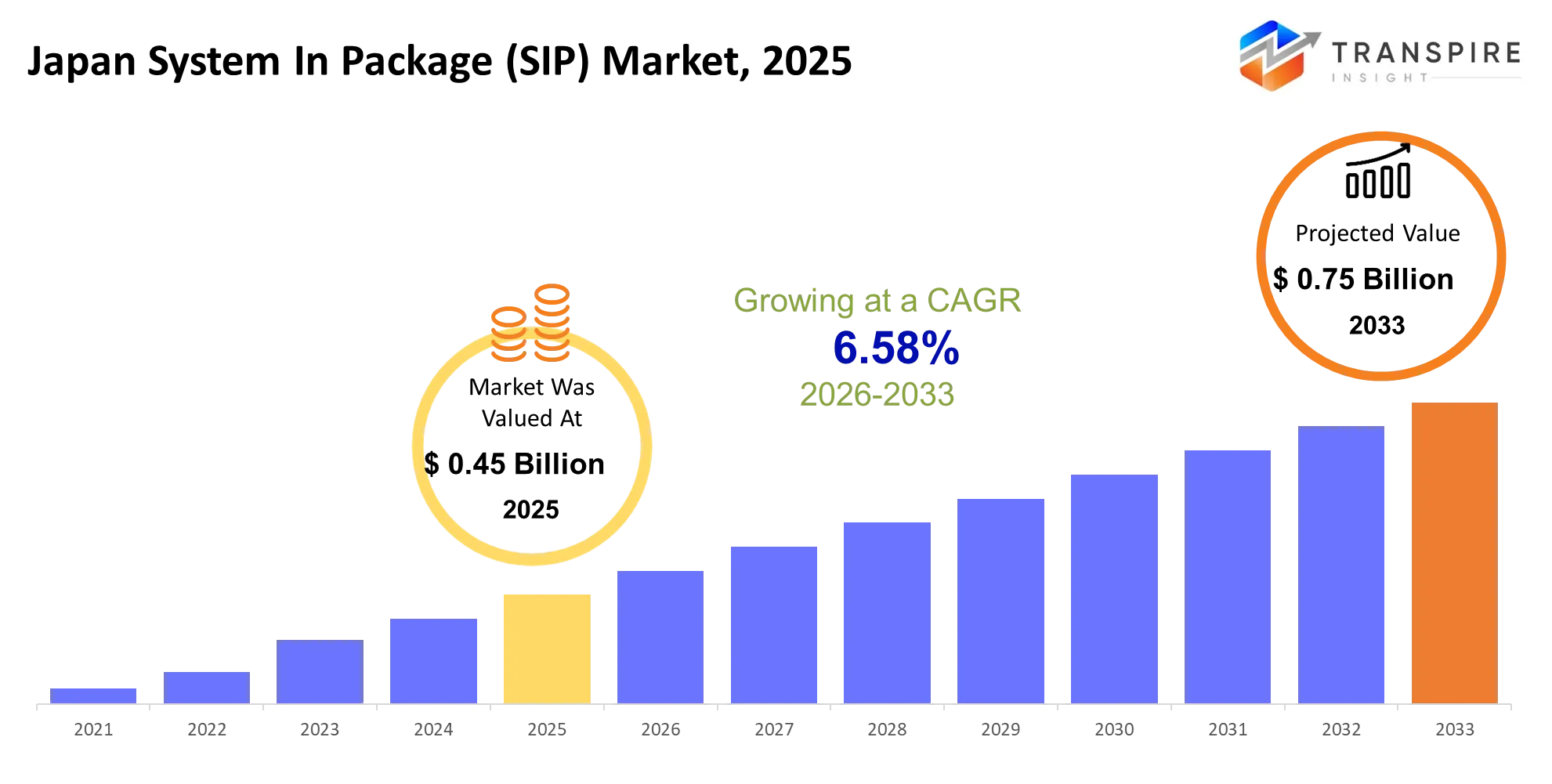
- Market Value (2025): USD 0.45 Billion.
- Expected Market Value (2026): USD 0.48 Billion.
- Estimated Market Value (2033): USD 0.75 Billion.
- Forecast CAGR (2026–2033): 6.58%
Introduction
System in Package (SiP) is a single module or package that incorporates multiple integrated circuits (ICs) and components, which implement all or most of the functionalities of an electronic system. Rather than attaching the individual components or chips on a large printed circuit board (PCB), a SiP arranges them either in a stack or tiled formation in a single small space. In this way, SiPs result in cheaper assembly process, reduced power dissipation, and much smaller sizes of the electronic gadgets. System in Package (SiP) is a microelectronics packaging technique, wherein multiple integrated circuits (ICs), passive components (such as resistors and capacitors), and interconnections are included within a single package to carry out the functionalities of the electronic system. The SiP Technology market in Japan provides many advantages for advanced semiconductors and electronic applications. Minimization involves combining logic, memory, and radio frequency elements in small packages to make the device smaller and portable. Increased Performance is achieved because of the reduced interconnections leading to low energy loss and increased efficiency. Cost & Simplification could be utilized to ease the integration of the components as well as minimizing the bill of materials. Reliability of the technology can be achieved through encapsulation and improved packaging techniques that safeguard the internal connections from damage due to mechanical and thermal stress.
Key Market Highlights: -
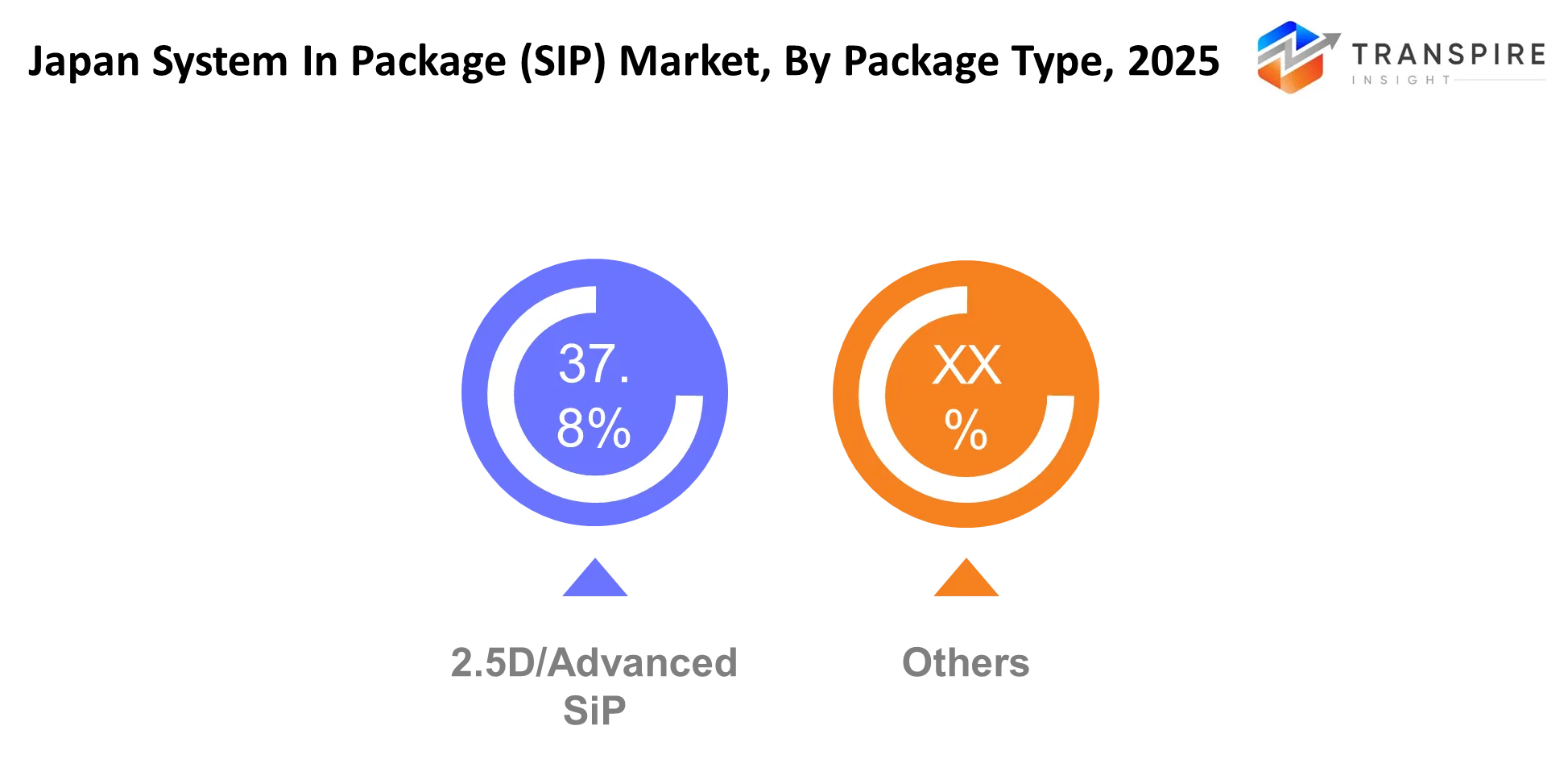
- By package type, the 2.5D SiP segment dominated the market and holds nearly 47% share in 2025 and is projected to grow at a substantial CAGR during the forecast period.
- By application, the Consumer Electronics segment dominated the market and holds nearly 51% share in 2025 and is projected to grow at a substantial CAGR during the forecast period.
- By end user, the Electronics OEMs segment dominated the market and holds nearly 28% share in 2025 and is projected to grow at a substantial CAGR during the forecast period.
- Government Strategic Support: The Japanese government is offering robust support to the development of semiconductors, particularly Rapidus' 2nm technology and advanced packaging. This helps boost semiconductor production in the country, promotes SiP, increases supply chain robustness, and develops advanced packaging technologies for AI, 5G, automotive electronics, industrial automation, and future computing applications in Japan.
How is Technology Driving Growth in the Japan System In Package (SIP) Market?
The Japanese market for SiP technology is making headway with heterogeneous integration and 3D stacking, incorporating logic, memory, RF, and sensors to enhance performance and power savings. Increasing need for miniaturization is resulting in smaller packages with shorter interconnects that reduce signal delays and energy loss. The development of substrate technology and panel-level packaging is optimizing material usage, production processes, and scale. The development of 5G communication and Edge AI is increasing the need for low-latency and high-performance SiP solutions in telecommunication, automotive, and intelligent devices. Moreover, government intervention and investment in R&D are supporting the Japanese semiconductor industry.
Market Drivers
Demand for smaller, lightweight, and high-performance electronic products is the main force behind Japan's SiP technology market. There are high demands for highly dense computing modules to enable industrial automation and robotics. The development of the 5G system and IoT products is contributing to the increase in demand for low power and high-performance semiconductors. Electrification of cars and advanced driving assistance systems are among other drivers of SiP technology adoption in automotive electronics. Finally, the support from the government and domestic semiconductor investments will further boost Japan's packaging capabilities, improve supply chain resiliency, accelerate development of advanced semiconductors, and drive the growth of Japan's SiP technology market. The Japan SIP technology market is poised to bring several benefits for electronic devices and semiconductor devices. Small Package allows for the incorporation of logic, memory, RF, and sensor technologies in a small form factor, which enables small devices. High Performance is accomplished by having shorter interconnects, enabling faster signals and energy conservation. Low Power Consumption is made possible by having optimized electrical pathways. Lower PCB Cost makes assembly and integration easier for circuits boards. Heterogeneous Integration makes possible the integration of semiconductor technologies in one package like analog, memory, and logic on different nodes. Moreover, the advanced Japan semiconductor industry can provide high precision materials, reliable production, resilience in supply chain and advanced packaging.
Restrain
The Japanese market for SiP is burdened with heavy initial expenses related to packaging technology, thermal management due to high density of devices, and reliance on an intricate chain of supplies. Furthermore, the multi-chip integration, testing process, and reliability issues complicate the manufacturing process and raise expenses. There is also a shortage of skilled workers in the field of semiconductors in Japan.
|
Driver |
Relative Impact on Growth (%) |
Geographic Relevance |
Impact Timeline |
Demand Strength |
Growth Mechanism |
Key Beneficiaries |
Major Constraint |
|
AI, HPC and Chiplet Integration |
28% |
Japan nationwide; major semiconductor clusters |
Short/Medium-term |
High |
Enables higher computing density through heterogeneous integration |
SiP manufacturers, chip designers, AI hardware companies |
High design and testing complexity |
|
Government Semiconductor Investment and Support |
22% |
Japan nationwide; Hokkaido and major industrial regions |
Medium/Long-term |
High |
Accelerates domestic advanced packaging R&D and capacity |
Packaging firms, semiconductor manufacturers, equipment suppliers |
Capital-intensive infrastructure requirements |
|
Miniaturization of Consumer Electronics |
20% |
Japan nationwide; electronics manufacturing centers |
Short/Medium-term |
High |
Integrates multiple functions within smaller packages |
Electronics OEMs, SiP suppliers, device manufacturers |
Thermal and power-density limitations |
|
Automotive Electrification and ADAS |
16% |
Japan nationwide; automotive manufacturing clusters |
Medium/Long-term |
High |
Increases demand for compact high-reliability electronic modules |
Automotive OEMs, Tier-1 suppliers, semiconductor vendors |
Automotive qualification and reliability requirements |
|
5G, IoT and Edge Computing Expansion |
14% |
Japan nationwide; urban and industrial networks |
Short/Medium-term |
High |
Drives compact low-power connectivity and processing modules |
Telecom firms, IoT vendors, SiP manufacturers |
Infrastructure investment and integration costs |
Analysis of Prices and Consumer Behaviour
The system-in-Package technology market has gained traction from the consumer electronics market (which accounted for around 53.68% of the global System-in-Package die market in 2025; owing to the demand for small, efficient and high-performing electronic devices). Advanced SiP solutions are priced based on their packaging complexities, integration densities, substrates and manufacturing needs; and Japan-specific standardization pricing information is not available. About 17.2% of the Asia-Pacific System-in-Package technology market was held by Japan in 2024. Market demands are being met because of the flexibility of SiP technology in smartphones, wearables, IoT devices, automotive electronics and telecommunications. In 2024, the consumer electronics segment made up for around USD 990.8 million of the semiconductor packaging materials market in Japan. Buying considerations are focusing more on integration density, performance, reliability, thermal management and power efficiency.
Who are the Key Players in the Japan System In Package (SIP) Market and how do they compete?
The competitiveness in the Japanese System-in-Package (SiP) industry is achieved through firms that specialize in advanced semiconductor packaging, heterogeneous integration, miniaturization, and high-performance electronic products. Competition in this industry does not solely rely on manufacturing skills but rather relies on packaging innovations, 2.5D/3D integration, advanced substrates, thermal management, and integration with AI, automotive, telecommunications, and consumer electronics products.
With the development of advanced semiconductor packaging, heterogeneous integration, and high-performance semiconductor products, Renesas Electronics increases its competitiveness in the Japanese semiconductor industry. With its specialization in advanced image sensors and miniaturized semiconductor solutions for SiP products, Sony Semiconductor Solutions gains a competitive advantage. The competitive advantages of ROHM and Resonac result from their semiconductor and packaging technologies, and power-device technology, respectively.
Top Companies in the Japan System In Package (SIP) Market
- TSMC
- ASE Technology
- Amkor Technology
- JCET
- Samsung Electronics
- Intel
- Sony Semiconductor Solutions
- Renesas Electronics
- Fujitsu
- Toshiba
- Kioxia
- Shinko Electric Industries
- Ibiden
- Toppan
- Dai Nippon Printing
|
Company |
Est. Revenue Share Range |
Key Offerings |
Strategic Positioning |
Geographic Strength |
Technology Focus |
|
Renesas Electronics Corporation |
6–10% (Estimated) |
SiP ICs; GaN SiP; MCU/SoC packages; automotive modules |
Automotive-focused integrated SiP solutions |
Japan; Asia Pacific; North America |
Heterogeneous integration; GaN SiP; miniaturized packages |
|
SHINKO ELECTRIC INDUSTRIES CO., LTD. |
8–12% (Estimated) |
Flip-chip packages; FC-BGA substrates; IC assembly; package substrates |
Advanced substrate and packaging specialization |
Japan; Asia Pacific; North America |
Flip-chip; high-density substrates; advanced IC assembly |
|
IBIDEN CO., LTD. |
7–11% (Estimated) |
High-performance IC substrates; FC-BGA; package substrates; advanced interconnects |
AI-server substrate capacity expansion |
Japan; Asia Pacific; North America |
High-density substrates; AI packaging; fine-line interconnects |
|
Sony Semiconductor Solutions Corporation |
4–8% (Estimated) |
Image-sensor packages; stacked sensors; compact semiconductor modules; 3D integration |
Image-sensor-led advanced packaging |
Japan; Asia Pacific; North America |
3D stacking; wafer-level integration; compact sensor packaging |
|
Murata Manufacturing Co., Ltd. |
5–9% (Estimated) |
RF modules; wireless modules; power SiP; integrated passive modules |
High-density RF and module integration |
Japan; Asia Pacific; North America |
RF integration; passive embedding; miniaturization |
|
TOPPAN Inc. |
4–7% (Estimated) |
FC-BGA substrates; glass-core substrates; RDL interposers; T-RECS |
Next-generation substrate innovation |
Japan; Asia Pacific; North America |
Glass-core; coreless interposers; panel-level manufacturing |
|
ASE Technology Holding Co., Ltd. / ASE Japan |
3–6% (Estimated) |
SiP modules; automotive modules; DC-DC modules; assembly and test |
Integrated OSAT and SiP manufacturing |
Japan; Asia Pacific; North America |
2.5D/3D; fan-out; flip-chip; advanced assembly |
|
Amkor Technology, Inc. |
3–6% (Estimated) |
SiP; RF SiP; AiP/AoP; automotive SiP; turnkey test |
Global outsourced SiP manufacturing |
Japan; Asia Pacific; North America |
Fan-out; RDL; AiP/AoP; advanced SiP assembly |
|
Resonac Holdings Corporation |
3–5% (Estimated) |
Packaging materials; temporary bonding films; thermal materials; interposers |
Advanced packaging materials ecosystem |
Japan; North America; Asia Pacific |
2.5D/3D materials; thermal management; chiplet packaging |
|
ROHM Co., Ltd. |
2–5% (Estimated) |
Power modules; SiC modules; GaN devices; integrated power packages |
Power-semiconductor packaging specialization |
Japan; Asia Pacific; Europe |
SiC/GaN integration; power modules; thermal reliability |
Japan System In Package (SIP) Market Segmentation
The Japan System In Package (SIP) Market share is divided into six categories: By package type, application, component, packaging technology, end user and device.
The 2.5D SiP dominated the market, accounting for nearly 47% in 2025 and is expected to rise at a significant CAGR during the forecast period.
The Japan System In Package (SIP) Market is segmented by package type into 2D SiP, 2.5D SiP, 3D SiP, Fan-Out SiP, Embedded SiP, Chiplet-Based SiP, Module-Based SiP, Advanced SiP. Among these, the 2.5D SiP segment dominated the market, accounting for nearly 47% in 2025 and expected to increase at a significant CAGR during the forecast period. Market share of the 2.5D SiP held the largest market share with nearly 47% in 2025 and is projected to grow at a considerable CAGR throughout the forecast period. Factors such as the need for enhanced computing performance, heterogeneous integration, bandwidth improvement, and effective inter-chip connections have helped in the dominance of 2.5D SiP technology in the market.
The Consumer Electronics dominated the market, accounting for nearly 51% in 2025, and is expected to rise at a significant CAGR during the forecast period.
The Japan System In Package (SIP) Market is segmented by application into Consumer Electronics, Smartphones, Wearables, Automotive, IoT, AI & Computing, Healthcare, Aerospace & Defense. Among these, the Consumer Electronics segment dominated the market, accounting for nearly 51% in 2025 and expected to increase at a significant CAGR during the forecast period. Consumer Electronics segment held the dominant position in the market with more than 51% in 2025, and its growth rate is anticipated to be a significant CAGR throughout the forecast period. This is attributed to growing demands of small-sized and light weight electronic devices. The increasing number of smart phones, wearable electronics, Internet of Things products, and advanced connected electronics leads to growing demands for SiP technology.
The Electronics OEMs dominated the market, accounting for nearly 28% in 2025 and is expected to rise at a significant CAGR during the forecast period.
The Japan System In Package (SIP) Market is segmented by end user into Semiconductor Companies, OSATs, Foundries, Electronics OEMs, Automotive OEMs, Telecom Companies, Medical Device Companies, Aerospace Companies. Among these, the Electronics OEMs segment dominated the market, accounting for nearly 28% in 2025 and expected to increase at a significant CAGR during the forecast period. Electronics OEMs held the largest market share in 2025, with almost 28%, and is predicted to grow at a substantial CAGR during the forecast period. This is attributed to growing demand for small, high-performing electronic devices, as well as increased semiconductor integration. With the adoption of SiP technology, the OEMs have been able to achieve miniaturization, performance, reduced power consumption, and integration.
Future Market Trends for the Japan System In Package (SIP) Market: -
- Artificial Intelligence and Edge Computing: Incorporation of AI within small edge systems necessitates multi-chip SiP packages for low latency.
- Electrification of Vehicles: The autonomous driving and cockpit domains are dependent upon reliability-based SiP design.
- Wearable Devices: Wearables adopt health sensors to become permanently connected while being accommodated in less than 30 square mm area.
- New Generation of Telecommunication (5G/6G): Research into high-frequency RF components and antennas module packaging.
- Heterogeneous Integration: Integrating MEMS, optoelectronic and logic chips into one package are more energy efficient.
Recent Development
- In June 2026: In an announcement of their partnership to offer advanced packaging solutions in Japan, ASMPT SMT Solutions and Shinwa Co., Ltd., have collaborated for the purposes of SiP manufacture, high-precision component placement, innovations in semiconductor packaging, intelligent manufacturing, and the increasing need for dense electronic components in automotive, industrial, and telecommunication uses.
- In April 2026: Resonac established an R&D center through the US-JOINT consortium for developing cutting-edge semiconductor package technologies. This technology is related to 2.5-D and 3-D integration that enhances technologies pertinent to SiP applications. It fosters advancements in packaging, dense semiconductor integration, supply chain resiliency, and capabilities linked to Japan for AI, automotive, and high-performance computing applications.
Market Segment
This study forecasts revenue at Japan, regional and country levels from 2020 to 2033. Transpire Insight has segmented the Japan System In Package (SIP) Market based on the below-mentioned segments:
Japan System In Package (SIP) Market, By Package Type
- 2D SiP
- 2.5D SiP
- 3D SiP
- Fan-Out SiP
- Embedded SiP
- Chiplet-Based SiP
- Module-Based SiP
- Advanced SiP
Japan System In Package (SIP) Market, By Application
- Consumer Electronics
- Smartphones
- Wearables
- Automotive
- IoT
- AI & Computing
- Healthcare
- Aerospace & Defense
Japan System In Package (SIP) Market, By Component
- Processors
- Memory
- Sensors
- RF Components
- Power Management ICs
- Analog ICs
- Connectivity ICs
- Passive Components
Japan System In Package (SIP) Market, Packaging Technology
- Wire Bonding
- Flip-Chip
- Fan-Out
- TSV
- Wafer-Level Packaging
- Embedded Die
- Hybrid Bonding
- Chiplet Integration
Japan System In Package (SIP) Market, By End User
- Semiconductor Companies
- OSATs
- Foundries
- Electronics OEMs
- Automotive OEMs
- Telecom Companies
- Medical Device Companies
- Aerospace Companies
Japan System In Package (SIP) Market, By Device Type
- Mobile Devices
- RF Modules
- Memory Modules
- Sensor Modules
- Power Modules
- Automotive Modules
- Communication Modules
- Computing Modules
Frequently Asked Questions
Find quick answers to common questions.
The market is projected to grow at 6.58% CAGR from 2026–2033, driven by miniaturization, AI, automotive electronics, 5G, IoT, and packaging.
The 2.5D SiP segment dominates, accounting for nearly 47% in 2025, supported by heterogeneous integration, bandwidth improvements, and high-performance computing requirements.
Consumer Electronics dominates, accounting for nearly 51% in 2025, driven by smartphones, wearables, IoT devices, miniaturization, and high-performance electronics demand.
Key drivers include miniaturization, AI computing, 5G, IoT, automotive electrification, ADAS adoption, heterogeneous integration, and government semiconductor investments across Japan.
Key players include Renesas, SHINKO Electric, IBIDEN, Sony Semiconductor Solutions, Murata, TOPPAN, ASE, Amkor, Resonac, and ROHM in Japan's SiP ecosystem.
- TSMC
- ASE Technology
- Amkor Technology
- JCET
- Samsung Electronics
- Intel
- Sony Semiconductor Solutions
- Renesas Electronics
- Fujitsu
- Toshiba
- Kioxia
- Shinko Electric Industries
- Ibiden
- Toppan
- Dai Nippon Printing
About the Authors

Avinash Kumar
I’m Avinash Kumar, a Senior Research Analyst at Transpire Insight, with expertise in the Electronics and Semiconductor and Energy & Power industry. My work focuses on analyzing emerging technologies, market trends, industry developments, and innovation across these sectors. I specialize in transforming complex technical and market insights into clear, research-backed content that helps professionals, businesses, and decision-makers stay informed. Through continuous industry research and data-driven analysis, I strive to deliver accurate, reliable, and practical perspectives on the latest advancements shaping the semiconductor and energy landscape.

Chakradhar Khansole
Chakradhar serves as the Research Director at Transpire Insight, bringing over 8 years of experience in technology, innovation, and strategic market intelligence. He specializes in transforming complex market data into actionable business insights that enable organizations to make informed, growth-oriented decisions. Recognized for his strategic vision and analytical expertise, Chakradhar leads high-impact research initiatives, delivering comprehensive market assessments, competitive intelligence, and forward-looking industry analysis.
Recently Published Reports
-
Apr 2026
Fiber Optic Faceplates Market
Fiber Optic Faceplates Market Size, Share & Analysis Report By Type (< 300 mm2, 300-350 mm2, and > 350 mm2, By Application (Night Vision, Holographic Imaging, Medical, and Others), and Geography (North America, Europe, Asia-Pacific, Middle East and Africa, South and Central America), 2021 - 2031
-
Apr 2026
High Temperature Superconductors Market
High Temperature Superconductors Market Size, Share & Analysis Report By Type (1G HTS, and 2G HTS), By Application (Power Cable, Fault Current Limiter, and Transformer), and Geography (North America, Europe, Asia-Pacific, Middle East and Africa, South and Central America), 2021 - 2031
-
Apr 2026
Industrial Plugs and Socket Market
Industrial Plugs and Socket Market Size, Share & Analysis Report By Type (Industrial Plugs, Industrial Sockets), By Current (Up to 32 A, 32 to 125 A, Above 125 A), By Protection (Dustproof and Splash Proof, Waterproof, Explosion Proof), By End User (Heavy Industries, Oil and Gas, Chemicals and Pharmaceuticals, Power Generation, Others), and Geography (North America, Europe, Asia-Pacific, Middle East and Africa, South and Central America), 2021 - 2031
-
Apr 2026
InGaAs Avalanche Photodiodes Market
InGaAs Avalanche Photodiodes Market Size, Share & Analysis Report By Type (1100 - 1700 nm, and 1000 - 1600 nm), By Application (Missile Warning System, Muzzle Flash Detection, Wafer Defect Inspection, Laser Rangefinders, and Others), and Geography (North America, Europe, Asia-Pacific, Middle East and Africa, South and Central America), 2021 - 2031