

Japan Scaffold-free 3D Cell Culture Market Size & Forecast:
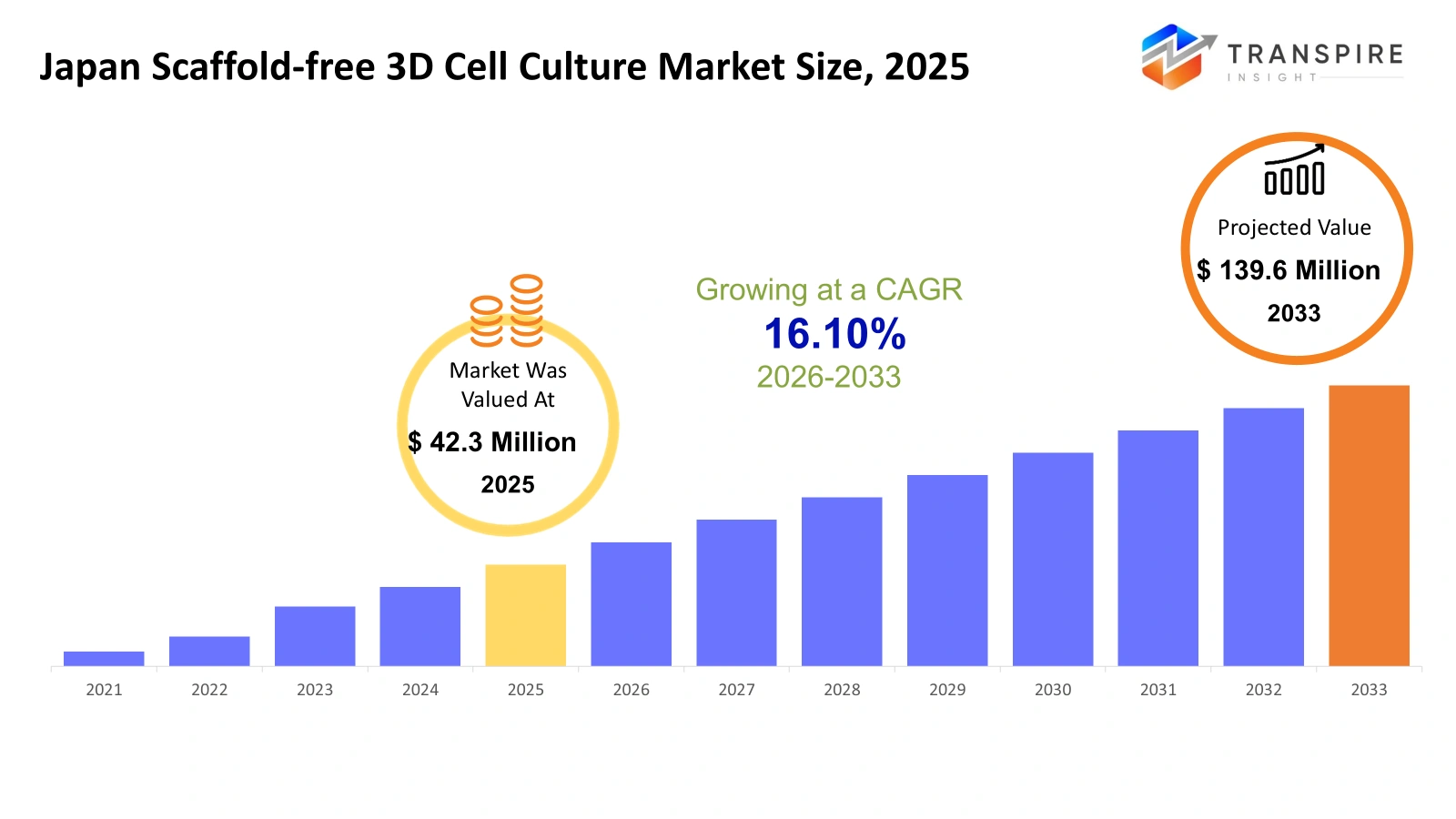
- Japan Scaffold-free 3D Cell Culture Market Size 2025: USD 42.3 Million
- Japan Scaffold-free 3D Cell Culture Market Size 2033: USD 139.6 Million
- Japan Scaffold-free 3D Cell Culture Market CAGR: 16.10%
- Japan Scaffold-free 3D Cell Culture Market Segments:By Product Type (Microplates, Magnetic Levitation Systems, Hanging Drop Systems), By Application (Drug Discovery, Cancer Research, Stem Cell Research).
To learn more about this report,  Download Free Sample Report
Japan Scaffold-free 3D Cell Culture Market Summary:
The Japan scaffold-free 3D cell culture market size is estimated at USD 42.3 million in 2025 and is anticipated to reach USD 139.6 million by 2033, growing at a CAGR of 16.10% from 2026 to 2033. The Japan scaffold-free 3D cell culture market continues to grow as researchers and biotech companies search for better methods to study human biology. The advanced models demonstrate superior performance because they create closer representations of natural cell behaviour compared to conventional techniques, which request particular experimental setups. Increasing funding for regenerative medicine research and cancer research studies drives higher demand for medical solutions. Japan establishes itself as a major player in the developing industry through its advanced research partnerships and its development of new technologies, which create valuable business prospects for domestic and international partners.
Key Market Trends & Insights:
- Researchers in Japan are increasingly shifting toward scaffold-free 3D cultures as they closely replicate natural tissue environments. The research creates more trustworthy results which scientists can use to study complex medical conditions.
- Pharmaceutical companies use scaffold-free 3D cultures to improve their drug screening processes. The method decreases the need for animal testing while it enhances the accuracy of forecasting human reactions.
- The field gains efficiency through automated culture systems and imaging tools which continuously develop new innovations. The advancement makes research laboratories more likely to adopt these new technologies.
- The Japanese university system cooperates with biotech companies to speed up research progress. The partnerships stimulate invention while they hasten the process of bringing new technologies to the market.
- The market experiences growth because private investors and government funding programmes have increased their financial support. Research institutions receive encouragement from supportive policies to implement advanced culture techniques.
Japan Scaffold-free 3D Cell Culture Market Segmentation
By Product Type
- Microplates: Japanese laboratories prefer microplates because their design enables easy operation with standard laboratory instruments. The technology provides multiple screening capabilities which make it suitable for testing purposes. Researchers use this method because it delivers consistent results with simple testing procedures, which they need to conduct their work in pharmaceutical and academic research environments where they need to operate efficiently.
- Magnetic Levitation Systems: Researchers are showing increasing interest in magnetic levitation systems because these systems create 3D cell cultures which need no physical support structures to function. Magnetic fields cause cells to self-organise into structures that resemble human tissues. This groundbreaking method produces more lifelike models, which scientists use for cutting-edge biomedical research and regenerative medicine studies.
- Hanging Drop Systems: Hanging drop systems provide researchers with an affordable method to create three-dimensional cell spheroids through a simple testing process. The Japanese research community uses this method because it offers precise results while needing only basic equipment for their initial testing phases. Scientists use this technology to control how cells group together, which helps them investigate how cells interact and how they behave.
By Application
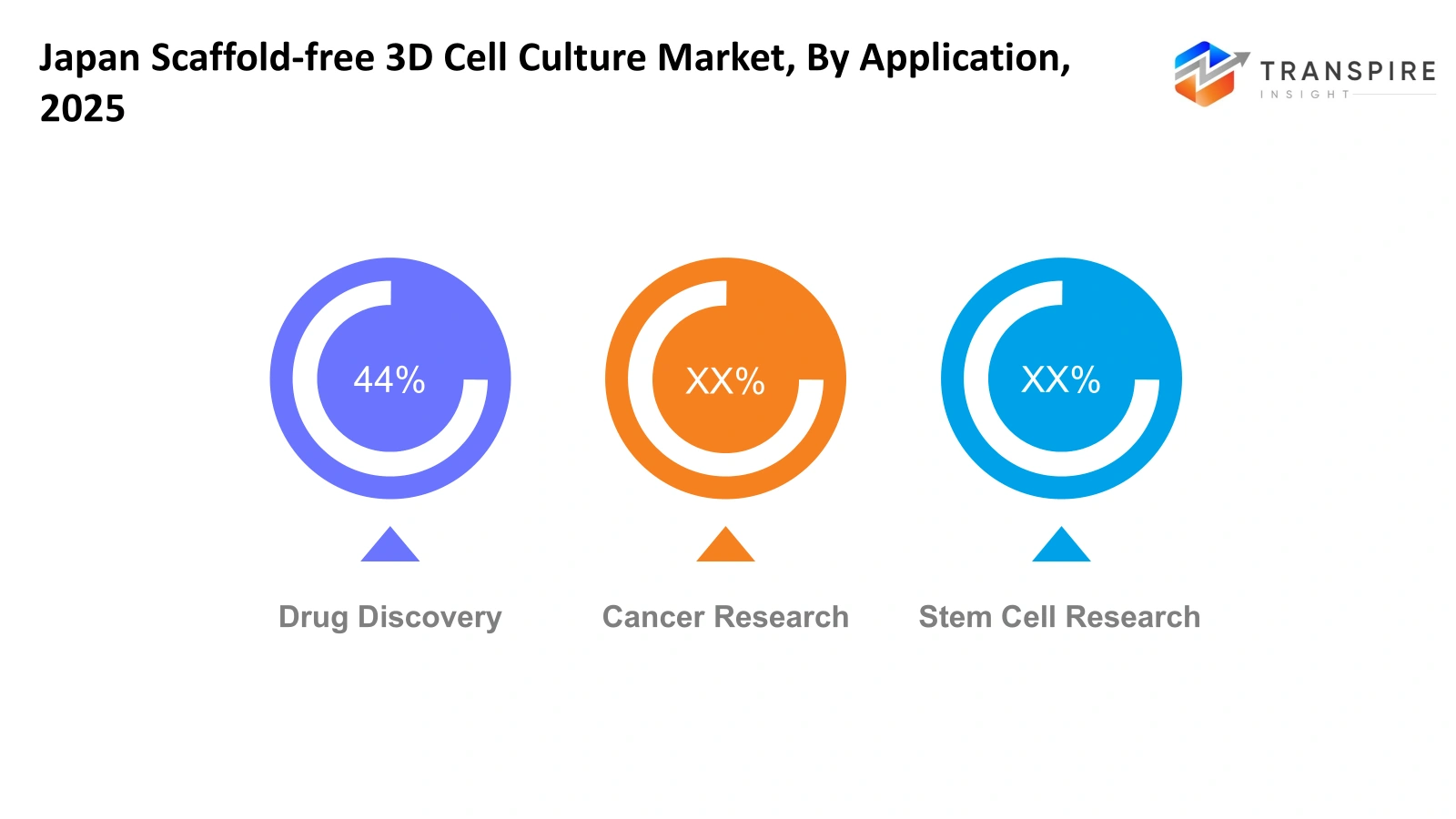
- Drug Discovery: The development of scaffold-free 3D cell culture models has created a new method for testing drug therapies in the field of drug discovery. Japanese pharmaceutical companies use these systems to better predict human responses, reducing late-stage failures. The approach enables quicker and more dependable testing procedures while decreasing the need for conventional animal testing methods.
- Cancer Research: The primary function of scaffold-free models in cancer research is to recreate authentic tumour microenvironments. Japanese researchers employ these systems to investigate how cancer develops and how patients respond to treatment. The process produces deeper insights which enhance the creation of targeted therapies, thus improving research results.
- Stem Cell Research: The application of scaffold-free three-dimensional cultures has become essential for stem cell research throughout Japan. The system creates a basis for cells to develop and mature in their cells. The system enables researchers to investigate regenerative medicine and tissue engineering, which leads to developments in personalised healthcare and enduring medical solutions.
To learn more about this report, Download Free Sample Report
Country Insights
The Japan scaffold-free 3D cell culture market shows that the country dedicates itself to developing new life sciences and healthcare technologies. Japan maintains its commitment to biotechnology by funding research activities which lead to better disease modeling and drug discovery processes. Universities and research institutions, together with pharmaceutical companies, establish a collaborative framework which promotes scientific advancement.
The government provides backing for stem cell research and regenerative medicine, which has led to increased usage of scaffold-free technologies. The need for effective treatments has risen because of Japan's aging population, which has resulted in increased demand for dependable research models. The market keeps growing because skilled researchers work together with advanced research facilities. Japan emerges as an important centre for innovation because its scientific research and practical uses of technology work together to create advancements in 3D cell culture methods.
Recent Development News
Precision Medicine Push Drives Demand for 3D Cell Culture Technologies in Japan: Japan’s focus on precision medicine is encouraging the use of 3D cell culture models for more accurate disease modeling.
Japan’s 3D Cell Culture Market Expands with Rising Demand for Advanced Models: Japan’s life sciences sector is witnessing steady growth, supported by rising demand for advanced cell culture technologies in drug discovery and regenerative medicine.
|
Report Metrics |
Details |
|
Market size value in 2025 |
USD 42.3 Million |
|
Market size value in 2026 |
USD 49.11 Million |
|
Revenue forecast in 2033 |
USD 139.6 Million |
|
Growth rate |
CAGR of 16.10% from 2026 to 2033 |
|
Base year |
2025 |
|
Historical data |
2021 – 2024 |
|
Forecast period |
2026 – 2033 |
|
Report coverage |
Revenue forecast, competitive landscape, growth factors, and trends |
|
Country scope |
Japan |
|
Key company profiled |
Thermo Fisher Scientific Inc., Merck KGaA, Corning Incorporated, Lonza Group AG, Greiner Bio-One International GmbH, 3D Biotek LLC, InSphero AG, Mimetas BV, Nano3D Biosciences Inc., Tecan Group Ltd., Synthecon Inc., PromoCell GmbH, Cellink AB, Danaher Corporation, Agilent Technologies Inc. |
|
Customization scope |
Free report customization (country, regional & segment scope). Avail customized purchase options to meet your exact research needs. |
|
Report Segmentation |
By Product Type (Microplates, Magnetic Levitation Systems, Hanging Drop Systems), By Application (Drug Discovery, Cancer Research, Stem Cell Research). |
Key Japan Scaffold-free 3D Cell Culture Company Insights
The scaffolding-free three-dimensional cell culture market in Japan exists between established life science businesses and emerging biotechnology startups. The organisations focus their efforts on creating advanced culture systems which produce results that scientists can replicate with greater accuracy. Companies make research partnerships with universities their main strategy for maintaining innovation leadership. The company focuses on two main areas, which include product usability improvements and product scalability enhancements. Japanese companies use ongoing technological progress and their strategic partnerships to build stronger market positions in both domestic and international spaces.
Company List
- Thermo Fisher Scientific Inc.
- Merck KGaA
- Corning Incorporated
- Lonza Group AG
- Greiner Bio-One International GmbH
- 3D Biotek LLC
- InSphero AG
- Mimetas BV
- Nano3D Biosciences Inc.
- Tecan Group Ltd.
- Synthecon Inc.
- PromoCell GmbH
- Cellink AB
- Danaher Corporation
- Agilent Technologies Inc.
Japan Scaffold-free 3D Cell Culture Market Report Segmentation
By Product Type
- Microplates
- Magnetic Levitation Systems
- Hanging Drop Systems
By Application
- Drug Discovery
- Cancer Research
- Stem Cell Research
Frequently Asked Questions
Find quick answers to common questions.
The Approximate Japan scaffold-free 3D cell culture Market size for the Market will be USD 139.6 million in 2033.
The key Segments of the Japan Scaffold-free 3D cell culture Market are By Product Type (Microplates, Magnetic Levitation Systems, Hanging Drop Systems), By Application (Drug Discovery, Cancer Research, Stem Cell Research).
Major Players in the Japan Scaffold-free 3D Cell Culture Market are Thermo Fisher Scientific Inc., Merck KGaA, Corning Incorporated, Lonza Group AG, Greiner Bio-One International GmbH, 3D Biotek LLC, InSphero AG, Mimetas BV, Nano3D Biosciences Inc., Tecan Group Ltd., Synthecon Inc., PromoCell GmbH, Cellink AB, Danaher Corporation, Agilent Technologies Inc.
The Current Market size of the Japan scaffold-free 3D cell Culture Market is USD 42.3 million in 2025.
The Japan scaffold-free 3D cell Culture Market CAGR is 16.10%.
- Thermo Fisher Scientific Inc.
- Merck KGaA
- Corning Incorporated
- Lonza Group AG
- Greiner Bio-One International GmbH
- 3D Biotek LLC
- InSphero AG
- Mimetas BV
- Nano3D Biosciences Inc.
- Tecan Group Ltd.
- Synthecon Inc.
- PromoCell GmbH
- Cellink AB
- Danaher Corporation
- Agilent Technologies Inc.
Recently Published Reports
-
Apr 2026
Cord Blood Banking Services Market
Cord Blood Banking Services Market Size, Share & Analysis Report By Type of Service (Collection, Processing, Storage), By Bank Type (Private Banks, Public Banks, and Hybrid Banks), By Component (Cord Blood, and Cord Tissue), By End User (Hospitals, Research Institutions, Biotechnology Companies, and Others) and Geography (North America, Europe, Asia-Pacific, Middle East and Africa, South and Central America), 2021 - 2031
-
Apr 2026
ELISA Processors Market
ELISA Processors Market Size, Share & Analysis Report By Type (Optical Filter ELISA Analyzer, and Optical Grating ELISA Analyzers), By Mode (Automated ELISA Analyzers, and Semi-Automated ELISA Analyzers), By Applications (Immunology, Vaccine development, Drug Monitoring, and Others), By End Users (Biotechnology Companies, Pharmaceutical Companies, Contract Research Organization, and Diagnostic Laboratories) and Geography (North America, Europe, Asia-Pacific, Middle East and Africa, South and Central America), 2021 - 2031
-
Apr 2026
Microscope Slide Scanner Market
Microscope Slide Scanner Market Size, Share & Analysis Report By Type (Portable Microscope Slide Scanner, and Desktop Microscope Slide Scanner), By Application (Biological Research, Medicine, Veterinary, and Other) and Geography (North America, Europe, Asia-Pacific, Middle East and Africa, South and Central America), 2021 - 2031
-
Apr 2026
Microwave Cookware Market
Microwave Cookware Market Size, Share & Analysis Report By Material Type (Plastic, Glass, Ceramic, Silicone, and Metal), By Application (Cooking, Reheating, and Defrosting), By End User (Household, Commercial (Restaurants, Hotels, and Cafes), and Food Service Industry), By Sales Channel (Online Retail, Offline Retail (Supermarkets, Hypermarkets, Specialty Stores), and Direct Sales (Company Outlets)) and Geography (North America, Europe, Asia-Pacific, Middle East and Africa, South and Central America), 2021 - 2031