

Japan Push-to-talk (PTT) Market Size & Forecast:
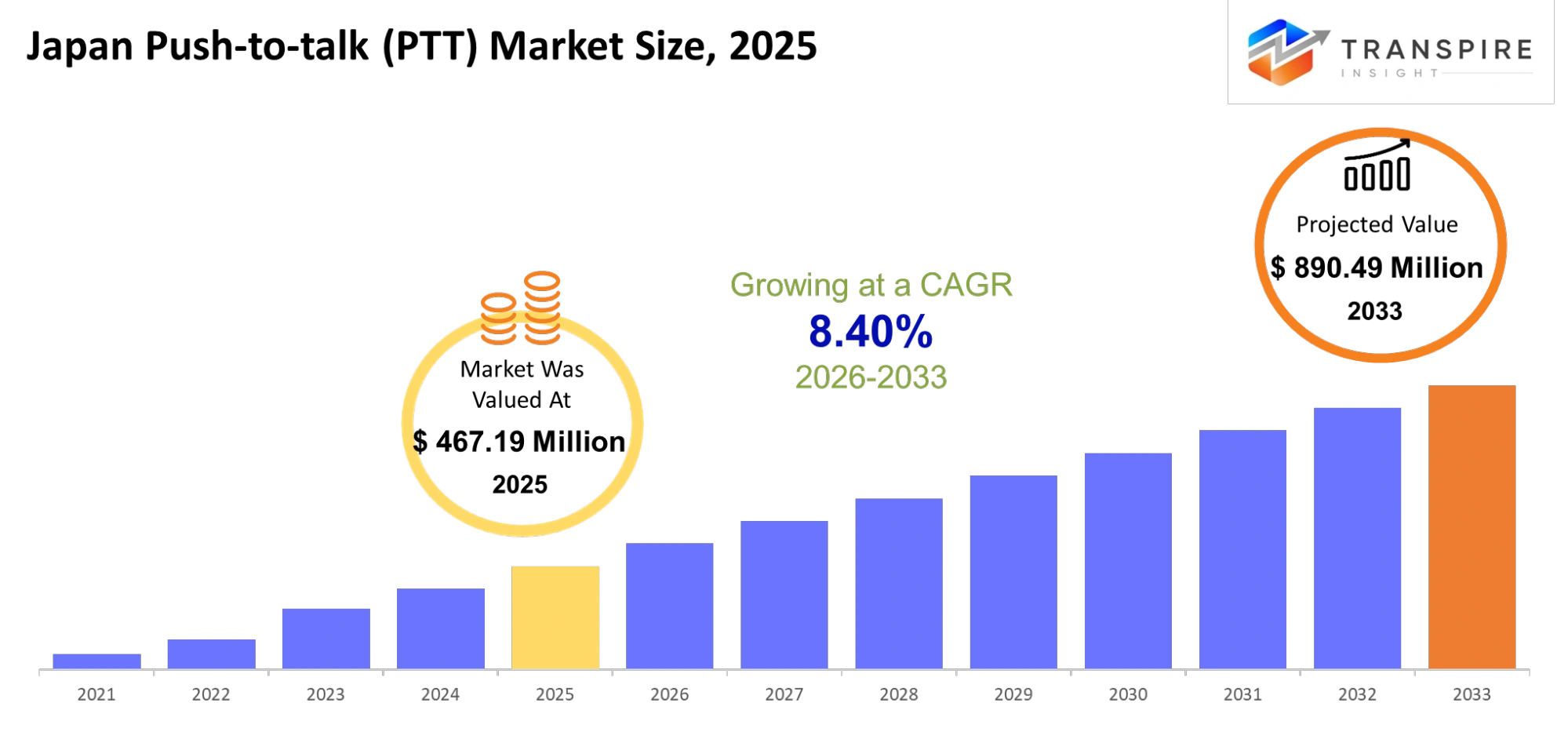
- Japan Push-to-talk (PTT) Market Size 2025: USD 467.19 Million
- Japan Push-to-talk (PTT) Market Size 2033: USD 890.49 Million
- Japan Push-to-talk (PTT) Market CAGR: 8.40%
- Japan Push-to-talk (PTT) Market Segments: By Type (Hardware, Software, Services, Others); By Application (Public Safety, Enterprise Communication, Transportation, Construction, Logistics, Others); By End-User (Government, Enterprises, Defense, Transport Operators, Industrial Firms, Others); By Technology (LTE-based PTT, Cellular PTT, VoIP-based PTT, Others)
To learn more about this report,  Download Free Sample Report
Japan Push-to-talk (PTT) Market Summary
The Japan Push-to-talk (PTT) Market was valued at USD 467.19 Million in 2025. It is forecast to reach USD 890.49 Million by 2033. That is a CAGR of 8.40% over the period.
The Japan Push-to-talk systems enable field teams in various operational fields to communicate their work requirements through instant voice contact which functions as a substitute for delayed telephone communication and disjointed text messaging. The system enables dispatchers and logistics coordinators to maintain continuous contact with shift workers during operational periods which require precise timing because each second directly impacts operational efficiency and safety results.
Dedicated radio hardware has declined in market presence within the past three to five years as customers now prefer to use PTT platforms that operate on smartphones and rugged devices which support LTE and 5G technology together with built-in dispatch software and location tracking systems. The COVID-19 pandemic served as a primary catalyst which revealed operational vulnerabilities in shared-device systems and compelled businesses to develop new methods for coordinating work between remote teams and managing disrupted supply chains. The establishment of cloud-based communication systems began which enables organizations to manage field operations through central control because these systems allow quick operational changes. The current adoption process occurs because organizations require digital operations and employees need to work remotely instead of needing to replace their equipment.
Key Market Insights
- The Kanto region controls almost 38 percent of the Japan Push-to-talk (PTT) market because its industrial and logistics networks create high-density areas.
- The Kansai region is the fastest-growing area (2025–2030), supported by manufacturing modernization and smart factory deployment initiatives.
- The Japan Push-to-talk (PTT) Market is led by LTE and 5G-based PTT solutions which control about 52% of the market because of their cloud integration and mobility features.
- Digital radio systems remain the second-largest segment, sustaining legacy adoption in public safety and transport operations.
- The fastest-growing segment until 2030 consists of software-based PTT platforms which enable users to communicate across multiple devices through SaaS deployment.
- Industrial communication dominates with nearly 41% share, as factories and logistics hubs prioritize real-time coordination efficiency.
- The fastest-growing application of transportation and fleet management systems results from the adoption of smart mobility technologies and connected dispatch systems.
- The manufacturing sector leads the Japan Push-to-talk (PTT) Market with around 35% market share because manufacturing facilities require automated systems together with efficient workforce management solutions.
- Infrastructure expansion together with supply chain digitization make logistics and construction end-users the fastest-growing user group.
- Companies build stronger market positions through their use of AI-based dispatch systems together with LTE PTT enhancements and cloud-native communication platforms.
What are the Key Drivers, Restraints, and Opportunities in the Japan Push-to-talk (PTT) Market?
The Japan Push-to-talk (PTT) Market exists because organizations switch from their old land mobile radio systems to modern LTE and 5G communication systems. The shift occurred because enterprises needed their employees to communicate through multimedia systems while working in various locations during their field operations. Organizations use cloud-based PTT systems that track GPS locations and dispatch information instead of their traditional radio systems which require physical equipment. The system implementation enables operational processes to work better while the software revenue streams which companies generate from their products increase thus creating stronger market revenue streams for the future.
The Japan Push-to-talk (PTT) Market faces a major restriction because critical industries including railways and emergency services depend on their existing interoperable legacy systems. The systems have become essential to business operations which makes their replacement process expensive because it needs financial resources and official approval. The organizations of the company face difficulties in migrating to better platforms because their current systems create obstacles which work against their plans to implement LTE-based PTT systems on a wide scale. The companies keep their existing radio systems operational which leads to lower revenue growth because they choose to renew their current technology instead of upgrading to new systems.
The deployment of private 5G networks in industrial zones and smart ports creates a significant business opportunity because it affects areas such as Kansai and Kyushu. The KDDI Corporation Company operates dedicated 5G enterprise networks to test systems which provide ultra-reliable low-latency PTT communication for their automated logistics and workforce connectivity needs. The networks will provide access to valuable applications which include AI-based dispatching and unified safety management systems as they increase their operational capacity.
What Has the Impact of Artificial Intelligence Been on the Japan Push-to-talk (PTT) Market?
Artificial intelligence now operates throughout the Japanese Push-to-talk (PTT) Market because real-time voice communication systems connect with advanced operational intelligence systems that support logistics, port operations, and industrial fleet management. AI-enabled monitoring tools within scrubber performance systems and marine emission control technology observe exhaust gas cleaning system efficiency while they identify compliance parameter deviations. Integrated PTT networks enable fleet operators to issue immediate corrective commands which decrease manual inspection times and enhance operational coordination between ships and shore-based teams.
Machine learning models support predictive maintenance processes by analyzing communication logs along with sensor feeds and equipment telemetry to identify potential failures in propulsion units and scrubbers and auxiliary systems. The system enables maintenance personnel to schedule maintenance work before machine failures happen which leads to better equipment availability and lower costs for unplanned repairs. AI-based dispatch communication optimization within port logistics operations has resulted in operational efficiency improvements through faster task allocation and reduced idle times for vessels and vehicles.
The maritime industry faces challenges because it lacks sufficient training data and suffers from poor sea connectivity which results in reduced model accuracy during real-world testing. The need to connect legacy communication systems with cloud-based AI technology creates high integration expenses which delay the complete implementation of Japan Push-to-talk (PTT) Market and its associated marine communication networks.
Key Market Trends
- The Japan Push-to-Talk market transitioned from using analog radio systems to adopting LTE-based platforms after more than 50% of businesses began using the technology in 2022.
- Public safety agencies decreased their use of independent radio systems after 2021 when they started using unified broadband communication networks to improve their emergency response times.
- Manufacturing companies implemented data-capable platforms which replaced traditional voice-only PTT systems to enhance their operational processes in 2023.
- KDDI Corporation built new private LTE networks during 2024, which helped companies switch to secure cloud-based push-to-talk systems throughout the country.
- Rail and transport operators started using GPS-enabled PTT systems after 2022 because the technology helped them deliver better dispatch services and decreased their communication delays.
- Organizations across industrial sectors adopted smartphone-based PTT applications because workplace mobility and bring-your-own-device policies led to decreased needs for hardware-based communication systems.
- Panasonic and Icom Inc. developed hybrid communication devices which combine traditional radio systems with modern digital broadband capabilities.
- Logistics companies implemented AI-powered dispatch PTT systems after 2023 which allowed them to modify routes in real time while boosting their fleet operational performance.
- The regulatory requirements for disaster-proof communication systems which emerged after significant weather events forced businesses to adopt backup cloud-based PTT systems.
Japan Push-to-talk (PTT) Market Segmentation
By Type :
Push-to-talk solutions support fast coordination in public safety operations, helping emergency teams respond quickly. Enterprise communication uses these systems for internal teamwork and quick updates. Transportation and logistics rely on instant communication for route updates and delivery coordination, while construction sites use them for worker safety and task alignment.
Industrial usage is growing as more sectors require instant voice communication without delays. Logistics networks and transport operators benefit from real-time coordination across locations. Adoption across different application areas will continue expanding as organizations focus on safety, speed, and efficiency in daily operations.
By Application :
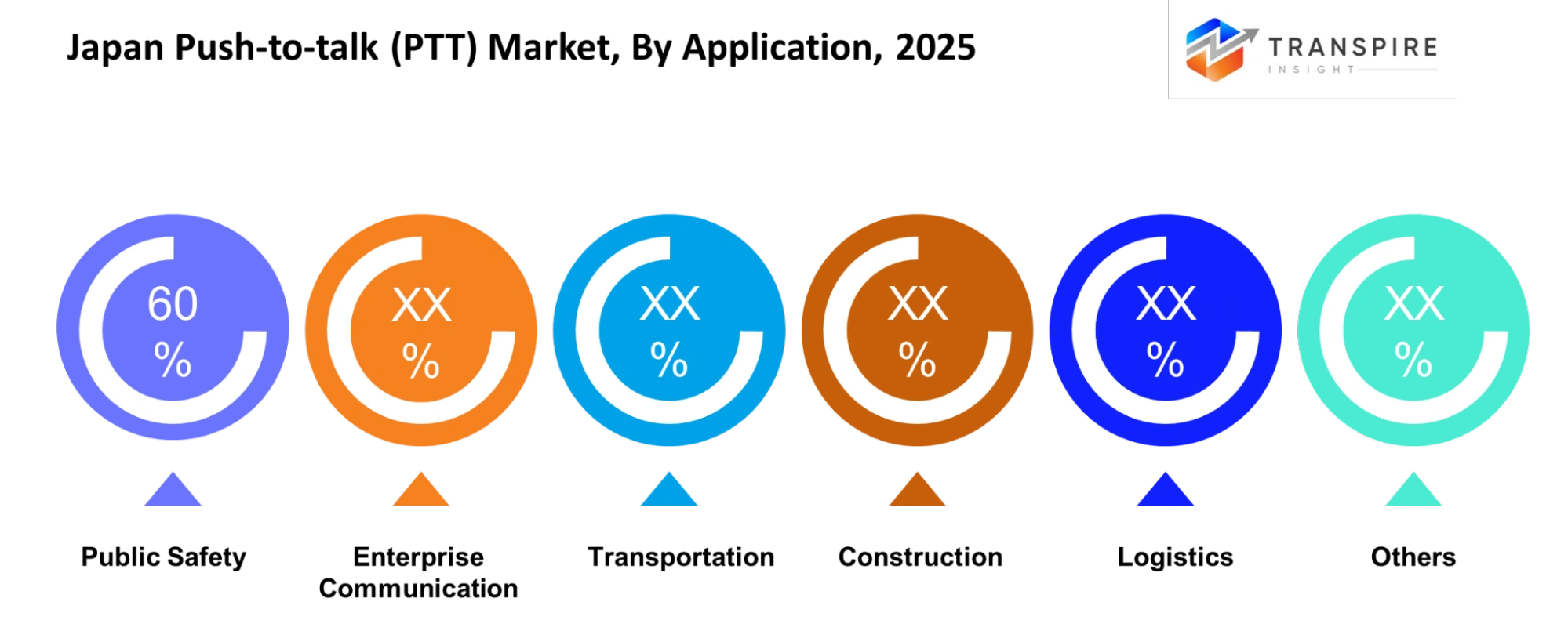
Public safety operations use push-to-talk solutions which enable emergency teams to achieve fast coordination. The systems enable enterprise communication through their use in internal team collaboration and rapid information dissemination. Instant communication enables transportation and logistics companies to update route information and coordinate their deliveries, while construction sites use it to ensure worker safety and manage their activities.
The need for immediate voice communication without interruptions is driving industrial sectors to adopt industrial applications. Real-time coordination enables logistics networks and transport operators to operate multiple locations effectively. Organizations that prioritize safety and speed and efficiency will continue to adopt new technological solutions across different business functions.
To learn more about this report, Download Free Sample Report
By End-User :
Government organizations use push-to-talk systems for three main purposes which include emergency response and field coordination and administrative communication. Enterprises implement these tools to enable their internal teams to collaborate with other departments. Defense sectors depend on secure instant communication systems to coordinate their missions while transport operators and industrial firms use these systems for operational efficiency and employee supervision.
The demand for dependable communication systems in dynamic environments has led to increased adoption among all end-user groups. Industrial firms and transport operators especially depend on uninterrupted connectivity for daily activities. The upcoming years will see increased digital communication tool usage across all end-user groups.
By Technology :
The advanced network infrastructure of LTE-based push-to-talk systems delivers excellent coverage and fast response capabilities. The Cellular PTT system uses mobile networks to provide communication services that reach across extensive geographic territories. VoIP-based systems require internet access which enables users to make voice calls through digital platforms on multiple devices. Organizations now prefer integrated systems that depend on cloud technology for their technology adoption instead of using traditional radio systems.
Field operations use LTE and cellular solutions while organizations increasingly adopt VoIP systems for their office spaces. The ongoing network enhancements will enable organizations to achieve broader and more reliable communication capabilities throughout various business sectors.
What are the Key Use Cases Driving the Japan Push-to-talk (PTT) Market?
The Japan Push-to-Talk PTT Market uses industrial coordination as its primary application for voice communication which enables manufacturing plants and logistics hubs to operate their facilities through voice communication during different work shifts. The system provides immediate task distribution which enables personnel to respond quickly when equipment fails or work processes stop, thus maintaining the operational flow of production facilities and distribution networks.
Transportation and fleet management show increasing demand for PTT systems which rail companies and delivery services use to manage driver updates, routing operations, and schedule changes through their integrated PTT systems. Construction companies use ruggedized devices to control their field teams because these devices enhance safety communication and decrease delays in major infrastructure projects.
AI-assisted emergency response coordination and smart port operations emerge as new use cases through the development of these technologies. The system combines PTT with sensor information and forecasted alerts to assist organizations in preparing for disasters while automating their vessel operations. Japan demonstrates rising demand for defense-related communication improvements and offshore wind farm maintenance through its development of permanent operational systems which enable continuous connectivity.
|
Report Metrics |
Details |
|
Market size value in 2025 |
USD 467.19 Million |
|
Market size value in 2026 |
USD 506.45 Million |
|
Revenue forecast in 2033 |
USD 890.49 Million |
|
Growth rate |
CAGR of 8.40% from 2026 to 2033 |
|
Base year |
2025 |
|
Historical data |
2021 - 2024 |
|
Forecast period |
2026 - 2033 |
|
Report coverage |
Revenue forecast, competitive landscape, growth factors, and trends |
|
Country scope |
Japan |
|
Key company profiled |
Motorola Solutions, Verizon, AT&T, Qualcomm, Ericsson, Nokia, Huawei, ZTE, Hytera, Samsung, Cisco, NEC, Fujitsu, Sony, Panasonic |
|
Customization scope |
Free report customization (country, regional & segment scope). Avail customized purchase options to meet your exact research needs. |
|
Report Segmentation |
By Type (Hardware, Software, Services, Others); By Application (Public Safety, Enterprise Communication, Transportation, Construction, Logistics, Others); By End-User (Government, Enterprises, Defense, Transport Operators, Industrial Firms, Others); By Technology (LTE-based PTT, Cellular PTT, VoIP-based PTT, Others) |
Which Regions are Driving the Japan Push-to-talk (PTT) Market Growth?
The Kanto region serves as the main driver for the Japanese Push-to-talk (PTT) market because it contains numerous manufacturing centers and logistics routes and government facilities. The adoption rate remains high in Tokyo and its neighboring areas because businesses need their staff members to work together throughout their complete daily operations in urban environments. The regulatory system mandates organizations to create disaster response plans which results in the implementation of multi-channel communication systems that maintain operational activities. The region benefits from a mature ecosystem of telecom providers, device manufacturers, and system integrators that continuously upgrade enterprise-grade PTT networks.
The Kansai region develops its economy through steady progress which relies on its existing industrial base instead of its administrative areas. Osaka and Kobe function as operational bases for established manufacturing and trading activities which develop their communication systems according to their financial progress schedule. The shipbuilding and chemicals industries together with export-oriented businesses sustain ongoing needs for dependable push-to-talk communication systems. The Kanto region experiences rapid digital changes while the Kansai area adopts new technologies through gradual improvements that vendors make to their system over time.
Kyushu functions as the fastest-expanding area because of its new port upgrades and its growing smart logistics system investments. The government-backed programs to improve regional trade links and establish disaster-proof communication networks have resulted in faster technology adoption since 2023. Integrated mobile coordination systems receive higher demand because of new semiconductor and advanced manufacturing facilities. The period from 2026 to 2033 presents high-growth potential for Kyushu market entry and investor activities because advanced Japan Push-to-talk (PTT) Market solutions will be needed throughout the duration of greenfield industrial projects and smart port development activities.
Who are the Key Players in the Japan Push-to-talk (PTT) Market and How Do They Compete?
The Japan Push-to-talk (PTT) Market displays moderate market consolidation because established telecom and industrial communication providers control most enterprise deployment activities. The incumbents maintain their market share through three methods which include long-term service contracts and integrated device ecosystems and their close ties to manufacturing and public safety users. The current competitive landscape now centers on technology integration which includes LTE and 5G migration and cloud-based dispatch platforms instead of hardware pricing. New companies encounter obstacles because they must achieve two things which include operating with existing radio systems and meeting the mission-critical reliability standards.
Motorola Solutions develops its competitive advantage through reliable mission-critical PTT platforms which work together with their command center software to provide complete public safety communication solutions used in transportation and emergency response. JVCKENWOOD develops hybrid radio and broadband products because the company already possesses a strong market position with its rugged communication devices that industrial and rail operators use throughout Japan. Icom Inc. maintains advantage through durable analog and digital radio systems which provide essential benefits to maritime and construction sectors that prioritize testing equipment durability and signal strength stability during their purchasing decisions.
Panasonic and KDDI Corporation are expanding their business operations through digital transformation initiatives because they do not rely exclusively on hardware sales for growth. Panasonic develops communication systems which operate together with industrial IoT solutions to support factory automation applications, while KDDI enhances its market position through the establishment of private LTE and 5G networks that serve business customers. The two companies expand their operations through partnerships with industrial operators and their telecom infrastructure expansion efforts, which will help them secure more profitable recurring service revenue streams in the developing Japan Push-to-talk (PTT) Market.
Company List
- Motorola Solutions
- Verizon
- AT&T
- Qualcomm
- Ericsson
- Nokia
- Huawei
- ZTE
- Hytera
- Samsung
- Cisco
- NEC
- Fujitsu
- Sony
- Panasonic
Recent Development News
In July 2025, Siyata Mobile entered into a partnership with RAM Mounts. The collaboration focused on integrating in-vehicle mounting solutions for Push-to-Talk handsets, improving operational reliability and deployment flexibility for first responders and enterprise users relying on PTT communications, including in Asia-Pacific markets such as Japan where rugged in-vehicle PTT systems are widely deployed. Source https://www.prnewswire.com/
In March 2026, JVCKENWOOD Corp. announced its agreement to acquire ESChat, a U.S.-based mission-critical push-to-talk over cellular (PTToC) provider. The acquisition is aimed at integrating ESChat’s broadband PTT platform into JVCKENWOOD’s existing land mobile radio (LMR) and enterprise communication portfolio, strengthening its position in secure, mission-critical communications for public safety and enterprise users in Japan and global markets. Source https://urgentcomm.com/
What Strategic Insights Define the Future of the Japan Push-to-talk (PTT) Market?
The Japan Push-to-talk (PTT) Market establishes a path toward software-based cloud communication systems which utilize private 5G and enterprise IoT networks. The next 5 to 7 years will see value creation methods transition from traditional communication devices to platforms which enable organizations to combine voice and data and operational intelligence. Enterprises need real-time coordination for their distributed industrial operations which include logistics and manufacturing and smart infrastructure systems.
The risk which people do not notice is that telecom infrastructure dependency will increase toward a few providers which will enable them to dictate pricing and hinder technological progress if network operators make access more difficult while standardization efforts face delays. The upcoming market opportunity enables PTT systems to connect with AI-based industrial control systems which operate in smart ports and automated logistics corridors throughout coastal areas building private 5G networks.
Market participants should build open API-based ecosystems which enable enterprise systems and IoT platforms to connect. Companies that do not adapt from hardware-based products to digital communication solutions which scale will experience decreasing market share and lower profitability in Japan's changing industrial communication market.
Japan Push-to-talk (PTT) Market Report Segmentation
By Type
- Hardware
- Software
- Services
By Application
- Public Safety
- Enterprise Communication
- Transportation
- Construction
- Logistics
By End-User
- Government
- Enterprises
- Defense
- Transport Operators
- Industrial Firms
By Technology
- LTE-based PTT
- Cellular PTT
- VoIP-based PTT
Frequently Asked Questions
Find quick answers to common questions.
The Japan Push-to-talk (PTT) Market size is USD 890.49 Million in 2033.
Key segments for the Japan Push-to-talk (PTT) Market are By Type (Hardware, Software, Services, Others); By Application (Public Safety, Enterprise Communication, Transportation, Construction, Logistics, Others); By End-User (Government, Enterprises, Defense, Transport Operators, Industrial Firms, Others); By Technology (LTE-based PTT, Cellular PTT, VoIP-based PTT, Others).
Major Japan Push-to-talk (PTT) Market players are Motorola Solutions, Verizon, AT&T, Qualcomm, Ericsson, Nokia, Huawei, ZTE, Hytera, Samsung, Cisco, NEC, Fujitsu, Sony, Panasonic.
The Japan Push-to-talk (PTT) Market size is USD 467.19 Million in 2025.
The Japan Push-to-talk (PTT) Market CAGR is 8.40% from 2026 to 2033.
- Motorola Solutions
- Verizon
- AT&T
- Qualcomm
- Ericsson
- Nokia
- Huawei
- ZTE
- Hytera
- Samsung
- Cisco
- NEC
- Fujitsu
- Sony
- Panasonic
Recently Published Reports
-
Apr 2026
3D Optical Profiler Market
3D Optical Profiler Market Size, Share & Analysis Report By Type (Desktop 3D Optical Profiler, and Portable 3D Optical Profiler), By Technology (Confocal Technology, and White Light Interference), By End-Use Industry (Manufacturing, Research Institutions, Automotive, Aerospace and Defense, Medical Devices, and Other), and Geography (North America, Europe, Asia-Pacific, Middle East and Africa, South and Central America), 2021 - 2031
-
Apr 2026
Depth Sensor Market
Depth Sensor Market Size, Share & Analysis Report By Type (Infrared Depth Sensors, Time-of-Flight (ToF) Sensors, Stereo Vision Sensors, Structured Light Sensors, Ultrasonic Depth Sensors), By Application (Automotive, Robotics, Gaming, Consumer Electronics, Industrial Automation, Healthcare, Security & Surveillance, Others), By End Users (Automotive Manufacturers, Consumer Electronics Companies, Healthcare Providers, Industrial Companies, Security Agencies, Gaming Companies, Robotics Companies, Others), and Geography (North America, Europe, Asia-Pacific, Middle East and Africa, South and Central America), 2021 – 2031
-
Apr 2026
Digital Manufacturing Market
Digital Manufacturing Market Size, Share & Analysis Report By Component (Hardware, Software, and Services), By Technology (Robotics, 3D Printing, Internet of Things (IoT), and Others), By Application (Automotive and Transportation, Aerospace and Defense, Consumer Electronics, Industrial Machinery, and Others), By Process Type (Computer-Based Designing, Computer-Based Simulation, Computer 3D Visualization, Analytics, and Others), and Geography (North America, Europe, Asia-Pacific, Middle East and Africa, South and Central America), 2021 – 2031
-
Apr 2026
Digital Visa Services Market
Digital Visa Services Market Size, Share & Analysis Report By Type (Individual Travelers, Group Travelers), By Application (Tourism, Business Travel, Others), and Geography (North America, Europe, Asia-Pacific, Middle East and Africa, South and Central America), 2021 – 2031