

Japan Polyacrylamide Market Size & Forecast:
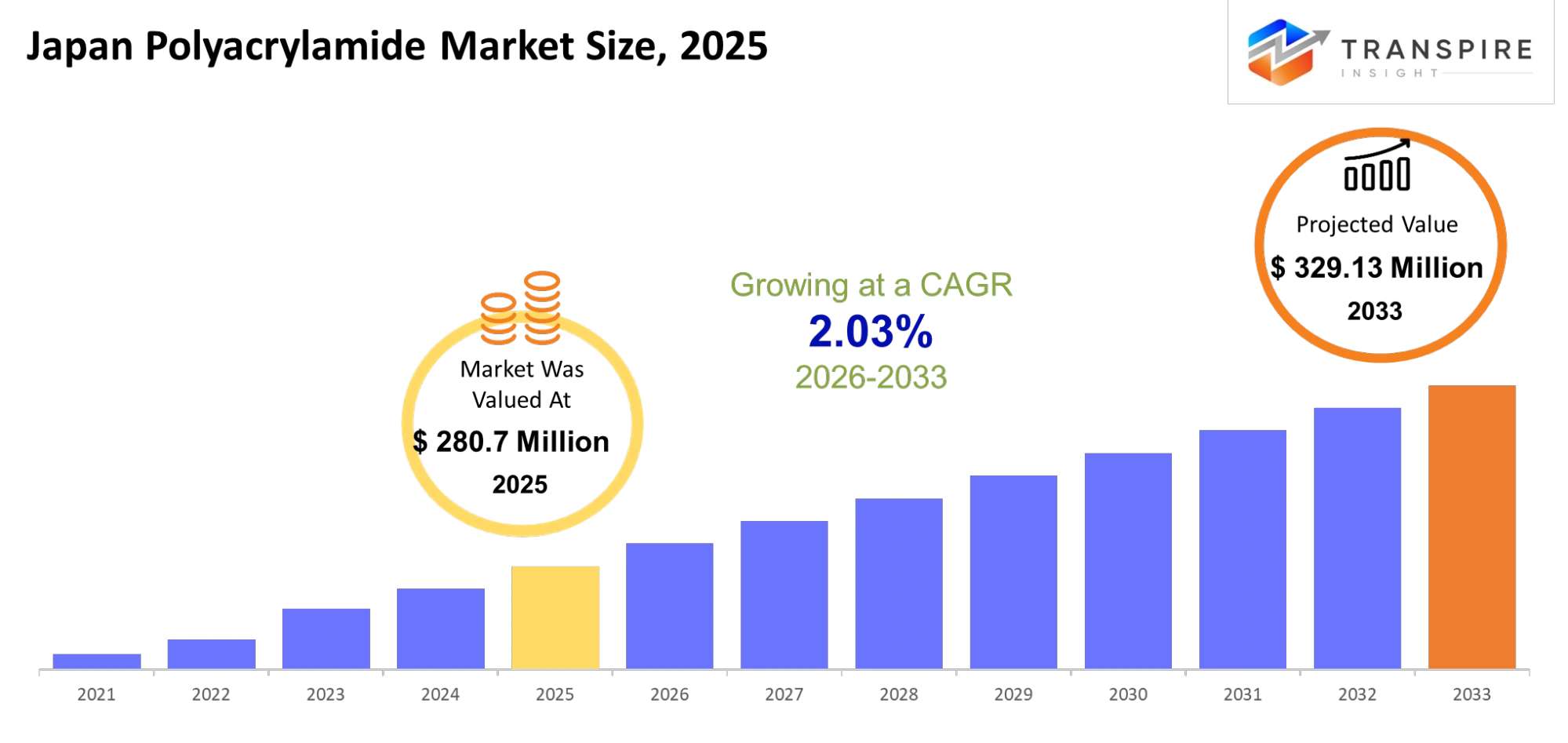
- Japan Polyacrylamide Market Size 2025: USD 280.7 Million
- Japan Polyacrylamide Market Size 2033: USD 329.13 Million
- Japan Polyacrylamide Market CAGR: 2.03%
- Japan Polyacrylamide Market Segments: By Type (Anionic, Cationic, Non-ionic, Others); By Application (Water Treatment, Oil & Gas, Paper Making, Mining, Others); By End-User (Municipal Sector, Oil & Gas Industry, Paper Industry, Mining Industry, Others); By Form (Powder, Liquid, Gel, Others)
To learn more about this report,  Download Free Sample Report
Japan Polyacrylamide Market Summary:
The Japan Polyacrylamide Market size is estimated at USD 280.7 Million in 2025 and is anticipated to reach USD 329.13 Million by 2033, growing at a CAGR of 2.03% from 2026 to 2033.
The specialty chemicals industry includes Japan's polyacrylamide market, which serves three main applications, water treatment, paper processing, and oil recovery. Japan’s strong environmental responsibility and resource efficiency efforts will be demonstrated through this upcoming project.The necessity for advanced treatment systems will grow because industries need to use high-performance flocculants to meet stricter wastewater treatment requirements which result from their outdated facilities. The growing consumer understanding of sustainability will determine how organizations make purchasing decisions because it encourages environmentally friendly manufacturing methods and decreases harmful chemical waste.
The market will develop through ongoing advancements in polymer engineering and process optimization. Manufacturers will create better formulations which improve their products' solubility and performance across different environmental conditions. The industry will adopt automation and precise dosing systems because they help decrease waste while maintaining product quality. Companies will face increasing regulatory requirements which compel them to meet safety and environmental standards while they operate within a cost-effective framework of high-quality industrial operations.
What Has the Impact of Artificial Intelligence Been on the Japan Polyacrylamide Market?
Artificial intelligence is instantly transforming industrial value chains which creates major effects for the Japan Polyacrylamide Market. The AI technology used in Japan Polyacrylamide Market operations enables researchers to conduct market studies and analyze data because it can process extensive information at faster speeds and higher precision. Companies utilize machine learning and predictive analytics to identify demand patterns across sectors which includes water treatment and oil recovery. This shift is also improving the ability to anticipate regulatory changes and customer requirements which supports more strategic planning.
Japan Polyacrylamide Market production uses artificial intelligence to achieve better operational results through advanced robotic systems and process efficiency improvements. Manufacturers use AI systems to watch chemical processes which helps them cut expenses while achieving uniform product standards. The new changes help companies decrease their operating expenses while they boost their manufacturing dependability. AI-powered supply chain optimization systems enable businesses to enhance their management of raw materials and inventory and their logistics operations which leads to quicker business processes and better customer satisfaction across the Japanese Polyacrylamide Market.
Key Market Trends & Insights:
- The Japan Polyacrylamide Market experiences steady growth because wastewater treatment regulations become more stringent and industrial requirements from chemical and oil processing sectors increase.
- The Kanto region leads the market by obtaining approximately 35% of total market share during 2024. The Kansai region will see the fastest growth until 2030 because of its industrial development activities.
- Anionic polyacrylamide leads the market with approximately 45% market share during 2024 while cationic variants follow behind; non-ionic variants will experience the fastest growing demand between 2025 and 2030.
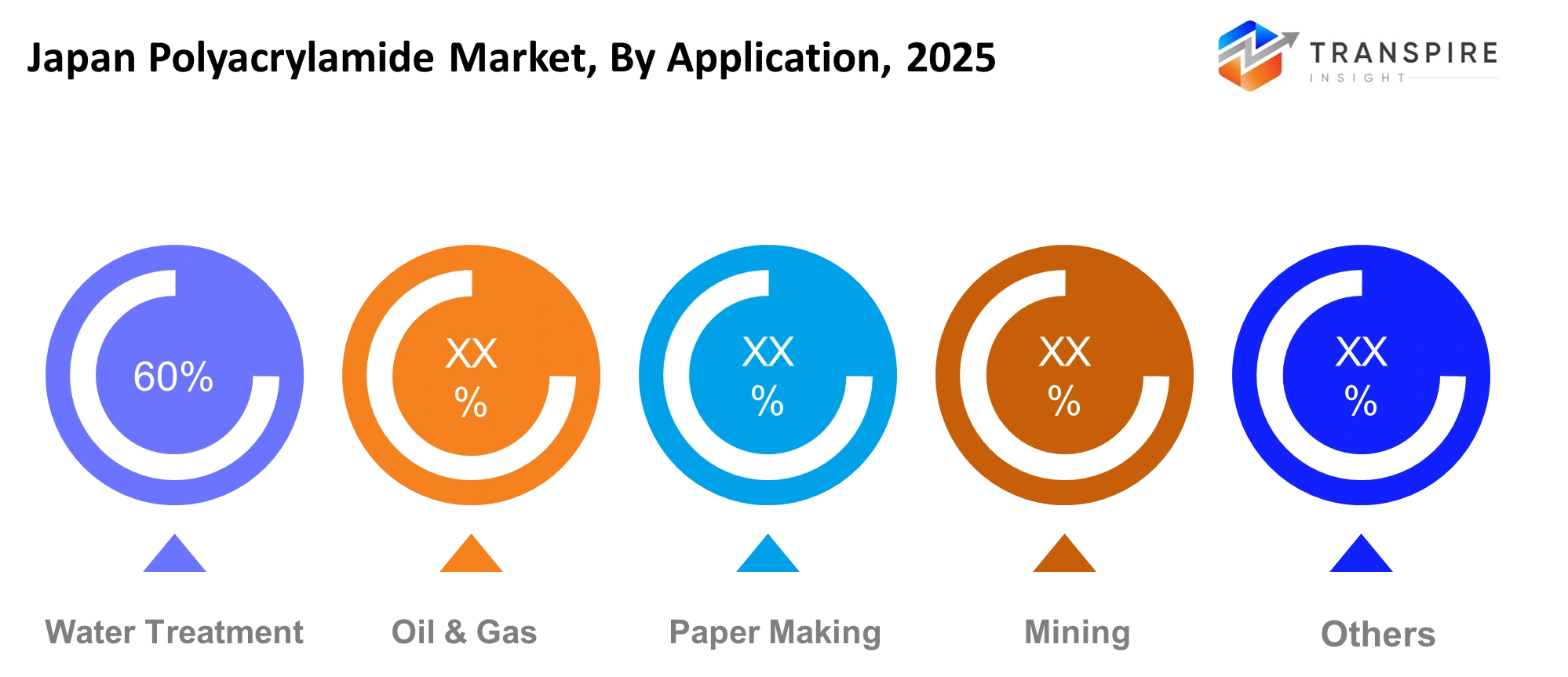
- Water treatment leads the Japan Polyacrylamide Market application distribution with more than 50% market share during 2024. Enhanced oil recovery shows the fastest growth among application segments in the Japan Polyacrylamide Market.
- Municipal water treatment occupies a major market share above 40% while the pulp and paper industry represents the fastest expanding end-user segment until 2030.
- The Japan Polyacrylamide Market operates under control of major companies including SNF Group and Kemira and BASF and Mitsubishi Chemical Group and Sumitomo Seika Chemicals.
- The companies are pursuing market share growth and improved competitiveness through two main strategies which involve developing new products and establishing partnerships and expanding their operations to new markets.
- The Japan Polyacrylamide Market benefits from technology improvements which include AI-based process optimization and intelligent automation because they enhance production efficiency while enabling businesses to decrease their expenses.
Japan Polyacrylamide Market Segmentation
By Type :
The Japan Polyacrylamide Market presents multiple types which demonstrate different charge characteristics that impact industrial performance. Anionic variants find wide use in water treatment and mineral processing due to strong particle binding ability, while cationic types support sludge dewatering and wastewater clarification through effective interaction with negatively charged particles. Non-ionic variants serve applications requiring neutral behavior, especially in textile and paper processing where balanced reactions are necessary.
Specialty formulations which exist for industrial applications develop specific viscosity and reactivity control. The market demand pattern displays consistent preference for anionic and cationic grades because of their wide industrial applicability, whereas non-ionic and other products maintain constant demand for particular processes that need chemical control with minimal impact on surrounding substances.
By Application :
The Japan Polyacrylamide Market according to its applications shows strong reliance on water treatment processes which use polyacrylamide for coagulation and flocculation and sedimentation operations. The oil and gas industry depends on enhanced oil recovery methods which use polymer solutions to boost extraction rates. The paper making process experiences advantages through improved fiber bonding and retention which results in higher product quality and lower waste generation.
Polyacrylamide serves mining purposes through solid-liquid separation and tailings control, which helps organizations run efficiently while meeting environmental requirements. Agriculture and textile processing use controlled water absorption and stabilization properties for their applications. Industrial production and environmental regulations create the primary factors which drive application growth.
To learn more about this report, Download Free Sample Report
By End-User :
The municipal sector leads Japan's Polyacrylamide Market because of current investments in wastewater treatment facilities. The oil and gas sector requires products which enhance recovery rates and boost operational performance. The paper industryuses a fixed amount of resourcesbecause its production process requires specific standards for packaging and printing materials.
The mining industry uses products to support mineral extraction and waste handling, which creates a constant need for these products. The chemical processing and agriculture sectors use polyacrylamide for soil conditioning and process optimization as part of their operations. The demand from different end-users shows stable industrial operations which need to comply with environmental protection laws.
By Form :
The Japan Polyacrylamide Market distribution by form shows that powder form has become the top choice because it provides easier storage solutions and extended product durability and lower shipping costs.The product's liquid state enables straightforward processing because its rapid dissolution property makes it suitable for industries that need to operate at high speeds. The gel form of the product enables specific applications that need both controlled release mechanisms and high viscosity levels.
The three product forms provide different benefits to users, who will select between them based on their operational needs. The powder form serves industrial applications which process high volume operations. The liquid and gel products continue to be used in applications which need instant product availability or specific texture requirements.
What are the Main Challenges for the Japan Polyacrylamide Market Growth?
The Japan Polyacrylamide Market encounters multiple technical and operational obstacles which restrict its development potential. Product stability and performance consistency remain key issues, because environmental conditions change with different temperature and pH levels during water treatment operations.
The production process faces multiple hazards because of complex polymerization methods and quality control standards, which require manufacturers to rely on acrylamide raw materials that create supply chain risks. The operational challenges which exist within the Japan Polyacrylamide Market create operational inefficiencies, which prevent manufacturers from scaling operations to meet increasing market demand.
Existing manufacturing obstacles and commercialization challenges generate additional restrictions for the Japan Polyacrylamide Market. Chemical companies face rising operational expenses because they need to spend money for ongoing chemical safety compliance and environmental impact assessment needs.
The production process needs to consume large amounts of energy while it proceeds through multiple complex procedures, which leads to higher production costs and reduced profit margins.The Japan Polyacrylamide Market faces growth obstacles because of product approval delays and commercialization setbacks, which impact companies that aim to launch advanced or eco-friendly products.
The market expansion process experiences a major delay because of two factors which include adoption challenges and infrastructure limitations. The industry suffers from operational difficulties because there are not enough skilled workers who can operate advanced polymer technologies.
Smaller enterprises face difficulties because they lack sufficient funds to purchase high-performance polyacrylamide solutions. The Japanese Polyacrylamide Market experiences market restrictions because different industrial sectors show inconsistent product adoption patterns which result from uneven infrastructure development.
Country Insights
The Japan Polyacrylamide Market experiences consistent expansion because of both industrial needs and ongoing investments in water treatment facilities. The increased emphasis on clean drinking water and proper wastewater treatment has led to the use of polyacrylamide in both municipal and industrial applications. The market continues to grow because paper manufacturing and chemical processing industries maintain their demand for products which they have used consistently during the past years.
The Japan Polyacrylamide Market benefits from its developed infrastructure and its enforcement of environmental rules which promote effective water treatment methods. Government policies promote sustainable industrial operations, leading to steady adoption of treatment chemicals. Industrial clusters in urban areas create constant product need, while technological advancements enable organizations to sustain their product standards and operational performance across various uses.
The Japan Polyacrylamide Market shows strong local production through its numerous domestic manufacturers and its research-based companies that focus on developing new products and enhancing existing ones. Ongoing polymer technology advancements lead to improved efficiency in flocculation and separation operations. The market position grows through export activities and global partnerships which create stable development from both domestic market and international trade demand.
Recent Development News
In March 2026, Shiva Performance Materials publicized their technology licensing partnership with Mitsui Chemicals. The company obtained exclusive access to advanced toner-binding resin technology from Mitsui Chemicals which enables them to maintain high-performance polymer materials that connect to acrylamide derivatives used in their polyacrylamide production process.
Source https://www.chemicalweekly.com/
In April 2026,Japan's Ministry of Economy Trade and Industry started new regulations which affect chemical production processes. The Japanese government which includes the Ministry of Economy Trade and Industry opened public consultation to discuss proposed changes to chemical substance regulations under CSCL which will impact production and handling of polymers like polyacrylamide and its intermediate materials.
Source https://enviliance.com/
|
Report Metrics |
Details |
|
Market size value in 2025 |
USD 280.7 Million |
|
Market size value in 2026 |
USD 286.03 Million |
|
Revenue forecast in 2033 |
USD 329.13 Million |
|
Growth rate |
CAGR of 2.03% from 2026 to 2033 |
|
Base year |
2025 |
|
Historical data |
2021 - 2024 |
|
Forecast period |
2026 - 2033 |
|
Report coverage |
Revenue forecast, competitive landscape, growth factors, and trends |
|
Country scope |
Japan |
|
Key company profiled |
BASF, SNF Group, Kemira, Solenis, Ashland, Dow, Mitsubishi Chemical, Kuraray, Sumitomo Chemical, Nippon Shokubai, Arkema, LG Chem, PetroChina, Anhui Jucheng, Black Rose Industries |
|
Customization scope |
Free report customization (country, regional & segment scope). Avail customized purchase options to meet your exact research needs. |
|
Report Segmentation |
By Type (Anionic, Cationic, Non-ionic, Others); By Application (Water Treatment, Oil & Gas, Paper Making, Mining, Others); By End-User (Municipal Sector, Oil & Gas Industry, Paper Industry, Mining Industry, Others); By Form (Powder, Liquid, Gel, Others) |
How Can New Companies Establish a Strong Foothold in the Japan Polyacrylamide Market?
New entrants can build a strong position in the Japan Polyacrylamide Market by targeting niche, high-growth applications and aligning offerings with evolving industry trends. Specialized market companies which focus on advanced wastewater treatment for smart cities and high-performance polymers for electronics manufacturing will achieve market success because they operate in areas with no direct competition from established competitors. New companies can establish distinct market value through their solutions which solve specific industry challenges of sludge reduction efficiency and flocculation performance enhancement in the Japan Polyacrylamide Market.
Innovation strategies serve as essential components for achieving success within the Japan Polyacrylamide Market. Startups that invest in eco-friendly and biodegradable polyacrylamide formulations will satisfy the increasing demand for environmental compliance and sustainable practices. Digital tools which include AI-driven process optimization and predictive analytics enable organizations to improve their product quality and operational efficiency.
AquaPolyTech which operates as an emerging company develops low-toxicity flocculants for municipal water systems while GreenFloc Solutions creates bio-based flocculants which provide solutions for industrial wastewater treatment. The two methods demonstrate how innovation enables market expansion while establishing unique business advantages.
The establishment of strategic partnerships together with regional business development initiatives creates stronger market entry pathways. New market entrants establish their business operations through partnerships with local distributors and engineering companies and government entities which help them meet regulatory obligations while speeding up their market launch activities.
The establishment of local production facilities and supply chain networks enables organizations to decrease operational expenses while enhancing their ability to respond to demands. Companies achieve sustainable market presence in the Japan Polyacrylamide Market through their ability to combine niche market strategies with technological innovation and their establishment of strong business partnerships which enables them to access growing demand in the market.
Key Japan Polyacrylamide Market Company Insights
Japan's polyacrylamide market experiences continuous development because water treatment and paper processing and oil recovery activities create increased demand for the product. The industrial sector requires efficient flocculants because both environmental regulations and industrial growth create a need for better performance. The combination of dependable infrastructure and our commitment to wastewater recycling will maintain consumption levels which will be driven by both industrial and municipal needs.
The increasing levels of urban development together with higher industrial waste outputs will lead to greater adoption of polyacrylamide for use in purification systems. The paper and pulp sector will also maintain demand due to quality improvement needs. Market participants will focus on product efficiency and cost balance to remain competitive, while regulatory compliance will remain a key influencing factor.
The market outlook displays established domestic manufacturers who operate alongside international suppliers. Companies will establish their market position through their product quality and pricing and distribution networks. The implementation of strategic partnerships together with reliable supply chains will help companies achieve sustainable development, while the development of environmentally friendly products will help them stand out from their competitors.
Company List
- BASF
- SNF Group
- Kemira
- Solenis
- Ashland
- Dow
- Mitsubishi Chemical
- Kuraray
- Sumitomo Chemical
- Nippon Shokubai
- Arkema
- LG Chem
- PetroChina
- Anhui Jucheng
- Black Rose Industries
What are the Key Use-Cases Driving the Growth of Japan Polyacrylamide Market?
The Japan Polyacrylamide Market shows continuous growth because wastewater treatment operations require polyacrylamide as their main operational material. The municipal and industrial sectors use polyacrylamide to achieve effective flocculation, which enables them to separate solids from liquids more quickly while improving their water treatment results. The increasing need for water reuse and discharge compliance regulations drives market expansion because this application has become essential to the Japan Polyacrylamide Market.Smart water management systems now utilize advanced polymer solutions to improve treatment efficiency while decreasing their operational expenses.
Enhanced oil recovery (EOR) stands as another significant market driver for the Japan Polyacrylamide Market within the energy industry. The oil industry employs polyacrylamide for better reservoir sweep efficiency, which allows them to extract more oil from aging oil fields. This application enables energy optimization methods while extending the operational life of current resources. The pulp and paper industry utilizes polyacrylamide to enhance the strength of paper products which improves drainage efficiency and results in increased productivity with reduced waste output.
The market potential for manufacturing and electronics applications continues to grow through new application development. The fields of precision cleaning and chemical processing now use polyacrylamide as a required material because these industries need both steady performance and exacting standards. Companies have possibilities to create sustainable products that provide superior performance through the development of eco-friendly and high-performance variants which address specific industry demands. The Japan Polyacrylamide Market experiences increased market acceptance together with sustainable growth because various industries require multiple different applications.
Japan Polyacrylamide Market Report Segmentation
By Type
- Anionic
- Cationic
- Non-ionic
By Application
- Water Treatment
- Oil & Gas
- Paper Making
- Mining
By End-User
- Municipal Sector
- Oil & Gas Industry
- Paper Industry
- Mining Industry
By Form
- Powder
- Liquid
- Gel
Frequently Asked Questions
Find quick answers to common questions.
The approximate Japan Polyacrylamide Market size for the market will be USD 329.13 Million in 2033.
Key segments for the Japan Polyacrylamide Market are By Type (Anionic, Cationic, Non-ionic, Others); By Application (Water Treatment, Oil & Gas, Paper Making, Mining, Others); By End-User (Municipal Sector, Oil & Gas Industry, Paper Industry, Mining Industry, Others); By Form (Powder, Liquid, Gel, Others).
Major Japan Polyacrylamide Market players are BASF, SNF Group, Kemira, Solenis, Ashland, Dow, Mitsubishi Chemical, Kuraray, Sumitomo Chemical, Nippon Shokubai, Arkema, LG Chem, PetroChina, Anhui Jucheng, Black Rose Industries.
The Japan Polyacrylamide Market size is USD 280.7 Million in 2025.
The Japan Polyacrylamide Market CAGR is 2.03%.
- BASF
- SNF Group
- Kemira
- Solenis
- Ashland
- Dow
- Mitsubishi Chemical
- Kuraray
- Sumitomo Chemical
- Nippon Shokubai
- Arkema
- LG Chem
- PetroChina
- Anhui Jucheng
- Black Rose Industries
Recently Published Reports
-
Apr 2026
Healthcare Polymer Packaging Market
Healthcare Polymer Packaging Market Size, Share & Analysis Report By Packaging Type (Syringes, IV Bottles and Pouches, Clamshells, Blisters, Bottles & Jars, Containers, Tubes, IV Parental Packaging, Others), By Type (Regulated, Non-regulated), By Polymer Type (LDPE (Low-Density Polyethylene), HDPE (High-Density Polyethylene), Homo-polymer (Homo), Random Copolymer (Random), Block Copolymer (Block), PET, Polystyrene, Polyvinyl Chloride, Polyamide/EVOH, Others), and Geography (North America, Europe, Asia-Pacific, Middle East and Africa, South and Central America), 2021 - 2031
-
Apr 2026
Hydrophilic Tape (Waterstop) Market
Hydrophilic Tape (Waterstop) Market Size, Share & Analysis Report By Type (Bentonite-Based Hydrophilic Tape, Rubber-Based Hydrophilic Tape), By Application (Residential Buildings, Commercial Buildings, Infrastructure Projects), and Geography (North America, Europe, Asia-Pacific, Middle East and Africa, South and Central America), 2021 - 2031
-
Apr 2026
Metalens Market
Metalens Market Size, Share & Analysis Report By Type (Visible Light Metalens, and Infrared Metalens), By Application (Consumer Electronics, Automotive Electronics, Industrial, Medical, and Others), and Geography (North America, Europe, Asia-Pacific, Middle East and Africa, South and Central America), 2021 - 2031
-
Apr 2026
PBT Resin Market
PBT Resin Market Size, Share & Analysis Report By Type (Reinforced PBT Resin, Unreinforced PBT Resin), By Processing Method (Injection Molding, Extrusion, Blow Molding, Others), By End-User (Automotive, Electrical & Electronics, Consumer Appliances, Industrial Machinery, Medical Devices, Packaging, Others), and Geography (North America, Europe, Asia-Pacific, Middle East and Africa, South and Central America), 2021 - 2031