

Japan Multifocal Intraocular Lens (IOL) Market Size & Forecast:
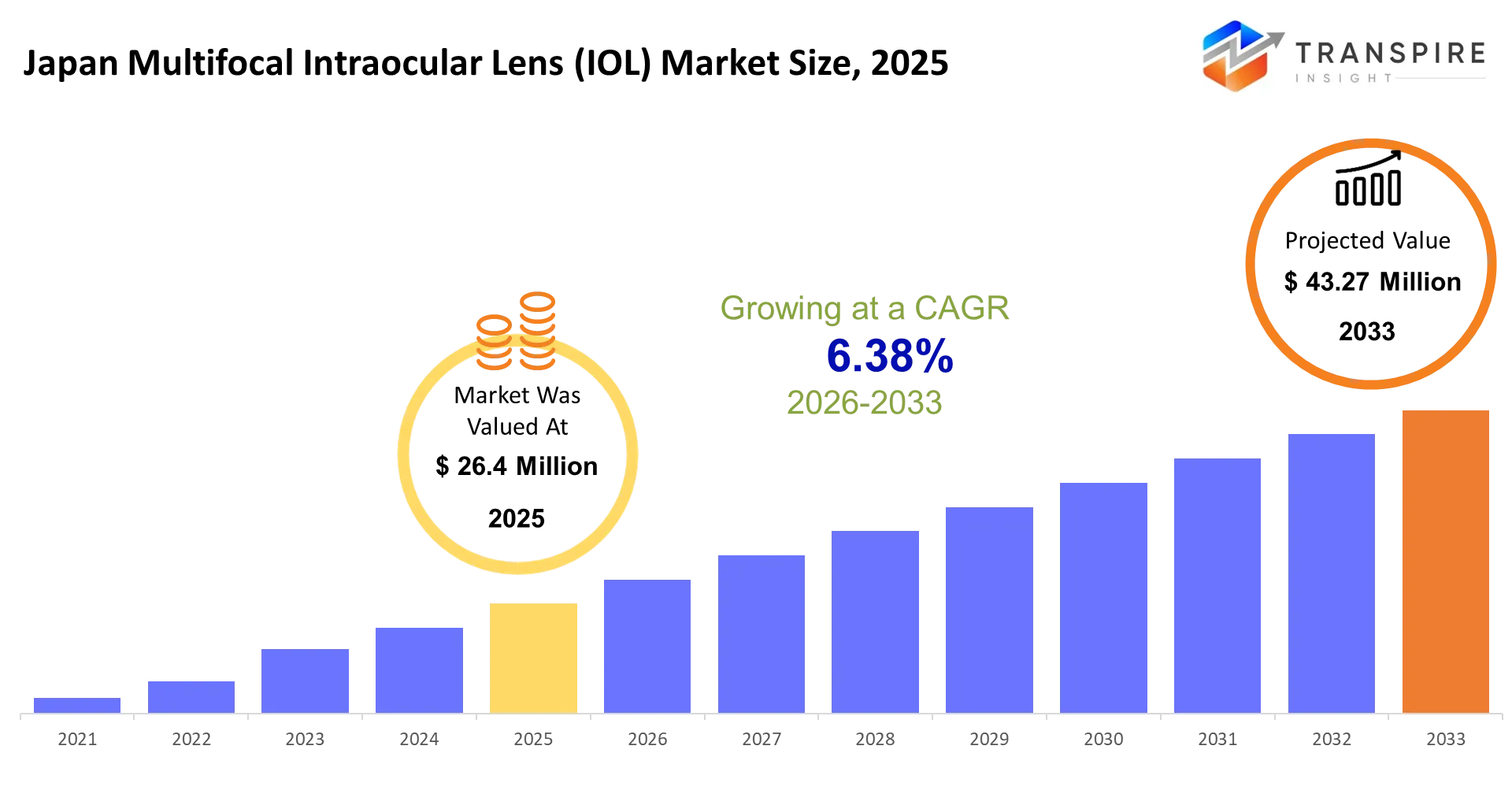
- Japan Multifocal Intraocular Lens (IOL) Market Size 2025: USD 26.4 Million
- Japan Multifocal Intraocular Lens (IOL) Market Size 2033: USD 43.27 Million
- Japan Multifocal Intraocular Lens (IOL) Market CAGR: 6.38%
- Japan Multifocal Intraocular Lens (IOL) Market Segments: By Type (Diffractive IOL, Refractive IOL, Hybrid IOL, Others); By Application (Cataract Surgery, Vision Correction, Others); By End-User (Hospitals, Eye Clinics, Ophthalmology Centers, Others); By Material (Hydrophobic Acrylic, Hydrophilic Acrylic, Silicone, Others)
To learn more about this report,  Download Free Sample Report
Japan Multifocal Intraocular Lens (IOL) Market Summary:
The Japan Multifocal Intraocular Lens (IOL) Market size is estimated at USD 26.4 Million in 2025 and is anticipated to reach USD 43.27 Million by 2033, growing at a CAGR of 6.38% from 2026 to 2033.
The Japan multifocal intraocular lens IOL market will maintain its market presence within the Japanese ophthalmic medical device sector because cataract treatment now uses premium vision correction technologies which doctors create for active aging patients. Patients will seek lenses that offer clearer intermediate and near vision without heavy dependence on spectacles, which will force clinics to change their recommended surgical procedures. Urban consumers, especially those with demanding digital lifestyles, will place greater value on visual comfort across screens and daily mobility, which will drive their buying decisions for private ophthalmology centers.
Manufacturers will create better optical designs which will produce clearer vision while their anti-glare technology and their lens materials will provide easier surgical implantation. Japan's regulatory system will enforce rigorous product evaluation requirements which will drive companies to make continuous improvements until their products reach market readiness. The majority of surgeons will choose devices which come with extensive clinical research findings and data about patient satisfaction after surgery. The market will show a strong demand for personalized visual correction solutions which combine advanced technology with solutions that enhance visual performance and overall life experience.
What Has the Impact of Artificial Intelligence Been on the Japan Multifocal Intraocular Lens (IOL) Market?
Artificial intelligence is currently driving major changes in healthcare technology while its impact on Japan's multifocal intraocular lens (IOL) market grows because ophthalmic manufacturers and care providers are beginning to use digital solutions. The AI-driven market research and predictive analytics tools enable companies in the Japan multifocal intraocular lens (IOL) market to analyze extensive datasets which contain information about cataract surgery volumes and patient demographics and their post-operative results.
The Japan Multifocal Intraocular Lens (IOL) Market stakeholders use this system to track emerging market trends which helps them decide product placement and investment choices based on data analysis. Machine learning models improve demand forecasting capabilities by providing precise predictions about upcoming consumer trends for high-end vision correction products.
Artificial intelligence implementation in Japan's Multifocal Intraocular Lens (IOL) Market manufacturing process has resulted in better production accuracy through intelligent automation systems which include ongoing production quality assessment. AI-based process optimization methods decrease material waste while producing consistent lens products which lead to lower business expenses and higher profits for manufacturers in the Japan multifocal intraocular lens (IOL) market.
AI-powered supply chain optimization tools help businesses manage their procurement processes while maintaining efficient inventory management and distribution operations which leads to quicker availability of products throughout Japan's expanding ophthalmology network.
The Japan Multifocal Intraocular Lens (IOL) Market uses artificial intelligence technology to create operational efficiency and develop personalized lens designs which improve patient result predictions. Artificial intelligence in Japan Multifocal Intraocular Lens (IOL) Market applications enables surgeons and manufacturers to better match lens specifications with individual visual needs, improving patient satisfaction and strengthening competitive advantage. The Japan Multifocal Intraocular Lens (IOL) Market will experience growth through ongoing artificial intelligence development which enhances precise and scalable operations while establishing permanent market growth.
Key Market Trends & Insights:
- The Kanto region controls the Japan multifocal intraocular lens market because it serves 38% of the market in 2025 through its modern ophthalmology facilities.
- The Kansai region has emerged as the fastest-growing area which will experience 7.9% annual growth between 2026 and 2032 because of the rising number of specialty eye care facilities.
- The urban healthcare clusters maintain their strong market position because patients become more aware about premium refractive cataract procedures which they can access.
- Trifocal multifocal IOLs dominate the market because they provide better vision correction for near, intermediate, and distance viewing, which enables them to capture 46% market share.
- Bifocal lenses hold the second-largest share, benefiting from affordability and established clinical acceptance in the japan multifocal intraocular lens (iol) market.
- The market for Extended depth-of-focus (EDOF) lenses will reach an annual growth rate of 8.4% until 2032.
- The Japan Multifocal Intraocular Lens (IOL) Market will receive its highest revenue from cataract surgery applications which will account for approximately 72% of total revenue in 2025.
- The growing elderly population demands refractive lens exchange because they want to achieve premium independence from glasses.
- The specialized ophthalmology hospitals lead the market with their advanced surgical capabilities which provide them with approximately 55% market share.
- The main industry competitors in the market are Alcon, Johnson & Johnson Vision, HOYA Corporation, Bausch + Lomb, Carl Zeiss Meditec, and Rayner.
Japan Multifocal Intraocular Lens (IOL) Market Segmentation
By Type:
The diffractive IOL segment maintains a strong position in the Japan Multifocal Intraocular Lens IOL Market because advanced cataract procedures have developed into standard practice for this technology. The technology distributes light with accurate precision which enables users to see clearly at both short and long distances, thus providing an effective solution for people who want to depend less on eyeglasses. Product development efforts by manufacturers will result in increased usage of their products across different medical settings.
The refractive IOL segment continues to attract attention due to optical design flexibility and suitability for selected patient groups. The Hybrid IOL system which merges different optical methods has gained popularity because it enhances visual results. New lens designs in the others category provide special vision correction solutions which enable Japanese patients to access more treatment alternatives through the Japan Multifocal Intraocular Lens IOL Market.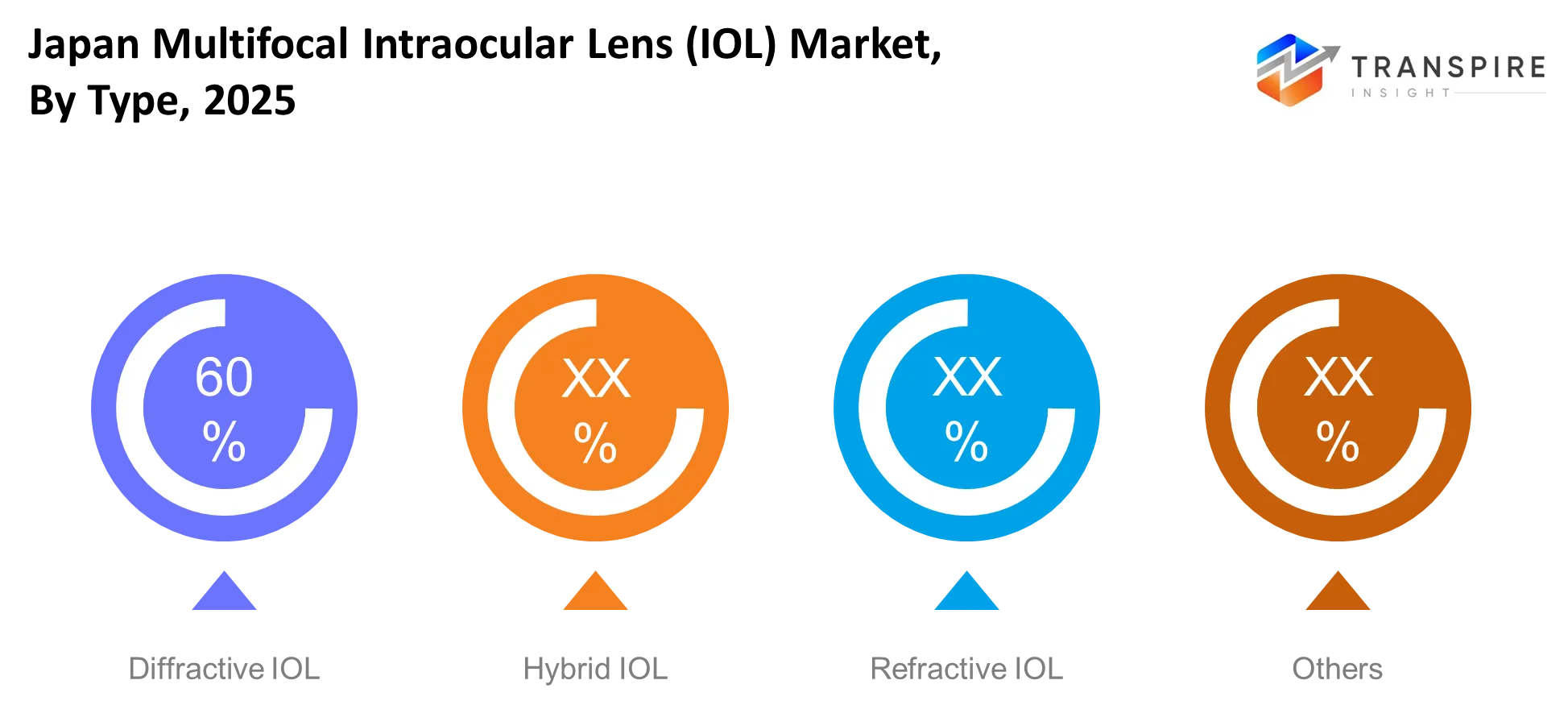
To learn more about this report, Download Free Sample Report
By Application:
The Japan Multifocal Intraocular Lens (IOL) Market shows its highest usage in cataract surgery because of increased surgical procedures resulting from the growing elderly population. The market demand exists because people now understand how advanced lens implantation improves their vision after surgery while decreasing their need for corrective eyewear.
The number of people who seek vision correction solutions continues to rise because they want to treat presbyopia and related conditions through elective procedures. The other segment includes specialized ophthalmic procedures where multifocal lenses are selected for complex visual restoration requirements. The market will experience a growing application range because of improved surgical accuracy and better diagnostic technology.
By End-User:
Your training extends until October of the year 2023. The Japan Multifocal Intraocular Lens IOL Market shows substantial hospital presence which results from their capability to operate advanced surgical facilities together with their staff of highly trained ophthalmology professionals. The need for hospitals to operate multifocal lens implantation procedures together with their responsibility for handling high patient volumes makes them essential to the implementation of new ophthalmic technologies.
Specialized outpatient services drive rapid growth in eye clinics and ophthalmology centers which now operate as dedicated treatment facilities. Patients now prefer lens implantation procedures at these facilities because they offer specialized expertise and faster treatment and greater convenience. The other category includes ambulatory surgical units that contribute to procedural accessibility across regional healthcare networks.
By Material:
The Japan Multifocal Intraocular Lens (IOL) Market selects hydrophobic acrylic as its primary material because this material exhibits excellent biocompatibility and long-lasting durability and it results in fewer postoperative complications which include lens opacification. The premium multifocal lens market continues to utilize this technology because it provides stable optical performance and works with minimally invasive implantation procedures.
Surgeons still use hydrophilic acrylic materials because these materials provide them with operational flexibility and they can easily insert the materials during their surgical procedures. Certain clinical requirements need silicone-based lenses which offer both unique optical properties and special structural features. The development of new materials stands as an essential requirement for medical device producers who seek to enhance their products with improved user comfort and sustained visual clarity and complete visual performance for their patients.
What are the Main Challenges for the Japan Multifocal Intraocular Lens (IOL) Market Growth?
The Japan Multifocal Intraocular Lens (IOL) Market faces several technical and operational challenges that continue to affect its growth trajectory. The Japan Multifocal Intraocular Lens (IOL) market faces its main obstacle which restricts its growth because it needs to achieve regular optical results without bringing visual problems which include halos and glare and loss of contrast sensitivity.
The performance restrictions create doubt for both patients and surgeons. The Japan Multifocal Intraocular Lens (IOL) market faces supply chain disruptions which include essential optical materials and cutting-edge manufacturing elements, which result in production delays that restrict market growth. The Japanese market for multifocal intraocular lenses (IOLs) faces manufacturing complexity as its main obstacle which prevents market development. The production of multifocal intraocular lenses (IOLs) needs exacting engineering standards together with quality control measures that meet Japan's medical device certification requirements.
The product launch process faces delays because of the regulatory approval system which requires additional time for completion and manufacturers experience financial stress because of increasing costs for raw materials and operational expenses. The barriers to commercialization drive up product costs which create challenges for Japanese companies that operate in the multifocal intraocular lens (IOL) market because they struggle to compete with their rivals.
Adoption challenges have maintained their status as major obstacles. Patients face barriers to accessing premium cataract solutions because of limited reimbursement options and expensive out-of-pocket expenses. Regional healthcare facilities which serve smaller areas do not possess the necessary ophthalmic equipment and specialized doctors who can perform multifocal lens surgeries. The Japan Multifocal Intraocular Lens Market faces market restrictions because monofocal lenses and extended depth-of-focus lenses serve as cheaper options that require less time for visual recovery. The japan multifocal intraocular lens (iol) market faces permanent growth obstacles because of these factors.
Country Insights
The Japan Multifocal Intraocular Lens IOL Market demonstrates continuous development through the effective operation of ophthalmic care systems found in its primary urban areas. The increasing capacity for cataract treatment at hospitals and specialty eye clinics will expand their operational capacity while advanced diagnostic tools will enable better lens selection. The surgical field will experience increased demand for multifocal lens solutions because medical professionals are adopting precision-based surgical techniques.
The Japan Multifocal Intraocular Lens IOL Market receives operational support from an increasing elderly population which creates continuous demand for cataract surgery and vision restoration procedures. The rising demand for solutions that help people stop using glasses will affect how customers make their purchasing decisions. The increasing understanding of premium intraocular lens advantages among senior citizens will drive market growth through both urban and rural healthcare systems.
The Japan Multifocal Intraocular Lens IOL Market develops through product innovation that creates better visual results and greater comfort for patients. Manufacturers will develop new lens designs because they need to solve problems with contrast sensitivity and visual disruptions. Japanese healthcare professionals have a strong preference for high-quality medical equipment which will lead to more widespread use of advanced multifocal intraocular lenses in the coming years.
Recent Development News
In April 2026, Alcon launched the product. Alcon introduced its Clareon TruPlus enhanced-design monofocal and toric IOLs at ASCRS 2026, strengthening its premium cataract surgery portfolio and reinforcing its competitive positioning in Japan’s advanced IOL segment alongside its multifocal/trifocal PanOptix platform. Source https://investor.alcon.com/
In March 2026, Alcon reported milestone growth. Alcon announced that it had surpassed 175 million IOL implants globally, highlighting continued uptake of Clareon PanOptix Pro, which is already commercially available in Japan and remains a major driver in the country’s multifocal IOL category. Source https://investor.alcon.com/
|
Report Metrics |
Details |
|
Market size value in 2025 |
USD 26.4 Million |
|
Market size value in 2026 |
USD 28.07 Million |
|
Revenue forecast in 2033 |
USD 43.27 Million |
|
Growth rate |
CAGR of 6.38% from 2026 to 2033 |
|
Base year |
2025 |
|
Historical data |
2021 - 2024 |
|
Forecast period |
2026 - 2033 |
|
Report coverage |
Revenue forecast, competitive landscape, growth factors, and trends |
|
Country scope |
Japan |
|
Key company profiled |
Alcon, Johnson & Johnson Vision, Bausch + Lomb, Carl Zeiss Meditec, Hoya, Rayner, STAAR Surgical, Oculentis, Lenstec, PhysIOL, Nidek, Topcon, SIFI, HumanOptics, Ophtec |
|
Customization scope |
Free report customization (country, regional & segment scope). Avail customized purchase options to meet your exact research needs. |
|
Report Segmentation |
By Type (Diffractive IOL, Refractive IOL, Hybrid IOL, Others); By Application (Cataract Surgery, Vision Correction, Others); By End-User (Hospitals, Eye Clinics, Ophthalmology Centers, Others); By Material (Hydrophobic Acrylic, Hydrophilic Acrylic, Silicone, Others) |
How Can New Companies Establish a Strong Foothold in the Japan Multifocal Intraocular Lens (IOL) Market?
New entrants to the Japan Multifocal Intraocular Lens IOL Market need to establish their competitive position through innovative product development and focused market entry approaches. The japan multifocal intraocular lens (iol) market requires businesses to concentrate on specific customer segments because of its specialized nature. Companies can gain traction by developing advanced lens technologies that address persistent clinical concerns such as glare reduction, enhanced intermediate vision, and faster neural adaptation after surgery.
The Japan Multifocal Intraocular Lens IOL Market offers companies a competitive edge through its product development process which matches customer requirements for premium cataract results. The market requires companies to establish strategic partnerships because they serve as essential elements for business development. The emerging companies need to collaborate with academic research centers and specialized surgical facilities and ophthalmology hospitals to test their products and gain professional recognition.
Startups such as AcuFocus have shown how technology-driven innovation can disrupt vision correction markets with their unique optical solutions. The early-stage innovators who use AI-powered lens simulation platforms can enhance their market presence in the japan multifocal intraocular lens (iol) market by providing customized lens selection solutions.
The Japan Multifocal Intraocular Lens (IOL) Market requires companies to use technology differentiation as their main approach for entering the market. The new companies can solve industry challenges through their development of advanced manufacturing systems and automated operations and their creation of surgical planning systems which use data to enhance medical outcomes and reduce manufacturing waste.
The development of regulatory compliance and partnerships with local distributors and training programs for surgeons will support new companies in their efforts to operate within Japan's strict medical device regulations. The Japanese multifocal intraocular lens (iol) market will experience long-term success for companies that use innovative strategies and excel at commercializing their products according to the current trend toward individualized eye care.
Key Japan Multifocal Intraocular Lens (IOL) Market Company Insights
The Japan Multifocal Intraocular Lens (IOL) Market displays intense rivalry between established ophthalmic device manufacturers who specialize in advanced lens development and high-precision optical systems and superior visual solutions. Market participants continue strengthening product portfolios through innovation in lens design, improved material quality, and expanded partnerships with hospitals and specialty eye clinics across Japan.
The market establishes pricing strategies that depend on the premium product positioning and the preferences of surgeons and the increasing demand for cataract treatments that require less eyewear usage. The market competition shows how companies prioritize their clinical research efforts and regulatory approval processes and surgeon education initiatives which lead to technology-based product differences and established brand identities.
Company List
- Alcon
- Johnson & Johnson Vision
- Bausch + Lomb
- Carl Zeiss Meditec
- Hoya
- Rayner
- STAAR Surgical
- Oculentis
- Lenstec
- PhysIOL
- Nidek
- Topcon
- SIFI
- HumanOptics
- Ophtec
What are the Key Use-Cases Driving the Growth of Japan's Multifocal Intraocular Lens (IOL) Market?
The Japan Multifocal Intraocular Lens IOL Market experiences its main expansion through premium cataract surgery which enables patients to achieve better vision results after their treatment. The cataract treatment market in Japan experiences growth because elderly people need advanced lens implants which help them see better without needing glasses. The Japan multifocal intraocular lens iol market has experienced enhanced growth because healthcare providers now select technologies which produce better visual results and maintain patient satisfaction throughout their entire life.
The Japan Multifocal Intraocular Lens IOL Market experiences its second main growth driver through refractive lens exchange procedures which middle-aged and elderly patients use to achieve their desired vision correction. Patients with active professional and personal routines are increasingly opting for multifocal lenses to achieve spectacle independence for reading, digital device usage, and distance vision. The Japan multifocal intraocular lens iol market uses this use-case to develop trifocal and extended depth-of-focus lenses which improve visual accuracy.
Advanced ophthalmic research and AI-assisted preoperative diagnostics also represent critical applications which support the Japan Multifocal Intraocular Lens IOL Market. The hospitals and surgical centers use digital imaging together with predictive analytics to enhance lens selection accuracy and develop personalized treatment plans. The japan multifocal intraocular lens iol market acquires scalable growth opportunities through these innovations because they decrease surgical differences while improving patient results. The use cases will continue to drive precision healthcare development in Japan which invests in healthcare systems and infrastructure.
Japan Multifocal Intraocular Lens (IOL) Market Report Segmentation
By Type
- Diffractive IOL
- Refractive IOL
- Hybrid IOL
By Application
- Cataract Surgery
- Vision Correction
By End-User
- Hospitals
- Eye Clinics
- Ophthalmology Centers
By Material
- Hydrophobic Acrylic
- Hydrophilic Acrylic
- Silicone
Frequently Asked Questions
Find quick answers to common questions.
The Approximate Japan Multifocal Intraocular Lens (IOL) Market size for the Market will be USD 43.27 Million in 2033.
Key Segments for the Japan Multifocal Intraocular Lens (IOL) Market are By Type (Diffractive IOL, Refractive IOL, Hybrid IOL, Others); By Application (Cataract Surgery, Vision Correction, Others); By End-User (Hospitals, Eye Clinics, Ophthalmology Centers, Others); By Material (Hydrophobic Acrylic, Hydrophilic Acrylic, Silicone, Others).
Major Japan Multifocal Intraocular Lens (IOL) Market players are Alcon, Johnson & Johnson Vision, Bausch + Lomb, Carl Zeiss Meditec, Hoya, Rayner, STAAR Surgical, Oculentis, Lenstec, PhysIOL, Nidek, Topcon, SIFI, HumanOptics, Ophtec.
The Current Japan Multifocal Intraocular Lens (IOL) Market size is USD 26.4 Million in 2025.
The Japan Multifocal Intraocular Lens (IOL) Market CAGR is 6.38%.
- Alcon
- Johnson & Johnson Vision
- Bausch + Lomb
- Carl Zeiss Meditec
- Hoya
- Rayner
- STAAR Surgical
- Oculentis
- Lenstec
- PhysIOL
- Nidek
- Topcon
- SIFI
- HumanOptics
- Ophtec
Recently Published Reports
-
Apr 2026
Biosimilars Market
Biosimilars Market By Product Type (Monoclonal Antibodies, Recombinant Hormones, Erythropoietin, G-CSF, Others), By Indication (Oncology, Autoimmune Diseases, Blood Disorders, Diabetes, Others), By Manufacturing Type (In-House Manufacturing, Contract Manufacturing), By Distribution Channel (Hospital Pharmacies, Retail Pharmacies, Online Pharmacies), By Industry Analysis, Size, Share, Growth, Trends, and Forecasts 2021-2033
-
Apr 2026
Gastrointestinal Endoscopy Market
Gastrointestinal Endoscopy Market By Type (Rigid Gastrointestinal Endoscope, Flexible Gastrointestinal Endoscopes, Disposable Gastrointestinal Endoscope), By Procedure Type (Colonoscopy, Gastroscopy, Duodenoscopy, Enteroscopy, Flexible Sigmoidoscopy, Others), By Application (Diagnosis, Treatment), By End-Users (Hospitals, Ambulatory Surgical Centers, Specialty Clinics, Laboratories, Others), By Industry Analysis, Size, Share, Growth, Trends, and Forecasts 2021-2033
-
Apr 2026
Rare Inherited Metabolic Disorder Drug Market
Rare Inherited Metabolic Disorder Drug Market By Drug Class (Enzyme Replacement Drugs, Gene Therapy Drugs, Substrate Reduction Drugs, Small Module Drugs, Protein Drugs), By Route of Administration(Parenteral, Oral, Intrathecal), By Clinical Development (Marketed Drugs, Late Stage Clinical Phase III, Early Stage Clinical Phase I-II, Preclinical Candidates), By Indication (Lysosomal Storage Disorders, Urea Cycle Disorders, Amino Acid Metabolic Disorders, organic Acidemias, Peroximal Disorders), By Industry Analysis, Size, Share, Growth, Trends, and Forecasts 2021-2033
-
Jan 2026
Pharmaceutical Cleanroom Technology Market
Pharmaceutical Cleanroom Technology Market By Product (Equipment, Consumables, Services); By Cleanroom Type (Standard Cleanrooms, Modular Cleanrooms); By End Use (Pharmaceutical Companies, Biotechnology Companies), By Industry Analysis, Size, Share, Growth, Trends, and Forecasts 2021-2033