

Japan Methylene Diphenyl Di-Isocyanate (MDI) Market Summary:
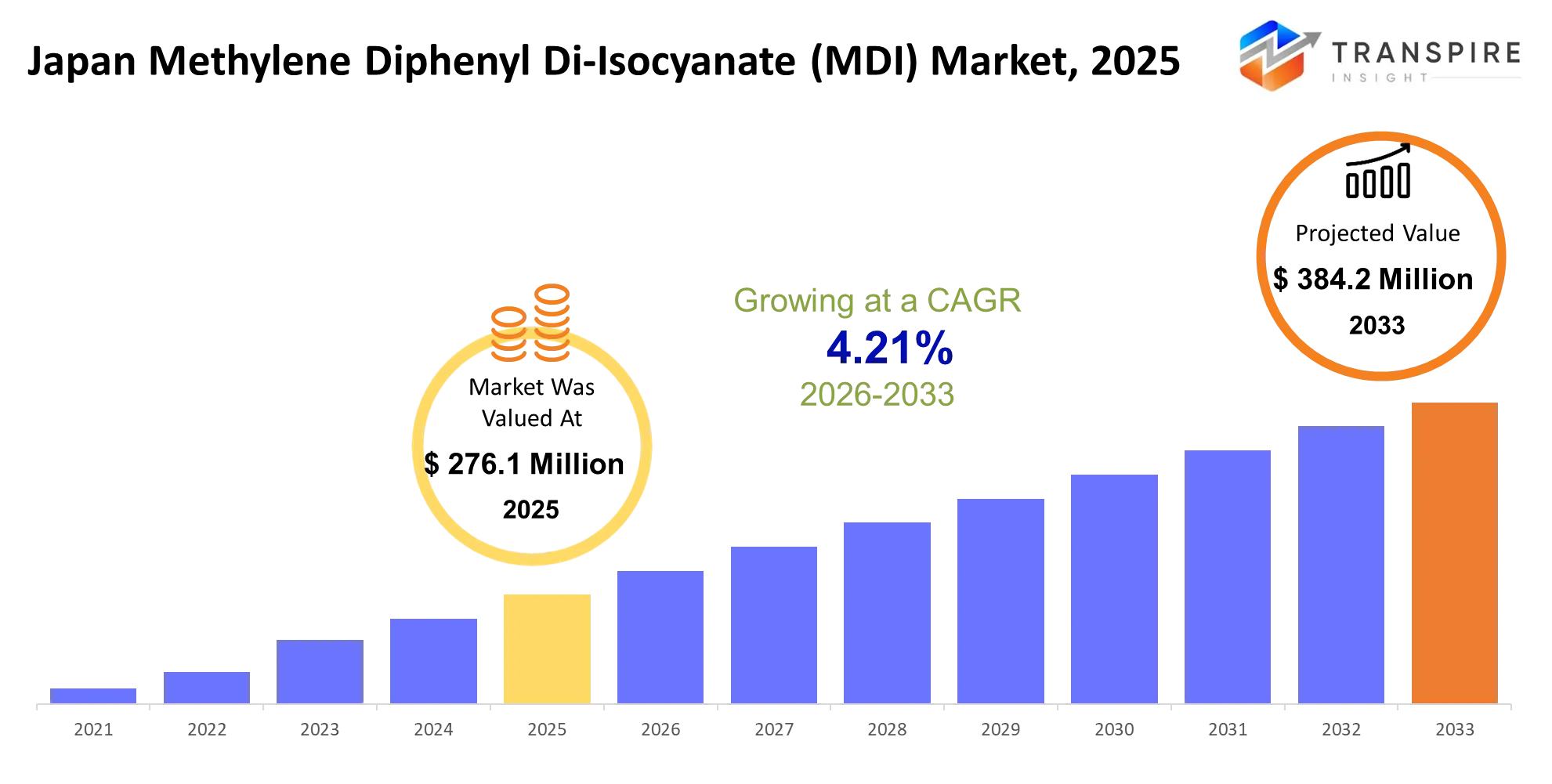
According to Transpire Insight, a detailed research report on the market reflects that the Japan Methylene Diphenyl Di-Isocyanate (MDI) Market was valued at approximately USD 276.1 million in 2025, is expected to reach USD 287.8 million in 2026, and is estimated to reach USD 384.2 million by 2033, expanding at a CAGR of 4.21% during 2026–2033. The market is expected to witness steady growth, driven by increasing demand for MDI-based polyurethane products, expanding industrial applications, technological advancements in production processes, and evolving end-use requirements across Japan.
Market Snapshot
- Market Value (2025): USD 276.1 Million.
- Expected Market Value (2026): USD 287.8 Million.
- Estimated Market Value (2033): USD 384.2 Million.
- Forecast CAGR (2026–2033): 4.21%
Introduction
The Japan Methylene Diphenyl Di-Isocyanate (MDI) Market is a vital component of the specialty chemicals sector, providing the raw material for the manufacture of high-performance polyurethane materials used in diverse end-use industries. MDI is a key chemical building block for rigid and flexible foams, coatings, adhesives, sealants and elastomers that enable applications requiring durability, insulation, light-weight construction and dimensional stability. Japan demand is driven by advanced automotive manufacturing, energy-efficient construction, industrial equipment, refrigeration systems and advanced manufacturing processes. Opportunities for MDI producers and downstream manufacturers are being opened up with the growing use of lightweight materials, improved insulation solutions and performance-oriented polyurethane systems. In Japan's changing industrial and manufacturing scene, MDI's part is still being strengthened by more technological progress in formulation, processing efficiency and material performance.
Key Market Highlights: -
- By Type, the Polymeric MDI dominated the market and holds approximately 30% share in 2025 and is projected to grow at a substantial CAGR during the forecast period.
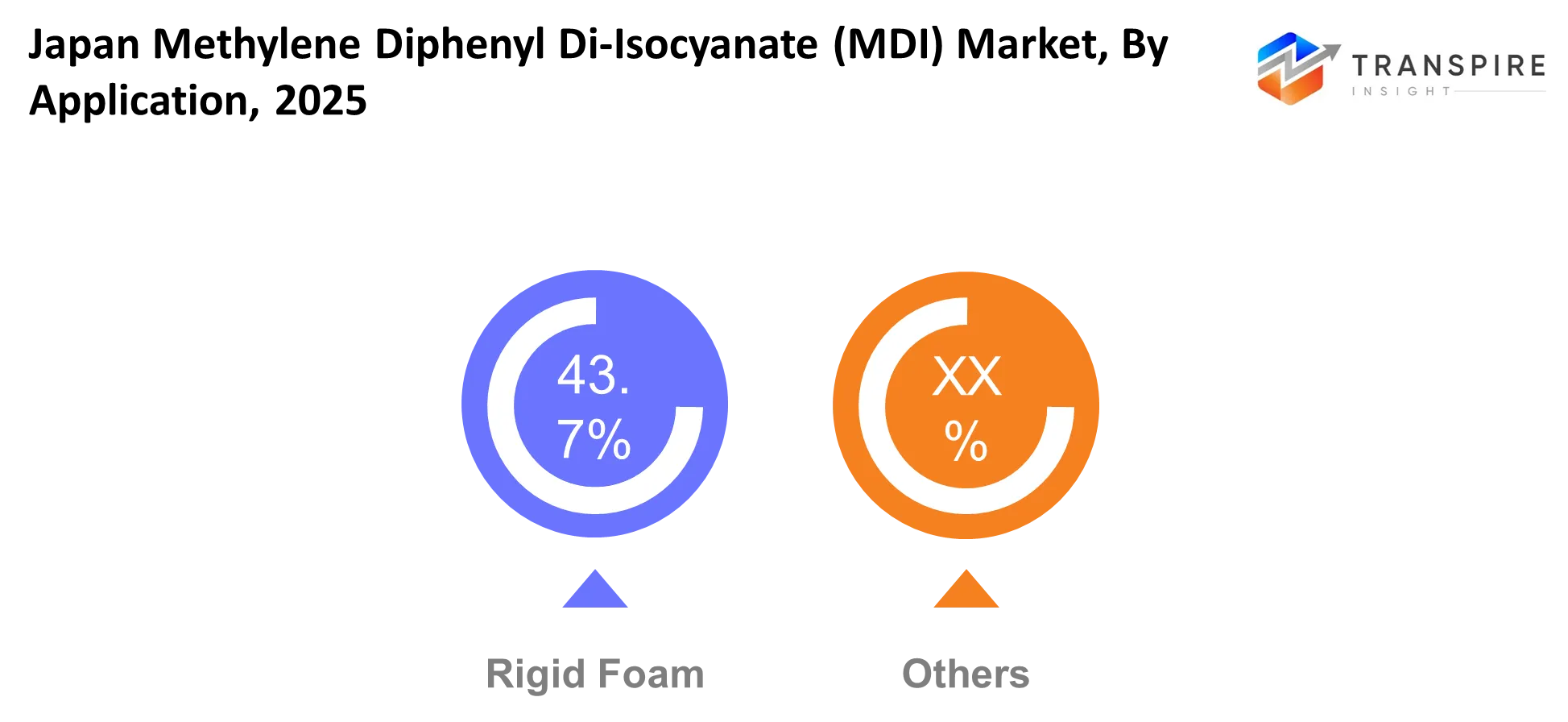
- By Application, the foams segment dominated the market and holds approximately 33% share in 2025 and is projected to grow at a substantial CAGR during the forecast period.
- By End User, the Building & ConstructionManufacturers segment dominated the market and holds approximately 30% share in 2025 and is projected to grow at a substantial CAGR during the forecast period.
- Japan’s MDI market is shaped by stringent chemical safety regulations, eco-friendly polyurethane production, high automation levels, and growing demand for high-performance insulation and lightweight materials in the automotive and construction industries.
How is Technology Driving Growth in the Japan Methylene Diphenyl Di-Isocyanate (MDI) Market?
The Japan Methylene Diphenyl Di-Isocyanate (MDI) Market is driven by technology as advanced manufacturing, polymer innovation and digital process optimization. Automated production systems increase operational efficiency, consistent quality and safety in the workplace, and Industry 4.0 technologies enable predictive maintenance and resource management. New developments in the formulation of polyurethanes are enabling manufacturers to create high-performance rigid foams, adhesives, coatings and elastomers which offer better insulation and durability. The demand for MDI-based materials is also driven by energy efficient construction and refrigeration applications. Specialized polyurethane components and advanced structural applications are opportunities for automotive lightweighting, including electric vehicle development.
Market Drivers
Japan Methylene Diphenyl Di-Isocyanate (MDI) Market is driven by increasing demand for high performance polyurethane materials in construction, refrigeration, automotive and industrial applications. MDI-based rigid foams are efficient thermal insulation solutions for energy efficient buildings and cold-chain infrastructure. Polyurethane materials are also used by automotive manufacturers for lightweight components, interior systems, and improved comfort. In addition, new developments in polyurethane formulations are making it possible to improve durability, insulation performance and processing efficiency. These application-led developments are driving MDI consumption and offering sustained opportunities for manufacturers across Japan’s advanced industrial ecosystem.
Restrain
High Production Costs and Raw Material Volatility: The Japan Methylene Diphenyl Di-Isocyanate (MDI) Market is constrained by fluctuating petrochemical feedstock prices, energy-intensive production, and high costs of advanced production processes. Workplace safety and environmental compliance, and strict standards for handling chemicals, can also drive up operating costs. Domestic MDI manufacturers may also be affected by supply-chain disruptions and limited flexibility in sourcing of critical inputs, which may affect the stability of prices, production planning, and profitability.
Analysis of Prices and Consumer Behaviour
The Japan Methylene Diphenyl Di-Isocyanate (MDI) market was valued at USD 276.1 million in 2025 and is expected to reach USD 287.8 million in 2026 and USD 384.2 million by 2033. The market is projected to grow at a CAGR of 4.21% during the forecast period 2026-2033, owing to an increase in the demand for MDI-based polyurethane materials in construction, automotive, refrigeration, and industrial applications. The market trend is driven by increased adoption of energy-efficient insulation, lightweight automotive components, advanced polyurethane systems and high performance industrial materials. Advances in MDI processing and polyurethane formulation technology are helping to further improve product performance, manufacturing efficiency and application expansion across Japan’s advanced industrial sectors.
Top Companies in the Japan Methylene Diphenyl Di-Isocyanate (MDI) Market
- BASF
- Covestro
- Wanhua Chemical
- Huntsman
- Tosoh
- Mitsui Chemicals
- Kumho Mitsui Chemicals
- Dow
- DIC Corporation
- Nippon Polyurethane Industry
- Mitsui Chemicals & SKC Polyurethanes
- Sumitomo Chemical
- Mitsubishi Chemical
- Asahi Kasei
- UBE Corporation
Japan Methylene Diphenyl Di-Isocyanate (MDI) Market Segmentation
The Japan Methylene Diphenyl Di-Isocyanate (MDI) Market share is divided into six categories: By Type, By Application, By End User, By Grade, By Form, By Distribution Channel.
The Polymeric MDI dominated the market, accounting for nearly 30% in 2025 and is expected to rise at a significant CAGR during the forecast period.
The Japan Methylene Diphenyl Di-Isocyanate (MDI) Market is segmented by type into polymeric mdi, pure mdi, modified mdi, monomeric mdi, low-viscosity mdi, high-purity mdi, specialty mdi, bio-based mdi. Among these, the Polymeric MDI segment dominated the market, accounting for nearly 30% in 2025 and expected to increase at a significant CAGR during the forecast period. In 2025, polymeric MDI occupied a major share of nearly 30% in the Japan MDI market, as it is widely used in rigid polyurethane foams, construction insulation, refrigeration, and industrial applications.
The foams segment dominated the market, accounting for nearly 33% in 2025, and is expected to rise at a significant CAGR during the forecast period.
The Japan Methylene Diphenyl Di-Isocyanate (MDI) Market is segmented by application into rigid foam, flexible foam, coatings, adhesives & sealants, elastomers, insulation, binders, other applications. Among these, the foams segment dominated the market, accounting for nearly 33% in 2025 and expected to increase at a significant CAGR during the forecast period. The foams segment represented almost 33% of the Japan MDI market in 2025, owing to strong demand from insulation, refrigeration, automotive seating and light-weight polyurethane applications.
The Building & Construction dominated the market, accounting for nearly 30% in 2025 and is expected to rise at a significant CAGR during the forecast period.
The Japan Methylene Diphenyl Di-Isocyanate (MDI) Market is segmented by end user into building & construction, appliances, automotive, furniture & bedding, footwear, packaging, industrial engineering, healthcare. Among these, the Building & Construction dominated the market, accounting for nearly 30% in 2025 and expected to increase at a significant CAGR during the forecast period. The Building & Construction segment was the leading segment in the Japan MDI market, with nearly 30% market share in 2025, due to increasing demand for energy-efficient insulation and durable polyurethane materials.
Future Market Trends for the Japan Methylene Diphenyl Di-Isocyanate (MDI) Market:
- Energy Efficient Insulation: As energy efficiency in buildings and refrigeration gains prominence, the need for MDI-based polyurethane foams with superior thermal insulation and durability is anticipated to rise.
- Lightweighting of electric vehicles: Japan’s growing electric vehicle ecosystem should drive demand for specialized MDI-based polyurethane materials used for lightweight components, insulation and acoustic applications.
- Advanced Manufacturing: The growing convergence of automation, process monitoring and digital manufacturing technologies is likely to enhance the efficiency of MDI production, the consistency of quality, safety and utilization of resources.
Recent Development
- In June 2026, Price Correction : Polymeric MDI prices in Japan declined by 11% in June 2026 due to better supply conditions, cheaper benzene feedstock costs and higher import availability.
- In July 2026, Regulatory Developments: In Japan, regulatory developments continue to focus on strengthening workplace safety considerations for di-isocyanates. These developments are centered around the management of occupational exposure and chemical handling practices.
- In April 2026, Manufacturing Developments: Japanese chemical manufacturers are increasingly adopting robotics, automation and digital manufacturing technologies to enhance efficiency of MDI processing, production consistency and operations safety.
Market Segmentation
This study forecasts revenue at Japan, regional and country levels from 2020 to 2033. Transpire Insight has segmented the Japan Methylene Diphenyl Di-Isocyanate (MDI) Market based on the below-mentioned segments:
Japan Methylene Diphenyl Di-Isocyanate (MDI) Market, By Type
- Polymeric MDI
- Pure MDI
- Modified MDI
- Monomeric MDI
- Low-Viscosity MDI
- High-Purity MDI
- Specialty MDI
- Bio-Based MDI
Japan Methylene Diphenyl Di-Isocyanate (MDI) Market, By Application
- Rigid Foam
- Flexible Foam
- Coatings
- Adhesives & Sealants
- Elastomers
- Insulation
- Binders
- Other Applications
Japan Methylene Diphenyl Di-Isocyanate (MDI) Market, By End User
- Building & Construction
- Appliances
- Automotive
- Furniture & Bedding
- Footwear
- Packaging
- Industrial Engineering
- Healthcare
Japan Methylene Diphenyl Di-Isocyanate (MDI) Market, By Grade
- Standard Grade
- High-Purity Grade
- Polymer Grade
- Elastomer Grade
- Coating Grade
- Adhesive Grade
- Foam Grade
- Specialty Grade
Japan Methylene Diphenyl Di-Isocyanate (MDI) Market, By Form
- Liquid MDI
- Solid/Modified MDI
- Prepolymer
- Blended MDI
- Monomeric MDI
- Polymeric MDI
- Customized Formulation
- Specialty Formulation
Japan Methylene Diphenyl Di-Isocyanate (MDI) Market, By Distribution Channel
- Direct Sales
- Chemical Distributors
- Industrial Distributors
- Specialty Suppliers
- OEM Supply
- Importers
- Exporters
- Contract Supply
Frequently Asked Questions
Find quick answers to common questions.
Demand for energy-efficient insulation, polyurethane materials, automotive lightweighting, refrigeration, and advanced industrial applications is supporting Japan’s MDI market growth.
Polymeric MDI dominates due to extensive utilization in rigid polyurethane foams, construction insulation, refrigeration systems, and industrial applications across Japan.
Foams lead the application segment because MDI-based polyurethane foams provide thermal insulation, lightweight performance, durability, and energy-efficiency across diverse applications.
Building and Construction demand is supported by energy-efficient insulation requirements, durable polyurethane materials, building modernization, and performance-focused construction solutions.
Opportunities arise from advanced polyurethane formulations, electric vehicle lightweighting, energy-efficient insulation, automation, and expanding high-performance industrial material applications.
- BASF
- Covestro
- Wanhua Chemical
- Huntsman
- Tosoh
- Mitsui Chemicals
- Kumho Mitsui Chemicals
- Dow
- DIC Corporation
- Nippon Polyurethane Industry
- Mitsui Chemicals & SKC Polyurethanes
- Sumitomo Chemical
- Mitsubishi Chemical
- Asahi Kasei
- UBE Corporation
About the Authors

Pankaj Ghogare Patil
I am Pankaj Ghogare Patil, a Senior Research Analyst at Transpire Insight, specializing in the Pharmaceutical, Chemicals & Materials, Healthcare IT, and Biotechnology industry. My expertise lies in conducting comprehensive market research, analyzing industry trends, evaluating competitive landscapes, and translating complex data into actionable insights. At Transpire Insight, I closely follow emerging technologies, regulatory developments, and market innovations to create accurate, well-researched, and informative content that helps businesses and professionals make informed decisions. I am committed to producing credible, evidence-based articles that reflect industry best practices while making technical topics accessible and valuable for a broad audience.

Chakradhar Khansole
Chakradhar serves as the Research Director at Transpire Insight, bringing over 8 years of experience in technology, innovation, and strategic market intelligence. He specializes in transforming complex market data into actionable business insights that enable organizations to make informed, growth-oriented decisions. Recognized for his strategic vision and analytical expertise, Chakradhar leads high-impact research initiatives, delivering comprehensive market assessments, competitive intelligence, and forward-looking industry analysis.
Recently Published Reports
-
May 2026
Healthcare Polymer Packaging Market
Healthcare Polymer Packaging Market Size, Share & Analysis Report By Packaging Type (Syringes, IV Bottles and Pouches, Clamshells, Blisters, Bottles & Jars, Containers, Tubes, IV Parental Packaging, Others), By Type (Regulated, Non-regulated), By Polymer Type (LDPE (Low-Density Polyethylene), HDPE (High-Density Polyethylene), Homo-polymer (Homo), Random Copolymer (Random), Block Copolymer (Block), PET, Polystyrene, Polyvinyl Chloride, Polyamide/EVOH, Others), and Geography (North America, Europe, Asia-Pacific, Middle East and Africa, South and Central America), 2021 - 2031
-
Apr 2026
Hydrophilic Tape (Waterstop) Market
Hydrophilic Tape (Waterstop) Market Size, Share & Analysis Report By Type (Bentonite-Based Hydrophilic Tape, Rubber-Based Hydrophilic Tape), By Application (Residential Buildings, Commercial Buildings, Infrastructure Projects), and Geography (North America, Europe, Asia-Pacific, Middle East and Africa, South and Central America), 2021 - 2031
-
Apr 2026
Metalens Market
Metalens Market Size, Share & Analysis Report By Type (Visible Light Metalens, and Infrared Metalens), By Application (Consumer Electronics, Automotive Electronics, Industrial, Medical, and Others), and Geography (North America, Europe, Asia-Pacific, Middle East and Africa, South and Central America), 2021 - 2031
-
Apr 2026
PBT Resin Market
PBT Resin Market Size, Share & Analysis Report By Type (Reinforced PBT Resin, Unreinforced PBT Resin), By Processing Method (Injection Molding, Extrusion, Blow Molding, Others), By End-User (Automotive, Electrical & Electronics, Consumer Appliances, Industrial Machinery, Medical Devices, Packaging, Others), and Geography (North America, Europe, Asia-Pacific, Middle East and Africa, South and Central America), 2021 - 2031