

Japan Medical Foods for Inborn Errors of Metabolism Market Summary:
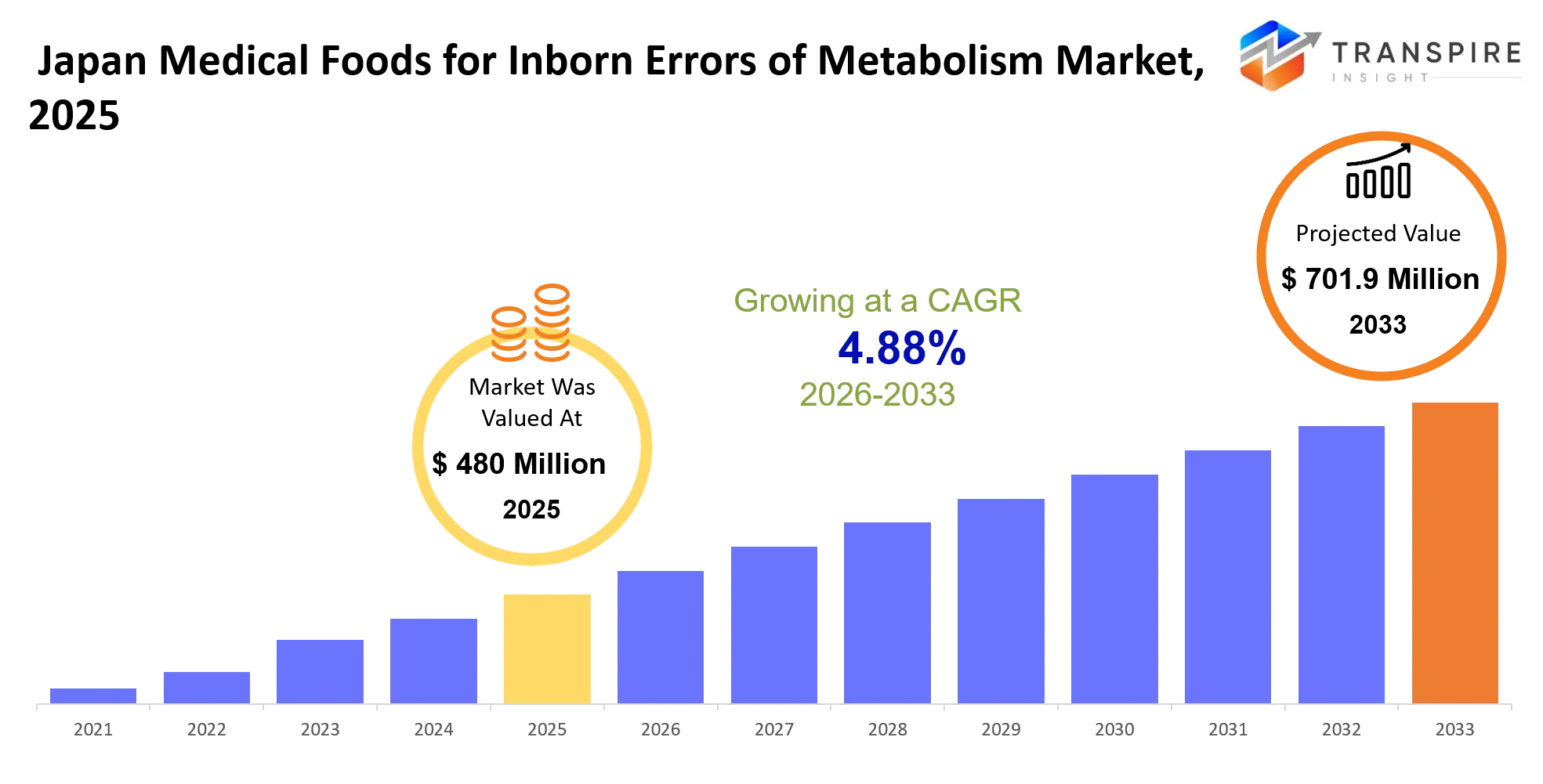
According to Transpire Insights, a detailed research report on the Japan Medical Foods for Inborn Errors of Metabolism Market reflects that the market was valued at approximately USD 480.0 million in 2025, is expected to reach USD 503.0 million in 2026, and is projected to reach approximately USD 701.9 million by 2033, expanding at a CAGR of 4.88% during 2026–2033, making it a significant contributor to Japan’s medical nutrition landscape, specialized dietary management, innovation in metabolic disorder nutrition, advanced medical food formulations, expanding product development capabilities, and overall market growth dynamics.
Market Snapshot
- Market Value (2025): USD 480.0 Million.
- Expected Market Value (2026): USD 503.0 Million.
- Estimated Market Value (2033): USD 701.9 Million.
- Forecast CAGR (2026–2033): 4.88%
Introduction
The Japan Medical Foods for Inborn Errors of Metabolism Market is segmented into Product Type (Medical Food Products) and Distribution Channel (Hospital Pharmacies and Retail Pharmacies). The report provides the value (USD million) and volume (Units) of the market for the country and segment levels. These medical foods play an important role in the disease-specific nutritional management that restricts harmful substrates, provides vital nutrients, and supports adequate growth and metabolic stability. Phenylketonuria (PKU), maple syrup urine disease (MSUD), urea cycle disorders, organic acidemias and other metabolic conditions that are medically managed are the most important conditions. Japan has a well-developed newborn screening system which has enabled early detection and intervention for several inborn error of metabolism, highlighting the need for specialized nutritional intervention. The disease-specific formulas, clinical dietetic supervision, specialized low-protein foods, amino acid-based formulas and long-term nutritional management in pediatric and adult patients are also characteristics of the market.
Key Market Highlights: -
- By Product Type, the Inborn Errors of Metabolism dominated the market and holds approximately 50% share in 2025 and is projected to grow at a substantial CAGR during the forecast period.
- By Disorder, the Phenylketonuria dominated the market and holds approximately 42% share in 2025 and is projected to grow at a substantial CAGR during the forecast period.
- By Form, the Liquid Manufacturers segment dominated the market and holds approximately 66% share in 2025 and is projected to grow at a substantial CAGR during the forecast period.
- Japan’s rare-disease policies, such as expanded newborn screening, clinical nutritional management, and healthcare support mechanisms, facilitate early IEM diagnosis, access to specialized medical food, and long-term patient management.
How is Technology Driving Growth in the Japan Medical Foods for Inborn Errors of Metabolism Market?
Technological advancements for improving formulation accuracy, quality assurance, and disease-specific nutritional management are driving the Japan Medical Foods for Inborn Errors of Metabolism Market. With advanced analytical technologies, amino acid and nutrient composition can be accurately determined to produce specialized formulas for phenylketonuria, maple syrup urine disease and urea cycle disorders. Automated manufacturing and strict process controls enhance consistency, safety and batch reliability for nutritionally sensitive patient groups. At the same time, the improvement in genomic diagnostics and expansion of newborn screening allow for earlier detection of metabolic disorders and appropriate nutritional intervention. Digital healthcare tools also enhance dietary monitoring and communication among patients, caregivers and clinicians, aiding long-term adherence to specialized medical nutrition and helping to develop more targeted IEM medical food solutions in Japan.
Market Drivers
The Japan Medical Foods for Inborn Errors of Metabolism Market is driven by systematic newborn screening, enhanced metabolic and genetic diagnostics, and increased clinical recognition of rare metabolic disorders. Early identification allows for timely dietary intervention and ongoing use of disease-specific medical foods. Government support for rare-disease management and specialized healthcare services make patient access to appropriate nutritional therapies even easier. Japan’s advanced healthcare infrastructure also allows for specialist-directed dietary monitoring and management of chronic disease. Also, the precise formulation technologies and stringent manufacturing controls ensure the products are uniform, safe and appropriate for patients needing very specialized metabolic nutrition.
Restrain
Restraints in the Japan Medical Foods for Inborn Errors of Metabolism Market are high cost of specialized formulations, limited patient population and complex manufacturing requirements. Limited availability of metabolic nutrition specialists outside major medical centers may limit consistent dietary management. Regulatory requirements and the complexity of product development may also extend commercialization timelines. Also, an unawareness of rare metabolic diseases may lead to diagnosticdelay, misunderstanding of treatment and affect long-term compliance. Moreover, economic barriers to continued specialized dietary management may limit availability to certain individuals.
Analysis of Prices and Consumer Behaviour
The medical food market for inborn errors of metabolism is dominated by specialized disease-specific formulations (68% of total market; mainly because therapeutic nutrition is essential for the management of inherited metabolic disorders such as phenylketonuria, maple syrup urine disease, and urea cycle disorders). High-purity, clinically standardized medical food formulations are anticipated to cost 35% more than other products due to the specialized nutrient composition, stringent quality controls, clinical validation, and consistent nutritional performance these products require. Powdered medical foods to treat inborn errors of metabolism constitute about 45% of total unit sales. The sales volume is due to the convenience, formulation flexibility, easy preparation and extended storage characteristics of the powdered metabolic nutrition products. About 70% of the demand for these products is in the nutrition-therapy and health-care specialties. The purchasing behavior of patients, caregivers and healthcare providers demonstrates that 55% place the highest importance on nutritional suitability, formulation quality, safety and consistency of nutrient composition. Another 33% prefer to purchase products through bulk agreements or long-term supply arrangements because they seek to manage procurement costs and ensure a reliable, consistent supply of specialized medical foods for long-term metabolic disease management.
Top Companies in the Japan Medical Foods for Inborn Errors of Metabolism Market
- Nutricia
- Danone
- Abbott
- Nestlé Health Science
- Mead Johnson
- Ajinomoto
- Cambrooke
- Vitaflo
- SHS International
- Fresenius Kabi
- Takeda
- Meiji
- Morinaga Milk Industry
- Snow Brand Megmilk
- Otsuka Pharmaceutical
Japan Medical Foods for Inborn Errors of Metabolism Market Segmentation
The Japan Medical Foods for Inborn Errors of Metabolism Market share is divided into six categories: By Product Type, By Disorder, By Form, By Age Group, By Distribution Channel, By End User.
The Inborn Errors of Metabolism dominated the market, accounting for nearly 50% in 2025 and is expected to rise at a significant CAGR during the forecast period.
The Japan Medical Foods for Inborn Errors of Metabolism Market is segmented by product typeinto amino-acid-free formulas, protein-restricted foods, low-protein foods, medical drinks, special carbohydrate products, fat-modified foods, micronutrient supplements, modular medical foods. Among these, the Inborn Errors of Metabolism segment dominated the market, accounting for nearly 50% in 2025 and expected to increase at a significant CAGR during the forecast period. High prevalence of dietary management requirements, early diagnosis and lifelong specialized nutrition sustains the demand of medical foods across metabolic disorders.
The Phenylketonuria dominated the market, accounting for nearly 42% in 2025, and is expected to rise at a significant CAGR during the forecast period.
The Japan Medical Foods for Inborn Errors of Metabolism Market is segmented by disorder into pku, msud, urea cycle disorders, organic acidemias, galactosemia, tyrosinemia, homocystinuria, fatty-acid oxidation disorders. Among these, the phenylketonuria dominated the market, accounting for nearly 42% in 2025 and expected to increase at a significant CAGR during the forecast period. Phenylketonuria dominates due to lifelong phenylalanine restriction needs, screening, special formulations and increasing clinical focus on sustained dietary management.
The Liquid dominated the market, accounting for nearly 66% in 2025 and is expected to rise at a significant CAGR during the forecast period.
The Japan Medical Foods for Inborn Errors of Metabolism Market is segmentedby form into powder, liquid, ready-to-drink, bars, tablets, capsules, pureed foods, granules. Among these, the Liquid dominated the market, accounting for nearly 66% in 2025 and expected to increase at a significant CAGR during the forecast period. Liquid formulations are preferred because of ease of administration, flexible dosing, rapid consumption and suitability for pediatric patients requiring specialized metabolic nutrition.

Future Market Trends for the Japan Medical Foods for Inborn Errors of Metabolism Market: -
Precision Nutrition and Diagnostics: Genomic testing, metabolic biomarkers, and advanced diagnostics are anticipated to be incorporated to support more targeted IEM medical food formulations and personalized dietary management.
Demand is expected to rise for home-based specialized nutrition, including easy-to-use, shelf-stable, medical foods for long-term home-based management of metabolic disorders, particularly among pediatric and adult patients.
Advanced Formulation and Quality Control: Manufacturers are expected to focus on improving amino-acid formulations, palatability, quality systems automation and precise nutrient composition to improve safety and adherence.
Recent Development
In August 2026: PTC Therapeutics reported additional data from its Sephience sepiapterin program for PKU, showing reductions in phenylalanine levels and the potential to liberalize the diet of patients.
In August 2026: Japan’s medical nutrition ecosystem increasingly leveraged AI, automation, and digital technologies to improve manufacturing efficiency, quality control, and specialized metabolic food production.
In April 2026: Industry reports noted the growth of Japan's medical foods sector, supported by tight safety standards, regulatory supervision, specific nutritional requirements, and expanding clinical uses.
Market Segmentation
This study forecasts revenue at Japan, regional and country levels from 2020 to 2033. Transpire Insights has segmented the Japan Medical Foods for Inborn Errors of Metabolism Market based on the below-mentioned segments:
Japan Medical Foods for Inborn Errors of Metabolism Market, By Product Type
- Amino-Acid-Free Formulas
- Protein-Restricted Foods
- Low-Protein Foods
- Medical Drinks
- Special Carbohydrate Products
- Fat-Modified Foods
- Micronutrient Supplements
- Modular Medical Foods
Japan Medical Foods for Inborn Errors of Metabolism Market, By Disorder
- PKU
- MSUD
- Urea Cycle Disorders
- Organic Acidemias
- Galactosemia
- Tyrosinemia
- Homocystinuria
- Fatty-Acid Oxidation Disorders
Japan Medical Foods for Inborn Errors of Metabolism Market, By Form
- Powder
- Liquid
- Ready-to-Drink
- Bars
- Tablets
- Capsules
- Pureed Foods
- Granules
Japan Medical Foods for Inborn Errors of Metabolism Market, By Age Group
- Infants
- Toddlers
- Children
- Adolescents
- Adults
- Elderly
- Neonates
- All-Age Products
Japan Medical Foods for Inborn Errors of Metabolism Market, By Distribution Channel
- Hospitals
- Specialty Pharmacies
- Retail Pharmacies
- Online Pharmacies
- Direct Sales
- Clinics
- Government Programs
- Home Healthcare
Japan Medical Foods for Inborn Errors of Metabolism Market, By End User
- Hospitals
- Pediatric Clinics
- Metabolic Centers
- Dietetic Clinics
- Specialty Pharmacies
- Research Institutes
- Homecare
- Government Healthcare
Frequently Asked Questions
Find quick answers to common questions.
The market is driven by systematic newborn screening, improved metabolic and genetic diagnostics, rare-disease management, and increasing clinical recognition of inherited metabolic disorders. Early diagnosis supports timely dietary intervention and sustained use of disease-specific medical foods, while Japan’s healthcare infrastructure facilitates specialist-led nutritional management
Phenylketonuria (PKU) dominates the disorder segment, accounting for approximately 42% in 2025. Its leadership reflects lifelong phenylalanine restriction requirements, established screening practices, specialized formulations, and sustained clinical dietary management.
Liquid formulations dominate the market, representing approximately 66% in 2025. Their popularity is supported by convenient administration, flexible dosing, rapid consumption, and suitability for pediatric patients requiring specialized metabolic nutrition.
Advanced analytical technologies, automated manufacturing, genomic diagnostics, newborn screening, and digital healthcare tools are improving formulation accuracy, quality assurance, early detection, dietary monitoring, and long-term adherence to specialized metabolic nutrition.
Future growth is expected to emphasize precision nutrition, genomic and biomarker-based diagnostics, convenient home-based medical foods, improved amino-acid formulations, enhanced palatability, automated quality systems, and precise nutrient composition
- Nutricia
- Danone
- Abbott
- Nestlé Health Science
- Mead Johnson
- Ajinomoto
- Cambrooke
- Vitaflo
- SHS International
- Fresenius Kabi
- Takeda
- Meiji
- Morinaga Milk Industry
- Snow Brand Megmilk
- Otsuka Pharmaceutical
About the Authors

Pankaj Ghogare Patil
I am Pankaj Ghogare Patil, a Senior Research Analyst at Transpire Insight, specializing in the Pharmaceutical, Chemicals & Materials, Healthcare IT, and Biotechnology industry. My expertise lies in conducting comprehensive market research, analyzing industry trends, evaluating competitive landscapes, and translating complex data into actionable insights. At Transpire Insight, I closely follow emerging technologies, regulatory developments, and market innovations to create accurate, well-researched, and informative content that helps businesses and professionals make informed decisions. I am committed to producing credible, evidence-based articles that reflect industry best practices while making technical topics accessible and valuable for a broad audience.

Chakradhar Khansole
Chakradhar serves as the Research Director at Transpire Insight, bringing over 8 years of experience in technology, innovation, and strategic market intelligence. He specializes in transforming complex market data into actionable business insights that enable organizations to make informed, growth-oriented decisions. Recognized for his strategic vision and analytical expertise, Chakradhar leads high-impact research initiatives, delivering comprehensive market assessments, competitive intelligence, and forward-looking industry analysis.
Recently Published Reports
-
Apr 2026
AI in Diabetic Retinopathy Market
AI in Diabetic Retinopathy Market Size, Share & Analysis Report By Type (Screening AI Systems, Diagnostic AI Systems, and Predictive AI Models), By Application Segment (Hospitals, Ophthalmology Clinics, Diagnostic Centers, and Research and Development), and Geography (North America, Europe, Asia-Pacific, Middle East and Africa, South and Central America), 2021 - 2031
-
Apr 2026
Psychometric Tests Market
Psychometric Tests Market Size, Share & Analysis Report By Type (Personality Tests, Ability/Aptitude Tests, Skill/Knowledge Tests, and Others), By Application (Talent Acquisition and Talent Management), and Geography (North America, Europe, Asia-Pacific, Middle East and Africa, South and Central America), 2021 – 2031
-
Apr 2026
Rare Biological Sample Collection Market
Rare Biological Sample Collection Market Size, Share & Analysis Report By Type (Isolation Kits & Reagent, Blood Collection Tubes, and Others), By Application (Oncology, Transcriptomics, Pharmacogenomics, and Others), and Geography (North America, Europe, Asia-Pacific, Middle East and Africa, South and Central America), 2021 – 2031
-
Jul 2026
Diabetic Retinopathy Market
Diabetic Retinopathy Market Size, Share & Analysis Report By Type (Proliferative Diabetic Retinopathy, and Diabetic Macular Edema (DME)), By Treatment Type (Anti VEGF Drug, Steroid Implants, Laser Surgeries, and Vitrectomy), and Geography (North America, Europe, Asia-Pacific, Middle East and Africa, South and Central America), 2021 – 2031
Our Clients







