
Sports Drinks Market Summary:
According to Transpire Insights, a detailed research report on the market reflects that the isotonic sports drinks product type segment dominates the Sports Drinks Market, accounting for approximately 57.2% of the total share worldwide. PepsiCo Inc. leads the market with approximately (around USD 8.96% market share) in market share and an estimated leading position globally, making it the leading contributor to market development, innovation, advanced sports drinks production, expanding manufacturing capabilities, and growth dynamics.
Market Snapshot
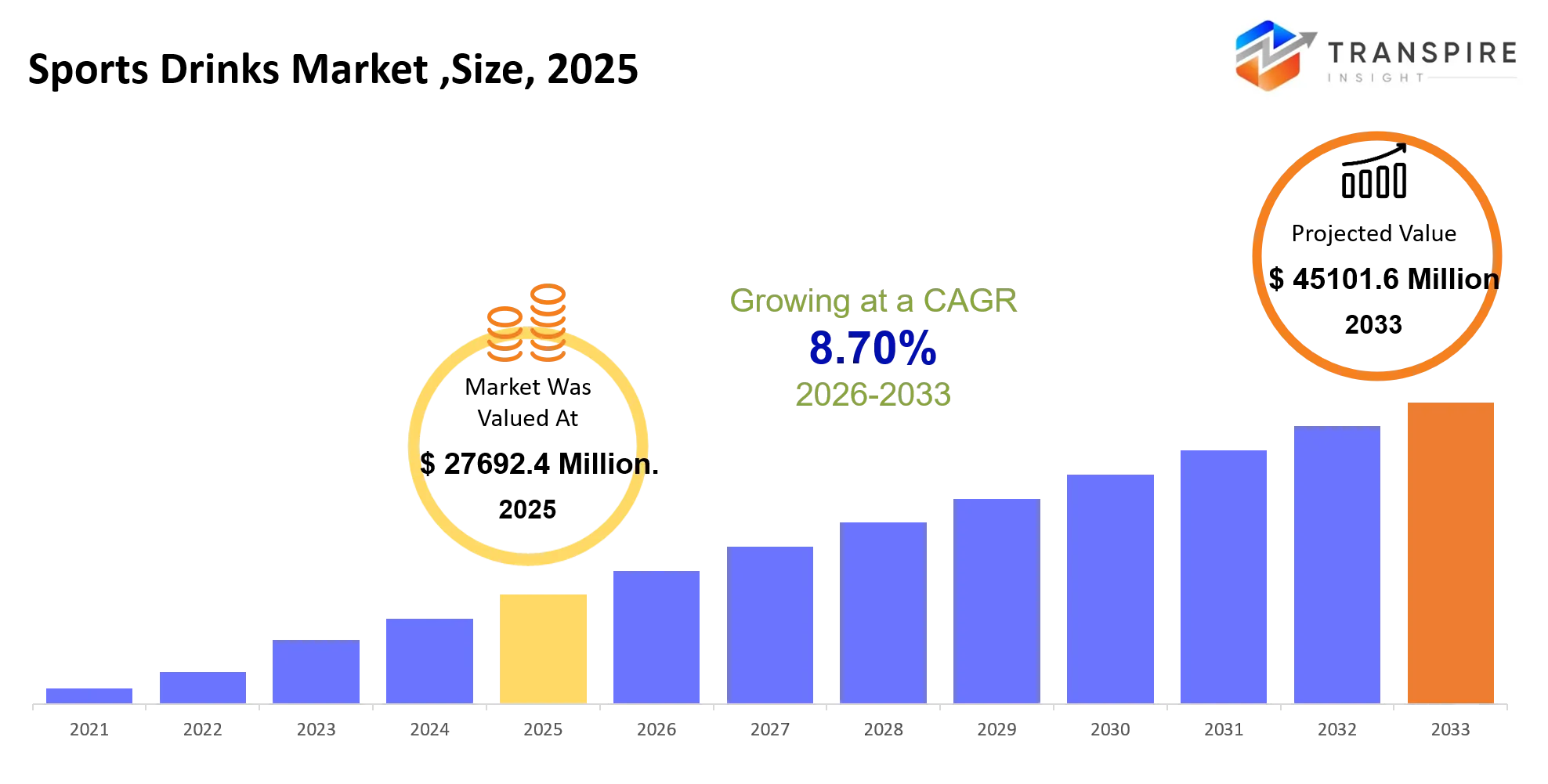
- Market Value (2025): USD 27692.4 Million.
- Expected Market Value (2026): USD 45101.6 Million.
- Estimated Market Value (2033): USD 53944.5 Million.
- Forecast CAGR (2026–2033): 8.70%.
- Leading Region in 2025: North America
- Second-largest Region: Europe
- Fastest Growing Region: Asia Pacific
Introduction
The Sports Drinks Market refers to a set of functional beverages that are used to hydrate, replace electrolytes and replenish energy during and after physical activity. These drinks consist mainly of water, carbohydrates and essential electrolytes to help consumers replenish fluids and nutrients lost through perspiration and prolonged exercise. The market has expanded beyond professional athletes to encompass growing adoption among fitness enthusiasts, recreational exercisers, active lifestyle consumers and those looking for convenient hydration solutions. Product innovation is increasingly focused on low-sugar, zero-calorie, natural, organic and clean-label formulations in response to shifting health and wellness preferences. There are three types of sports drinks: isotonic, hypotonic and hypertonic. Each has different effects on hydration and energy levels. The Sports Drinks Market continues to be driven by the growth of fitness participation, changing consumer lifestyles, retail accessibility, e-commerce penetration and growing demand for functional beverages.
For instance:
- North America: Strong consumer preference for hydration, fitness and functional beverages is driving demand for sports drinks, while established brands and product innovation are supporting regional market growth.
- Europe: Consumers are increasingly opting for low-sugar, natural and clean-label sports drinks, but sustainability initiatives and strict regulation are also driving innovation in formulation and packaging.
Market Highlights: -
- North America is expected to grow at a rapid CAGR in the Sports Drinks Market by holding around40% of the share during the forecast period.
- Europe is anticipated to hold roughly28% share of the Sports Drinks Market over the predicted time frame.
- Asia Pacific is anticipated to hold around28% share of the Sports Drinks Market over the predicted time frame.
- By Product Type, the Isotonic Drinks dominated the market and holds nearly 56.1% share in 2025 and is projected to grow at a substantial CAGR during the forecast period.
- By Ingredient, theProteins and amino acids dominated the market and holds nearly 42.93% share in 2025 and is projected to grow at a substantial CAGR during the forecast period.
- By Packaging, the Bottles dominated the market and holds nearly 45% share in 2025 and is projected to grow at a substantial CAGR during the forecast period.
- Physical activity driven by government investments in sports infrastructure, national fitness initiatives, and food-processing incentives is driving the consumption of functional beverages and providing lucrative growth opportunities for the Sports Drinks Market.
How is Technology Driving Growth in the Sports Drinks Market?
Technology is disrupting the Sports Drinks Market with advancements in smart formulation, smart manufacturing, digital retail and sustainable packaging. Food processing technologies allow manufacturers to develop low sugar, natural & clean-label formulations while improving flavor, electrolyte delivery and product stability. More personalized hydration & nutrition solutions are driven by consumer activity patterns with data analytics and emerging integrations of wearables. AI also helps beverage companies to predict demand, optimize inventory and improve supply-chain efficiency. Meanwhile e-commerce, direct-to-consumer platforms and social commerce are making the market more accessible for emerging brands. Automated manufacturing and recyclable packaging have also increased efficiency, consistency and sustainability in the sports drinks sector.
|
Report Metrics |
Details |
|
Market size value in 2025 |
USD 27692.4 Million |
|
Market size value in 2026 |
USD 45101.6 Million |
|
Revenue forecast in 2033 |
USD 53944.5 Million |
|
Growth rate |
CAGR of 8.70% from 2026 to 2033 |
|
Base year |
2025 |
|
Historical data |
2021 - 2024 |
|
Forecast period |
2026 - 2033 |
|
Report coverage |
Revenue forecast, competitive landscape, growth factors, and trends |
|
Regional scope |
United States; Canada; Mexico; United Kingdom; Germany; France; Italy; Spain; Denmark; Sweden; Norway; China; Japan; India; Australia; South Korea; Thailand; Brazil; Argentina; South Africa; Saudi Arabia; United Arab Emirates |
|
Key company profiled |
PepsiCo, Coca-Cola, Gatorade, Powerade, Red Bull, Monster Beverage, BODYARMOR, PRIME, Electrolit, Pocari Sweat, Lucozade, Dr Pepper Snapple, Abbott, Nestlé Health Science, Otsuka Pharmaceutical |
|
Customization scope |
Free report customization (country, regional & segment scope). Avail customized purchase options to meet your exact research needs. |
|
Report Segmentation |
By Product Type (Isotonic Drinks, Hypotonic Drinks, Hypertonic Drinks, Electrolyte Drinks, Energy Sports Drinks, Protein Sports Drinks, Organic Sports Drinks, Others); By Ingredient (Electrolytes, Carbohydrates, Vitamins, Minerals, Amino Acids, Protein, Botanical Ingredients, Others); By Packaging (PET Bottles, Cans, Pouches, Glass Bottles, Sachets, Powder Packs, Bulk Containers, Others); By Distribution Channel (Supermarkets & Hypermarkets, Convenience Stores, Online Retail, Specialty Stores, Gyms & Fitness Centers, Foodservice, Others); By End User (Professional Athletes, Fitness Enthusiasts, Recreational Athletes, Students, Outdoor Consumers, Health-conscious Consumers, General Consumers, Others) |
Market Drivers
Sports Drinks Market Drivers Increasing participation in fitness activities Increasing health and wellness awareness Increasing demand for convenient hydration and recovery drinks. Technology is disrupting the Sports Drinks Market with advancements in smart formulation, smart manufacturing, digital retail and sustainable packaging. The pace of product innovation is increasing market growth by means of electrolyte formulations that are low in sugar, calorie-free, natural, clean-label, and plant-based. The expansion of e-commerce, quick-commerce, and direct-to-consumer sales channels is enhancing the availability of products and allowing new brands to target specific consumer groups. At the same time, sustainable packaging, advanced formulation technologies, and a wider range of products are helping to boost brand competitiveness. Increasing consumer interest in functional beverages and personalized nutrition is still generating promising opportunities in the Sports Drinks Market.
For Instance: Asia-Pacific Increasing fitness levels, urbanization, disposable incomes and growing e-commerce are driving the adoption of sports drinks, providing huge opportunities to regional and international beverage manufacturers.
Restrain
The sports drinks market is hindered by worries regarding its high sugar content, artificial ingredients, and their alleged health effects, and demand for ordinary sports drinks can be reduced because of increasing competition from coconut water, electrolyte powders, enhanced waters, and other functional beverages. Strict requirements regarding labeling and the formulation of products can lead to higher compliance costs, and variations in the prices of ingredients, packaging, and transportation can put pressure on profit margins.Also, natural and clean-label formulations may present shelf-life challenges that could complicate distribution and supply-chain management.
Analysis of Prices and Consumer Behaviour
The sports drink market is dominated by isotonic drinks (52.54% of the overall volume of the 2025 market; mostly due to their ideal mix of carbohydrates and electrolytes for quick hydration and recovery of energy). The need for isotonic sports drinks is fueled by the wide variety of applications of such drinks (athletes, people who train at gyms, team sport players and regular fitness enthusiasts). Around 56.38% of the revenue from sports drink sales comes from PET bottles due to the convenience and resealable feature of such bottles and compatibility with beverage supply chains. The supermarkets and hypermarkets distribution channel account for around 57.17% of sports drinks sales owing to their extensive availability and good accessibility of the products. Consumer buying behavior shows that flavor (46%) is one of the most crucial attributes which affects the choice of sports drinks. In addition, 32% of American consumers choose sports drinks based on their absence of sugar content. Moreover, 50% of consumers from the Asia-Pacific region look for flavored fruit fortified sports drinks.
Who are the Key Players in the Sports Drinks Market and how do they compete?
In the international market for Sports Drinks Market, competitiveness is possible through companies that engage in innovation of products, provision of solutions that are unique to consumers, and creation of distribution networks. Competitive strategy not only based on pricing but on product innovations, functional ingredients, packaging and integration with digital platforms and retail systems will lead to continuous product innovation as well as help in ensuring consumer engagement, market reach, product differentiation and efficient operations.
Through innovation of sports drinks, electrolyte drinks, functional drinks, and consumer-centric solutions, PepsiCo builds its competitive advantage in the market. Through innovation of high performance sports drinks that serve purposes such as hydration, energy replacement, recovery, and others, Coca-Cola differentiates itself from its competitors. Through integration of solutions in sports hydration, electrolyte replacement, functional beverages, and nutrition that focus on performance, Gatorade builds its competitive advantage.
Top Companies in the Sports Drinks Market
- PepsiCo
- Coca-Cola
- Gatorade
- Powerade
- Red Bull
- Monster Beverage
- BODYARMOR
- PRIME
- Electrolit
- Pocari Sweat
- Lucozade
- Dr Pepper Snapple
- Abbott
- Nestlé Health Science
- Otsuka Pharmaceutical
Market Segmentation
The Sports Drinks Market share is divided into five categories: By Product Type, By Ingredient, By Packaging, By Distribution Channel, By End User.
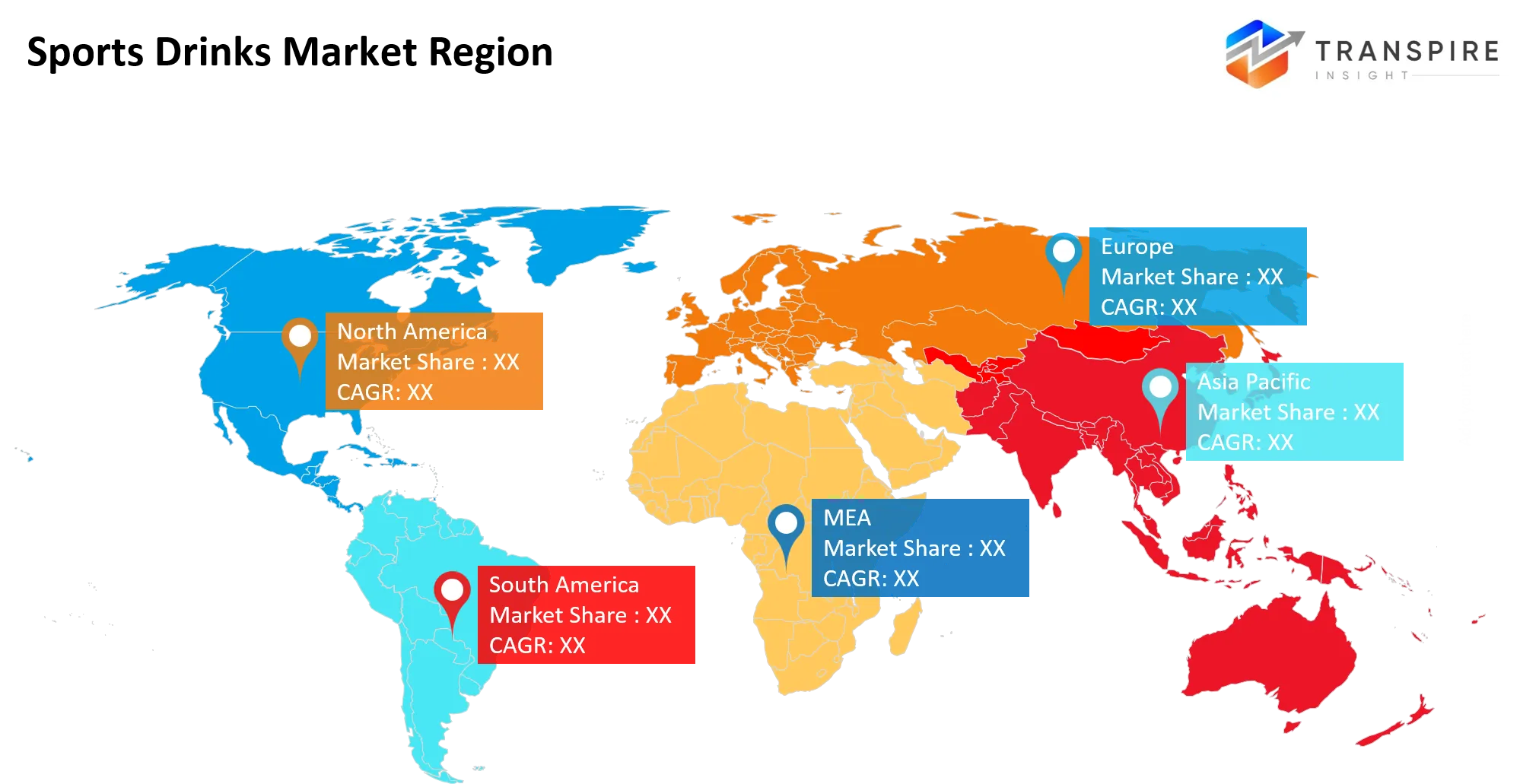
The Isotonic Drinks dominated the market, accounting for nearly 56.1% in 2025 and is expected to rise at a significant CAGR during the forecast period.
The Sports Drinks Market is segmented by product type into isotonic drinks, hypotonic drinks, hypertonic drinks, electrolyte drinks, energy sports drinks, protein sports drinks, organic sportsDrinks, others. Among these, the Isotonic Drinks dominated the market, accounting for nearly 56.1% in 2025 and expected to increase at a significant CAGR during the forecast period. The isotonic drinks segment is leading as it offers good balance in terms of hydration, electrolyte replenishment, energy intake, consumer acceptance, and compatibility with moderate to high intensity physical activity.
The Proteins and amino acids dominated the market, accounting for nearly 42.93% in 2025, and is expected to rise at a significant CAGR during the forecast period.
The Sports Drinks Market is segmentd by ingredient into electrolytes, carbohydrates, vitamins, minerals, amino acids, protein, botanical ingredients, others. Among these, the Proteins and amino acids dominated the market, accounting for nearly Proteins and amino acids 42.93% in 2025 and expected to increase at a significant CAGR during the forecast period. The proteins and amino acids segment is leading because of the use of such elements in the recovery of the muscles, improvement of performance, hydrating capability, and increased requirement for sports nutrition products.
The Bottles dominated the market, accounting for nearly 45% in 2025 and is expected to rise at a significant CAGR during the forecast period.
The Sports Drinks Market is by packaging into pet bottles, cans, pouches, glass bottles, sachets, powder packs, bulk containers, others. Among these, the Bottles dominated the market, accounting for nearly 45% in 2025 and expected to increase at a significant CAGR during the forecast period. The bottle segment is leading owing to portability, convenience, ability to be sealed again, wide availability through retailers, and preference of the consumer for ready to drink beverages during physical activities.
Regional Segment Analysis of the Sports Drinks Market:
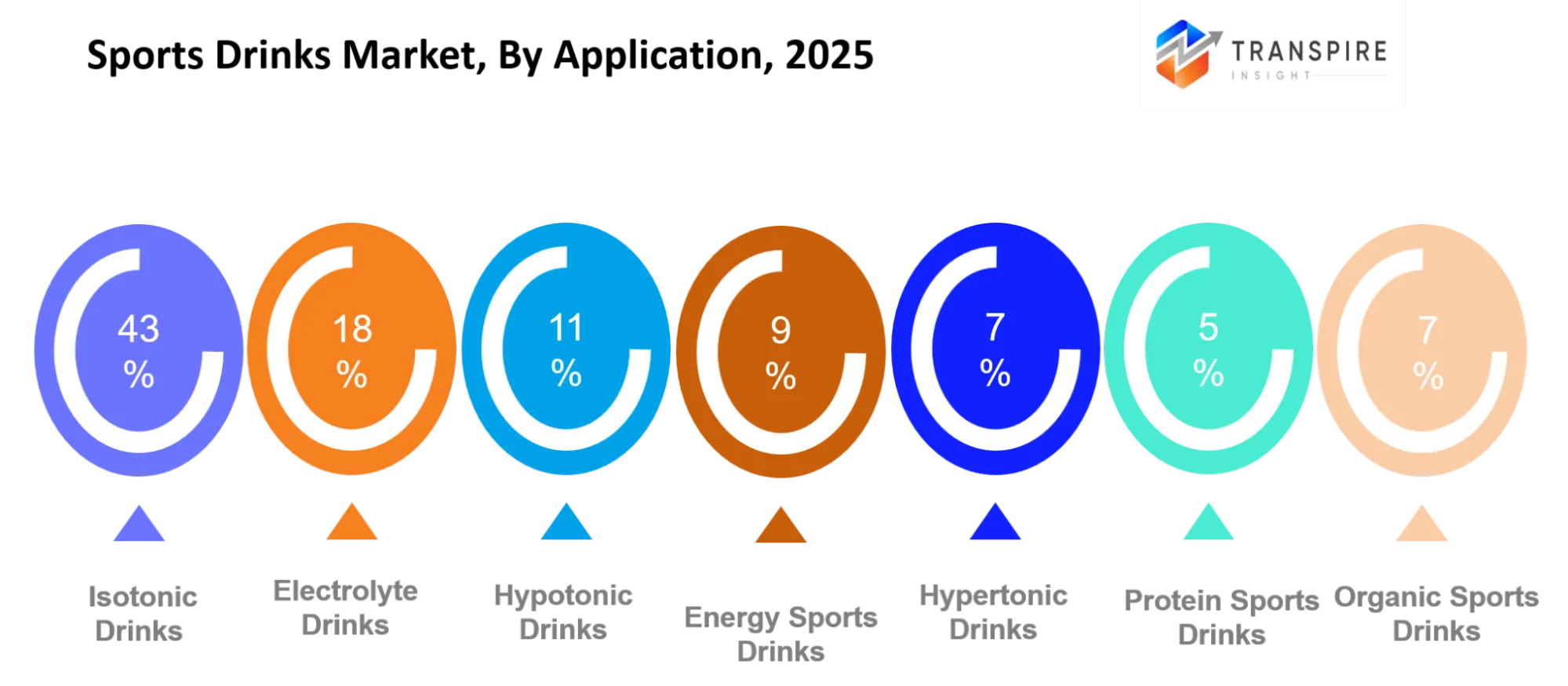
- North America (U.S., Canada, Mexico)
- Asia Pacific (Germany, France, U.K., Italy, Spain, Rest of Asia Pacific)
- Asia-Pacific (China, Japan, India, Rest of APAC)
- South America (Brazil and the Rest of South America)
- The Middle East and Africa (UAE, South Africa, Rest of MEA)
- North America is the fastest-growing region in the Sports Drinks Market during the period, holding around 40%share.
North America leads the Sports Drinks Market due to high sports participation, strong fitness culture, high consumer awareness about hydration products, and established network for beverage distribution in the region. Continuous product innovations, increased demand for low sugar and functional beverages, and brand availability through retail stores and e-commerce sites are other key factors contributing to market dominance of North America.
Europe is expected to grow at a rapid CAGR in theSports Drinks Market, holding roughly28%of the share during the forecast period.
The Europe region is anticipated to have high growth potential in the Sports Drinks Market driven by the growing fitness trends, awareness about health & wellness, and the rising demand for functional beverages. There is an increase in the demand for low-calorie, natural, clean-label, and electrolyte fortified beverages. Growing sports activities, gym membership, recreation and fitness, and outdoor lifestyle trends contribute towards the demand for the product. Retail infrastructure development, e-commerce development, innovation in the product, and sustainable packaging initiatives contribute to the sports drinks market in the region.
Asia Pacific is the fastest- Platform Market during the period, holding around28%share.
The Asia-Pacific region is anticipated to be the fastest-growing region in the Platform Market owing to its rapid digital transformation, growing internet penetration, the rise in adoption of cloud-based platforms, and increasing investment in digital infrastructure. The region offers a large number of technologically oriented consumers, growing usage of smartphones, and increasing demand for scalable digital platforms across industries. Government-led digitalization efforts, e-commerce ecosystem development, and enterprise technology adoption efforts contribute towards the growth of the platform market.
Strategies for Market Growth in Non-Leading Regions:
The development of non-leading regions through innovative and scalable technologies for sports drink manufacturing will have its positive impact on small and medium sized beverage manufacturers. The local supply of electrolytes, functional ingredients, and packaging material together with the establishment of regional sports drinks production facilities will help in minimizing dependence on imports and lower the cost of production. Strategic cooperation with regional suppliers of ingredients, sports nutrition manufacturers, food retailers, and beverage distributors will increase the penetration of sports drink products in the market. Training and technical skills enhancement are necessary to increase the level of expertise in sports drink formulation, quality control, nutritional standards, and development. Flexible types of financing, long-term supply agreements, and contract manufacturing will provide greater availability of sports drinks and encourage their consumption. The development of cooperative programs in the field of sports, nutrition, government, and food processing together with digital sales systems will increase the availability of sports drinks and foster sustainable worldwide growth of the market in developing countries.
Future Market Trends for the Sports Drinks Market: -
Clean Label and Functional Product Innovation: The trend is towards sugar-free, low-calorie, natural, electrolyte-enriched, vitamin-fortified, and plant-based sports drinks in alignment with shifting health-conscious consumer preferences.
Convenience and Sustainability: Powder sticks, tablets, lightweight bottles, and sustainable packaging options are gaining traction through enhanced convenience, reduced transportation needs, and sustainability.
Digital and Regional Expansion: Growth is being fueled by e-commerce and direct-to-consumer selling, digital fitness community platforms, and increasing sports participation in emerging economies.
Recent Development
Launch of Powerade by The Coca-Cola Company in India on February 22, 2026: The company introduced electrolyte-based sports hydration products into the Sports Drinks Market.
Portfolio Development of Zero Sugar and Honey-Based Electrolytes in Early 2026: A-GAME expanded its zero-sugar, honey-based electrolyte beverages portfolio in the Sports Drinks Market
This study forecasts revenue at global, regional and country levels from 2020 to 2033. Transpire Insights has segmented the Sports DrinksMarket based on the below-mentioned segments:
Sports Drinks Market, By Product Type
- Isotonic Drinks
- Hypotonic Drinks
- Hypertonic Drinks
- Electrolyte Drinks
- Energy Sports Drinks
- Protein Sports Drinks
- Organic Sports Drinks
- Others
Sports Drinks Market, By Ingredient
- Electrolytes
- Carbohydrates
- Vitamins
- Minerals
- Amino Acids
- Protein
- Botanical Ingredients
- Others
Sports Drinks Market, By Packaging
- PET Bottles
- Cans
- Pouches
- Glass Bottles
- Sachets
- Powder Packs
- Bulk Containers
- Others
Sports Drinks Market, By Distribution Channel
- Supermarkets & Hypermarkets
- Convenience Stores
- Online Retail
- Specialty Stores
- Gyms & Fitness Centers
- Foodservice
- Others
Sports Drinks Market, By End User
- Professional Athletes
- Fitness Enthusiasts
- Recreational Athletes
- Students
- Outdoor Consumers
- Health-conscious Consumers
- General Consumers
- Others
Sports Drinks Market, By Regional Analysis
North America
- US
- Canada
- Mexico
Asia Pacific
- Germany
- UK
- France
- Italy
- Spain
- Russia
- Rest of Asia Pacific
North America
- China
- Japan
- India
- South Korea
- Australia
- Rest of North America
South America
- Brazil
- Argentina
- Rest of South America
Middle East & AfricaUAE
- Saudi Arabia
- Qatar
- South Africa
- Rest of the Middle East & Africa
Frequently Asked Questions
Find quick answers to common questions.
Rising fitness participation, health awareness, convenient hydration demand, e-commerce expansion, product innovation, and functional beverage adoption are driving market growth.
Isotonic drinks dominate due to balanced hydration, electrolyte replenishment, energy delivery, consumer acceptance, and suitability for moderate-to-high intensity activities.
North America leads the market due to strong fitness culture, high sports participation, consumer awareness, established distribution networks, and product innovation.
Technology enables smart formulation, automated manufacturing, personalized hydration, AI-driven forecasting, digital retail, supply-chain optimization, and sustainable packaging solutions.
Clean-label formulations, sugar-free products, functional ingredients, sustainable packaging, convenient formats, e-commerce, direct-to-consumer sales, and emerging regional demand will shape growth.
- PepsiCo
- Coca-Cola
- Gatorade
- Powerade
- Red Bull
- Monster Beverage
- BODYARMOR
- PRIME
- Electrolit
- Pocari Sweat
- Lucozade
- Dr Pepper Snapple
- Abbott
- Nestlé Health Science
- Otsuka Pharmaceutical
About the Authors

Chetan Dhatrak
I’m Chetan Dhatrak, a Senior Research Analyst at Transpire Insight, specializing in the Consumer Goods, Foods and Beverages industry. I focus on analyzing market trends, consumer behavior, competitive landscapes, and industry developments to deliver accurate, data-driven insights. My research at Transpire Insight is built on credible sources and in-depth analysis, helping businesses and readers better understand market dynamics, emerging opportunities, and evolving consumer preferences. I’m committed to creating reliable, well-researched content that supports informed decision-making and reflects the latest developments in the consumer goods and food & beverage sectors.

Chakradhar Khansole
Chakradhar serves as the Research Director at Transpire Insight, bringing over 8 years of experience in technology, innovation, and strategic market intelligence. He specializes in transforming complex market data into actionable business insights that enable organizations to make informed, growth-oriented decisions. Recognized for his strategic vision and analytical expertise, Chakradhar leads high-impact research initiatives, delivering comprehensive market assessments, competitive intelligence, and forward-looking industry analysis.
Recently Published Reports
-
Apr 2026
Baby Infant Formula Market
Baby Infant Formula Market Size, Share & Analysis Report By ype (Infant Milk, Follow On Milk, Specialty Baby Milk, Growing-Up Milk), By Ingredient (Carbohydrate, Fat, Protein, Minerals, Vitamins, and Others), By Product Form (Powder, Liquid, and Ready-to-feed), By Distribution Channels (Supermarket/Hypermarket, Specialty Store, Pharmacies, Online Retail, and Others), and Geography (North America, Europe, Asia-Pacific, Middle East and Africa, South and Central America), 2021 - 2031
-
Apr 2026
Edible Insects for Animal Feed Market
Edible Insects for Animal Feed Market Size, Share & Analysis Report By Type (Insect Powder, Insect Meal, Insect Bar, Insect Paste, Insect Oil, and Others), By Insect Type (Beetles, Cricket, Caterpillar, Hymenoptera, Orthoptera, Tree Bugs, and Others), By Application (Livestock, Pet Food, and Aquaculture), By Livestock Type (Poultry, Swine, and Others), and Geography (North America, Europe, Asia-Pacific, Middle East and Africa, South and Central America), 2021 - 2031
-
Apr 2026
Food Industry Disinfection and Bacterial Control Market
Food Industry Disinfection and Bacterial Control Market Size, Share & Analysis Report By Type (Chemical Disinfectants, Physical Disinfectants, and Biocides and Antimicrobials), By Application (Food Processing Equipment Surface Disinfection, Food Preparation Areas Surface Disinfection, Storage Areas Surface Disinfection, Anti-microbial Coatings Food Preservation, and Preservative Solutions Food Preservation), By End User (Meat and Poultry Processing, Dairy Processing, Seafood Processing, Bakery and Confectionery, Restaurants and Commercial Kitchens, and Food Service Providers), By Sales Channel (Online, Offline), and Geography (North America, Europe, Asia-Pacific, Middle East and Africa, South and Central America), 2021 - 2031
-
May 2026
Freeze Dried Food Market
Freeze Dried Food Market Size, Share & Analysis Report By Product Type (Fruits, Vegetables, Freeze-Dried Dairy Products, Freeze-Dried Meat and Seafood, Freeze-Dried Pet Food, and Prepared Meal), By Nature (Organic, and Conventional), By Form (Powdered, Granules, and Diced), By End Use (Breakfast Cereals, Dairy Products, Bakery & Confectionery, Nutritional Bars & Supplements, Powdered Beverages, Snacks, and Retail (Household)), and Geography (North America, Europe, Asia-Pacific, Middle East and Africa, South and Central America), 2021 - 2031