

Japan Light Fidelity (LIFI) Technology Market Size & Forecast:
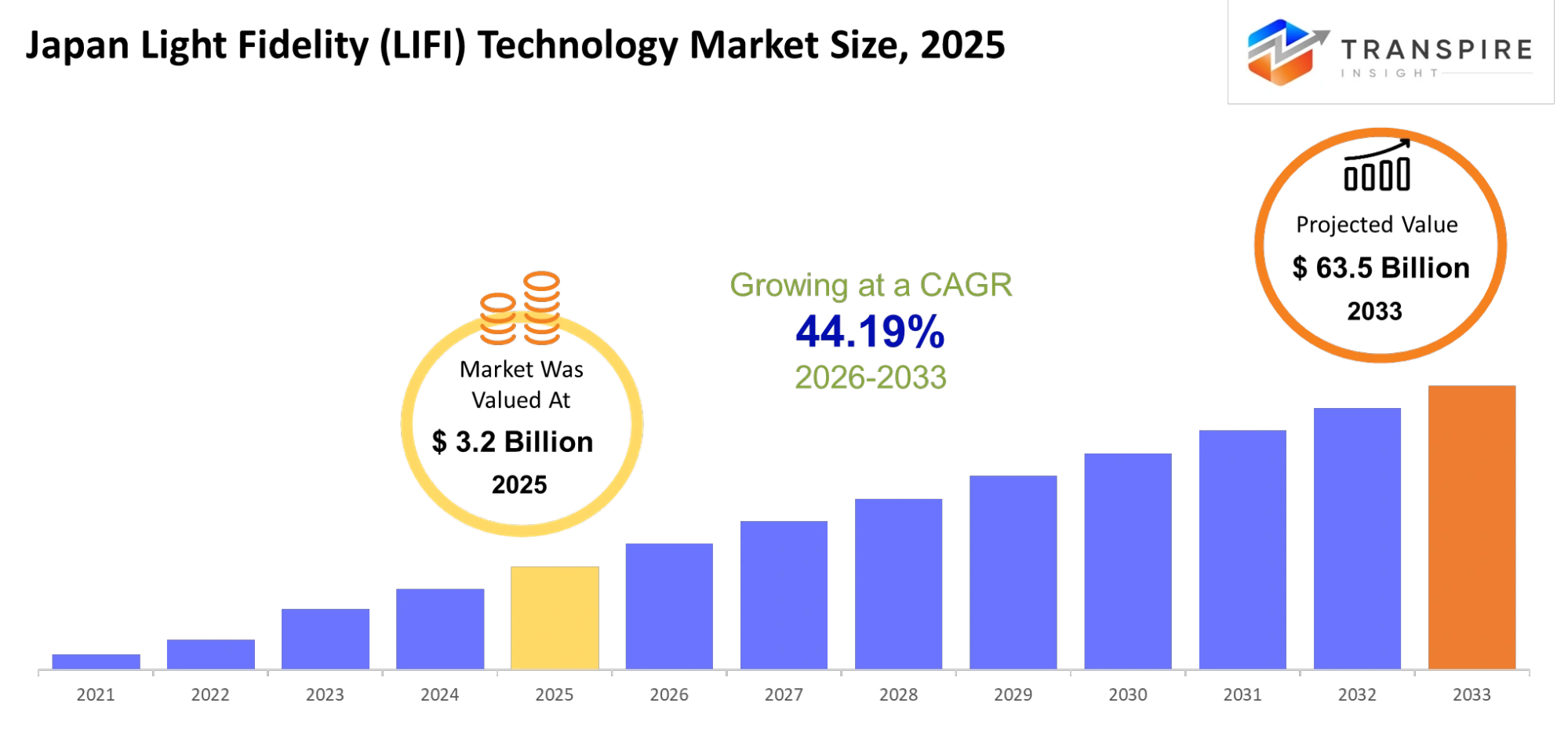
- Japan Light Fidelity (LIFI) Technology Market Size 2025: USD 3.2 Billion
- Japan Light Fidelity (LIFI) Technology Market Size 2033: USD 63.5 Billion
- Japan Light Fidelity (LIFI) Technology Market CAGR: 44.19%
- Japan Light Fidelity (LIFI) Technology Market Segments: By Type (Hardware, Software, Services, Others); By Application (Indoor Networking, Smart Lighting, Healthcare, Aviation, Defense, Others); By End-User (Enterprises, Hospitals, Government, Defense, Consumers, Others); By Technology (LED-based Communication, VLC, Hybrid Systems, Others)
To learn more about this report,  Download Free Sample Report
Japan Light Fidelity (LIFI) Technology Market Summary:
The Japan Light Fidelity (LIFI) Technology Market size is estimated at USD 3.2 Billion in 2025 and is anticipated to reach USD 63.5 Billion by 2033, growing at a CAGR of 44.19% from 2026 to 2033.
Japan's light fidelity (LIFI) technology market operates as part of the optical wireless communication industry which transmits data through visible light instead of using traditional radio frequencies. The Japanese market will develop through the demand for fast internet which requires low-latency connections that can operate in urban areas despite ongoing issues with spectrum congestion. Transit facilities and medical centers and intelligent workspaces will create a demand for complete wireless internet access which will lead to the use of lighting systems that function as data transmission equipment.
The current landscape will reflect steady progress in semiconductor lighting, sensor integration, and network security protocols. Japanese companies will proceed to enhance their LED-based communication technologies in order to achieve dependable results within locations that experience strong electromagnetic interference. The development of deployment standards requires regulatory discussions which specifically address public infrastructure and healthcare settings. The market for light-based communication systems will benefit from users who demand secure networks without interruptions, making this technology a valuable solution within Japan's advanced digital ecosystem.
What Has the Impact of Artificial Intelligence Been on the Japan Light Fidelity (LIFI) Technology Market?
The entire Japan Light Fidelity (LIFI) Technology Market now experiences transformation because organizations use data-based insights to establish their operational practices and market strategies. The Japan Light Fidelity (LIFI) Technology Market uses artificial intelligence to support market research activities through its ability to process extensive datasets at high speeds which then allows stakeholders to track market developments and customer behavior patterns with improved precision.
Businesses utilize advanced machine learning models to create predictive analytics that help them forecast customer demand and develop optimal pricing and product development strategies which match actual market requirements. The Japan Light Fidelity (LIFI) Technology Market uses artificial intelligence to create more accurate decision-making processes which decrease uncertainty in a market that requires fast-paced competition between businesses.
AI-driven smart automation systems create operational improvements which lead to higher production rates while they streamline across multiple industries including healthcare and defense and smart infrastructure which needs LiFi system integration. Japanese companies in the Light Fidelity (LIFI) Technology Market use artificial intelligence to enhance their supply chain management processes while decreasing expenses and achieving better inventory control through advanced tracking and prediction technologies.
AI now enables organizations to create innovative solutions through adaptive communication systems that self-optimize their operations according to real-time environmental data which helps improve their overall performance and reliability. The Japan Light Fidelity (LIFI) Technology Market uses artificial intelligence to develop personalized user experiences which provide businesses with a competitive edge while opening new avenues for growth which will help them achieve success in future wireless communication systems.
Key Market Trends & Insights:
- Japan will maintain its leadership position in the Japan light fidelity (LIFI) technology market until 2025 because of its advanced digital infrastructure and high research and development expenditures which currently give it an 85 percent market share.
- The smart city and IoT adoption initiatives drive urban development in Tokyo and Osaka which show the fastest growth among cities until 2030.
- LiFi systems that operate with LED technology control more than 60 percent of the market in 2025 because they provide affordable solutions that can operate as both lighting systems and communication networks.
- The second-largest market share in communication devices comes from microcontroller and photodetector components which manufacturers increasingly use to develop their products.
- The software and analytics platforms sector will experience the highest growth rate as AI technology adoption in Japan light fidelity (LIFI) systems will drive market expansion between 2026 and 2030.
- The indoor networking sector controls 55% of the market because enterprises and healthcare facilities and defense organizations require secure communication systems.
- The combination of predictive analytics together with automation technologies drives the fastest growth of smart transportation systems and vehicular communication applications.
- The commercial sector maintains market dominance with 45% share in 2025 because businesses use high-speed data transfer together with advanced cybersecurity solutions.
- The healthcare sector and defense sector show rapid growth as end-users who implement LiFi technology for secure data transmission without interference.
- The Japan light fidelity (LiFi) technology market sees its main competition between Panasonic Corporation and Sony Corporation and pureLiFi and Signify and Oledcomm.
Japan Light Fidelity (LIFI) Technology Market Segmentation
By Type :
The Japan Light Fidelity (LIFI) Technology Market divides into four main parts which include hardware, software, services, and other supporting elements. The adoption process follows different paths from each segment of the market. The hardware component consists of LED transmitters together with photodetectors and networking components which enable high-speed optical data transfer. The demand for dependable and energy-efficient lighting systems drives continuous hardware expansion in both commercial and industrial environments.
The software used in Japan Light Fidelity (LIFI) Technology Market operates through three functions which include signal processing and data modulation and network management to maintain stable communication through light signals. The organization provides services which include installation and system integration and maintenance to help organizations adopt the technology without operational disruption. The other segments of the business offer consulting and customization solutions which enable different industries to fulfill their unique deployment needs.
By Application :
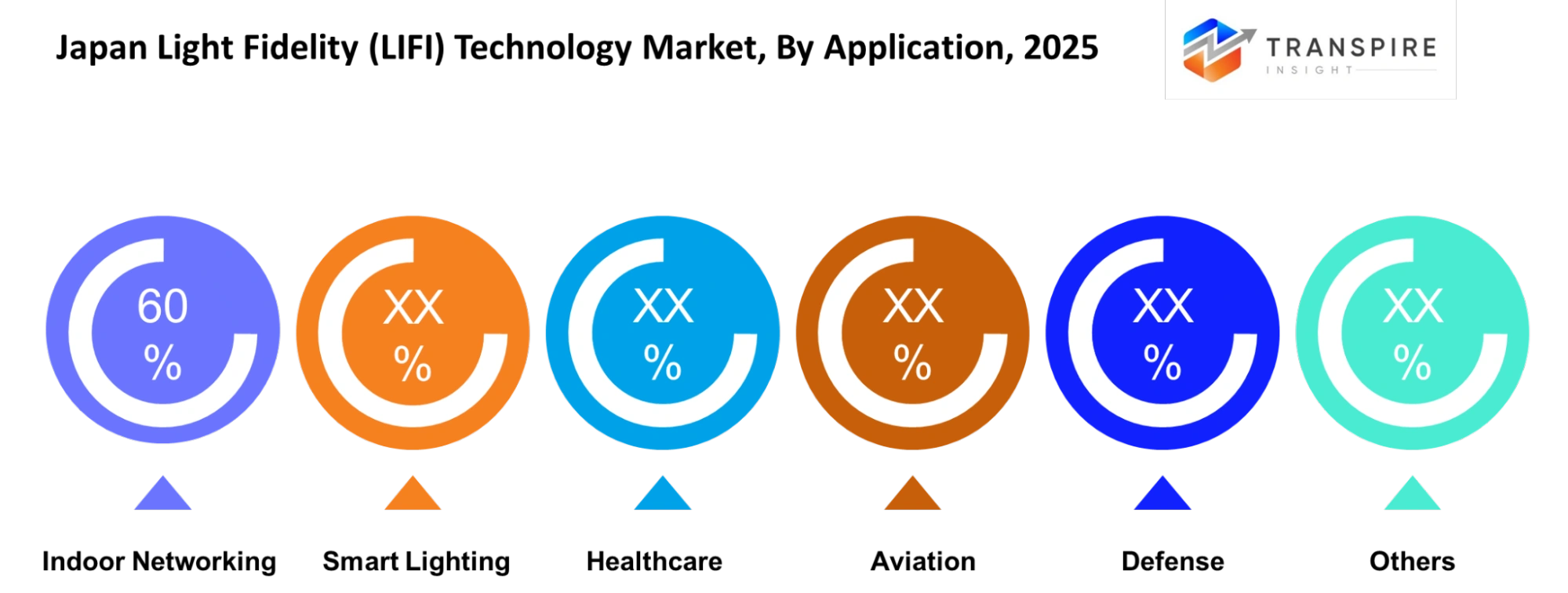
The Japan Light Fidelity (LIFI) Technology Market demonstrates its main usage for indoor networking needs which require both secure and fast internet connections in office spaces, retail locations and home environments. The smart lighting systems enable dual functions of providing light and transmitting data which lets users make better use of current LED systems while achieving better connectivity results without using radio frequency signals.
Healthcare and aviation and defense industries show greater interest because these sectors provide security and reliability benefits. Hospitals need to maintain uninterrupted communication in areas close to delicate equipment while aviation and defense operations depend on secure spaces that use optical communication to decrease potential hazards. The technology supports educational needs and industrial automation by delivering constant data links which enhance operational performance.
To learn more about this report, Download Free Sample Report
By End-User :
The primary customer base for Japan Light Fidelity (LIFI) Technology Market consists of businesses which require secure internal communication networks and fast data transfer capabilities. Businesses and office spaces use LIFI technology to decrease network traffic problems while achieving better performance in areas with many users.
The security requirements and need for minimal disruption at hospitals and government facilities and defense organizations make LIFI technology an appropriate choice for these institutions which need reliable wireless communication systems. The development of smart homes together with the rise of advanced connectivity solutions has led to a gradual increase in consumer adoption of these technologies. Educational institutions and research facilities conduct studies to develop new communication systems which they will use for their research work.
By Technology :
The Japan Light Fidelity (LIFI) Technology Market operates through LED-based communication which uses light-emitting diodes to transmit data through quick light changes. The Visible Light Communication (VLC) system enables simultaneous lighting and data transmission which results in efficient integrated systems that modernize infrastructure.
Wireless technologies like Wi-Fi operate together with LIFI through hybrid systems which provide users with uninterrupted connections between different spaces. The system allows users to maintain communication links without interrupted signals because of its ability to operate in intricate environments. The ongoing development of these technologies produces enhanced speed and reliability and expanded scalability which boosts industry market capacity.
What are the Main Challenges for the Japan Light Fidelity (LIFI) Technology Market Growth?
The market for Japan light fidelity (LiFi) technology encounters multiple technical and operational obstacles which prevent its successful implementation at large scales. The primary Japanese light fidelity (LiFi) technology market faces challenges because it needs line-of-sight communication, which diminishes system performance when physical objects obstruct direct paths. The system performance faces two limitations because ambient light sources create signal interference problems and the system has a smaller coverage area than standard Wi-Fi systems. The existing network infrastructure of LiFi systems must go through complicated processes for successful integration, which prevents network expansion and hinders commercial system adoption.
The Japanese light fidelity (LiFi) technology market faces growth restrictions because of both manufacturing and commercialization obstacles which exist within the industry. Advanced LED components and photodetector production requires precise manufacturing using specialized methods, which leads to higher overall expenses. Companies face double challenges because they need to meet strict safety regulations while obtaining product market approval, which leads to delays in product release. The small businesses need to compete with established companies, but they lack technical expertise and cost advantages, which leads to product development delays.
The Japan light fidelity (LiFi) technology market still faces adoption challenges because most people do not understand the technology and the necessary infrastructure remains unavailable. Organizations continue to use traditional wireless systems, which delays their adoption of LiFi technology. The industry faces a shortage of qualified professionals who can install and run LiFi systems, which restricts the industry's expansion. The high costs required for initial implementation together with the unpredictable nature of returns on investments create barriers that prevent widespread adoption.
Country Insights
The Japan Light Fidelity (LIFI) Technology Market demonstrates continuous growth because of its strong digital infrastructure and its initial implementation of advanced communication technologies. The need for rapid and secure data transmission in urban centers and industrial zones will drive up market demand. Research institutions and technology companies are investing in visible light communication technology which will lead to ongoing development and commercial use across different industries.
The Country Insights report shows that Japan uses its established electronics sector and its smart city development programs and next-generation connectivity initiatives to improve its technology capabilities. Organizations will adopt LIFI technology for their transport systems and medical centers and workspaces as they search for new solutions to replace existing wireless technologies. The implementation of energy-efficient LED lighting systems enables stakeholders to establish better conditions for nationwide adoption.
The market will grow because more people want secure communication methods that work better than radio frequency signals. The manufacturing hubs together with the densely populated cities present ideal conditions for LIFI technology implementation because they provide minimal signal interference and advanced bandwidth capabilities. The ongoing partnership between academic institutions and business organizations will create new innovations which will boost product performance and reliability while lowering operational costs.
Recent Development News
In March 2026, pureLiFi launched its next-generation “Connectivity DNA” LiFi platform at MWC 2026. The company introduced high-speed optical wireless modules with enhanced security and multi-gigabit performance, targeting enterprise and smart infrastructure deployments including potential applications in Japan.Source https://www.purelifi.com/
In April 2026, Toyota Motor Corporation through Woven by Toyota introduced new AI-enabled smart city technologies at Woven City. The initiative includes advanced connected infrastructure capable of integrating next-generation communication technologies such as optical wireless (LiFi-compatible) systems for real-time data exchange.
Source https://global.toyota/en/
|
Report Metrics |
Details |
|
Market size value in 2025 |
USD 3.2 Billion |
|
Market size value in 2026 |
USD 4.9 Billion |
|
Revenue forecast in 2033 |
USD 63.5 Billion |
|
Growth rate |
CAGR of 44.19% from 2026 to 2033 |
|
Base year |
2025 |
|
Historical data |
2021 - 2024 |
|
Forecast period |
2026 - 2033 |
|
Report coverage |
Revenue forecast, competitive landscape, growth factors, and trends |
|
Country scope |
Japan |
|
Key company profiled |
Signify, Oledcomm, PureLiFi, Panasonic, Sony, Toshiba, Fujitsu, NEC, Samsung, Intel, Cisco, Qualcomm, GE, Acuity Brands, Velmenni |
|
Customization scope |
Free report customization (country, regional & segment scope). Avail customized purchase options to meet your exact research needs. |
|
Report Segmentation |
By Type (Hardware, Software, Services, Others); By Application (Indoor Networking, Smart Lighting, Healthcare, Aviation, Defense, Others); By End-User (Enterprises, Hospitals, Government, Defense, Consumers, Others); By Technology (LED-based Communication, VLC, Hybrid Systems, Others) |
How Can New Companies Establish a Strong Foothold in the Japan Light Fidelity (LIFI) Technology Market?
New entrants can build a strong position in the japan light fidelity (LIFI) technology market by focusing on niche applications where LiFi offers clear advantages over conventional wireless systems. Targeting sectors such as healthcare, defense, and smart manufacturing enables companies to solve particular challenges which include electromagnetic interference and data security and high-speed indoor connectivity. In the Japan light fidelity (LIFI) technology market, businesses that deliver solutions which match industry demands will experience higher solution adoption rates while developing unique value propositions which enable them to expand their market presence.
Innovation strategies play a critical role in gaining traction within the Japan light fidelity (LIFIi) technology market. Startups should invest in advanced chip design, adaptive optics, and AI-driven network optimization to enhance performance and reliability. For example, pureLiFi and Oledcomm demonstrate how continuous research and development together with product innovation can help emerging companies become technology leaders. The use of artificial intelligence in japan light fidelity (LIFI) technology market solutions will enable better predictive maintenance and network efficiency together with improved user experience which will create a competitive advantage.
New companies that want to enter the Japan light fidelity (Lifi) technology market need to develop both strategic partnerships and ecosystem integration. The company can achieve faster market entry by working together with telecom operators and LED manufacturers and smart city developers. The company provides deployment models which organizations can implement at any scale while maintaining budget control thus making LiFi solutions available to more users. Emerging companies can create permanent market presence through their combination of innovation and specific applications and their establishment of strong business collaborations which allow them to take advantage of growing market demand for safe fast communication solutions.
Key Japan Light Fidelity (LIFI) Technology Market Company Insights
The Japan Light Fidelity (LIFI) Technology Market experiences continuous demand because businesses search for rapid and secure solutions to transmit data. Light-based communication will enable urban networks to function effectively in areas where radio frequency interference creates problems. Infrastructure enhancements together with device interoperability and business understanding of alternative wireless technologies will determine future growth.
The competitive landscape will be determined by technology companies and telecommunications operators and research-based startups which develop optical communication technologies. The early product advantage will be achieved by companies through their investments in product testing and partnerships and pilot deployments. The market presence of organizations will depend on their system reliability and cost-effectiveness and their ability to integrate with existing infrastructure, which will drive adoption throughout different industries.
Company List
- Signify
- Oledcomm
- PureLiFi
- Panasonic
- Sony
- Toshiba
- Fujitsu
- NEC
- Samsung
- Intel
- Cisco
- Qualcomm
- GE
- Acuity Brands
- Velmenni
What are the Key Use-Cases Driving the Growth of Japan Light Fidelity (LIFI) Technology Market?
The japan light fidelity (lifi) technology market is gaining momentum through high-impact use-cases in healthcare, where secure and interference-free communication is critical. through LiFi hospitals create patient monitoring systems which need real-time data for surgical operations and to connect devices in areas that need protection from electromagnetic fields. The japan light fidelity (lifi) technology market has seen increased adoption through this use-case because it protects data security while maintaining operational reliability for intensive care units and advanced diagnostic facilities.
The japan light fidelity (lifi) technology market grows through vehicle-to-vehicle and vehicle-to-infrastructure communication systems which connect different vehicles within the automotive and transportation sector. LiFi technology allows users to transmit data at high speeds through their headlights and street lights, which enables smart traffic management and autonomous driving functions to operate.
Market growth results from these developments because they enhance road safety while decreasing latency and providing smart mobility solutions that support Japan's smart city development plans. The japan light fidelity (lifi) technology market expands through manufacturing and industrial automation because LiFi technology enables factories to operate secure high-speed communication systems.
The technology allows smart factories to operate through enhanced machine-to-machine connectivity while it protects against cyber threats and improves operational productivity. The market is expanding through enterprise and consumer applications which include high-speed indoor networking for offices and smart home environments. The japan light fidelity (lifi) technology market shows strong potential for ongoing growth because its various use-cases develop better scalability through the continuing process of innovation.
Japan Light Fidelity (LIFI) Technology Market Report Segmentation
By Type
- Hardware
- Software
- Services
By Application
- Indoor Networking
- Smart Lighting
- Healthcare
- Aviation
- Defense
By End-User
- Enterprises
- Hospitals
- Government
- Defense
- Consumers
By Technology
- LED-based Communication
- VLC
- Hybrid Systems
Frequently Asked Questions
Find quick answers to common questions.
The approximate Japan Light Fidelity (LIFI) Technology Market size for the market will be USD 63.5 Billion in 2033.
Key segments for the Japan Light Fidelity (LIFI) Technology Market are By Type (Hardware, Software, Services, Others); By Application (Indoor Networking, Smart Lighting, Healthcare, Aviation, Defense, Others); By End-User (Enterprises, Hospitals, Government, Defense, Consumers, Others); By Technology (LED-based Communication, VLC, Hybrid Systems, Others).
Major Japan Light Fidelity (LIFI) Technology Market players are Signify, Oledcomm, PureLiFi, Panasonic, Sony, Toshiba, Fujitsu, NEC, Samsung, Intel, Cisco, Qualcomm, GE, Acuity Brands, Velmenni.
The Japan Light Fidelity (LIFI) Technology Market size is USD 3.2 Billion in 2025.
The Japan Light Fidelity (LIFI) Technology Market CAGR is 44.19%.
- Signify
- Oledcomm
- PureLiFi
- Panasonic
- Sony
- Toshiba
- Fujitsu
- NEC
- Samsung
- Intel
- Cisco
- Qualcomm
- GE
- Acuity Brands
- Velmenni
Recently Published Reports
-
Apr 2026
3D Optical Profiler Market
3D Optical Profiler Market Size, Share & Analysis Report By Type (Desktop 3D Optical Profiler, and Portable 3D Optical Profiler), By Technology (Confocal Technology, and White Light Interference), By End-Use Industry (Manufacturing, Research Institutions, Automotive, Aerospace and Defense, Medical Devices, and Other), and Geography (North America, Europe, Asia-Pacific, Middle East and Africa, South and Central America), 2021 - 2031
-
Apr 2026
Depth Sensor Market
Depth Sensor Market Size, Share & Analysis Report By Type (Infrared Depth Sensors, Time-of-Flight (ToF) Sensors, Stereo Vision Sensors, Structured Light Sensors, Ultrasonic Depth Sensors), By Application (Automotive, Robotics, Gaming, Consumer Electronics, Industrial Automation, Healthcare, Security & Surveillance, Others), By End Users (Automotive Manufacturers, Consumer Electronics Companies, Healthcare Providers, Industrial Companies, Security Agencies, Gaming Companies, Robotics Companies, Others), and Geography (North America, Europe, Asia-Pacific, Middle East and Africa, South and Central America), 2021 – 2031
-
Apr 2026
Digital Manufacturing Market
Digital Manufacturing Market Size, Share & Analysis Report By Component (Hardware, Software, and Services), By Technology (Robotics, 3D Printing, Internet of Things (IoT), and Others), By Application (Automotive and Transportation, Aerospace and Defense, Consumer Electronics, Industrial Machinery, and Others), By Process Type (Computer-Based Designing, Computer-Based Simulation, Computer 3D Visualization, Analytics, and Others), and Geography (North America, Europe, Asia-Pacific, Middle East and Africa, South and Central America), 2021 – 2031
-
Apr 2026
Digital Visa Services Market
Digital Visa Services Market Size, Share & Analysis Report By Type (Individual Travelers, Group Travelers), By Application (Tourism, Business Travel, Others), and Geography (North America, Europe, Asia-Pacific, Middle East and Africa, South and Central America), 2021 – 2031