
Japan Gastric Antral Angiectasia (GAVE) Treatment Market Size & Forecast:
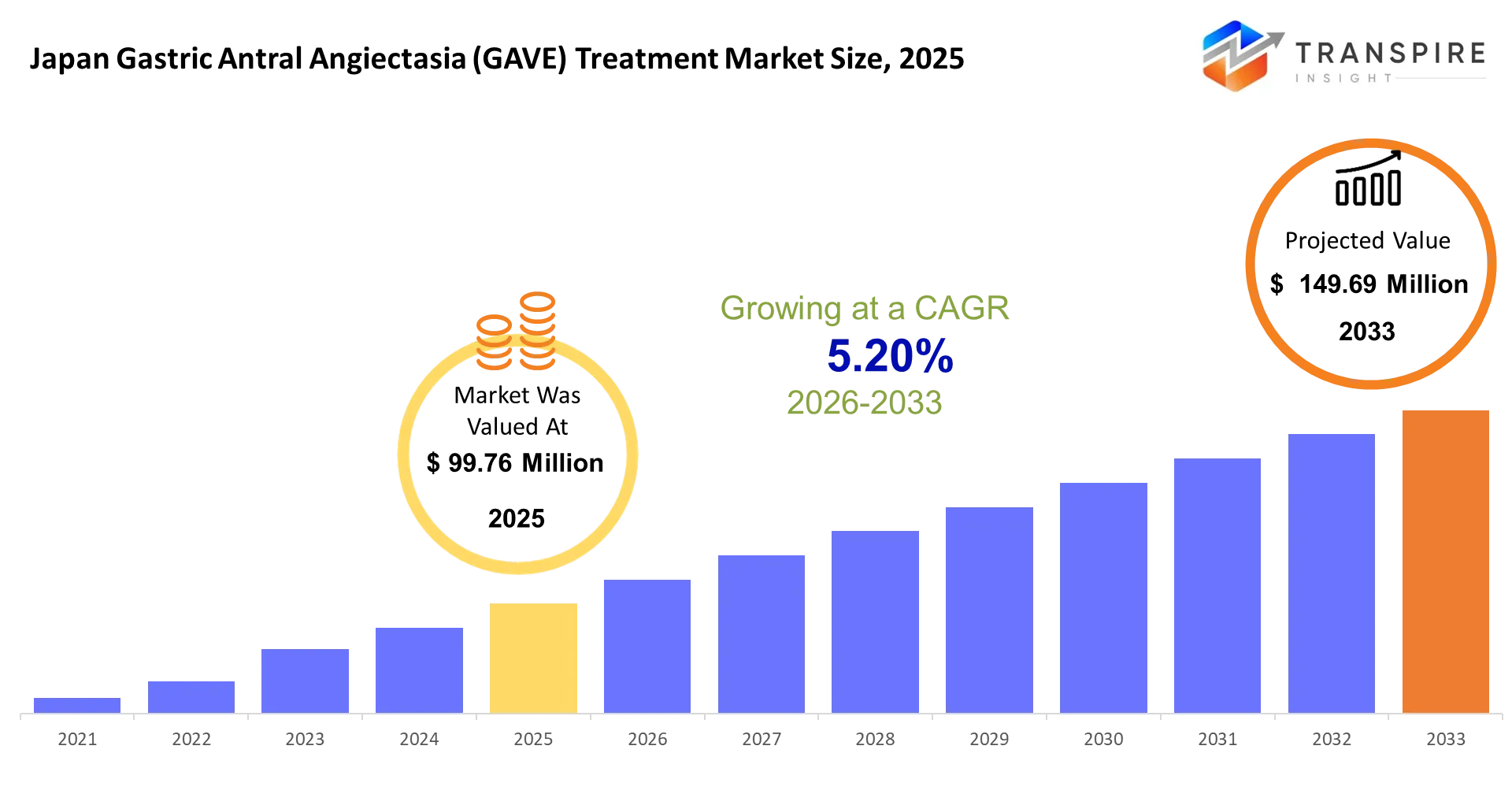
- Japan Gastric Antral Angiectasia (GAVE) Treatment Market Size 2025: USD 99.76 Million
- Japan Gastric Antral Angiectasia (GAVE) Treatment Market Size 2033: USD 149.69 Million
- Japan Gastric Antral Angiectasia (GAVE) Treatment Market CAGR: 5.20%
- Japan Gastric Antral Angiectasia (GAVE) Treatment Market Segments: By Type (Endoscopic Therapy, Pharmacological Therapy, Surgical Treatment, Others); By Application (Gastric Disorders, GI Bleeding, Others); By End-User (Hospitals, Clinics, Gastroenterology Centers, Others); By Distribution (Hospitals, Pharmacies, Others)
To learn more about this report,  Download Free Sample Report
Japan Gastric Antral Angiectasia (GAVE) Treatment Market Summary:
The Japan Gastric Antral Angiectasia (GAVE) Treatment Market size is estimated at USD 99.76 Million in 2025 and is anticipated to reach USD 149.69 Million by 2033, growing at a CAGR of 5.20% from 2026 to 2033.
The Japan gastric antral angiectasia (gave) treatment market within Japan’s specialized gastroenterology and therapeutic healthcare industry will experience gradual changes as hospitals and specialty digestive care centers implement their new treatment methods for rare gastric vascular disorders. The market has been shaped by a stronger clinical focus on early endoscopic diagnosis, particularly as aging demographics increase the number of patients requiring routine gastrointestinal evaluation.
Healthcare providers in Japan will develop more advanced therapeutic techniques to treat patients with less invasive methods while hospitals will continue using argon plasma coagulation and advanced endoscopic ablation systems as their primary treatment methods. Medical institutions will make investments in precision imaging tools which will enable physicians to detect vascular abnormalities with improved precision, thereby reducing the need for repeat procedures and enhancing the efficiency of long-term patient care.
Patients now have different expectations about medical treatments because they want procedures that will help them recover faster and shorten their time in hospitals. The changing preference will drive more hospitals to adopt outpatient procedures which use advanced endoscopic systems that have been improved. Japan will maintain its medical device regulatory system which promotes innovation by allowing faster evaluations of technologies that show clinically significant differences from existing products.
Partnerships between local hospitals and international medical device manufacturers will lead to the development of advanced treatment systems which meet regional medical standards. The Japan gastric antral angiectasia treatment market will develop more personalized technology-based medical solutions because gastroenterologists gain better understanding of the disease and diagnostic methods become more accurate.
What Has the Impact of Artificial Intelligence Been on the Japan Gastric Antral Angiectasia (GAVE) Treatment Market?
The Japan Gastric Antral Angiectasia (GAVE) Treatment Market experiences transformation through artificial intelligence which brings measurable advances to clinical decision-making processes and operational productivity and market forecasting capabilities. Artificial intelligence applications in the Japan Gastric Antral Angiectasia (GAVE) Treatment Market analysis enable healthcare providers and pharmaceutical stakeholders to handle intricate patient information while they determine treatment outcomes and assess new treatment options.
The Japan Gastric Antral Angiectasia (GAVE) Treatment Market obtains enhanced market intelligence through machine learning and predictive analytics which assist businesses in tracking disease occurrence patterns and making better research funding decisions and discovering neglected areas of treatment within Japan's specialized gastroenterology facilities.
Artificial intelligence integration into the Japan Gastric Antral Angiectasia (GAVE) Treatment Market processes enables smart automation development which affects production planning and supply chain management and treatment distribution optimization. Advanced data models enhance demand forecasting capabilities through their ability to study hospital procurement behaviors and diagnostic frequency and changes in patient demographics which leads to quicker market adaptation.
Artificial intelligence in Japan Gastric Antral Angiectasia (GAVE) Treatment Market development enables researchers to assess unique patient treatment results while developing new personalized treatment methods through its support of personalized treatment research. AI-powered market trends analysis enables manufacturers to achieve competitive advantages through reduced operating expenses and optimized inventory control and expedited product development.The Japan Gastric Antral Angiectasia GAVE Treatment Market will use artificial intelligence to improve its accuracy of medical treatments and develop new business opportunities which will respond to data assessment.
Key Market Trends & Insights:
- The Kanto region will maintain its lead in the Japanese gastric antral angiectasia (GAVE) treatment market because it operates advanced tertiary care facilities which provide patients access to treatment.
- The Kansai region holds a significant share at approximately 24%, driven by specialized gastroenterology centers and increasing treatment accessibility.
- Chubu region will experience the highest growth between 2026 and 2032 through its healthcare modernization projects which will lead to 7.4% CAGR growth.
- The endoscopic therapy method holds the highest market share for Japanese gastric antral angiectasia (GAVE) treatments because it accounts for 46% of industry size in 2025.
- The second most effective treatment method during this period comes from pharmacological treatment which accounts for almost 29% of market share because it remains available at most hospitals.
- The laser coagulation treatment field is experiencing its fastest growth rate which will continue to expand at 8.2% annual growth rate until 2032 according to the new market trends.
- The hospital treatment sector uses specialized gastrointestinal surgeries which account for 57% of its activities because patients choose these specialized services.
- The fastest growing medical sector is ambulatory care which will expand at 7.8% annual growth rate because of the rising popularity of minimally invasive medical procedures.
- Japanese specialty gastroenterology hospitals control 49% of the gastric antral angiectasia treatment market according to their market share.
- The growth of private diagnostic centers is accelerating because they establish new referral networks which enable them to deliver quicker patient screening services.
Japan Gastric Antral Angiectasia (GAVE) Treatment Market Segmentation
By Type:
The endoscopic therapy segment holds a strong position in the Japan Gastric Antral Angiectasia (GAVE) Treatment Market because of wide clinical acceptance and faster symptom management. Treatment centers prefer argon plasma coagulation procedures because they offer precise results and shorter recovery times. The increasing diagnosis rates at specialized healthcare institutions drive the demand for medical procedures.
Pharmacological therapy remains relevant for cases requiring supportive management or long-term monitoring. Drug-based approaches provide flexible treatment options because procedural intervention does not need to start at this moment. The surgical treatment exists as a minor treatment option which doctors use to treat patients with severe or difficult-to-treat conditions. The Japan Gastric Antral Angiectasia (GAVE) Treatment Market includes various treatment methods which involve blood management support and combination therapy approaches.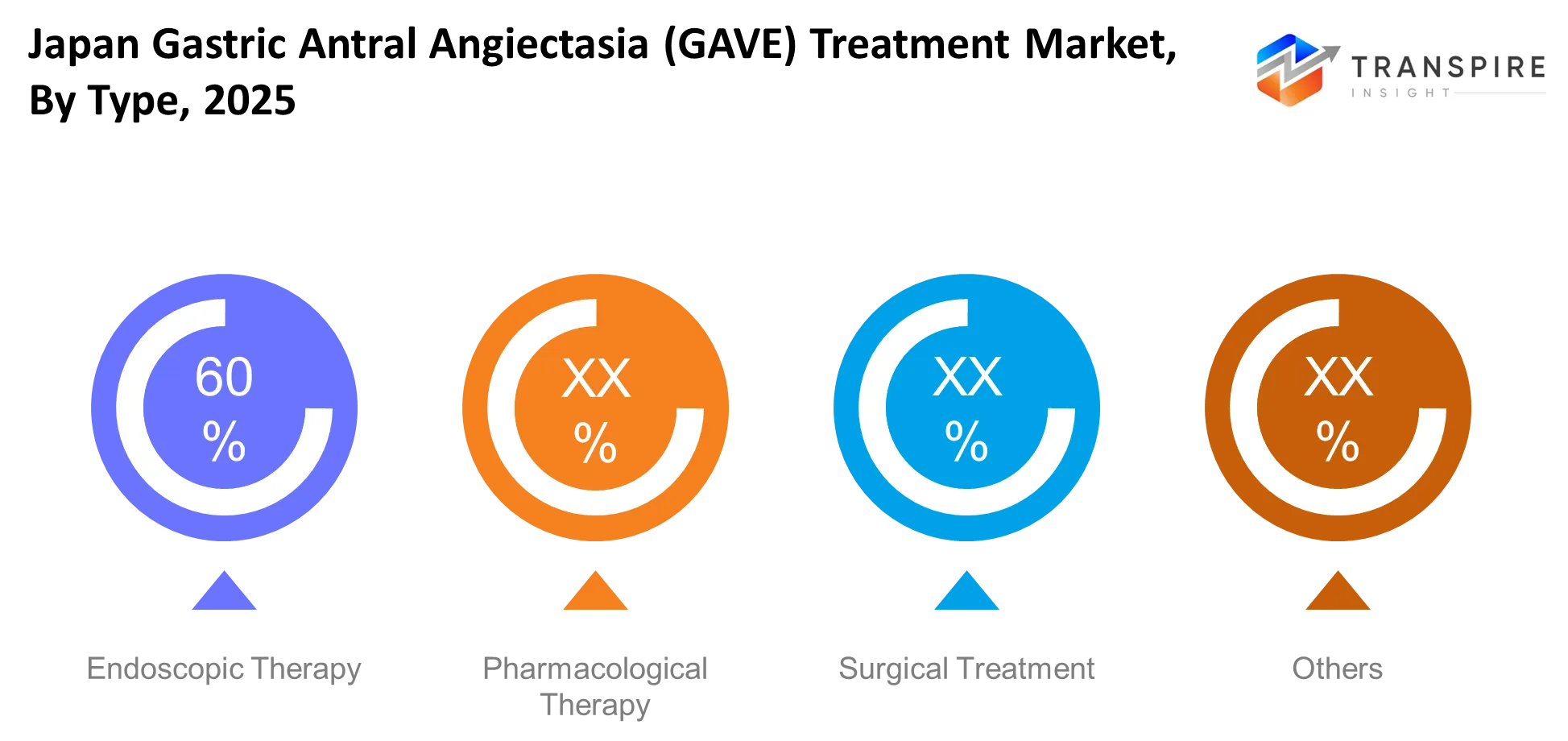
To learn more about this report, Download Free Sample Report
By Application:
The gastric disorders application segment accounts for a considerable share of the Japan Gastric Antral Angiectasia (GAVE) Treatment Market, supported by increasing identification of chronic gastric conditions linked to vascular abnormalities. Healthcare professionals who become more aware of medical conditions will experience better results because they can identify illnesses at early stages which enables them to provide needed treatments.
GI bleeding remains another major application area because gastric antral angiectasia frequently presents through recurrent bleeding episodes requiring immediate medical attention. Advanced diagnostic endoscopy usage has increased which helps medical professionals create treatment plans for this medical field. The other category includes less common associated gastrointestinal complications which create extra demand for specialized medical treatments that researchers have developed throughout the Japan Gastric Antral Angiectasia (GAVE) Treatment Market.
By End-User:
The Japan Gastric Antral Angiectasia GAVE Treatment Market primarily depends on hospitals because they possess diagnostic equipment which exceeds current standards and their medical staff members who perform procedures and their teams who provide services across multiple fields. The combination of high patient volume and available emergency services enhances the treatment capacity of hospitals. The continuous development of gastroenterology facilities enables this particular market segment to experience growth.
Stable patients who need ongoing evaluation can benefit from clinics which deliver both diagnostic services and ongoing treatment. Gastroenterology centers represent a rapidly developing segment due to specialization in digestive disease management and access to focused treatment technologies. The Japan Gastric Antral Angiectasia GAVE Treatment Market benefits from healthcare facilities which provide essential support through their medical services and patient referral capabilities.
By Distribution:
The Japan Gastric Antral Angiectasia GAVE Treatment Market depends on hospital-based distribution channels because they provide direct treatment and deliver complete medication services to patients. Medical facilities obtain both drug solutions and essential medical equipment which allows hospitals to deliver uninterrupted patient care. Hospitals achieve optimal operational results because their different departments work together to deliver complete medical treatment and patient assistance services.
Pharmacies continue to play a significant role in supporting pharmacological therapy requirements, particularly for outpatient management and follow-up prescriptions. The healthcare system benefits from improved access to pharmaceuticals which enables patients to receive medical treatment in urban areas. The Japan Gastric Antral Angiectasia GAVE Treatment Market experiences ongoing growth because hospitals and pharmacies have improved their distribution systems which make treatments more accessible to patients.
What are the Main Challenges for the Japan Gastric Antral Angiectasia (GAVE) Treatment Market Growth?
The Japan Gastric Antral Angiectasia (GAVE) Treatment Market faces several technical and operational challenges that continue to limit growth momentum. The process of diagnosing gastric antral angiectasia becomes more difficult because patients show symptoms that resemble those of other gastrointestinal disorders. The diagnostic uncertainty hinders treatment accuracy while patients in the japan gastric antral angiectasia (gave) treatment market face difficulties in using new treatment technologies. The absence of standardized treatment protocols results in inconsistent treatment outcomes across different healthcare facilities.
The Japan Gastric Antral Angiectasia (GAVE) Treatment Market still faces important obstacles that hinder both production and market entry. The production expenses for advanced endoscopic devices increase because manufacturers must meet both Japanese healthcare regulations and quality control standards. Product approval delays combined with lengthy clinical validation periods create market barriers that prevent quick access to new treatment options in the Japan gastric antral angiectasia (GAVE) treatment market.
Market expansion faces obstacles because adoption problems affect smaller regional healthcare facilities which lack advanced gastroenterology infrastructure. The field faces two major challenges which include both inadequate funding for technological improvements and the shortage of specialized endoscopy experts. The Japanese Gastric Antral Angiectasia (GAVE) Treatment Market faces growth obstacles which come from three main sources: competing gastrointestinal treatment technologies, reimbursement system challenges, and changes in clinical practice guidelines. The market development process requires continuous financing because the business environment remains unpredictable and necessary investments must be made for innovative solutions and physician education and infrastructure upgrades.
Country Insights
The Japan Gastric Antral Angiectasia GAVE Treatment Market maintains its upward trajectory because advanced healthcare facilities are now diagnosing rare gastrointestinal bleeding disorders with greater emphasis. The combination of established hospital systems and improved endoscopic diagnostic techniques together with expanding use of precision-based treatment methods helps to maintain treatment options. Medical professionals who understand more about their field will create better methods to identify diseases at an early stage while they treat patients in major city hospitals.
The increasing elderly demographic throughout Japan creates ongoing necessity for dedicated gastrointestinal medical facilities which leads to gradual growth of the Japan Gastric Antral Angiectasia GAVE Treatment Market. The medical field demonstrates its practical approach to treatment results through its regular use of argon plasma coagulation together with radiofrequency-based procedures and enhanced patient support systems. University hospitals will conduct research activities which will result in better treatment methods and improved long-term surgical results.
The market development process receives its direction from two main forces which include regulatory stability and active partnerships between healthcare organizations and medical device companies and research institutions. The field of gastroenterology benefits from investments that create less invasive treatment options and enhance diagnostic imaging systems for better disease detection. The dedicated efforts to clinical education and the upgrading of medical facilities together with the implementation of proven treatment methods will create a positive trend in specialized gastrointestinal medical services throughout Japan during the next several years.
Recent Development News
In April 2026, FUJIFILM Holdings showcased AI-enabled gastrointestinal diagnostic technology. During its April 2026 investor briefing, Fujifilm highlighted Japan regulatory approval progress for its AI-supported endoscopic ultrasound diagnostic platform, strengthening advanced endoscopy capabilities relevant for complex gastric vascular lesion detection and treatment workflows. Source https://ir.fujifilm.com/
In March 2026, Olympus Corporation published clinical validation results. Olympus released EAGLE trial findings demonstrating AI-assisted lesion detection advances in gastrointestinal endoscopy, reinforcing its endoscopy innovation strategy in Japan and supporting procedural precision for upper GI therapeutic interventions relevant to GAVE management.
Source https://www.theworldfolio.com/
|
Report Metrics |
Details |
|
Market size value in 2025 |
USD 99.76 Million |
|
Market size value in 2026 |
USD 104.95 Million |
|
Revenue forecast in 2033 |
USD 149.69 Million |
|
Growth rate |
CAGR of 5.20% from 2026 to 2033 |
|
Base year |
2025 |
|
Historical data |
2021 - 2024 |
|
Forecast period |
2026 - 2033 |
|
Report coverage |
Revenue forecast, competitive landscape, growth factors, and trends |
|
Country scope |
Japan |
|
Key company profiled |
Boston Scientific, Olympus, Medtronic, Cook Medical, Fujifilm, Pentax Medical, Abbott, Johnson & Johnson, B. Braun, Terumo, GE Healthcare, Siemens Healthineers, Stryker, Conmed, Karl Storz |
|
Customization scope |
Free report customization (country, regional & segment scope). Avail customized purchase options to meet your exact research needs. |
|
Report Segmentation |
By Type (Endoscopic Therapy, Pharmacological Therapy, Surgical Treatment, Others); By Application (Gastric Disorders, GI Bleeding, Others); By End-User (Hospitals, Clinics, Gastroenterology Centers, Others); By Distribution (Hospitals, Pharmacies, Others) |
How Can New Companies Establish a Strong Foothold in the Japan Gastric Antral Angiectasia (GAVE) Treatment Market?
New entrants can build a strong position in the Japan Gastric Antral Angiectasia (GAVE) Treatment Market by focusing on specialized clinical gaps that established medical device manufacturers have not yet addressed. Companies can establish their market presence through advanced argon plasma coagulation systems and AI-assisted endoscopic diagnostic tools which represent the latest industry trends. The success of the japan gastric antral angiectasia (gave) treatment market requires technology solutions which solve vital challenges that involve diagnosis delays and therapy effectiveness and procedure accuracy and treatment recurrence management.
Market analysts believe that partnerships represent the most effective method for companies to develop market trustworthiness. Product validation processes require partnerships between companies and Japanese hospitals and academic gastroenterology research centers and regional healthcare distributors to achieve better market access. Emerging players can strengthen competitive positioning by investing in localized clinical trials and regulatory alignment with Japan’s strict medical device approval framework. This approach helps to establish trust with healthcare providers while decreasing barriers for commercialization.
Current innovation-focused businesses are establishing proof that targeted operational methods will generate business growth. The Japanese market for gastric antral angiectasia treatment now faces disruption through technological differentiation which EndoMind and Odin Medical bring to the market with their AI endoscopic imaging system and advanced gastrointestinal diagnosis platform respectively. The newly established companies in the market will achieve sustainable growth by developing predictive analytics systems and providing doctors with training tools and delivering affordable treatment options which match the increasing need for advanced gastroenterology services.
Key Japan Gastric Antral Angiectasia (GAVE) Treatment Market Company Insights
The Japan Gastric Antral Angiectasia GAVE Treatment Market experiences growth because hospitals expand their services and doctors increase their efforts to treat gastrointestinal bleeding and medical facilities adopt advanced endoscopic systems. The market competition will proceed to develop through medical device companies and specialty pharmaceutical companies and healthcare organizations which develop precision medicine solutions.
Domestic healthcare technology companies and international device manufacturers establish their strong market presence which affects both product distribution and treatment protocols. The Japan Gastric Antral Angiectasia GAVE Treatment Market will see further growth through established hospital partnerships with equipment suppliers which enable hospitals to implement minimally invasive treatments. The Japan Gastric Antral Angiectasia GAVE Treatment Market will develop through ongoing research projects and product development activities which help organizations maintain their competitive advantage.
Company List
- Boston Scientific
- Olympus
- Medtronic
- Cook Medical
- Fujifilm
- Pentax Medical
- Abbott
- Johnson & Johnson
- B. Braun
- Terumo
- GE Healthcare
- Siemens Healthineers
- Stryker
- Conmed
- Karl Storz
What are the Key Use-Cases Driving the Growth of Japan Gastric Antral Angiectasia (GAVE) Treatment Market?
The main market application for Japan Gastric Antral Angiectasia GAVE Treatment Market stems from hospitals using advanced endoscopic techniques to treat ongoing gastrointestinal bleeding. Japanese hospitals are adopting argon plasma coagulation technology together with radiofrequency ablation systems to deliver patients less invasive procedures which enable quicker recovery periods. Healthcare providers in Japan gastric antral angiectasia GAVE treatment market are shifting their treatment methods because they prefer precision-based medical solutions which result in lower patient recurrence rates and better overall results.
The Japan Gastric Antral Angiectasia GAVE Treatment Market experiences its second major growth driver through AI-powered diagnostic imaging systems which enable immediate lesion identification. Gastroenterology centers use intelligent endoscopic platforms to enhance their capability in diagnosing patients at an early stage and creating effective treatment strategies. The Japan gastric antral angiectasia GAVE treatment market expands through these use cases because they enable doctors to make quicker clinical judgments while they enhance efficiency in high-volume urban medical facilities.
In Japan elder care management requires specialized practices because the country's aging population experiences higher rates of gastrointestinal vascular disorders. The treatment centers for long-term care hospitals now use specific protocols to address their patients' ongoing bleeding problems. The development of innovation possibilities happens through the use of telemedicine systems which support post-treatment patient observation and the development of predictive analysis technology. The Japan Gastric Antral Angiectasia (GAVE) Treatment Market experiences continuous growth because its healthcare applications reach multiple patients while delivering better treatment outcomes and increasing operational productivity through improved access to medical services.
Japan Gastric Antral Angiectasia (GAVE) Treatment Market Report Segmentation
By Type
- Endoscopic Therapy
- Pharmacological Therapy
- Surgical Treatment
By Application
- Gastric Disorders
- GI Bleeding
By End-User
- Hospitals
- Clinics
- Gastroenterology Centers
By Distribution
- Hospitals
- Pharmacies
Frequently Asked Questions
Find quick answers to common questions.
The Approximate Japan Gastric Antral Angiectasia (GAVE) Treatment Market size for the market will be USD 149.69 Million in 2033.
Key Segments for the Japan Gastric Antral Angiectasia (GAVE) Treatment Market are By Type (Endoscopic Therapy, Pharmacological Therapy, Surgical Treatment, Others); By Application (Gastric Disorders, GI Bleeding, Others); By End-User (Hospitals, Clinics, Gastroenterology Centers, Others); By Distribution (Hospitals, Pharmacies, Others).
Major Japan Gastric Antral Angiectasia (GAVE) Treatment Market players are Boston Scientific, Olympus, Medtronic, Cook Medical, Fujifilm, Pentax Medical, Abbott, Johnson & Johnson, B. Braun, Terumo, GE Healthcare, Siemens Healthineers, Stryker, Conmed, Karl Storz.
The Japan Gastric Antral Angiectasia (GAVE) Treatment Market size is USD 99.76 Million in 2025.
The Japan Gastric Antral Angiectasia (GAVE) Treatment Market CAGR is 5.20%.
- Boston Scientific
- Olympus
- Medtronic
- Cook Medical
- Fujifilm
- Pentax Medical
- Abbott
- Johnson & Johnson
- B. Braun
- Terumo
- GE Healthcare
- Siemens Healthineers
- Stryker
- Conmed
- Karl Storz
Recently Published Reports
-
Apr 2026
Biosimilars Market
Biosimilars Market By Product Type (Monoclonal Antibodies, Recombinant Hormones, Erythropoietin, G-CSF, Others), By Indication (Oncology, Autoimmune Diseases, Blood Disorders, Diabetes, Others), By Manufacturing Type (In-House Manufacturing, Contract Manufacturing), By Distribution Channel (Hospital Pharmacies, Retail Pharmacies, Online Pharmacies), By Industry Analysis, Size, Share, Growth, Trends, and Forecasts 2021-2033
-
Apr 2026
Gastrointestinal Endoscopy Market
Gastrointestinal Endoscopy Market By Type (Rigid Gastrointestinal Endoscope, Flexible Gastrointestinal Endoscopes, Disposable Gastrointestinal Endoscope), By Procedure Type (Colonoscopy, Gastroscopy, Duodenoscopy, Enteroscopy, Flexible Sigmoidoscopy, Others), By Application (Diagnosis, Treatment), By End-Users (Hospitals, Ambulatory Surgical Centers, Specialty Clinics, Laboratories, Others), By Industry Analysis, Size, Share, Growth, Trends, and Forecasts 2021-2033
-
Apr 2026
Rare Inherited Metabolic Disorder Drug Market
Rare Inherited Metabolic Disorder Drug Market By Drug Class (Enzyme Replacement Drugs, Gene Therapy Drugs, Substrate Reduction Drugs, Small Module Drugs, Protein Drugs), By Route of Administration(Parenteral, Oral, Intrathecal), By Clinical Development (Marketed Drugs, Late Stage Clinical Phase III, Early Stage Clinical Phase I-II, Preclinical Candidates), By Indication (Lysosomal Storage Disorders, Urea Cycle Disorders, Amino Acid Metabolic Disorders, organic Acidemias, Peroximal Disorders), By Industry Analysis, Size, Share, Growth, Trends, and Forecasts 2021-2033
-
Jan 2026
Pharmaceutical Cleanroom Technology Market
Pharmaceutical Cleanroom Technology Market By Product (Equipment, Consumables, Services); By Cleanroom Type (Standard Cleanrooms, Modular Cleanrooms); By End Use (Pharmaceutical Companies, Biotechnology Companies), By Industry Analysis, Size, Share, Growth, Trends, and Forecasts 2021-2033