
Japan Electric Two Wheeler Market Summary
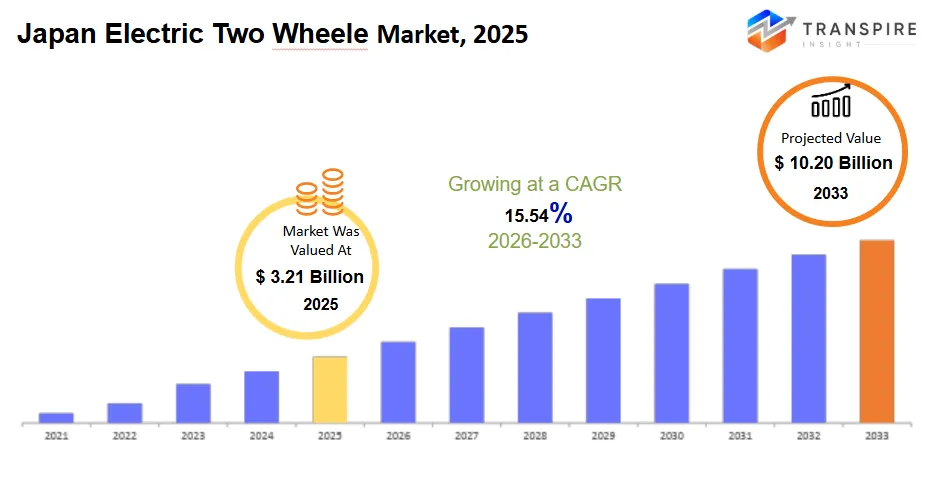
As per Transpire Insight Analysis theJapan Electric Two Wheeler Market size is estimated at USD 3.21 Billion in 2025 and is anticipated to reach USD 10.20 Billion by 2033, growing at a CAGR of 15.54% from 2026 to 2033.
The Japan Electric Two Wheeler Market supports city movement a bit better by offering efficient, low-emission rides for everyday commuting , commercial deliveries, and also shared mobility programs. Electric motorcycles and scooters contribute to less fuel reliance , cheaper day to day operations, and help ease congestion in densely populated areas, all while aligning with Japan’s carbon neutrality goals.
In the last five years, the whole market has basically gone through a structural change from conventional gasoline driven two wheelers to battery powered models. This shift is tied to progress in lithium-ion batteries, smarter connected vehicle systems, and even battery swapping facilities that are becoming more common. Then Japan’s Green Growth Strategy got rolling, plus stricter vehicle emission rules, which pushed automakers to invest faster.At the same time, global fuel price swings , plus some supply chain disruptions after the COVID-19 pandemic made consumers and fleet operators start hunting for more cost effective transit choices, rather than just clinging to the old approach.
As a result, adoption has crept up across private use and business fleets too, and it has carved out new revenue pathways for vehicle manufacturers, battery companies, charging infrastructure providers, as well as mobility service operators.
Japan Electric Two Wheeler Market Size & Forecast:
- Japan Electric Two Wheeler Market Size 2025: USD 3.21 Billion
- Expected Market Value 2033: USD 10.20 Billion
- Forecast CAGR: 15.54%
- Leading region in 2025:Kanto
- Fastest Growing region:Chubu
- Key Profile: Yamaha Motor, Honda Motor, Suzuki Motor, Kawasaki Motors, Terra Motors, NIU Technologies, Gogoro, Vmoto, Yadea Group, Segway-Ninebot, Panasonic Energy, Toyota Industries, KYMCO, Hero MotoCorp, Okinawa Autotech
Key Market Insights
- Kanto kind of dominates the Japan Electric Two Wheeler market with around 39% of share in 2025, mostly because the urban population density stays high, and there’s solid commercial delivery demand too.
- Kansai is likely to be the quickest-growing regional market through 2033. That’s tied to municipal decarbonization programs and the continuing expansion of charging infrastructure, even when timelines vary a bit.
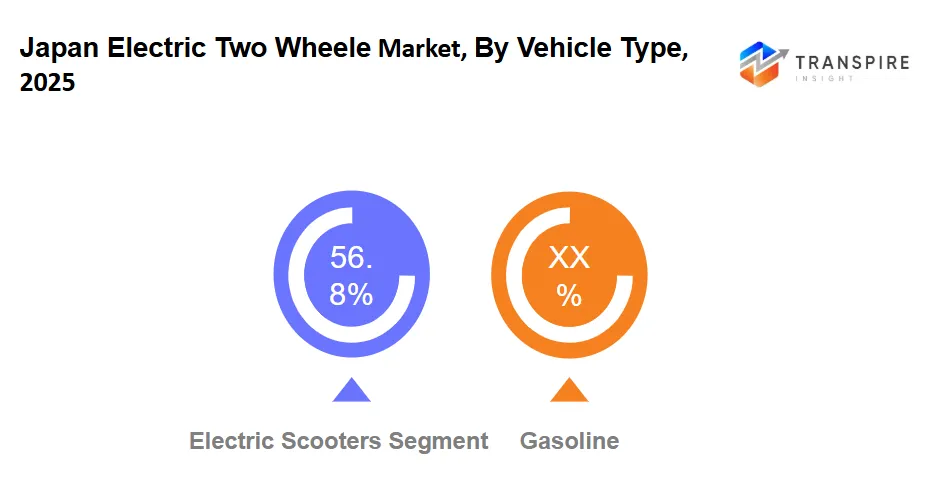
- For the product lineup, electric scooters lead the way with nearly 48% market share in 2025, since they’re practical for street commuting and delivery operations, generally speaking.
- Electric motorcycles sit in second place as buyers increasingly chase higher performance and an extended battery range, not just basic commuting.
- Battery-swapping compatible vehicles are forecast to show the fastest growth from 2026 to 2033, supported by the roll out of battery-swapping infrastructure across more locations.
- When we look at applications, personal commuting stays dominant, hitting about 56% of market demand in 2025, especially across major metropolitan areas.
- Commercial last-mile delivery fleets are becoming the fastest-growing application area as logistics firms electrify urban operations to cut operating expenses.
- For end users, individual consumers remain the leading segment, while food delivery, courier services, and rental fleet operators are the fastest-expanding customer group overall.
- Key companies like Honda Motor, Yamaha Motor, Suzuki Motor, Terra Motors, Gogoro, and NIU Technologies keep pushing their competitive positions via battery innovation, strategic alliances, and connected mobility solutions that are, frankly, becoming more important.
- Manufacturers also collaborate more often on standardized batteries, digital connectivity, and battery-swapping ecosystems, so convenience improves and electric two wheeler adoption can accelerate faster.
What are the Key Drivers, Restraints, and Opportunities in theJapan Electric Two Wheeler Market?
Japan is pushing hard for carbon neutrality, and the transport sector decarbonization agenda is sort of the main spark behind electric two wheeler adoption. The Government keeps backing low emission mobility , and at the same time lithium ion battery technology has been improving, plus day to day operating costs are getting lower too. That combo makes it easier for manufacturers to roll out wider lineups of models. On the commercial delivery side, fleet electrification is moving even faster, since electric vehicles typically cut fuel spending and also reduce maintenance hassles, so operators see better operating margins over time. It also helps them stay in compliance with environmental rules , so everyone benefits in a way.
Still though, there are structural roadblocks. Charging infrastructure is limited beyond the big urban areas, and the upfront purchase price for electric motorcycles is still relatively high. Also battery production relies on critical minerals, and those global supply chains can swing around a lot which makes short term cost reductions difficult. Consumers are also turned off by range limitations and the long charging times , especially people who regularly go further distances. That means adoption can slow down, and it constrains market revenue potential.
Looking ahead, battery swapping technology looks like one of the stronger long term opportunities for this market. If manufacturers coordinate and standardize removable battery systems, it can cut charging downtime noticeably, and improve fleet utilization. Companies like Honda, Yamaha, Suzuki, Kawasaki, and Gogoro are working together to grow battery swapping ecosystems, which creates better conditions for commercial fleets, city commuters, and shared mobility providers . In turn, this should support sustained industry expansion through 2033.
What Has the Impact of Artificial Intelligence Been on theJapan Electric Two Wheeler Market?
Artificial intelligence along with advanced digital technologies are kinda shifting Japan’s electric two wheeler industry, not just in a small way, but by boosting vehicle efficiency, getting better battery management, supporting predictive maintenance, and making fleet operations more organized. More and more manufacturers are putting in AI driven battery management systems that keep an eye on battery temperature, how charging actually happens, and the cell health status, so they can stretch battery life and also fine tune energy use. Machine learning then goes on to study riding patterns, weather conditions, and even traffic signals, which helps estimate the remaining driving range with less guesswork, and it can nudge riders or systems toward more efficient routes. For fleet operators, AI enabled telematics platforms are also showing up, these help track vehicle utilization, arrange preventive servicing, spot abnormal component behavior early , and avoid the surprise kind of downtime that messes up schedules. In the end, those improvements tend to raise fleet availability, reduce maintenance expenses , and support smoother daily operations for commercial delivery services.
AI is also backing intelligent manufacturing, by raising production quality through automated visual inspections, predictive checks for equipment health, plus supply chain optimization, in a very practical sense. Connected vehicles are increasingly folding in cloud based analytics, which can push over the air software updates and keep refining vehicle performance over time. Still, full scale AI use is limited, mainly because integration costs can be high , cybersecurity demands are non optional, and big operational datasets for electric two wheelers are not always readily available. Smaller manufacturers in particular often struggle with adding these advanced AI platforms, because investment requirements stack up , and compatibility questions show up with existing vehicle architectures, which then slows broader adoption across the industry.
Key Market Trends
- Battery-swapping partnerships really took off after 2021, which meant less charging downtime and, kinda more importantly, better day to day output for commercial fleets.
- Japanese manufacturers also started pushing connected electric scooters, with smartphone integration in a way that feels pretty seamless, plus remote diagnostics and over-the-air software updates.
- Between 2021 and 2026, lithium-ion battery energy density improved steadily, so practical riding range went up, while the battery weight went down, not instantly but in that gradual way.
- Last mile logistics companies leaned harder into fleet electrification too, partly because fuel price volatility kept climbing, raising the real total operating cost of conventional motorcycles.
- At the same time, manufacturers moved investment toward standardized removable battery platforms , mainly to boost interoperability across multiple vehicle brands, rather than keeping everything locked into one ecosystem.
- Urban municipalities after 2022 increasingly backed low-emission mobility, through expanded charging infrastructure and sustainable transport initiatives , which helped reduce friction for end users.
- AI-enabled battery monitoring systems became more common as well, helping predictive maintenance efforts, and in turn extending battery service life across commercial fleets.
- Premium electric motorcycles with connected safety technologies also saw stronger consumer acceptance, and that lines up with the fact that battery performance kept getting better.
- International players like NIU Technologies, Yadea Group, and Gogoro expanded their strategic footprint through technology partnerships , distribution deals, and related agreements.
- Overall, competition has been shifting away from pure hardware differences , toward integrated software platforms, battery ecosystems, and digital mobility services.
Japan Electric Two Wheeler Market Segmentation
By Source
Lithium-ion battery tech still takes the largest share, mainly due to high energy density, a longer operating life, and faster charging in practice, which helps for everyday commuting plus commercial transportation. Lead-acid battery models keep showing up in entry-level products where the lower purchase cost is still a big consideration, kinda obvious but, yeah. Solid-state battery research keeps pulling investment because better safety and higher energy density may translate into stronger future vehicle performance. A few other battery approaches stay around, but only in a smaller way, for specialized uses and ongoing research programs.
Choosing a battery affects vehicle range, charging time, the amount of maintenance involved, and the whole total ownership cost. Lithium-ion solutions continue spreading across premium scooters and motorcycles as battery prices slowly ease down. Lead-acid options are still around for budget-focused models meant for short-distance travel. Solid-state batteries, once they move into wider commercialization, should open up new opportunities when production ramps up and manufacturing costs get more competitive.
By Product Type
Electric scooters kinda sit at the front of the pack, mainly because they’re small and manageable, and the day to day operating costs stay pretty low which works well for jammed urban roads. Electric motorcycles, on the other hand, pull in people who want more speed, a higher power output, and also an extended ride distance for regular transportation. Electric mopeds still seem to hold their ground for short-distance commutes and neighborhood travel, since the lighter build makes them easier to run and get comfortable with. Other vehicle kinds exist too, they cover more specific mobility needs across commercial tasks and recreational outings, depending on what someone is doing.
Product development keeps going with a push toward more battery range, smarter connected features, and better riding comfort overall. Electric scooters also get a boost from growing delivery services, plus the fact that daily commuting keeps rising in big metropolitan areas. Electric motorcycles gain more attention as battery performance improves, and as premium tech integration shows up more often. Electric mopeds stay in steady demand among users who want economical personal transportation, without overcomplicating things.
By Application
Battery capacity under 2 kWh fits light vehicles made for short city trips and more relaxed, low-speed movement. The 2–4 kWh band is the one that takes the lead, mainly because a steady driving range , easier charging, and reasonable costs line up with everyday transport needs. When you go above 4 kWh , battery systems start serving premium motorcycles that want stronger performance and longer way-finding capability. Picking the capacity right away affects the vehicle price, real-world efficiency, and what customers tend to favor.
Over time , manufacturers keep refining battery chemistry so drivers can go farther, but without stacking on much extra vehicle weight. Mid-capacity packs stay the go-to choice since their practical output matches typical commuting rhythms in the city. Bigger capacity batteries are still being used more often in business fleets and higher-end motorcycles , where longer operation means fewer charging stops. Meanwhile, lower-capacity batteries keep their role too, especially for compact mobility ideas where the trip distance stays pretty predictable.
By End User
A voltage under 48V really supports compact electric vehicles, used more for short-distance transportation and that kind of neighborhood travel. The 48V–60V range still takes the lead, since it hits a nice balance for power delivery and overall energy efficiency, so most urban riders get what they need. Anything above 60V tends to end up on high-performance motorcycles, where you want stronger acceleration and the ability to keep higher operating speeds. Picking the right voltage, affects motor behavior, battery efficiency, and how capable the whole vehicle becomes.
Manufacturers keep rolling out better power management systems, and they boost efficiency across multiple voltage platforms. Mid-voltage options stay a good match for commercial deliveries and personal commuting, because the performance feels dialed in for daily transportation. High-voltage platforms are also expanding, especially in premium vehicle categories that demand more driving capability. Meanwhile, lower-voltage vehicles are still appealing for budget friendly, entry-level mobility solutions, since they cost less and can cover basic use.
By Distribution Channel
OEM dealerships still take the biggest chunk , mostly because shoppers really like seeing the product in action, and they also want clear financing choices, warranty coverage and that after sale kind of help before they commit. Online sales keep growing too, since digital platforms make it easier to compare models, place orders, and even sort out financing with less friction . Then there are multi brand dealers , they kind of work as a one stop showroom where buyers can look at several manufacturers side by side . Other routes help fill in the gaps for regional needs and more specific purchasing situations, so the whole thing doesn’t feel so limited.
Over time, digital retail plans keep reshaping how customers buy, and you can see that across the industry . Manufacturers are leaning harder into dealership networks, but at the same time they’re pushing online platforms to extend their reach . Multi brand dealers stay relevant, since some buyers want both sharp pricing and a wider set of options . In the end, distribution diversification just helps people get access in both city centers and outlying areas , which matters a lot for overall coverage .
What are the Key Use Cases Driving theJapan Electric Two Wheeler Market?
Urban commutes still seem to be the biggest use case, since electric scooters deliver quick movement across crowded areas and that also cuts down operating expenses , a lot. People going out every day for work, school, and personal errands create a fairly steady need for vehicles, especially in dense metropolitan zones where parking is tight and traffic makes compact transport feel more reasonable
Also, commercial delivery services and shared mobility programs keep growing. Logistics companies are getting more operationally efficient by switching to electric vehicle fleets . That helps food delivery groups, courier businesses, and rental operators, because they see less servicing , steadier day-to-day expenses, and better fleet utilization across city transport routes.
On top of that, battery swapping mobility services, plus connected fleet management applications are starting to look like the emerging angles with real staying power. Smart city transit initiatives, autonomous fleet monitoring, and AI-driven vehicle oversight tools continue to draw investment too, which opens additional chances for mobility providers and technology developers throughout the forecast window.
|
Report Metrics |
Details |
|
Market size value in 2025 |
USD 3.21 Billion |
|
Market size value in 2026 |
USD 3.71 Billion |
|
Revenue forecast in 2033 |
USD 10.20 Billion |
|
Growth rate |
CAGR of 15.54% from 2026 to 2033 |
|
Base year |
2025 |
|
Historical data |
2021 - 2024 |
|
Forecast period |
2026 - 2033 |
|
Report coverage |
Revenue forecast, competitive landscape, growth factors, and trends |
|
Regional scope |
Japan |
|
Key company profiled |
Yamaha Motor, Honda Motor, Suzuki Motor, Kawasaki Motors, Terra Motors, NIU Technologies, Gogoro, Vmoto, Yadea Group, Segway-Ninebot, Panasonic Energy, Toyota Industries, KYMCO, Hero MotoCorp, Okinawa Autotech |
|
Customization scope |
Free report customization (country, regional & segment scope). Avail customized purchase options to meet your exact research needs. |
|
Report Segmentation |
By Vehicle Type (Electric Scooters, Electric Motorcycles, Electric Mopeds, Electric Bicycles, Others); By Battery Type (Lithium-ion, Lead Acid, Solid-State, Others); By Battery Capacity (Below 2 kWh, 2–4 kWh, Above 4 kWh, Others); By Sales Channel (OEM Dealerships, Online Sales, Multi-Brand Dealers, Others); By End User (Personal Use, Commercial Fleets, Delivery Services, Others) |
Which Regions are Driving the Japan Electric Two Wheeler Market Growth?
Kanto region still looks like the biggest contributor to market revenue, mostly because Tokyo plus the surrounding prefectures, kinda stack strong purchasing power with newer urban transportation policies, that push electric mobility. Local governments keep expanding charging stations and backing low emission transit using sustainability initiatives, that also fit the national carbon reduction plan. And because there’s so much dense commercial activity, you get steady demand from courier services, food delivery operators, and shared mobility providers. Over time, a pretty mature network of vehicle makers, battery suppliers, dealerships, and tech companies forms, which helps the market stay in a leadership position for a long time and keeps new product adoption moving.
Kansai region gives a more steady type of contribution, with a growth style that’s based on existing manufacturing muscle and ongoing industrial investment. Osaka, Kyoto, and Kobe benefit from solid engineering know how, dependable supplier networks, and relatively calm but consistent consumer demand rather than the heavy metro density you see in Kanto. Regional businesses keep switching out conventional two wheelers for electric versions, aiming for better day to day operating efficiency and lower fuel costs. Plus, stable economic conditions and continuous infrastructure upgrades make Kansai a reliable, long term revenue source.
Chubu region is expected to show the quickest growth across the 2026–2033 forecast window as manufacturing investment and smart mobility programs pick up pace in major industrial cities. In particular, the recent push around battery production facilities, vehicle testing schedules, and cleaner transportation initiatives has created favorable circumstances for electric two wheeler deployment.
Who are the Key Players in theJapan Electric Two Wheeler Market and How Do They Compete?
Competition stays kind of moderately consolidated, with established Japanese manufacturers still in the mix, alongside international electric mobility specialists, and it’s not just one lane anymore. What really separates products mostly comes down to battery tech, how the vehicle performs, digital connectivity, and after-sales service, not pricing by itself. The older motorcycle brands keep pushing to hold market share by leaning on wide dealer networks and that familiar brand recognition, while the newer entrants tend to aim for connected mobility platforms plus battery-swapping ecosystems, mainly to pull in urban customers who want convenience fast.
Honda Motor is trying to expand practical urban mobility via standardized battery technologies and partnerships, backing battery swapping in a more systematic way. Yamaha Motor tends to set itself apart by mixing powertrain efficiency development with connected-vehicle features that are geared for both commercial and personal mobility use cases. Suzuki Motor leans into lightweight electric models so affordability gets better, while also using the existing manufacturing know-how and its domestic distribution strengths.
Gogoro builds a competitive edge by investing in battery-swapping infrastructure, not only vehicle sales, so they can create a wider mobility ecosystem for fleet operators as well as individual riders. Terra Motors concentrates on commercial mobility solutions and fleet electrification projects across several Asian markets. NIU Technologies, on the other hand, strengthens its market presence through smart electric scooters that include IoT connectivity, mobile applications, and cloud-based vehicle management systems.
Overall these strategies let companies compete through technology innovation, mobility services, and strategic partnerships rather than going head-to-head on price only, and yeah, that distinction really matters.
Company List
- Yamaha Motor
• Honda Motor
• Suzuki Motor
• Kawasaki Motors
• Terra Motors
• NIU Technologies
• Gogoro
• Vmoto
• Yadea Group
• Segway-Ninebot
• Panasonic Energy
• Toyota Industries
• KYMCO
• Hero MotoCorp
• Okinawa Autotech
Recent Development News
In April 2026, Honda Motor announced that it made Gachaco a consolidated subsidiary by subscribing to newly issued shares. The move strengthens Japan's battery-swapping infrastructure for electric motorcycles and supports wider deployment of standardized swappable battery services.https://global.honda/en
In September 2025, Gogoro announced a 1-for-20 share consolidation to regain compliance with Nasdaq listing requirements. The action supports the company's financial strategy as it continues expanding its battery-swapping ecosystem and electric mobility business.https://gogoro.gcs-web.com
In August 2025, Yamaha Motor expanded its portfolio of Gogoro-powered electric scooters with the launch of the CUXiE model. The launch strengthened the battery-swapping ecosystem and broadened electric scooter choices for urban riders.https://gogoro.gcs-web.com
What Strategic Insights Define the Future of theJapan Electric Two Wheeler Market?
The market is shifting toward integrated mobility ecosystems, where vehicles, battery packs, charging backbone, digital connectivity, and fleet management services kinda work like one unified platform , not separate things you buy as stand alone products. Battery standardization, software-enabled vehicle oversight, and commercial fleet electrification will probably matter more as competitive strengths, than just the vehicle specs alone. There’s also a less obvious risk that doesn’t get much attention , which is the ongoing reliance on imported battery ingredients, that could still leave manufacturers exposed to raw material price swings and supply interruptions even while sales keep looking strong.
Battery-swapping infrastructure is turning into an interesting upside though, especially as standardized systems get actually practical and commercially viable across different manufacturers. Firms that go early on interoperable battery frameworks, AI-powered fleet management, and serious infrastructure partnerships should be better placed to hang onto long-term market share and also earn recurring revenue that goes beyond vehicle sales between 2026 and 2033.
Japan Electric Two Wheeler Market Report Segmentation
By Source
• Post-Consumer PET
• Post-Industrial PET
• Bottle Flakes
• Others
By Product Type
• rPET Flakes
• rPET Pellets
• rPET Fibers
• rPET Sheets
• Others
By Application
• Bottles
• Packaging
• Textiles
• Automotive Components
• Consumer Goods
• Construction
• Others
By End User
• Packaging Industry
• Textile Industry
• Automotive
• Food & Beverage
• Consumer Goods
• Others
By Distribution Channel
• Direct Sales
• Recycling Companies
• Distributors
• Others
Frequently Asked Questions
Find quick answers to common questions.
The expectedJapan Electric Two Wheeler Market size for the market will be USD 10.20 Billion in 2033.
Key segments for theJapan Electric Two Wheeler Market are By Vehicle Type (Electric Scooters, Electric Motorcycles, Electric Mopeds, Electric Bicycles, Others); By Battery Type (Lithium-ion, Lead Acid, Solid-State, Others); By Battery Capacity (Below 2 kWh, 2–4 kWh, Above 4 kWh, Others); By Sales Channel (OEM Dealerships, Online Sales, Multi-Brand Dealers, Others); By End User (Personal Use, Commercial Fleets, Delivery Services, Others)
MajorJapan Electric Two Wheeler Market players are Yamaha Motor, Honda Motor, Suzuki Motor, Kawasaki Motors, Terra Motors, NIU Technologies, Gogoro, Vmoto, Yadea Group, Segway-Ninebot, Panasonic Energy, Toyota Industries, KYMCO, Hero MotoCorp, Okinawa Autotech
The Japan Electric Two Wheeler Market size is USD 3.21 Billion in 2025
The Japan Electric Two Wheeler Market CAGR is 15.54% from 2026 to 2033.
- Yamaha Motor
• Honda Motor
• Suzuki Motor
• Kawasaki Motors
• Terra Motors
• NIU Technologies
• Gogoro
• Vmoto
• Yadea Group
• Segway-Ninebot
• Panasonic Energy
• Toyota Industries
• KYMCO
• Hero MotoCorp
• Okinawa Autotech
About the Authors

Mayur Shinde
I am Mayur Shinde, a Senior Research Analyst at Transpire Insight, specializing in the Automotive & Transportation and Information & Communication Technology (ICT) Industry. My work focuses on analyzing emerging market trends, technological advancements, competitive landscapes, and industry developments to deliver accurate, data-driven insights. I am passionate about transforming complex market information into clear, actionable content that helps businesses, professionals, and decision-makers stay informed and make confident strategic decisions.

Chakradhar Khansole
Chakradhar serves as the Research Director at Transpire Insight, bringing over 8 years of experience in technology, innovation, and strategic market intelligence. He specializes in transforming complex market data into actionable business insights that enable organizations to make informed, growth-oriented decisions. Recognized for his strategic vision and analytical expertise, Chakradhar leads high-impact research initiatives, delivering comprehensive market assessments, competitive intelligence, and forward-looking industry analysis.
Recently Published Reports
-
Apr 2026
ATV & UTV Market
ATV & UTV Market Size, Share & Analysis Report By Type (ATV, and UTV), By Variants (Less Than 400 CC, 400 CC To 800 CC, and More Than 800 CC), and Geography (North America, Europe, Asia-Pacific, Middle East and Africa, South and Central America), 2021 - 2031
-
Apr 2026
Automotive Central Gateway Module Market
Automotive Central Gateway Module Market Size, Share & Analysis Report By Type (Ethernet Central Gateway Module, CAN Central Gateway Module, LIN Central Gateway Module, and FlexRay), By Application (Powertrain Control, Body Control, Infotainment System, Advanced Driver Assistance Systems (ADAS), and Others), By End User (Passenger Vehicles, and Commercial Vehicles), and Geography (North America, Europe, Asia-Pacific, Middle East and Africa, South and Central America), 2021 - 2031
-
Apr 2026
Automotive Engine Oil Filter Market
Automotive Engine Oil Filter Market Size, Share & Analysis Report By Filter Type (Fuel Filter, Engine Oil Filter, Hydraulic Oil Filter, and Others), By Filter Media (Cellulose, Synthetic, and Micro), By Sales Channel (OEMs, and Aftermarket), By Vehicle Type (Passenger Cars, Light Commercial Vehicles, Heavy Duty Trucks, Buses and Coaches, and Off-road Vehicles), and Geography (North America, Europe, Asia-Pacific, Middle East and Africa, South and Central America), 2021 - 2031
-
Apr 2026
Automotive Parts Aluminium Die Casting Market
Automotive Parts Aluminium Die Casting Market Size, Share & Analysis Report By Production Process (Pressure Die Casting, Vacuum Die Casting, Squeeze Die Casting, Gravity Die Casting), By Application (Body Parts, Engine Parts, Transmission Parts, Battery And Related Components, Other Application Types), and Geography (North America, Europe, Asia-Pacific, Middle East and Africa, South and Central America), 2021 - 2031
Our Clients