South Korea Electric Two-wheeler Market Summary:
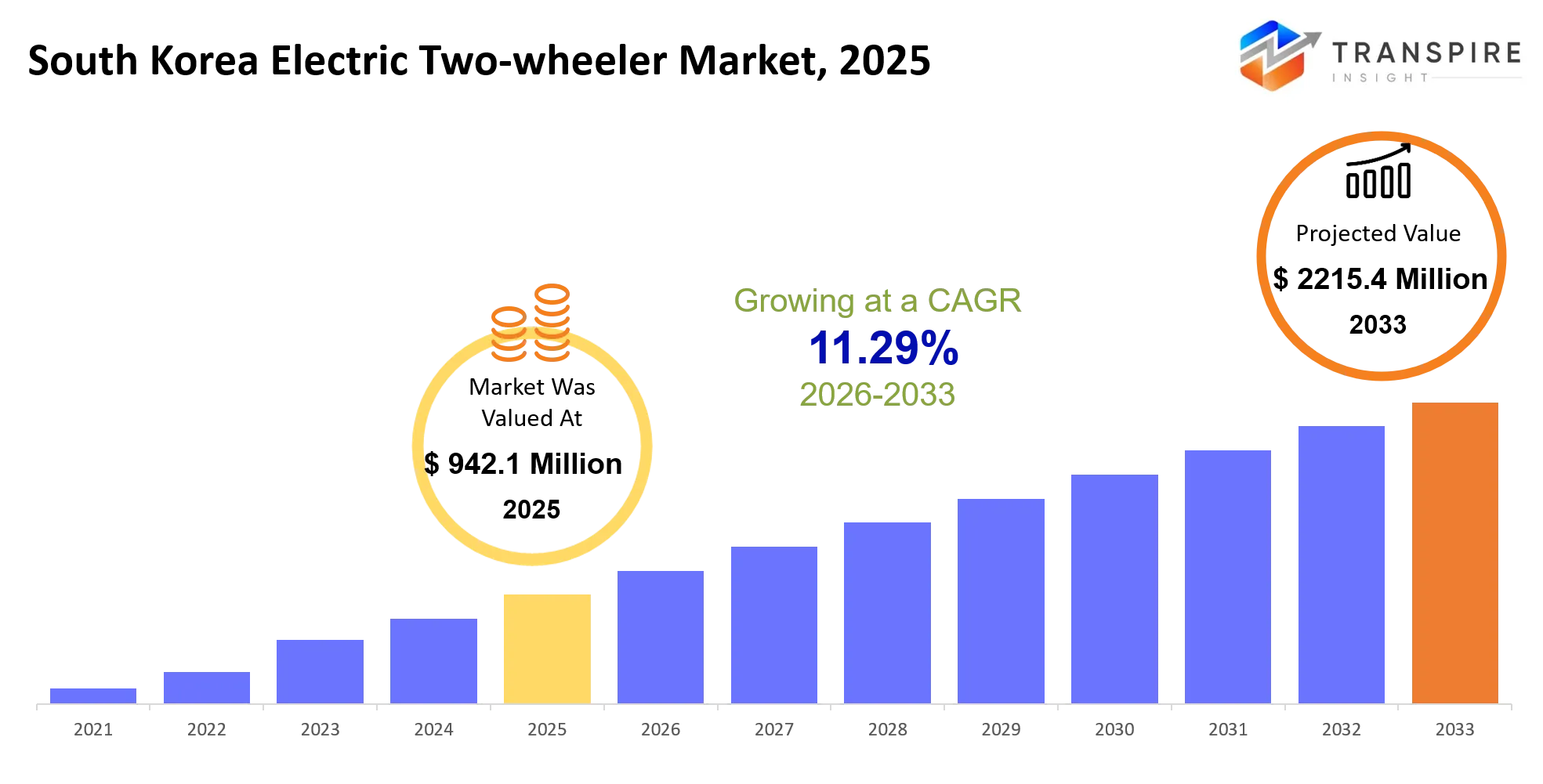
According to Transpire Insights, a detailed research report on the South Korea Electric Two-wheeler Market reflects that the electric scooter segment represents a major component of the market, supported by expanding urban e-mobility adoption, government incentives, improving battery technology, and increasing demand for efficient low-emission transportation. The South Korea electric two-wheeler market was valued at approximately USD 942.1 million in 2025 and is projected to reach USD 2,518.5 million by 2034, registering a CAGR of 11.20% during 2026–2034. Within the related electric scooter market, hub motors accounted for approximately 88.24% of revenue in 2025, highlighting the strong adoption of hub-motor-based electric mobility solutions.
Market Snapshot
- Market Value (2025): USD 942.1 Million.
- Expected Market Value (2026): USD 1047.5 Million.
- Estimated Market Value (2033): USD 2215.4 Million.
- Forecast CAGR (2026–2033): 11.29%
Introduction
The South Korea Preterm Birth Prevention and Management Market comprises all the processes relating to the discovery, production, distribution, and utilization of pharmaceuticals, medical devices, diagnostic techniques, and digital healthcare products that are used for preventing, delaying, diagnosing, and managing premature birth. This market consists of such solutions as progesterone therapy, tocolytics, corticosteroids, antibiotics, magnesium sulfate, cervix cerclage devices, fetal monitoring systems, biomarkers’ analysis, and ultrasound-based measurement of cervix length. South Korea’s well-developed healthcare industry, well-established network of maternity and neonatology centers, as well as increasing popularity of reproductive technologies contribute to the need for effective solutions for the management of preterm birth in the region. In addition, increasing focus on early detection of risks, monitoring of maternal and fetal state, non-invasive interventions, and evidence-based protocols encourages innovations.
Key Market Highlights: -
- By Vehicle Type, the Electric scooters dominated the market and holds approximately 85% share in 2025 and is projected to grow at a substantial CAGR during the forecast period.
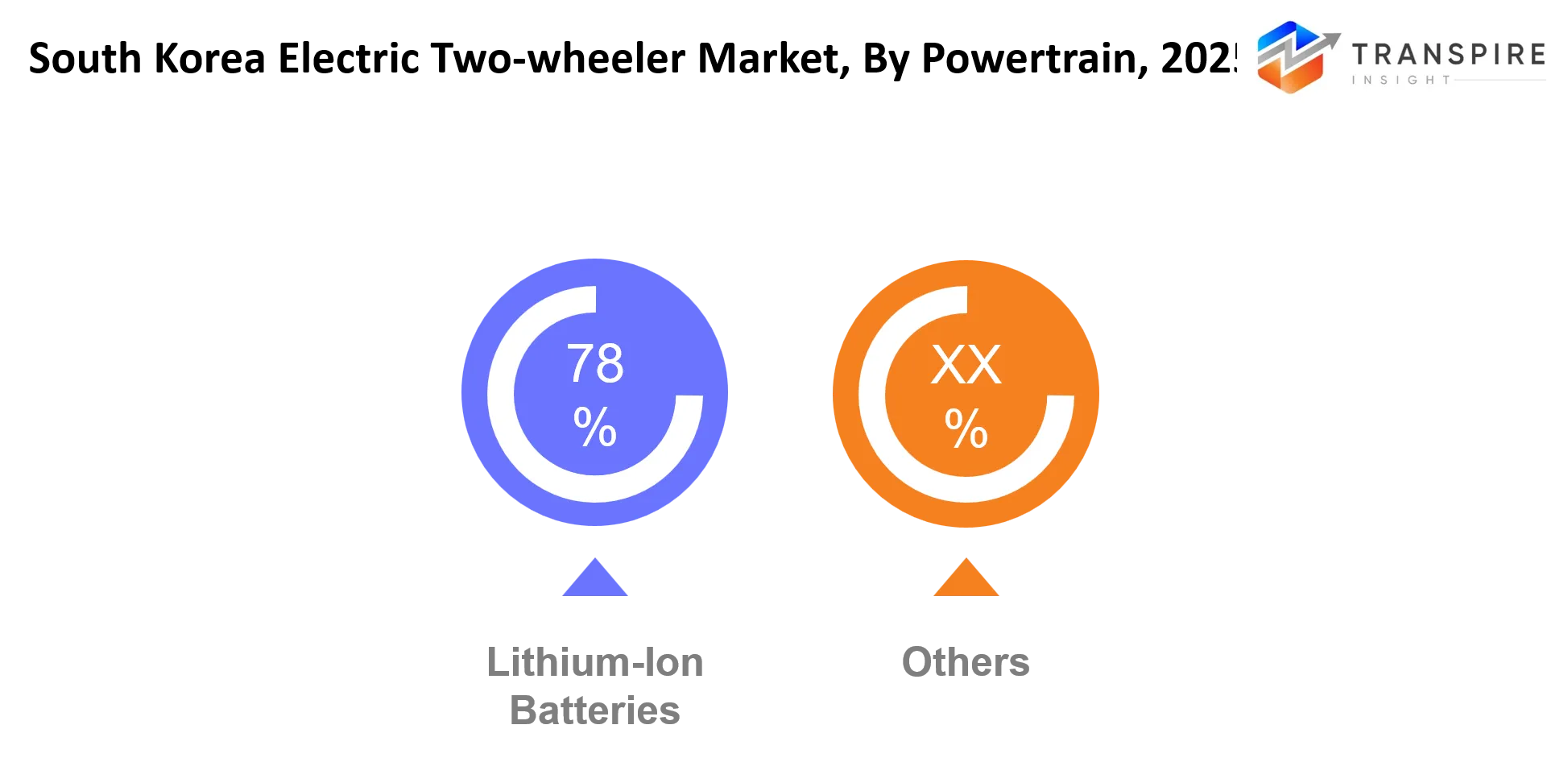
- By Battery, the Lithium-Ion dominated the market and holds approximately 57.2%share in 2025 and is projected to grow at a substantial CAGR during the forecast period.
- By Range, the Fetal Fibronectin (fFN) Testing dominated the market and holds approximately 40.61% share in 2025 and is projected to grow at a substantial CAGR during the forecast period.
- Preventive efforts against preterm births have been improved by South Korea due to financial assistance for pregnant women in terms of medical costs, increased coverage of neonatal care services, and other vital measures.
How is Technology Driving Growth in the South Korea Electric Two-wheeler Market?
Technology is propelling the South Korea Electric Two-wheeler Market with innovations like efficient batteries, electric engines, battery swapping technology, and intelligent mobility solutions. The use of efficient lithium-ion batteries increases the efficiency of operation and range of operations, whereas high torque engines increase performance in the city and in delivery scenarios. The battery swapping solution reduces downtime for charging and hence supports efficient use of the two-wheelers in high usage commercial riding scenarios. Smart mobility solutions allow for monitoring of battery status, diagnostic checks, navigation, maintenance alerts, and security applications. In addition, South Korea is building infrastructure based on the KS standard battery swapping system to increase interoperability and efficiency of the process.
Market Drivers
The market of South Korea Electric Two-wheeler is fueled by government incentives, rising commercial delivery needs, reduced operating costs, development of battery swapping infrastructure, and environmentally friendly mobility policies. Incentives provided by the government decrease initial costs of purchasing these vehicles and help speed up the changeover process from internal combustion motorcycles to electric two-wheelers. There is an increasing adoption of electric two-wheelers in commercial delivery due to their suitability in crowded cities and repeated usage. Moreover, reduced maintenance and energy costs make ownership more economically advantageous. On the other hand, the development of battery swapping infrastructure according to the KS standard increases the efficiency of such use.
Restrain
Among the constraints that will impede the South Korea Electric Two-Wheeler Market include reduced purchase incentive programs, battery range restrictions, lack of access to chargers, high initial cost of vehicles, and volatility of prices for battery materials. Lack of charger access will be especially challenging for those users who will use their vehicles in locations away from the big cities. Deterioration of batteries and the downtime associated with charging may limit the usage of the vehicles in some business scenarios.
|
Driver |
Relative Impact on Growth (%) |
Geographic Relevance |
Impact Timeline |
Demand Strength |
Growth Mechanism |
Key Beneficiaries |
Major Constraint |
|
Driver 1: Government Subsidies and ICE-to-Electric Conversion Programs |
28% |
Seoul, Gyeonggi, Incheon, major metropolitan areas |
Short-term |
High |
Reduces upfront prices and accelerates electric motorcycle adoption. |
Manufacturers, dealers, delivery riders, end users |
Subsidy budgets and eligibility restrictions can limit adoption. |
|
Driver 2: Electrification of Delivery and Last-Mile Mobility |
24% |
Seoul, Gyeonggi, Busan, Incheon |
Short-term |
High |
High-utilization delivery fleets favor lower operating-cost electric vehicles. |
Delivery platforms, fleet operators, riders, manufacturers |
Battery range and charging downtime constrain intensive utilization. |
|
Driver 3: Battery-Swapping and Charging Infrastructure Expansion |
20% |
Seoul and dense urban delivery corridors |
Medium-term |
High |
Battery swapping reduces charging downtime and improves fleet productivity. |
Battery providers, swapping operators, fleet owners, riders |
Interoperability and infrastructure coverage remain limited. |
|
Driver 4: Battery, Motor and Connected-Vehicle Technology Advancements |
16% |
Nationwide, especially technology-intensive urban markets |
Medium-term |
Medium |
Better batteries and smart systems improve range, efficiency, safety, and usability. |
Battery makers, OEMs, software vendors, consumers |
High technology costs can increase vehicle purchase prices. |
|
Driver 5: Urban Sustainability and Low-Emission Transportation Policies |
12% |
Seoul, metropolitan cities, environmentally regulated urban areas |
Long-term |
Medium |
Emission reduction policies encourage replacement of conventional motorcycles. |
Cities, OEMs, fleet operators, environmentally conscious riders |
Limited consumer willingness beyond financial incentives. |
Analysis of Prices and Consumer Behaviour
The South Korea Electric Two-wheeler Market is characterized by government-led adoption, as the national program for 2025 plans to deploy 20,000 electric two-wheelers, offering KRW 16 billion purchase subsidies. Further, battery-swapping facilities are gaining investment worth KRW 5 billion for 500 facilities, enhancing commercial delivery and highly used scenarios. Battery-swapping electric two-wheelers have been getting 70% performance-based subsidy in 2025 compared to 60% previously, making them relatively more attractive. Electric scooters dominate the vehicle type market segment, while the hub motors segment constitutes around 88.24% revenue share in the South Korean electric scooter market in 2025. The market was valued at about USD 942.1 million in 2025 and expected to reach about USD 2.52 billion by 2034, registering an 11.20% CAGR.
|
Company |
Est. Revenue Share Range |
Key Offerings |
Strategic Positioning |
Geographic Strength |
Technology Focus |
|
DNA Motors |
14–18% |
eCITI, EM-1D, EM-1S, D-STATION |
Domestic scale and integrated electric-mobility positioning |
South Korea, Asia-Pacific |
Battery swapping, electric powertrains, connected mobility |
|
Daedong Mobility |
10–14% |
GS100, GS100 Lite, BSS-compatible scooters |
Domestic manufacturing and service-network differentiation |
South Korea, Asia-Pacific |
PMSM motors, telematics, BSS, smart maintenance |
|
WACCO Motors |
8–12% |
X10, X10A, E7S |
Performance-focused domestic electric-scooter differentiation |
South Korea, selected overseas markets |
High-output motors, dual-battery architecture, BSS |
|
KIMST |
6–9% |
DICE, DICE SUPER, DICE TRUCK |
Value-oriented electric motorcycle specialization |
South Korea |
High-output motors, lithium-ion batteries, BSS compatibility |
|
KR Motors |
5–8% |
E-Lution, E-SKO electric models |
Established motorcycle platform with EV diversification |
South Korea, Southeast Asia |
Swappable batteries, EV powertrains, standardized batteries |
|
Enuri |
4–7% |
OK1 KS, OK1 KooRoo Pro, OK1 Solo, YOLO |
Delivery-focused product and battery ecosystem strategy |
South Korea |
KS-standard batteries, BSS compatibility, extended range |
|
DOTSTATION |
3–6% |
EV-C1, Gogoro S2, Gogoro 2 Plus, Gogoro 2 Utility |
Battery-swapping ecosystem and smart-scooter specialization |
South Korea, Asia-Pacific |
Battery swapping, IoT apps, smart security systems |
|
MAC MOTORS |
2–5% |
MONSTER S, MONSTER X |
Premium high-performance electric-scooter positioning |
South Korea |
Large-capacity batteries, fast charging, ABS, connected systems |
|
NIU Korea / Enable International |
2–4% |
NQi GTS, NQi Pro, NQi Pro B26, UQi Pro |
Smart imported-scooter and urban mobility positioning |
South Korea, Europe, Asia-Pacific |
Smart connectivity, lithium-ion batteries, digital mobility |
|
KooRoo |
2–4%* |
O.Station, G.Station, battery-swapping services, mobility subscriptions |
Battery-swapping infrastructure and mobility ecosystem |
South Korea |
BSS, KS-standard batteries, mobility platforms, energy management |
Who are the Key Players in the South Korea Electric Two-wheeler Market and how do they compete?
Competitiveness of South Korea Electric Two-wheeler Market is based on companies focusing on innovations in technology, solutions in electric mobility, and creating networks of distribution at a global level. Firms compete not only through prices but also through their use of durable vehicles, advanced technologies, smart solutions and integration with digital and mobility platforms; thus, such approach to competitiveness results in constant product development as well as increasing efficiency, resources optimization, performance and visibility of vehicles.
Thanks to its development of intelligent electric two-wheelers, precision mobility solutions, autonomous solutions and connected equipment, Deere & Company strengthens its market position. Thanks to the high-performance electric mobility solutions developed for urban transport, last-mile mobility and commercial deliveries, CNH Industrial stands out among its competitors. AGCO Corporation builds up its market position by integrating solutions in electric mobility, automation, connected technologies and smart transportation, helping customers increase their productivity and efficiency.
Top Companies in the South Korea Electric Two-wheeler Market
- Hyundai Motor Group
- Kia
- LG Energy Solution
- Samsung SDI
- SK On
- Gogoro
- NIU Technologies
- Yadea
- Segway-Ninebot
- Yamaha Motor
- Honda
- Suzuki
- BMW Motorrad
- Zero Motorcycles
- Daelim Motor
South Korea Electric Two-wheeler Market Segmentation
The South Korea Electric Two-wheeler Market share is divided into five categories: By Vehicle Type, By Battery, By Range, By Application, By Power.
The Electric scooters dominated the market, accounting for nearly 85% in 2025 and is expected to rise at a significant CAGR during the forecast period.
The South Korea Electric Two-wheeler Market is segmented by vehicle type into electric scooters, electric motorcycles, electric mopeds, electric bicycles, electric tricycles, electric cargo two-wheelers, electric delivery bikes. Among these, the Electric scooters segment dominated the market, accounting for nearly 85% in 2025 and expected to increase at a significant CAGR during the forecast period. Electric scooters dominated because of cost-effective operation, easy maneuverability in cities, delivery purposes, swapping ability of batteries, and support from the government for electric mobility.
The Lithium-Ion dominated the market, accounting for nearly 57.2%in 2025, and is expected to rise at a significant CAGR during the forecast period.
The South Korea Electric Two-wheeler Market is segmented by battery into lithium-ion, lead-acid, lithium-iron phosphate, solid-state, swappable battery, fixed battery, other batteries. Among these, the Lithium-Ion dominated the market, accounting for nearly 57.2%in 2025 and expected to increase at a significant CAGR during the forecast period. Lithium-ion batteries dominated because of high energy density, long distance, light weight, quick charging, reduced cost, and usage in urban electric two wheelers.
The 150 km and 300 km dominated the market, accounting for nearly 40.61% in 2025 and is expected to rise at a significant CAGR during the forecast period.
The South Korea Electric Two-wheeler Market is segmentedby range into below 50 km, 50–100 km, 101–150 km, 151–200 km, above 200 km, short range, long range. Among these, the Fetal Fibronectin (fFN) Testing dominated the market, accounting for nearly 40.61% in 2025 and expected to increase at a significant CAGR during the forecast period. Range of 150-300 km dominated because of appropriate range, usability in cities, suitability for deliveries, charging ease, and increasing consumer need for longer distances.
Future Market Trends for the South Korea Electric Two-wheeler Market:-
Battery and Charging Technology Advancements: High energy density batteries, enhanced battery management systems, fast charging capabilities, and battery swapping systems are anticipated to increase the range and decrease charging time.
Connectivity and Smart Electric Two-wheelers: Incorporation of GPS, telematics, smartphone apps, diagnostics, security and fleet management systems will provide increased connectivity, better maintenance, increased rider convenience, and better utilization in commercial fleets.
Last-Mile Delivery Electrification & Battery Swapping: Increasing demands for last mile delivery services and battery swapping will help in achieving high-utilization electric two-wheelers, especially by delivery riders and commercial fleets.
Recent Development
In January 2026 – Last-mile Logistics Launch: Operators from South Korea increased the use of electric delivery two-wheelers for e-commerce logistics and urban deliveries through low-emission transport vehicles.
In March 2026 – Battery Swap Infrastructure Launch: Metro city initiatives helped expand battery swapping infrastructure for electric two-wheelers, enabling faster turnaround and high utilization by commercial delivery riders.
In April 2026 – Electric Two-wheeler Subsidy Launch: Government-sponsored purchase incentives helped encourage more people to opt for electric two-wheelers.
Market Segmentation
This study forecasts revenue at Japan, regional and country levels from 2020 to 2033. Transpire Insights has segmented the South Korea Electric Two-wheeler Market based on the below-mentioned segments:
South Korea Electric Two-wheeler Market, By Vehicle Type
- Electric Scooters
- Electric Motorcycles
- Electric Mopeds
- Electric Bicycles
- Electric Tricycles
- Electric Cargo Two-Wheelers
- Electric Delivery Bikes
South Korea Electric Two-wheeler Market, By Battery
- Lithium-Ion
- Lead-Acid
- Lithium-Iron Phosphate
- Solid-State
- Swappable Battery
- Fixed Battery
- Other Batteries
South Korea Electric Two-wheeler Market, By Range
- Below 50 km
- 50–100 km
- 101–150 km
- 151–200 km
- Above 200 km
- Short Range
- Long Range
South Korea Electric Two-wheeler Market, By Application
- Personal Mobility
- Delivery & Logistics
- Ride Sharing
- Commuting
- Recreation
- Commercial Fleets
- Last-Mile Delivery
South Korea Electric Two-wheeler Market, By Power
- Below 2 kW
- 2–5 kW
- 5–10 kW
- 10–20 kW
- Above 20 kW
- Low Power
- High Power
Frequently Asked Questions
Find quick answers to common questions.
Government incentives, delivery electrification, lower operating costs, battery-swapping infrastructure, and sustainability policies are accelerating electric two-wheeler adoption.
Electric scooters dominate due to urban maneuverability, affordable operation, delivery applications, battery-swapping compatibility, and increasing demand for efficient mobility
Lithium-ion batteries offer high energy density, lightweight construction, longer range, faster charging, and improved suitability for urban electric mobility.
Battery swapping reduces charging downtime, improves vehicle utilization, supports delivery fleets, and enables convenient energy replenishment across dense urban markets.
High upfront costs, limited charging infrastructure, battery degradation, range limitations, and evolving subsidy policies can constrain broader market adoption.
- Hyundai Motor Group
- Kia
- LG Energy Solution
- Samsung SDI
- SK On
- Gogoro
- NIU Technologies
- Yadea
- Segway-Ninebot
- Yamaha Motor
- Honda
- Suzuki
- BMW Motorrad
- Zero Motorcycles
- Daelim Motor
About the Authors

Mayur Shinde
I am Mayur Shinde, a Senior Research Analyst at Transpire Insight, specializing in the Automotive & Transportation and Information & Communication Technology (ICT) Industry. My work focuses on analyzing emerging market trends, technological advancements, competitive landscapes, and industry developments to deliver accurate, data-driven insights. I am passionate about transforming complex market information into clear, actionable content that helps businesses, professionals, and decision-makers stay informed and make confident strategic decisions.

Chakradhar Khansole
Chakradhar serves as the Research Director at Transpire Insight, bringing over 8 years of experience in technology, innovation, and strategic market intelligence. He specializes in transforming complex market data into actionable business insights that enable organizations to make informed, growth-oriented decisions. Recognized for his strategic vision and analytical expertise, Chakradhar leads high-impact research initiatives, delivering comprehensive market assessments, competitive intelligence, and forward-looking industry analysis.
Recently Published Reports
-
Apr 2026
ATV & UTV Market
ATV & UTV Market Size, Share & Analysis Report By Type (ATV, and UTV), By Variants (Less Than 400 CC, 400 CC To 800 CC, and More Than 800 CC), and Geography (North America, Europe, Asia-Pacific, Middle East and Africa, South and Central America), 2021 - 2031
-
Apr 2026
Automotive Central Gateway Module Market
Automotive Central Gateway Module Market Size, Share & Analysis Report By Type (Ethernet Central Gateway Module, CAN Central Gateway Module, LIN Central Gateway Module, and FlexRay), By Application (Powertrain Control, Body Control, Infotainment System, Advanced Driver Assistance Systems (ADAS), and Others), By End User (Passenger Vehicles, and Commercial Vehicles), and Geography (North America, Europe, Asia-Pacific, Middle East and Africa, South and Central America), 2021 - 2031
-
Apr 2026
Automotive Engine Oil Filter Market
Automotive Engine Oil Filter Market Size, Share & Analysis Report By Filter Type (Fuel Filter, Engine Oil Filter, Hydraulic Oil Filter, and Others), By Filter Media (Cellulose, Synthetic, and Micro), By Sales Channel (OEMs, and Aftermarket), By Vehicle Type (Passenger Cars, Light Commercial Vehicles, Heavy Duty Trucks, Buses and Coaches, and Off-road Vehicles), and Geography (North America, Europe, Asia-Pacific, Middle East and Africa, South and Central America), 2021 - 2031
-
Apr 2026
Automotive Parts Aluminium Die Casting Market
Automotive Parts Aluminium Die Casting Market Size, Share & Analysis Report By Production Process (Pressure Die Casting, Vacuum Die Casting, Squeeze Die Casting, Gravity Die Casting), By Application (Body Parts, Engine Parts, Transmission Parts, Battery And Related Components, Other Application Types), and Geography (North America, Europe, Asia-Pacific, Middle East and Africa, South and Central America), 2021 - 2031
Our Clients