

Japan Cocoa Butter Equivalent Market Summary:
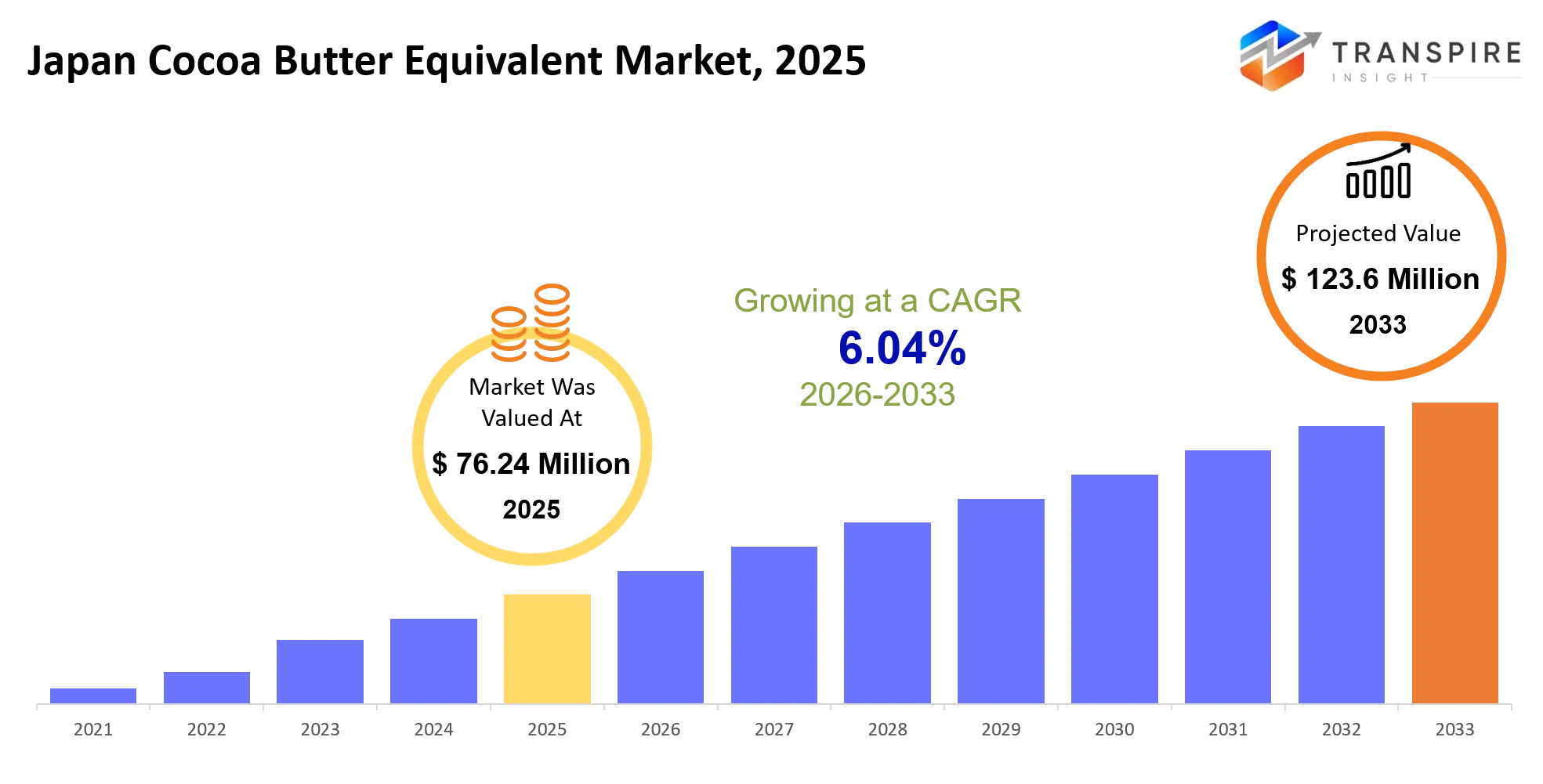
According to Transpire Insights, a detailed research report on the market reflects that the confectionery application segment dominates the Japan Cocoa Butter Equivalent Market, accounting for approximately 41% of the total market share in 2025. Fuji Oil Holdings Inc. leads the market with approximately USD 5.2 billion in annual revenue and an estimated 18–22% Japan market share, making it a leading contributor to Japan market development, innovation, advanced cocoa butter equivalent production, expanding manufacturing capabilities, and growth dynamics.
Market Snapshot
- Market Value (2025): USD 76.24 Million.
- Expected Market Value (2026): USD 81.97 Million.
- Estimated Market Value (2033): USD 123.6 Million.
- Forecast CAGR (2026–2033): 6.04%
Introduction
The Cocoa Butter Equivalent (CBE) market is made up of specialized vegetable fats and oils that have been formulated to emulate the sensory, melting and physical properties of cocoa butter. CBEs are prepared by fractionation and the mixing of vegetable fats and oils such as shea, sal, illipe and palm oil, whose properties are fully compatible with cocoa butter in order to lower costs and stabilize supplies of cocoa butter in the process. Cocoa Butter Equivalent (CBE) is a type of vegetable oil made from a combination of highly purified vegetable oils so that it is perfectly identical to cocoa butter in terms of composition, melting and crystallization properties, etc. Cocoa butter substitutes have various benefits for producers in Japan. The costs involved allow confectionery companies to deal with cocoa price changes. The properties of special fats enable them to mimic cocoa butter attributes such as a pleasant crunch, shine, smoothness, and melting point near body temperatures. The reliability and weather resistance of cocoa butter alternatives ensure that they are not affected by fat bloom and remain a quality product in cases of temperature changes. The healthiness and presence of functional properties meet the needs of consumers for clean-label, plant-based, and allergen-free products.
Key Market Highlights: -
- By source, the Shea Butter segment dominated the market and holds nearly 39% share in 2025 and is projected to grow at a substantial CAGR during the forecast period.
- By application, the Chocolate segment dominated the market and holds nearly 45% share in 2025 and is projected to grow at a substantial CAGR during the forecast period.
- By end user, the Confectionery Companies segment dominated the market and holds nearly 54% share in 2025 and is projected to grow at a substantial CAGR during the forecast period.
- Digital Transformation (DX) & Automation: Japan's METI and MAFF promote DX, AI, IoT, robotics, and automation throughout manufacturing and food processing sectors. These projects enhance business efficiency, product quality, and operational uniformity. In the case of the Japan Cocoa Butter Equivalent Market, advanced automation is beneficial for efficient fat processing, blending, formulation, and quality assurance and helps strengthen production capabilities.
How is Technology Driving Growth in the Japan Cocoa Butter Equivalent Market?
In Japan, Cocoa Butter Equivalent market is growing with the help of automation, digital transformation, and cutting-edge fat-modifying technologies. Automated manufacturing lines are making use of the capability of real-time monitoring of temperature and assuring the best manufacturing accuracy, stable processes, and chocolate tempering efficiency, as well as the minimal waste of raw materials and energy. Furthermore, key functions in the areas of AI, digital twins, Industrial IoT, and cloud-based systems are responsible for predictive process optimization, supply-chain tracking, and the state-of-the-art quality assurance schemes. On the other hand, innovative technologies of enzymatic interesterification, precision blending, and advanced fractionation allow cocoa butter equivalents to provide desirable characteristics such as snap, gloss, texture, and controlled melting properties.
Market Drivers
The Japanese Cocoa Butter Alternatives Market is driven by fluctuating cocoa prices, changing consumer preferences, advanced technologies in the process, diversified applications and Sustainability. Increasing cocoa prices and limited supplies have motivated confectionery companies to switch to cost-effective vegetable fat replacements. Growing interest in non-GMO, plant-based, allergen-free and functional chocolate products is boosting the use of such specialty fats like sal fat and kokum butter. Innovative fractionation and enzymatic interesterification processes allow companies to produce products with the same melting profile, texture and stability as cocoa butter. In addition, the booming applications of cocoa butter alternatives in the cosmetics, skincare, and pharmaceutical industries, together with the increasing usage of sustainably sourced raw materials, are opening new opportunities in their market development. Japan's cocoa butter alternatives market has considerable advantages in terms of flexibility, price, efficiency, functionality, and sustainability. The predictability of prices makes it possible for producers to use vegetable fats that are both fractionated and hydrogenated. As a result of excellent performance level, the segment provides optimized melting, great snap, desired shine, good texture, and excellent bloom resistance, contributing to the quality and durability of products. Sustainability and ethical sourcing are the factors for plant-based alternatives with accountable supply chain and lower dependency on traditional cocoa sourcing. Finally, purity and health support the fast-growing demand for non-GMO and allergen-free ingredients in Japan's food and cooking, cosmetic, and personal care industries.
Restrain
There are many restraints that the Japan Cocoa Butter Alternatives Market is facing. For instance, there is significant consumer preference for real cocoa butter in premium chocolates. Moreover, there are Food Composition and Labeling Regulations. Also, there is too much dependency on imported specialty fats and raw materials. Furthermore, suppliers of specialty fats and raw materials face issues like changing import costs and complicated supply chains. In addition, the technical difficulties in imitating the melting profile, texture, taste and sensory properties of cocoa butter may limit market growth.
|
Driver |
Relative Impact on Growth (%) |
Geographic Relevance |
Impact Timeline |
Demand Strength |
Growth Mechanism |
Key Beneficiaries |
Major Constraint |
|
1. Cocoa Price Volatility and Supply Constraints |
30% |
Japan; major confectionery manufacturing hubs |
Short-term |
High |
Stabilizes costs amid cocoa price volatility |
CBE manufacturers; chocolate producers; confectioners |
Authentic cocoa butter preference limits substitution |
|
2. Premium Chocolate and Confectionery Demand |
24% |
Nationwide; Tokyo, Osaka, major urban markets |
Medium-term |
High |
Supports specialty fats in premium chocolate formulations |
CBE suppliers; chocolate brands; ingredient distributors |
Higher prices can suppress chocolate volumes |
|
3. Advanced Fat Modification Technologies |
19% |
Japan; advanced food-processing clusters |
Medium-term |
High |
Improves melting, texture, snap, gloss, stability |
Specialty-fat producers; technology providers; confectioners |
Development costs and formulation complexity |
|
4. Sustainable and Traceable Ingredient Demand |
15% |
Nationwide; sustainability-focused manufacturers |
Long-term |
Medium |
Encourages lower-risk, traceable vegetable-fat sourcing |
Sustainable-fat suppliers; food manufacturers; retailers |
Sustainability premiums can raise input costs |
|
5. Food Manufacturing Automation and Digitalization |
12% |
Nationwide; automated food-production facilities |
Long-term |
Medium |
Enhances precision, consistency, productivity, and quality |
CBE manufacturers; automation vendors; food processors |
High capital expenditure and integration requirements |
Analysis of Prices and Consumer Behaviour
Around 52% of total cocoa butter equivalent market is taken over by high-quality cocoa butter equivalents as demand comes from the bakery, confectionery and food industry. A high-purity standardized cocoa butter equivalent with consistent melting properties would cost about 20% more than its counterparts since it would use advanced fractionation and blending processes and would have certified quality assurance and stable performance. Around 48% of total unit sales are in solid form due to solid products providing versatility of application in the food industry and long shelf life. Cakes and confectioneries account for around 65% of the demand from cocoa butter equivalents. Purchase behavior characterization shows that around 58% of customers assess the quality, purity and stability of cocoa butter equivalent as the most important parameter and another 30% of customers prefer to buy products in bulk in order to cut expenses on product acquisition and ensure stable supply for their customers worldwide.
Who are the Key Players in the Japan Cocoa Butter Equivalent Market and how do they compete?
Competitive advantage in the international cocoa butter equivalents market is held by companies implementing progressive specialty fat technology, producing high-quality ingredients, altering lipid structure, and creating cocoa butter equivalents of the highest performance for chocolate, confectionery, bakery, cosmetics, and personal care applications. The organizations competing through their technologies, besides the cost advantage, provide high-quality products with high status in terms of fat functionality, melting, structure, oxidation, blooming, formulation flexibility, production scalability, and special requirements, thus making it possible for the companies to continuously innovate their product lines to enhance chocolate quality and processing efficiency.
AAK, Bunge, and Fuji Oil create advanced cocoa butter equivalents and special fats, owing to which they strengthen their position in the Japan Cocoa Butter Equivalent Market. They produce top-quality cocoa butter equivalents with advanced properties for confectionery and chocolate coatings as well as bakery products, which distinguishes them from the companies operating in the same field (AAK and its chocolate and confectionery fat, and Bunge and its specialty oil lines).
Top Companies in the Japan Cocoa Butter Equivalent Market
- AAK
- Bunge Loders Croklaan
- Fuji Oil
- Cargill
- Wilmar International
- Olam Food Ingredients
- Bunge
- IOI Corporation
- Nisshin Oillio
- AD
- Barry Callebaut
- Ofi
- Musim Mas
- Sime Darby Oils
- Fuji Oil Holdings
|
Company |
Est. Revenue Share Range |
Key Offerings |
Strategic Positioning |
Geographic Strength |
Technology Focus |
|
Fuji Oil |
18–24% (Estimated) |
Melano SS; CBE hard butters; chocolate fats; specialty fats |
Japan-focused leadership with integrated chocolate expertise |
Japan; Asia Pacific; Europe |
Enzymatic interesterification and advanced fractionation |
|
AAK |
12–17% (Estimated) |
ILLEXAO™; ILLEXAO™ EN 10; CBE chocolate fats; compound solutions |
Innovation-led specialty-fat and formulation leadership |
Europe; Asia Pacific; North America |
Tailored melting profiles and crystallization control |
|
Bunge |
8–12% (Estimated) |
Coberine Shea; Coberine 206; CBE confectionery fats |
Premium shea-based CBE differentiation and supply integration |
Asia Pacific; Europe; North America |
Shea fractionation and specialty-fat formulation |
|
Wilmar International |
7–11% (Estimated) |
WILCHOC; WILCHOC 2000; cocoa butter alternatives; confectionery fats |
Broad specialty-fat portfolio with cost-performance focus |
Asia Pacific; Europe; Middle East & Africa |
Fractionation, blending and customized specialty fats |
|
Cargill |
6–10% (Estimated) |
Coconera™ AP4002/AP4003; specialty fats; confectionery solutions |
Integrated cocoa-to-specialty-fat solutions |
North America; Europe; Asia Pacific |
CBE formulation, sensory optimization and process support |
|
Nisshin OilliO Group |
4–7% (Estimated) |
CBE hard butters; CBR; CBS; chocolate fats |
Domestic Japanese specialty-fat customization |
Japan; Asia Pacific |
Fat composition control and hard-butter technology |
|
Musim Mas |
3–6% (Estimated) |
CBE CHOCO® 43/48/60; CBR CHOCO®; confectionery fats |
Sustainable palm-based specialty-fat specialization |
Asia Pacific; Europe; Middle East & Africa |
Fractionation, blending and climate-specific formulations |
|
ofi |
2–5% (Estimated) |
Britannia CBE fats; CBI; specialty confectionery fats |
Integrated cocoa and specialty-fat customer solutions |
Europe; Asia Pacific; North America |
Custom formulation and traceable specialty-fat sourcing |
|
IOI Loders Croklaan |
2–5% (Estimated) |
Coberine™ CBE range; confectionery fats; specialty oils |
Specialty-fat technology and application expertise |
Asia Pacific; Europe; North America |
Enzymatic interesterification and fractionation |
|
ADM |
1–4% (Estimated) |
Chocovit™ CBE blends; specialty oils and fats; confectionery solutions |
Formulation-driven ingredient and application solutions |
North America; Europe; Asia Pacific |
Custom CBE blending and chocolate formulation |
Japan Cocoa Butter Equivalent Market Segmentation
The Japan Cocoa Butter Equivalent Market share is divided into six categories: By type, source, application, form, function and end user.
The Shea Butter dominated the market, accounting for nearly 39% in 2025 and is expected to rise at a significant CAGR during the forecast period.
The Japan Cocoa Butter Equivalent Market is segmented by source into Shea Butter, Palm Oil, Illipe Butter, Kokum Butter, Sal Butter, Mango Kernel Fat, Vegetable Oils, Specialty Fats. Among these, the Shea Butter segment dominated the market, accounting for nearly 39% in 2025 and expected to increase at a significant CAGR during the forecast period. In 2025, Japan's Cocoa Butter Alternatives Market was largely driven by Shea Butter which led the segment with about 39% market share as it is known to have good melting properties, rich texture, and functional properties. Shea butter's applicability in confectionery, cosmetics, and personal care has increased its demand in the market. In the coming years, growing preference for sustainable, plant-based, and versatile specialty fats can help Segment progress.
The Chocolate dominated the market, accounting for nearly 45% in 2025, and is expected to rise at a significant CAGR during the forecast period.
The Japan Cocoa Butter Equivalent Market is segmented by application into Chocolate, Compound Chocolate, Confectionery, Bakery, Biscuits, Ice Cream, Spreads, Functional Foods. Among these, the Chocolate segment dominated the market, accounting for nearly 45% in 2025 and expected to increase at a significant CAGR during the forecast period.The leading part of the Japan Cocoa Butter Alternatives Market was the Chocolate part which took up 45% of the market in 2025 due to high demand in premium chocolate and confectionery products, chocolate molds and coatings as well as fillings. Cocoa butter alternatives use is growing in Japan as these have cost effectiveness, stable melting characteristics and desired texture as well as improved processing.
The Confectionery Companies dominated the market, accounting for nearly 54% in 2025 and is expected to rise at a significant CAGR during the forecast period.
The Japan Cocoa Butter Equivalent Market is segmented by end user into Chocolate Manufacturers, Confectionery Companies, Bakeries, Dairy Companies, Ice Cream Producers, Foodservice Companies, Ingredient Manufacturers, Private-Label Producers. Among these, the Confectionery Companies segment dominated the market, accounting for nearly 54% in 2025 and expected to increase at a significant CAGR during the forecast period. The largest segment in the Japan Cocoa Butter Alternatives Market is that of Confectionery Companies. In 2025, the Confectionery Companies segment will comprise more than half of the total share in the market, as cocoa butter substitutes are increasingly used in confectionery items like fillings, coatings, chocolates, and other compound confectionery products. Cocoa butter substitutes offer benefits such as cost efficiency, consistency in quality, stability in processing, and good sensory properties that motivate Japanese confectionery manufacturers to use them.
Future Market Trends for the Japan Cocoa Butter Equivalent Market: -
- Alternatives as Cost Saving Measures: Volatile cocoa prices have compelled Japanese companies like Fuji Oil to seek sustainable fat replacements that are cocoa-free and plant-based.
- Health-Driven and Functional Products: Products are increasingly enriched with beneficial nutrients aimed at health-conscious and older consumers.
- Premiumization and Sensory Comparison: Manufacturers are employing novel processing techniques and advanced fractionation to replicate the melting characteristics and texture of natural cocoa butter.
- Smart Manufacturing and Industry 4.0: The use of artificial intelligence and robotics in Japanese production facilities made specialty fat production flexible, efficient, and adaptable.
- Cross-Sector Cosmetic Applications: Alternatives such as sal fat and kokum butter are gaining increased acceptance within Japan's cosmetics sector due to their high purity.
Recent Development
- In June 2026: Sun Bear Biofuture has successfully executed its first pilot-scale production-run to manufacture a yeast-derived cocoa butter substitute by means of precision fermentation, an innovation that allows sustainable ingredient sourcing and supply-chain resilience while exhibiting important properties of cocoa butter. This is a breakthrough in the Cocoa Butter Equivalent Market in Japan where new biotechnologies are emerging in food, confectionery, cosmetics, and personal care products.
- In May 2026: The Company AAK introduced ILLEXAO™ EN 10 cocoa butter equivalent, a dedicated CBE product for chocolate enrobing. This introduction guarantees constant texture, perfect processing, and better production stability. The development is significant for Japan’s Cocoa Butter Equivalent Market because it symbolizes the increasing demand for specialty fats used for improving chocolate processing, quality, and production efficiency.
Market Segment
This study forecasts revenue at Japan, regional and country levels from 2020 to 2033. Transpire Insights has segmented the Japan Cocoa Butter Equivalent Market based on the below-mentioned segments:
Japan Cocoa Butter Equivalent Market, By Type
- Lauric CBE
- Non-Lauric CBE
- Shea-Based CBE
- Palm-Based CBE
- Illipe-Based CBE
- Kokum-Based CBE
- Sal-Based CBE
- Blended CBE
Japan Cocoa Butter Equivalent Market, By Source
- Shea Butter
- Palm Oil
- Illipe Butter
- Kokum Butter
- Sal Butter
- Mango Kernel Fat
- Vegetable Oils
- Specialty Fats
Japan Cocoa Butter Equivalent Market, By Application
- Chocolate
- Compound Chocolate
- Confectionery
- Bakery
- Biscuits
- Ice Cream
- Spreads
- Functional Foods
Japan Cocoa Butter Equivalent Market, By Form
- Solid Fat
- Powder
- Liquid Oil
- Blended Fat
- Granules
- Blocks
- Pellets
- Specialty Formulations
Japan Cocoa Butter Equivalent Market, Function
- Texture Improvement
- Melting Point Control
- Cocoa Butter Replacement
- Cost Reduction
- Stability Enhancement
- Bloom Resistance
- Shelf-Life Extension
- Flavor Carrier
Japan Cocoa Butter Equivalent Market, By End User
- Chocolate Manufacturers
- Confectionery Companies
- Bakeries
- Dairy Companies
- Ice Cream Producers
- Foodservice Companies
- Ingredient Manufacturers
- Private-Label Producers
Frequently Asked Questions
Find quick answers to common questions.
The market is projected to grow at a 6.04% CAGR from 2026 to 2033, reaching USD 123.6 million
The Shea Butter segment dominates, accounting for nearly 39% in 2025, supported by favorable functionality and broad confectionery applications.
Chocolate accounted for nearly 45% in 2025, driven by premium confectionery demand and cocoa butter equivalents’ processing advantages.
Key players include Fuji Oil, AAK, Bunge, Cargill, Wilmar, Nisshin OilliO, Musim Mas, ofi, IOI, and ADM.
Cocoa price volatility, premium chocolate demand, advanced fat technologies, sustainable sourcing, and manufacturing digitalization are major market growth drivers.
- AAK
- Bunge Loders Croklaan
- Fuji Oil
- Cargill
- Wilmar International
- Olam Food Ingredients
- Bunge
- IOI Corporation
- Nisshin Oillio
- AD
- Barry Callebaut
- Ofi
- Musim Mas
- Sime Darby Oils
- Fuji Oil Holdings
About the Authors

Chetan Dhatrak
I’m Chetan Dhatrak, a Senior Research Analyst at Transpire Insight, specializing in the Consumer Goods, Foods and Beverages industry. I focus on analyzing market trends, consumer behavior, competitive landscapes, and industry developments to deliver accurate, data-driven insights. My research at Transpire Insight is built on credible sources and in-depth analysis, helping businesses and readers better understand market dynamics, emerging opportunities, and evolving consumer preferences. I’m committed to creating reliable, well-researched content that supports informed decision-making and reflects the latest developments in the consumer goods and food & beverage sectors.

Chakradhar Khansole
Chakradhar serves as the Research Director at Transpire Insight, bringing over 8 years of experience in technology, innovation, and strategic market intelligence. He specializes in transforming complex market data into actionable business insights that enable organizations to make informed, growth-oriented decisions. Recognized for his strategic vision and analytical expertise, Chakradhar leads high-impact research initiatives, delivering comprehensive market assessments, competitive intelligence, and forward-looking industry analysis.
Recently Published Reports
-
Apr 2026
Baby Infant Formula Market
Baby Infant Formula Market Size, Share & Analysis Report By ype (Infant Milk, Follow On Milk, Specialty Baby Milk, Growing-Up Milk), By Ingredient (Carbohydrate, Fat, Protein, Minerals, Vitamins, and Others), By Product Form (Powder, Liquid, and Ready-to-feed), By Distribution Channels (Supermarket/Hypermarket, Specialty Store, Pharmacies, Online Retail, and Others), and Geography (North America, Europe, Asia-Pacific, Middle East and Africa, South and Central America), 2021 - 2031
-
Apr 2026
Edible Insects for Animal Feed Market
Edible Insects for Animal Feed Market Size, Share & Analysis Report By Type (Insect Powder, Insect Meal, Insect Bar, Insect Paste, Insect Oil, and Others), By Insect Type (Beetles, Cricket, Caterpillar, Hymenoptera, Orthoptera, Tree Bugs, and Others), By Application (Livestock, Pet Food, and Aquaculture), By Livestock Type (Poultry, Swine, and Others), and Geography (North America, Europe, Asia-Pacific, Middle East and Africa, South and Central America), 2021 - 2031
-
Apr 2026
Food Industry Disinfection and Bacterial Control Market
Food Industry Disinfection and Bacterial Control Market Size, Share & Analysis Report By Type (Chemical Disinfectants, Physical Disinfectants, and Biocides and Antimicrobials), By Application (Food Processing Equipment Surface Disinfection, Food Preparation Areas Surface Disinfection, Storage Areas Surface Disinfection, Anti-microbial Coatings Food Preservation, and Preservative Solutions Food Preservation), By End User (Meat and Poultry Processing, Dairy Processing, Seafood Processing, Bakery and Confectionery, Restaurants and Commercial Kitchens, and Food Service Providers), By Sales Channel (Online, Offline), and Geography (North America, Europe, Asia-Pacific, Middle East and Africa, South and Central America), 2021 - 2031
-
May 2026
Freeze Dried Food Market
Freeze Dried Food Market Size, Share & Analysis Report By Product Type (Fruits, Vegetables, Freeze-Dried Dairy Products, Freeze-Dried Meat and Seafood, Freeze-Dried Pet Food, and Prepared Meal), By Nature (Organic, and Conventional), By Form (Powdered, Granules, and Diced), By End Use (Breakfast Cereals, Dairy Products, Bakery & Confectionery, Nutritional Bars & Supplements, Powdered Beverages, Snacks, and Retail (Household)), and Geography (North America, Europe, Asia-Pacific, Middle East and Africa, South and Central America), 2021 - 2031