

Japan Compound Chocolate Market Size & Forecast:
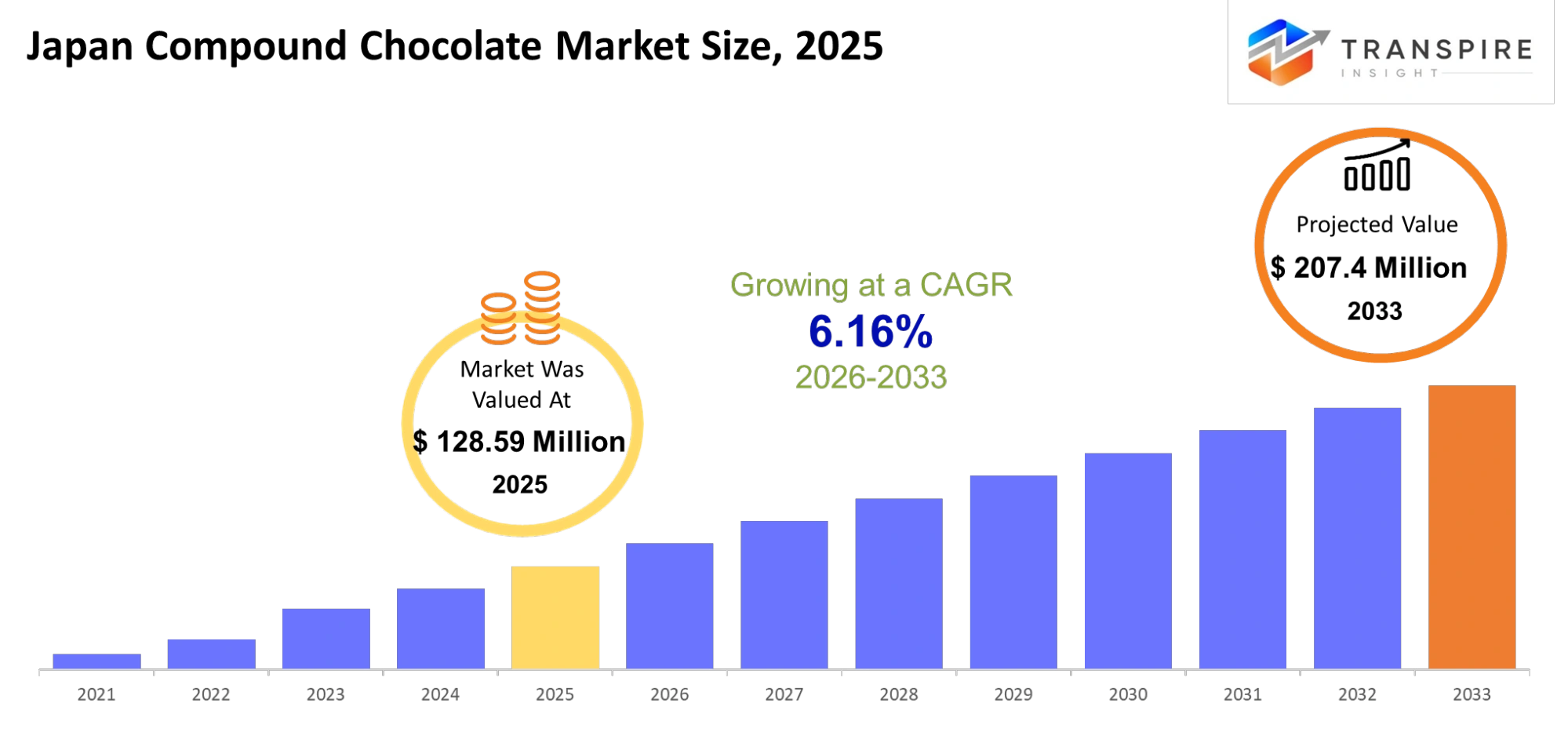
- Japan Compound Chocolate Market Size 2025: USD 128.59 Million
- Japan Compound Chocolate Market Size 2033: USD 207.4 Million
- Japan Compound Chocolate Market CAGR: 6.16%
- Japan Compound Chocolate Market Segments: By Type (Dark Compound Chocolate, Milk Compound Chocolate, White Compound Chocolate, Flavored Compound Chocolate, Others); By Application (Bakery, Confectionery, Desserts, Ice Cream, Beverages, Others); By End-User (Food Industry, Bakeries, Confectionery Manufacturers, Retailers, Food Service Providers, Others); By Form (Blocks, Chips, Coatings, Drops, Others)
To learn more about this report,  Download Free Sample Report
Japan Compound Chocolate Market Summary
The Japan Compound Chocolate Market was valued at USD 128.59 Million in 2025. It is forecast to reach USD 207.4 Million by 2033. That is a CAGR of 6.16% over the period.
The Japan compound chocolate market helps food manufacturers to produce their products with identical taste and texture and shelf life which applies to their work in confectionery and bakery and frozen dessert production. Chocolate-like performance without processing problems and pure couverture chocolate costs for cocoa butter make this product essential for industrial food production at large facilities.
The market has evolved during the past five years because premium compound products now combine cleaner product labels with lower sugar levels and plant-based fat systems. Retailers now expect different product standards which require them to examine ingredient origins more thoroughly. Japanese manufacturers changed their formulation methods because climate change caused global cocoa supply errors which drove cocoa prices up due to West African production problems.
Compound chocolate now serves beyond its original purpose of helping companies cut their expenses. Advanced formulation methods enable producers to achieve better profit margins while developing unique products at a faster pace, which results in increased market demand for their processed food products and their exported candy manufacturing operations.
Key Market Insights
- The Japanese Compound Chocolate Market sees Kanto as its largest player which controls 38% of the market share through its network of specialized confectionery production sites.
- The Kansai region holds a substantial market portion which reaches 27% because of its existing bakery production centers and high demand for industrial chocolate.
- The Kyushu region will experience its most rapid market growth until 2030 because of its food processing development projects and its increasing capacity for international market production.
- The market for dark compound chocolate will reach 42% by 2025 because premium confectionery products adopt it and manufacturers launch products that contain less sugar.
- The milk compound chocolate segment maintains its position as the second largest market segment because consumers demand the product at stable rates during their purchase of traditional bakery items and snack foods.
- The market for white compound chocolate will expand at its highest rate until 2030 because decorative confectionery products and seasonal products drive innovations in this sector.
- About 36% of the market belongs to bakery applications because compound coatings help mass production processes by delivering better efficiency and longer-lasting product stability.
- Frozen desserts show the fastest growth among application segments because they need flexible formulation options and better temperature protection.
- Industrial formulations help large-scale food manufacturers in Japan to achieve margin optimization, which enables them to control more than 48% of the country's compound chocolate market.
- Mid-sized artisanal confectionery producers show the highest growth rates among all end-user groups because they choose to use premium compouCompetitive Landscape & Strategy.
What are the Key Drivers, Restraints, and Opportunities in the Japan Compound Chocolate Market?
The Japan compound chocolate market grows because international cocoa butter prices show unpredictable patterns which climatic conditions destroy crops in West African cocoa fields and create international supply shortages. Japanese confectionery and bakery manufacturers have needed to change their products by using compound chocolate because it provides them with better control over their product expenses and manufacturing processes. The production shift has helped manufacturers to handle their production costs because they can now fix their product prices while keeping their production levels constant. The market revenue visibility increases because processors adopt compound formulations as standard production methods which lead to stable procurement agreements with suppliers.
Japan's established consumer preference for premium couverture chocolate and high-cocoa-content chocolate products creates the most important structural obstacle for the market especially during gift and holiday retail moments. Japanese food culture associates quality with premiumization trends which have existed for a long time. The product modification process requires product knowledge development through extended training which includes testing products and obtaining approval from retailers. The system restricts compound chocolate market growth because it makes premium category products less accessible and prevents companies from increasing their revenue potential.
The main chance for success exists through the development of functional and health-oriented confectionery products which use advanced plant-based chocolate compounds. Japanese food manufacturers are increasing investment in reduced-sugar and dairy-free product lines especially in urban markets like Tokyo and Osaka. The development of new fat alternatives and flavor-masking methods will enable compound chocolate manufacturers to access emerging wellness confectionery markets during the coming ten years.
What Has the Impact of Artificial Intelligence Been on the Japan Compound Chocolate Market?
The use of automated process control systems enables artificial intelligence to transform Japan's compound chocolate production by monitoring three key production factors which include tempering consistency and mixing viscosity and cooling cycles and coating precision in real time. Food processors utilize AI-enabled sensors throughout their production lines which enable them to detect formulation deviations at all times, thus achieving better operational efficiency and lower batch rejection rates. Computer vision systems enable surface defect inspection which allows for faster detection of coating inconsistencies while decreasing the need for manual quality assurance work.
Manufacturers increasingly use machine learning models to create predictive maintenance solutions for their molding and enrobing and cooling equipment systems. These systems use vibration and temperature and runtime data to predict when components will fail, which helps manufacturers achieve unplanned downtime reductions of 10 to 20% across their automated facilities. The AI-driven demand forecasting tools enable confectionery producers to synchronize their compound chocolate purchasing with seasonal consumption patterns, which results in better inventory management and decreased raw material wastage.
The digital systems enable companies to boost production uptime while decreasing their operational costs and achieving faster product reformulation which responds to changes in cocoa butter market prices. The high integration costs combined with the lack of historical production data, prevent Japanese confectionery manufacturers from implementing new systems, especially those who still depend on their outdated semi-automated processing systems.
Key Market Trends
- Japanese manufacturers have raised their use of compound chocolate in industrial confectionery production by 18% since 2022 because of cocoa butter price fluctuations.
- From 2021 to 2025 processors moved away from basic formulations toward premium compound blends which contained reduced sugar and demonstrated better texture quality.
- Fuji Oil Holdings and other companies started their specialty fat innovation programs after supply disruptions showed them the dangers of relying on traditional cocoa-based manufacturing.
- Bakery producers have increased their reformulation cycles since 2023 which has shortened product development times by almost 20% through automatic processing control systems.
- Japanese confectionery exporters increased their use of heat-stable compound coatings after logistics problems created risks for product safety during extended transportation.
- Retailers have shifted their shelf space distribution since 2024 to prefer hybrid premium-value chocolate products which provide complete ingredient information at affordable retail pricing.
- Mid-sized manufacturers increasingly partnered with ingredient suppliers like Barry Callebaut to co-develop customized formulations for seasonal product launches.
- The launch of plant-based compound chocolate products experienced significant growth after 2023 because these products matched better with dairy-free confectionery development in urban consumer markets.
- Digital quality monitoring adoption expanded across Japanese processing facilities, which resulted in batch inconsistencies reduction that reached 10 to 15 percent compared to 2021 levels.
- Producers now focus on developing formulation patents and improving their processing technology because they have changed their competitive strategies since 2022.
Japan Compound Chocolate Market Segmentation
By Type :
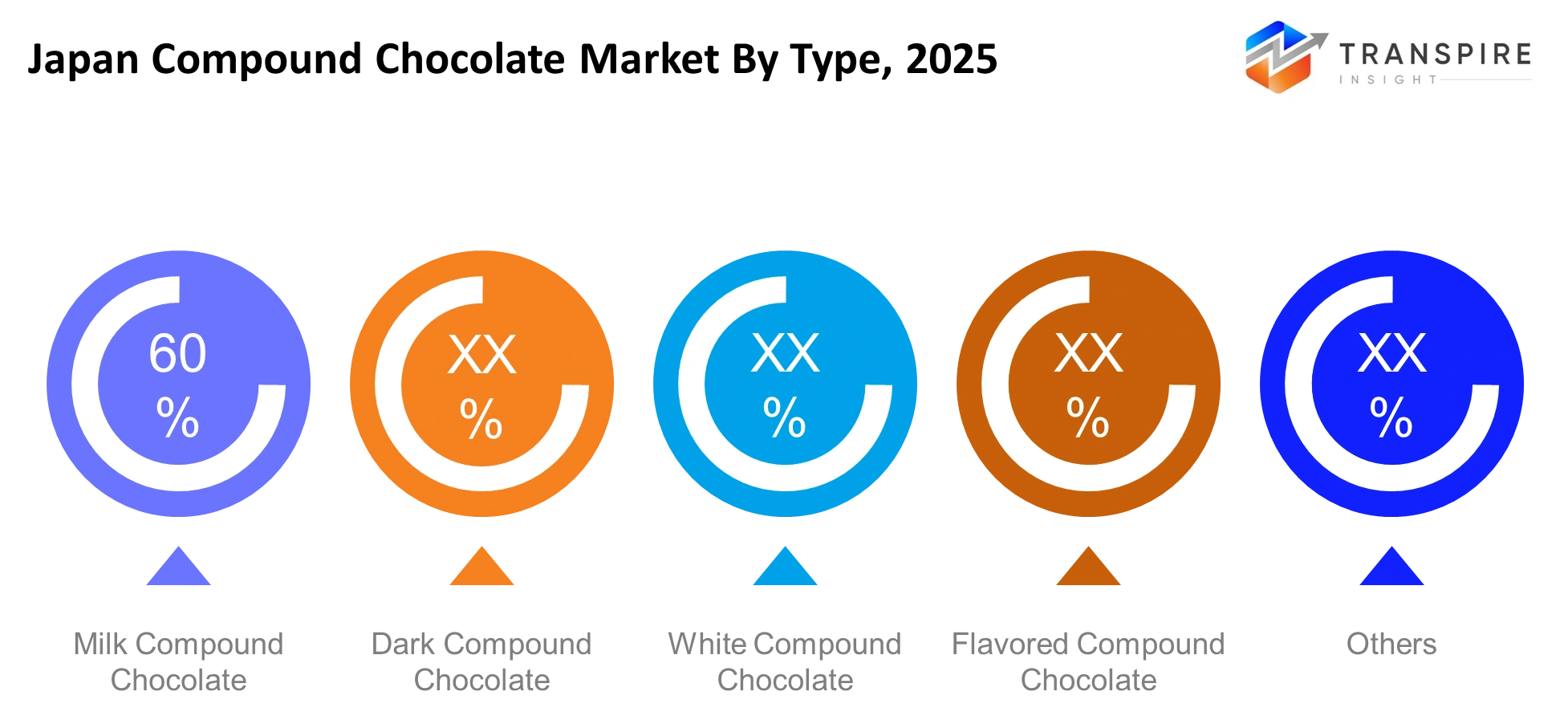
The market shows constant interest in dark compound chocolate because consumers prefer its taste and bakers use it for their filling and coating needs. Milk compound chocolate will remain widely used because of its smooth texture and balanced sweetness. White and flavored variants support product innovation across confectionery lines and seasonal offerings. Other types serve niche needs in specialized food products.
Milk compound chocolate continues strong usage across mass production due to cost efficiency and consistent taste profile. Dark compound chocolate supports premium positioning in bakery and dessert items. The market will grow white and flavored forms because of shifting consumer preferences and increased demand for diverse options. Other categories maintain a limited but stable presence in industrial food processing.
To learn more about this report, Download Free Sample Report
By Application :
The main market share of bakery applications comes from their use in producing cakes and pastries and bread fillings. The confectionery market maintains high demand for chocolate products and pralines and coated sweets. The dessert and ice cream markets drive expansion through their use of toppings and inclusions. The use of flavored drinks and cocoa-based products for beverages remains constant at a low level.
The demand for bakery products keeps growing because more people want to buy ready-to-eat items. The production of confectionery products remains strong because people buy them as gifts and consume them daily. The decorative and taste-enhancing functions of dessert products and ice cream create new opportunities for growth. The beverage market uses flavored drinks and cocoa-based products in small but consistent quantities. Industrial food formulations receive support from other functional applications.
By End-User :
The food industry remains the largest end-user because it needs to process food at large scales while requiring consistent ingredient quality. Compound chocolate serves as the main ingredient for bakeries and confectionery manufacturers because it provides them with both stable product texture and effective expense management. Retailers support packaged product distribution, while food service providers use it for desserts and prepared dishes.
Food industry demand remains steady because businesses require products for their mass production operations. Bakeries and confectionery manufacturers create ongoing product needs because they develop new items throughout the year and introduce special items during holidays. Retailers support growing packaged sweet products in stores. Food service providers contribute through desserts and menu items. Other users include small-scale producers and specialty food makers with limited volume needs.
By Form :
The industrial sector heavily relies on blocks because they provide simple storage solutions and melting capabilities. Bakery products such as cookies and muffins use chips because they deliver consistent distribution through their processing. Coatings serve as vital components which manufacturers use to cover confectionery items and bakery products. The use of drops in desserts and baked goods enables producers to control portions while creating mixes.
The use of blocks in production processes exists because they provide cost advantages and operational benefits for large-scale processing. Baking operations that require complete melting use chips as their functional solution. Coatings serve as essential components that complete the final appearance of sweets and baked goods. Drops enable recipe developers to create flexible recipes which they can use for specific portion needs. The manufacturing process requirements of various food production segments receive support from each form.
What are the Key Use Cases Driving the Japan Compound Chocolate Market?
The industrial bakery and mass confectionery coating applications still represent the main application area for Japan's compound chocolate market. Manufacturers who operate at large scales use compound formulations because these compounds provide stable melting performance and simplified processing and reduced temperature sensitivity which makes them suitable for coating high-volume wafer products and filled biscuit items and molded snack goods.
Frozen desserts and quick-service food manufacturing now experience increased demand because of their expanding applications. Ice cream producers increasingly use compound coatings for improved crack resistance and longer shelf stability while convenience food suppliers are incorporating compound chocolate into ready-to-eat seasonal snacks sold through Japan's extensive convenience store networks.
Functional confectionery products and plant-based wellness items are developing new applications through emerging use cases. Manufacturers are testing dairy-free compound formulations for protein-enriched snack bars and reduced-sugar chocolate alternatives targeted at health-conscious urban consumers. Specialty producers who want to create new products at an accelerated pace through flexible formulation solutions show strong interest in premium decorative applications which create decorative elements for artisanal patisserie and limited-edition seasonal confectionery products.
|
Report Metrics |
Details |
|
Market size value in 2025 |
USD 128.59 Million |
|
Market size value in 2026 |
USD 136.5 Million |
|
Revenue forecast in 2033 |
USD 207.4 Million |
|
Growth rate |
CAGR of 6.16% from 2026 to 2033 |
|
Base year |
2025 |
|
Historical data |
2021 - 2024 |
|
Forecast period |
2026 - 2033 |
|
Report coverage |
Revenue forecast, competitive landscape, growth factors, and trends |
|
Country scope |
Japan |
|
Key company profiled |
Barry Callebaut, Cargill, Fuji Oil, Olam Cocoa, Blommer Chocolate, Nestle, Mars, Mondelez, Meiji, Lotte, Hershey, Puratos, Aalst Chocolate, ICAM, Clasen Quality Chocolate |
|
Customization scope |
Free report customization (country, regional & segment scope). Avail customized purchase options to meet your exact research needs. |
|
Report Segmentation |
By Type (Dark Compound Chocolate, Milk Compound Chocolate, White Compound Chocolate, Flavored Compound Chocolate, Others); By Application (Bakery, Confectionery, Desserts, Ice Cream, Beverages, Others); By End-User (Food Industry, Bakeries, Confectionery Manufacturers, Retailers, Food Service Providers, Others); By Form (Blocks, Chips, Coatings, Drops, Others) |
Which Regions are Driving the Japan Compound Chocolate Market Growth?
The Kanto region leads Japan's compound chocolate market because it contains the country's biggest confectionery production facilities and its modern food processing systems and its most efficient retail distribution systems. The food companies which operate their production facilities in Tokyo and its adjacent prefectures can implement their special compound formulas and automated processing technologies more rapidly. The region establishes rapid product development through food technology developers who work together with ingredient suppliers and packaging companies. The integrated industrial system allows manufacturers to react to cocoa price changes and shifts in consumer product preferences which enables Kanto to keep its market leadership.
The Kansai region contributes differently because its manufacturing industry depends on its historical background which developed high-end confectionery and baking products. Osaka and Kyoto-based producers emphasize product consistency and controlled formulation upgrades rather than aggressive production expansion. The company develops a stable revenue stream through long-term supplier contracts and strategic expenses on cutting-edge chocolate manufacturing equipment. Kansai maintains its market strength through consistent participation in premium product markets which it balances with its capacity to produce specialty items.
Kyushu has become the most rapidly developing regional market because of increasing investments in food processing and growing demand for export-based confectionery manufacturing.Industrial modernization initiatives combined with reduced operational expenses have attracted manufacturers to build new facilities and expand their existing ones since the year 2023. The enhanced logistics system which connects major southern transport hubs has improved the efficiency of outbound distribution operations. Between 2026 and 2033, Kyushu provides significant business prospects to new market entrants and investors through its capacity growth and contract manufacturing agreements and its specialized production of compound chocolate for Asian export markets.
Who are the Key Players in the Japan Compound Chocolate Market and How Do They Compete?
The competitive landscape of Japan's compound chocolate market shows moderate consolidation because multinational ingredient suppliers compete with specialized domestic manufacturers. Companies now compete through their ability to create specialized solutions which combine advanced formulation methods and new specialty fat products instead of using traditional price-based methods. Established players use their premium compound product expansion and their improved technical support systems for Japanese confectionery manufacturers to protect their market positions. Regional suppliers use their specialized bakery and frozen dessert and functional confectionery solutions to pursue niche markets.
Fuji Oil Holdings uses its specialized knowledge of plant-based oil and fat technologies to create customized compound chocolate systems that meet Japan's reformulation requirements. Its proprietary vegetable fat solutions enable manufacturers to achieve texture stability while decreasing their dependence on unpredictable cocoa butter pricing. The company expands its operations through research and development funding and research collaborations with local confectionery manufacturers. Barry Callebaut differentiates itself through advanced industrial application labs and rapid co-development capabilities that help processors accelerate product launch timelines.
Cargill uses its worldwide supply chain operations together with its economical sourcing methods to provide Japanese manufacturers predictable costs of their raw materials. The company developed its digital formulation tools to enhance the speed at which customers can create personalized products. Puratos develops special compound coatings to serve premium niche bakery markets which it distributes to artisanal and mid-sized customers while expanding its business through technical partnerships and customer support facilities that it operates throughout Asia.
Company List
- Barry Callebaut
- Cargill
- Fuji Oil
- Olam Cocoa
- Blommer Chocolate
- Nestle
- Mars
- Mondelez
- Meiji
- Lotte
- Hershey
- Puratos
- Aalst Chocolate
- ICAM
- Clasen Quality Chocolate
Recent Development News
In April 2026, Meiji Co., Ltd. announced the launch of its limited-time ‘Nomitsu Ka Tsubutsubu Ichigo’ chocolate product in Japan. The product introduced a dual-layer strawberry and milk chocolate format aimed at expanding fruit-based compound chocolate consumption during peak seasonal demand. Source https://www.foodbev.com/
In April 2026, Meiji Co., Ltd. announced the launch of a limited-edition strawberry fruit chocolate product “Nomitsu Ka Tsubutsubu Ichigo” across Japan. The product expands Meiji’s fruit-chocolate hybrid lineup, reinforcing innovation in premium and flavored chocolate formats that influence demand for compound chocolate bases used in mass-market confectionery production.
Source https://www.foodbev.com/
What Strategic Insights Define the Future of the Japan Compound Chocolate Market?
The upcoming five to seven years will see the Japan compound chocolate market transforming itself from broad-based commodity production to specialized high-performance product development. The hidden aspect of this situation is that cocoa prices keep fluctuating while food manufacturers need to maintain higher profit margins and produce new products within shorter timeframes. Suppliers will need to compete with their customers through technical product customization and the development of specialized fat products and digitalized manufacturing systems instead of traditional methods which involve expanding their production capacity.
The market currently faces a hidden danger because it depends on specialized fat products from a small group of advanced suppliers. The supply chain disruptions together with feedstock limitations will create formulation problems which will delay product development while reducing profit margins for manufacturers. An emerging opportunity exists in Kyushu-based export-oriented confectionery production because lower operating costs and better logistics infrastructure create a suitable environment for specialized compound chocolate production.
The most effective strategic option for market participants involves creating co-development capabilities which they should establish through early investments in partnerships with mid-sized Japanese food processors. Japanese confectionery production will become more innovation-driven, which will enable suppliers who provide rapid prototyping and plant-based formulation and technical support to gain a competitive advantage during upcoming product launches.
Japan Compound Chocolate Market Report Segmentation
By Type
- Dark Compound Chocolate
- Milk Compound Chocolate
- White Compound Chocolate
- Flavored Compound Chocolate
By Application
- Bakery
- Confectionery
- Desserts
- Ice Cream
- Beverages
By End-User
- Food Industry
- Bakeries
- Confectionery Manufacturers
- Retailers
- Food Service Providers
By Form
- Blocks
- Chips
- Coatings
- Drops
Frequently Asked Questions
Find quick answers to common questions.
The Japan Compound Chocolate Market size is USD 207.4 Million in 2033.
Key segments for the Japan Compound Chocolate Market are By Type (Dark Compound Chocolate, Milk Compound Chocolate, White Compound Chocolate, Flavored Compound Chocolate, Others); By Application (Bakery, Confectionery, Desserts, Ice Cream, Beverages, Others); By End-User (Food Industry, Bakeries, Confectionery Manufacturers, Retailers, Food Service Providers, Others); By Form (Blocks, Chips, Coatings, Drops, Others).
Major Japan Compound Chocolate Market players are Barry Callebaut, Cargill, Fuji Oil, Olam Cocoa, Blommer Chocolate, Nestle, Mars, Mondelez, Meiji, Lotte, Hershey, Puratos, Aalst Chocolate, ICAM, Clasen Quality Chocolate.
The Japan Compound Chocolate Market size is USD 128.59 Million in 2025.
The Japan Compound Chocolate Market CAGR is 6.16% from 2026 to 2033.
- Barry Callebaut
- Cargill
- Fuji Oil
- Olam Cocoa
- Blommer Chocolate
- Nestle
- Mars
- Mondelez
- Meiji
- Lotte
- Hershey
- Puratos
- Aalst Chocolate
- ICAM
- Clasen Quality Chocolate
Recently Published Reports
-
Apr 2026
Baby Infant Formula Market
Baby Infant Formula Market Size, Share & Analysis Report By ype (Infant Milk, Follow On Milk, Specialty Baby Milk, Growing-Up Milk), By Ingredient (Carbohydrate, Fat, Protein, Minerals, Vitamins, and Others), By Product Form (Powder, Liquid, and Ready-to-feed), By Distribution Channels (Supermarket/Hypermarket, Specialty Store, Pharmacies, Online Retail, and Others), and Geography (North America, Europe, Asia-Pacific, Middle East and Africa, South and Central America), 2021 - 2031
-
Apr 2026
Edible Insects for Animal Feed Market
Edible Insects for Animal Feed Market Size, Share & Analysis Report By Type (Insect Powder, Insect Meal, Insect Bar, Insect Paste, Insect Oil, and Others), By Insect Type (Beetles, Cricket, Caterpillar, Hymenoptera, Orthoptera, Tree Bugs, and Others), By Application (Livestock, Pet Food, and Aquaculture), By Livestock Type (Poultry, Swine, and Others), and Geography (North America, Europe, Asia-Pacific, Middle East and Africa, South and Central America), 2021 - 2031
-
Apr 2026
Food Industry Disinfection and Bacterial Control Market
Food Industry Disinfection and Bacterial Control Market Size, Share & Analysis Report By Type (Chemical Disinfectants, Physical Disinfectants, and Biocides and Antimicrobials), By Application (Food Processing Equipment Surface Disinfection, Food Preparation Areas Surface Disinfection, Storage Areas Surface Disinfection, Anti-microbial Coatings Food Preservation, and Preservative Solutions Food Preservation), By End User (Meat and Poultry Processing, Dairy Processing, Seafood Processing, Bakery and Confectionery, Restaurants and Commercial Kitchens, and Food Service Providers), By Sales Channel (Online, Offline), and Geography (North America, Europe, Asia-Pacific, Middle East and Africa, South and Central America), 2021 - 2031
-
Apr 2026
Freeze Dried Food Market
Freeze Dried Food Market Size, Share & Analysis Report By Product Type (Fruits, Vegetables, Freeze-Dried Dairy Products, Freeze-Dried Meat and Seafood, Freeze-Dried Pet Food, and Prepared Meal), By Nature (Organic, and Conventional), By Form (Powdered, Granules, and Diced), By End Use (Breakfast Cereals, Dairy Products, Bakery & Confectionery, Nutritional Bars & Supplements, Powdered Beverages, Snacks, and Retail (Household)), and Geography (North America, Europe, Asia-Pacific, Middle East and Africa, South and Central America), 2021 - 2031