

Asia Pacific Chocolate Confectionery Market Summary
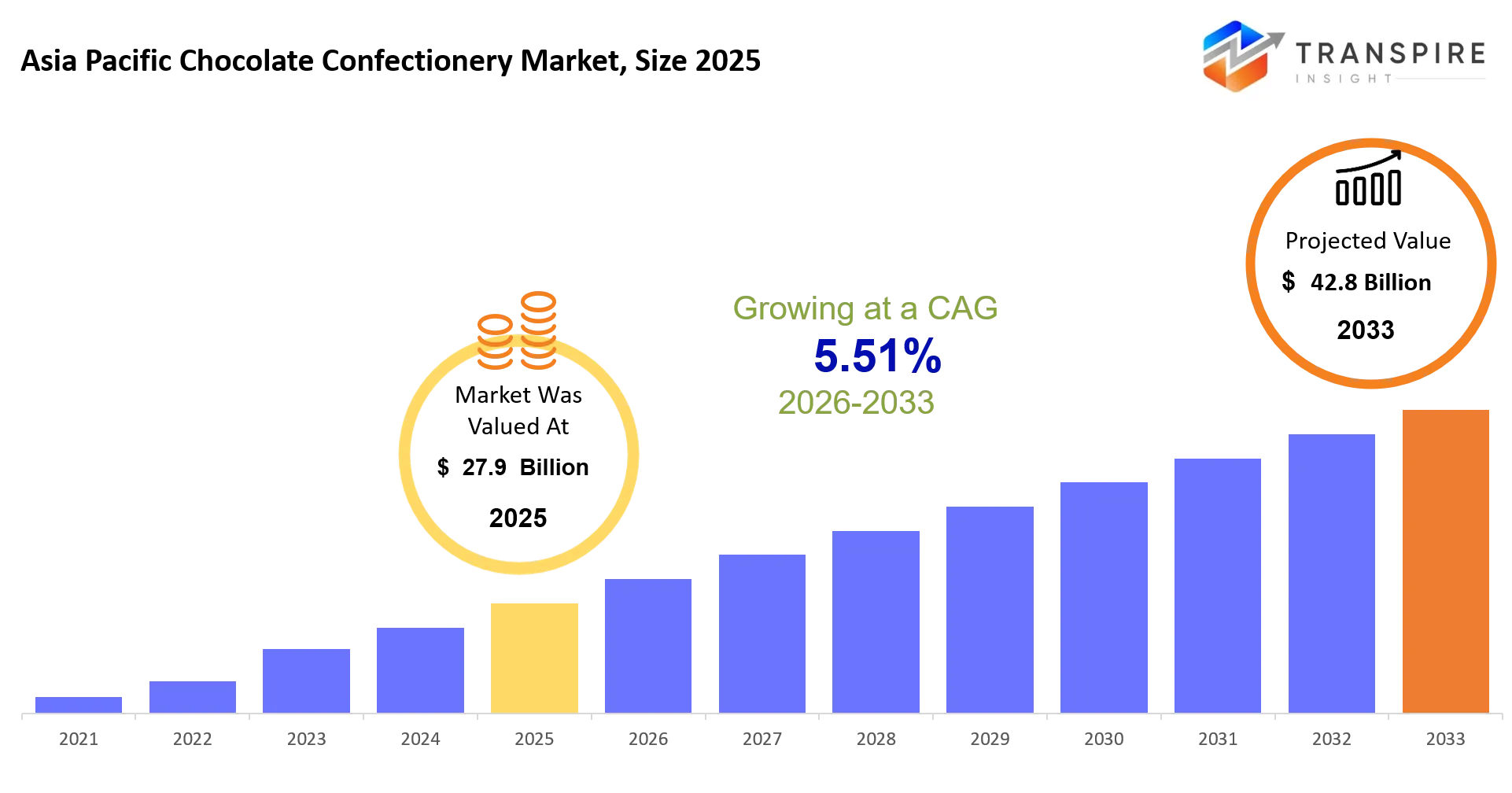
As per Transpire Insight Analysis, the Asia Pacific Chocolate Confectionery Market size is estimated at USD 27.9 Billion in 2025 and is anticipated to reach USD 42.8 Billion by 2033, growing at a CAGR of 5.51% from 2026 to 2033.
The Asia Pacific Chocolate Confectionery Market provides ready made chocolate that ends up in retail, foodservice, gifting, travel retail, and even industrial food manufacturing, so brands can keep up with what people want, like indulgence, easy access, and that premium snacking feeling, across a bunch of different times people buy. Over the past five years, the market kinda moved away from only chasing higher volumes, and instead leaned into value based ranges where you’ll see premium ingredients show up more often, sugar levels adjusted down, and the flavors move toward what feels more local or region inspired. During the pandemic, supply chain problems, plus cocoa prices that were all over the place, made manufacturers rethink how they buy raw materials, push harder on regional production, and also build inventory resilience.Because of all that, more localization happened, plus product innovation too, which helped lower supply risk while still making it easier to respond quickly to changing tastes. And since city life keeps nudging people toward convenient premium comforts and like, seasonal gifting that still seems a pretty solid sales lane, manufacturers are quietly making better margins by pushing more differentiated choices, building up a stronger brand closeness, and also widening their reach through both organized retail channels and these digital commerce sites.
Asia Pacific Chocolate Confectionery Market Size & Forecast:
- Asia Pacific Chocolate Confectionery Market Size 2025: USD 27.9 Billion
- Expected Market Value 2033: USD 42.8 Billion
- Forecast CAGR: 5.51%
- Leading region in 2025: East Asia
- Fastest Growing region: South Asia
- Key Profile: Mars, Mondelez International, Nestlé, Ferrero, Lindt & Sprüngli, Meiji Holdings, Lotte, Hershey, Yıldız Holding (Godiva), Glico, Orion Confectionery, Arcor, Barry Callebaut, LOTTE Wellfood, Guan Chong Berhad
Key Market Insights
- In 2025, East Asia kind of dominated the regional market with around 46% share, backed by mature retail infrastructure , premium consumption, and large scale domestic manufacturing , overall it just looks very solid.
- Meanwhile South Asia is projected to stay the fastest growing regional market from 2025–2033, mainly because middle income households are expanding, and modern retail penetration is happening a lot faster than before.
- When it comes to products, chocolate bars stayed on top, grabbing nearly 38% market share in 2025. Manufacturers kept expanding premium and portion controlled product lines, so yeah the momentum continued.
- Boxed chocolates were second, and they’re doing well thanks to festive gifting demand. Also their premium positioning seems stronger across urban retail channels, which really matters.
- Sugar free and functional chocolate products are expected to see the fastest growth through 2033, supported by ingredient innovation and that more premium, health focused angle consumers are increasingly interested in.
- For applications, everyday snacking basically led the pack, with close to 57% share in 2025. This reflects frequent buys through supermarkets, convenience stores, and online platforms .
- Looking ahead, seasonal gifting is forecast to deliver the quickest application growth during the forecast period, because premium packaging , plus limited edition launches, keeps nudging consumer spending upward.
- On the end-user side, household consumers remained the leading segment with about 74% share in 2025. That’s driven by steady retail purchases and better product accessibility over time.
- Foodservice is projected to become the fastest growing end-user category through 2033 , fueled by premium desserts, cafés , bakeries , and quick service restaurants , where menu innovation is picking up speed.
What are the Key Drivers, Restraints, and Opportunities in the Asia Pacific Chocolate Confectionery Market?
The main push behind the regional chocolate confectionery industry is premiumization, kind of helped by modern retail growth along with digital commerce. Organized retail spending, broader cold chain delivery, and newer packaging methods have made it easier to find the products in most urban areas and also in secondary cities. In response, manufacturers are rolling out limited edition taste ideas, premium cocoa mixtures, and region specific items much quicker than before. Since the higher value variants bring in more revenue per unit than the usual chocolate bars, the overall economics look better. On top of that, foodservice players are also adding premium dessert options, which basically gives people more chances to buy and consume. So overall, margins tend to improve for makers and adoption spreads across several different consumer groups.
Still, volatile cocoa prices are the biggest structural drag because the supply leans heavily on production happening outside the region. Weather disruptions, transportation slowdowns, and currency swings keep raising procurement spend. It’s not like plants can just replace cocoa fast without risking the taste, texture, and the whole brand stance. And from Transpire Insight review of regional procurement updates, plus launch calendars, the concentration in the supply chain stays the main execution risk. When inputs get more expensive, launches move back, operating margins get squeezed, and promotional plans often soften, which then limits revenue growth in markets that are quite sensitive to value.
The most promising opportunity seems to be in premium functional chocolate, made with alternative sweeteners, higher cocoa percentage, and added nutritional components. There are regional investments in advanced processing technologies that help enable faster commercialization, kind of like getting to market quicker. South Asia and Southeast Asia look especially attractive for expansion , because modern retail penetration keeps improving alongside digital grocery platforms. Local manufacturing investments also help, with shorter delivery timelines and less reliance on imports. All these steps should make it possible for brands to broaden their premium lines, and in the same breath raise profitability, plus tighten their regional market reach as well.
What Has the Impact of Artificial Intelligence Been on the Asia Pacific Chocolate Confectionery Market?
Artificial intelligence, plus digital techs, are slowly changing how chocolate confectionery is produced across Asia Pacific, mainly because it helps push manufacturing efficiency, keeps the quality more steady, and also makes inventory handling less chaotic. In a lot of plants, producers now tend to rely on AI vision systems, that can look at the chocolate coating, figure out if the packaging is really sealed, and even verify product sizes in real time, without much delay.This kind of setup cuts down on the need for so much manual inspection, and it tends to lower the number of defects during production, overall.
At the same time smart sensors keep tracking temperature, humidity, and the actual processing conditions. Then the line can do automated adjustments, which helps protect the product quality during the whole run. Machine learning models also play a role in demand prediction, they mix retail sales, seasonal buying behavior, promo activities, and even weather-related signals to better decide how much to produce, and where to place stock. There are also predictive maintenance tools that kind of keep an eye on how the equipment behaves, spotting early symptoms of trouble before a sudden shutdown really hits. That helps keep uptime higher, and it can push overall maintenance costs down a bit too.
On top of that, digital supply chain platforms make procurement plus warehouse routines more clever. They reduce spoilage and waste more often , and they also boost how right on time the orders get fulfilled across regional distribution routes.In general these upgrades support lower operational spending, better forecasting results, and faster responses when retail demand shifts. Still, rolling AI out is not always easy , because the integration costs can be pretty high , production sites often get fragmented, and operational data is frequently messy or just inconsistent across older manufacturing systems. Smaller regional producers , in particular, may struggle to justify the spend, since the rollout needs specialized know-how, infrastructure changes and in practice a long term plan for digital transformation.
Key Market Trends
- Premium chocolate portfolios kinda expanded a lot between 2022 and 2025, with manufacturers rolling out increased cocoa presence, single-origin lineups, and that sort of artisanal product range, you know.
- After 2021 , regional manufacturing investments picked up steam again, and that sort of helped reduce how much we were leaning on imported finished products, plus it made supply chain resilience feel more practical i guess.
- By 2025 , digital commerce was taking a larger chunk of chocolate sales, so brands started pushing online-only offerings, with promotional pushes too, and then more targeted campaigns that felt less broad than before.
- From 2023 to 2025 , manufacturers more often leaned on recyclable and paper based packaging, because sustainability commitments were shifting, and retailers started expecting different procurement standards as well, kind of quietly at first but still.
- Reduced sugar, protein enriched, and functional chocolate products showed up more on shelves after 2022, and it was supported by ingredient innovation , plus a firmer premium positioning that made the whole category look a bit more upgraded.
- Mondelez International together with Nestlé expanded regional production investments, so localized manufacturing became more solid, and at the same time they trimmed product delivery timelines across Asia Pacific too.
- Between 2023 and 2025 , seasonal gifting became less about plain bundles and more about premium wrapping, along with limited edition collections, which lifted average selling prices, and made brand differentiation seem easier to spot.
- After 2022, companies also diversified cocoa sourcing, partly to lower procurement risks from weather disruptions , and from the global supply concentrating in fewer places.
- Automation investments rolled out across chocolate processing facilities during 2024 to 2025, improving production efficiency, supporting steadier product consistency, and helping manufacturing costs stay more optimized.
Asia Pacific Chocolate Confectionery Market Segmentation
By Product Type :
Milk Chocolate kept the leading share , mainly because its sweetness feels nicely balanced, the texture is very smooth, and customers generally like it across pretty much every age group. Big manufacturers kept pushing out new flavors, tweaks in portion sizes , and seasonal collections, so it stays visible on the shelf. Also, buying was easy through supermarkets, convenience stores, and online places, which helped keep sales steady. Even with shifts between developed and developing economies, consumption stayed fairly stable , and that really helped it hold leadership during the forecast.
Dark Chocolate sat in the second-largest spot because many people seem to prefer a stronger cocoa profile, plus the whole premium vibe. Premium Chocolate grew the quickest, since brands put money into single-origin cocoa, more artisanal recipes, and more noticeable packaging meant to pull in higher-value purchases. Sugar-Free Chocolate caught on steadily too , with better sweetener technology and wider distribution. White Chocolate, Filled Chocolate, and the other specialty types kept adding variety, by aiming at more specific cravings and that festive season demand.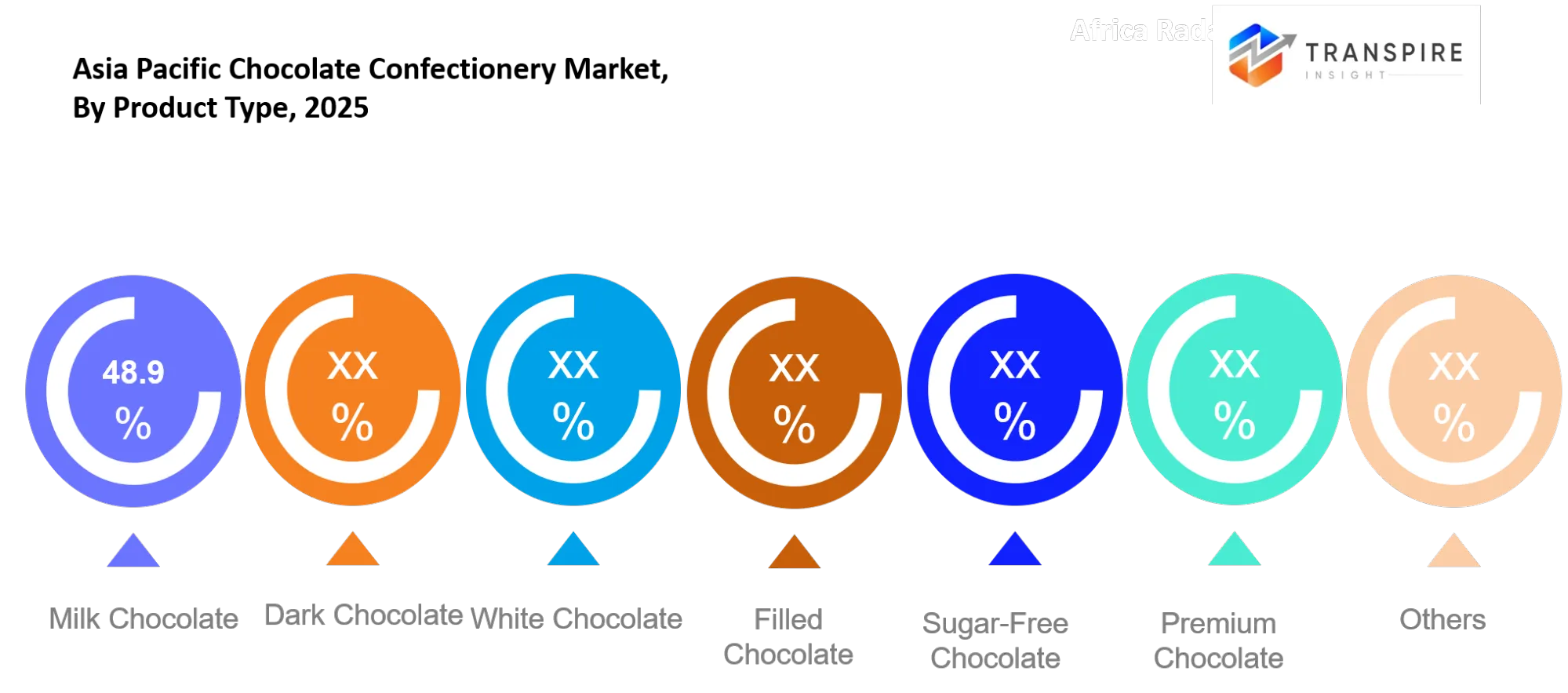
By Distribution Channel :
Milk Chocolate basically kept the top spot, mostly because its balanced sweetness, that smooth feel, and general consumer approval, helped drive pretty solid retail sales across basically every age range. Bigger manufacturers kept rolling out new flavors, different serving sizes, and seasonal collections , just to keep that “right here” presence on shelves. Since it was easy to find, via supermarkets, convenience stores, and online platforms , sales stayed steady and predictable. Even with consumption staying relatively stable in both developed and developing economies, the category leadership stayed intact during the whole forecast window.
Dark Chocolate landed as the second biggest segment, mainly because more people leaned toward items with higher cocoa content, plus the premium vibe that comes with it. Premium Chocolate moved the quickest, as producers put money into single-origin cocoa, artisan-style recipes, and upgraded premium packaging to pull in higher value purchases. Sugar-Free Chocolate also picked up momentum , supported by better sweetener technology and wider distribution. Meanwhile White Chocolate, Filled Chocolate, and other specialty types kept the portfolio more diverse, by aiming at smaller consumer preferences and that usual festive demand.
By Application :
Everyday Consumption stayed as the biggest application, because frequent snacking along with impulse purchases kept a steady flow of product turnover through the year, like pretty much on repeat. Broad availability across organized retail and convenience outlets helped drive repeat buys in both the metropolitan plus regional pockets. Manufacturers also rolled out portion controlled formats and value packs, in a way that fits the changing purchase habits. Overall, regular consumption patterns made a pretty stable revenue base across several countries.
Gifting came in as the second-largest application, mostly due to strong cultural traditions around festivals, celebrations, and those personal moments people mark. Food Service showed the fastest growth, since cafés, bakeries, hotels, and restaurants kept expanding their premium dessert options, with chocolate based ingredients featuring often. Seasonal Products held up pretty well during festive moments too, thanks to themed packaging and limited edition collections. Baking & Cooking applications kept benefiting from growing demand for premium ingredients, used in home kitchens and commercial ones as well.
By End User :
Adults were the main end user segment, mostly because premium items, improved formulations, and those handy snack formats matched the way people buy these days. A pretty wide assortment of products also nudged consumers to shop across several price bands, and for different moments of consumption. The premium range, especially the ones with higher cocoa content, added even more perceived value and helped drive steady category growth. Ongoing product development also kept the market on a long term stable path, more or less.
Families still made up the second biggest share, since multipack buying is common and people often share at home. Corporate Buyers became the quickest growing group thanks to premium gifting programs, employee recognition schemes, and a lot of festive business ordering. Children kept pushing solid retail sales too, with character themed packaging and smaller pack sizes that are easier to grab. Tourists and other customer groups brought extra momentum via travel retail and shopping at destinations.
By Packaging Type :
Packaging was kinda dominated by the category simply because it felt more portable, affordable, and those handy portion sizes made people buy more often across a lot of retail channels. The manufacturers would regularly roll out new flavors and those premium variants, but they still kept the familiar packaging formats so customers wouldn’t get confused. With efficient production and distribution in place, the products stayed easy to find in both urban as well as rural markets. Also, strong shelf visibility helped keep the consumer preference really consistent, you know.
Boxes were next, still the second-largest packaging format. A more premium look supported gifting and the festive buys happening all over the region. Gift Packs grew the quickest in a way because luxury packaging, plus seasonal collections, lifted average selling prices and also reinforced brand value. Pouches, meanwhile, became more popular for resealable convenience, and they fit well with family sized consumption. Bulk Packaging and other types stayed important too, especially for foodservice operators, bakeries, and industrial users who need larger product volumes.
What are the Key Use Cases Driving the Asia Pacific Chocolate Confectionery Market?
Everyday consumption still looks like the main use case , and it also drives the strongest sales across supermarkets, hypermarkets, convenience stores , and those online retail platforms. Working adults, families, and city consumers pick up chocolate products for plain snacking, lunchbox add-ons and that quick on-the-go style of eating, so sales stay pretty steady from season to season.
Gifting plus foodservice use are growing, bit by bit, across the region. Corporate buyers more and more grab premium chocolate gift packs for employee appreciation, and for business moments. At the same time, cafés, bakeries, hotels, and restaurants lean on premium chocolate in desserts, drinks, and baking items. This helps them sharpen the menu and nudge customer spend.
New opportunities are also showing up around functional, and reduced sugar chocolate, mostly aimed at health aware adults and specialized retail outlets. There’s another interesting angle too , premium chocolate made with sustainably sourced cocoa. That kind of product fits corporate environmental procurement rules and matches what retailers say they want on sustainability. So it opens fresh space for manufacturers trying to reach premium institutional and commercial buyers.
|
Report Metrics |
Details |
|
Market size value in 2025 |
USD 27.9 Billion |
|
Market size value in 2026 |
USD 29.4 Billion |
|
Revenue forecast in 2033 |
USD 42.8 Billion |
|
Growth rate |
CAGR of 5.51% from 2026 to 2033 |
|
Base year |
2025 |
|
Historical data |
2021 - 2024 |
|
Forecast period |
2026 - 2033 |
|
Report coverage |
Revenue forecast, competitive landscape, growth factors, and trends |
|
Regional scope |
Asia Pacific (India, China, Japan, Australia, South Korea, Rest of Asia Pacific) |
|
Key company profiled |
Mars, Mondelez International, Nestlé, Ferrero, Lindt & Sprüngli, Meiji Holdings, Lotte, Hershey, Yıldız Holding (Godiva), Glico, Orion Confectionery, Arcor, Barry Callebaut, LOTTE Wellfood, Guan Chong Berhad . |
|
Customization scope |
Free report customization (country, regional & segment scope). Avail customized purchase options to meet your exact research needs. |
|
Report Segmentation |
By Product Type (Milk Chocolate, Dark Chocolate, White Chocolate, Filled Chocolate, Sugar-Free Chocolate, Premium Chocolate, Others); By Distribution Channel (Supermarkets & Hypermarkets, Convenience Stores, Online Retail, Specialty Stores, Duty-Free Stores, Others); By Application (Everyday Consumption, Gifting, Seasonal Products, Baking & Cooking, Food Service, Others); By End User (Children, Adults, Families, Corporate Buyers, Tourists, Others); By Packaging Type (Bars, Boxes, Pouches, Gift Packs, Bulk Packaging, Others) |
Which Regions are Driving the Asia Pacific Chocolate Confectionery Market Growth?
East Asia was roughly 46% of regional revenue in 2025, so yeah it became the big, dominant regional market. The thing is, stricter food safety rules, more advanced retail infrastructure,and logistics that actually work smoothly help chocolate get made and moved at scale across the major economies. There is also this dense little ecosystem with global manufacturers, domestic brands, ingredient suppliers, and packaging companies. Together they keep product availability steady and drive continuous innovation, even when the market shifts a bit. Going forward, ongoing spending on premium offerings, automation efforts, and broader roll outs of organized retail should keep East Asia in the lead for most of the forecast period.
Then Southeast Asia comes in as the second-largest regional market, mostly because consumer spending is increasing and retail channels are more diverse,not just tied to one place. That creates a steadier growth basis instead of relying on a single economy. Economic progress stays relatively stable, foreign investment policies are supportive,and modern retail networks keep expanding in a consistent way. These factors shape business conditions that feel more predictable. At the same time, local manufacturing capabilities continue getting stronger,so import dependence eases and chocolate and related products can reach domestic markets faster. In the end, this mix gives manufacturers dependable revenue, for both mass-market lines and premium product categories too.
South Asia is projected to show the quickest growth during the forecast period, mainly because investments in organized retail, digital commerce and food processing continue to ramp up. Household incomes are getting higher, cold chain infrastructure keeps expanding, and the manufacturing initiatives that are favorable have made products easier to reach across city and semi-urban markets. On top of that, more backing for homegrown production is easing supply constraints and at the same time enabling wider product ranges. All these shifts should open appealing prospects for manufacturers, distributors and investors who are looking for a long term expansion window between 2026 and 2033.
Who are the Key Players in the Asia Pacific Chocolate Confectionery Market and How Do They Compete?
Across the regional chocolate confectionery industry the competition is sort of moderately consolidated, like multinational manufacturers and also some solid domestic brands are all in the same ring. In practice, it mostly comes down to product innovation, premium positioning pricing strategy, distribution reach, and manufacturing efficiency. The bigger, established companies keep doing the usual market share protection with portfolio expansion, plus regional production investments, and the regional brands try to keep up by launching localized flavors, using more affordable pricing, and shaping products for pretty specific consumer preferences.
Mars, in particular, strengthens its competitiveness with continuous product innovation and retail distribution that keeps the flagship brands visible in quite a few sales channels. Mondelez International expands manufacturing capacity too, and it develops localized product variants, which helps supply efficiency, and makes regional responsiveness feel faster. Ferrero leans into differentiation via premium gifting products distinctive packaging, and it pushes harder into high value retail channels. Nestlé leans on reduced-sugar formulations and sustainable cocoa sourcing, so it can match shifting purchasing preferences while also protecting longer-term brand value. Lotte builds advantage through strong regional brand recognition, frequent new product releases, and investments in flavor innovation that tend to match local tastes, while also growing presence across Asia Pacific markets.
Company List
- Mars
- Mondelez International
- Nestlé
- Ferrero
- Lindt & Sprüngli
- Meiji Holdings
- Lotte
- Hershey
- Yıldız Holding (Godiva)
- Glico
- Orion Confectionery
- Arcor
- Barry Callebaut
- LOTTE Wellfood
- Guan Chong Berhad
Recent Development News
In January 2025, Nestlé Australia announced a AUD 30 million investment in its Campbellfield, Victoria KitKat manufacturing facility to introduce advanced production technology and AI-enabled manufacturing capabilities. The investment will improve wafer quality, increase production capacity, reduce waste, and support faster chocolate product innovation across Australia and the wider Asia Pacific region.
Source https://www.nestle.com.au/
In May 2025, Nestlé Malaysia showcased KITKAT® Dark Borneo at the Malaysian International Cocoa Fair and reaffirmed its commitment to source 10,000 metric tonnes of Malaysian cocoa by 2034. The initiative strengthens local cocoa sourcing, supports sustainable supply chains, and reinforces regional premium chocolate product development.
Source https://www.nestle.com.my/
What Strategic Insights Define the Future of the Asia Pacific Chocolate Confectionery Market?
The Asia Pacific Chocolate Confectionery Market is set to drift , pretty steadily, toward a value focused growth model during the next five to seven years… with premium product innovation, more regional manufacturing, and retail networks that are digitally connected, not just raw volume gains. There will be more localization of production and product development, letting makers move quicker when consumer tastes shift , and also help margins along the way.
Still, there’s a challenge that’s less in-your-face, coming from the continued concentration in global cocoa supply. Climate variability and sourcing disruptions can spark a longer stretch of cost volatility, and this kind of thing can’t really be wiped away quickly only by adjusting prices.
At the same time , there’s an emerging opening in traceable cocoa supply chains, enabled by digital tracking platforms and sustainability certifications. This matters especially as retailers and institutional buyers tighten their procurement expectations, and start asking for proof rather than promises. Firms that broaden cocoa sourcing, pour investment into regional processing capacity, and create data driven supply chain visibility, should end up stronger for resilience, guard profitability , and also win longer term advantages across the region.
Asia Pacific Chocolate Confectionery Market Report Segmentation
By Product Type
- Milk Chocolate
- Dark Chocolate
- White Chocolate
- Filled Chocolate
- Sugar-Free Chocolate
- Premium Chocolate
By Distribution Channel
- Supermarkets & Hypermarkets
- Convenience Stores
- Online Retail
- Specialty Stores
- Duty-Free Stores
By Application
- Everyday Consumption
- Gifting, Seasonal Products
- Baking & Cooking
- Food Service
By End User
- Children
- Adults
- Families
- Corporate Buyers
- Tourists
By Packaging Type
- Bars
- Boxes
- Pouches
- Gift Packs
- Bulk Packaging
Frequently Asked Questions
Find quick answers to common questions.
The Expected Asia Pacific Chocolate Confectionery Market size for the Market will be USD 42.8 Billion in 2033.
Key segments for the Asia Pacific Chocolate Confectionery Market are By Product Type (Milk Chocolate, Dark Chocolate, White Chocolate, Filled Chocolate, Sugar-Free Chocolate, Premium Chocolate, Others); By Distribution Channel (Supermarkets & Hypermarkets, Convenience Stores, Online Retail, Specialty Stores, Duty-Free Stores, Others); By Application (Everyday Consumption, Gifting, Seasonal Products, Baking & Cooking, Food Service, Others); By End User (Children, Adults, Families, Corporate Buyers, Tourists, Others); By Packaging Type (Bars, Boxes, Pouches, Gift Packs, Bulk Packaging, Others).
Major Asia Pacific Chocolate Confectionery Market players are Mars, Mondelez International, Nestlé, Ferrero, Lindt & Sprüngli, Meiji Holdings, Lotte, Hershey, Yıldız Holding (Godiva), Glico, Orion Confectionery, Arcor, Barry Callebaut, LOTTE Wellfood, Guan Chong Berhad.
The Current Asia Pacific Chocolate Confectionery Market size is USD 27.9 Billion in 2025.
The Asia Pacific Chocolate Confectionery Market CAGR is 5.51% from 2026 to 2033.
- Mars
- Mondelez International
- Nestlé
- Ferrero
- Lindt & Sprüngli
- Meiji Holdings
- Lotte
- Hershey
- Yıldız Holding (Godiva)
- Glico
- Orion Confectionery
- Arcor
- Barry Callebaut
- LOTTE Wellfood
- Guan Chong Berhad
About the Authors

Chetan Dhatrak
I’m Chetan Dhatrak, a Senior Research Analyst at Transpire Insight, specializing in the Consumer Goods, Foods and Beverages industry. I focus on analyzing market trends, consumer behavior, competitive landscapes, and industry developments to deliver accurate, data-driven insights. My research at Transpire Insight is built on credible sources and in-depth analysis, helping businesses and readers better understand market dynamics, emerging opportunities, and evolving consumer preferences. I’m committed to creating reliable, well-researched content that supports informed decision-making and reflects the latest developments in the consumer goods and food & beverage sectors.

Chakradhar Khansole
Chakradhar serves as the Research Director at Transpire Insight, bringing over 8 years of experience in technology, innovation, and strategic market intelligence. He specializes in transforming complex market data into actionable business insights that enable organizations to make informed, growth-oriented decisions. Recognized for his strategic vision and analytical expertise, Chakradhar leads high-impact research initiatives, delivering comprehensive market assessments, competitive intelligence, and forward-looking industry analysis.
Recently Published Reports
-
Apr 2026
Baby Infant Formula Market
Baby Infant Formula Market Size, Share & Analysis Report By ype (Infant Milk, Follow On Milk, Specialty Baby Milk, Growing-Up Milk), By Ingredient (Carbohydrate, Fat, Protein, Minerals, Vitamins, and Others), By Product Form (Powder, Liquid, and Ready-to-feed), By Distribution Channels (Supermarket/Hypermarket, Specialty Store, Pharmacies, Online Retail, and Others), and Geography (North America, Europe, Asia-Pacific, Middle East and Africa, South and Central America), 2021 - 2031
-
Apr 2026
Edible Insects for Animal Feed Market
Edible Insects for Animal Feed Market Size, Share & Analysis Report By Type (Insect Powder, Insect Meal, Insect Bar, Insect Paste, Insect Oil, and Others), By Insect Type (Beetles, Cricket, Caterpillar, Hymenoptera, Orthoptera, Tree Bugs, and Others), By Application (Livestock, Pet Food, and Aquaculture), By Livestock Type (Poultry, Swine, and Others), and Geography (North America, Europe, Asia-Pacific, Middle East and Africa, South and Central America), 2021 - 2031
-
Apr 2026
Food Industry Disinfection and Bacterial Control Market
Food Industry Disinfection and Bacterial Control Market Size, Share & Analysis Report By Type (Chemical Disinfectants, Physical Disinfectants, and Biocides and Antimicrobials), By Application (Food Processing Equipment Surface Disinfection, Food Preparation Areas Surface Disinfection, Storage Areas Surface Disinfection, Anti-microbial Coatings Food Preservation, and Preservative Solutions Food Preservation), By End User (Meat and Poultry Processing, Dairy Processing, Seafood Processing, Bakery and Confectionery, Restaurants and Commercial Kitchens, and Food Service Providers), By Sales Channel (Online, Offline), and Geography (North America, Europe, Asia-Pacific, Middle East and Africa, South and Central America), 2021 - 2031
-
May 2026
Freeze Dried Food Market
Freeze Dried Food Market Size, Share & Analysis Report By Product Type (Fruits, Vegetables, Freeze-Dried Dairy Products, Freeze-Dried Meat and Seafood, Freeze-Dried Pet Food, and Prepared Meal), By Nature (Organic, and Conventional), By Form (Powdered, Granules, and Diced), By End Use (Breakfast Cereals, Dairy Products, Bakery & Confectionery, Nutritional Bars & Supplements, Powdered Beverages, Snacks, and Retail (Household)), and Geography (North America, Europe, Asia-Pacific, Middle East and Africa, South and Central America), 2021 - 2031